Society
By
Dr Utpal Sharma
Demonstrator
Deptt. Of Community Medicine, FAAMCH
Society
Term is derived from latin word “Societus” meaning
“companionship”
In general the word society denotes a group of people…..
……..however in sociology it refers to the
relationships between them
Society is also defined as the web of social relationships
Man is a social being…..
Needs society……
Enjoys group life……..
Meaning of society
A complex of groups in reciprocal relationships…
Interacting upon one another……

Enabling people to carry on their life activities and…..
Helping each person to fulfill his wishes and…..
Accomplish his interest in association with his fellows
Elements of society
Mutual interaction of individuals
Mutual inter relationship between individuals
A pattern of system
Reciprocal awareness is the most important ingredient
Common propensity….. “we” feeling
Like mindedness
Implications of differences/ diversities/ variations
Interdependence
Cooperation
More on elements of society….
Society is responsible for the mental and intellectual
development of its dwellers
Confers safeguard of our cultures and guarantees its
transmission to the future generations
Individual and society interacts with each other and depends on one
another
Instability in any of the aspect gives rise to opposition between the
individuals and society
So basically, society and individuals are complimentary
and supplementary to each others
Characteristics of society
Composed of people
Mutual awareness, continuous reciprocal interaction
and inter relationship among members
Likeness and differences eg similarities like needs, activities, ideals
values etc differences like looks, personality, talents, attitudes etc.
Members have cooperation and share common interest.
Desires are satisfied and interests fulfilled with joined efforts
promoting solidarity and social cohesion
Responsibilities held by means of division of labor and delegation of
authority
Cont…..
Members shows a pattern of interdependence
necessary to meet social needs
Society is dynamic….changes take place abruptly or gradually
Society has its own way of social control (formal or informal)
Each society has its distinct culture….
……..Its expression of human behavior viz. attitudes,
judgements, morals etc.
Interdependence is seen among groups,
communities, societies and even nations
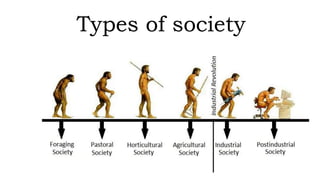
Types of society
Tribal society
Common territory and language but
nomadic in nature
Blood relationship (Family) and kinship are the only interconnected
social institutions
Endogamy viz. marriages within the tribe
Political organization are not defined as all people are considered to
be equal as they virtually have no property.
Religion is not developed among these people in to a complex
institution viz. believed in spirits.
Common name e.g Bushmen of South Africa, some Eskimo tribes
etc.
Features of tribal society
Small and homogeneous (20-40 members) in composition
Main economic activity was hunting and food gathering
Division of labour is minimal, based on gender and age without any
specialization
No private property, viz. property is common to all members of the
tribe
Folkways and mores are more important means of social control
There is no competition and conflict too is minimal as there is no
accumulated surplus to fight over.
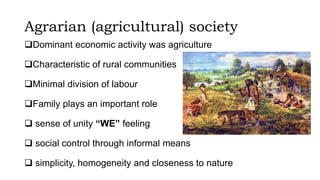
Agrarian (agricultural) society
Dominant economic activity was agriculture
Characteristic of rural communities
Minimal division of labour
Family plays an important role
 sense of unity “WE” feeling
 social control through informal means
 simplicity, homogeneity and closeness to nature
Industrial society
Emergence of modern family
 manufacture and services are the dominant economic activities
Division of labour according to the specialization pronounced
Multiple roles
Impersonal relationships
Class is more important than caste
Social mobility feasible
Women are economically and socially more independent.
Thank you

Society

  • 1.
  • 2.
    Society Term is derivedfrom latin word “Societus” meaning “companionship” In general the word society denotes a group of people….. ……..however in sociology it refers to the relationships between them Society is also defined as the web of social relationships Man is a social being….. Needs society…… Enjoys group life……..
  • 3.
    Meaning of society Acomplex of groups in reciprocal relationships… Interacting upon one another……  Enabling people to carry on their life activities and….. Helping each person to fulfill his wishes and….. Accomplish his interest in association with his fellows
  • 4.
    Elements of society Mutualinteraction of individuals Mutual inter relationship between individuals A pattern of system Reciprocal awareness is the most important ingredient Common propensity….. “we” feeling Like mindedness Implications of differences/ diversities/ variations Interdependence Cooperation
  • 5.
    More on elementsof society…. Society is responsible for the mental and intellectual development of its dwellers Confers safeguard of our cultures and guarantees its transmission to the future generations Individual and society interacts with each other and depends on one another Instability in any of the aspect gives rise to opposition between the individuals and society So basically, society and individuals are complimentary and supplementary to each others
  • 6.
    Characteristics of society Composedof people Mutual awareness, continuous reciprocal interaction and inter relationship among members Likeness and differences eg similarities like needs, activities, ideals values etc differences like looks, personality, talents, attitudes etc. Members have cooperation and share common interest. Desires are satisfied and interests fulfilled with joined efforts promoting solidarity and social cohesion Responsibilities held by means of division of labor and delegation of authority
  • 7.
    Cont….. Members shows apattern of interdependence necessary to meet social needs Society is dynamic….changes take place abruptly or gradually Society has its own way of social control (formal or informal) Each society has its distinct culture…. ……..Its expression of human behavior viz. attitudes, judgements, morals etc. Interdependence is seen among groups, communities, societies and even nations
  • 8.
  • 9.
    Tribal society Common territoryand language but nomadic in nature Blood relationship (Family) and kinship are the only interconnected social institutions Endogamy viz. marriages within the tribe Political organization are not defined as all people are considered to be equal as they virtually have no property. Religion is not developed among these people in to a complex institution viz. believed in spirits. Common name e.g Bushmen of South Africa, some Eskimo tribes etc.
  • 10.
    Features of tribalsociety Small and homogeneous (20-40 members) in composition Main economic activity was hunting and food gathering Division of labour is minimal, based on gender and age without any specialization No private property, viz. property is common to all members of the tribe Folkways and mores are more important means of social control There is no competition and conflict too is minimal as there is no accumulated surplus to fight over.
  • 11.
    Agrarian (agricultural) society Dominanteconomic activity was agriculture Characteristic of rural communities Minimal division of labour Family plays an important role  sense of unity “WE” feeling  social control through informal means  simplicity, homogeneity and closeness to nature
  • 12.
    Industrial society Emergence ofmodern family  manufacture and services are the dominant economic activities Division of labour according to the specialization pronounced Multiple roles Impersonal relationships Class is more important than caste Social mobility feasible Women are economically and socially more independent.
  • 13.