JAPANESE ENCEPHALITIS
INTRODUCTION
• Definition:
JE is an acute arboviral infection of horses,
pigs and humans. It’s a zoonotic disease i.e.
infecting mainly animals and incidentally man.
ARBOVIRUSES (ABV)
• Viruses of vertebrates biologically transmitted
by hematophagus insect vectors
• Special characteristic: Ability to multiply in
arthropods
AETIOLOGY
• Zoonotic disease
• Family: Flaviviridae
JE - GLOBAL SCENARIO
• Major public health disease in Asia
• Virus first isolated in Japan in 1935
• As per WHO estimates 50 thousand serious
cases and 10 thousand deaths each year
• Disease is prevalent in Indian Sub-continent,
Nepal, India, Sri Lanka and some areas in
Bangladesh
5
Global scenario contd…,
 Other SE Asian countries reporting cases
include:
• Myanmar, Thailand, Cambodia, China
• Indonesia, Laos, Vietnam, Malaysia,
Philippines, Taiwan,
• Hong Kong and
• Korea
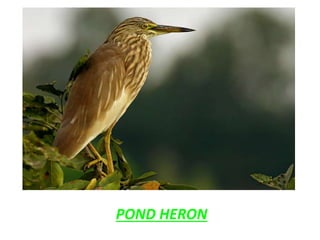
POND HERON
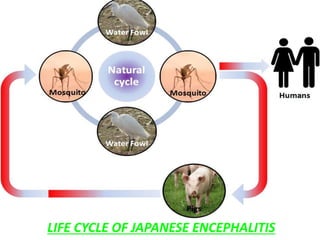
LIFE CYCLE OF JAPANESE ENCEPHALITIS
Mosquito Vectors
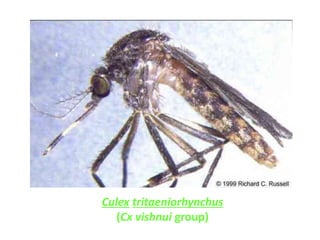
• C. tritaeniorhynchus
• C. vishnui
• C. gelidus
Culex tritaeniorhynchus
(Cx vishnui group)
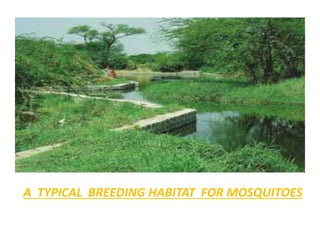
Breeding Habitat
• Rice fields
• Shallow pools
• Ditches
A TYPICAL BREEDING HABITAT FOR MOSQUITOES
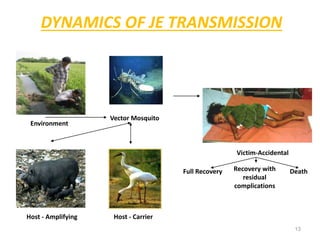
DYNAMICS OF JE TRANSMISSION
13
Environment
Vector Mosquito
Host - Amplifying Host - Carrier
Victim-Accidental
Full Recovery Death
Recovery with
residual
complications
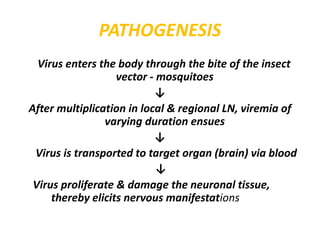
PATHOGENESIS
Virus enters the body through the bite of the insect
vector - mosquitoes
↓
After multiplication in local & regional LN, viremia of
varying duration ensues
↓
Virus is transported to target organ (brain) via blood
↓
Virus proliferate & damage the neuronal tissue,
thereby elicits nervous manifestations
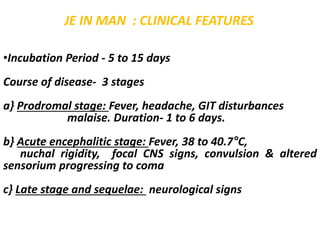
JE IN MAN : CLINICAL FEATURES
•Incubation Period - 5 to 15 days
Course of disease- 3 stages
a} Prodromal stage: Fever, headache, GIT disturbances
malaise. Duration- 1 to 6 days.
b} Acute encephalitic stage: Fever, 38 to 40.7°C,
nuchal rigidity, focal CNS signs, convulsion & altered
sensorium progressing to coma
c} Late stage and sequelae: neurological signs
Treatment
• No clearly effective antiviral agent exists.
• Therapy for symptomatic Japanese
encephalitis virus (JEV) infection is supportive.
• Patients often require feeding, airway
management and anticonvulsants for seizure
control
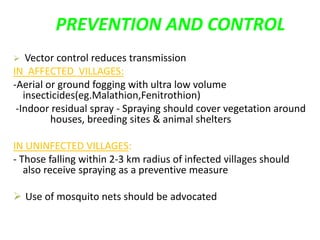
PREVENTION AND CONTROL
 Vector control reduces transmission
IN AFFECTED VILLAGES:
-Aerial or ground fogging with ultra low volume
insecticides(eg.Malathion,Fenitrothion)
-Indoor residual spray - Spraying should cover vegetation around
houses, breeding sites & animal shelters
IN UNINFECTED VILLAGES:
- Those falling within 2-3 km radius of infected villages should
also receive spraying as a preventive measure
 Use of mosquito nets should be advocated
AGRICULTURAL PRACTICES :
- water management practice of Paddy
cultivation-
At least one dry day every week - conserve
water, reduce larval population,increase rice
grain yield
Using neem products as fertilizers will also
reduce the mosquito population
Vaccines
▪ Three types of JE vaccine in large scale use are:
1. Mouse brain derive, purified & inactivated
vaccine
2. Cell culture derived inactivated vaccine
3. Cell culture derived, live attenuated vaccine –
SA-14-14-2 strain
THANK YOU

JE ppt.ppt

  • 1.
  • 2.
    INTRODUCTION • Definition: JE isan acute arboviral infection of horses, pigs and humans. It’s a zoonotic disease i.e. infecting mainly animals and incidentally man.
  • 3.
    ARBOVIRUSES (ABV) • Virusesof vertebrates biologically transmitted by hematophagus insect vectors • Special characteristic: Ability to multiply in arthropods
  • 4.
  • 5.
    JE - GLOBALSCENARIO • Major public health disease in Asia • Virus first isolated in Japan in 1935 • As per WHO estimates 50 thousand serious cases and 10 thousand deaths each year • Disease is prevalent in Indian Sub-continent, Nepal, India, Sri Lanka and some areas in Bangladesh 5
  • 6.
    Global scenario contd…, Other SE Asian countries reporting cases include: • Myanmar, Thailand, Cambodia, China • Indonesia, Laos, Vietnam, Malaysia, Philippines, Taiwan, • Hong Kong and • Korea
  • 7.
  • 8.
    LIFE CYCLE OFJAPANESE ENCEPHALITIS
  • 9.
    Mosquito Vectors • C.tritaeniorhynchus • C. vishnui • C. gelidus
  • 10.
  • 11.
    Breeding Habitat • Ricefields • Shallow pools • Ditches
  • 12.
    A TYPICAL BREEDINGHABITAT FOR MOSQUITOES
  • 13.
    DYNAMICS OF JETRANSMISSION 13 Environment Vector Mosquito Host - Amplifying Host - Carrier Victim-Accidental Full Recovery Death Recovery with residual complications
  • 14.
    PATHOGENESIS Virus enters thebody through the bite of the insect vector - mosquitoes ↓ After multiplication in local & regional LN, viremia of varying duration ensues ↓ Virus is transported to target organ (brain) via blood ↓ Virus proliferate & damage the neuronal tissue, thereby elicits nervous manifestations
  • 15.
    JE IN MAN: CLINICAL FEATURES •Incubation Period - 5 to 15 days Course of disease- 3 stages a} Prodromal stage: Fever, headache, GIT disturbances malaise. Duration- 1 to 6 days. b} Acute encephalitic stage: Fever, 38 to 40.7°C, nuchal rigidity, focal CNS signs, convulsion & altered sensorium progressing to coma c} Late stage and sequelae: neurological signs
  • 16.
    Treatment • No clearlyeffective antiviral agent exists. • Therapy for symptomatic Japanese encephalitis virus (JEV) infection is supportive. • Patients often require feeding, airway management and anticonvulsants for seizure control
  • 17.
    PREVENTION AND CONTROL Vector control reduces transmission IN AFFECTED VILLAGES: -Aerial or ground fogging with ultra low volume insecticides(eg.Malathion,Fenitrothion) -Indoor residual spray - Spraying should cover vegetation around houses, breeding sites & animal shelters IN UNINFECTED VILLAGES: - Those falling within 2-3 km radius of infected villages should also receive spraying as a preventive measure  Use of mosquito nets should be advocated
  • 18.
    AGRICULTURAL PRACTICES : -water management practice of Paddy cultivation- At least one dry day every week - conserve water, reduce larval population,increase rice grain yield Using neem products as fertilizers will also reduce the mosquito population
  • 19.
    Vaccines ▪ Three typesof JE vaccine in large scale use are: 1. Mouse brain derive, purified & inactivated vaccine 2. Cell culture derived inactivated vaccine 3. Cell culture derived, live attenuated vaccine – SA-14-14-2 strain
  • 20.