JAPANESE
ENCEPHALITIS
SUBASH KUMAR PATRA
NEWSHREE ROUT
3RD SEMESTER
S.C.B. MEDICAL COLLEGE
CUTTACK
DR BIMOCH PROJNA PATY
ASSOCIATE PROFESSOR,
DEPT. OF MICROBIOLOGY
S.C.B. MEDICAL COLLEGE
CUTTACK
INTRODUCTION
 Japanese Encephalitis is an arboviral infection of
horses, pigs, birds and humans caused by mosquito
borne Japanese Encephalitis Virus(JEV)
Why the
name ARBO
???ARTHROPOD
BORNE
HISTORY
 1871: 1st case of JE
 1924: Great epidemic in Japan
-6125 human cases, 3797 deaths
 1930’s: JE vaccines first became available
 1935: Virus first isolated
-From a fatal human encephalitis case
 1938: Virus first isolated from mosquito
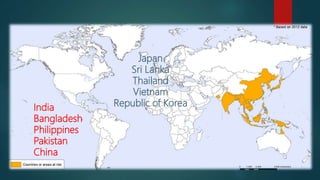
GEOGRAPHICAL DISTRIBUTION
India
Bangladesh
Philippines
Pakistan
China
Japan
Sri Lanka
Thailand
Vietnam
Republic of Korea
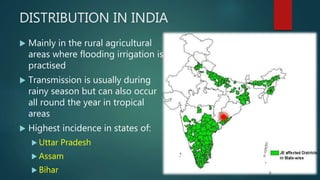
DISTRIBUTION IN INDIA
 Mainly in the rural agricultural
areas where flooding irrigation is
practised
 Transmission is usually during
rainy season but can also occur
all round the year in tropical
areas
 Highest incidence in states of:
 Uttar Pradesh
 Assam
 Bihar
ETIOLOGY
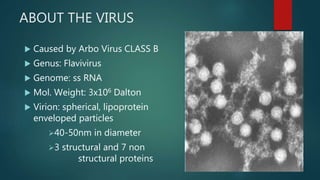
ABOUT THE VIRUS
 Caused by Arbo Virus CLASS B
 Genus: Flavivirus
 Genome: ss RNA
 Mol. Weight: 3x10⁶ Dalton
 Virion: spherical, lipoprotein
enveloped particles
40-50nm in diameter
3 structural and 7 non
structural proteins
RESISTANCE
 Temperature: Destroyed by heating
above 56oC for 30 minutes
 pH: Inactivated in acidic
environment pH 1-3
 Survival: sensitive to UV light and
gamma irradiation
TRANSMISSION
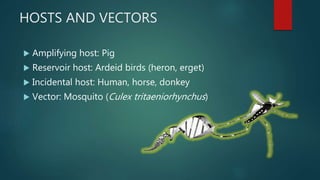
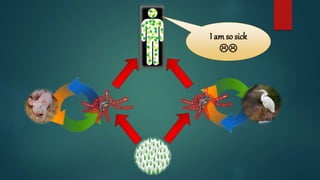
HOSTS AND VECTORS
 Amplifying host: Pig
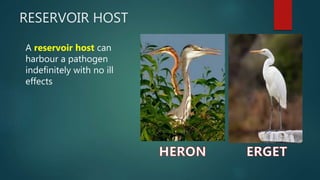
 Reservoir host: Ardeid birds (heron, erget)
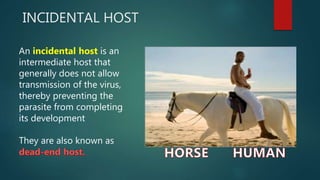
 Incidental host: Human, horse, donkey
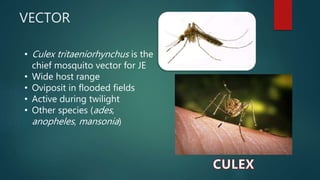
 Vector: Mosquito (Culex tritaeniorhynchus)
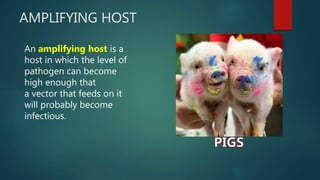
AMPLIFYING HOST
An amplifying host is a
host in which the level of
pathogen can become
high enough that
a vector that feeds on it
will probably become
infectious.
RESERVOIR HOST
A reservoir host can
harbour a pathogen
indefinitely with no ill
effects
INCIDENTAL HOST
An incidental host is an
intermediate host that
generally does not allow
transmission of the virus,
thereby preventing the
parasite from completing
its development
They are also known as
VECTOR
• Culex tritaeniorhynchus is the
chief mosquito vector for JE
• Wide host range
• Oviposit in flooded fields
• Active during twilight
• Other species (ades,
anopheles, mansonia)
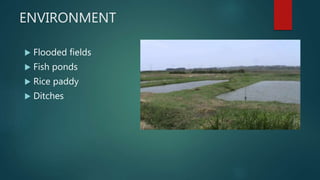
ENVIRONMENT
 Flooded fields
 Fish ponds
 Rice paddy
 Ditches
I amso sick

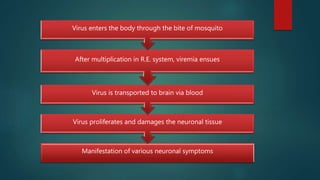
PATHOGENESIS
Manifestation of various neuronal symptoms
Virus proliferates and damages the neuronal tissue
Virus is transported to brain via blood
After multiplication in R.E. system, viremia ensues
Virus enters the body through the bite of mosquito
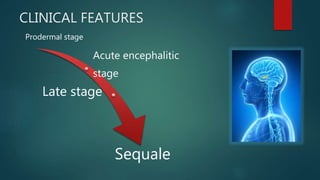
CLINICAL FEATURES
Prodermal stage
Acute encephalitic
stage
Late stage
Sequale
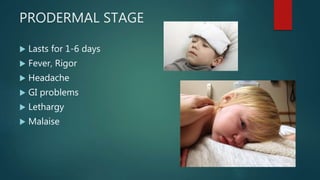
PRODERMAL STAGE
 Lasts for 1-6 days
 Fever, Rigor
 Headache
 GI problems
 Lethargy
 Malaise
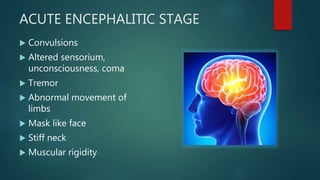
ACUTE ENCEPHALITIC STAGE
 Convulsions
 Altered sensorium,
unconsciousness, coma
 Tremor
 Abnormal movement of
limbs
 Mask like face
 Stiff neck
 Muscular rigidity
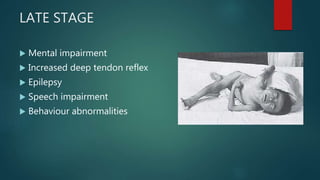
LATE STAGE
 Mental impairment
 Increased deep tendon reflex
 Epilepsy
 Speech impairment
 Behaviour abnormalities
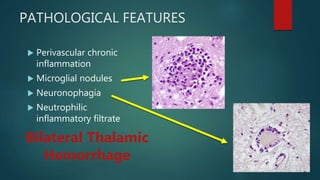
PATHOLOGICAL FEATURES
 Perivascular chronic
inflammation
 Microglial nodules
 Neuronophagia
 Neutrophilic
inflammatory filtrate
Bilateral Thalamic
Hemorrhage
DIAGNOSIS AND TREATMENT
DIAGNOSIS
 History
 Brain tissue analysis
 CSF analysis: moderately increased CSF
protein
 Serological tests: JE specific IgM
TREATMENT
 No antiviral drug for JE
has been found yet
 Only supportive
treatment:
 Suction-oxygen
IV fluids and mannitol
Anti convulsion
Inj. Paracetamol
JENVAC
 JENVAC ® is a purified inactivated JE
vaccine
 Prepared at National Institute of Virology,
Pune
 2 doses of 0.5 ml at 28 days interval
 Booster dose after 1 year
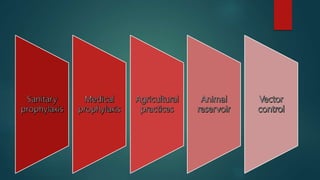
PREVENTION AND CONTROL
SANITARY PROPHYLAXIS
 Housing of animals
indoors in screened
stabling
 During JE outbreaks
 During peak vector
activity
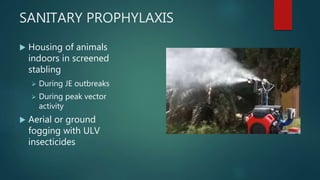
 Aerial or ground
fogging with ULV
insecticides
MEDICAL PROPHYLAXIS
 Vaccination of humans, horses and
pigs
 Available under UIP in 112 endemic
districts of India
 Travellers are needed to take
proper vaccination before visiting
the south east Asian countries
AGRICULTURAL PRACTICES
 Adopt water management practices of paddy
cultivation by having a dry day in a week this will:
 Conserve water
 Reduce larval population
 Increase rice grain yield
 Reduce emission of methane
 Using neem products as fertilizers.
ANIMAL RESERVOIR
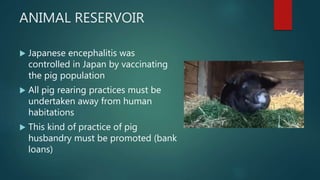
 Japanese encephalitis was
controlled in Japan by vaccinating
the pig population
 All pig rearing practices must be
undertaken away from human
habitations
 This kind of practice of pig
husbandry must be promoted (bank
loans)
VECTOR CONTROL
 Eliminate mosquito breeding
areas
 Adult and larva control: ULV
insecticides and PPM
 Cover all water containers,
wells, water storage tanks
 Use mosquito nets, coil
incenses mosquito repellents
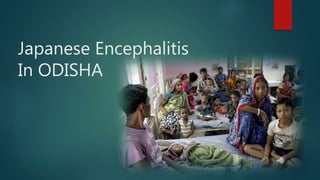
Japanese Encephalitis
In ODISHA
CASE SENARIO IN ODISHA
 Most affected district : Malkangiri
 1st JE death – 8th Sept 2016
 Death toll reached more than 130
Now Odisha has been added to the list
of JE high burden state [23rd Nov 2016]
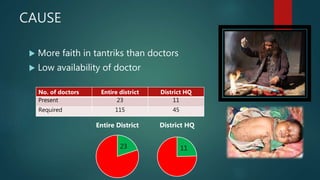
CAUSE
 More faith in tantriks than doctors
 Low availability of doctor
No. of doctors Entire district District HQ
Present 23 11
Required 115 45
23
Entire District
11
District HQ
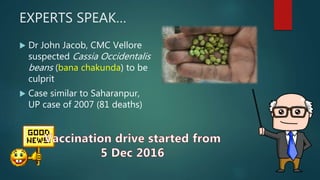
EXPERTS SPEAK…
 Dr John Jacob, CMC Vellore
suspected Cassia Occidentalis
beans (bana chakunda) to be
culprit
 Case similar to Saharanpur,
UP case of 2007 (81 deaths)
REFERENCES
Japanese Encephalitis: Case in Odisha

Japanese Encephalitis: Case in Odisha

  • 2.
    JAPANESE ENCEPHALITIS SUBASH KUMAR PATRA NEWSHREEROUT 3RD SEMESTER S.C.B. MEDICAL COLLEGE CUTTACK DR BIMOCH PROJNA PATY ASSOCIATE PROFESSOR, DEPT. OF MICROBIOLOGY S.C.B. MEDICAL COLLEGE CUTTACK
  • 3.
    INTRODUCTION  Japanese Encephalitisis an arboviral infection of horses, pigs, birds and humans caused by mosquito borne Japanese Encephalitis Virus(JEV) Why the name ARBO ???ARTHROPOD BORNE
  • 4.
    HISTORY  1871: 1stcase of JE  1924: Great epidemic in Japan -6125 human cases, 3797 deaths  1930’s: JE vaccines first became available  1935: Virus first isolated -From a fatal human encephalitis case  1938: Virus first isolated from mosquito
  • 5.
  • 6.
  • 7.
    DISTRIBUTION IN INDIA Mainly in the rural agricultural areas where flooding irrigation is practised  Transmission is usually during rainy season but can also occur all round the year in tropical areas  Highest incidence in states of:  Uttar Pradesh  Assam  Bihar
  • 8.
  • 9.
    ABOUT THE VIRUS Caused by Arbo Virus CLASS B  Genus: Flavivirus  Genome: ss RNA  Mol. Weight: 3x10⁶ Dalton  Virion: spherical, lipoprotein enveloped particles 40-50nm in diameter 3 structural and 7 non structural proteins
  • 10.
    RESISTANCE  Temperature: Destroyedby heating above 56oC for 30 minutes  pH: Inactivated in acidic environment pH 1-3  Survival: sensitive to UV light and gamma irradiation
  • 11.
  • 12.
    HOSTS AND VECTORS Amplifying host: Pig  Reservoir host: Ardeid birds (heron, erget)  Incidental host: Human, horse, donkey  Vector: Mosquito (Culex tritaeniorhynchus)
  • 13.
    AMPLIFYING HOST An amplifyinghost is a host in which the level of pathogen can become high enough that a vector that feeds on it will probably become infectious.
  • 14.
    RESERVOIR HOST A reservoirhost can harbour a pathogen indefinitely with no ill effects
  • 15.
    INCIDENTAL HOST An incidentalhost is an intermediate host that generally does not allow transmission of the virus, thereby preventing the parasite from completing its development They are also known as
  • 16.
    VECTOR • Culex tritaeniorhynchusis the chief mosquito vector for JE • Wide host range • Oviposit in flooded fields • Active during twilight • Other species (ades, anopheles, mansonia)
  • 17.
    ENVIRONMENT  Flooded fields Fish ponds  Rice paddy  Ditches
  • 18.
  • 19.
  • 20.
    Manifestation of variousneuronal symptoms Virus proliferates and damages the neuronal tissue Virus is transported to brain via blood After multiplication in R.E. system, viremia ensues Virus enters the body through the bite of mosquito
  • 21.
    CLINICAL FEATURES Prodermal stage Acuteencephalitic stage Late stage Sequale
  • 22.
    PRODERMAL STAGE  Lastsfor 1-6 days  Fever, Rigor  Headache  GI problems  Lethargy  Malaise
  • 23.
    ACUTE ENCEPHALITIC STAGE Convulsions  Altered sensorium, unconsciousness, coma  Tremor  Abnormal movement of limbs  Mask like face  Stiff neck  Muscular rigidity
  • 24.
    LATE STAGE  Mentalimpairment  Increased deep tendon reflex  Epilepsy  Speech impairment  Behaviour abnormalities
  • 25.
    PATHOLOGICAL FEATURES  Perivascularchronic inflammation  Microglial nodules  Neuronophagia  Neutrophilic inflammatory filtrate Bilateral Thalamic Hemorrhage
  • 26.
  • 27.
    DIAGNOSIS  History  Braintissue analysis  CSF analysis: moderately increased CSF protein  Serological tests: JE specific IgM
  • 28.
    TREATMENT  No antiviraldrug for JE has been found yet  Only supportive treatment:  Suction-oxygen IV fluids and mannitol Anti convulsion Inj. Paracetamol
  • 29.
    JENVAC  JENVAC ®is a purified inactivated JE vaccine  Prepared at National Institute of Virology, Pune  2 doses of 0.5 ml at 28 days interval  Booster dose after 1 year
  • 30.
  • 32.
    SANITARY PROPHYLAXIS  Housingof animals indoors in screened stabling  During JE outbreaks  During peak vector activity  Aerial or ground fogging with ULV insecticides
  • 33.
    MEDICAL PROPHYLAXIS  Vaccinationof humans, horses and pigs  Available under UIP in 112 endemic districts of India  Travellers are needed to take proper vaccination before visiting the south east Asian countries
  • 34.
    AGRICULTURAL PRACTICES  Adoptwater management practices of paddy cultivation by having a dry day in a week this will:  Conserve water  Reduce larval population  Increase rice grain yield  Reduce emission of methane  Using neem products as fertilizers.
  • 35.
    ANIMAL RESERVOIR  Japaneseencephalitis was controlled in Japan by vaccinating the pig population  All pig rearing practices must be undertaken away from human habitations  This kind of practice of pig husbandry must be promoted (bank loans)
  • 36.
    VECTOR CONTROL  Eliminatemosquito breeding areas  Adult and larva control: ULV insecticides and PPM  Cover all water containers, wells, water storage tanks  Use mosquito nets, coil incenses mosquito repellents
  • 37.
  • 38.
    CASE SENARIO INODISHA  Most affected district : Malkangiri  1st JE death – 8th Sept 2016  Death toll reached more than 130 Now Odisha has been added to the list of JE high burden state [23rd Nov 2016]
  • 39.
    CAUSE  More faithin tantriks than doctors  Low availability of doctor No. of doctors Entire district District HQ Present 23 11 Required 115 45 23 Entire District 11 District HQ
  • 40.
    EXPERTS SPEAK…  DrJohn Jacob, CMC Vellore suspected Cassia Occidentalis beans (bana chakunda) to be culprit  Case similar to Saharanpur, UP case of 2007 (81 deaths)
  • 41.