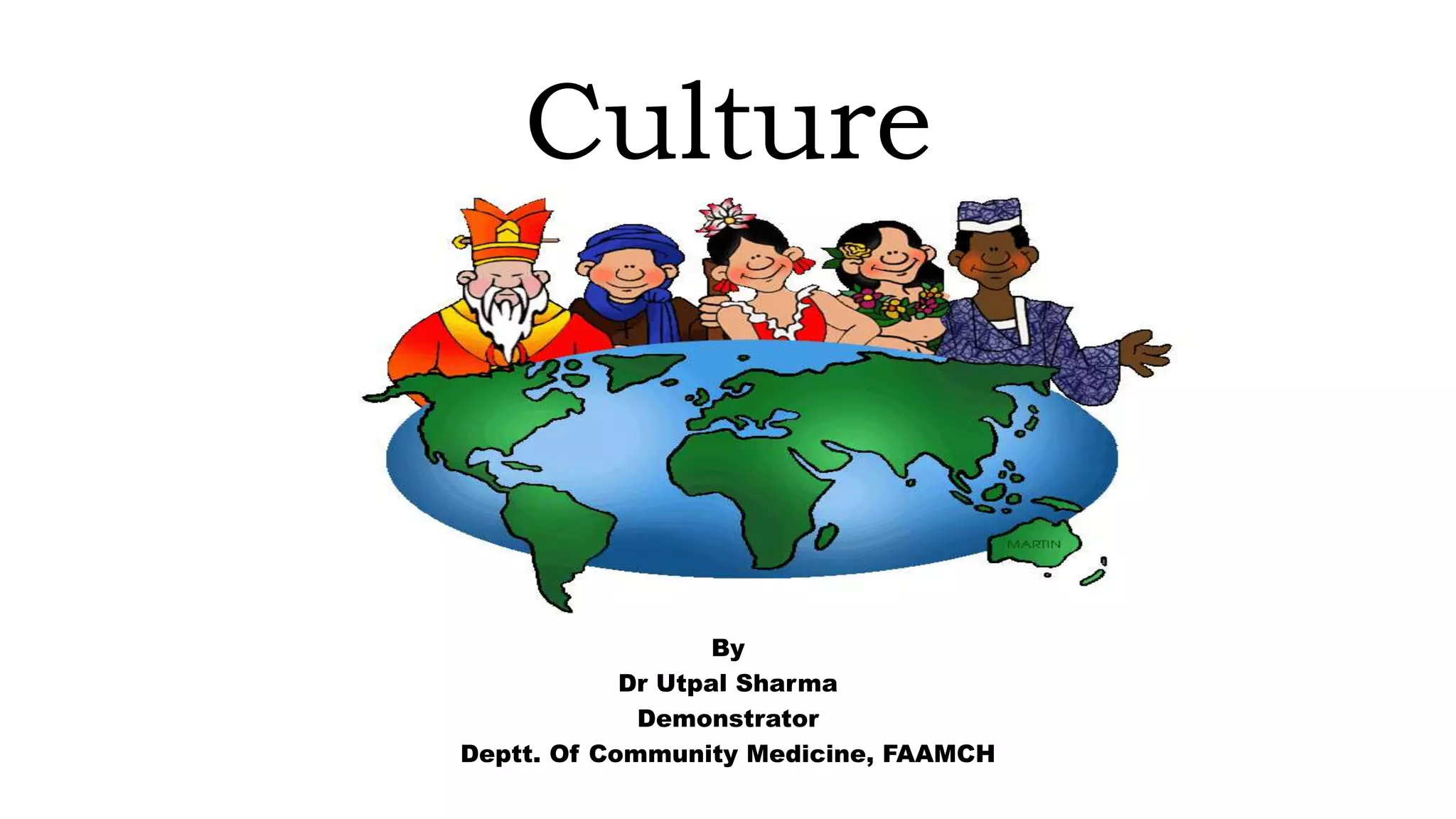
Culture
By
Dr Utpal Sharma
Demonstrator
Deptt. Of Community Medicine, FAAMCH
Introduction
๏ฑCulture is one of the most important concepts in social sciences.
๏ฑIn sociological usage, culture specifically refers to social structure and
ideas that give meaning to human social structureโ€ฆโ€ฆโ€ฆ
โ€ฆโ€ฆโ€ฆโ€ฆwhile society refers to social structure apart
from underlying values and ideas.
๏ฑThey are inseparableโ€ฆโ€ฆ.it is important to distinguish between the
related concepts of culture and society.
๏ฑSometimes the concepts are used synonymously to mean all learned
habits the total ways of life of a social group, or a groupโ€™s social heritage.
๏ฑAlthough culture and society are closely related concepts that can never
be wholly separated.
Simplifiedโ€ฆ.
๏ฑCulture comes from the Latin word "colere",meaning
to build on, to cultivate, to foster.
๏ฑCulture is a set of accepted behaviour patterns, values,
assumptions, and shared common experiences.
๏ฑCulture defines social structure, decision making practices,
and communication styles.
Cultureโ€ฆ.. meaning
๏ฑ Culture refers to the beliefs, values, behavior and material objects
that, together, form a people's way of life.
๏ฑ Culture determines how we view the world around us
๏ฑ Culture includes the traditions we inherit and pass on to the next
generation
๏ฑ Culture: totality of our shared language, knowledge, material
objects, and behavior
Understanding cultureโ€ฆ
๏ฑCulture is a unique possession of manโ€ฆโ€ฆ.
โ€ฆโ€ฆโ€ฆโ€ฆโ€ฆโ€ฆevery man is born into a society is
the same as saying that โ€œevery man is born into a culture.
๏ฑEvery man can be regarded as a representative of this culture.
๏ฑCulture is the unique quality of man which separates him from the lower animals.
๏ฑCulture can be said to include all the human phenomena in a societyโ€ฆโ€ฆ
โ€ฆโ€ฆโ€ฆโ€ฆincluding all learned behaviour.
๏ฑCulture is a very board term that includesโ€ฆ..
๏ƒ˜ our ways of life and modes of behaviour,
๏ƒ˜ our philosophies and ethics,
๏ƒ˜ our morals and manners,
๏ƒ˜ our customs and tradition,
๏ƒ˜ our religious, political, economic and other types of activities.
Structure of culture
Trait
๏ฑSmallest unit of culture is โ€œCultural Traitโ€ e.g Shaking hands etc
Complexes
๏ฑTraits combine to form โ€œCultural Complexesโ€ e.g. Dance group consists of
dancers, choreographers, production house, manager, audience etc.
Pattern
๏ฑCultural Complexes combines to form Cultural Pattern e.g. industrial township
has a way of life different from agricultural society
Cultural Institutions
๏ฑAn institution is a series of complexes and patterns centering around a
configuration of needs. e.g.: Family: match making complex, wedding pattern,
child rearing pattern, husband-wife relation pattern, etc.
Culture and Society
๏ฑ Society: the structure of relationships within which culture is
created and shared through regularized patterns of social interactionโ€ฆโ€ฆ.
๏ƒผ Society provides the context within which our relationships with the
external world develop
๏ƒผ How we structure society constrains the kind of culture we construct
๏ƒผ Cultural preferences vary across societies
Functions of culture
Culture defines situation
๏ฑCulture conditions and determines what we eat, and drink what we
wear, where to laugh, weep sleep to make friends with, what work we
do, what to worship etc.
Culture is the treasury of knowledge
๏ฑCulture provides knowledge which is important for the physical, social
and intellectual existence of man.
๏ฑCulture preserves knowledge and helps its transmission from
generation to generation through its element that is language.
๏ฑLanguage helps not only the transmission of knowledge but also its
preservation, accumulation and diffusion.
Contโ€ฆ
Culture provides behavior patterns
๏ฑCulture assigns goals and provides means for achieving them. It rewards
his noble ones and punishes the immoral ones.
๏ฑCulture not only controls but also liberates human, energy and activities.
Culture defines attitudes, values and goals
๏ฑCulture conditions our attitudes towards various issues such as religion,
morality, science, family planning, prostitution, and so on.
๏ฑOur values concerning private property, fundamental rights, being
respectful and obedient to elders and teachers being patriotic, loyal etc.
are influenced by our culture.
Contโ€ฆ.
Culture models personality
๏ฑCulture prepares man for group life and provides him the design of living.
๏ฑIt is not possible to develop human qualities viz. personalities in the absence of a
cultural environment.
๏ฑIt is culture that provides opportunities for the development of personality and
sets limits on its growth
Culture decides our career
๏ฑCulture sets limitations on our choice to select different careers.
๏ฑIndividual is exposed to and molded by the culture of the group into which he is
born.
๏ฑEvery individual is unique in any cultureโ€ฆโ€ฆ but the culture provides not only for
โ€œuniversalsโ€ but also for โ€œalternativesโ€.
๏ฑThe uniqueness may be based on individual differences in ability, aptitude and
learning.
Characteristics of culture
๏ฑCulture is shared and acquired with birthโ€ฆโ€ฆand it is transmitted from one
generation to the next.
๏ฑCulture is basically a blueprint for living in a particular society.
Culture is learnt
๏ฑIt is not an inborn tendency but learnt socially by man.
๏ฑUnlearned behavior such as closing the eyes while sleeping, the eye blinking
reflex and so on, are purely physiological and not cultural.
๏ฑE.g. Shaking hands or saying โ€œnamaskarโ€ or โ€œthanksโ€ on the other hand, are
cultural.
Culture is social
๏ฑCulture does not exist in isolation neither is an individual phenomenon.
๏ฑIt is a product of society and originates and develops through social interactions.
๏ฑNo man can acquire culture without association with other human beings.
๏ฑIt is the culture which helps man to develop human qualities in a human
environment.
Contโ€ฆ
Culture is shared
๏ฑCulture in the sociological sense, is something shared.
๏ฑIt is not something that an individual alone can possess e.g. customs, traditions,
beliefs, ideas, values, morals etc. are all shared by people of a group or society.
๏ฑCulture is something adopted, used, believed, practiced or possessed by more
than one person. It depends upon group life for its existence.
Culture is transmissive
๏ฑCulture is transmitted not through genes but by means of language through
generations.
๏ฑLanguage in its different forms like reading and writing is the main vehicle of
culture.
๏ฑBut language itself is a part a culture. Once language is acquired, transmission of
culture may take place by imitation as well as by instruction.
Contโ€ฆ
Culture is continuous and cumulative
๏ฑCulture is a โ€œgrowing wholeโ€ which includes in itselfโ€ฆ..
โ€ฆโ€ฆ.Achievements of the past andโ€ฆ..
โ€ฆโ€ฆ.The present andโ€ฆโ€ฆ
โ€ฆโ€ฆ.Makes provision for the future achievements of mankind
Culture is consistent and integrated
๏ฑCulture has a tendency to be consistent and are interconnected.
Culture is dynamic and adaptive
๏ฑCulture is subjected to slow but constant changes.
๏ฑChange and growth are latent in cultureโ€ฆโ€ฆculture is therefore dynamic.
๏ฑCulture is responsive to the changing conditions of the physical worldโ€ฆโ€ฆ.
adaptive nature.
Contโ€ฆ
Culture is gratifying
๏ฑCulture provides proper opportunities and prescribes means for the
satisfaction of our needs and desires.
๏ฑThese needs may be biological or social in nature.
๏ฑCulture determines and guides the varied activities of man
Culture varies from society to society
๏ฑCulture of every society is unique to itself โ€ฆโ€ฆ..they are not uniform.
๏ฑCulture elements such as customs, traditions, morals, ideas, values,
ideologies etc, are not uniform everywhere.
๏ฑNo culture ever remains constant it varies from time to time also.
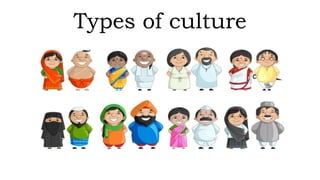
Types of culture
Material Culture
๏ฑ Refers to the physical objects and resources people use to define their culture.
๏ฑ These include homes, neighborhoods, cities, schools, churches, temples, mosques,
offices, factories and plants, products stores etc.
๏ฑPhysical aspects of a culture help to define its members' behaviors and perceptions.
Non Material Culture
๏ฑIncludes creations and abstract ideas that are not embodied in physical objects.
๏ฑIntangible products created and shared between the members of a culture over time
E.g. Social roles, rules, ethics, and beliefs
๏ฑCrucial guides for members of a culture to use to know how to behave in their society
and interpret the world.
Components of Culture
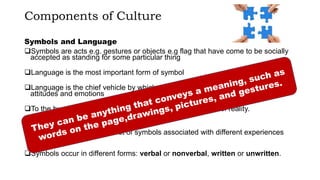
Symbols and Language
๏ฑSymbols are acts e.g. gestures or objects e.g flag that have come to be socially
accepted as standing for some particular thing
๏ฑLanguage is the most important form of symbol
๏ฑLanguage is the chief vehicle by which people communicate ideas, information,
attitudes and emotions
๏ฑTo the human mind, symbols are cultural representations of reality.
๏ƒผ Gun in the hands of policemanโ€ฆโ€ฆ.Protection
๏ƒผ Gun in the hands of civilianโ€ฆ..crime
๏ฑEvery culture has its own set of symbols associated with different experiences
and perceptions.
๏ฑSymbols occur in different forms: verbal or nonverbal, written or unwritten.
Contโ€ฆ
Values
๏ฑThese are ideas about what is โ€œrightโ€ and what is โ€œwrongโ€
๏ฑThey are standards that people use to decide what is desirable, good, and
beautiful and that serve as broad guidelines for social living.
๏ฑValues differs from society to society as every social order chooses what
to be valued and what not
๏ฑE.g. our value system gives more importance to religion, concern for
others etc. while in western world success, achievements are given more
importance
Contโ€ฆ.
Norms
๏ฑThese are social rules which dictates correct and appropriate
behavior in the society
๏ฑNorms tells us what we MUST do and what we MUST NOT do
๏ฑNorms are enforced with sanctions i.e. Reward or
Punishments that encourage conformity to cultural norms.
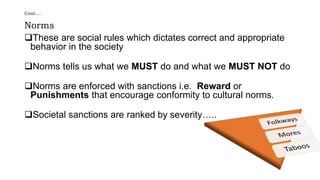
๏ฑSocietal sanctions are ranked by severityโ€ฆ..
Contโ€ฆ
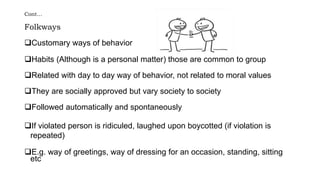
Folkways
๏ฑCustomary ways of behavior
๏ฑHabits (Although is a personal matter) those are common to group
๏ฑRelated with day to day way of behavior, not related to moral values
๏ฑThey are socially approved but vary society to society
๏ฑFollowed automatically and spontaneously
๏ฑIf violated person is ridiculed, laughed upon boycotted (if violation is
repeated)
๏ฑE.g. way of greetings, way of dressing for an occasion, standing, sitting
etc
Contโ€ฆ
Mores
๏ฑStandards of behavior which influences the moral conduct of
the people conformity to mass
๏ฑAssociated with moral vales and is more vital (security) of society than
folkways
๏ฑSociety considers compliance with mores more important for its welfare
and maintenance of order
๏ฑThe reaction to violation is stronger compared to folkways
๏ฑNegative mores (not to be done) are called taboos
๏ฑMore closely associated with law e.g. stealing is a taboo as well as crime
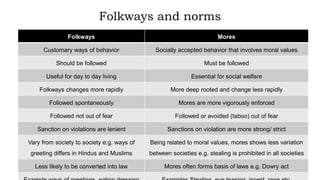
Folkways and norms
Folkways Mores
Customary ways of behavior Socially accepted behavior that involves moral values
Should be followed Must be followed
Useful for day to day living Essential for social welfare
Folkways changes more rapidly More deep rooted and change less rapidly
Followed spontaneously Mores are more vigorously enforced
Followed not out of fear Followed or avoided (taboo) out of fear
Sanction on violations are lenient Sanctions on violation are more strong/ strict
Vary from society to society e.g. ways of
greeting differs in Hindus and Muslims
Being related to moral values, mores shows less variation
between societies e.g. stealing is prohibited in all societies
Less likely to be converted into law Mores often forms basis of laws e.g. Dowry act
Role or functions of culture
๏ฑCulture makes a Human being out of a biological organism
๏ฑCulture provides us guidelines for day to day living
๏ฑCulture provides us a configuration of DOโ€™s and DONโ€™Ts
๏ฑCulture ensures stable social order
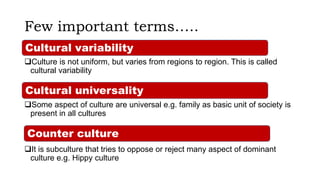
Few important termsโ€ฆ..
๏ฑCulture is not uniform, but varies from regions to region. This is called
cultural variability
๏ฑSome aspect of culture are universal e.g. family as basic unit of society is
present in all cultures
๏ฑIt is subculture that tries to oppose or reject many aspect of dominant
culture e.g. Hippy culture
Counter culture
Cultural variability
Cultural universality
Contโ€ฆ
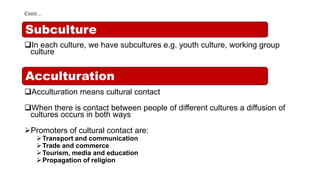
๏ฑIn each culture, we have subcultures e.g. youth culture, working group
culture
๏ฑAcculturation means cultural contact
๏ฑWhen there is contact between people of different cultures a diffusion of
cultures occurs in both ways
๏ƒ˜Promoters of cultural contact are:
๏ƒ˜Transport and communication
๏ƒ˜Trade and commerce
๏ƒ˜Tourism, media and education
๏ƒ˜Propagation of religion
Subculture
Acculturation
Thank you

Culture

  • 1.
  • 2.
    Introduction ๏ฑCulture is oneof the most important concepts in social sciences. ๏ฑIn sociological usage, culture specifically refers to social structure and ideas that give meaning to human social structureโ€ฆโ€ฆโ€ฆ โ€ฆโ€ฆโ€ฆโ€ฆwhile society refers to social structure apart from underlying values and ideas. ๏ฑThey are inseparableโ€ฆโ€ฆ.it is important to distinguish between the related concepts of culture and society. ๏ฑSometimes the concepts are used synonymously to mean all learned habits the total ways of life of a social group, or a groupโ€™s social heritage. ๏ฑAlthough culture and society are closely related concepts that can never be wholly separated.
  • 3.
    Simplifiedโ€ฆ. ๏ฑCulture comes fromthe Latin word "colere",meaning to build on, to cultivate, to foster. ๏ฑCulture is a set of accepted behaviour patterns, values, assumptions, and shared common experiences. ๏ฑCulture defines social structure, decision making practices, and communication styles.
  • 4.
    Cultureโ€ฆ.. meaning ๏ฑ Culturerefers to the beliefs, values, behavior and material objects that, together, form a people's way of life. ๏ฑ Culture determines how we view the world around us ๏ฑ Culture includes the traditions we inherit and pass on to the next generation ๏ฑ Culture: totality of our shared language, knowledge, material objects, and behavior
  • 5.
    Understanding cultureโ€ฆ ๏ฑCulture isa unique possession of manโ€ฆโ€ฆ. โ€ฆโ€ฆโ€ฆโ€ฆโ€ฆโ€ฆevery man is born into a society is the same as saying that โ€œevery man is born into a culture. ๏ฑEvery man can be regarded as a representative of this culture. ๏ฑCulture is the unique quality of man which separates him from the lower animals. ๏ฑCulture can be said to include all the human phenomena in a societyโ€ฆโ€ฆ โ€ฆโ€ฆโ€ฆโ€ฆincluding all learned behaviour. ๏ฑCulture is a very board term that includesโ€ฆ.. ๏ƒ˜ our ways of life and modes of behaviour, ๏ƒ˜ our philosophies and ethics, ๏ƒ˜ our morals and manners, ๏ƒ˜ our customs and tradition, ๏ƒ˜ our religious, political, economic and other types of activities.
  • 6.
    Structure of culture Trait ๏ฑSmallestunit of culture is โ€œCultural Traitโ€ e.g Shaking hands etc Complexes ๏ฑTraits combine to form โ€œCultural Complexesโ€ e.g. Dance group consists of dancers, choreographers, production house, manager, audience etc. Pattern ๏ฑCultural Complexes combines to form Cultural Pattern e.g. industrial township has a way of life different from agricultural society Cultural Institutions ๏ฑAn institution is a series of complexes and patterns centering around a configuration of needs. e.g.: Family: match making complex, wedding pattern, child rearing pattern, husband-wife relation pattern, etc.
  • 7.
    Culture and Society ๏ฑSociety: the structure of relationships within which culture is created and shared through regularized patterns of social interactionโ€ฆโ€ฆ. ๏ƒผ Society provides the context within which our relationships with the external world develop ๏ƒผ How we structure society constrains the kind of culture we construct ๏ƒผ Cultural preferences vary across societies
  • 8.
    Functions of culture Culturedefines situation ๏ฑCulture conditions and determines what we eat, and drink what we wear, where to laugh, weep sleep to make friends with, what work we do, what to worship etc. Culture is the treasury of knowledge ๏ฑCulture provides knowledge which is important for the physical, social and intellectual existence of man. ๏ฑCulture preserves knowledge and helps its transmission from generation to generation through its element that is language. ๏ฑLanguage helps not only the transmission of knowledge but also its preservation, accumulation and diffusion.
  • 9.
    Contโ€ฆ Culture provides behaviorpatterns ๏ฑCulture assigns goals and provides means for achieving them. It rewards his noble ones and punishes the immoral ones. ๏ฑCulture not only controls but also liberates human, energy and activities. Culture defines attitudes, values and goals ๏ฑCulture conditions our attitudes towards various issues such as religion, morality, science, family planning, prostitution, and so on. ๏ฑOur values concerning private property, fundamental rights, being respectful and obedient to elders and teachers being patriotic, loyal etc. are influenced by our culture.
  • 10.
    Contโ€ฆ. Culture models personality ๏ฑCultureprepares man for group life and provides him the design of living. ๏ฑIt is not possible to develop human qualities viz. personalities in the absence of a cultural environment. ๏ฑIt is culture that provides opportunities for the development of personality and sets limits on its growth Culture decides our career ๏ฑCulture sets limitations on our choice to select different careers. ๏ฑIndividual is exposed to and molded by the culture of the group into which he is born. ๏ฑEvery individual is unique in any cultureโ€ฆโ€ฆ but the culture provides not only for โ€œuniversalsโ€ but also for โ€œalternativesโ€. ๏ฑThe uniqueness may be based on individual differences in ability, aptitude and learning.
  • 11.
    Characteristics of culture ๏ฑCultureis shared and acquired with birthโ€ฆโ€ฆand it is transmitted from one generation to the next. ๏ฑCulture is basically a blueprint for living in a particular society. Culture is learnt ๏ฑIt is not an inborn tendency but learnt socially by man. ๏ฑUnlearned behavior such as closing the eyes while sleeping, the eye blinking reflex and so on, are purely physiological and not cultural. ๏ฑE.g. Shaking hands or saying โ€œnamaskarโ€ or โ€œthanksโ€ on the other hand, are cultural. Culture is social ๏ฑCulture does not exist in isolation neither is an individual phenomenon. ๏ฑIt is a product of society and originates and develops through social interactions. ๏ฑNo man can acquire culture without association with other human beings. ๏ฑIt is the culture which helps man to develop human qualities in a human environment.
  • 12.
    Contโ€ฆ Culture is shared ๏ฑCulturein the sociological sense, is something shared. ๏ฑIt is not something that an individual alone can possess e.g. customs, traditions, beliefs, ideas, values, morals etc. are all shared by people of a group or society. ๏ฑCulture is something adopted, used, believed, practiced or possessed by more than one person. It depends upon group life for its existence. Culture is transmissive ๏ฑCulture is transmitted not through genes but by means of language through generations. ๏ฑLanguage in its different forms like reading and writing is the main vehicle of culture. ๏ฑBut language itself is a part a culture. Once language is acquired, transmission of culture may take place by imitation as well as by instruction.
  • 13.
    Contโ€ฆ Culture is continuousand cumulative ๏ฑCulture is a โ€œgrowing wholeโ€ which includes in itselfโ€ฆ.. โ€ฆโ€ฆ.Achievements of the past andโ€ฆ.. โ€ฆโ€ฆ.The present andโ€ฆโ€ฆ โ€ฆโ€ฆ.Makes provision for the future achievements of mankind Culture is consistent and integrated ๏ฑCulture has a tendency to be consistent and are interconnected. Culture is dynamic and adaptive ๏ฑCulture is subjected to slow but constant changes. ๏ฑChange and growth are latent in cultureโ€ฆโ€ฆculture is therefore dynamic. ๏ฑCulture is responsive to the changing conditions of the physical worldโ€ฆโ€ฆ. adaptive nature.
  • 14.
    Contโ€ฆ Culture is gratifying ๏ฑCultureprovides proper opportunities and prescribes means for the satisfaction of our needs and desires. ๏ฑThese needs may be biological or social in nature. ๏ฑCulture determines and guides the varied activities of man Culture varies from society to society ๏ฑCulture of every society is unique to itself โ€ฆโ€ฆ..they are not uniform. ๏ฑCulture elements such as customs, traditions, morals, ideas, values, ideologies etc, are not uniform everywhere. ๏ฑNo culture ever remains constant it varies from time to time also.
  • 15.
  • 16.
    Material Culture ๏ฑ Refersto the physical objects and resources people use to define their culture. ๏ฑ These include homes, neighborhoods, cities, schools, churches, temples, mosques, offices, factories and plants, products stores etc. ๏ฑPhysical aspects of a culture help to define its members' behaviors and perceptions. Non Material Culture ๏ฑIncludes creations and abstract ideas that are not embodied in physical objects. ๏ฑIntangible products created and shared between the members of a culture over time E.g. Social roles, rules, ethics, and beliefs ๏ฑCrucial guides for members of a culture to use to know how to behave in their society and interpret the world.
  • 17.
    Components of Culture Symbolsand Language ๏ฑSymbols are acts e.g. gestures or objects e.g flag that have come to be socially accepted as standing for some particular thing ๏ฑLanguage is the most important form of symbol ๏ฑLanguage is the chief vehicle by which people communicate ideas, information, attitudes and emotions ๏ฑTo the human mind, symbols are cultural representations of reality. ๏ƒผ Gun in the hands of policemanโ€ฆโ€ฆ.Protection ๏ƒผ Gun in the hands of civilianโ€ฆ..crime ๏ฑEvery culture has its own set of symbols associated with different experiences and perceptions. ๏ฑSymbols occur in different forms: verbal or nonverbal, written or unwritten.
  • 18.
    Contโ€ฆ Values ๏ฑThese are ideasabout what is โ€œrightโ€ and what is โ€œwrongโ€ ๏ฑThey are standards that people use to decide what is desirable, good, and beautiful and that serve as broad guidelines for social living. ๏ฑValues differs from society to society as every social order chooses what to be valued and what not ๏ฑE.g. our value system gives more importance to religion, concern for others etc. while in western world success, achievements are given more importance
  • 19.
    Contโ€ฆ. Norms ๏ฑThese are socialrules which dictates correct and appropriate behavior in the society ๏ฑNorms tells us what we MUST do and what we MUST NOT do ๏ฑNorms are enforced with sanctions i.e. Reward or Punishments that encourage conformity to cultural norms. ๏ฑSocietal sanctions are ranked by severityโ€ฆ..
  • 20.
    Contโ€ฆ Folkways ๏ฑCustomary ways ofbehavior ๏ฑHabits (Although is a personal matter) those are common to group ๏ฑRelated with day to day way of behavior, not related to moral values ๏ฑThey are socially approved but vary society to society ๏ฑFollowed automatically and spontaneously ๏ฑIf violated person is ridiculed, laughed upon boycotted (if violation is repeated) ๏ฑE.g. way of greetings, way of dressing for an occasion, standing, sitting etc
  • 21.
    Contโ€ฆ Mores ๏ฑStandards of behaviorwhich influences the moral conduct of the people conformity to mass ๏ฑAssociated with moral vales and is more vital (security) of society than folkways ๏ฑSociety considers compliance with mores more important for its welfare and maintenance of order ๏ฑThe reaction to violation is stronger compared to folkways ๏ฑNegative mores (not to be done) are called taboos ๏ฑMore closely associated with law e.g. stealing is a taboo as well as crime
  • 22.
    Folkways and norms FolkwaysMores Customary ways of behavior Socially accepted behavior that involves moral values Should be followed Must be followed Useful for day to day living Essential for social welfare Folkways changes more rapidly More deep rooted and change less rapidly Followed spontaneously Mores are more vigorously enforced Followed not out of fear Followed or avoided (taboo) out of fear Sanction on violations are lenient Sanctions on violation are more strong/ strict Vary from society to society e.g. ways of greeting differs in Hindus and Muslims Being related to moral values, mores shows less variation between societies e.g. stealing is prohibited in all societies Less likely to be converted into law Mores often forms basis of laws e.g. Dowry act
  • 23.
    Role or functionsof culture ๏ฑCulture makes a Human being out of a biological organism ๏ฑCulture provides us guidelines for day to day living ๏ฑCulture provides us a configuration of DOโ€™s and DONโ€™Ts ๏ฑCulture ensures stable social order
  • 24.
    Few important termsโ€ฆ.. ๏ฑCultureis not uniform, but varies from regions to region. This is called cultural variability ๏ฑSome aspect of culture are universal e.g. family as basic unit of society is present in all cultures ๏ฑIt is subculture that tries to oppose or reject many aspect of dominant culture e.g. Hippy culture Counter culture Cultural variability Cultural universality
  • 25.
    Contโ€ฆ ๏ฑIn each culture,we have subcultures e.g. youth culture, working group culture ๏ฑAcculturation means cultural contact ๏ฑWhen there is contact between people of different cultures a diffusion of cultures occurs in both ways ๏ƒ˜Promoters of cultural contact are: ๏ƒ˜Transport and communication ๏ƒ˜Trade and commerce ๏ƒ˜Tourism, media and education ๏ƒ˜Propagation of religion Subculture Acculturation
  • 26.

Editor's Notes

  • #3ย The study of society or any aspect of it becomes incomplete without a proper understanding of the culture of that society culture and society go together.
  • #9ย Birds and animals behave instinctively with the help of instincts they try to adapt themselves with the environment But man has greater intelligence and learning capacity with the help of these he has been able to adapt himself with the environment or modify it to suit his convenience.
  • #11ย Attitudes refer to the tendency to feel and act in certain ways, values are the measure of goodness or desirability. Goals refer to the attainment which our values define as worthy. . As Ruth Benedict has pointed out, every culture will produce its, special type or types of personality. This fact has been stressed by her in her โ€œPatterns of Cultureโ€ an analysis of the culture of three primitive societies. Yet another anthropologist by name Margaret Mead has stated that a culture shapes the character and behaviors of individual living in itโ€ฆ. This fact she has established in her โ€œSex and Temperament in Three Primitive Societies- A study of New Guinea tribal life.
  • #15ย Our need for food, shelter, and clothing on the one hand and our desire for status, name, fame, money etc. are all for example, fulfilled according to the cultural ways. Ways of eating speaking, greeting, dressing, entertaining living etc, of different societies differ significantly.