Social groups
By
Dr Utpal Sharma
Assist. Professor
Depatrment of Community Medicine, SMIMS
Introduction
Man is a social animal, no man can live in
isolation.
In fact every aspect of man’s life is influenced to a
great extent by the members of the different
groups of which he/she is a part.
Social group is a collection of human beings. “A
number of units of anything in close proximity to
one another.”
In human context social group is – “Any collection
of human beings who are brought into social
relationships with one another”
Lets peek into this….
Definitions
“A group is a social unit which consists of a
number of individuals who stand in (more or
less)definite status and role relationships to one
another and which possesses a set of values or
norms of its own, regulating the behavior of
individual members at least in matters of
consequence to the group” (Sheriff & Sheriff)
“A social group is a number of persons two or
more, who have some common objects of
attention, who are stimulating to each other, who
have common loyalty and participate in similar
activities.” (Bogardus)
More of definitions……
“Whenever two or more individuals come together
and influence one another, they may be said to
constitute a social group.” (Ogburn & Nimkoff)
Social group involves some degree of reciprocity
and mutual awareness between the related
individuals.
 The essence of social group is not physical
closeness but a consciousness of joint interaction.
Within a social group some of the members lead
while others follow.
Characteristics of
social group
Reciprocal relationships.
Sense of unity and feeling of sympathy
towards each other.
We- feeling: Members defend their interests
collectively.
Common interests and ideals.
Similar behavior: for achieving the common
goals and interests.
Group norms: Every group has it’s own set of
rules and norms.
Group v/s Society
Group Society
A collection of human beings A system of social relationships
An artificial creation A natural growth.
Membership is voluntary Membership is compulsory
Group is always organized Society may be unorganized
A specific purpose General purposes
Marked by co-operation Marked by both co-operation
and conflict
Group may be temporary Society is permanent.
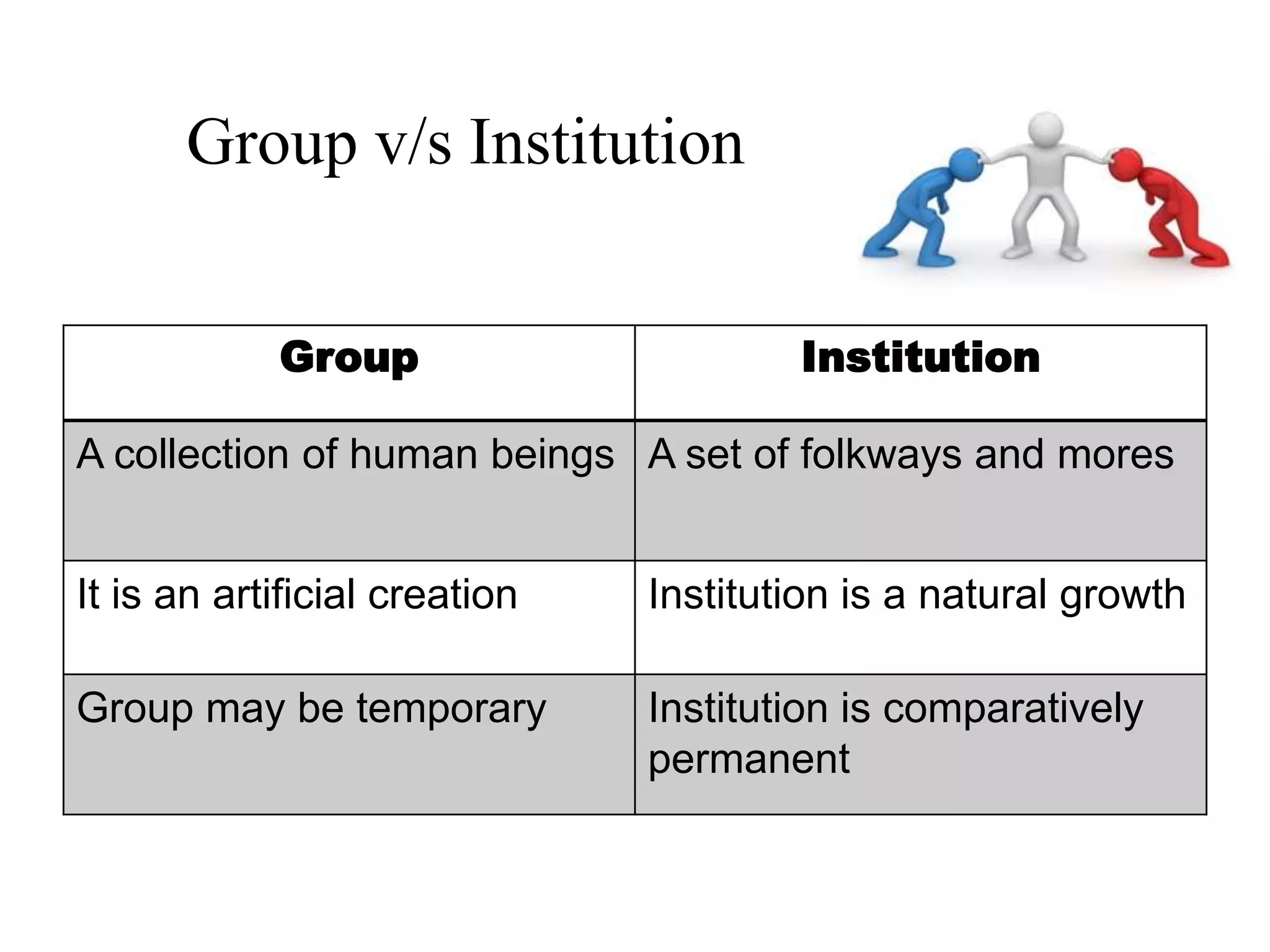
Group v/s Institution
Group Institution
A collection of human beings A set of folkways and mores
It is an artificial creation Institution is a natural growth
Group may be temporary Institution is comparatively
permanent
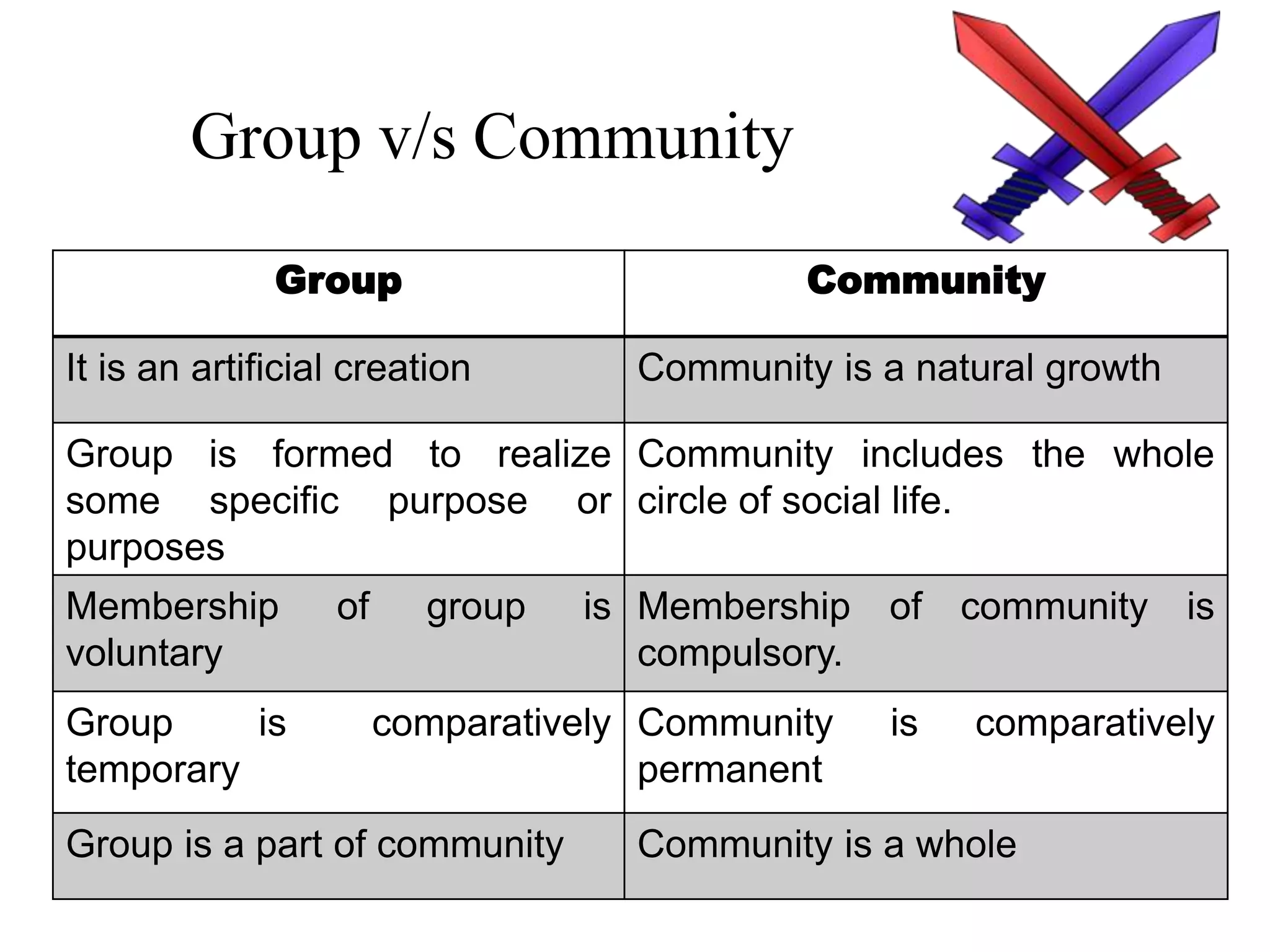
Group v/s Community
Group Community
It is an artificial creation Community is a natural growth
Group is formed to realize
some specific purpose or
purposes
Community includes the whole
circle of social life.
Membership of group is
voluntary
Membership of community is
compulsory.
Group is comparatively
temporary
Community is comparatively
permanent
Group is a part of community Community is a whole
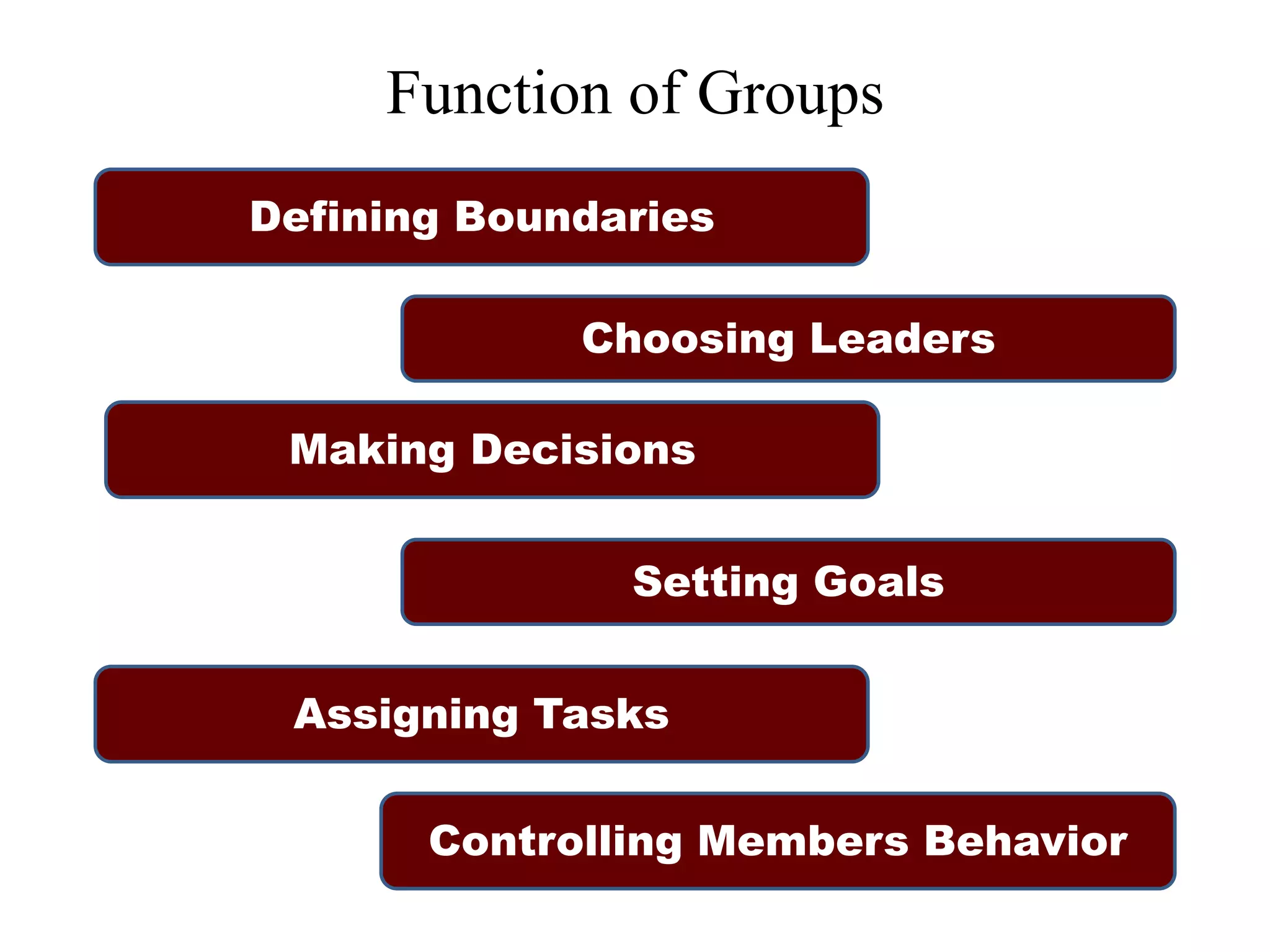
Function of Groups
Defining Boundaries
Choosing Leaders
Making Decisions
Setting Goals
Assigning Tasks
Controlling Members Behavior
Functions….
Defining boundaries
To identify who are members of a group, some sort
of devices must be used to mark the boundaries.
Choosing Leaders
Groups by nature must resolve the issue of
leadership.
A leader according to Tischler is someone who
occupies central role or position of dominance and
influence in a group.
INSTRUMENTAL LEADERSHIP
EXPRESSIVE LEADERSHIP
Cont….
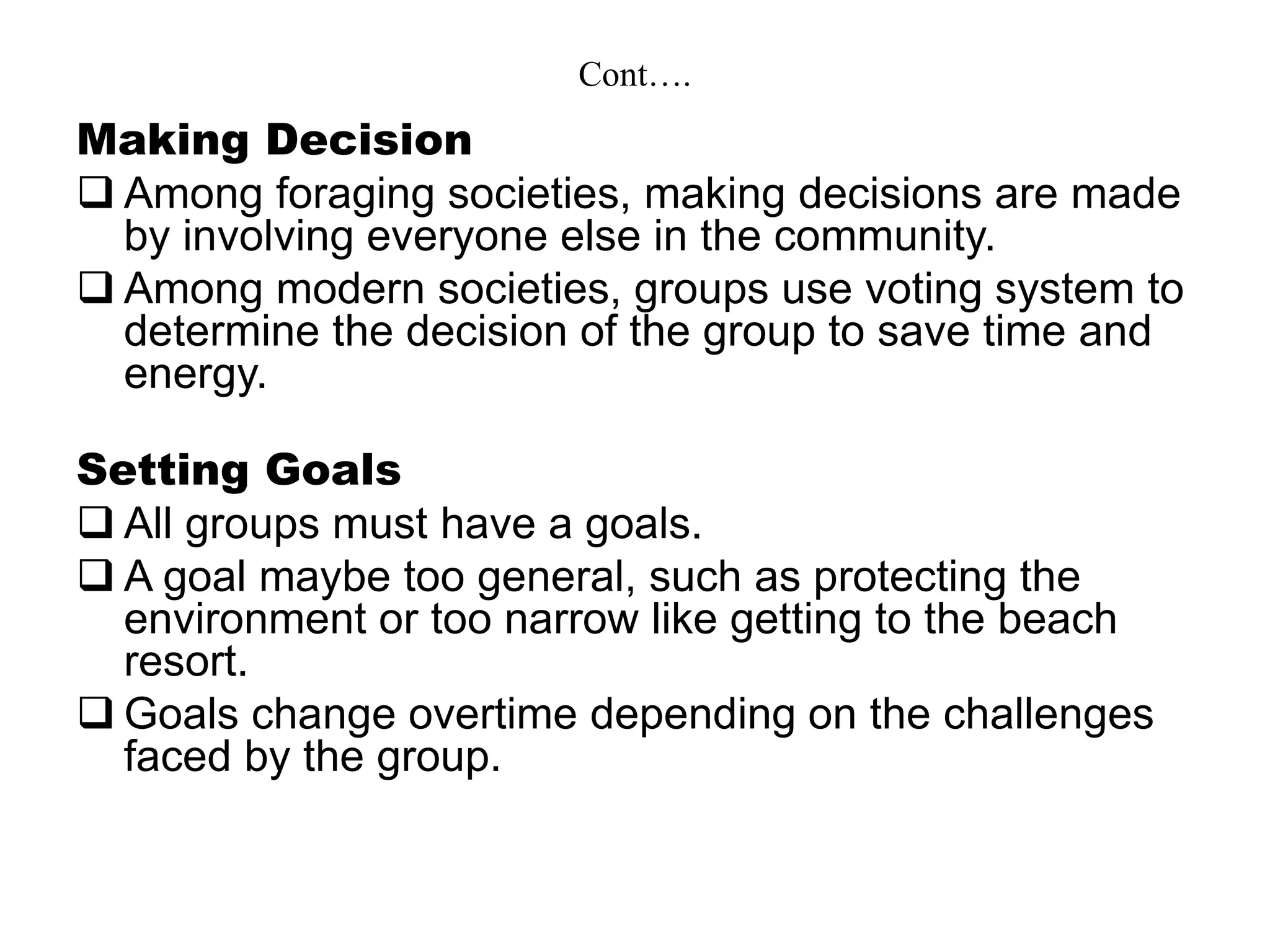
Making Decision
 Among foraging societies, making decisions are made
by involving everyone else in the community.
 Among modern societies, groups use voting system to
determine the decision of the group to save time and
energy.
Setting Goals
 All groups must have a goals.
 A goal maybe too general, such as protecting the
environment or too narrow like getting to the beach
resort.
 Goals change overtime depending on the challenges
faced by the group.
Cont…
Assigning task
 Goals, decision making, leadership are all important
functions of groups.
 Significant only when tasks are assigned to each
member to perform.
Controlling members behavior
 Group members behavior must be controlled for the
group to continuously.
 This is the reason why deviant behaviors of members of
the group are considered dangerous and threatening.
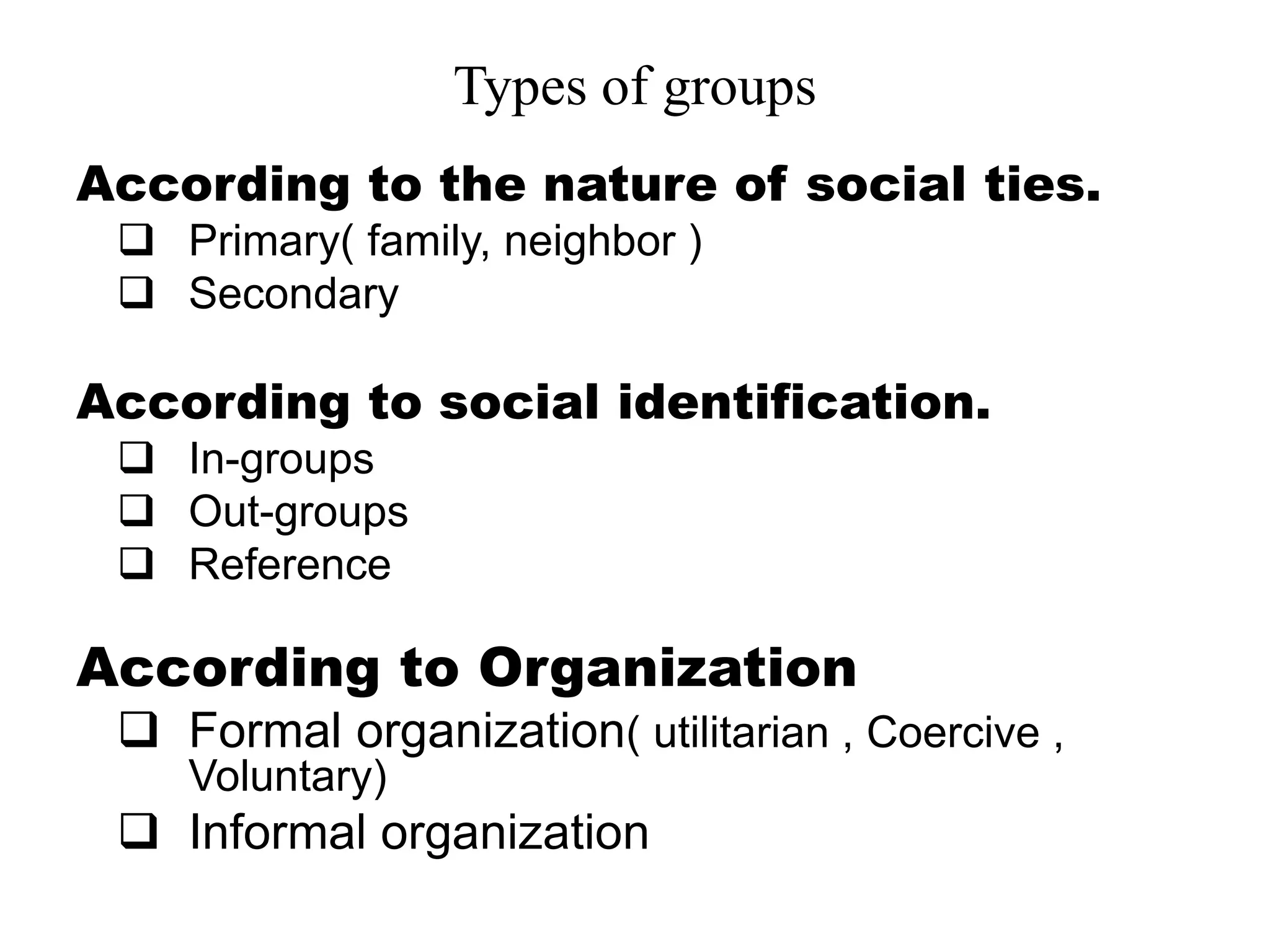
Types of groups
According to the nature of social ties.
 Primary( family, neighbor )
 Secondary
According to social identification.
 In-groups
 Out-groups
 Reference
According to Organization
 Formal organization( utilitarian , Coercive ,
Voluntary)
 Informal organization
Primary Group
 Primary group are small in size and characterized
by personal, intimate and non-specialized
relationship between their members .
 Eg. Family, Basketball team, A couple etc.
Some elements of primary group
 Tend to be small and ordinarily composed of fewer
than 15 to 20 individuals.
 Interaction and communication among members
is of intimate and personal nature.
 Members commonly develop strong emotional
bonds with other members.
 Generally persist over extensive period of time.
Importance of Primary Group
Primary Group is the birth place of human nature.
Primary Groups help in the socialization of the
individuals and maintain social control over them.
Teaches the members to work in the society
according to their rules.
Primary groups are the nuclear cells of social
organization.
Primary groups induces the development of the
individual personalities.
Secondary Group
 Secondary groups refer to a formal, impersonal group in
which there is little social intimacy or mutual understanding
eg. business organization, political parties, labor union etc.
 The relationship between the members is very superficial and
there is only indirect exertion of influence amongst them.
Definitions
 Secondary groups are those that are relatively casual and
impersonal in their relationships…. Relationships in them are
usually competitive rather than mutually helpful. (P.H.Landis)
 The groups which provide experience lacking in intimacy are
called secondary groups. (Ogburn)
Elements of Secondary Group
Formal and impersonal relations:
The group does not exert any primary influence upon
it’s members.
They do not meet face to face.
They perform their jobs, carry out their order, pay their
dues and still may not see each other face to face.
Large in size:
They may be spread all over the world.
Option of membership:
The membership of most of the secondary groups is
not compulsory.
Cont…
Active and inactive members
 Due to lack of intimate relations amongst themselves and
large size of the groups, some of the members of the
secondary group are active while others are inactive.
Formal Rules:
 A secondary group is regulated by formal rules.
 A formal authority is set up and a clear cut division of labour is
made.
 In fact the stability of a secondary group depends upon it’s
organization.
Goal oriented:
 The main purpose of a secondary group is to fulfill a specific
function.
Status of individual depends on his role and not upon
his personal qualities or birth.
Primary v/s Secondary Group.
Primary group Secondary group
Size
Small in size and area (Usually defined area
like family, study group. etc)
Widespread in size As well as area.
Type of co-operation
Direct. Intimate bonding. Indirect. To achieve only group objective and
no personal bonding.
Kind of structure
Based on informal structure. No detailed
rules are drafted and members work
spontaneously in adjustment with each other
Regulated by a set of formal rules. A formal
authority is set up with designated powers
and clear cut division of labour amongst it’s
members.
Relationship
Direct, Personal, intimate Indirect, not face to face, formal.
Role of Primary Group in Health and
sickness
Child Rearing.
Socialization.
Personality formation.
Care of dependent adults:
Care of the sick and injured.
Care of women during pregnancy and child birth.
Care of the aged and handicapped.
Stabilization of adult personality: Shock absorber.
Role of Primary Group in Health and sickness
 Familial susceptibility to disease:
 Common gene pools and environment
 Playground for communicable
 Broken family
 May lead to psychopathic behaviour, immature personality
and even retardation of growth, speech and intellect in
children.
 Problem family:
 Forms the basis of various social problems.
 Positive and negative influence of peer groups
 During sickness the peers may provide both psychological
support as well as may attend to the physical emergency.
Importance of Secondary Group
 The organized functioning with set rules and regulations,
clear cut authority and division of labour amongst it’s
members has facilitated efficient achievement of it’s goal.
 These groups provide greater channels of opportunity for
development of individual talents.
 A secondary group broadens the outlook of it’s members
beyond the vested interests of the primary group.
 It is more universal in it’s judgement than the primary
group which is influenced by local customs and personal
attitudes.
 It may shatter the bonds of provincialism and casteism.
Role of Secondary group in health and
sickness
At birth:
 Health care personnel provide immunization services, feeding,
bathing, bedding in etc to the child.
Toddler/Pre-school:
 The creche, play school etc teaches the child the art of sharing,
playing, singing eating, rest pattern, sleeping etc.
School Age:
 The schoolmates help the child to develop good
companionship, sharing and indulging in constructive activities.
Adolescence:
 Teachers serve as role models for inculcating healthy habits in
the individuals resulting in development of responsible citizens.
Cont…
Adulthood:
 Healthy working environment with congenial employee – employer
relationship promotes and protects the individual.
Old age
 Health promotion activities by the different members of the society.
In sickness….
 Hospitals: Data collection regarding health problems, examination,
lab investigations, diagnosis, selection of treatment or intervention
measure, counseling etc.
 Health camps conducted by health personnel.
 Rehabilitation centers team members provide the required services
 Insurance schemes like ESI benefit, health insurance schemes,
provision of safe drinking water etc.
Other groups….
 In-group feel strong identification and
loyalty with the members of their own groups
different, either culturally or racially
 Out-group is a group or category to which
people feel they do not belong.
 Reference group is a group that people
use as a standard in evaluating or
understanding themselves, their attitudes,
and their behavior
Thankyou guys…

Social groups

  • 1.
    Social groups By Dr UtpalSharma Assist. Professor Depatrment of Community Medicine, SMIMS
  • 2.
    Introduction Man is asocial animal, no man can live in isolation. In fact every aspect of man’s life is influenced to a great extent by the members of the different groups of which he/she is a part. Social group is a collection of human beings. “A number of units of anything in close proximity to one another.” In human context social group is – “Any collection of human beings who are brought into social relationships with one another”
  • 3.
    Lets peek intothis…. Definitions “A group is a social unit which consists of a number of individuals who stand in (more or less)definite status and role relationships to one another and which possesses a set of values or norms of its own, regulating the behavior of individual members at least in matters of consequence to the group” (Sheriff & Sheriff) “A social group is a number of persons two or more, who have some common objects of attention, who are stimulating to each other, who have common loyalty and participate in similar activities.” (Bogardus)
  • 4.
    More of definitions…… “Whenevertwo or more individuals come together and influence one another, they may be said to constitute a social group.” (Ogburn & Nimkoff) Social group involves some degree of reciprocity and mutual awareness between the related individuals.  The essence of social group is not physical closeness but a consciousness of joint interaction. Within a social group some of the members lead while others follow.
  • 5.
    Characteristics of social group Reciprocalrelationships. Sense of unity and feeling of sympathy towards each other. We- feeling: Members defend their interests collectively. Common interests and ideals. Similar behavior: for achieving the common goals and interests. Group norms: Every group has it’s own set of rules and norms.
  • 6.
    Group v/s Society GroupSociety A collection of human beings A system of social relationships An artificial creation A natural growth. Membership is voluntary Membership is compulsory Group is always organized Society may be unorganized A specific purpose General purposes Marked by co-operation Marked by both co-operation and conflict Group may be temporary Society is permanent.
  • 7.
    Group v/s Institution GroupInstitution A collection of human beings A set of folkways and mores It is an artificial creation Institution is a natural growth Group may be temporary Institution is comparatively permanent
  • 8.
    Group v/s Community GroupCommunity It is an artificial creation Community is a natural growth Group is formed to realize some specific purpose or purposes Community includes the whole circle of social life. Membership of group is voluntary Membership of community is compulsory. Group is comparatively temporary Community is comparatively permanent Group is a part of community Community is a whole
  • 9.
    Function of Groups DefiningBoundaries Choosing Leaders Making Decisions Setting Goals Assigning Tasks Controlling Members Behavior
  • 10.
    Functions…. Defining boundaries To identifywho are members of a group, some sort of devices must be used to mark the boundaries. Choosing Leaders Groups by nature must resolve the issue of leadership. A leader according to Tischler is someone who occupies central role or position of dominance and influence in a group. INSTRUMENTAL LEADERSHIP EXPRESSIVE LEADERSHIP
  • 11.
    Cont…. Making Decision  Amongforaging societies, making decisions are made by involving everyone else in the community.  Among modern societies, groups use voting system to determine the decision of the group to save time and energy. Setting Goals  All groups must have a goals.  A goal maybe too general, such as protecting the environment or too narrow like getting to the beach resort.  Goals change overtime depending on the challenges faced by the group.
  • 12.
    Cont… Assigning task  Goals,decision making, leadership are all important functions of groups.  Significant only when tasks are assigned to each member to perform. Controlling members behavior  Group members behavior must be controlled for the group to continuously.  This is the reason why deviant behaviors of members of the group are considered dangerous and threatening.
  • 13.
    Types of groups Accordingto the nature of social ties.  Primary( family, neighbor )  Secondary According to social identification.  In-groups  Out-groups  Reference According to Organization  Formal organization( utilitarian , Coercive , Voluntary)  Informal organization
  • 14.
    Primary Group  Primarygroup are small in size and characterized by personal, intimate and non-specialized relationship between their members .  Eg. Family, Basketball team, A couple etc. Some elements of primary group  Tend to be small and ordinarily composed of fewer than 15 to 20 individuals.  Interaction and communication among members is of intimate and personal nature.  Members commonly develop strong emotional bonds with other members.  Generally persist over extensive period of time.
  • 15.
    Importance of PrimaryGroup Primary Group is the birth place of human nature. Primary Groups help in the socialization of the individuals and maintain social control over them. Teaches the members to work in the society according to their rules. Primary groups are the nuclear cells of social organization. Primary groups induces the development of the individual personalities.
  • 16.
    Secondary Group  Secondarygroups refer to a formal, impersonal group in which there is little social intimacy or mutual understanding eg. business organization, political parties, labor union etc.  The relationship between the members is very superficial and there is only indirect exertion of influence amongst them. Definitions  Secondary groups are those that are relatively casual and impersonal in their relationships…. Relationships in them are usually competitive rather than mutually helpful. (P.H.Landis)  The groups which provide experience lacking in intimacy are called secondary groups. (Ogburn)
  • 17.
    Elements of SecondaryGroup Formal and impersonal relations: The group does not exert any primary influence upon it’s members. They do not meet face to face. They perform their jobs, carry out their order, pay their dues and still may not see each other face to face. Large in size: They may be spread all over the world. Option of membership: The membership of most of the secondary groups is not compulsory.
  • 18.
    Cont… Active and inactivemembers  Due to lack of intimate relations amongst themselves and large size of the groups, some of the members of the secondary group are active while others are inactive. Formal Rules:  A secondary group is regulated by formal rules.  A formal authority is set up and a clear cut division of labour is made.  In fact the stability of a secondary group depends upon it’s organization. Goal oriented:  The main purpose of a secondary group is to fulfill a specific function. Status of individual depends on his role and not upon his personal qualities or birth.
  • 19.
    Primary v/s SecondaryGroup. Primary group Secondary group Size Small in size and area (Usually defined area like family, study group. etc) Widespread in size As well as area. Type of co-operation Direct. Intimate bonding. Indirect. To achieve only group objective and no personal bonding. Kind of structure Based on informal structure. No detailed rules are drafted and members work spontaneously in adjustment with each other Regulated by a set of formal rules. A formal authority is set up with designated powers and clear cut division of labour amongst it’s members. Relationship Direct, Personal, intimate Indirect, not face to face, formal.
  • 20.
    Role of PrimaryGroup in Health and sickness Child Rearing. Socialization. Personality formation. Care of dependent adults: Care of the sick and injured. Care of women during pregnancy and child birth. Care of the aged and handicapped. Stabilization of adult personality: Shock absorber.
  • 21.
    Role of PrimaryGroup in Health and sickness  Familial susceptibility to disease:  Common gene pools and environment  Playground for communicable  Broken family  May lead to psychopathic behaviour, immature personality and even retardation of growth, speech and intellect in children.  Problem family:  Forms the basis of various social problems.  Positive and negative influence of peer groups  During sickness the peers may provide both psychological support as well as may attend to the physical emergency.
  • 22.
    Importance of SecondaryGroup  The organized functioning with set rules and regulations, clear cut authority and division of labour amongst it’s members has facilitated efficient achievement of it’s goal.  These groups provide greater channels of opportunity for development of individual talents.  A secondary group broadens the outlook of it’s members beyond the vested interests of the primary group.  It is more universal in it’s judgement than the primary group which is influenced by local customs and personal attitudes.  It may shatter the bonds of provincialism and casteism.
  • 23.
    Role of Secondarygroup in health and sickness At birth:  Health care personnel provide immunization services, feeding, bathing, bedding in etc to the child. Toddler/Pre-school:  The creche, play school etc teaches the child the art of sharing, playing, singing eating, rest pattern, sleeping etc. School Age:  The schoolmates help the child to develop good companionship, sharing and indulging in constructive activities. Adolescence:  Teachers serve as role models for inculcating healthy habits in the individuals resulting in development of responsible citizens.
  • 24.
    Cont… Adulthood:  Healthy workingenvironment with congenial employee – employer relationship promotes and protects the individual. Old age  Health promotion activities by the different members of the society. In sickness….  Hospitals: Data collection regarding health problems, examination, lab investigations, diagnosis, selection of treatment or intervention measure, counseling etc.  Health camps conducted by health personnel.  Rehabilitation centers team members provide the required services  Insurance schemes like ESI benefit, health insurance schemes, provision of safe drinking water etc.
  • 25.
    Other groups….  In-groupfeel strong identification and loyalty with the members of their own groups different, either culturally or racially  Out-group is a group or category to which people feel they do not belong.  Reference group is a group that people use as a standard in evaluating or understanding themselves, their attitudes, and their behavior
  • 26.