Investigation of an
Epidemic
By
Dr Utpal Sharma
Assistant Professor
Department of Community Medicine
SMIMS, Gangtok, Sikkim
The concept….
Endemic
Disease occurring in a population regularly at an
usual level
 Eg Tuberculosis, malaria
Epidemic
Unusual occurrence of disease clearly in excess
of its normal expectancy.
 In a geographical location
 At a given point of time.
 Eg: Hepatitis, Measles, Typhoid
Outbreak versus epidemic
 Occurrence of cases of illness in excess of the expected
numbers
Measure
 Outbreak
 Limited to a small area, within a district or a few blocks
 Epidemic
 Covers larger geographic areas
 Linked to control measure instituted in the district/ state
 Cluster
 Merely a group of cases in a given area over a particular
period without regard to whether the number of cases is more
than expected.
No formal difference, you are the one
who decide how
much importance
you want to give to the event.
Investigating an
epidemic….why????
 Epidemics or outbreaks signals some significant shift between
existing balance between agent, host and environment
 Calls for thorough investigation to uncover the factors
responsible and…
…..Institute control measures to prevent further spread of
the disease
 Role for research into a new laboratory method to diagnose
diseases
 why some are more susceptible, what risk factors do they have?
 To find out the limiting factor for outbreak of disease for which
an existing health programme is there.Keep the public’s confidence
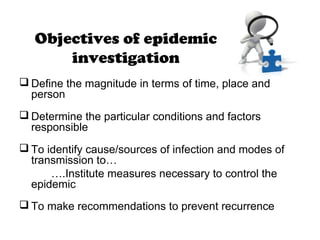
Objectives of epidemic
investigation
 Define the magnitude in terms of time, place and
person
 Determine the particular conditions and factors
responsible
 To identify cause/sources of infection and modes of
transmission to…
….Institute measures necessary to control the
epidemic
 To make recommendations to prevent recurrence
Salient feature of an epidemic
investigation
Epidemic investigation is meant for Description
as well as Intervention.
Generally investigations are done at the peak of
the epidemic….hence largely Retrospective
The steps for investigation are not necessary to be
undertaken in the same sequence…..
1. Verification of the
diagnosis
 Initial report is not in the form of particular diagnosis but rather
in the from of a “syndromic” constellation of symptoms and
signs
 It is therefore essential to verify the diagnosis on the spot, as
quickly as possible.
 Clinical examination of a sample of cases should be done.
 Laboratory investigation, where ever applicable boosts the
confirmation of diagnosis
 Epidemiological investigation should not be delayed until lab
results available
It is not necessary to examine or
investigate all the cases to arrive at a
diagnosis
2. Confirm the
existence of an
epidemic
 Done by comparing the disease frequencies the
same period of previous years (generally past 3 years)
 Epidemic confirmed when observed cases are clearly in
excess (more than 2SE) of that of previous experiences.
 Some of the epidemics are easy to confirm eg. cholera, food
poisoning…..
…..whereas it is difficult to establish in case of
modern epidemics eg. HTN, CVD without comparison
 Pragmatic considerations are also important as to whether to
investigate or not……
…a single case of a disease may be enough to call for
investigations eg. Polio, plague
3. Defining the population at risk
(Initial line-listing)
a) Obtaining map of the area
 Should contain information regarding natural landmarks,
roads and location of dwellings.
 Areas divided according to the landmarks and the
dwellings numbered
a) Counting the population
 Denominator is calculated of the affected area
 Health workers can be engaged for this.
 This is done to estabilish the population size of the area
 Population censes helps in computing the attack rates in
the groups and rest of the population subsequently.
4. Rapid search for all the cases
and their characteristics
a) Medical survey
 Done to identify all the cases under medical attention and
also the exposed.
 Trained Health workers employed to collect data by
administering “epidemiological case sheets”
b) Epidemiological case sheet
 Designed based on rapid preliminary inquiry
 Used to collect relevant information on
Identification
Occupation and social class
Travel and history of exposure
Time of onset and Signs and symptoms
Personal contacts
Events like attending parties or gatherings
History of reciept of any injections, blood products…etc
Cont….
c) Searching for more cases
 Patients were enquired about other case in the vicinity
having onset within the incubation period of the index case
 Cases admitted should also be taken into consideration
 this data reveals the situation with finding of additional cases
and also explains person-to-person spread
 Search of new (secondary) cases should be carried out
everyday, till the epidemic is over
This period is taken as the twice of the Incubation
period of the disease since the last case.
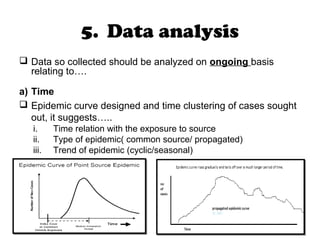
5. Data analysis
 Data so collected should be analyzed on ongoing basis
relating to….
a) Time
 Epidemic curve designed and time clustering of cases sought
out, it suggests…..
i. Time relation with the exposure to source
ii. Type of epidemic( common source/ propagated)
iii. Trend of epidemic (cyclic/seasonal)
Cont…
b) Place
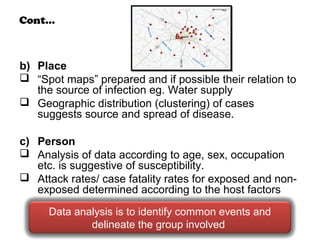
 “Spot maps” prepared and if possible their relation to
the source of infection eg. Water supply
 Geographic distribution (clustering) of cases
suggests source and spread of disease.
c) Person
 Analysis of data according to age, sex, occupation
etc. is suggestive of susceptibility.
 Attack rates/ case fatality rates for exposed and non-
exposed determined according to the host factors
Data analysis is to identify common events and
delineate the group involved
6. Formulation of hypothesis
 On the basis of Time-Place-Person distribution or…
…..Agent-Host-Environment model hypothesis is
formulated to explain….
 Possible source
 Causative agent
 Environmental factors responsible
Formulation of tentative hypothesis
guides further investigation
7. Testing of
hypothesis
All reasonable hypothesis should be considered
and weighed comparing attack rates with each
suspected factor
This helps to ascertain the hypothesis most
consistent with all known facts
Divergent hypothesis should also be checked out.
8. Evaluation of the ecological
factors
 Investigation of the circumstances should be made to prevent
further transmission
 Possible ecological factors responsible for the epidemic
should be investigated…
 Sanitary status of the eateries
 Water and food supply
 Population migration
 Atmospheric changes like air and water pollution, temperature
and humidity
 Vector bionomics and animal reservoir
 Evaluation of the ecological factors helps to relate disease to
the environmental factors to know the sources of infection,
reservoir and mode of transmission
Out break can be studied in a case
control manner
9. Further investigation of
population at risk
 This involves study o a population at risk or a sample of it for
more information.
 Involves medical examination, screening tests, biochemical
examination, examination of suspected food, faeces or blood
sample etc.
 The approach may either be retrospective or prospective
 Investigation of the healthy individuals will disclose the
classification of all members to…
a) Exposure to potential vehicle
b) Whether ill or not
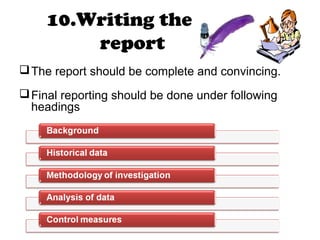
10.Writing the
report
The report should be complete and convincing.
Final reporting should be done under following
headings
Thank
you….will meet
soon

Out break investigation

  • 1.
    Investigation of an Epidemic By DrUtpal Sharma Assistant Professor Department of Community Medicine SMIMS, Gangtok, Sikkim
  • 2.
    The concept…. Endemic Disease occurringin a population regularly at an usual level  Eg Tuberculosis, malaria Epidemic Unusual occurrence of disease clearly in excess of its normal expectancy.  In a geographical location  At a given point of time.  Eg: Hepatitis, Measles, Typhoid
  • 3.
    Outbreak versus epidemic Occurrence of cases of illness in excess of the expected numbers Measure  Outbreak  Limited to a small area, within a district or a few blocks  Epidemic  Covers larger geographic areas  Linked to control measure instituted in the district/ state  Cluster  Merely a group of cases in a given area over a particular period without regard to whether the number of cases is more than expected. No formal difference, you are the one who decide how much importance you want to give to the event.
  • 4.
    Investigating an epidemic….why????  Epidemicsor outbreaks signals some significant shift between existing balance between agent, host and environment  Calls for thorough investigation to uncover the factors responsible and… …..Institute control measures to prevent further spread of the disease  Role for research into a new laboratory method to diagnose diseases  why some are more susceptible, what risk factors do they have?  To find out the limiting factor for outbreak of disease for which an existing health programme is there.Keep the public’s confidence
  • 5.
    Objectives of epidemic investigation Define the magnitude in terms of time, place and person  Determine the particular conditions and factors responsible  To identify cause/sources of infection and modes of transmission to… ….Institute measures necessary to control the epidemic  To make recommendations to prevent recurrence
  • 6.
    Salient feature ofan epidemic investigation Epidemic investigation is meant for Description as well as Intervention. Generally investigations are done at the peak of the epidemic….hence largely Retrospective The steps for investigation are not necessary to be undertaken in the same sequence…..
  • 7.
    1. Verification ofthe diagnosis  Initial report is not in the form of particular diagnosis but rather in the from of a “syndromic” constellation of symptoms and signs  It is therefore essential to verify the diagnosis on the spot, as quickly as possible.  Clinical examination of a sample of cases should be done.  Laboratory investigation, where ever applicable boosts the confirmation of diagnosis  Epidemiological investigation should not be delayed until lab results available It is not necessary to examine or investigate all the cases to arrive at a diagnosis
  • 8.
    2. Confirm the existenceof an epidemic  Done by comparing the disease frequencies the same period of previous years (generally past 3 years)  Epidemic confirmed when observed cases are clearly in excess (more than 2SE) of that of previous experiences.  Some of the epidemics are easy to confirm eg. cholera, food poisoning….. …..whereas it is difficult to establish in case of modern epidemics eg. HTN, CVD without comparison  Pragmatic considerations are also important as to whether to investigate or not…… …a single case of a disease may be enough to call for investigations eg. Polio, plague
  • 9.
    3. Defining thepopulation at risk (Initial line-listing) a) Obtaining map of the area  Should contain information regarding natural landmarks, roads and location of dwellings.  Areas divided according to the landmarks and the dwellings numbered a) Counting the population  Denominator is calculated of the affected area  Health workers can be engaged for this.  This is done to estabilish the population size of the area  Population censes helps in computing the attack rates in the groups and rest of the population subsequently.
  • 10.
    4. Rapid searchfor all the cases and their characteristics a) Medical survey  Done to identify all the cases under medical attention and also the exposed.  Trained Health workers employed to collect data by administering “epidemiological case sheets” b) Epidemiological case sheet  Designed based on rapid preliminary inquiry  Used to collect relevant information on Identification Occupation and social class Travel and history of exposure Time of onset and Signs and symptoms Personal contacts Events like attending parties or gatherings History of reciept of any injections, blood products…etc
  • 11.
    Cont…. c) Searching formore cases  Patients were enquired about other case in the vicinity having onset within the incubation period of the index case  Cases admitted should also be taken into consideration  this data reveals the situation with finding of additional cases and also explains person-to-person spread  Search of new (secondary) cases should be carried out everyday, till the epidemic is over This period is taken as the twice of the Incubation period of the disease since the last case.
  • 12.
    5. Data analysis Data so collected should be analyzed on ongoing basis relating to…. a) Time  Epidemic curve designed and time clustering of cases sought out, it suggests….. i. Time relation with the exposure to source ii. Type of epidemic( common source/ propagated) iii. Trend of epidemic (cyclic/seasonal)
  • 13.
    Cont… b) Place  “Spotmaps” prepared and if possible their relation to the source of infection eg. Water supply  Geographic distribution (clustering) of cases suggests source and spread of disease. c) Person  Analysis of data according to age, sex, occupation etc. is suggestive of susceptibility.  Attack rates/ case fatality rates for exposed and non- exposed determined according to the host factors Data analysis is to identify common events and delineate the group involved
  • 14.
    6. Formulation ofhypothesis  On the basis of Time-Place-Person distribution or… …..Agent-Host-Environment model hypothesis is formulated to explain….  Possible source  Causative agent  Environmental factors responsible Formulation of tentative hypothesis guides further investigation
  • 15.
    7. Testing of hypothesis Allreasonable hypothesis should be considered and weighed comparing attack rates with each suspected factor This helps to ascertain the hypothesis most consistent with all known facts Divergent hypothesis should also be checked out.
  • 16.
    8. Evaluation ofthe ecological factors  Investigation of the circumstances should be made to prevent further transmission  Possible ecological factors responsible for the epidemic should be investigated…  Sanitary status of the eateries  Water and food supply  Population migration  Atmospheric changes like air and water pollution, temperature and humidity  Vector bionomics and animal reservoir  Evaluation of the ecological factors helps to relate disease to the environmental factors to know the sources of infection, reservoir and mode of transmission Out break can be studied in a case control manner
  • 17.
    9. Further investigationof population at risk  This involves study o a population at risk or a sample of it for more information.  Involves medical examination, screening tests, biochemical examination, examination of suspected food, faeces or blood sample etc.  The approach may either be retrospective or prospective  Investigation of the healthy individuals will disclose the classification of all members to… a) Exposure to potential vehicle b) Whether ill or not
  • 18.
    10.Writing the report The reportshould be complete and convincing. Final reporting should be done under following headings
  • 19.