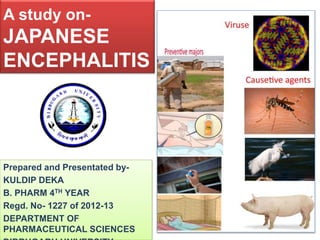
A study on-
JAPANESE
ENCEPHALITIS
Prepared and Presentated by-
KULDIP DEKA
B. PHARM 4TH YEAR
Regd. No- 1227 of 2012-13
DEPARTMENT OF
PHARMACEUTICAL SCIENCES
Introduction of JE
 It is a viral infection of the central nervous system
First case was documented in 1871 in Japan.
Transmitted by the of infected Culex species mosquitoes
Symptoms with phages:
i)Prodromal stage: fever, headache, vomiting and
diarrhea.lasts for 2-5 days.
ii)Acute encephalitic stage: headache, convulsions and
deterioration of mental status. May lasting from
several days to several weeks.
iii)Convalescent stage: This varies from a week to months
and in patients recovery left with paralysis, ataxia, mental
retardation and seizures.
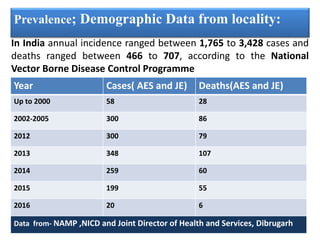
Prevalence; Demographic Data from locality:
In India annual incidence ranged between 1,765 to 3,428 cases and
deaths ranged between 466 to 707, according to the National
Vector Borne Disease Control Programme
Year Cases( AES and JE) Deaths(AES and JE)
Up to 2000 58 28
2002-2005 300 86
2012 300 79
2013 348 107
2014 259 60
2015 199 55
2016 20 6
Data from- NAMP ,NICD and Joint Director of Health and Services, Dibrugarh
Causative Agent and their Life Cycle
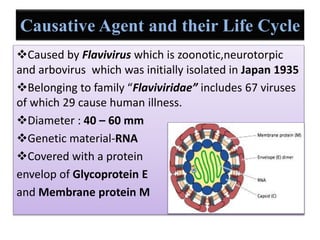
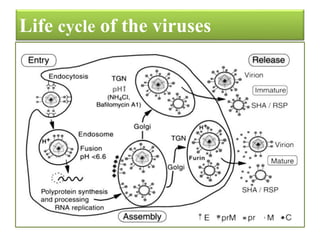
Caused by Flavivirus which is zoonotic,neurotorpic
and arbovirus which was initially isolated in Japan 1935
Belonging to family “Flaviviridae” includes 67 viruses
of which 29 cause human illness.
Diameter : 40 – 60 mm
Genetic material-RNA
Covered with a protein
envelop of Glycoprotein E
and Membrane protein M
Life cycle of the viruses
Sources of the Viruses
• Mosquito:Transmission host: Through the bite of
infected Culex species mosquitoes, particularly Culex
tritaeniorhynchus.Transfer the viruses from the infected pigs and
wading birds to humans(dead-end hosts)
• Amplifying Host:
Water birds: herons, egrets, night herons, and bitterns
Once infected swine: The virus grow most in the tonsils. Allow
virus multiplication without suffering from disease. Infected pigs
discharge the virus in their saliva through the mouth or nose.
• Also Introduction of JE virus strains from endemic areas may happen in
some cases.
Pathogenesis of the disease
JEV causes neuronal damage in the brain
through-
JEV may cross the BBB by passive transport
across the endothelium.
Monocytes and macrophages -carriers of the
virus in the CNS- deterioration of BBB stability.
JEV infection activates microglia which causes
raise in the level of pro-inflammatory mediators, such
as IL-6, TNF-α, MCP-1 etc. involved in inducing
neuronal death
Enzyme-linked Immune Sorbent Assay
(ELISA): IgM assay
Plaque Reduction Neutralization
Test(PRNT): Differentiate the JE virus from
other viruses.
RT-PCR(Reverse transcription polymerase
chain reaction): To detect the RNA expression
Diagnosis
Specimen collection and handling; Choice of specimen:
For detection of IgM antibodies to JEV
Details Information include in store
Cerebrospinal fluid (CSF) collection: Minimum 0.5ml of CSF
is required
Should be stored in 20°C
Blood specimen collection: 5 ml for older children and adults
and 1 ml for infants and younger children.
From vein-allow to clot at RT-Centrifuged-serum-IgM test.
Laboratory Procedures
Preventive Majors
Life Style to prevent the disease:
•Proper clothing to reduce mosquito bite.
•Use insecticide treated mosquito bed nets.
•Use repellents ;available in sprays, roll-ons, sticks and creams. E.g.-DEET
(diethyltoluamide)
•Vaccination is an important tool for prevention
Possible Therapeutic Treatment available:
IXIARO-Suspension ;Intramuscular Injection ;U.S. Approval: 2009
From 2 months infants up to elder
2 doses are given; 1st – as soon as possible after infection and 2nd is
after 28 days of 1st dose
IMOJEV-Can be administered to 9 months of age and over
JEEV -for active immunization against JE(WHO approved- 18 to 49 years)
Diethyldithiocarbamate(DDTC)-antiviral agents
Diethyldithiocarbamate – Immunomodulator
Vector control:
 Provide bed nets
Thermal fogging with insecticide like Malathion
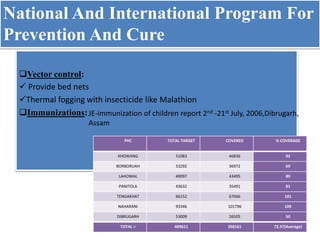
Immunizations:
PHC TOTAL TARGET COVERED % COVERAGE
KHOWANG 51083 46836 92
BORBORUAH 53292 36972 69
LAHOWAL 49097 43495 89
PANITOLA 43632 35491 81
TENGAKHAT 66152 67066 101
NAHARANI 93346 101796 109
DIBRUGARH 53009 26505 50
TOTAL = 409611 358161 72.57(Average)
JE-immunization of children report 2nd -21st July, 2006,Dibrugarh,
Assam
National And International Program For
Prevention And Cure
JE vaccination campaign was launched during 2006 wherein
11 most sensitive districts in Assam
During 2009-2010 an amount of Rs.2.90 crores was allocated
to the JE endemic states
Guidelines were developed on AES/JE case management and
on prevention and control of which have been circulated to the
states
As on 22nd February, 2014, adult vaccination was launched in
nine districts of Assam -Kamrup, Sivasagar, Golaghat, Jorhat,
Dibrugarh, Tinsukia, Dhemaji and Lakhimpur. By this footstep,
Assam is become the first state in the country to administer
vaccination for Japanese Encephalitis for adults.
The Steps Taken By Govt. Of India for
Prevention :
IMPORTANT FACTS FROM OUR LOCALITY
The presence of unvaccinated people who refused to take the
vaccine or the people who were not present in their locality during
vaccination period, may be at risk for JE infection in near future due
to lack of immunity against JE virus in their body
Recent increase in the swine population is a major reason for the
rapid spread of JE in the region
Flooding of paddy fields helps for proliferation of the mosquito
population.
Prevalence of animal, human and bird vectors is also greater in
numbers in JE endemic areas in Assam than in the other parts of the
state
Pig firming gaining importance for business purpose.
Migration of people carrying greater risk of JE virus transmission
CONCLUSION
From the observation of JE scenario in Assam especially in Dibrugarh,
it has been depicted that, maximum numbers of JE positive cases were
detected during the year 2013. In the same year, nearby state West
Bengal shares the second largest burden of JE.
Environmental and ecological factors are responsible for the spread
of JEV in assam.
The first outbreak was reported in 1978 from Lakhimpur District of
Assam
The peak season foir transmission was noticed during the month of
June to July every year/
There is no specific treatment for JE; only prevention can control the
disease. By developing a high-quality immunization program.
To control the burden, first and foremost thing is to provide
awareness among the people regarding the cause and route of JE
transmission.
BIBLIOGRAPHY:
1.National Vector Borne Disease Control Programme, Government of India,
New Delhi: Directorate General of Health Services; Annual report 2014-15
Official website-http://www.nvbdcp. gov.in/malaria.
2. World Health Organization.Vector-borne diseases, Factsheet # 387, March 2014.
Accessed on 26May 2016.
3.Author-Borah J,Dutta P, Khan SA, Mahanta J.A comparison of clinical features of
Japanese encephalitis virus infection in the adult and pediatric age group with acute
encephalitis syndrome. J Clin Virol 2011; 52:45-9.
4. Authors- Dev V, Sharma VP, Barman K; Title-Mosquito-borne diseases in Assam,
north-east India: current status and key challenges; a review article;
Published on- WHO South-East Asia J Public Health 2015; 4(1): 20–29
5. Authors-Sharma J, Baruah MK, Pathak A, Khan SA, Dutta P.title- Epidemiology
of Japanese encephalitis cases in Dhemaji district of Assam, India. 2014; 5:50-4.

Japanese encephalitis

  • 1.
    A study on- JAPANESE ENCEPHALITIS Preparedand Presentated by- KULDIP DEKA B. PHARM 4TH YEAR Regd. No- 1227 of 2012-13 DEPARTMENT OF PHARMACEUTICAL SCIENCES
  • 2.
    Introduction of JE It is a viral infection of the central nervous system First case was documented in 1871 in Japan. Transmitted by the of infected Culex species mosquitoes Symptoms with phages: i)Prodromal stage: fever, headache, vomiting and diarrhea.lasts for 2-5 days. ii)Acute encephalitic stage: headache, convulsions and deterioration of mental status. May lasting from several days to several weeks. iii)Convalescent stage: This varies from a week to months and in patients recovery left with paralysis, ataxia, mental retardation and seizures.
  • 3.
    Prevalence; Demographic Datafrom locality: In India annual incidence ranged between 1,765 to 3,428 cases and deaths ranged between 466 to 707, according to the National Vector Borne Disease Control Programme Year Cases( AES and JE) Deaths(AES and JE) Up to 2000 58 28 2002-2005 300 86 2012 300 79 2013 348 107 2014 259 60 2015 199 55 2016 20 6 Data from- NAMP ,NICD and Joint Director of Health and Services, Dibrugarh
  • 4.
    Causative Agent andtheir Life Cycle Caused by Flavivirus which is zoonotic,neurotorpic and arbovirus which was initially isolated in Japan 1935 Belonging to family “Flaviviridae” includes 67 viruses of which 29 cause human illness. Diameter : 40 – 60 mm Genetic material-RNA Covered with a protein envelop of Glycoprotein E and Membrane protein M
  • 5.
    Life cycle ofthe viruses
  • 6.
    Sources of theViruses • Mosquito:Transmission host: Through the bite of infected Culex species mosquitoes, particularly Culex tritaeniorhynchus.Transfer the viruses from the infected pigs and wading birds to humans(dead-end hosts) • Amplifying Host: Water birds: herons, egrets, night herons, and bitterns Once infected swine: The virus grow most in the tonsils. Allow virus multiplication without suffering from disease. Infected pigs discharge the virus in their saliva through the mouth or nose. • Also Introduction of JE virus strains from endemic areas may happen in some cases.
  • 7.
    Pathogenesis of thedisease JEV causes neuronal damage in the brain through- JEV may cross the BBB by passive transport across the endothelium. Monocytes and macrophages -carriers of the virus in the CNS- deterioration of BBB stability. JEV infection activates microglia which causes raise in the level of pro-inflammatory mediators, such as IL-6, TNF-α, MCP-1 etc. involved in inducing neuronal death
  • 8.
    Enzyme-linked Immune SorbentAssay (ELISA): IgM assay Plaque Reduction Neutralization Test(PRNT): Differentiate the JE virus from other viruses. RT-PCR(Reverse transcription polymerase chain reaction): To detect the RNA expression Diagnosis
  • 9.
    Specimen collection andhandling; Choice of specimen: For detection of IgM antibodies to JEV Details Information include in store Cerebrospinal fluid (CSF) collection: Minimum 0.5ml of CSF is required Should be stored in 20°C Blood specimen collection: 5 ml for older children and adults and 1 ml for infants and younger children. From vein-allow to clot at RT-Centrifuged-serum-IgM test. Laboratory Procedures
  • 10.
    Preventive Majors Life Styleto prevent the disease: •Proper clothing to reduce mosquito bite. •Use insecticide treated mosquito bed nets. •Use repellents ;available in sprays, roll-ons, sticks and creams. E.g.-DEET (diethyltoluamide) •Vaccination is an important tool for prevention Possible Therapeutic Treatment available: IXIARO-Suspension ;Intramuscular Injection ;U.S. Approval: 2009 From 2 months infants up to elder 2 doses are given; 1st – as soon as possible after infection and 2nd is after 28 days of 1st dose IMOJEV-Can be administered to 9 months of age and over JEEV -for active immunization against JE(WHO approved- 18 to 49 years) Diethyldithiocarbamate(DDTC)-antiviral agents Diethyldithiocarbamate – Immunomodulator
  • 11.
    Vector control:  Providebed nets Thermal fogging with insecticide like Malathion Immunizations: PHC TOTAL TARGET COVERED % COVERAGE KHOWANG 51083 46836 92 BORBORUAH 53292 36972 69 LAHOWAL 49097 43495 89 PANITOLA 43632 35491 81 TENGAKHAT 66152 67066 101 NAHARANI 93346 101796 109 DIBRUGARH 53009 26505 50 TOTAL = 409611 358161 72.57(Average) JE-immunization of children report 2nd -21st July, 2006,Dibrugarh, Assam National And International Program For Prevention And Cure
  • 12.
    JE vaccination campaignwas launched during 2006 wherein 11 most sensitive districts in Assam During 2009-2010 an amount of Rs.2.90 crores was allocated to the JE endemic states Guidelines were developed on AES/JE case management and on prevention and control of which have been circulated to the states As on 22nd February, 2014, adult vaccination was launched in nine districts of Assam -Kamrup, Sivasagar, Golaghat, Jorhat, Dibrugarh, Tinsukia, Dhemaji and Lakhimpur. By this footstep, Assam is become the first state in the country to administer vaccination for Japanese Encephalitis for adults. The Steps Taken By Govt. Of India for Prevention :
  • 13.
    IMPORTANT FACTS FROMOUR LOCALITY The presence of unvaccinated people who refused to take the vaccine or the people who were not present in their locality during vaccination period, may be at risk for JE infection in near future due to lack of immunity against JE virus in their body Recent increase in the swine population is a major reason for the rapid spread of JE in the region Flooding of paddy fields helps for proliferation of the mosquito population. Prevalence of animal, human and bird vectors is also greater in numbers in JE endemic areas in Assam than in the other parts of the state Pig firming gaining importance for business purpose. Migration of people carrying greater risk of JE virus transmission
  • 14.
    CONCLUSION From the observationof JE scenario in Assam especially in Dibrugarh, it has been depicted that, maximum numbers of JE positive cases were detected during the year 2013. In the same year, nearby state West Bengal shares the second largest burden of JE. Environmental and ecological factors are responsible for the spread of JEV in assam. The first outbreak was reported in 1978 from Lakhimpur District of Assam The peak season foir transmission was noticed during the month of June to July every year/ There is no specific treatment for JE; only prevention can control the disease. By developing a high-quality immunization program. To control the burden, first and foremost thing is to provide awareness among the people regarding the cause and route of JE transmission.
  • 15.
    BIBLIOGRAPHY: 1.National Vector BorneDisease Control Programme, Government of India, New Delhi: Directorate General of Health Services; Annual report 2014-15 Official website-http://www.nvbdcp. gov.in/malaria. 2. World Health Organization.Vector-borne diseases, Factsheet # 387, March 2014. Accessed on 26May 2016. 3.Author-Borah J,Dutta P, Khan SA, Mahanta J.A comparison of clinical features of Japanese encephalitis virus infection in the adult and pediatric age group with acute encephalitis syndrome. J Clin Virol 2011; 52:45-9. 4. Authors- Dev V, Sharma VP, Barman K; Title-Mosquito-borne diseases in Assam, north-east India: current status and key challenges; a review article; Published on- WHO South-East Asia J Public Health 2015; 4(1): 20–29 5. Authors-Sharma J, Baruah MK, Pathak A, Khan SA, Dutta P.title- Epidemiology of Japanese encephalitis cases in Dhemaji district of Assam, India. 2014; 5:50-4.