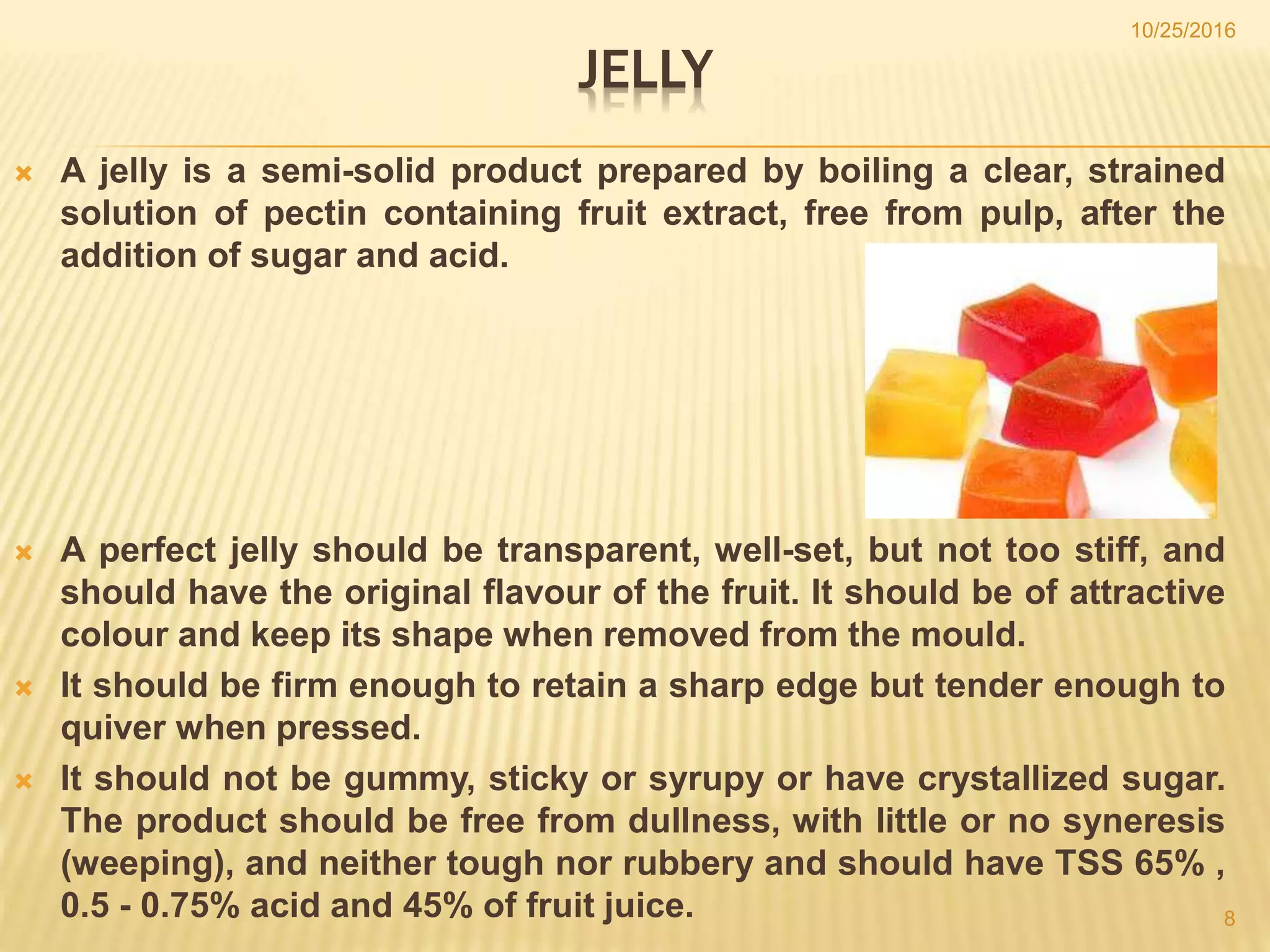
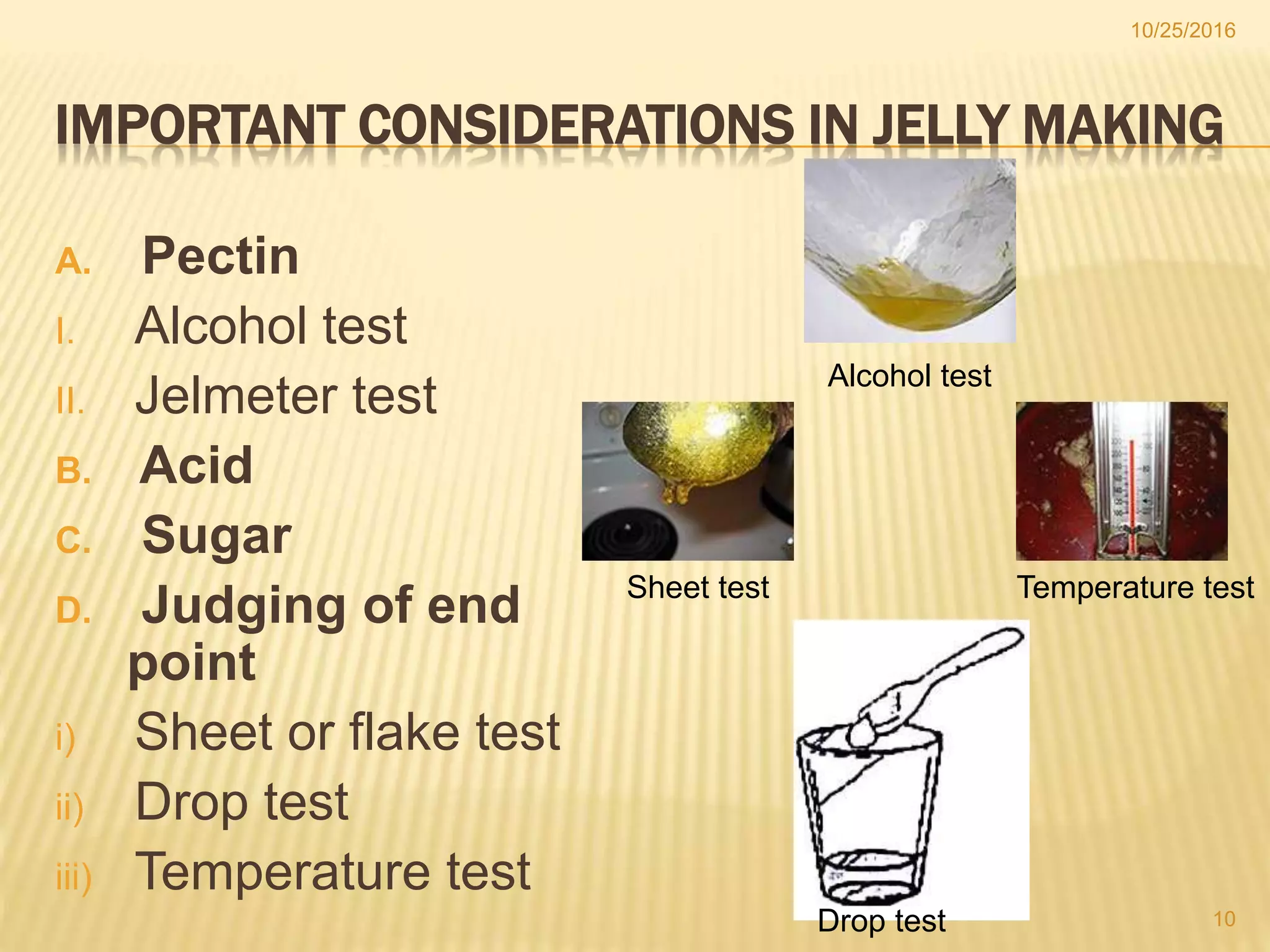
Jam, Jelly and Marmalade
Preparation
INSTITUTE OF AGRICULTURAL
SCIENCES ,
RGSC , BHU
BARKACHHA , MIRZAPUR
HOR 411 (0+4)
Guided By:
Prof. S.P. Singh
Submitted By:
Agrima
Srivastava
B. Sc. (Ag.) IVth
Yr.
10/25/2016
1
INTRODUCTION
 India is the second largest producer of fruit and vegetables in the
world. Total area under fruit and vegetable cultivation is estimated
at 12 million hectares, which is 7% of total cropped area in the
country. The commercial processing of fruit & vegetables is
approximately 2.0%. India exported processed fruits and
vegetables worth Rs. 5240 million in 1997-98.
 During 2015-16, India exported fruits and vegetables worth Rs.
8,391.41 crores which comprised of fruits worth Rs. 3,524.50
crores and vegetables worth Rs. 4,866.91 crores.
 As per the latest estimates, by (CIPHET), Ludhiana, the wastage
of fresh horticultural produce is upto 18 per cent due to poor
postharvest management practices. Hardly 2 per cent of
perishable horticultural produce is processed to value added
products.
Area
(1000ha)
Production
(1000
tonne)
Productivity
(Tonne/ha)
Fruits 6358 88819 13.97
vegetables 9541 168300 17.64
10/25/2016
2
.
JAM
 Jam is a product made by boiling fruit pulp with sufficient
sugar to a reasonably thick consistency, firm enough to
hold the fruit tissues in position .
 Apple, pear, sapota (chiku),apricot, loquat, peach,
papaya, karonda, carrot, plum, straw- berry, raspberry,
mango, tomato, grapes and muskmelon are used for
preparation of jams.
 It can be prepared from one kind of fruit or from two or
more kinds .
 Jam contains 0.5-0.6 per cent acid and sugar should not
be more than 40 percent and TSS 68%.
10/25/2016
3
Fruit/ vegetable
for 1 kg pulp
Sugar (kg) Citric acid (gm) Water (ml)
Aonla
.75 - 150
Apple .75 2.0 100
Apricot .60 1.0 100
Carrot .75 2.5 200
Grapes .70 1.0 50
Guava .75 2.5 150
Karonda .80 - 100
IN THE HOME IT CAN BE PREPARED BY USING THE RECIPES AS:
10/25/2016
4
TECHNOLOGICAL FLOW SHEET FOR PROCESSING OF JAM
Ripe firm
fruits
Washing
Peeling
Pulping
Addition
of sugar
10/25/2016
5
Boiling
Addition of citric
acid
Judging of end point by further
cooking up to 105 degree
Celsius or 68% TSS or by sheet
test
Filling hot into bottles
Cooling
Waxing
Capping
Storage
10/25/2016
6
PROBLEMS IN JAM PRODUCTION :
I. Crystallization
II. Sticky or gummy jam
III. Premature setting
IV. Surface graining and
shrinkage
V. Microbial spoilage
10/25/2016
7
JELLY
 A jelly is a semi-solid product prepared by boiling a clear, strained
solution of pectin containing fruit extract, free from pulp, after the
addition of sugar and acid.
 A perfect jelly should be transparent, well-set, but not too stiff, and
should have the original flavour of the fruit. It should be of attractive
colour and keep its shape when removed from the mould.
 It should be firm enough to retain a sharp edge but tender enough to
quiver when pressed.
 It should not be gummy, sticky or syrupy or have crystallized sugar.
The product should be free from dullness, with little or no syneresis
(weeping), and neither tough nor rubbery and should have TSS 65% ,
0.5 - 0.75% acid and 45% of fruit juice.
10/25/2016
8
IN THE HOME IT CAN BE PREPARED BY USING FOLLOWING RECIPES:
10/25/2016
9
IMPORTANT CONSIDERATIONS IN JELLY MAKING
A. Pectin
I. Alcohol test
II. Jelmeter test
B. Acid
C. Sugar
D. Judging of end
point
i) Sheet or flake test
ii) Drop test
iii) Temperature test
Drop test
Alcohol test
Sheet test Temperature test
10/25/2016
10
TECHNOLOGICAL FLOW SHEET FOR PROCESSING OF JELLY
Fruit (firm not over
ripe)
Washing
Cutting into thin slices
Boiling with water ( for
about 20-30 min )
Addition of citric acid during boiling (
2gm per kg of fruit )
Straining of extract
Pectin test ( for addition of sugar
)
10/25/2016
11
Addition of sugar
Boiling
Judging of end point
Removal of scum or foam ( 1 teaspoonful edible oil
is added for 45 kg sugar )
Colour and remaining citric
acid added )
Filling hot into bottles
Waxing
Capping
Storage at ambient
temperature
10/25/2016
12
PROBLEMS IN JELLY MAKING
1. Formation of crystals :
2. Failure to set : (i) Addition of too much sugar
(ii) Lack of acid or pectin
(iii) Cooking below the end-point
(iv) Cooking beyond the end-point
(v) Prolonged cooking
3. Cloudy or foggy jellies : (i) Use of non-clarified juice or extract
(ii) Use of immature fruits
(iii) Over-cooking
(iv) Over-cooling
(v) Non-removal of scum
(vi) Faulty pouring
(vii) Premature gelation
4. Syneresis or weeping of jelly : (i) Excess of acid
(ii) Insufficient pectin
(iii) Premature gelation
(iv) Fermentation
10/25/2016
13
MARMALADE
 This is a citrus fruit product prepared by cooking fruit pulp
or extract with sufficient amount of sugar and using shreds
of peel as suspended material.
 Marmalades are classified into :
1. Jelly marmalade
2. Jam marmalade
 The method of preparation for jam marmalade is
practically the same as that for jelly marmalade. In this
case the pectin extract of fruit is not clarified and the whole
pulp is used. Sugar is added according to the weight of
fruit, generally in the proportion of 1:1. The pulp-sugar
mixture is cooked till the TSS content reaches 65 per cent.
10/25/2016
14
PROBLEMS IN MARMALADE MAKING
 Browning during storage is very common which
can be prevented by addition of 0.09 g of KMS
per kg of marmalade and not using tin
containers. KMS dissolved in a small quantity of
water is added to the marmalade while it is
cooling. KMS also eliminates the possibility of
spoilage due to moulds.
10/25/2016
15
TECHNOLOGICAL FLOW SHEET FOR PROCESSING OF
MARMALADE
Ripe fruits
Washing
Peeling outer yellow portion ( flavedo )
Cutting yellow portion into fine shreds ( 1.9-2.5
cm long and .08 - .12 cm thick )
Boiling
Straining the extract
Testing for pectin content ( alcohol test )
Addition of sugar
10/25/2016
16
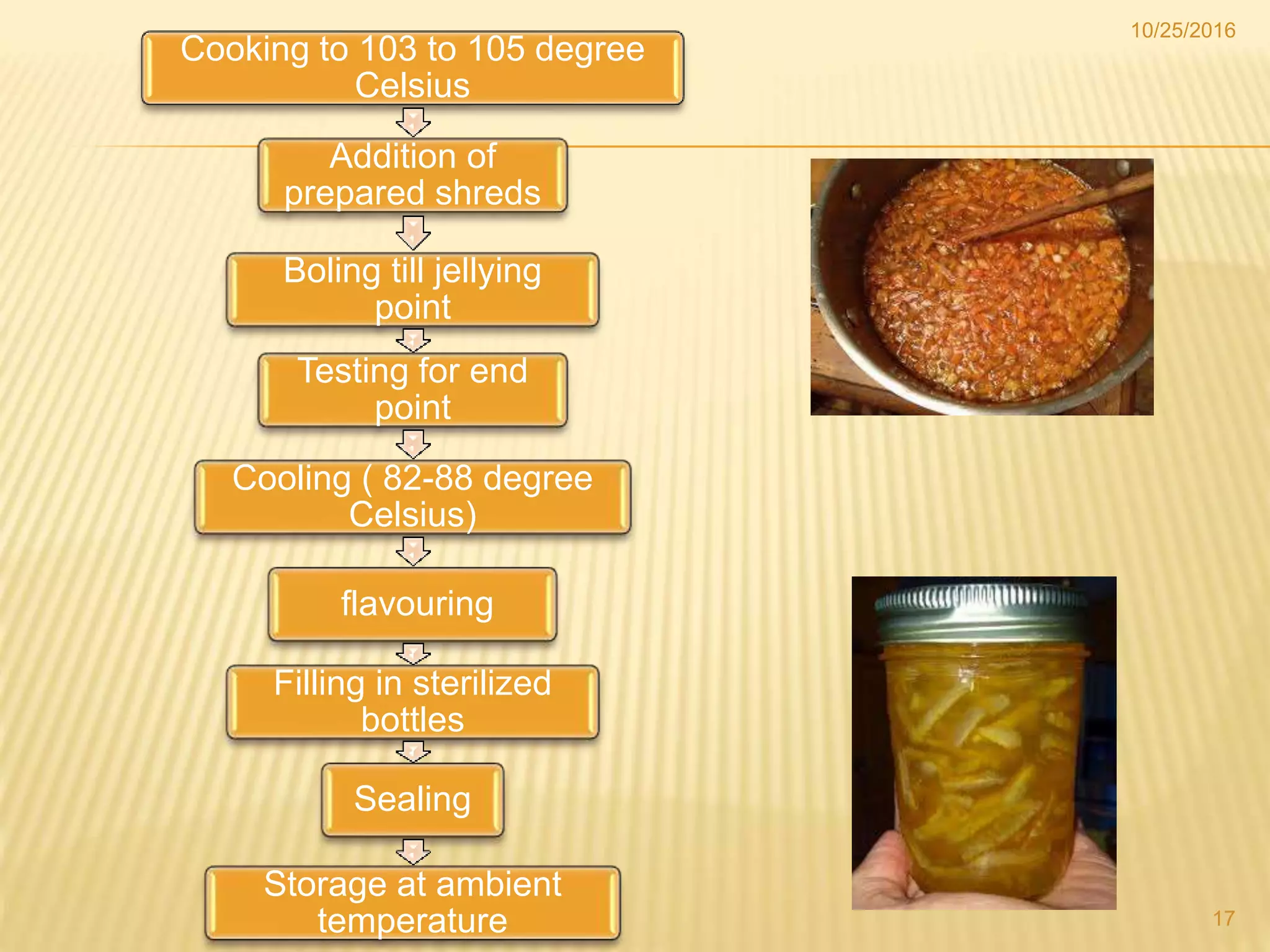
Cooking to 103 to 105 degree
Celsius
Addition of
prepared shreds
Boling till jellying
point
Testing for end
point
Cooling ( 82-88 degree
Celsius)
flavouring
Filling in sterilized
bottles
Sealing
Storage at ambient
temperature
10/25/2016
17
10/25/2016
18

Jam, jelly &marmalade

  • 1.
    Jam, Jelly andMarmalade Preparation INSTITUTE OF AGRICULTURAL SCIENCES , RGSC , BHU BARKACHHA , MIRZAPUR HOR 411 (0+4) Guided By: Prof. S.P. Singh Submitted By: Agrima Srivastava B. Sc. (Ag.) IVth Yr. 10/25/2016 1
  • 2.
    INTRODUCTION  India isthe second largest producer of fruit and vegetables in the world. Total area under fruit and vegetable cultivation is estimated at 12 million hectares, which is 7% of total cropped area in the country. The commercial processing of fruit & vegetables is approximately 2.0%. India exported processed fruits and vegetables worth Rs. 5240 million in 1997-98.  During 2015-16, India exported fruits and vegetables worth Rs. 8,391.41 crores which comprised of fruits worth Rs. 3,524.50 crores and vegetables worth Rs. 4,866.91 crores.  As per the latest estimates, by (CIPHET), Ludhiana, the wastage of fresh horticultural produce is upto 18 per cent due to poor postharvest management practices. Hardly 2 per cent of perishable horticultural produce is processed to value added products. Area (1000ha) Production (1000 tonne) Productivity (Tonne/ha) Fruits 6358 88819 13.97 vegetables 9541 168300 17.64 10/25/2016 2
  • 3.
    . JAM  Jam isa product made by boiling fruit pulp with sufficient sugar to a reasonably thick consistency, firm enough to hold the fruit tissues in position .  Apple, pear, sapota (chiku),apricot, loquat, peach, papaya, karonda, carrot, plum, straw- berry, raspberry, mango, tomato, grapes and muskmelon are used for preparation of jams.  It can be prepared from one kind of fruit or from two or more kinds .  Jam contains 0.5-0.6 per cent acid and sugar should not be more than 40 percent and TSS 68%. 10/25/2016 3
  • 4.
    Fruit/ vegetable for 1kg pulp Sugar (kg) Citric acid (gm) Water (ml) Aonla .75 - 150 Apple .75 2.0 100 Apricot .60 1.0 100 Carrot .75 2.5 200 Grapes .70 1.0 50 Guava .75 2.5 150 Karonda .80 - 100 IN THE HOME IT CAN BE PREPARED BY USING THE RECIPES AS: 10/25/2016 4
  • 5.
    TECHNOLOGICAL FLOW SHEETFOR PROCESSING OF JAM Ripe firm fruits Washing Peeling Pulping Addition of sugar 10/25/2016 5
  • 6.
    Boiling Addition of citric acid Judgingof end point by further cooking up to 105 degree Celsius or 68% TSS or by sheet test Filling hot into bottles Cooling Waxing Capping Storage 10/25/2016 6
  • 7.
    PROBLEMS IN JAMPRODUCTION : I. Crystallization II. Sticky or gummy jam III. Premature setting IV. Surface graining and shrinkage V. Microbial spoilage 10/25/2016 7
  • 8.
    JELLY  A jellyis a semi-solid product prepared by boiling a clear, strained solution of pectin containing fruit extract, free from pulp, after the addition of sugar and acid.  A perfect jelly should be transparent, well-set, but not too stiff, and should have the original flavour of the fruit. It should be of attractive colour and keep its shape when removed from the mould.  It should be firm enough to retain a sharp edge but tender enough to quiver when pressed.  It should not be gummy, sticky or syrupy or have crystallized sugar. The product should be free from dullness, with little or no syneresis (weeping), and neither tough nor rubbery and should have TSS 65% , 0.5 - 0.75% acid and 45% of fruit juice. 10/25/2016 8
  • 9.
    IN THE HOMEIT CAN BE PREPARED BY USING FOLLOWING RECIPES: 10/25/2016 9
  • 10.
    IMPORTANT CONSIDERATIONS INJELLY MAKING A. Pectin I. Alcohol test II. Jelmeter test B. Acid C. Sugar D. Judging of end point i) Sheet or flake test ii) Drop test iii) Temperature test Drop test Alcohol test Sheet test Temperature test 10/25/2016 10
  • 11.
    TECHNOLOGICAL FLOW SHEETFOR PROCESSING OF JELLY Fruit (firm not over ripe) Washing Cutting into thin slices Boiling with water ( for about 20-30 min ) Addition of citric acid during boiling ( 2gm per kg of fruit ) Straining of extract Pectin test ( for addition of sugar ) 10/25/2016 11
  • 12.
    Addition of sugar Boiling Judgingof end point Removal of scum or foam ( 1 teaspoonful edible oil is added for 45 kg sugar ) Colour and remaining citric acid added ) Filling hot into bottles Waxing Capping Storage at ambient temperature 10/25/2016 12
  • 13.
    PROBLEMS IN JELLYMAKING 1. Formation of crystals : 2. Failure to set : (i) Addition of too much sugar (ii) Lack of acid or pectin (iii) Cooking below the end-point (iv) Cooking beyond the end-point (v) Prolonged cooking 3. Cloudy or foggy jellies : (i) Use of non-clarified juice or extract (ii) Use of immature fruits (iii) Over-cooking (iv) Over-cooling (v) Non-removal of scum (vi) Faulty pouring (vii) Premature gelation 4. Syneresis or weeping of jelly : (i) Excess of acid (ii) Insufficient pectin (iii) Premature gelation (iv) Fermentation 10/25/2016 13
  • 14.
    MARMALADE  This isa citrus fruit product prepared by cooking fruit pulp or extract with sufficient amount of sugar and using shreds of peel as suspended material.  Marmalades are classified into : 1. Jelly marmalade 2. Jam marmalade  The method of preparation for jam marmalade is practically the same as that for jelly marmalade. In this case the pectin extract of fruit is not clarified and the whole pulp is used. Sugar is added according to the weight of fruit, generally in the proportion of 1:1. The pulp-sugar mixture is cooked till the TSS content reaches 65 per cent. 10/25/2016 14
  • 15.
    PROBLEMS IN MARMALADEMAKING  Browning during storage is very common which can be prevented by addition of 0.09 g of KMS per kg of marmalade and not using tin containers. KMS dissolved in a small quantity of water is added to the marmalade while it is cooling. KMS also eliminates the possibility of spoilage due to moulds. 10/25/2016 15
  • 16.
    TECHNOLOGICAL FLOW SHEETFOR PROCESSING OF MARMALADE Ripe fruits Washing Peeling outer yellow portion ( flavedo ) Cutting yellow portion into fine shreds ( 1.9-2.5 cm long and .08 - .12 cm thick ) Boiling Straining the extract Testing for pectin content ( alcohol test ) Addition of sugar 10/25/2016 16
  • 17.
    Cooking to 103to 105 degree Celsius Addition of prepared shreds Boling till jellying point Testing for end point Cooling ( 82-88 degree Celsius) flavouring Filling in sterilized bottles Sealing Storage at ambient temperature 10/25/2016 17
  • 18.