1
25-10-2016
“LITCHI PRODUCTION FOR EXPORT
MARKET”
B.Sc.(Ag.) 4th Yr., INSTITUTE OF AGRICULTURE SCIENCES, BHU
Course code:-RAWE-411
Course title:-Rural Agriculture Work
Experience
Credit hour:-(0+4)
PRESENTATION ON2
25-10-2016
Contents:
Botanical description.
Importance & Distribution.
Export oriented Varieties.
Climate & Soil.
Production Technology.
Protection Technology.
Post Production Processes. 25-10-2016
3
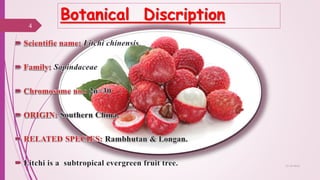
Botanical Discription
4
25-10-2016
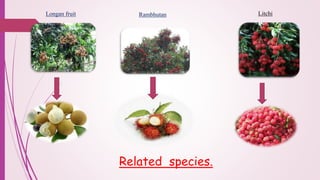
Longan fruit Rambhutan Litchi
Related species.
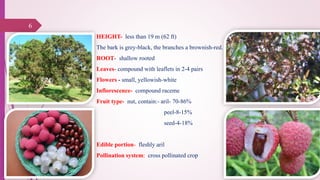
HEIGHT- less than 19 m (62 ft)
The bark is grey-black, the branches a brownish-red.
ROOT- shallow rooted
Leaves- compound with leaflets in 2-4 pairs
Flowers - small, yellowish-white
Inflorescence- compound raceme
Fruit type- nut, contain:- aril- 70-86%
peel-8-15%
seed-4-18%
Edible portion- fleshly aril
Pollination system: cross pollinated crop
6
25-10-2016
IMPORTANCE & DISTRIBUTION
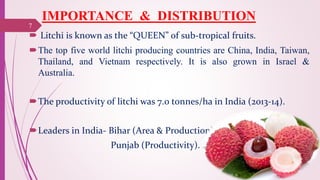
 Litchi is known as the “QUEEN” of sub-tropical fruits.
The top five world litchi producing countries are China, India, Taiwan,
Thailand, and Vietnam respectively. It is also grown in Israel &
Australia.
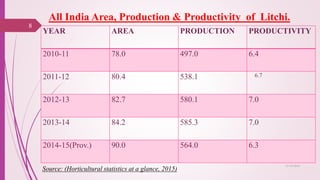
The productivity of litchi was 7.0 tonnes/ha in India (2013-14).
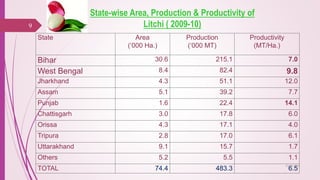
Leaders in India- Bihar (Area & Production)
Punjab (Productivity).
25-10-2016
7
8
25-10-2016
YEAR AREA PRODUCTION PRODUCTIVITY
2010-11 78.0 497.0 6.4
2011-12 80.4 538.1 6.7
2012-13 82.7 580.1 7.0
2013-14 84.2 585.3 7.0
2014-15(Prov.) 90.0 564.0 6.3
All India Area, Production & Productivity of Litchi.
Source: (Horticultural statistics at a glance, 2015)
State Area
(‘000 Ha.)
Production
(‘000 MT)
Productivity
(MT/Ha.)
Bihar 30.6 215.1 7.0
West Bengal 8.4 82.4 9.8
Jharkhand 4.3 51.1 12.0
Assam 5.1 39.2 7.7
Punjab 1.6 22.4 14.1
Chattisgarh 3.0 17.8 6.0
Orissa 4.3 17.1 4.0
Tripura 2.8 17.0 6.1
Uttarakhand 9.1 15.7 1.7
Others 5.2 5.5 1.1
TOTAL 74.4 483.3 6.5
State-wise Area, Production & Productivity of
Litchi ( 2009-10)9
25-10-2016
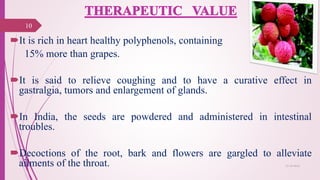
It is rich in heart healthy polyphenols, containing
15% more than grapes.
It is said to relieve coughing and to have a curative effect in
gastralgia, tumors and enlargement of glands.
In India, the seeds are powdered and administered in intestinal
troubles.
Decoctions of the root, bark and flowers are gargled to alleviate
ailments of the throat.
10
25-10-2016
NUTRITIVE VALUE
11
25-10-2016
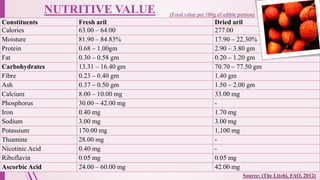
Constituents Fresh aril Dried aril
Calories 63.00 – 64.00 277.00
Moisture 81.90 – 84.83% 17.90 – 22.30%
Protein 0.68 – 1.00gm 2.90 – 3.80 gm
Fat 0.30 – 0.58 gm 0.20 – 1.20 gm
Carbohydrates 13.31 – 16.40 gm 70.70 – 77.50 gm
Fibre 0.23 – 0.40 gm 1.40 gm
Ash 0.37 – 0.50 gm 1.50 – 2.00 gm
Calcium 8.00 – 10.00 mg 33.00 mg
Phosphorus 30.00 – 42.00 mg -
Iron 0.40 mg 1.70 mg
Sodium 3.00 mg 3.00 mg
Potassium 170.00 mg 1,100 mg
Thiamine 28.00 mg -
Nicotinic Acid 0.40 mg -
Riboflavin 0.05 mg 0.05 mg
Ascorbic Acid 24.00 – 60.00 mg 42.00 mg
(Food value per 100g of edible portion)
Source: (The Litchi, FAO, 2012)
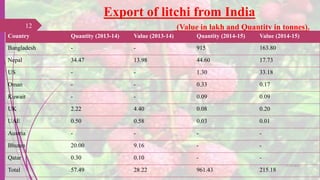
Export of litchi from India
(Value in lakh and Quantity in tonnes).
Country Quantity (2013-14) Value (2013-14) Quantity (2014-15) Value (2014-15)
Bangladesh - - 915 163.80
Nepal 34.47 13.98 44.60 17.73
US - - 1.30 33.18
Oman - - 0.33 0.17
Kuwait - - 0.09 0.09
UK 2.22 4.40 0.08 0.20
UAE 0.50 0.58 0.03 0.01
Austria - - - -
Bhutan 20.00 9.16 - -
Qatar 0.30 0.10 - -
Total 57.49 28.22 961.43 215.18
25-10-2016
12
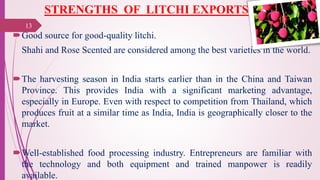
STRENGTHS OF LITCHI EXPORTS
Good source for good-quality litchi.
Shahi and Rose Scented are considered among the best varieties in the world.
The harvesting season in India starts earlier than in the China and Taiwan
Province. This provides India with a significant marketing advantage,
especially in Europe. Even with respect to competition from Thailand, which
produces fruit at a similar time as India, India is geographically closer to the
market.
Well-established food processing industry. Entrepreneurs are familiar with
the technology and both equipment and trained manpower is readily
available.
25-10-2016
13
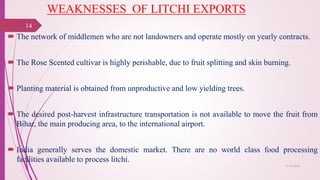
WEAKNESSES OF LITCHI EXPORTS
 The network of middlemen who are not landowners and operate mostly on yearly contracts.
 The Rose Scented cultivar is highly perishable, due to fruit splitting and skin burning.
 Planting material is obtained from unproductive and low yielding trees.
 The desired post-harvest infrastructure transportation is not available to move the fruit from
Bihar, the main producing area, to the international airport.
 India generally serves the domestic market. There are no world class food processing
facilities available to process litchi.
25-10-2016
14
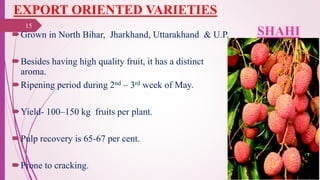
EXPORT ORIENTED VARIETIES
Grown in North Bihar, Jharkhand, Uttarakhand & U.P.
Besides having high quality fruit, it has a distinct
aroma.
Ripening period during 2nd – 3rd week of May.
Yield- 100–150 kg fruits per plant.
Pulp recovery is 65-67 per cent.
Prone to cracking. 25-10-2016
15
SHAHI
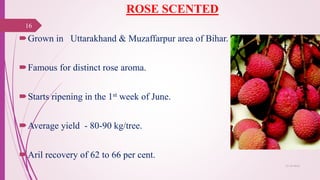
ROSE SCENTED
Grown in Uttarakhand & Muzaffarpur area of Bihar.
Famous for distinct rose aroma.
Starts ripening in the 1st week of June.
Average yield - 80-90 kg/tree.
Aril recovery of 62 to 66 per cent.
25-10-2016
16
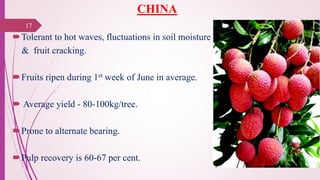
CHINA
Tolerant to hot waves, fluctuations in soil moisture
& fruit cracking.
Fruits ripen during 1st week of June in average.
 Average yield - 80-100kg/tree.
Prone to alternate bearing.
Pulp recovery is 60-67 per cent.
25-10-2016
17
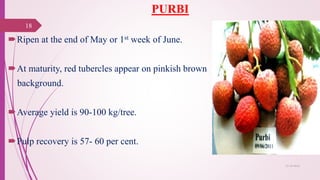
PURBI
Ripen at the end of May or 1st week of June.
At maturity, red tubercles appear on pinkish brown
background.
Average yield is 90-100 kg/tree.
Pulp recovery is 57- 60 per cent.
25-10-2016
18
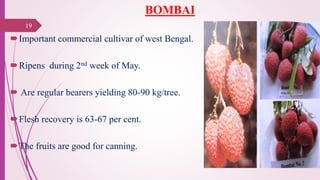
BOMBAI
Important commercial cultivar of west Bengal.
Ripens during 2nd week of May.
 Are regular bearers yielding 80-90 kg/tree.
Flesh recovery is 63-67 per cent.
The fruits are good for canning.
25-10-2016
19
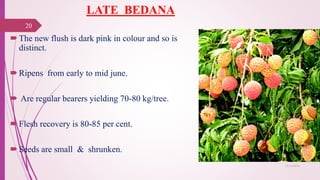
LATE BEDANA
The new flush is dark pink in colour and so is
distinct.
Ripens from early to mid june.
 Are regular bearers yielding 70-80 kg/tree.
Flesh recovery is 80-85 per cent.
Seeds are small & shrunken.
25-10-2016
20
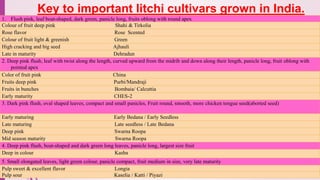
Key to important litchi cultivars grown in India.
25-10-2016
21
1. Flush pink, leaf boat-shaped, dark green, panicle long, fruits oblong with round apex
Colour of fruit deep pink Shahi & Tirkolia
Rose flavor Rose Scented
Colour of fruit light & greenish Green
High cracking and big seed Ajhauli
Late in maturity Dehradun
2. Deep pink flush, leaf with twist along the length, curved upward from the midrib and down along their length, panicle long, fruit oblong with
pointed apex
Color of fruit pink China
Fruits deep pink Purbi/Mandraji
Fruits in bunches Bombaia/ Calcuttia
Early maturity CHES-2
3. Dark pink flush, oval shaped leaves, compact and small panicles, Fruit round, smooth, more chicken tongue seed(aborted seed)
Early maturing Early Bedana / Early Seedless
Late maturing Late seedless / Late Bedana
Deep pink Swarna Roopa
Mid season maturity Swarna Roopa
4. Deep pink flush, boat-shaped and dark green long leaves, panicle long, largest size fruit
Deep in colour Kasba
5. Small elongated leaves, light green colour, panicle compact, fruit medium in size, very late maturity
Pulp sweet & excellent flavor Longia
Pulp sour Kaselia / Katti / Piyazi
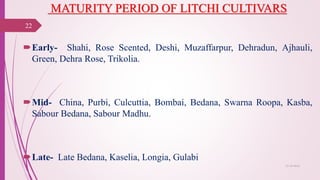
MATURITY PERIOD OF LITCHI CULTIVARS
Early- Shahi, Rose Scented, Deshi, Muzaffarpur, Dehradun, Ajhauli,
Green, Dehra Rose, Trikolia.
Mid- China, Purbi, Culcuttia, Bombai, Bedana, Swarna Roopa, Kasba,
Sabour Bedana, Sabour Madhu.
Late- Late Bedana, Kaselia, Longia, Gulabi
25-10-2016
22
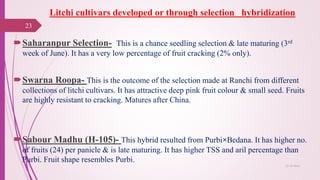
Litchi cultivars developed or through selection hybridization
Saharanpur Selection- This is a chance seedling selection & late maturing (3rd
week of June). It has a very low percentage of fruit cracking (2% only).
Swarna Roopa- This is the outcome of the selection made at Ranchi from different
collections of litchi cultivars. It has attractive deep pink fruit colour & small seed. Fruits
are highly resistant to cracking. Matures after China.
Sabour Madhu (H-105)- This hybrid resulted from Purbi×Bedana. It has higher no.
of fruits (24) per panicle & is late maturing. It has higher TSS and aril percentage than
Purbi. Fruit shape resembles Purbi.
25-10-2016
23
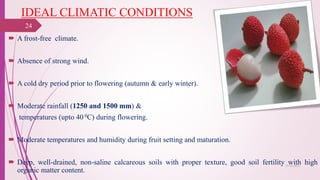
IDEAL CLIMATIC CONDITIONS
 A frost-free climate.
 Absence of strong wind.
 A cold dry period prior to flowering (autumn & early winter).
 Moderate rainfall (1250 and 1500 mm) &
temperatures (upto 40 0C) during flowering.
 Moderate temperatures and humidity during fruit setting and maturation.
 Deep, well-drained, non-saline calcareous soils with proper texture, good soil fertility with high
organic matter content.
25-10-2016
24
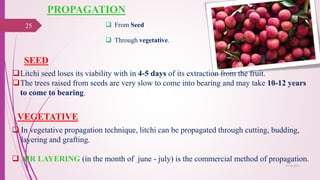
PROPAGATION
 From Seed
 Through vegetative.
Litchi seed loses its viability with in 4-5 days of its extraction from the fruit.
The trees raised from seeds are very slow to come into bearing and may take 10-12 years
to come to bearing.
 In vegetative propagation technique, litchi can be propagated through cutting, budding,
layering and grafting.
 AIR LAYERING (in the month of june - july) is the commercial method of propagation.
SEED
VEGETATIVE
25
25-10-2016
Details Usual Practice
Planting Time • August – September
• Planting may be done in spring and early summer if irrigation facility is available
Planting Distance • 10×8m. 5×5m. (HDP)
• Average no. of plants- 200 per ha.
Size of pits • 1x1x1 m (pits are dug a few weeks prior to planting)
Filling of pits • Pits are left undisturbed initially for a period of 15-20 days.
• Filled with top soil mixed with manures and fertilizers @ 20-25 kg FYM, 2 kg bone
meal and 300 g MOP per pit.
Planting • Square system of planting is usually followed, Hedge row system (HDP).
• A small hole is made at the center of the pit and the desired material is planted.
Water is applied immediately after planting
26
25-10-2016
27
25-10-2016
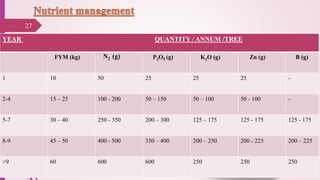
YEAR QUANTITY / ANNUM /TREE
FYM (kg) N2 (g) P2O5 (g) K2O (g) Zn (g) B (g)
1 10 50 25 25 25 -
2-4 15 – 25 100 - 200 50 – 150 50 – 100 50 - 100 -
5-7 30 – 40 250 - 350 200 – 300 125 – 175 125 - 175 125 - 175
8-9 45 – 50 400 - 500 350 – 400 200 – 250 200 - 225 200 – 225
>9 60 600 600 250 250 250
Methods- Basin or ring system of irrigation is recommended.
Two irrigations at an interval of 45 – 60 days during winter months is
required for bearing litchi trees.
The trees are irrigated from flowering onwards until the completion of the
post-harvest flush. However, the growers normally irrigate the tree at 7 to 10
day intervals from panicle emergence to fruit harvest or until the post-harvest
flush appears.
Irrigation28
25-10-2016
Intercultural Operations
Mulching- The farmyard manure,
compost or straw may be used for
soil mulching.
Cutting down of tall growing
weeds in the orchard and spreading
them over the soil is another
method of mulching the soil.
Training & Pruning- After
planting, a certain amount of
pruning is often necessary to give
proper shape to the litchi plant.
Once the desired shape is achieved,
no pruning is usually necessary,
except the removal of dead or
diseased branches.
29
25-10-2016
Plant Protection Measures
Diseases
30
25-10-2016
Anthracnose-
• Pruning &burning.
• Spray of 3:3:50
Bordeaux mixture.
Red Rust
•Pruning &burning.
•Copper oxychloride
@0.3 per cent.
.
Fruit Rot
• Low temperature storage.
•Hot benomyl dips at 48° to
52°C.
Physiological Disorders
Sunburning & Fruit cracking-
1. Adequate irrigation.
2. Treatment with 2,4-D @ 10 ppm or Gibberellic acid (GA) @20 ppm.
Flower and fruit drop- 1. Spraying of ZnSO4 @ 0.2% at 30 days
before panicle emergence.
2. Foliar application of 0.2% Boron, 2-3 times
during the period of fruit growth.
 Pericarp browning- 1. Packing fruit into moisture-proof (plastic) bags.
2. Cool temperature storage & SO2 fumigation.
31
25-10-2016
Pest control32
25-10-2016
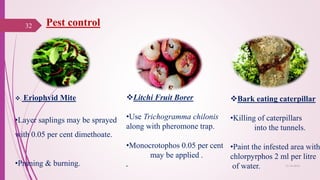
. Eriophyid Mite
•Layer saplings may be sprayed
with 0.05 per cent dimethoate.
•Pruning & burning.
Litchi Fruit Borer
•Use Trichogramma chilonis
along with pheromone trap.
•Monocrotophos 0.05 per cent
may be applied .
Bark eating caterpillar
•Killing of caterpillars
into the tunnels.
•Paint the infested area with
chlorpyrphos 2 ml per litre
of water.
Harvesting
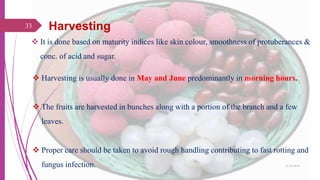
 It is done based on maturity indices like skin colour, smoothness of protuberances &
conc. of acid and sugar.
 Harvesting is usually done in May and June predominantly in morning hours.
 The fruits are harvested in bunches along with a portion of the branch and a few
leaves.
 Proper care should be taken to avoid rough handling contributing to fast rotting and
fungus infection.
33
25-10-2016
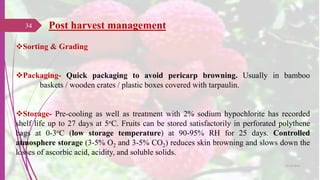
Sorting & Grading
Packaging- Quick packaging to avoid pericarp browning. Usually in bamboo
baskets / wooden crates / plastic boxes covered with tarpaulin.
Storage- Pre-cooling as well as treatment with 2% sodium hypochlorite has recorded
shelf life up to 27 days at 5oC. Fruits can be stored satisfactorily in perforated polythene
bags at 0-3oC (low storage temperature) at 90-95% RH for 25 days. Controlled
atmosphere storage (3-5% O2 and 3-5% CO2) reduces skin browning and slows down the
losses of ascorbic acid, acidity, and soluble solids.
Post harvest management34
25-10-2016
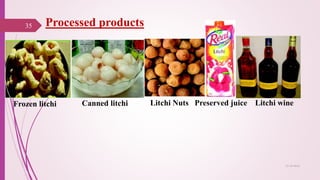
Processed products
25-10-2016
35
Frozen litchi Canned litchi Litchi Nuts Preserved juice Litchi wine
36
25-10-2016

Litchi production for export market

  • 1.
  • 2.
    “LITCHI PRODUCTION FOREXPORT MARKET” B.Sc.(Ag.) 4th Yr., INSTITUTE OF AGRICULTURE SCIENCES, BHU Course code:-RAWE-411 Course title:-Rural Agriculture Work Experience Credit hour:-(0+4) PRESENTATION ON2 25-10-2016
  • 3.
    Contents: Botanical description. Importance &Distribution. Export oriented Varieties. Climate & Soil. Production Technology. Protection Technology. Post Production Processes. 25-10-2016 3
  • 4.
  • 5.
    Longan fruit RambhutanLitchi Related species.
  • 6.
    HEIGHT- less than19 m (62 ft) The bark is grey-black, the branches a brownish-red. ROOT- shallow rooted Leaves- compound with leaflets in 2-4 pairs Flowers - small, yellowish-white Inflorescence- compound raceme Fruit type- nut, contain:- aril- 70-86% peel-8-15% seed-4-18% Edible portion- fleshly aril Pollination system: cross pollinated crop 6 25-10-2016
  • 7.
    IMPORTANCE & DISTRIBUTION Litchi is known as the “QUEEN” of sub-tropical fruits. The top five world litchi producing countries are China, India, Taiwan, Thailand, and Vietnam respectively. It is also grown in Israel & Australia. The productivity of litchi was 7.0 tonnes/ha in India (2013-14). Leaders in India- Bihar (Area & Production) Punjab (Productivity). 25-10-2016 7
  • 8.
    8 25-10-2016 YEAR AREA PRODUCTIONPRODUCTIVITY 2010-11 78.0 497.0 6.4 2011-12 80.4 538.1 6.7 2012-13 82.7 580.1 7.0 2013-14 84.2 585.3 7.0 2014-15(Prov.) 90.0 564.0 6.3 All India Area, Production & Productivity of Litchi. Source: (Horticultural statistics at a glance, 2015)
  • 9.
    State Area (‘000 Ha.) Production (‘000MT) Productivity (MT/Ha.) Bihar 30.6 215.1 7.0 West Bengal 8.4 82.4 9.8 Jharkhand 4.3 51.1 12.0 Assam 5.1 39.2 7.7 Punjab 1.6 22.4 14.1 Chattisgarh 3.0 17.8 6.0 Orissa 4.3 17.1 4.0 Tripura 2.8 17.0 6.1 Uttarakhand 9.1 15.7 1.7 Others 5.2 5.5 1.1 TOTAL 74.4 483.3 6.5 State-wise Area, Production & Productivity of Litchi ( 2009-10)9 25-10-2016
  • 10.
    It is richin heart healthy polyphenols, containing 15% more than grapes. It is said to relieve coughing and to have a curative effect in gastralgia, tumors and enlargement of glands. In India, the seeds are powdered and administered in intestinal troubles. Decoctions of the root, bark and flowers are gargled to alleviate ailments of the throat. 10 25-10-2016
  • 11.
    NUTRITIVE VALUE 11 25-10-2016 Constituents Fresharil Dried aril Calories 63.00 – 64.00 277.00 Moisture 81.90 – 84.83% 17.90 – 22.30% Protein 0.68 – 1.00gm 2.90 – 3.80 gm Fat 0.30 – 0.58 gm 0.20 – 1.20 gm Carbohydrates 13.31 – 16.40 gm 70.70 – 77.50 gm Fibre 0.23 – 0.40 gm 1.40 gm Ash 0.37 – 0.50 gm 1.50 – 2.00 gm Calcium 8.00 – 10.00 mg 33.00 mg Phosphorus 30.00 – 42.00 mg - Iron 0.40 mg 1.70 mg Sodium 3.00 mg 3.00 mg Potassium 170.00 mg 1,100 mg Thiamine 28.00 mg - Nicotinic Acid 0.40 mg - Riboflavin 0.05 mg 0.05 mg Ascorbic Acid 24.00 – 60.00 mg 42.00 mg (Food value per 100g of edible portion) Source: (The Litchi, FAO, 2012)
  • 12.
    Export of litchifrom India (Value in lakh and Quantity in tonnes). Country Quantity (2013-14) Value (2013-14) Quantity (2014-15) Value (2014-15) Bangladesh - - 915 163.80 Nepal 34.47 13.98 44.60 17.73 US - - 1.30 33.18 Oman - - 0.33 0.17 Kuwait - - 0.09 0.09 UK 2.22 4.40 0.08 0.20 UAE 0.50 0.58 0.03 0.01 Austria - - - - Bhutan 20.00 9.16 - - Qatar 0.30 0.10 - - Total 57.49 28.22 961.43 215.18 25-10-2016 12
  • 13.
    STRENGTHS OF LITCHIEXPORTS Good source for good-quality litchi. Shahi and Rose Scented are considered among the best varieties in the world. The harvesting season in India starts earlier than in the China and Taiwan Province. This provides India with a significant marketing advantage, especially in Europe. Even with respect to competition from Thailand, which produces fruit at a similar time as India, India is geographically closer to the market. Well-established food processing industry. Entrepreneurs are familiar with the technology and both equipment and trained manpower is readily available. 25-10-2016 13
  • 14.
    WEAKNESSES OF LITCHIEXPORTS  The network of middlemen who are not landowners and operate mostly on yearly contracts.  The Rose Scented cultivar is highly perishable, due to fruit splitting and skin burning.  Planting material is obtained from unproductive and low yielding trees.  The desired post-harvest infrastructure transportation is not available to move the fruit from Bihar, the main producing area, to the international airport.  India generally serves the domestic market. There are no world class food processing facilities available to process litchi. 25-10-2016 14
  • 15.
    EXPORT ORIENTED VARIETIES Grownin North Bihar, Jharkhand, Uttarakhand & U.P. Besides having high quality fruit, it has a distinct aroma. Ripening period during 2nd – 3rd week of May. Yield- 100–150 kg fruits per plant. Pulp recovery is 65-67 per cent. Prone to cracking. 25-10-2016 15 SHAHI
  • 16.
    ROSE SCENTED Grown inUttarakhand & Muzaffarpur area of Bihar. Famous for distinct rose aroma. Starts ripening in the 1st week of June. Average yield - 80-90 kg/tree. Aril recovery of 62 to 66 per cent. 25-10-2016 16
  • 17.
    CHINA Tolerant to hotwaves, fluctuations in soil moisture & fruit cracking. Fruits ripen during 1st week of June in average.  Average yield - 80-100kg/tree. Prone to alternate bearing. Pulp recovery is 60-67 per cent. 25-10-2016 17
  • 18.
    PURBI Ripen at theend of May or 1st week of June. At maturity, red tubercles appear on pinkish brown background. Average yield is 90-100 kg/tree. Pulp recovery is 57- 60 per cent. 25-10-2016 18
  • 19.
    BOMBAI Important commercial cultivarof west Bengal. Ripens during 2nd week of May.  Are regular bearers yielding 80-90 kg/tree. Flesh recovery is 63-67 per cent. The fruits are good for canning. 25-10-2016 19
  • 20.
    LATE BEDANA The newflush is dark pink in colour and so is distinct. Ripens from early to mid june.  Are regular bearers yielding 70-80 kg/tree. Flesh recovery is 80-85 per cent. Seeds are small & shrunken. 25-10-2016 20
  • 21.
    Key to importantlitchi cultivars grown in India. 25-10-2016 21 1. Flush pink, leaf boat-shaped, dark green, panicle long, fruits oblong with round apex Colour of fruit deep pink Shahi & Tirkolia Rose flavor Rose Scented Colour of fruit light & greenish Green High cracking and big seed Ajhauli Late in maturity Dehradun 2. Deep pink flush, leaf with twist along the length, curved upward from the midrib and down along their length, panicle long, fruit oblong with pointed apex Color of fruit pink China Fruits deep pink Purbi/Mandraji Fruits in bunches Bombaia/ Calcuttia Early maturity CHES-2 3. Dark pink flush, oval shaped leaves, compact and small panicles, Fruit round, smooth, more chicken tongue seed(aborted seed) Early maturing Early Bedana / Early Seedless Late maturing Late seedless / Late Bedana Deep pink Swarna Roopa Mid season maturity Swarna Roopa 4. Deep pink flush, boat-shaped and dark green long leaves, panicle long, largest size fruit Deep in colour Kasba 5. Small elongated leaves, light green colour, panicle compact, fruit medium in size, very late maturity Pulp sweet & excellent flavor Longia Pulp sour Kaselia / Katti / Piyazi
  • 22.
    MATURITY PERIOD OFLITCHI CULTIVARS Early- Shahi, Rose Scented, Deshi, Muzaffarpur, Dehradun, Ajhauli, Green, Dehra Rose, Trikolia. Mid- China, Purbi, Culcuttia, Bombai, Bedana, Swarna Roopa, Kasba, Sabour Bedana, Sabour Madhu. Late- Late Bedana, Kaselia, Longia, Gulabi 25-10-2016 22
  • 23.
    Litchi cultivars developedor through selection hybridization Saharanpur Selection- This is a chance seedling selection & late maturing (3rd week of June). It has a very low percentage of fruit cracking (2% only). Swarna Roopa- This is the outcome of the selection made at Ranchi from different collections of litchi cultivars. It has attractive deep pink fruit colour & small seed. Fruits are highly resistant to cracking. Matures after China. Sabour Madhu (H-105)- This hybrid resulted from Purbi×Bedana. It has higher no. of fruits (24) per panicle & is late maturing. It has higher TSS and aril percentage than Purbi. Fruit shape resembles Purbi. 25-10-2016 23
  • 24.
    IDEAL CLIMATIC CONDITIONS A frost-free climate.  Absence of strong wind.  A cold dry period prior to flowering (autumn & early winter).  Moderate rainfall (1250 and 1500 mm) & temperatures (upto 40 0C) during flowering.  Moderate temperatures and humidity during fruit setting and maturation.  Deep, well-drained, non-saline calcareous soils with proper texture, good soil fertility with high organic matter content. 25-10-2016 24
  • 25.
    PROPAGATION  From Seed Through vegetative. Litchi seed loses its viability with in 4-5 days of its extraction from the fruit. The trees raised from seeds are very slow to come into bearing and may take 10-12 years to come to bearing.  In vegetative propagation technique, litchi can be propagated through cutting, budding, layering and grafting.  AIR LAYERING (in the month of june - july) is the commercial method of propagation. SEED VEGETATIVE 25 25-10-2016
  • 26.
    Details Usual Practice PlantingTime • August – September • Planting may be done in spring and early summer if irrigation facility is available Planting Distance • 10×8m. 5×5m. (HDP) • Average no. of plants- 200 per ha. Size of pits • 1x1x1 m (pits are dug a few weeks prior to planting) Filling of pits • Pits are left undisturbed initially for a period of 15-20 days. • Filled with top soil mixed with manures and fertilizers @ 20-25 kg FYM, 2 kg bone meal and 300 g MOP per pit. Planting • Square system of planting is usually followed, Hedge row system (HDP). • A small hole is made at the center of the pit and the desired material is planted. Water is applied immediately after planting 26 25-10-2016
  • 27.
    27 25-10-2016 YEAR QUANTITY /ANNUM /TREE FYM (kg) N2 (g) P2O5 (g) K2O (g) Zn (g) B (g) 1 10 50 25 25 25 - 2-4 15 – 25 100 - 200 50 – 150 50 – 100 50 - 100 - 5-7 30 – 40 250 - 350 200 – 300 125 – 175 125 - 175 125 - 175 8-9 45 – 50 400 - 500 350 – 400 200 – 250 200 - 225 200 – 225 >9 60 600 600 250 250 250
  • 28.
    Methods- Basin orring system of irrigation is recommended. Two irrigations at an interval of 45 – 60 days during winter months is required for bearing litchi trees. The trees are irrigated from flowering onwards until the completion of the post-harvest flush. However, the growers normally irrigate the tree at 7 to 10 day intervals from panicle emergence to fruit harvest or until the post-harvest flush appears. Irrigation28 25-10-2016
  • 29.
    Intercultural Operations Mulching- Thefarmyard manure, compost or straw may be used for soil mulching. Cutting down of tall growing weeds in the orchard and spreading them over the soil is another method of mulching the soil. Training & Pruning- After planting, a certain amount of pruning is often necessary to give proper shape to the litchi plant. Once the desired shape is achieved, no pruning is usually necessary, except the removal of dead or diseased branches. 29 25-10-2016
  • 30.
    Plant Protection Measures Diseases 30 25-10-2016 Anthracnose- •Pruning &burning. • Spray of 3:3:50 Bordeaux mixture. Red Rust •Pruning &burning. •Copper oxychloride @0.3 per cent. . Fruit Rot • Low temperature storage. •Hot benomyl dips at 48° to 52°C.
  • 31.
    Physiological Disorders Sunburning &Fruit cracking- 1. Adequate irrigation. 2. Treatment with 2,4-D @ 10 ppm or Gibberellic acid (GA) @20 ppm. Flower and fruit drop- 1. Spraying of ZnSO4 @ 0.2% at 30 days before panicle emergence. 2. Foliar application of 0.2% Boron, 2-3 times during the period of fruit growth.  Pericarp browning- 1. Packing fruit into moisture-proof (plastic) bags. 2. Cool temperature storage & SO2 fumigation. 31 25-10-2016
  • 32.
    Pest control32 25-10-2016 . EriophyidMite •Layer saplings may be sprayed with 0.05 per cent dimethoate. •Pruning & burning. Litchi Fruit Borer •Use Trichogramma chilonis along with pheromone trap. •Monocrotophos 0.05 per cent may be applied . Bark eating caterpillar •Killing of caterpillars into the tunnels. •Paint the infested area with chlorpyrphos 2 ml per litre of water.
  • 33.
    Harvesting  It isdone based on maturity indices like skin colour, smoothness of protuberances & conc. of acid and sugar.  Harvesting is usually done in May and June predominantly in morning hours.  The fruits are harvested in bunches along with a portion of the branch and a few leaves.  Proper care should be taken to avoid rough handling contributing to fast rotting and fungus infection. 33 25-10-2016
  • 34.
    Sorting & Grading Packaging-Quick packaging to avoid pericarp browning. Usually in bamboo baskets / wooden crates / plastic boxes covered with tarpaulin. Storage- Pre-cooling as well as treatment with 2% sodium hypochlorite has recorded shelf life up to 27 days at 5oC. Fruits can be stored satisfactorily in perforated polythene bags at 0-3oC (low storage temperature) at 90-95% RH for 25 days. Controlled atmosphere storage (3-5% O2 and 3-5% CO2) reduces skin browning and slows down the losses of ascorbic acid, acidity, and soluble solids. Post harvest management34 25-10-2016
  • 35.
    Processed products 25-10-2016 35 Frozen litchiCanned litchi Litchi Nuts Preserved juice Litchi wine
  • 36.