125-10-2016
INSTRUCTOR:
Prof.S.P Singh
RGSC, BHU
SPEAKER:
PRIYANKA KUMARI
B.Sc(Ag) 4th year
R-13031 225-10-2016
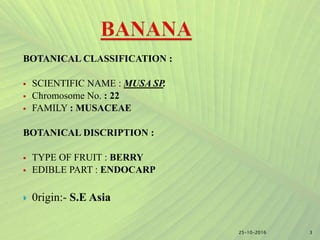
BOTANICAL CLASSIFICATION :
 SCIENTIFIC NAME : MUSA SP.
 Chromosome No. : 22
 FAMILY : MUSACEAE
BOTANICAL DISCRIPTION :
 TYPE OF FRUIT : BERRY
 EDIBLE PART : ENDOCARP
 0rigin:- S.E Asia
325-10-2016
425-10-2016
5
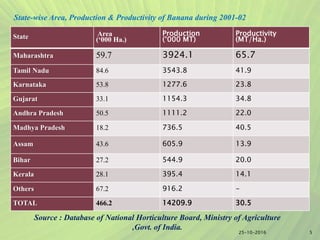
State Area
(‘000 Ha.)
Production
(‘000 MT)
Productivity
(MT/Ha.)
Maharashtra 59.7 3924.1 65.7
Tamil Nadu 84.6 3543.8 41.9
Karnataka 53.8 1277.6 23.8
Gujarat 33.1 1154.3 34.8
Andhra Pradesh 50.5 1111.2 22.0
Madhya Pradesh 18.2 736.5 40.5
Assam 43.6 605.9 13.9
Bihar 27.2 544.9 20.0
Kerala 28.1 395.4 14.1
Others 67.2 916.2 -
TOTAL 466.2 14209.9 30.5
Source : Database of National Horticulture Board, Ministry of Agriculture
,Govt. of India.
State-wise Area, Production & Productivity of Banana during 2001-02
25-10-2016
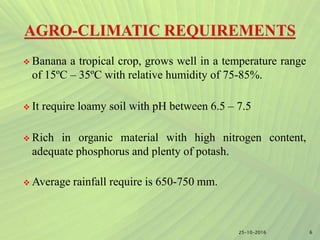
 Banana a tropical crop, grows well in a temperature range
of 15ºC – 35ºC with relative humidity of 75-85%.
 It require loamy soil with pH between 6.5 – 7.5
 Rich in organic material with high nitrogen content,
adequate phosphorus and plenty of potash.
 Average rainfall require is 650-750 mm.
625-10-2016
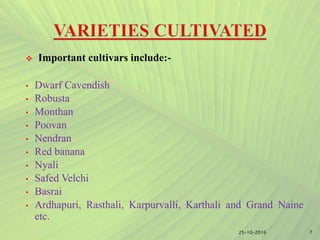
 Important cultivars include:-
• Dwarf Cavendish
• Robusta
• Monthan
• Poovan
• Nendran
• Red banana
• Nyali
• Safed Velchi
• Basrai
• Ardhapuri, Rasthali, Karpurvalli, Karthali and Grand Naine
etc.
725-10-2016
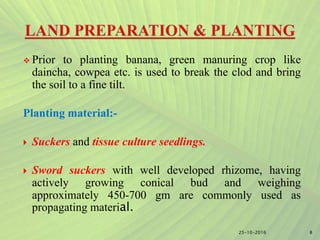
 Prior to planting banana, green manuring crop like
daincha, cowpea etc. is used to break the clod and bring
the soil to a fine tilt.
Planting material:-
 Suckers and tissue culture seedlings.
 Sword suckers with well developed rhizome, having
actively growing conical bud and weighing
approximately 450-700 gm are commonly used as
propagating material.
825-10-2016
9
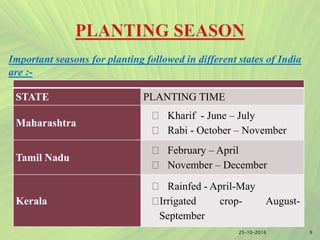
Important seasons for planting followed in different states of India
are :-
STATE PLANTING TIME
Maharashtra
Kharif - June – July
Rabi - October – November
Tamil Nadu
February – April
November – December
Kerala
Rainfed - April-May
Irrigated crop- August-
September
25-10-2016
10
• 10 kg FYM
• 200 - 250gm N/plant- As top dressing in three equal parts at
interval of 60,90 & 120 days.
• 60-70gm P/plant
• 300gm K/plant.
• Urea is applied in three to four split doses.
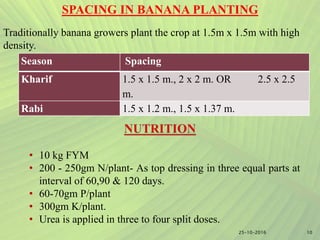
SPACING IN BANANA PLANTING
Traditionally banana growers plant the crop at 1.5m x 1.5m with high
density.
Season Spacing
Kharif 1.5 x 1.5 m., 2 x 2 m. OR 2.5 x 2.5
m.
Rabi 1.5 x 1.2 m., 1.5 x 1.37 m.
25-10-2016
 Spraying of Glyphosate before planting @ 2 lit/ha is carried
out to keep the plantation weed free.
 Four to five weeding.
 Harrowing the field three to four times to keep the soil loose.
 Earthing up should be done at 3-4 months after planting .
 DESUCKERING:-
1125-10-2016
12
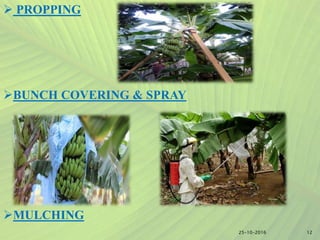
 PROPPING
BUNCH COVERING & SPRAY
MULCHING
25-10-2016
13
INTER-CROPPING:-
 Short duration crops (45-60 days) like mung, cowpea, daincha
are to be considered as green manuring crops.
 Leguminous crops, beetroot, ginger, turmeric and sunnhemp
grown as an inter-crop during the first 3-4 months.
GROWTH REGULATORS
 2,4 D (25 ppm)- Improves the grade of bunches.
 CCC (1000 ppm) at 4th & 6th month
 Plantozyme (2 ml./l.) at 6th & 8th month
 potassium dihydrogen phosphate (0.5%) and urea (1%) or 2,4 D
solution (10 ppm.) after bunch development improves banana size
& quality
25-10-2016
INSECT PESTS:-
 Root stock/rhizome weevil (Cosmopolites sordidus) ,
 Stem borer (Odioporus longicollis)
 Banana beetle ( Nodostoma subcostatum)
 Banana aphid (Pentalonia nigronervosa)
 Nematodes & Thrips
 Application of 0.04% endosulfan, 0.1 % carbaryl or 0.05 %
monocrotophos depending upon the type of pest infestation.
1425-10-2016
DISEASES:-
1. Panama wilt (Fusarium oxysporam)
2. Anthracnose (Gleosporium musarum)
3. Leaf spot (Sigatoka) [Mycosphaarella musicola & Cercospora
musae]
4. Shoot rot (Ceratostomella paradoxa)
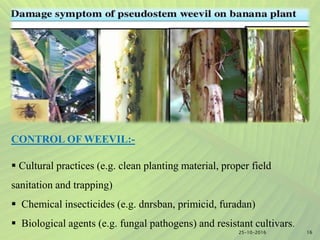
BANANA WEEVIL
Weevil infestation of young plants causes stunting of growth,
production of small bunches and sometimes plants death. 1525-10-2016
16
CONTROL OF WEEVIL:-
 Cultural practices (e.g. clean planting material, proper field
sanitation and trapping)
 Chemical insecticides (e.g. dnrsban, primicid, furadan)
 Biological agents (e.g. fungal pathogens) and resistant cultivars.
25-10-2016
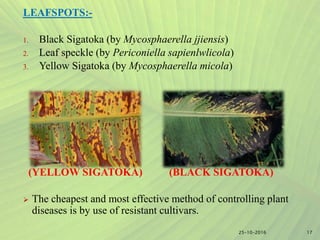
LEAFSPOTS:-
1. Black Sigatoka (by Mycosphaerella jjiensis)
2. Leaf speckle (by Periconiella sapienlwlicola)
3. Yellow Sigatoka (by Mycosphaerella micola)
(YELLOW SIGATOKA) (BLACK SIGATOKA)
 The cheapest and most effective method of controlling plant
diseases is by use of resistant cultivars.
1725-10-2016
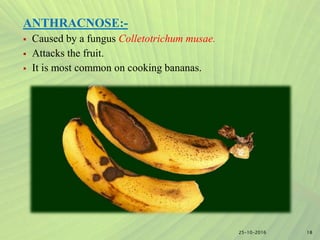
ANTHRACNOSE:-
 Caused by a fungus Colletotrichum musae.
 Attacks the fruit.
 It is most common on cooking bananas.
1825-10-2016
GRADING:-
Based on size, color and maturity of the fruits.
STORAGE:-
Stored for up to 3 weeks in ethylene free air or up to 6 weeks in a
controlled atmosphere at 140 C.
PACKING:-
 Wooden or cardboard boxes, and bamboo baskets are used.
 In some cases banana bunches are packed in old gunny bags
wrapped with banana leaves.
1925-10-2016
TRANSPORT:-
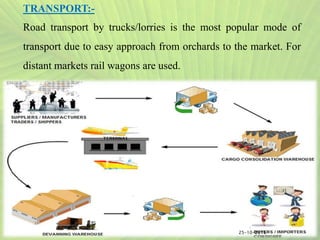
Road transport by trucks/lorries is the most popular mode of
transport due to easy approach from orchards to the market. For
distant markets rail wagons are used.
2025-10-2016
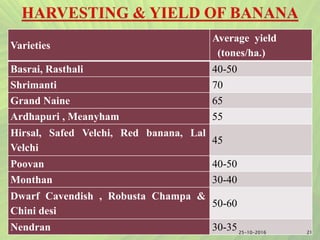
Varieties
Average yield
(tones/ha.)
Basrai, Rasthali 40-50
Shrimanti 70
Grand Naine 65
Ardhapuri , Meanyham 55
Hirsal, Safed Velchi, Red banana, Lal
Velchi
45
Poovan 40-50
Monthan 30-40
Dwarf Cavendish , Robusta Champa &
Chini desi
50-60
Nendran 30-35 2125-10-2016
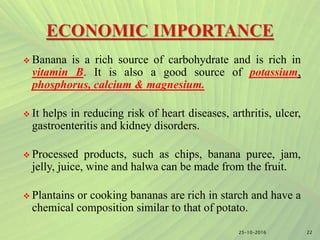
 Banana is a rich source of carbohydrate and is rich in
vitamin B. It is also a good source of potassium,
phosphorus, calcium & magnesium.
 It helps in reducing risk of heart diseases, arthritis, ulcer,
gastroenteritis and kidney disorders.
 Processed products, such as chips, banana puree, jam,
jelly, juice, wine and halwa can be made from the fruit.
 Plantains or cooking bananas are rich in starch and have a
chemical composition similar to that of potato.
2225-10-2016
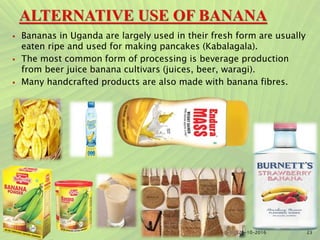
 Bananas in Uganda are largely used in their fresh form are usually
eaten ripe and used for making pancakes (Kabalagala).
 The most common form of processing is beverage production
from beer juice banana cultivars (juices, beer, waragi).
 Many handcrafted products are also made with banana fibres.
2325-10-2016
2425-10-2016

Banana cultivation

  • 1.
  • 2.
    INSTRUCTOR: Prof.S.P Singh RGSC, BHU SPEAKER: PRIYANKAKUMARI B.Sc(Ag) 4th year R-13031 225-10-2016
  • 3.
    BOTANICAL CLASSIFICATION : SCIENTIFIC NAME : MUSA SP.  Chromosome No. : 22  FAMILY : MUSACEAE BOTANICAL DISCRIPTION :  TYPE OF FRUIT : BERRY  EDIBLE PART : ENDOCARP  0rigin:- S.E Asia 325-10-2016
  • 4.
  • 5.
    5 State Area (‘000 Ha.) Production (‘000MT) Productivity (MT/Ha.) Maharashtra 59.7 3924.1 65.7 Tamil Nadu 84.6 3543.8 41.9 Karnataka 53.8 1277.6 23.8 Gujarat 33.1 1154.3 34.8 Andhra Pradesh 50.5 1111.2 22.0 Madhya Pradesh 18.2 736.5 40.5 Assam 43.6 605.9 13.9 Bihar 27.2 544.9 20.0 Kerala 28.1 395.4 14.1 Others 67.2 916.2 - TOTAL 466.2 14209.9 30.5 Source : Database of National Horticulture Board, Ministry of Agriculture ,Govt. of India. State-wise Area, Production & Productivity of Banana during 2001-02 25-10-2016
  • 6.
     Banana atropical crop, grows well in a temperature range of 15ºC – 35ºC with relative humidity of 75-85%.  It require loamy soil with pH between 6.5 – 7.5  Rich in organic material with high nitrogen content, adequate phosphorus and plenty of potash.  Average rainfall require is 650-750 mm. 625-10-2016
  • 7.
     Important cultivarsinclude:- • Dwarf Cavendish • Robusta • Monthan • Poovan • Nendran • Red banana • Nyali • Safed Velchi • Basrai • Ardhapuri, Rasthali, Karpurvalli, Karthali and Grand Naine etc. 725-10-2016
  • 8.
     Prior toplanting banana, green manuring crop like daincha, cowpea etc. is used to break the clod and bring the soil to a fine tilt. Planting material:-  Suckers and tissue culture seedlings.  Sword suckers with well developed rhizome, having actively growing conical bud and weighing approximately 450-700 gm are commonly used as propagating material. 825-10-2016
  • 9.
    9 Important seasons forplanting followed in different states of India are :- STATE PLANTING TIME Maharashtra Kharif - June – July Rabi - October – November Tamil Nadu February – April November – December Kerala Rainfed - April-May Irrigated crop- August- September 25-10-2016
  • 10.
    10 • 10 kgFYM • 200 - 250gm N/plant- As top dressing in three equal parts at interval of 60,90 & 120 days. • 60-70gm P/plant • 300gm K/plant. • Urea is applied in three to four split doses. SPACING IN BANANA PLANTING Traditionally banana growers plant the crop at 1.5m x 1.5m with high density. Season Spacing Kharif 1.5 x 1.5 m., 2 x 2 m. OR 2.5 x 2.5 m. Rabi 1.5 x 1.2 m., 1.5 x 1.37 m. 25-10-2016
  • 11.
     Spraying ofGlyphosate before planting @ 2 lit/ha is carried out to keep the plantation weed free.  Four to five weeding.  Harrowing the field three to four times to keep the soil loose.  Earthing up should be done at 3-4 months after planting .  DESUCKERING:- 1125-10-2016
  • 12.
    12  PROPPING BUNCH COVERING& SPRAY MULCHING 25-10-2016
  • 13.
    13 INTER-CROPPING:-  Short durationcrops (45-60 days) like mung, cowpea, daincha are to be considered as green manuring crops.  Leguminous crops, beetroot, ginger, turmeric and sunnhemp grown as an inter-crop during the first 3-4 months. GROWTH REGULATORS  2,4 D (25 ppm)- Improves the grade of bunches.  CCC (1000 ppm) at 4th & 6th month  Plantozyme (2 ml./l.) at 6th & 8th month  potassium dihydrogen phosphate (0.5%) and urea (1%) or 2,4 D solution (10 ppm.) after bunch development improves banana size & quality 25-10-2016
  • 14.
    INSECT PESTS:-  Rootstock/rhizome weevil (Cosmopolites sordidus) ,  Stem borer (Odioporus longicollis)  Banana beetle ( Nodostoma subcostatum)  Banana aphid (Pentalonia nigronervosa)  Nematodes & Thrips  Application of 0.04% endosulfan, 0.1 % carbaryl or 0.05 % monocrotophos depending upon the type of pest infestation. 1425-10-2016
  • 15.
    DISEASES:- 1. Panama wilt(Fusarium oxysporam) 2. Anthracnose (Gleosporium musarum) 3. Leaf spot (Sigatoka) [Mycosphaarella musicola & Cercospora musae] 4. Shoot rot (Ceratostomella paradoxa) BANANA WEEVIL Weevil infestation of young plants causes stunting of growth, production of small bunches and sometimes plants death. 1525-10-2016
  • 16.
    16 CONTROL OF WEEVIL:- Cultural practices (e.g. clean planting material, proper field sanitation and trapping)  Chemical insecticides (e.g. dnrsban, primicid, furadan)  Biological agents (e.g. fungal pathogens) and resistant cultivars. 25-10-2016
  • 17.
    LEAFSPOTS:- 1. Black Sigatoka(by Mycosphaerella jjiensis) 2. Leaf speckle (by Periconiella sapienlwlicola) 3. Yellow Sigatoka (by Mycosphaerella micola) (YELLOW SIGATOKA) (BLACK SIGATOKA)  The cheapest and most effective method of controlling plant diseases is by use of resistant cultivars. 1725-10-2016
  • 18.
    ANTHRACNOSE:-  Caused bya fungus Colletotrichum musae.  Attacks the fruit.  It is most common on cooking bananas. 1825-10-2016
  • 19.
    GRADING:- Based on size,color and maturity of the fruits. STORAGE:- Stored for up to 3 weeks in ethylene free air or up to 6 weeks in a controlled atmosphere at 140 C. PACKING:-  Wooden or cardboard boxes, and bamboo baskets are used.  In some cases banana bunches are packed in old gunny bags wrapped with banana leaves. 1925-10-2016
  • 20.
    TRANSPORT:- Road transport bytrucks/lorries is the most popular mode of transport due to easy approach from orchards to the market. For distant markets rail wagons are used. 2025-10-2016
  • 21.
    Varieties Average yield (tones/ha.) Basrai, Rasthali40-50 Shrimanti 70 Grand Naine 65 Ardhapuri , Meanyham 55 Hirsal, Safed Velchi, Red banana, Lal Velchi 45 Poovan 40-50 Monthan 30-40 Dwarf Cavendish , Robusta Champa & Chini desi 50-60 Nendran 30-35 2125-10-2016
  • 22.
     Banana isa rich source of carbohydrate and is rich in vitamin B. It is also a good source of potassium, phosphorus, calcium & magnesium.  It helps in reducing risk of heart diseases, arthritis, ulcer, gastroenteritis and kidney disorders.  Processed products, such as chips, banana puree, jam, jelly, juice, wine and halwa can be made from the fruit.  Plantains or cooking bananas are rich in starch and have a chemical composition similar to that of potato. 2225-10-2016
  • 23.
     Bananas inUganda are largely used in their fresh form are usually eaten ripe and used for making pancakes (Kabalagala).  The most common form of processing is beverage production from beer juice banana cultivars (juices, beer, waragi).  Many handcrafted products are also made with banana fibres. 2325-10-2016
  • 24.