Jam, Jelly and Marmalade-definition, role of pectin and
theory of gel preparation, evaluation, technology for
processed products like pickles, chutneys, sauces
particularly from raw mango, lime and other regional
fruits and vegetables of importance
Jam
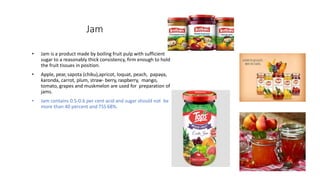
• Jam is a product made by boiling fruit pulp with sufficient
sugar to a reasonably thick consistency, firm enough to hold
the fruit tissues in position.
• Apple, pear, sapota (chiku),apricot, loquat, peach, papaya,
karonda, carrot, plum, straw- berry, raspberry, mango,
tomato, grapes and muskmelon are used for preparation of
jams.
• Jam contains 0.5-0.6 per cent acid and sugar should not be
more than 40 percent and TSS 68%.
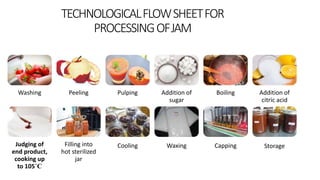
TECHNOLOGICALFLOWSHEETFOR
PROCESSINGOFJAM
Washing Peeling Pulping Addition of
sugar
Boiling Addition of
citric acid
Judging of
end product,
cooking up
to 105˚C
Filling into
hot sterilized
jar
Cooling Waxing Capping Storage
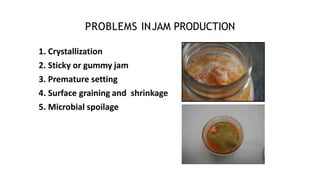
PROBLEMS INJAM PRODUCTION
1. Crystallization
2. Sticky or gummy jam
3. Premature setting
4. Surface graining and shrinkage
5. Microbial spoilage
JELLY
• A jelly is a semi-solid product prepared by
boiling a clear, strained solution of pectin
containing fruit extract, free from pulp,
after the addition of sugar andacid.
• A perfect jelly should be transparent, well-
set, but not too stiff, and should have the
original flavor of the fruit. It should be of
attractive color and keep its shape when
removed from the mould.
• It should not be gummy, sticky or syrupy or
have crystallized sugar. The product should
be free from dullness, with little or no
syneresis (weeping), and neither tough
nor rubbery and should have TSS 65%, 0.5
- 0.75% acid and 45% of fruit juice..
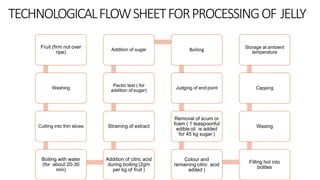
TECHNOLOGICALFLOWSHEETFORPROCESSINGOF JELLY
Fruit (firm not over
ripe)
Washing
Cutting into thin slices
Boiling with water
(for about 20-30
min)
Addition of citric acid
during boiling (2gm
per kg of fruit )
Straining of extract
Pectin test ( for
addition of sugar)
Addition of sugar Boiling
Judging of end point
Removal of scum or
foam ( 1 teaspoonful
edible oil is added
for 45 kg sugar )
Colour and
remaining citric acid
added )
Filling hot into
bottles
Waxing
Capping
Storage at ambient
temperature
Role of pectin
• Pectin substances present in the form of calcium pectate are responsible
for the firmness of fruits.
• Pectin is the most important constituent of jelly. It is a commercial term
for water soluble pectinic acid which under suitable conditions forms a gel
with sugar and acid.
• Stiffness of the gel increases with increasing concentration of pectin up to
a certain point beyond which the addition of more pectin has little effect.
• Pectin tends to keep the sugar from crystallizing by acting as a protective
colloid, but is not effective when the concentration of sugar is 70 per cent
or more.
Theory of gel preparation
• Jelly formation is due to the precipitation of pectin rather than its
swelling. Only when the pectin, acid, sugar and water are in definite
equilibrium range, the precipitation of pectin takes place. The rate of
precipitation depends on…
• Concentration of pectin in solution
• Constitution of pectin
• pH of the pectin solution
• Concentration of sugar in solution
• Temperature of mixture
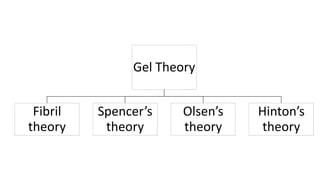
Gel Theory
Fibril
theory
Spencer’s
theory
Olsen’s
theory
Hinton’s
theory
Fibril theory
• When sugar is added to pectin solution, it destabilizes the
pectin water equilibrium and the pectin conglomerates
forming a network of fibrils holds the sugar solution in the
interfibrillar spaces.
• The strength of the jelly depends on the strength of fibrils,
their continuity and rigidity.
Spencer’s theory
• Pectin particles are negatively charged. A pectin solution is most
stable at the neutral pH . Thus increase in acidity or alkanity
decreases the stability of pectin solution.
• In jelly formation , sugar acts as a precipitating gent, and the presence
of acid helps it.
• Salts also help in the precipitation of pectin, while others hinder
according to their capacity to increase or decrease the stability.
Olsen’s theory
• Sugar acts as dehydrating agent, which disturbs the equilibrium existing between
water and pectin.
• Sugar does not dehydrate the pectin micelles instantaneously, but requires the
time to bring about an equilibrium
• If the negative charge on pectin is reduced, with the help of H+ concentration,
pectin precipitates and form a network of insoluble fibers provided that the sugar
is present in sufficient concentration.
• The rate of hydration and precipitation of pectin increases with the addition of
acid up to an optimum of about pH 2.0, in direct proportion to H+ concentration
• As the system reaches an equilibrium, the jelly strength becomes the maximum
Salt and other components which cause a change in the ultimate jelly strength of
the system, may function either by changing the rate of gelation or by affecting
the ultimate structure f the jelly or by combination of both
Hinton’s theory
• It s based upon the assumption that pectin's are complex mixtures of
variables composition.
• According to it, gelation's of pectin are a type of coagulation in which
the coagulated particles forma continuous network.
• It is only the non ionized, and not the ionized pectin, which enters
into jelly formation.
PROBLEMS IN JELLYMAKING
• Formation of crystals
• Failure to set
• Cloudy or foggy jellies
• Syneresis or weeping of jelly
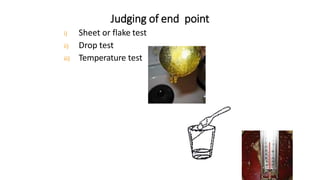
Judging of end point
i) Sheet or flake test
ii) Drop test
iii) Temperature test
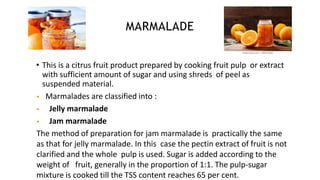
MARMALADE
• This is a citrus fruit product prepared by cooking fruit pulp or extract
with sufficient amount of sugar and using shreds of peel as
suspended material.
 Marmalades are classified into :
 Jelly marmalade
 Jam marmalade
The method of preparation for jam marmalade is practically the same
as that for jelly marmalade. In this case the pectin extract of fruit is not
clarified and the whole pulp is used. Sugar is added according to the
weight of fruit, generally in the proportion of 1:1. The pulp-sugar
mixture is cooked till the TSS content reaches 65 per cent.
PROBLEMSIN MARMALADE MAKING
• Browning during storage is very common which
can be prevented by addition of 0.09 g of KMS per
kg of marmalade and not using tin containers.
KMS dissolved in a small quantity of water is
added to the marmalade while it is cooling. KMS
also eliminates the possibility of spoilage due to
molds.
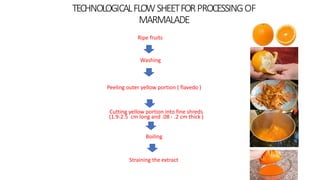
TECHNOLOGICALFLOWSHEETFORPROCESSINGOF
MARMALADE
Ripe fruits
Washing
Peeling outer yellow portion ( flavedo )
Straining the extract
Boiling
Cutting yellow portion into fine shreds
(1.9-2.5 cm long and .08 - .2 cm thick )
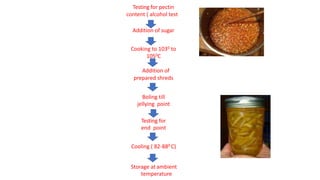
Testing for pectin
content ( alcohol test )
Boling till
jellying point
Cooling ( 82-880 C)
Addition of sugar
Cooking to 1030 to
1050C
Addition of
prepared shreds
Testing for
end point
Storage at ambient
temperature
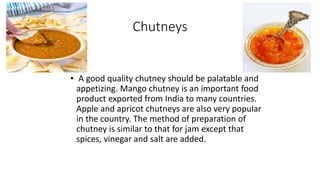
Chutneys
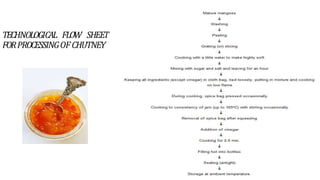
• A good quality chutney should be palatable and
appetizing. Mango chutney is an important food
product exported from India to many countries.
Apple and apricot chutneys are also very popular
in the country. The method of preparation of
chutney is similar to that for jam except that
spices, vinegar and salt are added.
TECHNOLOGICAL FLOW SHEET
FORPROCESSINGOFCHUTNEY
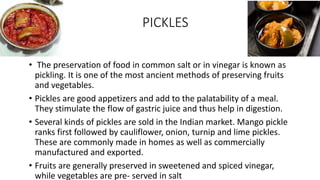
PICKLES
• The preservation of food in common salt or in vinegar is known as
pickling. It is one of the most ancient methods of preserving fruits
and vegetables.
• Pickles are good appetizers and add to the palatability of a meal.
They stimulate the flow of gastric juice and thus help in digestion.
• Several kinds of pickles are sold in the Indian market. Mango pickle
ranks first followed by cauliflower, onion, turnip and lime pickles.
These are commonly made in homes as well as commercially
manufactured and exported.
• Fruits are generally preserved in sweetened and spiced vinegar,
while vegetables are pre- served in salt
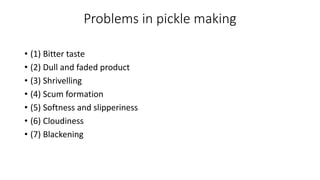
Problems in pickle making
• (1) Bitter taste
• (2) Dull and faded product
• (3) Shrivelling
• (4) Scum formation
• (5) Softness and slipperiness
• (6) Cloudiness
• (7) Blackening
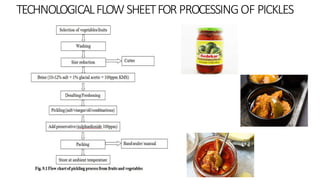
TECHNOLOGICALFLOW SHEETFORPROCESSINGOF PICKLES
SAUCES
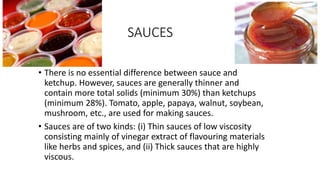
• There is no essential difference between sauce and
ketchup. However, sauces are generally thinner and
contain more total solids (minimum 30%) than ketchups
(minimum 28%). Tomato, apple, papaya, walnut, soybean,
mushroom, etc., are used for making sauces.
• Sauces are of two kinds: (i) Thin sauces of low viscosity
consisting mainly of vinegar extract of flavouring materials
like herbs and spices, and (ii) Thick sauces that are highly
viscous.
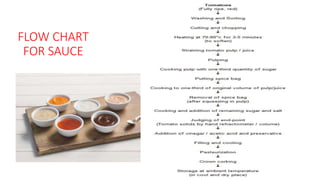
FLOW CHART
FOR SAUCE
Jam, jelly, marmalade, chutney,

Jam, jelly, marmalade, chutney,

  • 2.
    Jam, Jelly andMarmalade-definition, role of pectin and theory of gel preparation, evaluation, technology for processed products like pickles, chutneys, sauces particularly from raw mango, lime and other regional fruits and vegetables of importance
  • 3.
    Jam • Jam isa product made by boiling fruit pulp with sufficient sugar to a reasonably thick consistency, firm enough to hold the fruit tissues in position. • Apple, pear, sapota (chiku),apricot, loquat, peach, papaya, karonda, carrot, plum, straw- berry, raspberry, mango, tomato, grapes and muskmelon are used for preparation of jams. • Jam contains 0.5-0.6 per cent acid and sugar should not be more than 40 percent and TSS 68%.
  • 4.
    TECHNOLOGICALFLOWSHEETFOR PROCESSINGOFJAM Washing Peeling PulpingAddition of sugar Boiling Addition of citric acid Judging of end product, cooking up to 105˚C Filling into hot sterilized jar Cooling Waxing Capping Storage
  • 5.
    PROBLEMS INJAM PRODUCTION 1.Crystallization 2. Sticky or gummy jam 3. Premature setting 4. Surface graining and shrinkage 5. Microbial spoilage
  • 6.
    JELLY • A jellyis a semi-solid product prepared by boiling a clear, strained solution of pectin containing fruit extract, free from pulp, after the addition of sugar andacid. • A perfect jelly should be transparent, well- set, but not too stiff, and should have the original flavor of the fruit. It should be of attractive color and keep its shape when removed from the mould. • It should not be gummy, sticky or syrupy or have crystallized sugar. The product should be free from dullness, with little or no syneresis (weeping), and neither tough nor rubbery and should have TSS 65%, 0.5 - 0.75% acid and 45% of fruit juice..
  • 7.
    TECHNOLOGICALFLOWSHEETFORPROCESSINGOF JELLY Fruit (firmnot over ripe) Washing Cutting into thin slices Boiling with water (for about 20-30 min) Addition of citric acid during boiling (2gm per kg of fruit ) Straining of extract Pectin test ( for addition of sugar) Addition of sugar Boiling Judging of end point Removal of scum or foam ( 1 teaspoonful edible oil is added for 45 kg sugar ) Colour and remaining citric acid added ) Filling hot into bottles Waxing Capping Storage at ambient temperature
  • 8.
    Role of pectin •Pectin substances present in the form of calcium pectate are responsible for the firmness of fruits. • Pectin is the most important constituent of jelly. It is a commercial term for water soluble pectinic acid which under suitable conditions forms a gel with sugar and acid. • Stiffness of the gel increases with increasing concentration of pectin up to a certain point beyond which the addition of more pectin has little effect. • Pectin tends to keep the sugar from crystallizing by acting as a protective colloid, but is not effective when the concentration of sugar is 70 per cent or more.
  • 9.
    Theory of gelpreparation • Jelly formation is due to the precipitation of pectin rather than its swelling. Only when the pectin, acid, sugar and water are in definite equilibrium range, the precipitation of pectin takes place. The rate of precipitation depends on… • Concentration of pectin in solution • Constitution of pectin • pH of the pectin solution • Concentration of sugar in solution • Temperature of mixture
  • 10.
  • 11.
    Fibril theory • Whensugar is added to pectin solution, it destabilizes the pectin water equilibrium and the pectin conglomerates forming a network of fibrils holds the sugar solution in the interfibrillar spaces. • The strength of the jelly depends on the strength of fibrils, their continuity and rigidity.
  • 12.
    Spencer’s theory • Pectinparticles are negatively charged. A pectin solution is most stable at the neutral pH . Thus increase in acidity or alkanity decreases the stability of pectin solution. • In jelly formation , sugar acts as a precipitating gent, and the presence of acid helps it. • Salts also help in the precipitation of pectin, while others hinder according to their capacity to increase or decrease the stability.
  • 13.
    Olsen’s theory • Sugaracts as dehydrating agent, which disturbs the equilibrium existing between water and pectin. • Sugar does not dehydrate the pectin micelles instantaneously, but requires the time to bring about an equilibrium • If the negative charge on pectin is reduced, with the help of H+ concentration, pectin precipitates and form a network of insoluble fibers provided that the sugar is present in sufficient concentration. • The rate of hydration and precipitation of pectin increases with the addition of acid up to an optimum of about pH 2.0, in direct proportion to H+ concentration • As the system reaches an equilibrium, the jelly strength becomes the maximum Salt and other components which cause a change in the ultimate jelly strength of the system, may function either by changing the rate of gelation or by affecting the ultimate structure f the jelly or by combination of both
  • 14.
    Hinton’s theory • Its based upon the assumption that pectin's are complex mixtures of variables composition. • According to it, gelation's of pectin are a type of coagulation in which the coagulated particles forma continuous network. • It is only the non ionized, and not the ionized pectin, which enters into jelly formation.
  • 15.
    PROBLEMS IN JELLYMAKING •Formation of crystals • Failure to set • Cloudy or foggy jellies • Syneresis or weeping of jelly
  • 16.
    Judging of endpoint i) Sheet or flake test ii) Drop test iii) Temperature test
  • 17.
    MARMALADE • This isa citrus fruit product prepared by cooking fruit pulp or extract with sufficient amount of sugar and using shreds of peel as suspended material.  Marmalades are classified into :  Jelly marmalade  Jam marmalade The method of preparation for jam marmalade is practically the same as that for jelly marmalade. In this case the pectin extract of fruit is not clarified and the whole pulp is used. Sugar is added according to the weight of fruit, generally in the proportion of 1:1. The pulp-sugar mixture is cooked till the TSS content reaches 65 per cent.
  • 18.
    PROBLEMSIN MARMALADE MAKING •Browning during storage is very common which can be prevented by addition of 0.09 g of KMS per kg of marmalade and not using tin containers. KMS dissolved in a small quantity of water is added to the marmalade while it is cooling. KMS also eliminates the possibility of spoilage due to molds.

  • 19.
    TECHNOLOGICALFLOWSHEETFORPROCESSINGOF MARMALADE Ripe fruits Washing Peeling outeryellow portion ( flavedo ) Straining the extract Boiling Cutting yellow portion into fine shreds (1.9-2.5 cm long and .08 - .2 cm thick )
  • 20.
    Testing for pectin content( alcohol test ) Boling till jellying point Cooling ( 82-880 C) Addition of sugar Cooking to 1030 to 1050C Addition of prepared shreds Testing for end point Storage at ambient temperature
  • 21.
    Chutneys • A goodquality chutney should be palatable and appetizing. Mango chutney is an important food product exported from India to many countries. Apple and apricot chutneys are also very popular in the country. The method of preparation of chutney is similar to that for jam except that spices, vinegar and salt are added.
  • 22.
  • 23.
    PICKLES • The preservationof food in common salt or in vinegar is known as pickling. It is one of the most ancient methods of preserving fruits and vegetables. • Pickles are good appetizers and add to the palatability of a meal. They stimulate the flow of gastric juice and thus help in digestion. • Several kinds of pickles are sold in the Indian market. Mango pickle ranks first followed by cauliflower, onion, turnip and lime pickles. These are commonly made in homes as well as commercially manufactured and exported. • Fruits are generally preserved in sweetened and spiced vinegar, while vegetables are pre- served in salt
  • 24.
    Problems in picklemaking • (1) Bitter taste • (2) Dull and faded product • (3) Shrivelling • (4) Scum formation • (5) Softness and slipperiness • (6) Cloudiness • (7) Blackening
  • 25.
  • 26.
    SAUCES • There isno essential difference between sauce and ketchup. However, sauces are generally thinner and contain more total solids (minimum 30%) than ketchups (minimum 28%). Tomato, apple, papaya, walnut, soybean, mushroom, etc., are used for making sauces. • Sauces are of two kinds: (i) Thin sauces of low viscosity consisting mainly of vinegar extract of flavouring materials like herbs and spices, and (ii) Thick sauces that are highly viscous.
  • 27.