PROCESS FOODS BY
SUGAR
CONCENTRATION
Demonstration Teaching via LAC
May 18, 2022
Hello Students!
My name is Ma’am Eisan
Your Food Processing Teacher.
In this lesson you will be learning some topics
under Food Processing.
FATHER GOD, THANK YOU FOR THIS WONDERFUL DAY.
THANK YOU FOR GIVING US THE CHANCE TO
CONTINUE LEARNING AMIDST THE PANDEMIC THAT
HAVE CAUSED A LOT OF CHANGES IN OUR LIVES. WE
ASK YOU FATHER TO COME WITH US TODAY. FILL OUR
HEARTS WITH JOY AND KINDNESS, OUR MINDS WITH
LEARNING AND ENTHUSIASM, AND ABOVE ALL, FILL US
WITH YOUR LOVE.
ALL THIS WE PRAY, IN YOUR MIGHTY NAME,
AMEN.
REVIEW
TIME
IS UP
1. What substance
makes jelly firm and
rigid in structure?
a. Acid
b. Pectin
1
2
3
4
5
2. What instrument is
used to measure the
pectin content of
fruits?
a. Thermometer
b. Jelmeter
TIME
IS UP
1
2
3
4
5
TIME
IS UP
3. What appropriate
measurement needed
of sugar in jellies, jams
and marmalades?
a. ¾ to 1 cup
b. 2 cups
1
2
3
4
5
TIME
IS UP
4. How do you test the
acidity of the fruits?
a. By mixing two tablespoon of
calamansi juice and eight table-
spoons ( or one-half cup) of water
b. By mixing one tablespoon of
calamansi juice and eight table-
spoons ( or one-half cup) of water
1
2
3
4
5
5. How many tablespoons of
denatured alcohol do you
need using alcohol test to test
the pectin content of a fruits
and vegetables?
a. 2 tablespoons of denatured
95% wood alcohol
b. 1 tablespoon of denatured
90% wood alcohol
TIME
IS UP
1
2
3
4
5
1. What substance makes
jelly firm and rigid in
structure?
a. Acid
2. What instrument is
used to measure the
pectin content of
fruits?
a. Jelmeter
3. What appropriate
measurement needed
of sugar in jellies, jams
and marmalades?
a. ¾ to 1 cup
4. How do you test the
acidity of the fruits?
b. By mixing one tablespoon
of calamansi juice and eight
tablespoons ( or one- half
cup) of water
5. How many tablespoons of
denatured alcohol do you
need using alcohol test to test
the pectin content of a fruits
and vegetables?
a. 2 tablespoons of denatured
95% wood alcohol
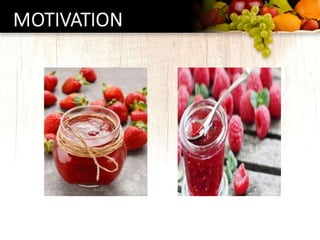
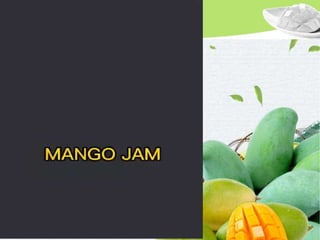
PICTURE PROMPT
Looking at the pictures below, what can
you say about it? Can you identify what kind of jam is it?
Most Essential Learning
Competencies
LO4. Cook sugar
concentrates
TLE_AFFP9-12SC-IVg-i-4
a. Identify the ingredients used in making
mango jam
b. Perform the correct steps in cooking
mango jam
c. Practice Occupational Health and
Safety during the process
OBJECTIVES
4.1. Cook mixture to required consistency
Replace with your own text
ACTIVITY
VIDEO PRESENTATION
Watch a video presentation
of making jams. Students should
take note while watching the
video presentation, especially
the process, procedures and
jellying point.
ANALYSIS
1. Base on the video presented, what
are the ingredients used?
Mango, sugar and lemon juice
ANALYSIS
2. When do you stop the boiling
of fruit?
When you reach the jelly
consistency of the jam
ANALYSIS
3. What are the tools and utensils
used?
Wooden spoon, non-
stick sauce pan, knife,
glass bottle
ANALYSIS
4. How can we avoid problems in
preparing sugar concentrated
products?
 We can avoid problems in preparing sugar
concentrated products by following the
accurate amount of ingredients to be used
and follow the correct procedure on how
to make sugar concentrated products.
ANALYSIS
5. How will you know if the jellying
point has been reached?
 You will know if the jellying point has been
reach if large bubbles that tend to jump
out of the pan are formed rather than uni-
formly small bubbles, another one is when
the jelly sets on the spoon and the last
two drops of the syrup flow together and
fall off the spoon as one sheet of flake.
UNLOCKING
OF TERMS
ABSTRACTION
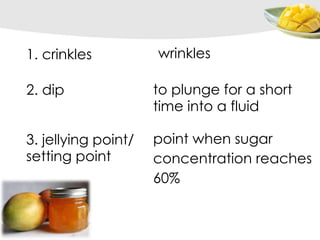
1. crinkles wrinkles
2. dip to plunge for a short
time into a fluid
3. jellying point/
setting point
point when sugar
concentration reaches
60%
4. lift raise
5. plump round
6. scum a film covering on the
surface of the jelly
7. quiver to tremble, shake or
shiver
HOW TO COOK SUGAR CONCENTRATED
PRODUCTS
A. Jellies
1. Measure the required amount of sugar
to be added to the fruit juice.
2. For every cup of juice, add ¾ to 1 cup
sugar. Stir to dissolve the sugar.
3. Strain again to remove any undissolved
sugar, scum or dirt.
4. Cook rapidly without stirring until jellying
point is reached.
5. Skim and pour in sterilized jars while still
hot.
6. Seal and label.
B. Jams
Jam is a food made of boiling fruit pulp with
sugar until thick.
1. Cook the pulp until soft. When cooking jams
add sugar when pulp of the fruit are completely
softened, otherwise the fruits become hard if
the sugar is added early.
2. Add the required amount of sugar. The usual
proportion is ½ to ¾ cup of sugar per cup of
pulp. If the fruit is moderately rich in protein, add
smaller amount of sugar.
3. After sugar has been added, boil rapidly until
the jam starts to set in. The secret in making jam
is to cook slowly before adding the sugar and
rapidly afterwards.
4. As soon as the jam reaches the setting point,
remove the scum by scooping with a clean
wooden spoon.
5. Pour the jam into sterilized jars while still hot.
6. Seal and label.
C. Marmalades
1. The amount of sugar needed depends on the
composition of the juice. More sugar can be
added to juices rich in pectin and acid than
those deficient in one or both constituents.
2. The sugar, juice and peel of sliced or chopped
fruits are boiled to jellying point which is usually
104◦c. A good marmalade should be of jelly-like
consistency and not syrupy.
3. Pour the marmalade into sterilized jars.
4. Seal and label.
D. Preserves
1. Prepare the kind of syrup needed for the fruit.
a. Thin - 3 cups water to 1 cup sugar
b. Medium - 2 cups water to 1 cup sugar
c. Thick -1 cup water to 1 cup sugar (good for s
our fruits)
2. Drop the fruit into boiling syrup and cook until
fruit is clear and tender. In cooking, make sure
that the fruits or vegetables are covered with th
e syrup at all times so that the surface will not
dry up and harden before the syrup is absorbed
by the pieces.
3. Cook rapidly so that the preserve will look
bright and attractive.
4. Drain fruits.
5. Pack in sterilized jars and pour boiling syrup.
6. Remove air bubbles.
7. Half – seal.
8. Sterilized jars for
9. Seal tightly.
10. Place jars upside down to test for leakage.
11. Label properly.
HOW TO TEST
JELLYING POINT
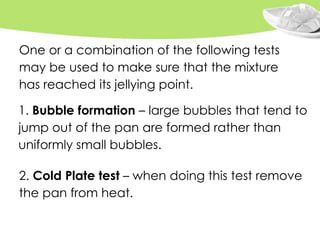
2. Cold Plate test – when doing this test remove
the pan from heat.
1. Bubble formation – large bubbles that tend to
jump out of the pan are formed rather than
uniformly small bubbles.
One or a combination of the following tests
may be used to make sure that the mixture
has reached its jellying point.
Two Ways of Doing the Cold Plate Test
a. With water. Pour a small amount of the boiling sy-
rup into the saucer. If the syrup forms a soft ball
which crinkles when pushed with the finger and
retains its shape when lifted out of the water,
then the jellying point has been reached.
b. Without water. Cool a teaspoonful of jelly in a
saucer. If the surface of the syrup sets and
crinkles when pushed with the finger, then the
jellying point has been reached.
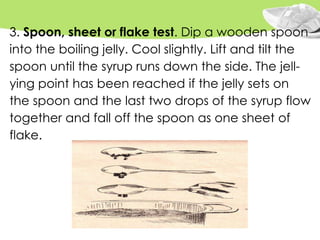
3. Spoon, sheet or flake test. Dip a wooden spoon
into the boiling jelly. Cool slightly. Lift and tilt the
spoon until the syrup runs down the side. The jell-
ying point has been reached if the jelly sets on
the spoon and the last two drops of the syrup flow
together and fall off the spoon as one sheet of
flake.
4. Temperature test. Before cooling the jelly, get
the temperature of the boiling water. The jelly
will set when the juice is heated 8º to10ºFahren-
heit higher than the boiling point of water. The
range is usually 119.5º to 222º Fahrenheit
depending on the desired consistency.
CHARACTERISTICS
OF GOOD FINISHED
PRODUCTS
A. JELLIES
1. Clear, transparent and have an at-
tractive color.
2. Retain their form, quivers and do not
flow when removed from their containers.
3. Retain the flavor and aroma of the or
iginal fruit.
4. Texture is tender.
B. JAMS
1. The color is bright, thick and smo
oth when spread.
2. Retain the natural flavor and ar
oma of the fruit.
C. MARMALADES
A good marmalade should be of
jelly – like consistency and not syrupy.
D. PRESERVES
1. Sparkling and glistening.
2. Retain the natural color and flavor
of fruits.
3. Plump, soft and tender.
HERE ARE THE STEPS OR PROCEDURES
ON HOW TO MAKE MANGO JAM
Raw material:
Quantity Unit Ingredients
½ kg ripe mangoes
Proportion
1 c mango pulp
1 c sugar
1 t calamansi
juice(optional)
1 pc bottle with seal
Label
Procedure:
1. Wear your PPE.
2. Prepare and wash tools and utensils needed.
3. Wash mango and slice. Then scoop the pulp
and mash.
4. Measure the pulp, sugar and calamansi juice.
5. Combine pulp and sugar.
6. Cook. After few minutes add calamansi juice
until it reaches jam consistency.
7. Fill in sterilized bottle while hot.
8. Seal and label.
Guide Questions:
1. What preparations are you going to do
before making mango jam?
Gather all the tools, utensils
and raw materials needed.
2. What are the steps in preparing mango
jams?
Guide Questions:
1. Prepare and wash tools and utensils needed.
2. Wash mango and slice. Then scoop the pulp and
mash.
3. Measure the pulp, sugar and calamansi juice.
4. Combine pulp and sugar.
5. Cook. After few minutes add calamansi juice until
it reaches jam consistency.
6. Fill in sterilized bottle while hot.
7. Seal and label.
Guide Questions:
3. What will be the effects if we do not follow the
correct process?
 Quality of the product cannot
be attained.
4. What are the correct consistency for jam,
jelly and marmalade?
Guide Questions:
 JAMS – The color is bright, thick and smooth when
spread.
- Retain the natural flavour and aroma of the fruit.
JELLY- Clear, transparent and have an attractive
color.
- Retain their form, quivers and do not flow when
removed from their containers.
- Texture is tender.
MARMALADE- A good marmalade should be of jelly-
consistency and not syrupy.
5. Why we should practice Occupational
Health and safety during the process?
Guide Questions:
To avoid contamination, food spoilage as
well as accidents during the process.
APPLICATION
A.Performance Task :
1.Prepare tools, utensils and supplies/materials
needed in preparing mango jam.
2. Perform mango jam. You can watch on YOU
TUBE on how to cook mango jam or simply follow
the steps that I have discuss a while ago and
check the desired endpoint by following the
ways on how to check the jellying point of the
sugar concentrated products. Use the sugges-
ted reference provided.
3. Observe Occupational Health and Safety
in performing the task to avoid food risks and
accidents or injuries such as burns, fires, falls,
cuts, and electrical shocks.
A.Performance Task :
4. Prepare production report after your perfor-
mance to determine your expenses, selling
price and your profit.
A.Performance Task :
5. Rate your performance using the Scoring Rub-
ric and accomplished the performance criteria
checklist. Write your total score on the space
provided.
6. Provide any supporting document
on this activity, you may take a picture
or videos while performing the task and
send it to your teacher via messenger
or email.
A.Performance Task :
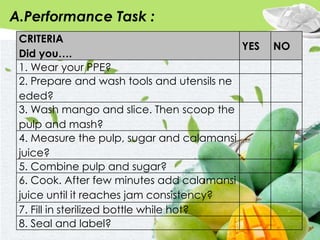
CRITERIA
Did you….
YES NO
1. Wear your PPE?
2. Prepare and wash tools and utensils ne
eded?
3. Wash mango and slice. Then scoop the
pulp and mash?
4. Measure the pulp, sugar and calamansi
juice?
5. Combine pulp and sugar?
6. Cook. After few minutes add calamansi
juice until it reaches jam consistency?
7. Fill in sterilized bottle while hot?
8. Seal and label?
Scoring rubric for rating the performance task
Level of Performance
Criteria Very Good
( 5 points)
Good
( 4 points)
Poor
( 3 points)
Score
Ability to cook
(mango jam)
following the
correct steps/
procedures.
Able to cook
(mango jam)
following the
correct steps
/procedures.
Able to cook
(mango jam)
but missed one
of the steps/
procedure.
Able to cook
(mango jam)
but missed
two or more
of the steps/
procedure.
Ability to check
the desired
endpoint follo-
wing the cor-
rect steps/pro
cedures.
Able to check
the desired
endpoint foll
owing the co
rrect steps/pr
ocedures
Able to check
the desired
endpoint but
missed one of
the steps/pro
cedure.
Able to check
the desired
endpoint but
missed two
or more of the
steps/proce
dure
Comments: Total Points
Earned
E. Assessment/
Evaluation:
1 - 3 Identify the ingredients used in mango jam
Arrange the procedures of mango jam in chronological
order. Write 1 for 1st step, 2 for 2nd step and so on.
____4. Fill in sterilized bottle while hot.
____5. Wash mango and slice. Then scoop the pulp and
mash.
____6. Prepare and wash tools and utensils needed.
____7. Seal and label.
____8. Measure the pulp, sugar and calamansi juice.
____9. Cook. After few minutes add calamansi juice until
it reaches jam consistency.
____10. Combine pulp and sugar.
F. Agreement:
Search for other recipes
about sugar concen-
trated products. Write
it on a 1 whole sheet
of pad paper.
V. REMARKS
Intervention Program for the Learners Who Cannot
Comply The Performance Task
1.Learners will be given a leeway in passing
their performance task.
2.Learners will be reminded of their lacking per-
formances through their contact number,
messenger, emails or a checklist.
3. Home visitation will be done to those who failed
to perform in spite of constant reminders.
4. Alternative task will be given to those learners
who cannot perform the task due to unavaila-
bility of raw materials, working, or any reason that
hinder the learners to perform the task.
List of Alternative Task
a. Learners will be given a link where they can
watch video in preparing chayote mixed pickles/
papaya pickles/bamboo shoot pickles from YOU
TUBE where they can follow when performing the
task or make a narrative report about it.
b. Learner can conduct an interview from any of
the family member or ask somebody who has an
experience or knowledge in cooking jam and
make a narrative report on it.
STUDENTS
OUTPUT
A.Performance Task :
THANK
YOU

Mango Jam PPT2.pptx

  • 2.
  • 3.
    Hello Students! My nameis Ma’am Eisan Your Food Processing Teacher. In this lesson you will be learning some topics under Food Processing.
  • 4.
    FATHER GOD, THANKYOU FOR THIS WONDERFUL DAY. THANK YOU FOR GIVING US THE CHANCE TO CONTINUE LEARNING AMIDST THE PANDEMIC THAT HAVE CAUSED A LOT OF CHANGES IN OUR LIVES. WE ASK YOU FATHER TO COME WITH US TODAY. FILL OUR HEARTS WITH JOY AND KINDNESS, OUR MINDS WITH LEARNING AND ENTHUSIASM, AND ABOVE ALL, FILL US WITH YOUR LOVE. ALL THIS WE PRAY, IN YOUR MIGHTY NAME, AMEN.
  • 5.
  • 6.
    TIME IS UP 1. Whatsubstance makes jelly firm and rigid in structure? a. Acid b. Pectin 1 2 3 4 5
  • 7.
    2. What instrumentis used to measure the pectin content of fruits? a. Thermometer b. Jelmeter TIME IS UP 1 2 3 4 5
  • 8.
    TIME IS UP 3. Whatappropriate measurement needed of sugar in jellies, jams and marmalades? a. ¾ to 1 cup b. 2 cups 1 2 3 4 5
  • 9.
    TIME IS UP 4. Howdo you test the acidity of the fruits? a. By mixing two tablespoon of calamansi juice and eight table- spoons ( or one-half cup) of water b. By mixing one tablespoon of calamansi juice and eight table- spoons ( or one-half cup) of water 1 2 3 4 5
  • 10.
    5. How manytablespoons of denatured alcohol do you need using alcohol test to test the pectin content of a fruits and vegetables? a. 2 tablespoons of denatured 95% wood alcohol b. 1 tablespoon of denatured 90% wood alcohol TIME IS UP 1 2 3 4 5
  • 11.
    1. What substancemakes jelly firm and rigid in structure? a. Acid
  • 12.
    2. What instrumentis used to measure the pectin content of fruits? a. Jelmeter
  • 13.
    3. What appropriate measurementneeded of sugar in jellies, jams and marmalades? a. ¾ to 1 cup
  • 14.
    4. How doyou test the acidity of the fruits? b. By mixing one tablespoon of calamansi juice and eight tablespoons ( or one- half cup) of water
  • 15.
    5. How manytablespoons of denatured alcohol do you need using alcohol test to test the pectin content of a fruits and vegetables? a. 2 tablespoons of denatured 95% wood alcohol
  • 16.
    PICTURE PROMPT Looking atthe pictures below, what can you say about it? Can you identify what kind of jam is it?
  • 18.
    Most Essential Learning Competencies LO4.Cook sugar concentrates TLE_AFFP9-12SC-IVg-i-4
  • 19.
    a. Identify theingredients used in making mango jam b. Perform the correct steps in cooking mango jam c. Practice Occupational Health and Safety during the process OBJECTIVES 4.1. Cook mixture to required consistency
  • 20.
    Replace with yourown text ACTIVITY VIDEO PRESENTATION Watch a video presentation of making jams. Students should take note while watching the video presentation, especially the process, procedures and jellying point.
  • 22.
    ANALYSIS 1. Base onthe video presented, what are the ingredients used? Mango, sugar and lemon juice
  • 23.
    ANALYSIS 2. When doyou stop the boiling of fruit? When you reach the jelly consistency of the jam
  • 24.
    ANALYSIS 3. What arethe tools and utensils used? Wooden spoon, non- stick sauce pan, knife, glass bottle
  • 25.
    ANALYSIS 4. How canwe avoid problems in preparing sugar concentrated products?  We can avoid problems in preparing sugar concentrated products by following the accurate amount of ingredients to be used and follow the correct procedure on how to make sugar concentrated products.
  • 26.
    ANALYSIS 5. How willyou know if the jellying point has been reached?  You will know if the jellying point has been reach if large bubbles that tend to jump out of the pan are formed rather than uni- formly small bubbles, another one is when the jelly sets on the spoon and the last two drops of the syrup flow together and fall off the spoon as one sheet of flake.
  • 27.
  • 28.
    1. crinkles wrinkles 2.dip to plunge for a short time into a fluid 3. jellying point/ setting point point when sugar concentration reaches 60%
  • 29.
    4. lift raise 5.plump round 6. scum a film covering on the surface of the jelly 7. quiver to tremble, shake or shiver
  • 30.
    HOW TO COOKSUGAR CONCENTRATED PRODUCTS A. Jellies 1. Measure the required amount of sugar to be added to the fruit juice. 2. For every cup of juice, add ¾ to 1 cup sugar. Stir to dissolve the sugar.
  • 31.
    3. Strain againto remove any undissolved sugar, scum or dirt. 4. Cook rapidly without stirring until jellying point is reached. 5. Skim and pour in sterilized jars while still hot. 6. Seal and label.
  • 32.
    B. Jams Jam isa food made of boiling fruit pulp with sugar until thick. 1. Cook the pulp until soft. When cooking jams add sugar when pulp of the fruit are completely softened, otherwise the fruits become hard if the sugar is added early. 2. Add the required amount of sugar. The usual proportion is ½ to ¾ cup of sugar per cup of pulp. If the fruit is moderately rich in protein, add smaller amount of sugar.
  • 33.
    3. After sugarhas been added, boil rapidly until the jam starts to set in. The secret in making jam is to cook slowly before adding the sugar and rapidly afterwards. 4. As soon as the jam reaches the setting point, remove the scum by scooping with a clean wooden spoon. 5. Pour the jam into sterilized jars while still hot. 6. Seal and label.
  • 34.
    C. Marmalades 1. Theamount of sugar needed depends on the composition of the juice. More sugar can be added to juices rich in pectin and acid than those deficient in one or both constituents. 2. The sugar, juice and peel of sliced or chopped fruits are boiled to jellying point which is usually 104◦c. A good marmalade should be of jelly-like consistency and not syrupy.
  • 35.
    3. Pour themarmalade into sterilized jars. 4. Seal and label. D. Preserves 1. Prepare the kind of syrup needed for the fruit. a. Thin - 3 cups water to 1 cup sugar b. Medium - 2 cups water to 1 cup sugar c. Thick -1 cup water to 1 cup sugar (good for s our fruits)
  • 36.
    2. Drop thefruit into boiling syrup and cook until fruit is clear and tender. In cooking, make sure that the fruits or vegetables are covered with th e syrup at all times so that the surface will not dry up and harden before the syrup is absorbed by the pieces. 3. Cook rapidly so that the preserve will look bright and attractive. 4. Drain fruits.
  • 37.
    5. Pack insterilized jars and pour boiling syrup. 6. Remove air bubbles. 7. Half – seal. 8. Sterilized jars for 9. Seal tightly. 10. Place jars upside down to test for leakage. 11. Label properly.
  • 38.
  • 39.
    2. Cold Platetest – when doing this test remove the pan from heat. 1. Bubble formation – large bubbles that tend to jump out of the pan are formed rather than uniformly small bubbles. One or a combination of the following tests may be used to make sure that the mixture has reached its jellying point.
  • 40.
    Two Ways ofDoing the Cold Plate Test a. With water. Pour a small amount of the boiling sy- rup into the saucer. If the syrup forms a soft ball which crinkles when pushed with the finger and retains its shape when lifted out of the water, then the jellying point has been reached. b. Without water. Cool a teaspoonful of jelly in a saucer. If the surface of the syrup sets and crinkles when pushed with the finger, then the jellying point has been reached.
  • 41.
    3. Spoon, sheetor flake test. Dip a wooden spoon into the boiling jelly. Cool slightly. Lift and tilt the spoon until the syrup runs down the side. The jell- ying point has been reached if the jelly sets on the spoon and the last two drops of the syrup flow together and fall off the spoon as one sheet of flake.
  • 42.
    4. Temperature test.Before cooling the jelly, get the temperature of the boiling water. The jelly will set when the juice is heated 8º to10ºFahren- heit higher than the boiling point of water. The range is usually 119.5º to 222º Fahrenheit depending on the desired consistency.
  • 43.
  • 44.
    A. JELLIES 1. Clear,transparent and have an at- tractive color. 2. Retain their form, quivers and do not flow when removed from their containers. 3. Retain the flavor and aroma of the or iginal fruit. 4. Texture is tender.
  • 45.
    B. JAMS 1. Thecolor is bright, thick and smo oth when spread. 2. Retain the natural flavor and ar oma of the fruit.
  • 46.
    C. MARMALADES A goodmarmalade should be of jelly – like consistency and not syrupy.
  • 47.
    D. PRESERVES 1. Sparklingand glistening. 2. Retain the natural color and flavor of fruits. 3. Plump, soft and tender.
  • 48.
    HERE ARE THESTEPS OR PROCEDURES ON HOW TO MAKE MANGO JAM Raw material: Quantity Unit Ingredients ½ kg ripe mangoes Proportion 1 c mango pulp 1 c sugar 1 t calamansi juice(optional) 1 pc bottle with seal Label
  • 49.
    Procedure: 1. Wear yourPPE. 2. Prepare and wash tools and utensils needed. 3. Wash mango and slice. Then scoop the pulp and mash. 4. Measure the pulp, sugar and calamansi juice. 5. Combine pulp and sugar. 6. Cook. After few minutes add calamansi juice until it reaches jam consistency. 7. Fill in sterilized bottle while hot. 8. Seal and label.
  • 50.
    Guide Questions: 1. Whatpreparations are you going to do before making mango jam? Gather all the tools, utensils and raw materials needed.
  • 51.
    2. What arethe steps in preparing mango jams? Guide Questions: 1. Prepare and wash tools and utensils needed. 2. Wash mango and slice. Then scoop the pulp and mash. 3. Measure the pulp, sugar and calamansi juice. 4. Combine pulp and sugar. 5. Cook. After few minutes add calamansi juice until it reaches jam consistency. 6. Fill in sterilized bottle while hot. 7. Seal and label.
  • 52.
    Guide Questions: 3. Whatwill be the effects if we do not follow the correct process?  Quality of the product cannot be attained.
  • 53.
    4. What arethe correct consistency for jam, jelly and marmalade? Guide Questions:  JAMS – The color is bright, thick and smooth when spread. - Retain the natural flavour and aroma of the fruit. JELLY- Clear, transparent and have an attractive color. - Retain their form, quivers and do not flow when removed from their containers. - Texture is tender. MARMALADE- A good marmalade should be of jelly- consistency and not syrupy.
  • 54.
    5. Why weshould practice Occupational Health and safety during the process? Guide Questions: To avoid contamination, food spoilage as well as accidents during the process.
  • 55.
  • 56.
    A.Performance Task : 1.Preparetools, utensils and supplies/materials needed in preparing mango jam. 2. Perform mango jam. You can watch on YOU TUBE on how to cook mango jam or simply follow the steps that I have discuss a while ago and check the desired endpoint by following the ways on how to check the jellying point of the sugar concentrated products. Use the sugges- ted reference provided.
  • 57.
    3. Observe OccupationalHealth and Safety in performing the task to avoid food risks and accidents or injuries such as burns, fires, falls, cuts, and electrical shocks. A.Performance Task : 4. Prepare production report after your perfor- mance to determine your expenses, selling price and your profit.
  • 58.
    A.Performance Task : 5.Rate your performance using the Scoring Rub- ric and accomplished the performance criteria checklist. Write your total score on the space provided. 6. Provide any supporting document on this activity, you may take a picture or videos while performing the task and send it to your teacher via messenger or email.
  • 59.
    A.Performance Task : CRITERIA Didyou…. YES NO 1. Wear your PPE? 2. Prepare and wash tools and utensils ne eded? 3. Wash mango and slice. Then scoop the pulp and mash? 4. Measure the pulp, sugar and calamansi juice? 5. Combine pulp and sugar? 6. Cook. After few minutes add calamansi juice until it reaches jam consistency? 7. Fill in sterilized bottle while hot? 8. Seal and label?
  • 60.
    Scoring rubric forrating the performance task Level of Performance Criteria Very Good ( 5 points) Good ( 4 points) Poor ( 3 points) Score Ability to cook (mango jam) following the correct steps/ procedures. Able to cook (mango jam) following the correct steps /procedures. Able to cook (mango jam) but missed one of the steps/ procedure. Able to cook (mango jam) but missed two or more of the steps/ procedure. Ability to check the desired endpoint follo- wing the cor- rect steps/pro cedures. Able to check the desired endpoint foll owing the co rrect steps/pr ocedures Able to check the desired endpoint but missed one of the steps/pro cedure. Able to check the desired endpoint but missed two or more of the steps/proce dure Comments: Total Points Earned
  • 61.
  • 62.
    1 - 3Identify the ingredients used in mango jam Arrange the procedures of mango jam in chronological order. Write 1 for 1st step, 2 for 2nd step and so on. ____4. Fill in sterilized bottle while hot. ____5. Wash mango and slice. Then scoop the pulp and mash. ____6. Prepare and wash tools and utensils needed. ____7. Seal and label. ____8. Measure the pulp, sugar and calamansi juice. ____9. Cook. After few minutes add calamansi juice until it reaches jam consistency. ____10. Combine pulp and sugar.
  • 63.
    F. Agreement: Search forother recipes about sugar concen- trated products. Write it on a 1 whole sheet of pad paper.
  • 64.
  • 65.
    Intervention Program forthe Learners Who Cannot Comply The Performance Task 1.Learners will be given a leeway in passing their performance task. 2.Learners will be reminded of their lacking per- formances through their contact number, messenger, emails or a checklist.
  • 66.
    3. Home visitationwill be done to those who failed to perform in spite of constant reminders. 4. Alternative task will be given to those learners who cannot perform the task due to unavaila- bility of raw materials, working, or any reason that hinder the learners to perform the task.
  • 67.
    List of AlternativeTask a. Learners will be given a link where they can watch video in preparing chayote mixed pickles/ papaya pickles/bamboo shoot pickles from YOU TUBE where they can follow when performing the task or make a narrative report about it. b. Learner can conduct an interview from any of the family member or ask somebody who has an experience or knowledge in cooking jam and make a narrative report on it.
  • 68.
  • 69.
  • 70.