PRESERVATION
OF FOODS BY
DRYING
PRINICIPLES AND METHODS OF DRYING
BY
N.SAI CHANDAN
CLASS:NAG-A
U.I.D:111718012050
TOPICS INCLUDED
• INTRODUCTION
• PRINCIPLE
• ADVANTAGES OF DRYING
• FACTORS INFLUENCING DRYING
• TYPES OF DRYING:
1) SUN DRYING
2) SOLAR DRYING
3) SHADE DRYING
• A HOME SCALE DEHYDRATOR OR DRIER:
1. OVEN DRYING
2. KILN DRYING
3. TOWER DRIER
4. TUNNEL BELT DRYER
5. BELT-TROUGH DRIER
6. FLUDIZED BED DRYING
7. FOAM MAT DRYING
8.SPRAY DRYING
9.DRUM OR ROLLER DRYING
10.MICROWAVE DRYING
11.VACCUM PUFFING AND DEHYDRATION
12.FREEZE DRYING
13.ACCELERATED FREEZE DRYING
• PROCESS OF DRYING
INTRODUCTION:
• Drying is the oldest method of food preservation
• Process derived from nature
• Microorganisms need free water in order to grow and multiply
• During drying ,the water content of the food is reduced to critical
level below which microorganisms cannot grow
PRINICIPLE OF PRESERVATION BY DRYING:
• Principle behind drying is sufficient moisture is removed , which is removed
, which is essential for of microorganisms and for enzyme activity
• Removal of moisture increases the storage of the product due to reduced
water activity
• If the moisture content is reduced to1 to 5 per cent then the project can
be stored more than 1year
• Processing should be done such a way that the food value , natural flavor
and characteristic cooking quality of fresh matter retained after drying
• A good dried product on reconstitution with water should resemble the
original product
ADVANTAGES OF DRYING
• Drying is advantageous for being cheaper than the other methods of
preservation with fewer requirements of equipment
• Storage of dried food products does not require special facilities like
refrigeration e.t.c
• Dried food products are simple to store and pack because of their low
volume
Factors in control of drying:
1. Composition of raw materials-foods containing high amount of sugar or
other solutes dry slowly
2. Size , shape , arrangement of stacking of produce : greater the surface
then greater the drying
3. Temperature as well as humidity and velocity of air :greater the
temperature differential between the product and the drying medium
faster the product dries ,lower the humidity of environment the faster
the drying will be
4. Pressure :lower the atmospheric pressure the lower temperature
required to evaporate water
5. Heat transfer to surface :the fastest method of heat transfer is radiation
consecutively followed by convection and conduction
Types of drying:
Drying can be of mechanical or natural type
1. In natural method of drying there is influence of air , wind , light ,
temperature and there is no control over temperature
2. In mechanical method of drying includes heated air , direct contact
of heated surface,application of energy from a radiating microwave
or dielectric source
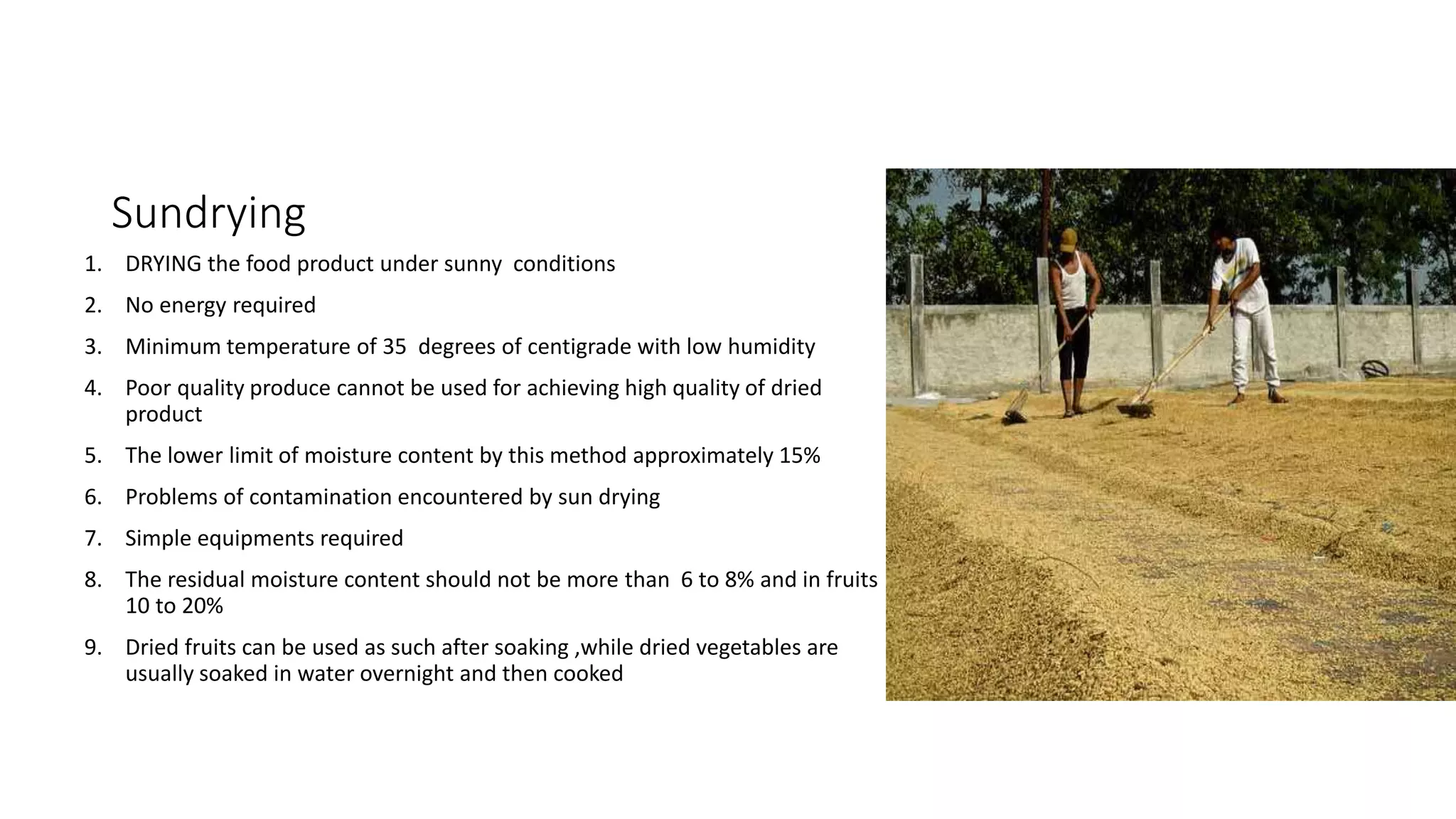
Sundrying
1. DRYING the food product under sunny conditions
2. No energy required
3. Minimum temperature of 35 degrees of centigrade with low humidity
4. Poor quality produce cannot be used for achieving high quality of dried
product
5. The lower limit of moisture content by this method approximately 15%
6. Problems of contamination encountered by sun drying
7. Simple equipments required
8. The residual moisture content should not be more than 6 to 8% and in fruits
10 to 20%
9. Dried fruits can be used as such after soaking ,while dried vegetables are
usually soaked in water overnight and then cooked
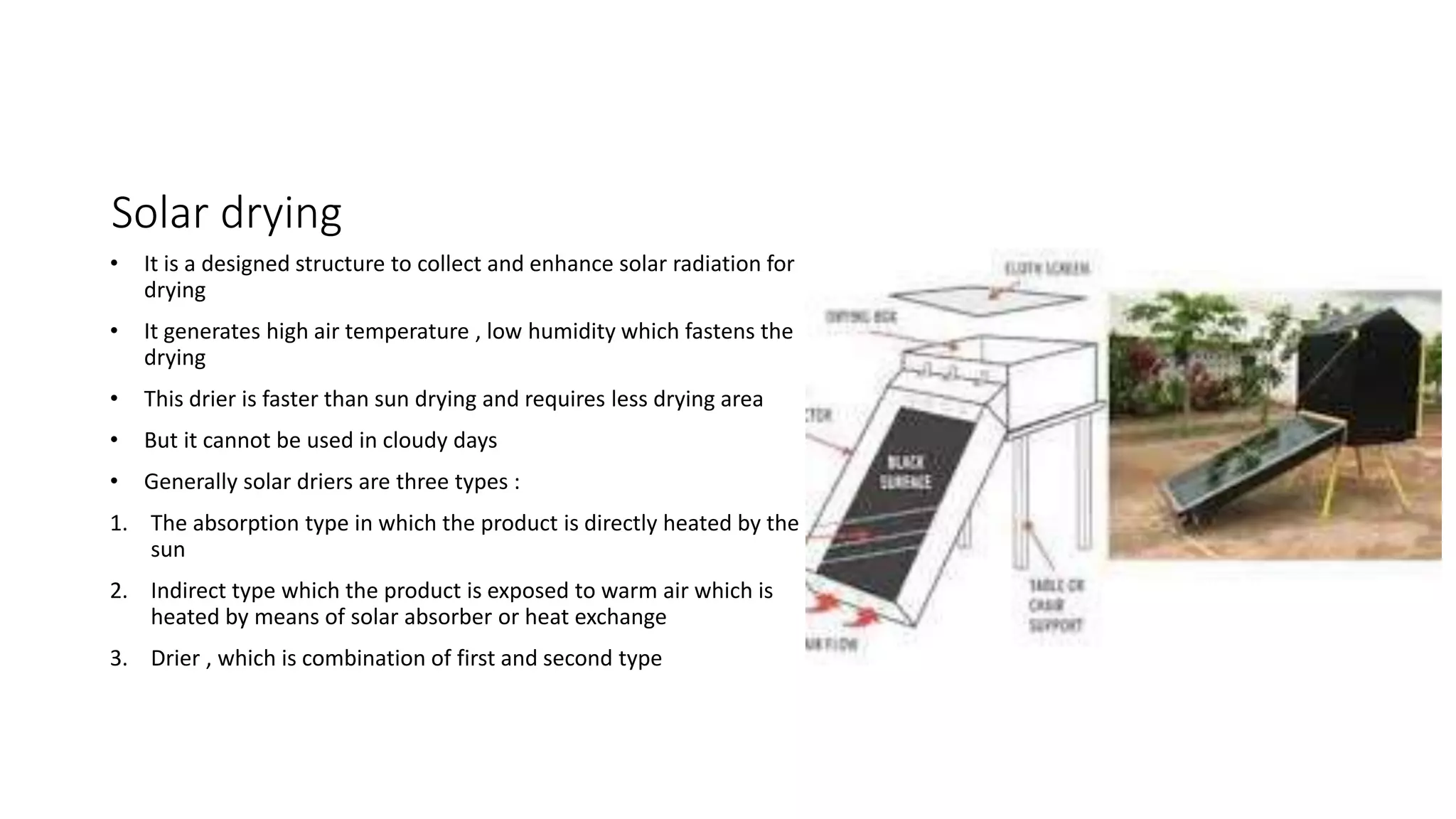
Solar drying
• It is a designed structure to collect and enhance solar radiation for
drying
• It generates high air temperature , low humidity which fastens the
drying
• This drier is faster than sun drying and requires less drying area
• But it cannot be used in cloudy days
• Generally solar driers are three types :
1. The absorption type in which the product is directly heated by the
sun
2. Indirect type which the product is exposed to warm air which is
heated by means of solar absorber or heat exchange
3. Drier , which is combination of first and second type
Shade drying
• This kind of method used for foods which lose their colour when exposed to direct
sunlight
• Generally herbs , green and red chillies ,okra, beans e.t.c are dried under shaded
and good air circulation
A HOME SCALE DEHYDRATOR OR
DRIER:
• It consists of a small galvanized box having dimensions of90/90/60c.m
• Lower portion it contain perforated iron tray
• Box is fitted on to a wooden frame which is kept about 2 to 3 feets above the ground
• At the top there are two silts which can be closed by shutters
• About 7 trays in the drier are placed
• The initial temperature of dehydrator is 43 degrees centigrade , which gradually increased to 60 to
66 degrees centigrade in case of vegetables and 66 to 71 degrees for fruits
• For a home scale dryer 100 to 200 grams of sulphur is required for 25kgs fruit and time required
for drying is generally 30 minutes to 120 minutes
Oven drying
• A conventional oven with a thermostatic setting of 60 degrees centigrade
is suitable for oven drying of fruits , vegetables, fruit leathers and meats
• This is a kind of cabinet driver
Kiln drier
• Also known as evaporator
• Consists of 2 floors
• On the top of floor ,food to be dried is spread and on the lower floor , the
furnace is housed
• Heat is conveyed by a ventilator
• Generally used for storing large pieces of food
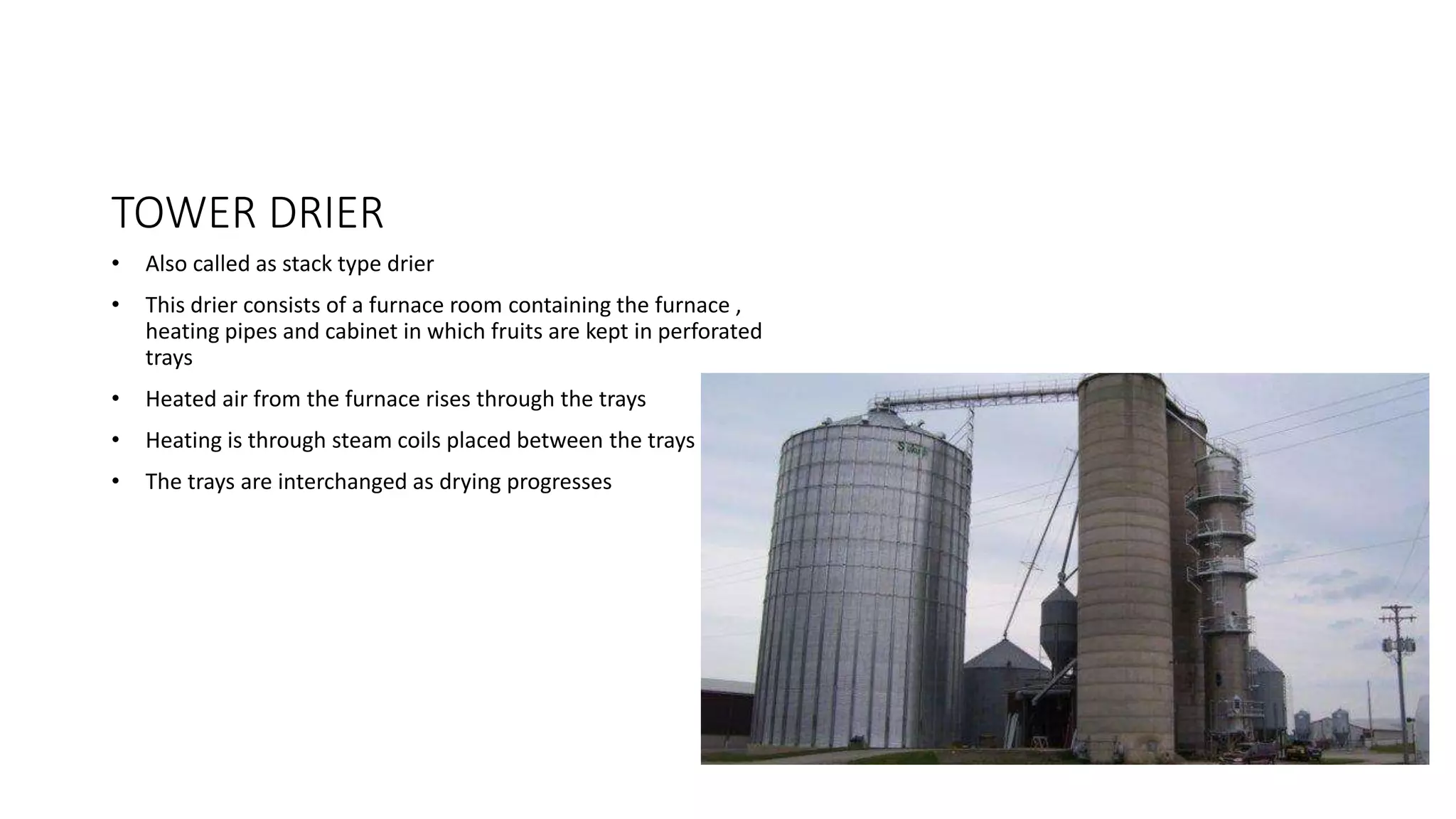
TOWER DRIER
• Also called as stack type drier
• This drier consists of a furnace room containing the furnace ,
heating pipes and cabinet in which fruits are kept in perforated
trays
• Heated air from the furnace rises through the trays
• Heating is through steam coils placed between the trays
• The trays are interchanged as drying progresses
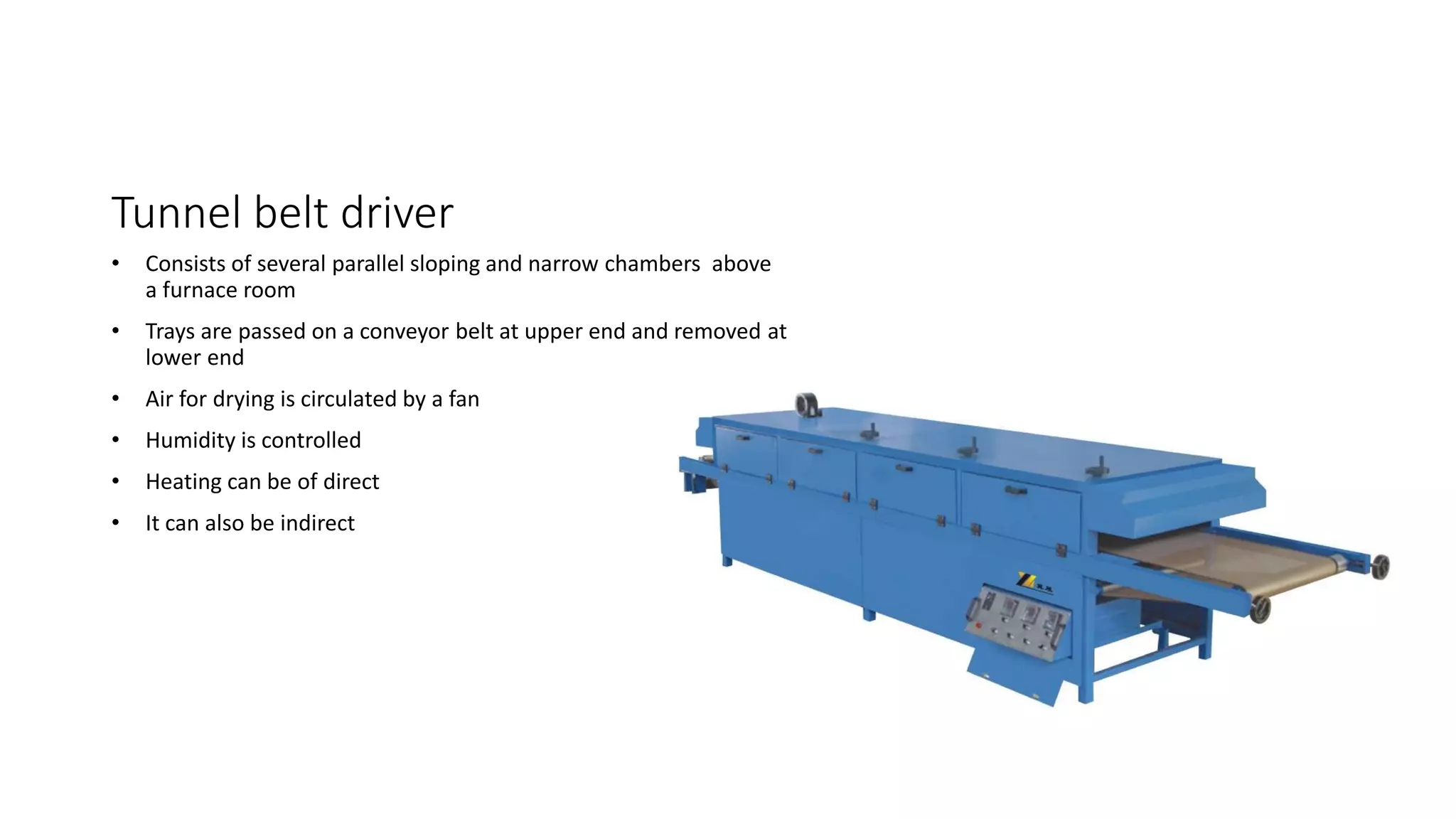
Tunnel belt driver
• Consists of several parallel sloping and narrow chambers above
a furnace room
• Trays are passed on a conveyor belt at upper end and removed at
lower end
• Air for drying is circulated by a fan
• Humidity is controlled
• Heating can be of direct
• It can also be indirect
Belt trough dryer
• In this drier belt is in the form of trough , which is made of metal mesh
• Hot air is blown through the mesh and food pieces lying on the trough are dried in
the process
Fluidized bed drying
• In this method ,food pieces are fed on a porous plate hot air is
blown up from the pores through the food particles with just
enough force to suspend them in gentle boiling motion
• The fresh food is fed from one side of the drier and other side it is
removed
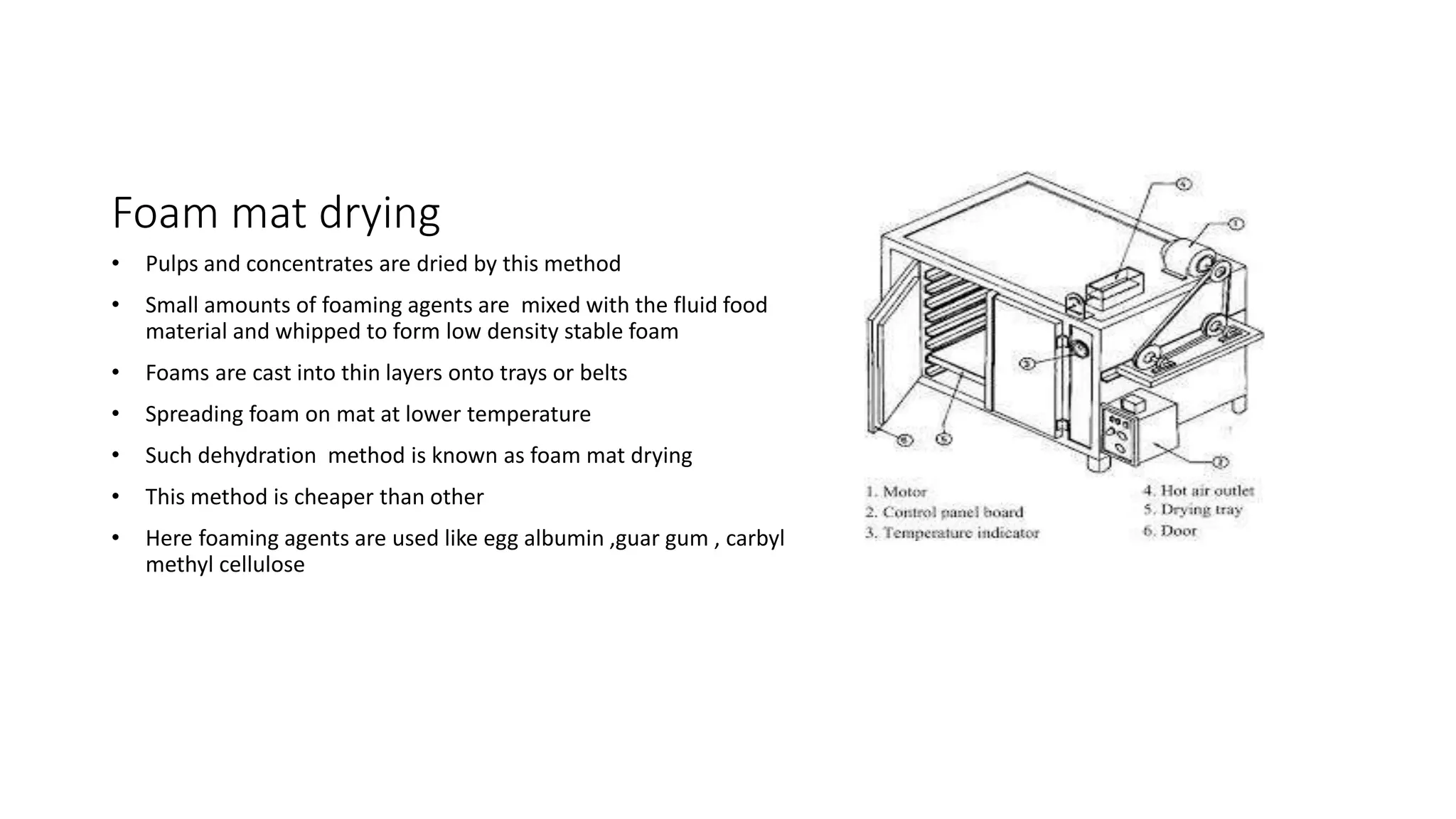
Foam mat drying
• Pulps and concentrates are dried by this method
• Small amounts of foaming agents are mixed with the fluid food
material and whipped to form low density stable foam
• Foams are cast into thin layers onto trays or belts
• Spreading foam on mat at lower temperature
• Such dehydration method is known as foam mat drying
• This method is cheaper than other
• Here foaming agents are used like egg albumin ,guar gum , carbyl
methyl cellulose
spray drying
• It is used to dry purees ,low viscosity pastes and liquids ,which can be atomized
• Dried products at the bottom was collected
• Automization of minute droplets results in drying in a matter of seconds with
inlet temperature of about 200 degrees centigrade
• Milk and coffee can be made for dehydration for obtaining high quality product
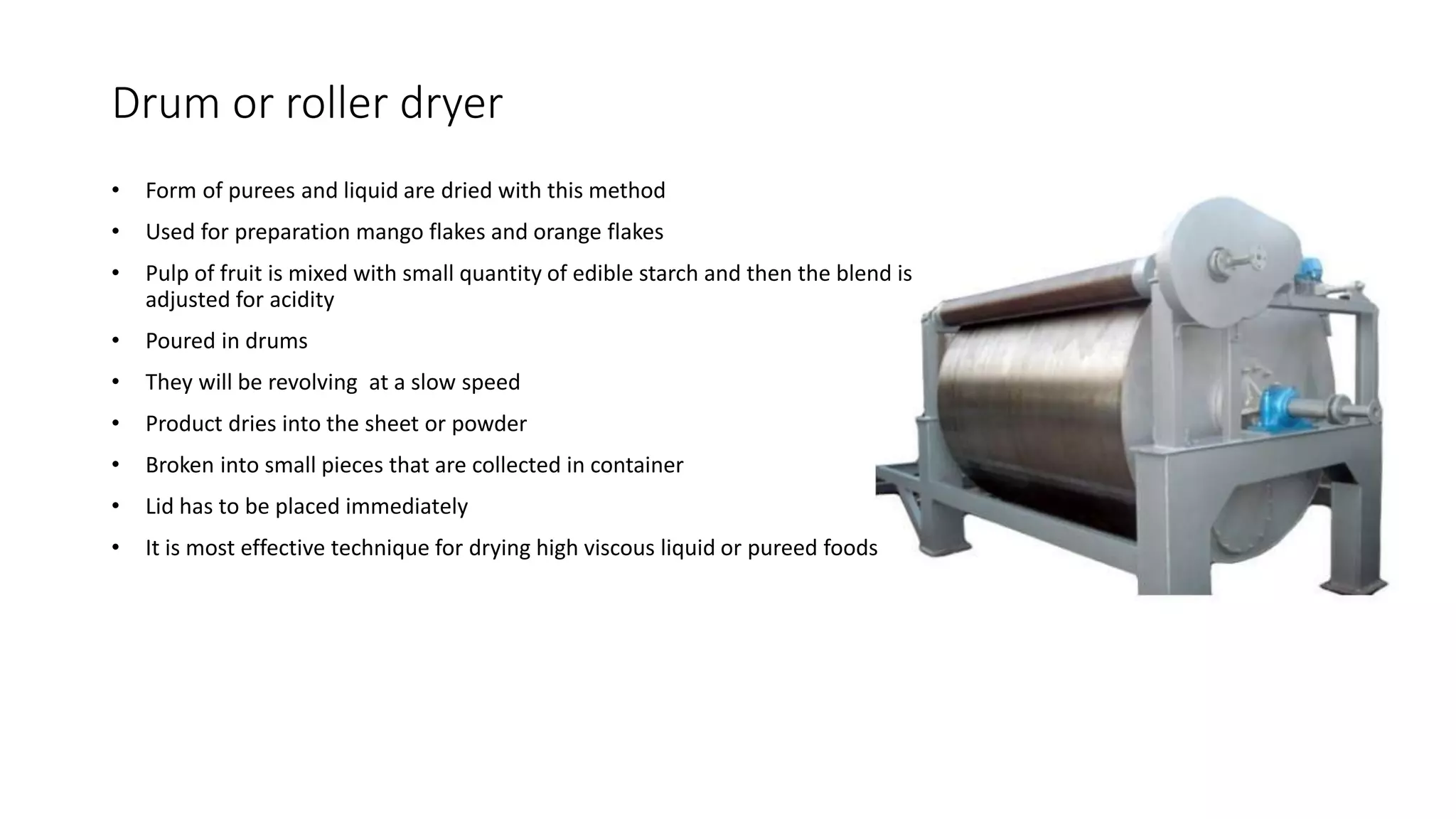
Drum or roller dryer
• Form of purees and liquid are dried with this method
• Used for preparation mango flakes and orange flakes
• Pulp of fruit is mixed with small quantity of edible starch and then the blend is
adjusted for acidity
• Poured in drums
• They will be revolving at a slow speed
• Product dries into the sheet or powder
• Broken into small pieces that are collected in container
• Lid has to be placed immediately
• It is most effective technique for drying high viscous liquid or pureed foods
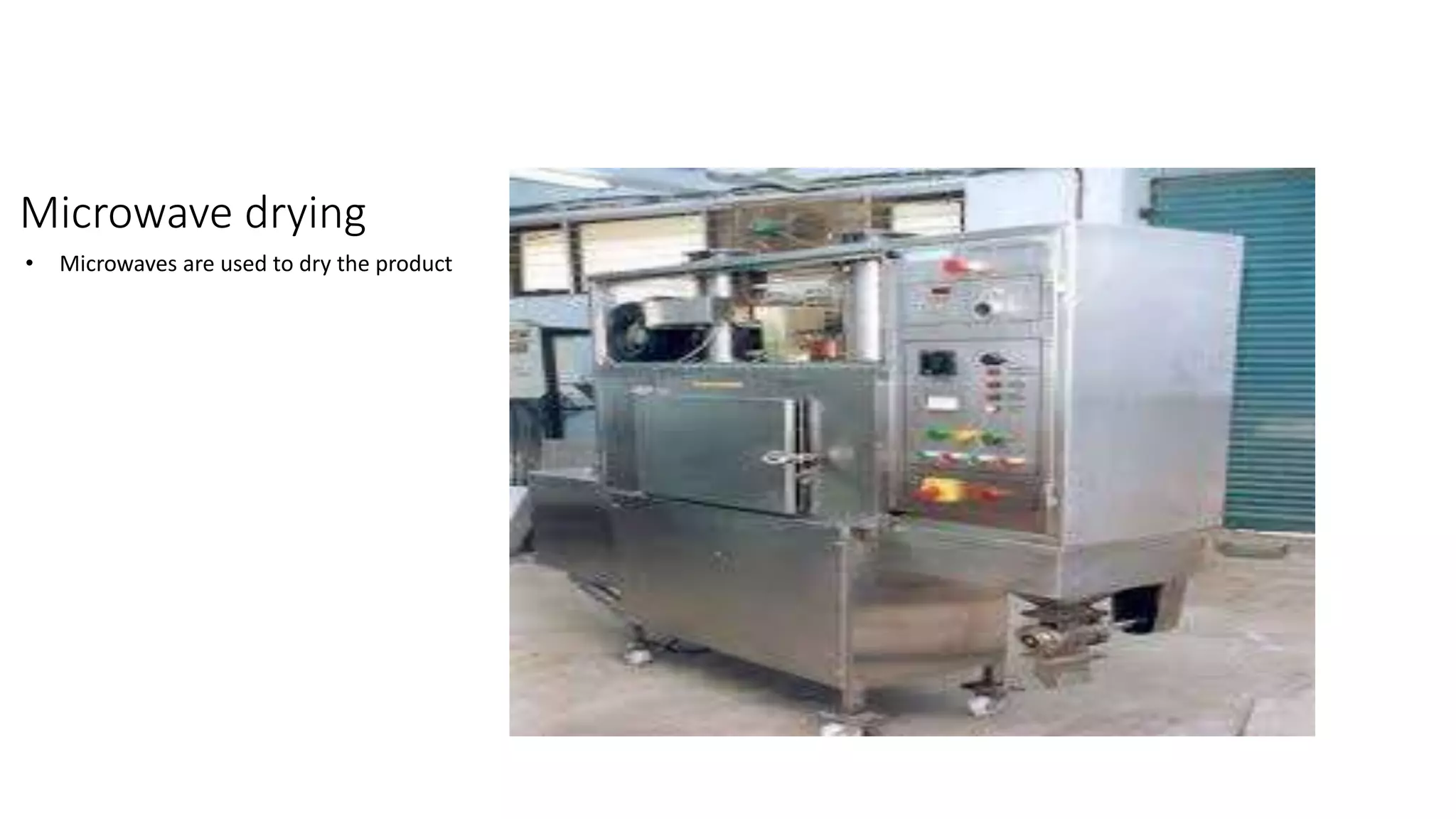
Microwave drying
• Microwaves are used to dry the product
Vacuum puffing and dehydration
• Drying comparatively at low temperature, vacuum driers are necessary
• Puffing of food obtained by sudden application of vacuum
• Potato pieces are usually cooked
• Instant flashing of water facilitates drying
Freeze drying
• Foods in the pieces and liquids are stored by this method
• Fruit juice concentrates are manufactured using freezing
• Frozen trays are dried under vacuum
• Low vapor pressure is subjected , water can evaporate from ice without melting
• Dried product is hygroscopic and reconstitutes readily
• Taste ,flavor of fruit juice hastened
ACCELERATED FREEZE DRYING
• This is used for drying of food material without disturbing their size and
texture
• Product has a good reconstitution property ,taste and flavor
• The pieces of material are kept pressed between two perforated or wire mesh
trays inside a cabinet freeze drier
• As the material dries , the bulk of the pieces is gradually reduced by
decreasing the clearance between the trays is reduced
• The dried material retains its shape and regains on rehydration
• Meat etc. are dried using this technique
Process of drying
1. Selection : The fruits should be in mature condition , sound and
firm
• Different lots at various stages of maturity must not be mix each
other ;as this result in a poor dried condition
2.sorting:
• Done to remove any decayed parts
• Damaged parts which are attacked by pest ,disease and infection
should be removed
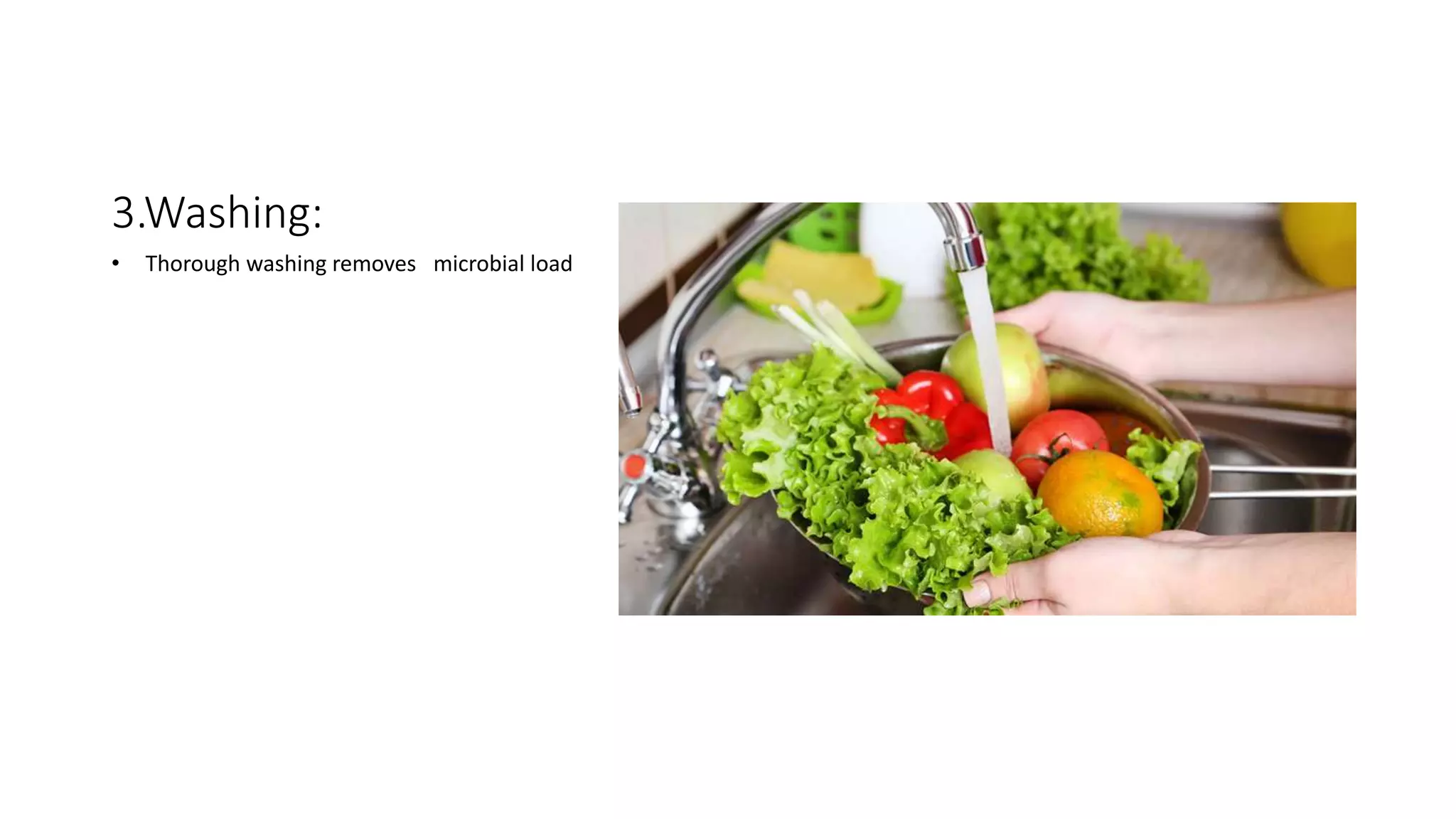
3.Washing:
• Thorough washing removes microbial load
4.peeling:
• It can be done by peelers, knives, by machines
• For thick skinned vegetables dipping in solution of lye
5.Sub division of raw material:
• Involves cutting or sectioning of vegetables
• Important to slice all at one size
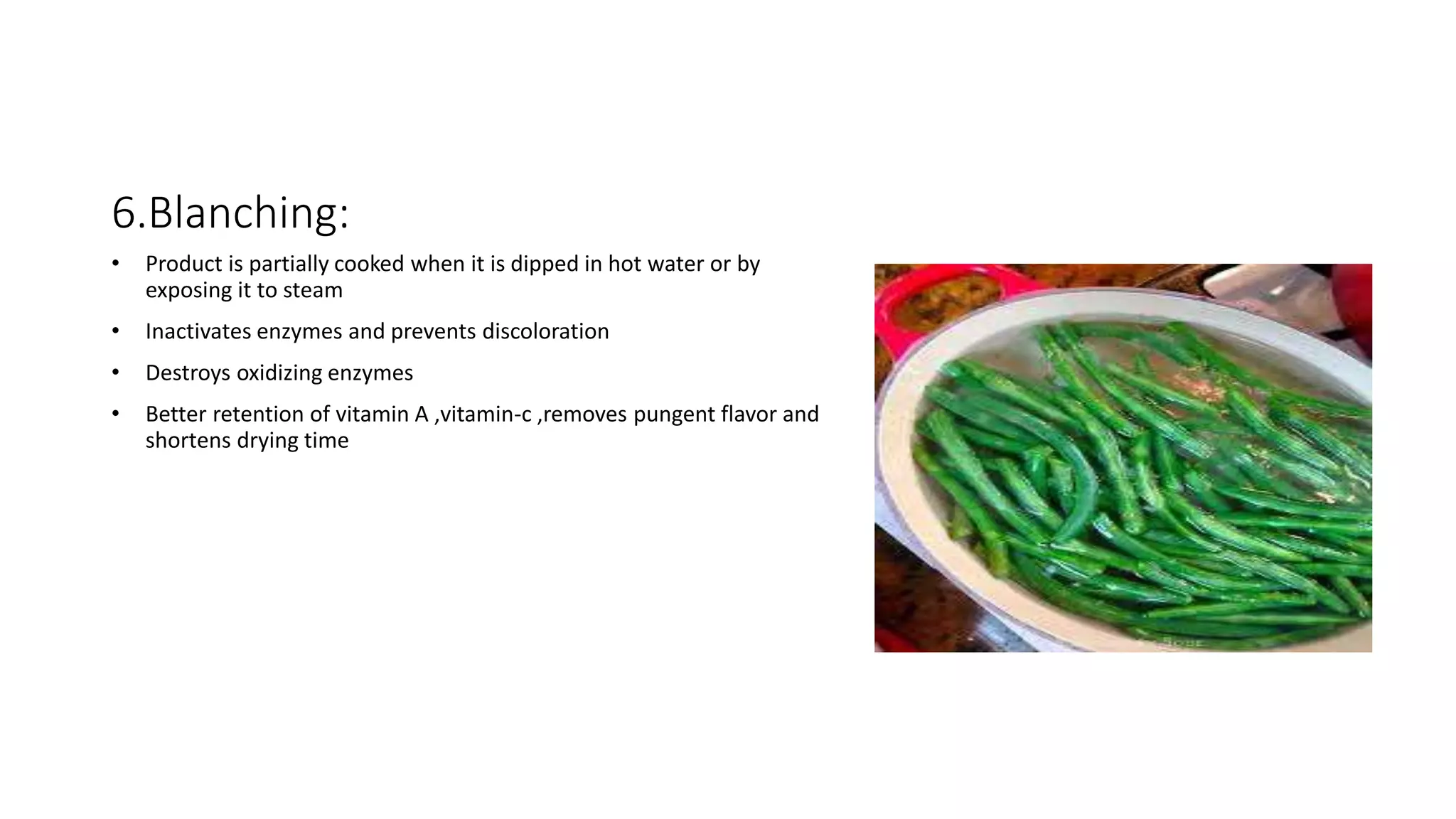
6.Blanching:
• Product is partially cooked when it is dipped in hot water or by
exposing it to steam
• Inactivates enzymes and prevents discoloration
• Destroys oxidizing enzymes
• Better retention of vitamin A ,vitamin-c ,removes pungent flavor and
shortens drying time
7.sulphiting:
• It involves in dipping the material in 1 to 2 percent potassium
bisulphate (KMS) or exposing the product to Sulphur fumes
(done in a closed room),respectively
• Sulphur prevents mold growth and preserves colour of light
coloured vegetables , repels insects and conserves vitamin –A
and vitamin –C
• Carotenoids preserved by coating with starch
• Food is exposed to Sulphur fumes in such a way that 1000-3000
ppm of it is absorbed
• Sulphuring of the fruit is done at the rate of 1.8 to 3.6 kg of
Sulphur per tonne of fruit
• After sulphuring , the trays are kept in the sun with occasionally
turning of the fruit till it is dried.
8.Drying:
Product is kept for drying
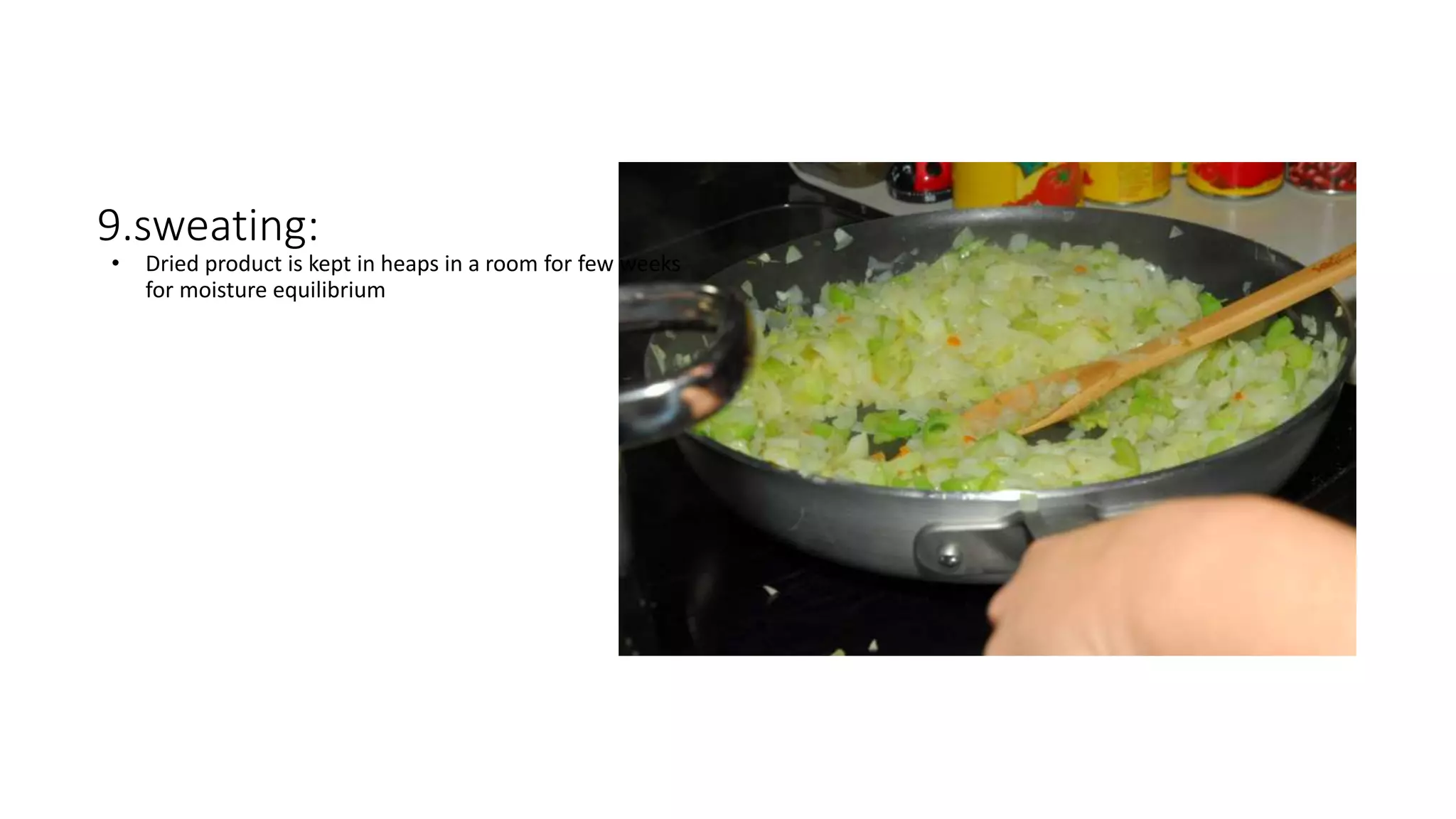
9.sweating:
• Dried product is kept in heaps in a room for few weeks
for moisture equilibrium
10.packing:
• Plastic or polyethene covers can be used
• Aluminum foils ,cardboard etc. can also be used
• Tin as such is not suitable as it becomes rusty but can be used after
coating with inert gas like N2
11.
• Some fruits and vegetables ,in particular ,banana , apples and potatoes go brown quickly
• When left in air after peeling and slicing
• This discoloration due to phenol oxidase
• To prevent slices from going brown ,they must be kept under until drying can be started
• For certain fruits like grapes ,figs etc
• Alkali(lye) dipping is done to help quicker drying due to the appearance of cracks using 0.1-1.5 percent Na2Co3 solution
• Acid dipping for apples and pears is done to prevent browing using 1percent ascorbic acid and 1.25 percent malic acid

Preservation by drying

  • 1.
    PRESERVATION OF FOODS BY DRYING PRINICIPLESAND METHODS OF DRYING BY N.SAI CHANDAN CLASS:NAG-A U.I.D:111718012050
  • 2.
    TOPICS INCLUDED • INTRODUCTION •PRINCIPLE • ADVANTAGES OF DRYING • FACTORS INFLUENCING DRYING • TYPES OF DRYING: 1) SUN DRYING 2) SOLAR DRYING 3) SHADE DRYING
  • 3.
    • A HOMESCALE DEHYDRATOR OR DRIER: 1. OVEN DRYING 2. KILN DRYING 3. TOWER DRIER 4. TUNNEL BELT DRYER 5. BELT-TROUGH DRIER 6. FLUDIZED BED DRYING 7. FOAM MAT DRYING
  • 4.
    8.SPRAY DRYING 9.DRUM ORROLLER DRYING 10.MICROWAVE DRYING 11.VACCUM PUFFING AND DEHYDRATION 12.FREEZE DRYING 13.ACCELERATED FREEZE DRYING • PROCESS OF DRYING
  • 5.
    INTRODUCTION: • Drying isthe oldest method of food preservation • Process derived from nature • Microorganisms need free water in order to grow and multiply • During drying ,the water content of the food is reduced to critical level below which microorganisms cannot grow
  • 6.
    PRINICIPLE OF PRESERVATIONBY DRYING: • Principle behind drying is sufficient moisture is removed , which is removed , which is essential for of microorganisms and for enzyme activity • Removal of moisture increases the storage of the product due to reduced water activity • If the moisture content is reduced to1 to 5 per cent then the project can be stored more than 1year • Processing should be done such a way that the food value , natural flavor and characteristic cooking quality of fresh matter retained after drying • A good dried product on reconstitution with water should resemble the original product
  • 7.
    ADVANTAGES OF DRYING •Drying is advantageous for being cheaper than the other methods of preservation with fewer requirements of equipment • Storage of dried food products does not require special facilities like refrigeration e.t.c • Dried food products are simple to store and pack because of their low volume
  • 8.
    Factors in controlof drying: 1. Composition of raw materials-foods containing high amount of sugar or other solutes dry slowly 2. Size , shape , arrangement of stacking of produce : greater the surface then greater the drying 3. Temperature as well as humidity and velocity of air :greater the temperature differential between the product and the drying medium faster the product dries ,lower the humidity of environment the faster the drying will be 4. Pressure :lower the atmospheric pressure the lower temperature required to evaporate water 5. Heat transfer to surface :the fastest method of heat transfer is radiation consecutively followed by convection and conduction
  • 9.
    Types of drying: Dryingcan be of mechanical or natural type 1. In natural method of drying there is influence of air , wind , light , temperature and there is no control over temperature 2. In mechanical method of drying includes heated air , direct contact of heated surface,application of energy from a radiating microwave or dielectric source
  • 10.
    Sundrying 1. DRYING thefood product under sunny conditions 2. No energy required 3. Minimum temperature of 35 degrees of centigrade with low humidity 4. Poor quality produce cannot be used for achieving high quality of dried product 5. The lower limit of moisture content by this method approximately 15% 6. Problems of contamination encountered by sun drying 7. Simple equipments required 8. The residual moisture content should not be more than 6 to 8% and in fruits 10 to 20% 9. Dried fruits can be used as such after soaking ,while dried vegetables are usually soaked in water overnight and then cooked
  • 11.
    Solar drying • Itis a designed structure to collect and enhance solar radiation for drying • It generates high air temperature , low humidity which fastens the drying • This drier is faster than sun drying and requires less drying area • But it cannot be used in cloudy days • Generally solar driers are three types : 1. The absorption type in which the product is directly heated by the sun 2. Indirect type which the product is exposed to warm air which is heated by means of solar absorber or heat exchange 3. Drier , which is combination of first and second type
  • 12.
    Shade drying • Thiskind of method used for foods which lose their colour when exposed to direct sunlight • Generally herbs , green and red chillies ,okra, beans e.t.c are dried under shaded and good air circulation
  • 13.
    A HOME SCALEDEHYDRATOR OR DRIER: • It consists of a small galvanized box having dimensions of90/90/60c.m • Lower portion it contain perforated iron tray • Box is fitted on to a wooden frame which is kept about 2 to 3 feets above the ground • At the top there are two silts which can be closed by shutters • About 7 trays in the drier are placed • The initial temperature of dehydrator is 43 degrees centigrade , which gradually increased to 60 to 66 degrees centigrade in case of vegetables and 66 to 71 degrees for fruits • For a home scale dryer 100 to 200 grams of sulphur is required for 25kgs fruit and time required for drying is generally 30 minutes to 120 minutes
  • 14.
    Oven drying • Aconventional oven with a thermostatic setting of 60 degrees centigrade is suitable for oven drying of fruits , vegetables, fruit leathers and meats • This is a kind of cabinet driver
  • 15.
    Kiln drier • Alsoknown as evaporator • Consists of 2 floors • On the top of floor ,food to be dried is spread and on the lower floor , the furnace is housed • Heat is conveyed by a ventilator • Generally used for storing large pieces of food
  • 16.
    TOWER DRIER • Alsocalled as stack type drier • This drier consists of a furnace room containing the furnace , heating pipes and cabinet in which fruits are kept in perforated trays • Heated air from the furnace rises through the trays • Heating is through steam coils placed between the trays • The trays are interchanged as drying progresses
  • 17.
    Tunnel belt driver •Consists of several parallel sloping and narrow chambers above a furnace room • Trays are passed on a conveyor belt at upper end and removed at lower end • Air for drying is circulated by a fan • Humidity is controlled • Heating can be of direct • It can also be indirect
  • 18.
    Belt trough dryer •In this drier belt is in the form of trough , which is made of metal mesh • Hot air is blown through the mesh and food pieces lying on the trough are dried in the process
  • 19.
    Fluidized bed drying •In this method ,food pieces are fed on a porous plate hot air is blown up from the pores through the food particles with just enough force to suspend them in gentle boiling motion • The fresh food is fed from one side of the drier and other side it is removed
  • 20.
    Foam mat drying •Pulps and concentrates are dried by this method • Small amounts of foaming agents are mixed with the fluid food material and whipped to form low density stable foam • Foams are cast into thin layers onto trays or belts • Spreading foam on mat at lower temperature • Such dehydration method is known as foam mat drying • This method is cheaper than other • Here foaming agents are used like egg albumin ,guar gum , carbyl methyl cellulose
  • 21.
    spray drying • Itis used to dry purees ,low viscosity pastes and liquids ,which can be atomized • Dried products at the bottom was collected • Automization of minute droplets results in drying in a matter of seconds with inlet temperature of about 200 degrees centigrade • Milk and coffee can be made for dehydration for obtaining high quality product
  • 22.
    Drum or rollerdryer • Form of purees and liquid are dried with this method • Used for preparation mango flakes and orange flakes • Pulp of fruit is mixed with small quantity of edible starch and then the blend is adjusted for acidity • Poured in drums • They will be revolving at a slow speed • Product dries into the sheet or powder • Broken into small pieces that are collected in container • Lid has to be placed immediately • It is most effective technique for drying high viscous liquid or pureed foods
  • 23.
    Microwave drying • Microwavesare used to dry the product
  • 24.
    Vacuum puffing anddehydration • Drying comparatively at low temperature, vacuum driers are necessary • Puffing of food obtained by sudden application of vacuum • Potato pieces are usually cooked • Instant flashing of water facilitates drying
  • 25.
    Freeze drying • Foodsin the pieces and liquids are stored by this method • Fruit juice concentrates are manufactured using freezing • Frozen trays are dried under vacuum • Low vapor pressure is subjected , water can evaporate from ice without melting • Dried product is hygroscopic and reconstitutes readily • Taste ,flavor of fruit juice hastened
  • 26.
    ACCELERATED FREEZE DRYING •This is used for drying of food material without disturbing their size and texture • Product has a good reconstitution property ,taste and flavor • The pieces of material are kept pressed between two perforated or wire mesh trays inside a cabinet freeze drier • As the material dries , the bulk of the pieces is gradually reduced by decreasing the clearance between the trays is reduced • The dried material retains its shape and regains on rehydration • Meat etc. are dried using this technique
  • 27.
    Process of drying 1.Selection : The fruits should be in mature condition , sound and firm • Different lots at various stages of maturity must not be mix each other ;as this result in a poor dried condition
  • 28.
    2.sorting: • Done toremove any decayed parts • Damaged parts which are attacked by pest ,disease and infection should be removed
  • 29.
    3.Washing: • Thorough washingremoves microbial load
  • 30.
    4.peeling: • It canbe done by peelers, knives, by machines • For thick skinned vegetables dipping in solution of lye
  • 31.
    5.Sub division ofraw material: • Involves cutting or sectioning of vegetables • Important to slice all at one size
  • 32.
    6.Blanching: • Product ispartially cooked when it is dipped in hot water or by exposing it to steam • Inactivates enzymes and prevents discoloration • Destroys oxidizing enzymes • Better retention of vitamin A ,vitamin-c ,removes pungent flavor and shortens drying time
  • 33.
    7.sulphiting: • It involvesin dipping the material in 1 to 2 percent potassium bisulphate (KMS) or exposing the product to Sulphur fumes (done in a closed room),respectively • Sulphur prevents mold growth and preserves colour of light coloured vegetables , repels insects and conserves vitamin –A and vitamin –C • Carotenoids preserved by coating with starch • Food is exposed to Sulphur fumes in such a way that 1000-3000 ppm of it is absorbed • Sulphuring of the fruit is done at the rate of 1.8 to 3.6 kg of Sulphur per tonne of fruit • After sulphuring , the trays are kept in the sun with occasionally turning of the fruit till it is dried.
  • 34.
  • 35.
    9.sweating: • Dried productis kept in heaps in a room for few weeks for moisture equilibrium
  • 36.
    10.packing: • Plastic orpolyethene covers can be used • Aluminum foils ,cardboard etc. can also be used • Tin as such is not suitable as it becomes rusty but can be used after coating with inert gas like N2
  • 37.
    11. • Some fruitsand vegetables ,in particular ,banana , apples and potatoes go brown quickly • When left in air after peeling and slicing • This discoloration due to phenol oxidase • To prevent slices from going brown ,they must be kept under until drying can be started • For certain fruits like grapes ,figs etc • Alkali(lye) dipping is done to help quicker drying due to the appearance of cracks using 0.1-1.5 percent Na2Co3 solution • Acid dipping for apples and pears is done to prevent browing using 1percent ascorbic acid and 1.25 percent malic acid