FRUIT JUICE
PREPARATION
PRESENTED BY: AYAZ AHMAD FYAZ
CLASS NO: 258
TEACHER: IHSAN MABOOD QAZI
SUBJECT: BEVERAGE TECHNOLOGY
DEPARTMENT: FOOD SCIENCE & TECHNOLOGY
INTRODUCTION
 Fruits play an important role in human nutrition.
 Before the 20th century, drinking squeezed fruit juices was the privilege of only a few.
 Welch was the first to preserve grape juice with heat treatment in America in 1869,
 followed by M¨uller-Thurgan in Switzerland in 1896
 Thus began the production of preserved fruit juice
 A wide range of drinks can be made using extracted fruit juice or fruit pulp as the base
material.
 The types of drink made from fruit can be separated into two basic types;
 - those that are drunk straight after opening
 - those that are used little by little from bottles which are stored between use.
CONT…
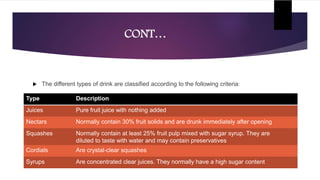
 The different types of drink are classified according to the following criteria:
Type Description
Juices Pure fruit juice with nothing added
Nectars Normally contain 30% fruit solids and are drunk immediately after opening
Squashes Normally contain at least 25% fruit pulp mixed with sugar syrup. They are
diluted to taste with water and may contain preservatives
Cordials Are crystal-clear squashes
Syrups Are concentrated clear juices. They normally have a high sugar content
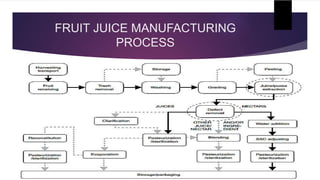
FRUIT JUICE MANUFACTURING
PROCESS
PREPARATION OF RAW MATERIALS
 mature, undamaged fruits are selected
 mouldy or under-ripe are sorted and removed
 The fruits are washed in clean water (removes mold and bacteria that spoil the
juice)
 It may be necessary to chlorinate the water
 Fruits are graded based on sizes
 The fruit is peeled to remove stones or seeds
 The fruit is chopped into pieces
JUICE EXTRACTION
 There are several methods to extract juice depending on the type of fruit
 For citrus fruits which are naturally juicy, the best option is to use a presser
 Some fruits such as melon and papaya are steamed to release the juice
 Apples are pressed (hydraulic, pneumatic, screw, or basket press) and fruits such as
mango, guava, sour sop, pineapple, strawberry must be pulped to extract the juice
 The fruit pieces are pushed through a perforated metal plate that crushes and turns them
into a pulp
 Some fruits can be pulped in a liquidiser and then filtered to remove the fruit pieces
 There is a range of equipment available that varies in size and in the type of power supply
CONT…
 polygalacturonase and pectinlyase and cellulase are used to hydrolyze pectin and
fruit cell wall, facilitating juice release during pressing and increasing yield
 Enzyme treatment requires heating because it is most effective at around 50 ºC
and requires some reaction time
 Juice yield is affected by pressing conditions (temperature, pressure, presence,
and type of pressing aid)
 Typical juice yields range between 70% and 95%
STRAINING, FILTRATION AND
CLARIFICATION
 Although juice is naturally cloudy it is strained or filtered (press, vacuum, and rotary filters)
to make it clear
 The production of clear juice requires the removal of suspended material and prevention of
the development of turbidity after juice bottling
 The most common cause of turbidity in clear fruit juices can be attributed to the interaction
between proteins and polyphenols
 Freshly pressed juice contains suspended solids that are deliberately precipitated prior to
filtration. This precipitation step is' called clarification
 Other measures often are taken to remove soluble materials that have the potential to form
after-bottling hazes. These measures are often called fining
 It may be necessary to use pectic enzymes to break down the pectin and to help clear the
juice
BLENDING AND PASTURIZATION
 Juices are sold either pure or sweetened.
 Fruit squashes would normally contain about 25% fruit material mixed with a sugar syrup to give a
final sugar concentration of about 40%. Squashes are diluted with water prior to use and, as the
bottle is opened, partly used and then stored, it is necessary to add a preservative (for example
800ppm sodium benzoate).
 Another popular product is fruit nectar, which is a sweet mixture of fruit pulp, sugar and water which
is consumed on a 'one shot' basis. Essentially, these consist of a 30% mix of fruit pulp and sugar
syrup to give a final sugar level of about 12-14%.
 All fruits contain sugar, usually around 8-10%.
CONT…
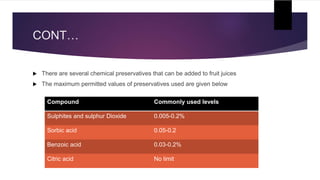
 There are several chemical preservatives that can be added to fruit juices
 The maximum permitted values of preservatives used are given below
Compound Commonly used levels
Sulphites and sulphur Dioxide 0.005-0.2%
Sorbic acid 0.05-0.2
Benzoic acid 0.03-0.2%
Citric acid No limit
CONT…
PASTURIZATION (microbial & enzyme inactivation)
 Yeasts, molds, and bacteria are commonly found in fruit juices, which if not killed
can spoil the final product
 Apart from these micro-organisms different enzymes are present which need to
be inactivated in order to stable the product
 Pasteurization time for different fruit juices are given below
CONT…
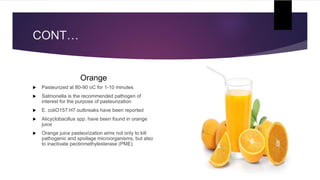
Orange
 Pasteurized at 80-90 oC for 1-10 minutes
 Salmonella is the recommended pathogen of
interest for the purpose of pasteurization
 E. coliO157:H7 outbreaks have been reported
 Alicyclobacillus spp. have been found in orange
juice
 Orange juice pasteurization aims not only to kill
pathogenic and spoilage microorganisms, but also
to inactivate pectinmethylesterase (PME)
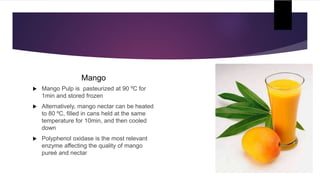
Mango
 Mango Pulp is pasteurized at 90 ºC for
1min and stored frozen
 Alternatively, mango nectar can be heated
to 80 ºC, filled in cans held at the same
temperature for 10min, and then cooled
down
 Polyphenol oxidase is the most relevant
enzyme affecting the quality of mango
pureé and nectar
CONT…
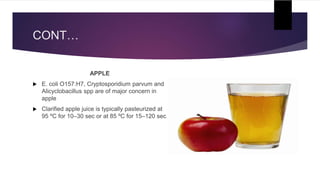
APPLE
 E. coli O157:H7, Cryptosporidium parvum and
Alicyclobacillus spp are of major concern in
apple
 Clarified apple juice is typically pasteurized at
95 ºC for 10–30 sec or at 85 ºC for 15–120 sec
CONT…
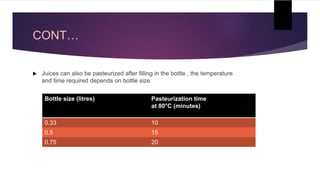
 Juices can also be pasteurized after filling in the bottle , the temperature
and time required depends on bottle size
Bottle size (litres) Pasteurization time
at 80°C (minutes)
0.33 10
0.5 15
0.75 20
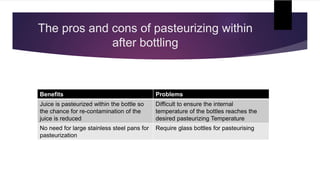
The pros and cons of pasteurizing within
after bottling
Benefits Problems
Juice is pasteurized within the bottle so
the chance for re-contamination of the
juice is reduced
Difficult to ensure the internal
temperature of the bottles reaches the
desired pasteurizing Temperature
No need for large stainless steel pans for
pasteurization
Require glass bottles for pasteurising
FILLING, SEALING & STERILIZATION
 In all cases, the products should be hot-filled into clean, sterilized bottles
 After filling hot, the bottles are capped and laid on their sides to cool prior to
labeling
 Different equipments are used for sterilization, filling, capping and labeling of the
products
PACKAGING MATERIALS
 The soft drinks sector uses a variety of different packaging formats. The main types are listed
below:
 Glass is the oldest type of packaging for soft drinks, fruit juices and waters. The advantage of
glass packaging is that it is chemically inert and will not affect quality, odor or taste of product. It
is strong, rigid and 100% recyclable.
 PET (polyethylene terephthalate) is a popular choice for packaging because it is lightweight,
flexible and recyclable. It can be used for both still and carbonated products.
 Cans, including aluminium and steel, are mainly used for carbonated drinks. They are 100%
recyclable and lightweight. Using recycled aluminium to make a new can saves 95% of the
energy that would be needed to make a can from virgin materials
 Cartons are a major packaging format for still drinks and fruit juices. They protect the freshness,
flavors and nutritional qualities of both fresh and long-life drink products, enabling distribution at
ambient temperatures or under refrigerated conditions
LABELLING
 The following information must appear by law on fruit drink labels:
 the name of the food;
 weight or volume;
 ingredient list;
 date mark and storage conditions;
 preparation instructions;
 name and address of manufacturer, packer or seller;
 place of origin;
 lot (or batch) mark;
 nutrition information
Fruit Juice Preparation

Fruit Juice Preparation

  • 1.
    FRUIT JUICE PREPARATION PRESENTED BY:AYAZ AHMAD FYAZ CLASS NO: 258 TEACHER: IHSAN MABOOD QAZI SUBJECT: BEVERAGE TECHNOLOGY DEPARTMENT: FOOD SCIENCE & TECHNOLOGY
  • 2.
    INTRODUCTION  Fruits playan important role in human nutrition.  Before the 20th century, drinking squeezed fruit juices was the privilege of only a few.  Welch was the first to preserve grape juice with heat treatment in America in 1869,  followed by M¨uller-Thurgan in Switzerland in 1896  Thus began the production of preserved fruit juice  A wide range of drinks can be made using extracted fruit juice or fruit pulp as the base material.  The types of drink made from fruit can be separated into two basic types;  - those that are drunk straight after opening  - those that are used little by little from bottles which are stored between use.
  • 3.
    CONT…  The differenttypes of drink are classified according to the following criteria: Type Description Juices Pure fruit juice with nothing added Nectars Normally contain 30% fruit solids and are drunk immediately after opening Squashes Normally contain at least 25% fruit pulp mixed with sugar syrup. They are diluted to taste with water and may contain preservatives Cordials Are crystal-clear squashes Syrups Are concentrated clear juices. They normally have a high sugar content
  • 4.
  • 5.
    PREPARATION OF RAWMATERIALS  mature, undamaged fruits are selected  mouldy or under-ripe are sorted and removed  The fruits are washed in clean water (removes mold and bacteria that spoil the juice)  It may be necessary to chlorinate the water  Fruits are graded based on sizes  The fruit is peeled to remove stones or seeds  The fruit is chopped into pieces
  • 6.
    JUICE EXTRACTION  Thereare several methods to extract juice depending on the type of fruit  For citrus fruits which are naturally juicy, the best option is to use a presser  Some fruits such as melon and papaya are steamed to release the juice  Apples are pressed (hydraulic, pneumatic, screw, or basket press) and fruits such as mango, guava, sour sop, pineapple, strawberry must be pulped to extract the juice  The fruit pieces are pushed through a perforated metal plate that crushes and turns them into a pulp  Some fruits can be pulped in a liquidiser and then filtered to remove the fruit pieces  There is a range of equipment available that varies in size and in the type of power supply
  • 7.
    CONT…  polygalacturonase andpectinlyase and cellulase are used to hydrolyze pectin and fruit cell wall, facilitating juice release during pressing and increasing yield  Enzyme treatment requires heating because it is most effective at around 50 ºC and requires some reaction time  Juice yield is affected by pressing conditions (temperature, pressure, presence, and type of pressing aid)  Typical juice yields range between 70% and 95%
  • 8.
    STRAINING, FILTRATION AND CLARIFICATION Although juice is naturally cloudy it is strained or filtered (press, vacuum, and rotary filters) to make it clear  The production of clear juice requires the removal of suspended material and prevention of the development of turbidity after juice bottling  The most common cause of turbidity in clear fruit juices can be attributed to the interaction between proteins and polyphenols  Freshly pressed juice contains suspended solids that are deliberately precipitated prior to filtration. This precipitation step is' called clarification  Other measures often are taken to remove soluble materials that have the potential to form after-bottling hazes. These measures are often called fining  It may be necessary to use pectic enzymes to break down the pectin and to help clear the juice
  • 9.
    BLENDING AND PASTURIZATION Juices are sold either pure or sweetened.  Fruit squashes would normally contain about 25% fruit material mixed with a sugar syrup to give a final sugar concentration of about 40%. Squashes are diluted with water prior to use and, as the bottle is opened, partly used and then stored, it is necessary to add a preservative (for example 800ppm sodium benzoate).  Another popular product is fruit nectar, which is a sweet mixture of fruit pulp, sugar and water which is consumed on a 'one shot' basis. Essentially, these consist of a 30% mix of fruit pulp and sugar syrup to give a final sugar level of about 12-14%.  All fruits contain sugar, usually around 8-10%.
  • 10.
    CONT…  There areseveral chemical preservatives that can be added to fruit juices  The maximum permitted values of preservatives used are given below Compound Commonly used levels Sulphites and sulphur Dioxide 0.005-0.2% Sorbic acid 0.05-0.2 Benzoic acid 0.03-0.2% Citric acid No limit
  • 11.
    CONT… PASTURIZATION (microbial &enzyme inactivation)  Yeasts, molds, and bacteria are commonly found in fruit juices, which if not killed can spoil the final product  Apart from these micro-organisms different enzymes are present which need to be inactivated in order to stable the product  Pasteurization time for different fruit juices are given below
  • 12.
    CONT… Orange  Pasteurized at80-90 oC for 1-10 minutes  Salmonella is the recommended pathogen of interest for the purpose of pasteurization  E. coliO157:H7 outbreaks have been reported  Alicyclobacillus spp. have been found in orange juice  Orange juice pasteurization aims not only to kill pathogenic and spoilage microorganisms, but also to inactivate pectinmethylesterase (PME)
  • 13.
    Mango  Mango Pulpis pasteurized at 90 ºC for 1min and stored frozen  Alternatively, mango nectar can be heated to 80 ºC, filled in cans held at the same temperature for 10min, and then cooled down  Polyphenol oxidase is the most relevant enzyme affecting the quality of mango pureé and nectar
  • 14.
    CONT… APPLE  E. coliO157:H7, Cryptosporidium parvum and Alicyclobacillus spp are of major concern in apple  Clarified apple juice is typically pasteurized at 95 ºC for 10–30 sec or at 85 ºC for 15–120 sec
  • 15.
    CONT…  Juices canalso be pasteurized after filling in the bottle , the temperature and time required depends on bottle size Bottle size (litres) Pasteurization time at 80°C (minutes) 0.33 10 0.5 15 0.75 20
  • 16.
    The pros andcons of pasteurizing within after bottling Benefits Problems Juice is pasteurized within the bottle so the chance for re-contamination of the juice is reduced Difficult to ensure the internal temperature of the bottles reaches the desired pasteurizing Temperature No need for large stainless steel pans for pasteurization Require glass bottles for pasteurising
  • 17.
    FILLING, SEALING &STERILIZATION  In all cases, the products should be hot-filled into clean, sterilized bottles  After filling hot, the bottles are capped and laid on their sides to cool prior to labeling  Different equipments are used for sterilization, filling, capping and labeling of the products
  • 18.
    PACKAGING MATERIALS  Thesoft drinks sector uses a variety of different packaging formats. The main types are listed below:  Glass is the oldest type of packaging for soft drinks, fruit juices and waters. The advantage of glass packaging is that it is chemically inert and will not affect quality, odor or taste of product. It is strong, rigid and 100% recyclable.  PET (polyethylene terephthalate) is a popular choice for packaging because it is lightweight, flexible and recyclable. It can be used for both still and carbonated products.  Cans, including aluminium and steel, are mainly used for carbonated drinks. They are 100% recyclable and lightweight. Using recycled aluminium to make a new can saves 95% of the energy that would be needed to make a can from virgin materials  Cartons are a major packaging format for still drinks and fruit juices. They protect the freshness, flavors and nutritional qualities of both fresh and long-life drink products, enabling distribution at ambient temperatures or under refrigerated conditions
  • 19.
    LABELLING  The followinginformation must appear by law on fruit drink labels:  the name of the food;  weight or volume;  ingredient list;  date mark and storage conditions;  preparation instructions;  name and address of manufacturer, packer or seller;  place of origin;  lot (or batch) mark;  nutrition information