Course code:-RAWE
Course title:-Rural
Agriculture Work
Experience
Credit hour:-(0+4)
B.Sc.(Ag.) 4th Yr., INSTITUTE OF AGRICULTURE SCIENCES, BHU
07-10-2016

Meaning:
 Teaching is the process of providing opportunities for
students to produce relatively permanent change through
the engagement in experiences provided by the teacher.
 Teaching is a social process, to define it is very difficult,
because the teaching influenced by the political and social
backgrounds of the country
TEACHING

H.C. Morrison
 – Teaching is an intimate contact between a more mature
personality and a less mature one which is designed to
further the education of the latter.
J. Brubacher
 – Teaching is an arrangement and manipulation of a
situation in which there are gaps and obstructions, which
an individual will seek to overcome and from in which he
will learn in the course of doing so.
Definition by various
psychologist

 FORMAL- Which is systematically deliberate and
consciously impart.
• Generally occurs when young.
 IN FORMAL- It is teaching one get the outside of classroom
• Can occurs throughout life.
Types of Teaching

 The ultimate purpose of teaching is not merely to inform
people but to transform them to bring about the desired
changes in their behaviour
 If the learner has not learnt, the teacher has not taught
 Teaching is not filling a bucket; it is lighting a lamp
 Teaching is an intentional purposeful process, not a bit or
miss undertaking
Amplification

 Effective teaching is done according to design not drift; it
is done by plan, not by trial and error
 Good teaching, therefore, requires careful planning of
content procedures, methods and techniques
 Good teaching is essentially a good communication and
good communication requires sympathetic sharing and
clear explaining.
Contd….

Meaning:
 Learning can be defined as the relatively permanent
change in an individual's behaviour or behaviour potential
(or capability) as a result of experience or practice(i.e., an
internal change inferred from overt behaviour).
 This can be compared with the other primary process
producing relatively permanent change (maturation) that
results from biological growth and development.
LEARNING

 Therefore, when we see a relatively permanent change in
others, or ourselves we know that the primary cause was
either maturation (biology) or learning (experience).
 As educators, there is nothing we can do to alter an
individual’s biology; the only influence open to use is to
provide an opportunity for students to engage in experiences
that will lead to relatively permanent change.
Contd….

Gates
 - Learning is modification of behaviour through experience.
Crow – Crow
 - Learning involves the acquisition of habits, knowledge and
attitude.
Ruch
 - Learning is a process, which bring about changes in the
individual way of responding as a result of contact with
aspects of environment.
Definition of Learning

 Learning is something that take place within the learner.
 It takes place within the individual when he feels a need,
strives for fulfilling it and experiences satisfaction with the
fruits of his labour.
 Learning is the goal of teaching.
 We must avoid any artificial separation, since teaching and
learning are really one process.
Amplification

 Non-associative learning
 Active learning
 Associative learning
 Informal learning
 Formal learning
 Non formal learning
Types of learning

 We are passing through a great transition. The old is becoming
obsolete and new is still in the process of emergence. The old
ways of learning & teaching is found to be too rigid & too out-
dated.
 A greater opportunity of psychological principle is being truly
demanded. It has been urged that the training of the young
requires on the part of teacher a deep psychological
knowledge.
TEACHING AND
LEARNING PROCESS

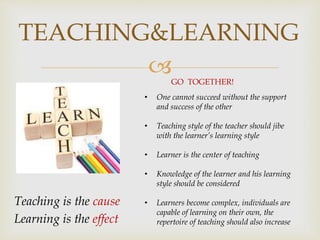
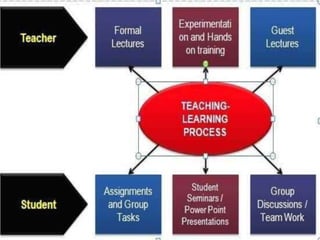
TEACHING&LEARNING
• One cannot succeed without the support
and success of the other
• Teaching style of the teacher should jibe
with the learner’s learning style
• Learner is the center of teaching
• Knowledge of the learner and his learning
style should be considered
• Learners become complex, individuals are
capable of learning on their own, the
repertoire of teaching should also increase
Teaching is the cause
Learning is the effect
GO TOGETHER!


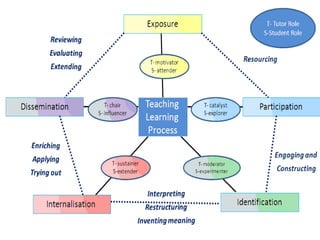
 It is informative to examine the ideal teaching-learning process, as proposed
by Diana Laurillard (Laurillard,1993; Laurillard, 1994). She argues that there
are four aspects of the teaching-learning process:
 Discussion -between the teacher and learner
 Interaction -between the learner and some aspect of the world defined by
the teacher.
 Adaptation -of the world by the teacher and action by the learner.
 Reflection -on the learner's performance by both teacher and learner.
Essential aspect of teaching
and learning process

 TEACHING PROCESS Approaches
 Attitudes
 Behaviour
 Materials
 Modes of Learning
 Teacher’s Conceptual Knowledge
 Student’s Conceptual Knowledge
 Teacher’s Constructed World
 Student Experimental Knowledge
Essential aspects of ideal teaching
learning process

Definition:
 It is the mental and /or physical reaction one makes through seeing,
hearing or doing the things to be learned, through which one gains
meanings and understandings of the material to be learned.
 Learning is an active process on the part of the learner.
 Hence a learning experience is not attained by mere physical presence in a
learning situation.
 The participant must give undivided attention to the instructor and deep
thought to getting
 the facts understanding their meaning and to seeing their application to his
needs and problems
LEARNING
EXPERIENCE

 Learning experience refers to any interaction, course, program,
or other experience in which learning takes place, whether it
occurs in traditional academic settings or non-traditional
settings or whether it includes traditional educational
interactions (students learning from teachers and professors) or
non-traditional interactions (students learning through games
and interactive software applications).
 Learning experience may also be used to underscore or reinforce
the goal of an educational interaction—learning—rather than
its location (school, classroom) or format (course, program) .
Contd....

Definition: It is a condition or environment in which all the
elements necessary for promoting learning are present.
Namely:
 Instructor
 Learner
 Subject matter
 Teaching material and equipment
 Physical facility
LEARNING
SITUATION

 An effective learning experience can only be had in well structured
and skilfully executed learning situation.
 Extension teaching consists basically or arranging situations that
promote desired learning.
 The essential role of extension worker is to create learning situations
that stimulates and guide the learning activity.
 The effective extension worker is one who can create and manage
learning situation in which learners have effective learning experience.
Contd....

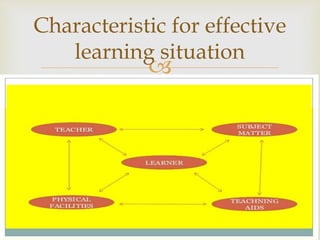
Characteristic for effective
learning situation

 Have clear objective
 Know the subject matter and have it well organized
 Be enthusiastic and interested in the subject
 Be able to communicate with learners
 Be democratic in his leadership
 Allow student participation, ask for it
 Be prepared, be prompt, be friendly, be courteous
 Use teaching plan
 Speak so that all can hear
Instructor should

 Have need for information
 Be interested
 Be capable of learning
 Use the information gained
Learner should

 Pertinent (related) to learner’s needs
 Applicable to real life situations
 Taught at intellectual level of learners
 Well organized – logically presented
 Presented clearly
 Challenging, satisfying and significant to the learners
 Fits into overall objectives
Subject matter or content

 Free from outside distractions
 Temperature as comfortable as possible
 Well lighted
 Adequate space for the group
 Furniture comfortable and well arranged
Physical facilities

 Meet the needs effectively
 Readily available
 Each item used skilfully
Teaching equipment and
supplies

 To expose students to working in teams
 To encourage following step by step procedures
 To expose children to child friendly technology
 To develop problem solving technique
 To expose children to creating image based story lines
 To have students construct and program their own robots
Aims of the learning
situation
