Primary processing and
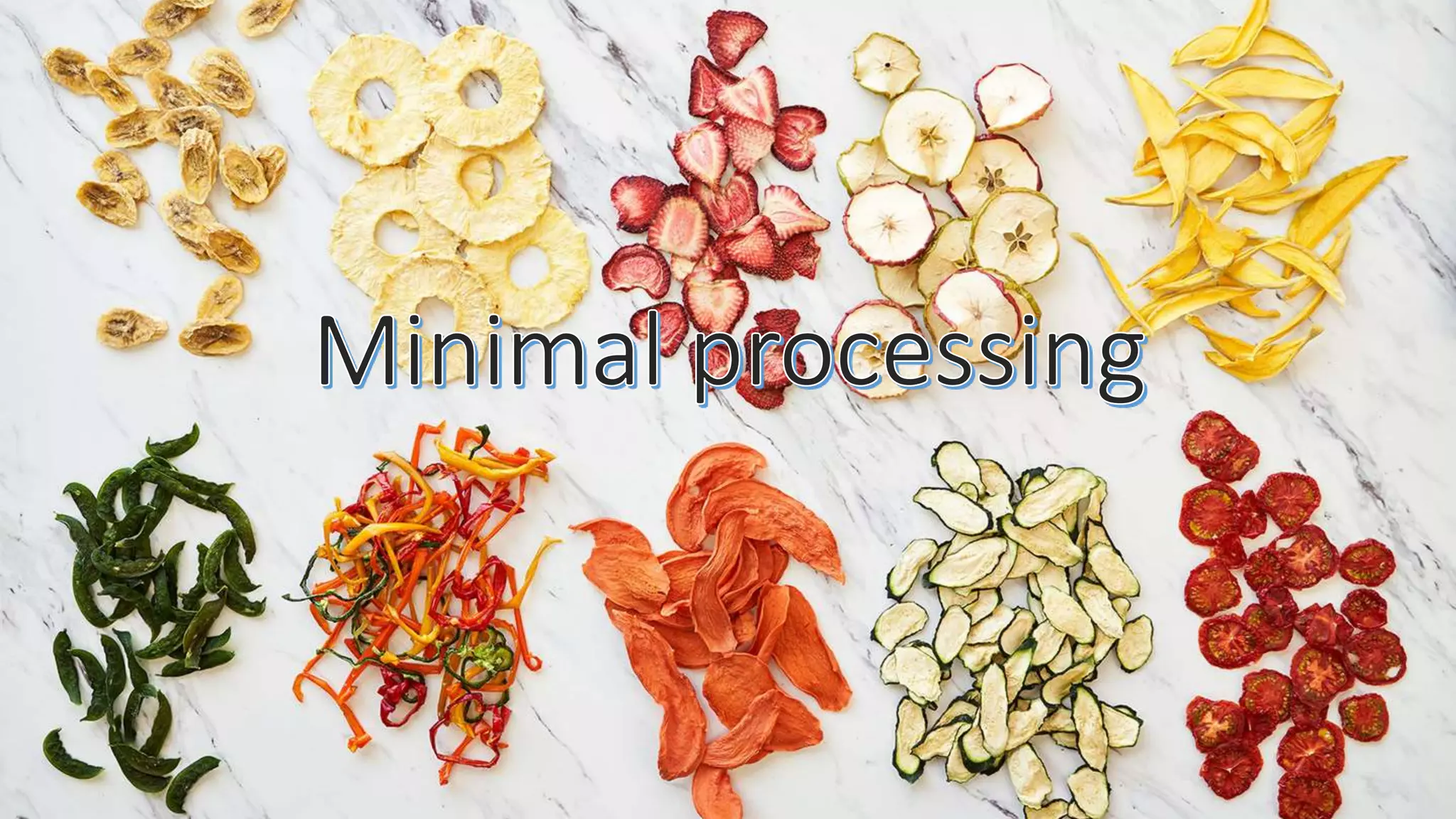
Minimal processing
By,
Mamatha Rani R
PhD(FST)
2019672804
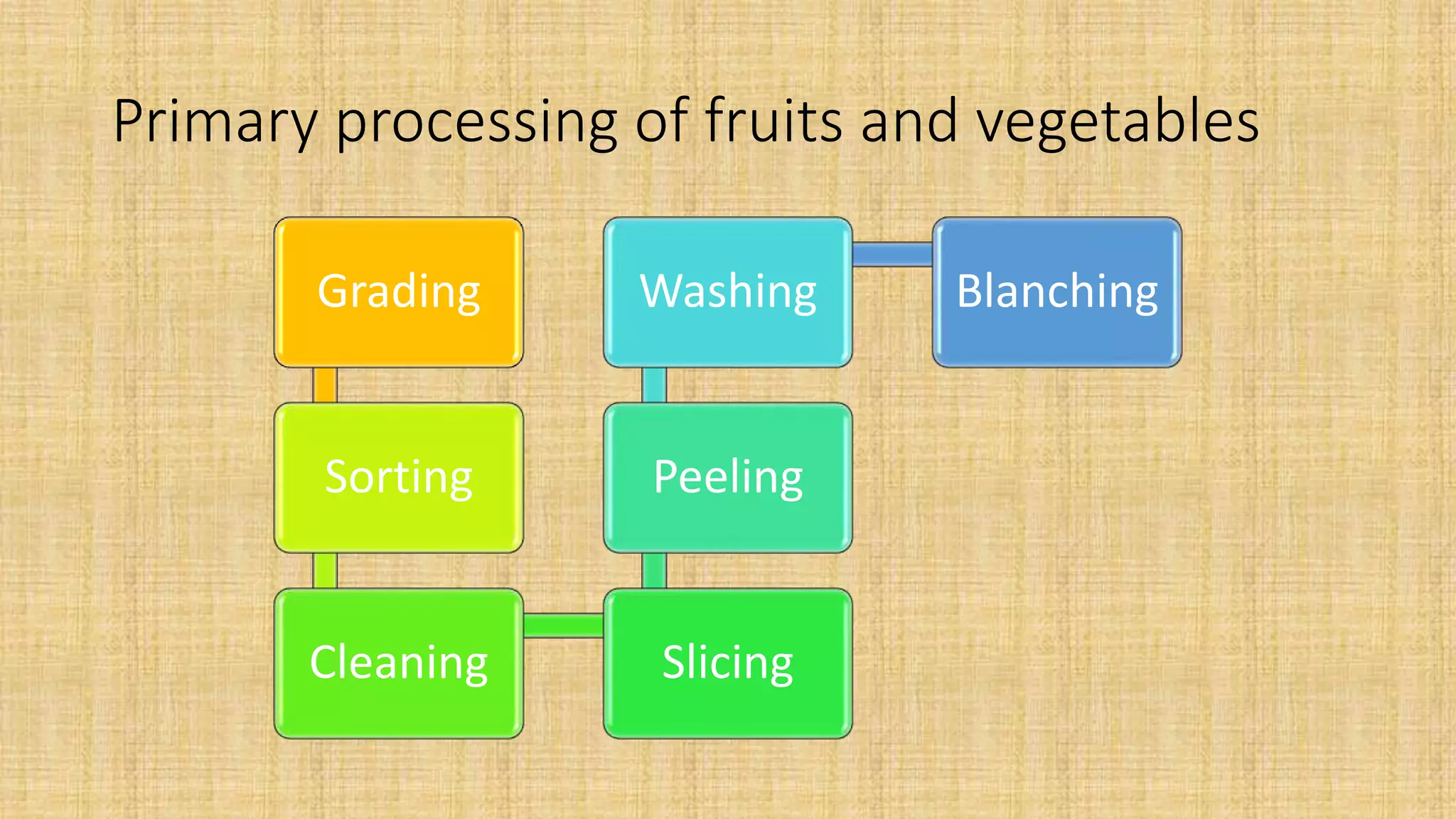
Primary processing of fruits and vegetables
Grading
Sorting
Cleaning Slicing
Peeling
Washing Blanching
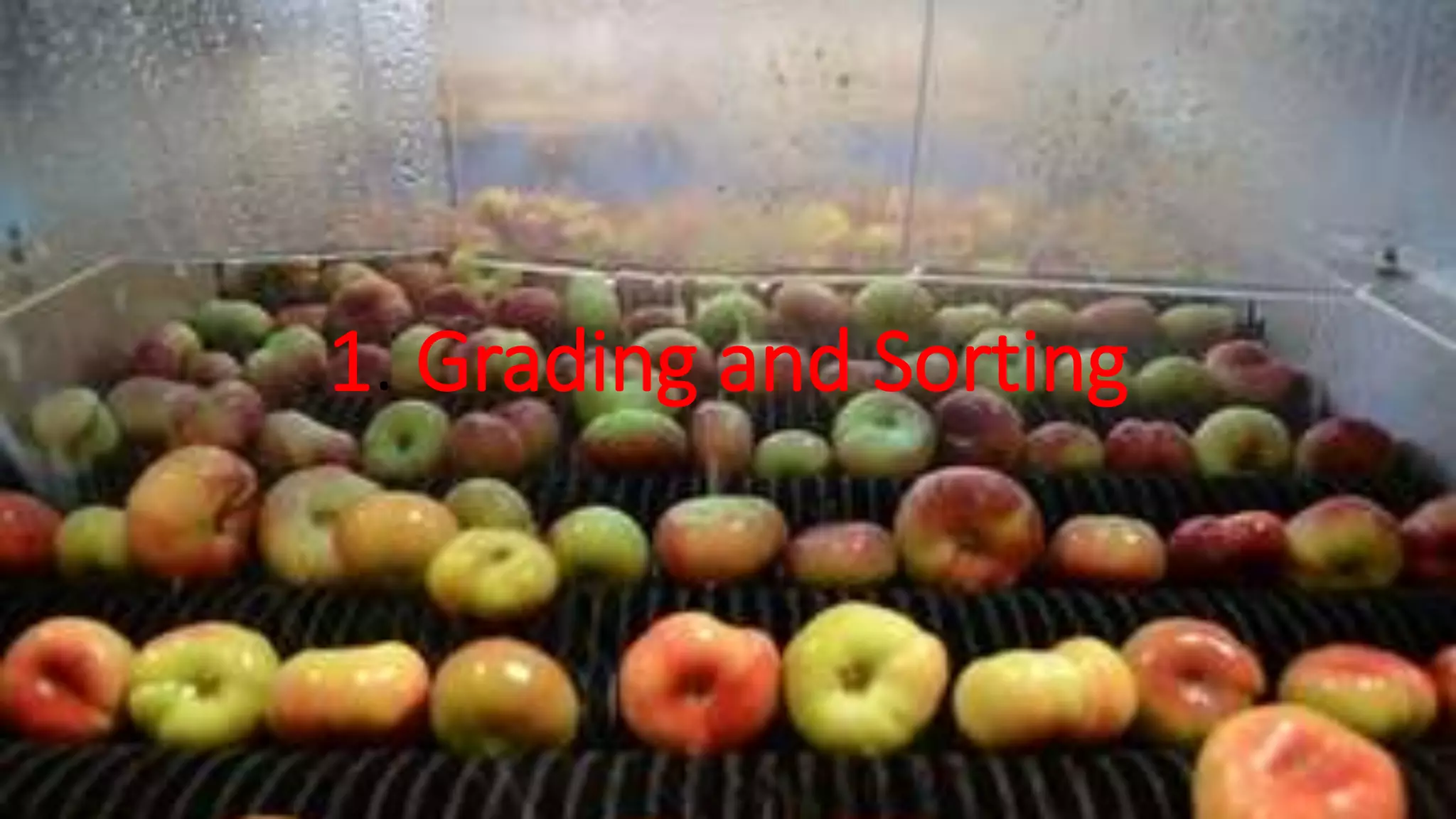
1. Grading and Sorting
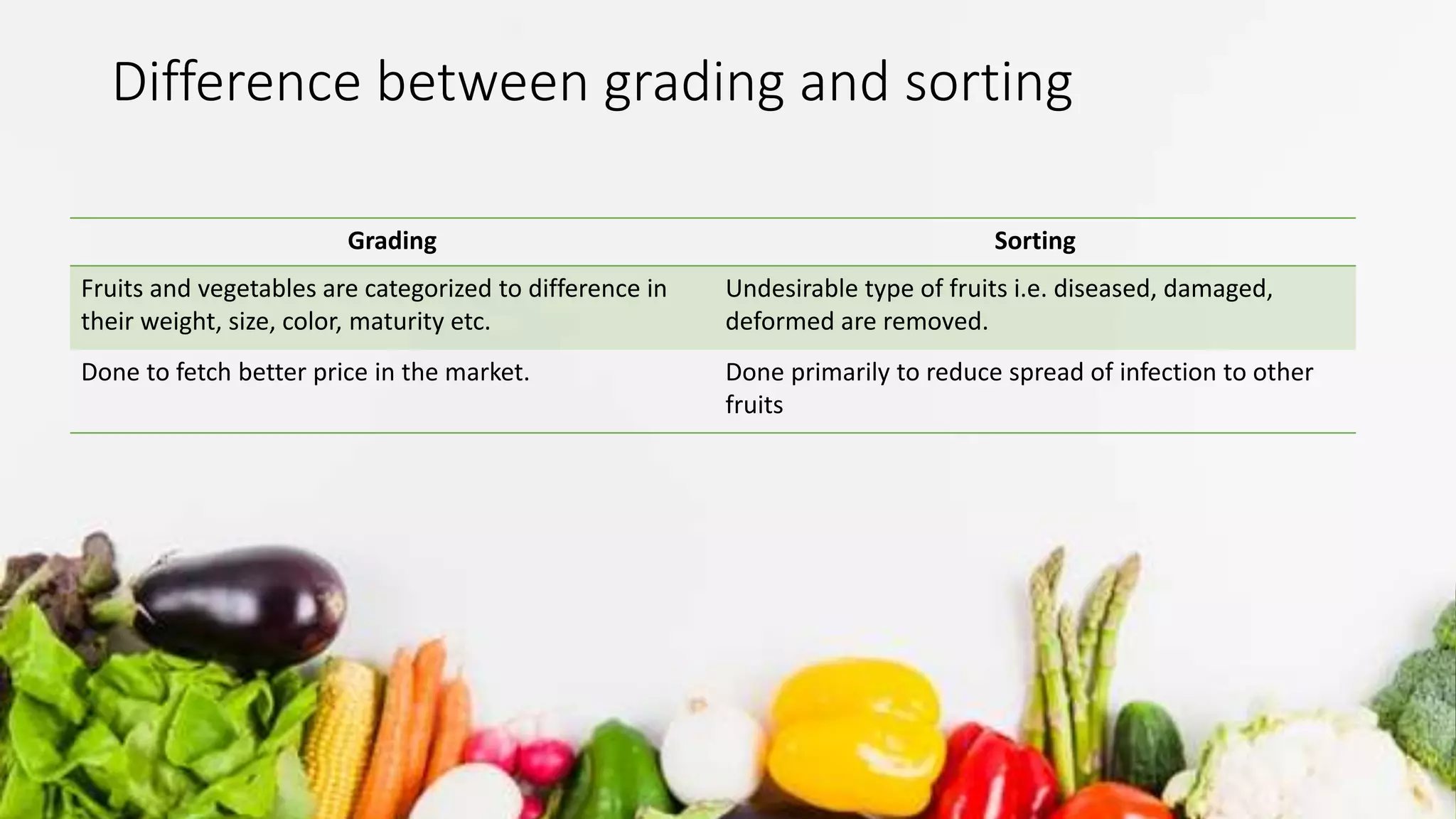
Difference between grading and sorting
Grading Sorting
Fruits and vegetables are categorized to difference in
their weight, size, color, maturity etc.
Undesirable type of fruits i.e. diseased, damaged,
deformed are removed.
Done to fetch better price in the market. Done primarily to reduce spread of infection to other
fruits
Sorting and Grading
• Machine
• Manual
• Sorting by size
Sorting by size
• Some crops produce inconsistent results if sorted by weight.
• Fruits moves through sorter and passes over or rolls along a continuously
enlarging exit orifice until it is able to fall through into appropriate container.
• There three types of sizing
1. Manual sizing
2. Dimensions sizers
3. Weight sizers
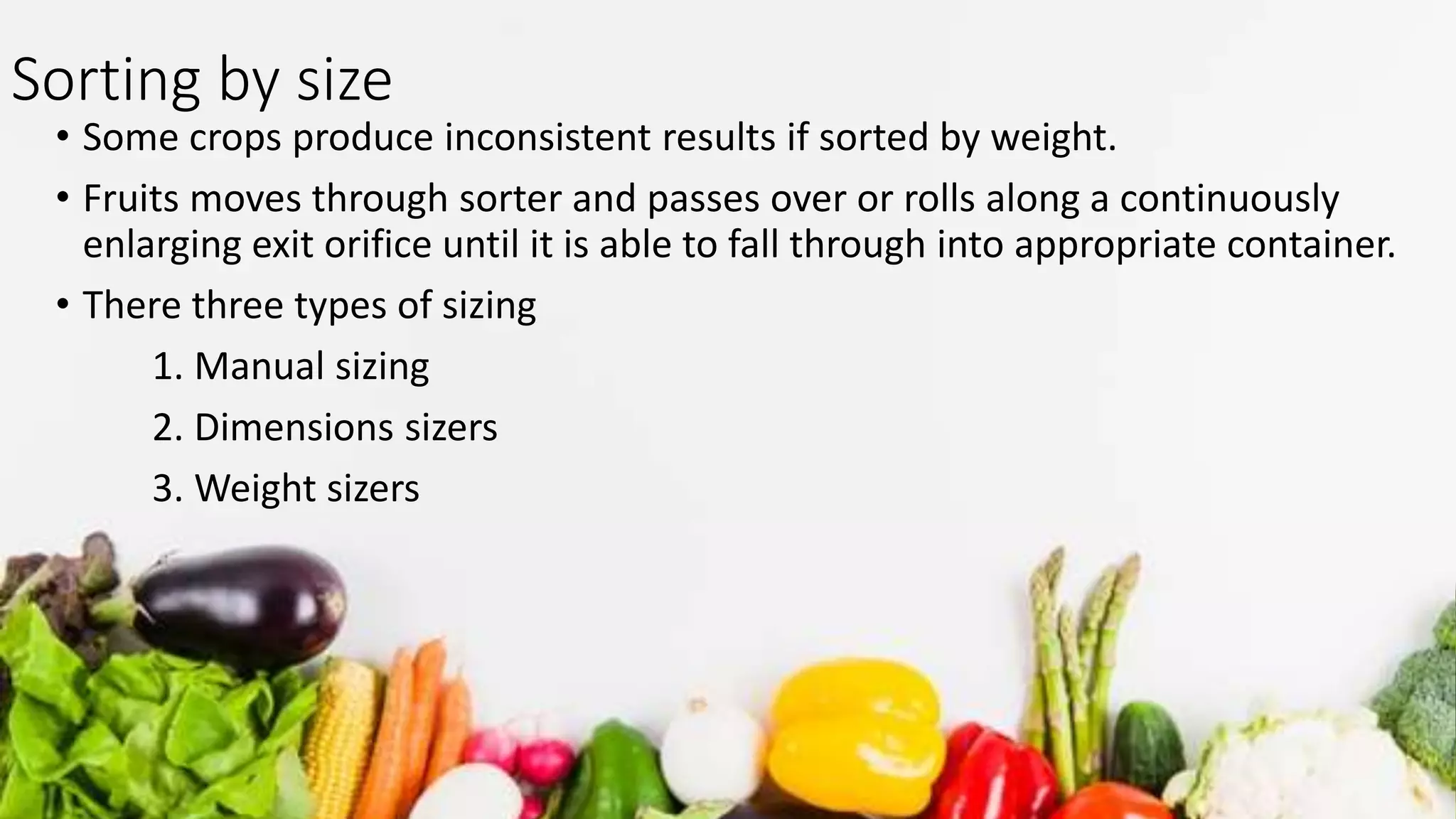
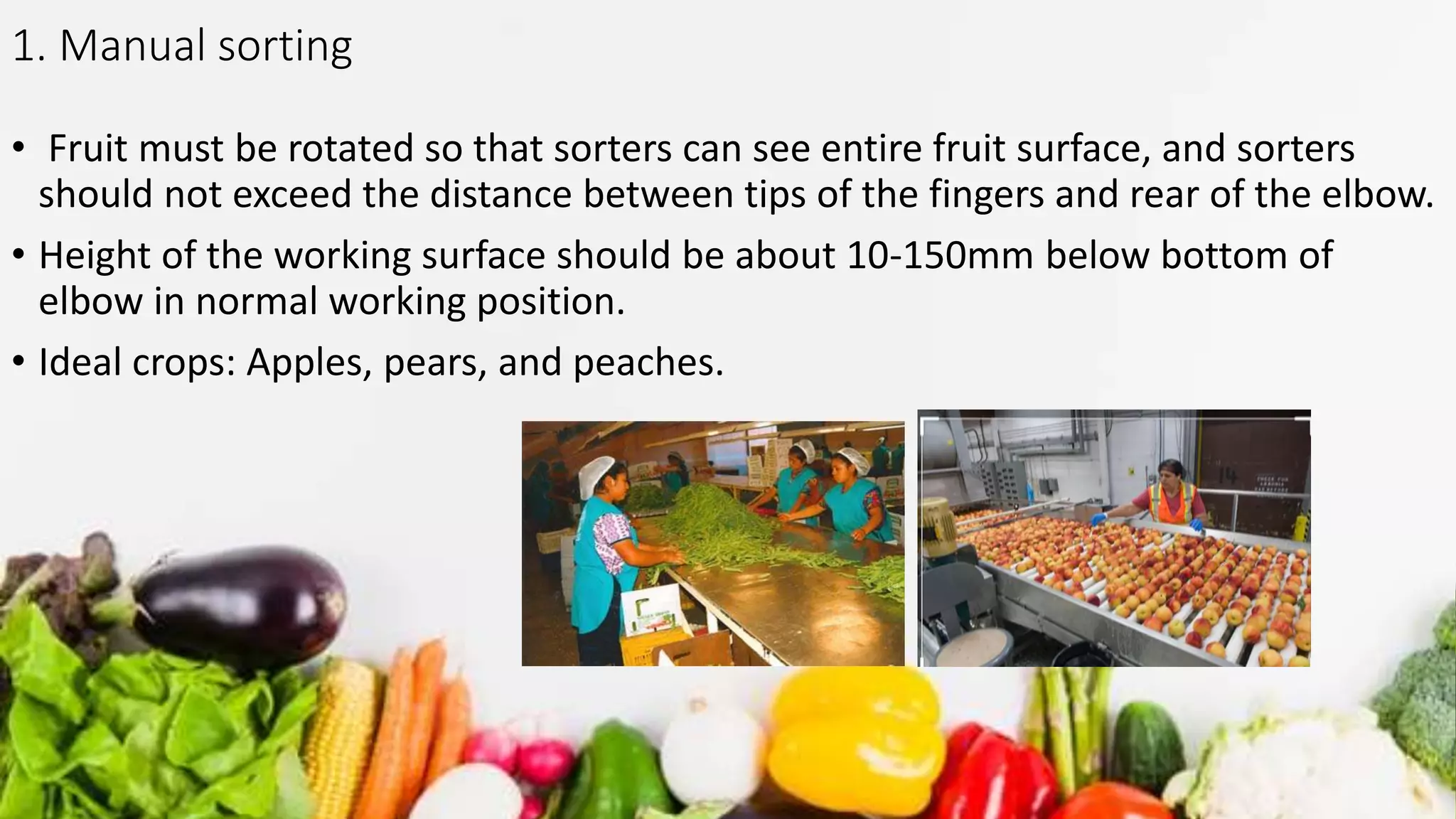
1. Manual sorting
• Fruit must be rotated so that sorters can see entire fruit surface, and sorters
should not exceed the distance between tips of the fingers and rear of the elbow.
• Height of the working surface should be about 10-150mm below bottom of
elbow in normal working position.
• Ideal crops: Apples, pears, and peaches.
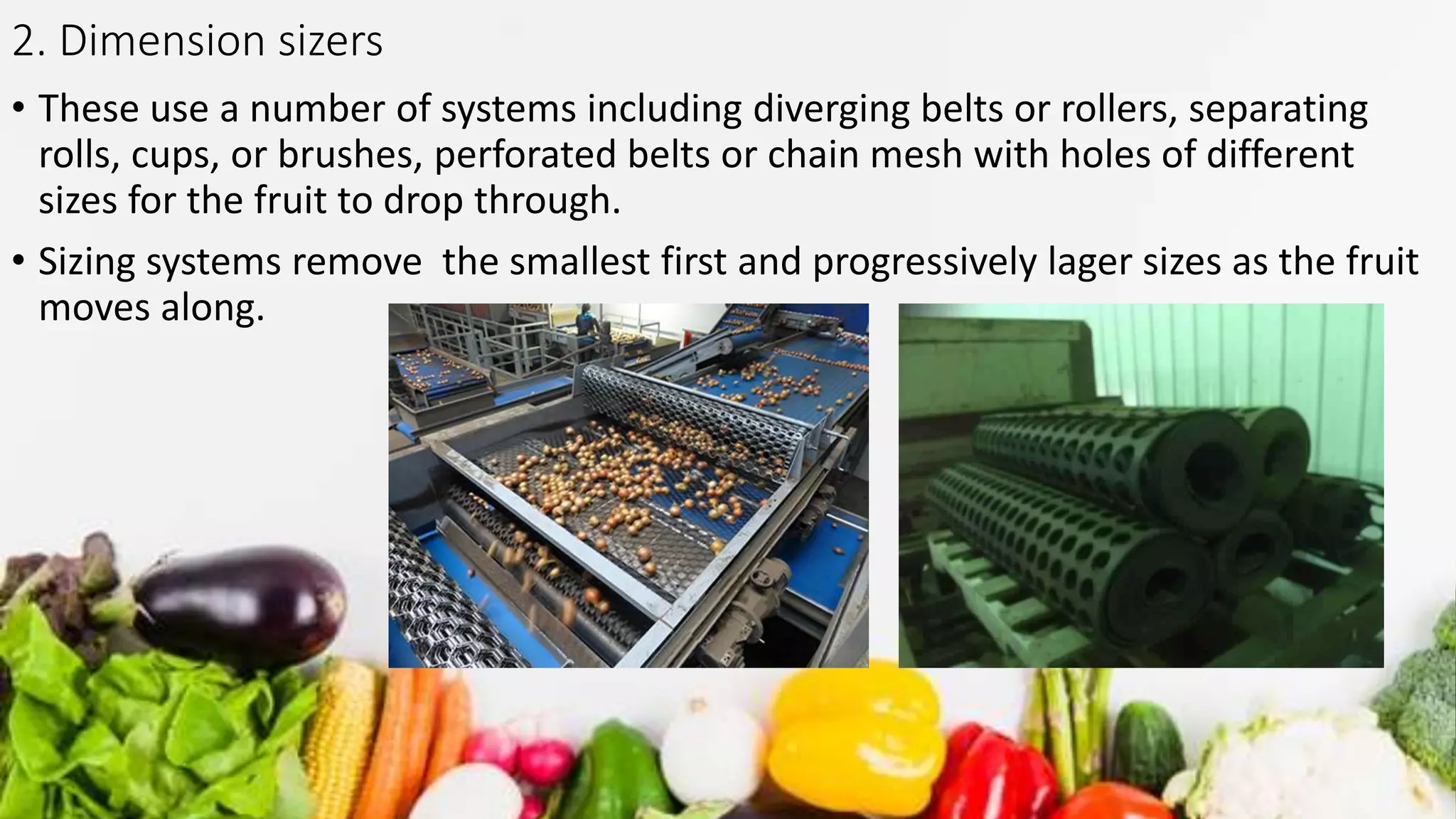
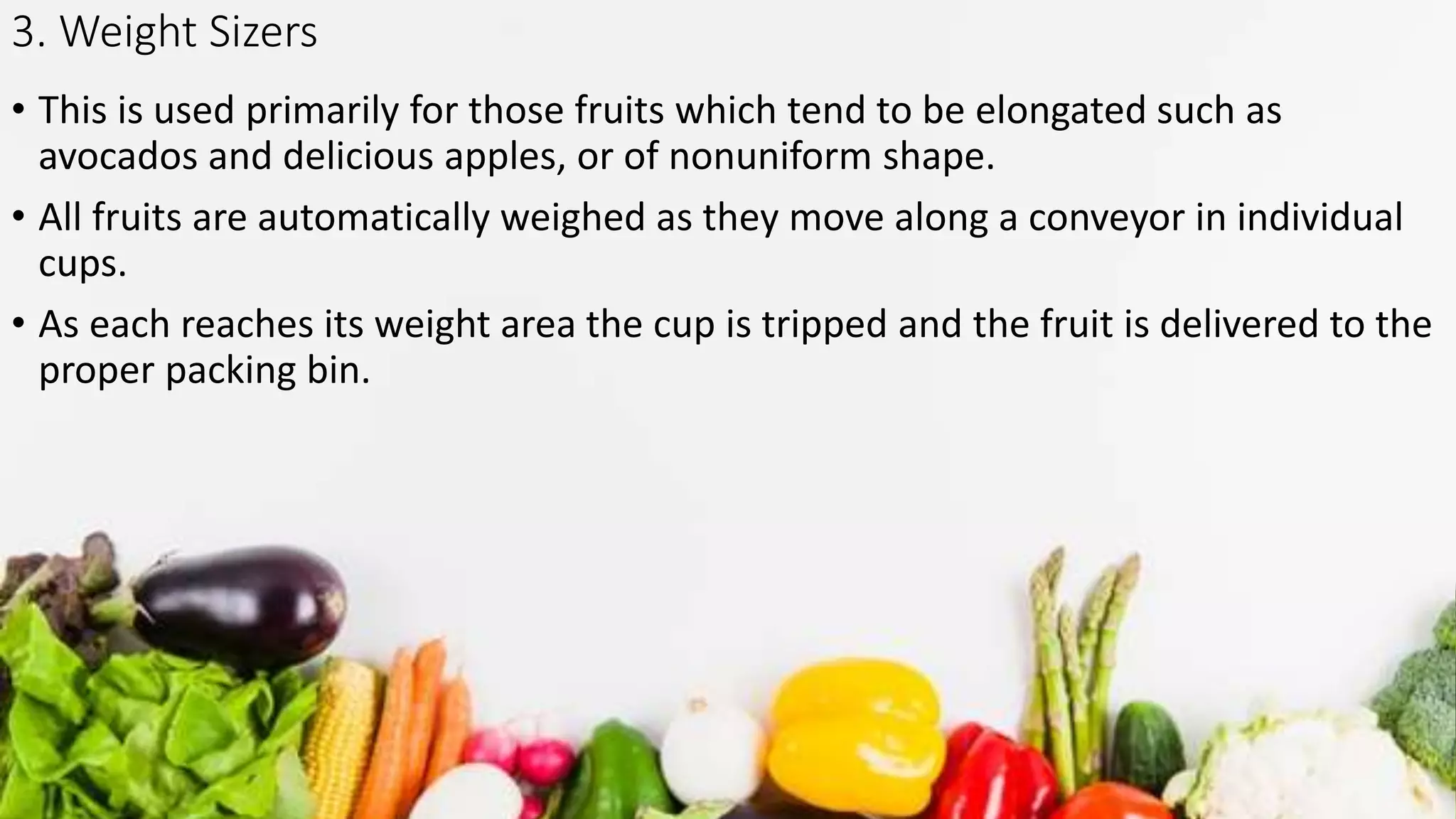
2. Dimension sizers
• These use a number of systems including diverging belts or rollers, separating
rolls, cups, or brushes, perforated belts or chain mesh with holes of different
sizes for the fruit to drop through.
• Sizing systems remove the smallest first and progressively lager sizes as the fruit
moves along.
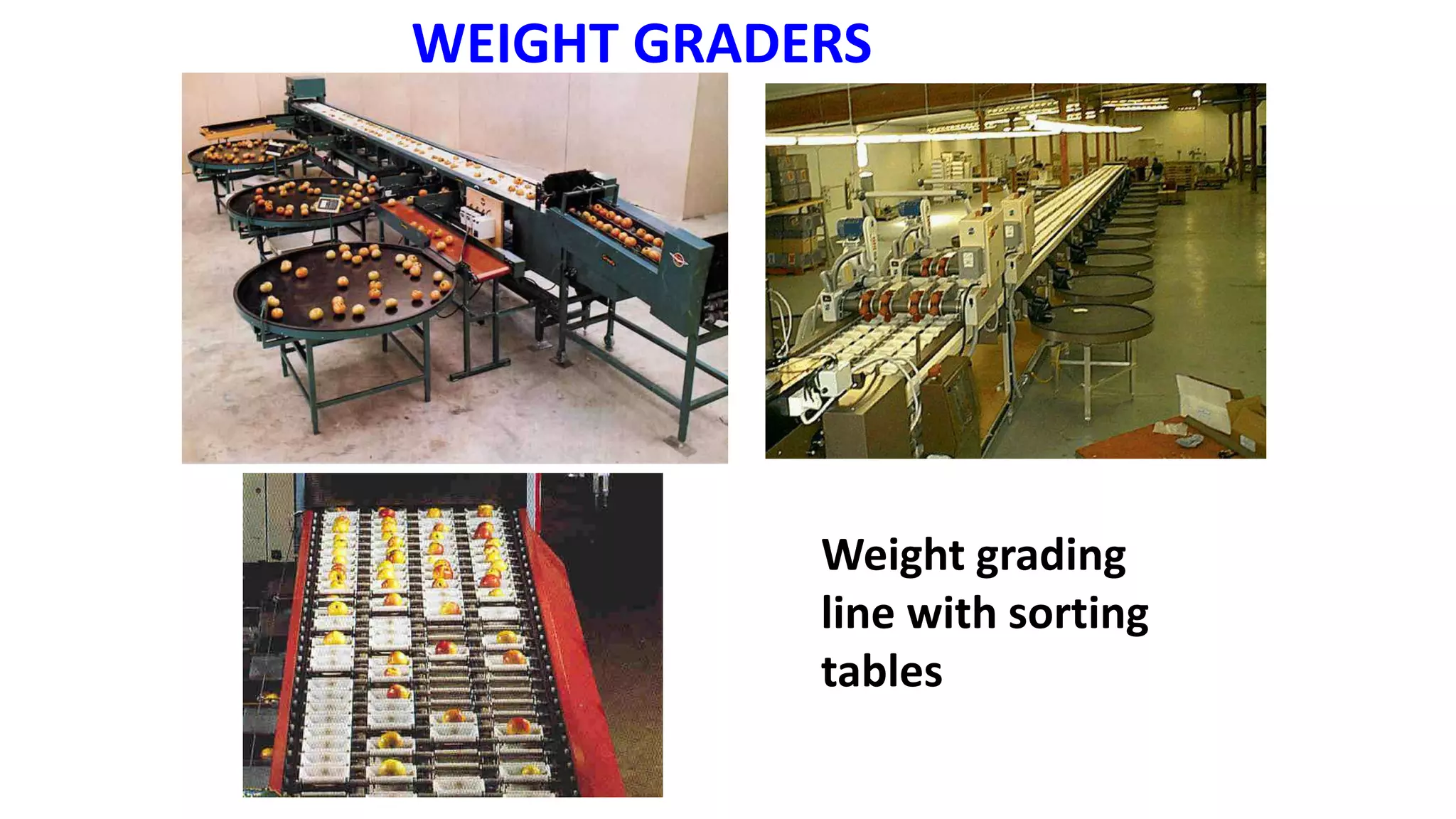
3. Weight Sizers
• This is used primarily for those fruits which tend to be elongated such as
avocados and delicious apples, or of nonuniform shape.
• All fruits are automatically weighed as they move along a conveyor in individual
cups.
• As each reaches its weight area the cup is tripped and the fruit is delivered to the
proper packing bin.
WEIGHT GRADERS
Weight grading
line with sorting
tables
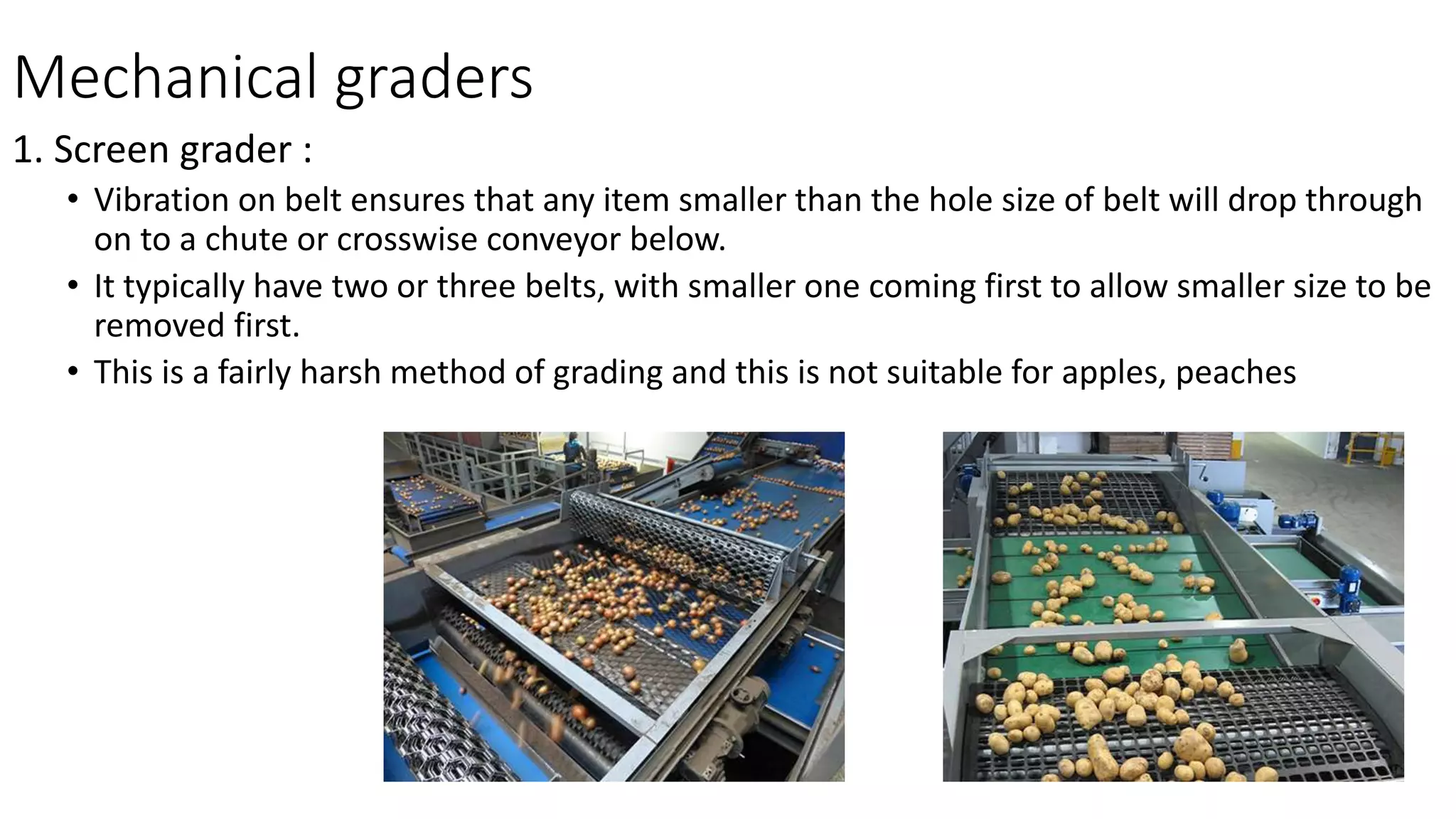
Mechanical graders
1. Screen grader :
• Vibration on belt ensures that any item smaller than the hole size of belt will drop through
on to a chute or crosswise conveyor below.
• It typically have two or three belts, with smaller one coming first to allow smaller size to be
removed first.
• This is a fairly harsh method of grading and this is not suitable for apples, peaches
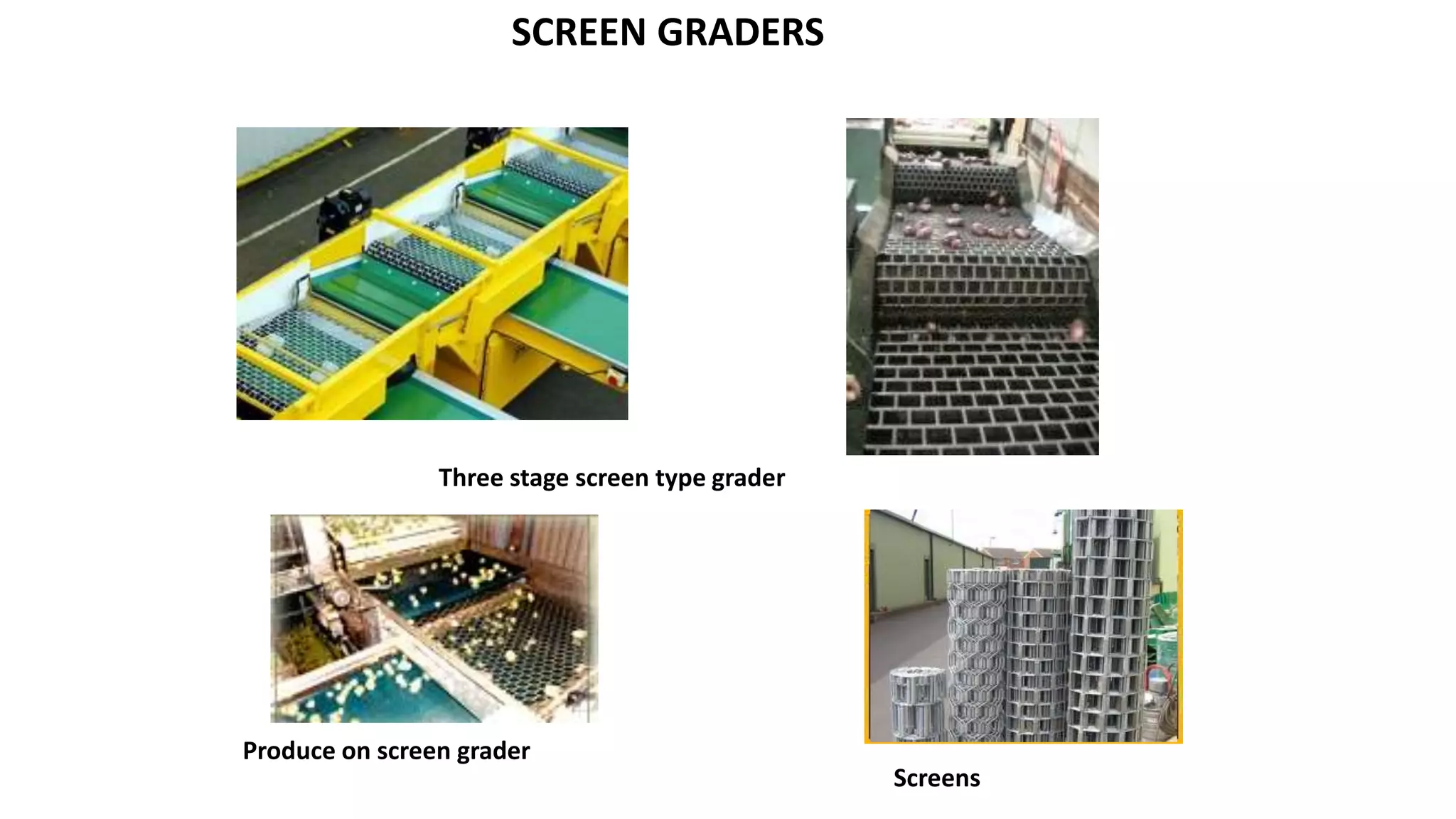
SCREEN GRADERS
Three stage screen type grader
Screens
Produce on screen grader
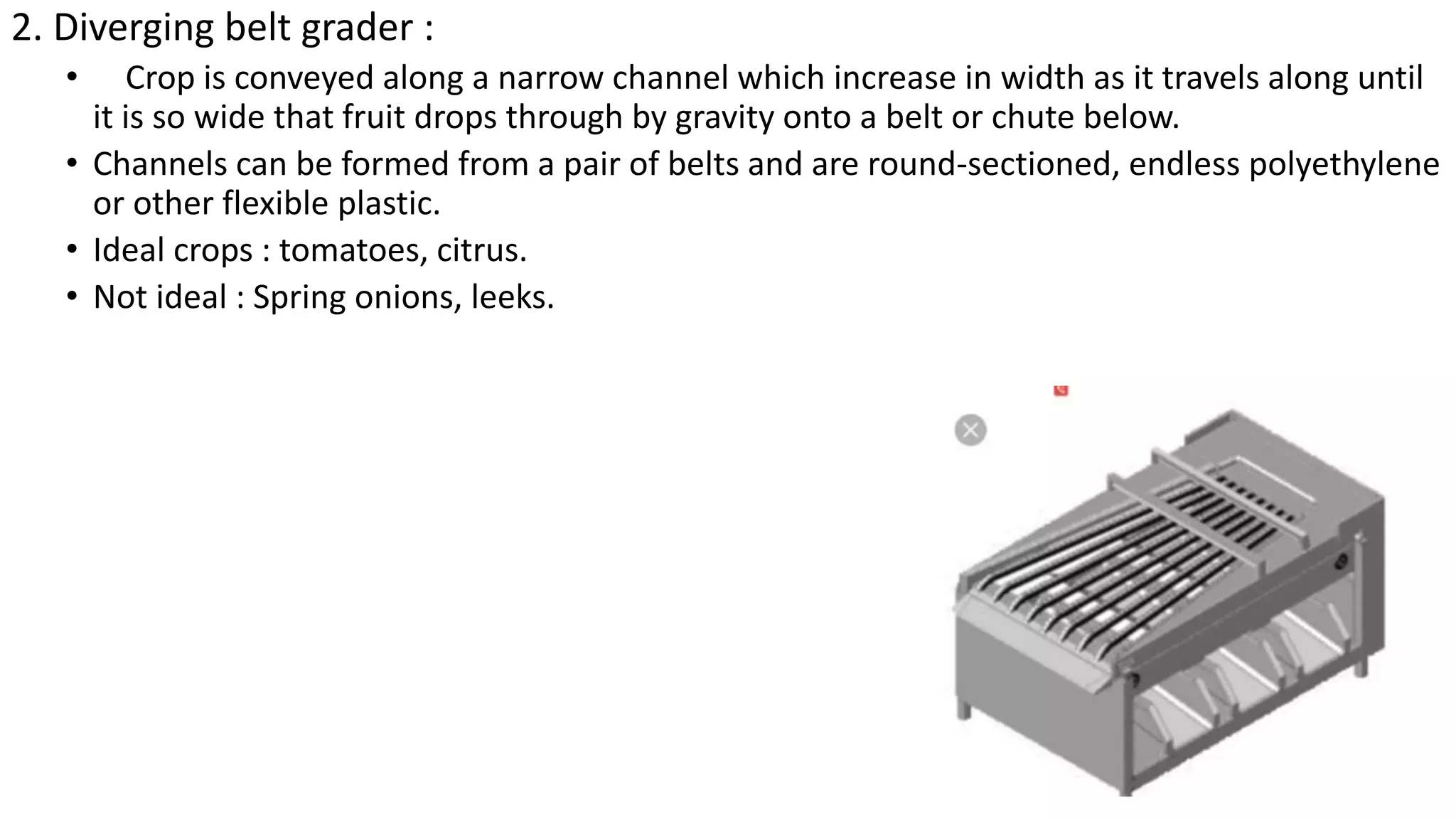
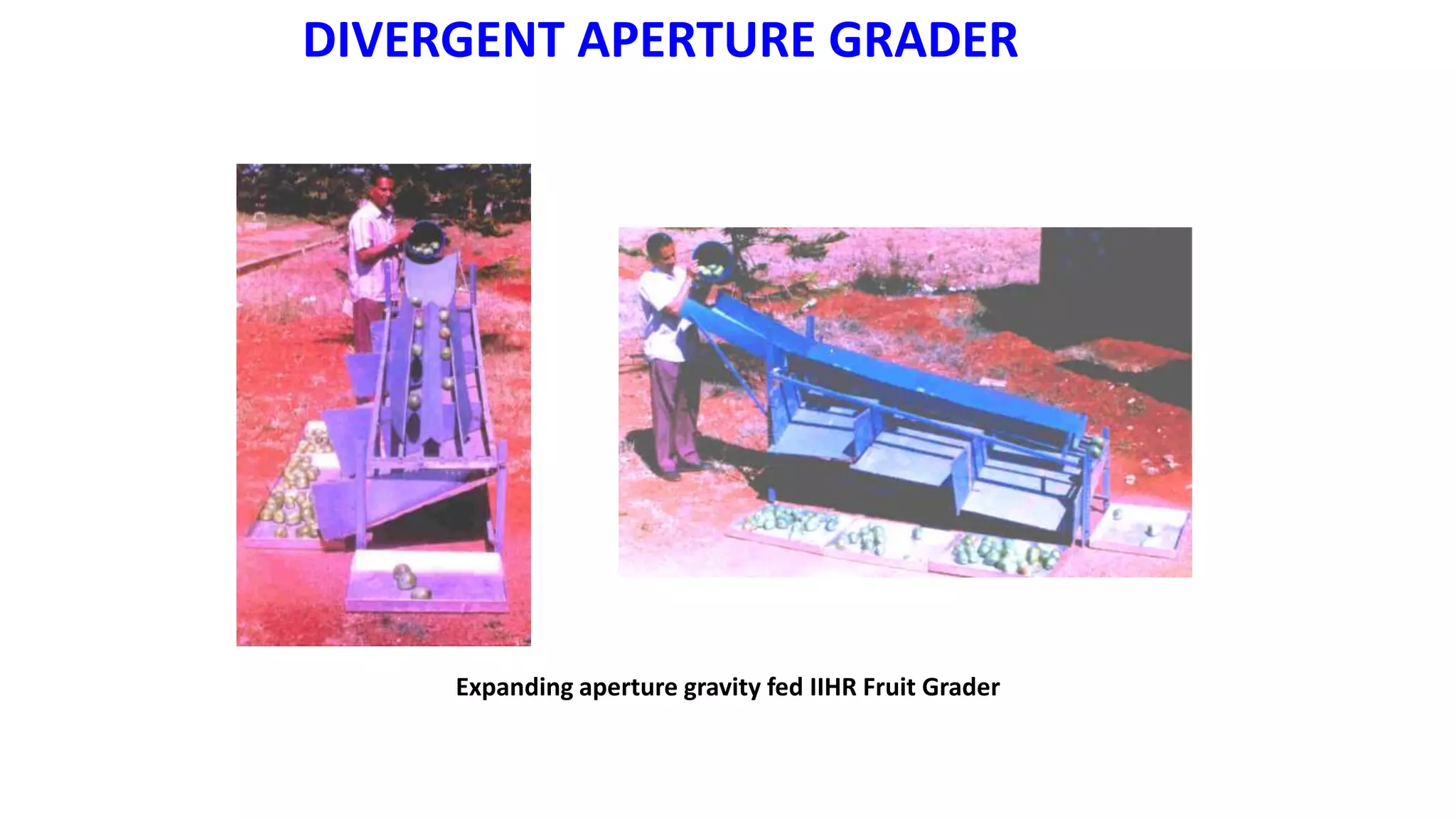
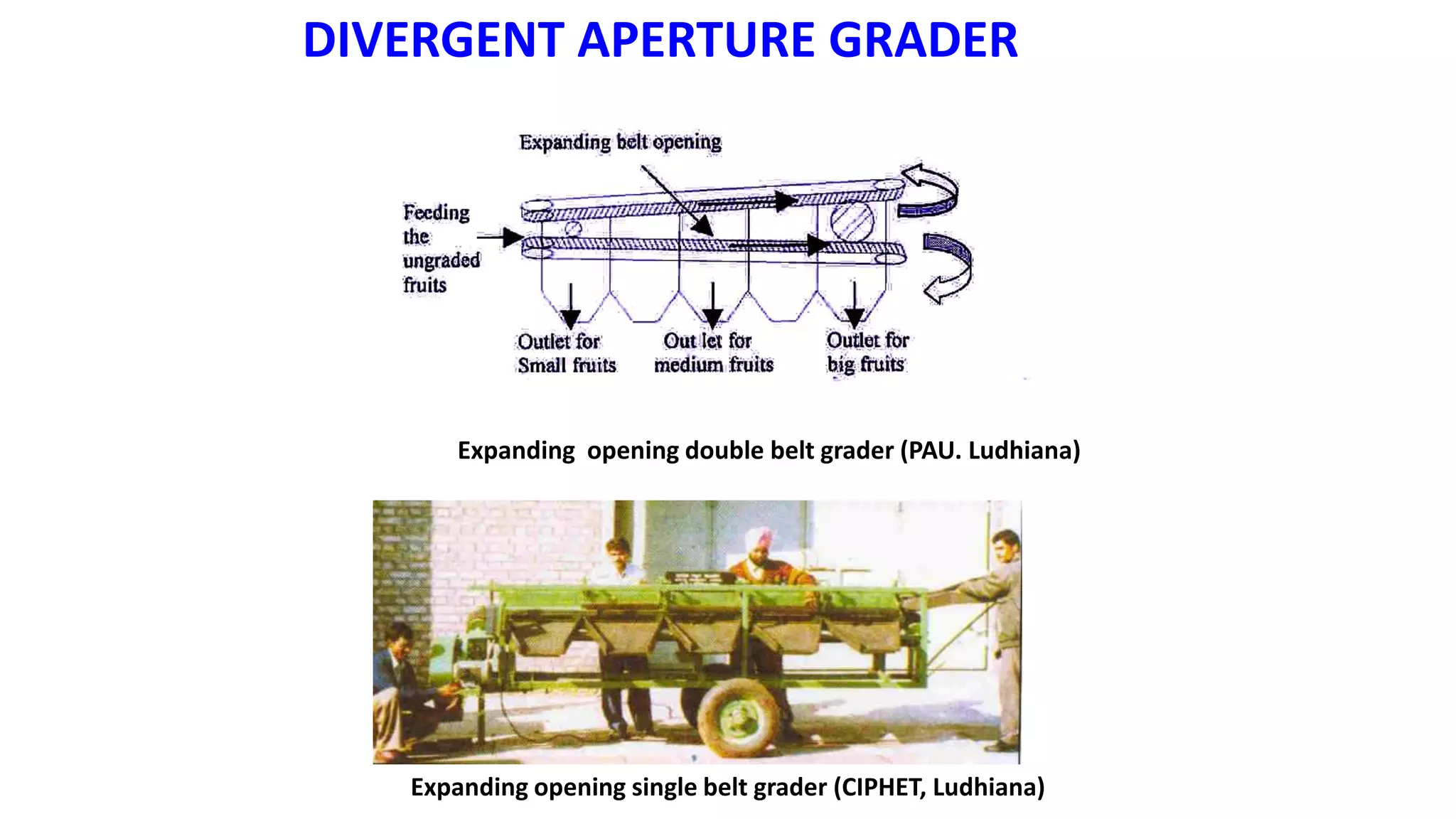
2. Diverging belt grader :
• Crop is conveyed along a narrow channel which increase in width as it travels along until
it is so wide that fruit drops through by gravity onto a belt or chute below.
• Channels can be formed from a pair of belts and are round-sectioned, endless polyethylene
or other flexible plastic.
• Ideal crops : tomatoes, citrus.
• Not ideal : Spring onions, leeks.
Expanding aperture gravity fed IIHR Fruit Grader
DIVERGENT APERTURE GRADER
Expanding opening double belt grader (PAU. Ludhiana)
Expanding opening single belt grader (CIPHET, Ludhiana)
DIVERGENT APERTURE GRADER
3. Pommelo sorter:
• It composed of a rectangular chute made of plywood, padded with foam to
prevent bruising.
• Fruits is dumped into octagonal platform at top of chute then allowed to roll,
one by one down toward a series of constrictions.
• Larger fruits are caught in first constriction, medium is second, and small is last.
• Sizing is the fastest when five workers are stationed at sorter.
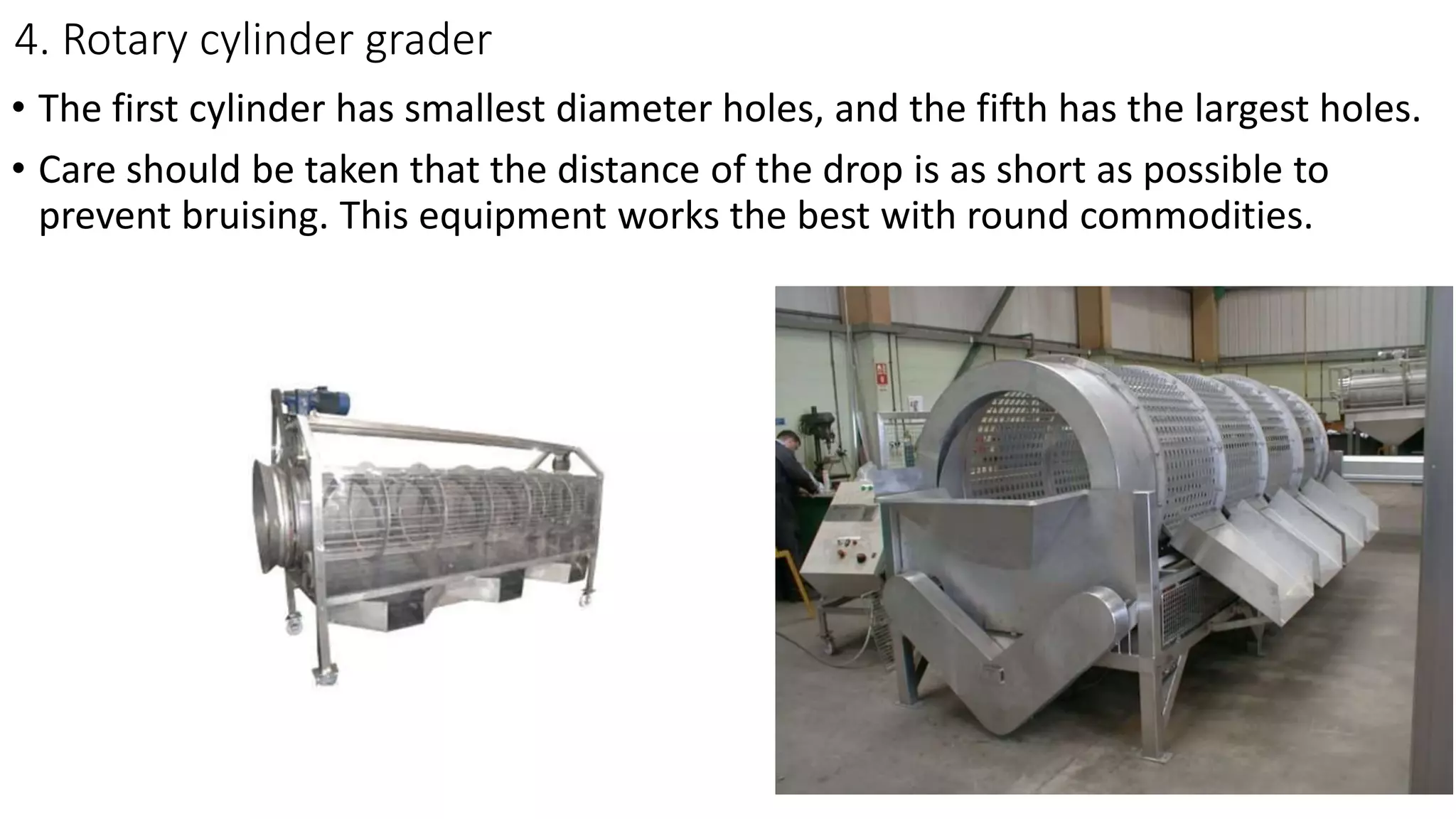
4. Rotary cylinder grader
• The first cylinder has smallest diameter holes, and the fifth has the largest holes.
• Care should be taken that the distance of the drop is as short as possible to
prevent bruising. This equipment works the best with round commodities.
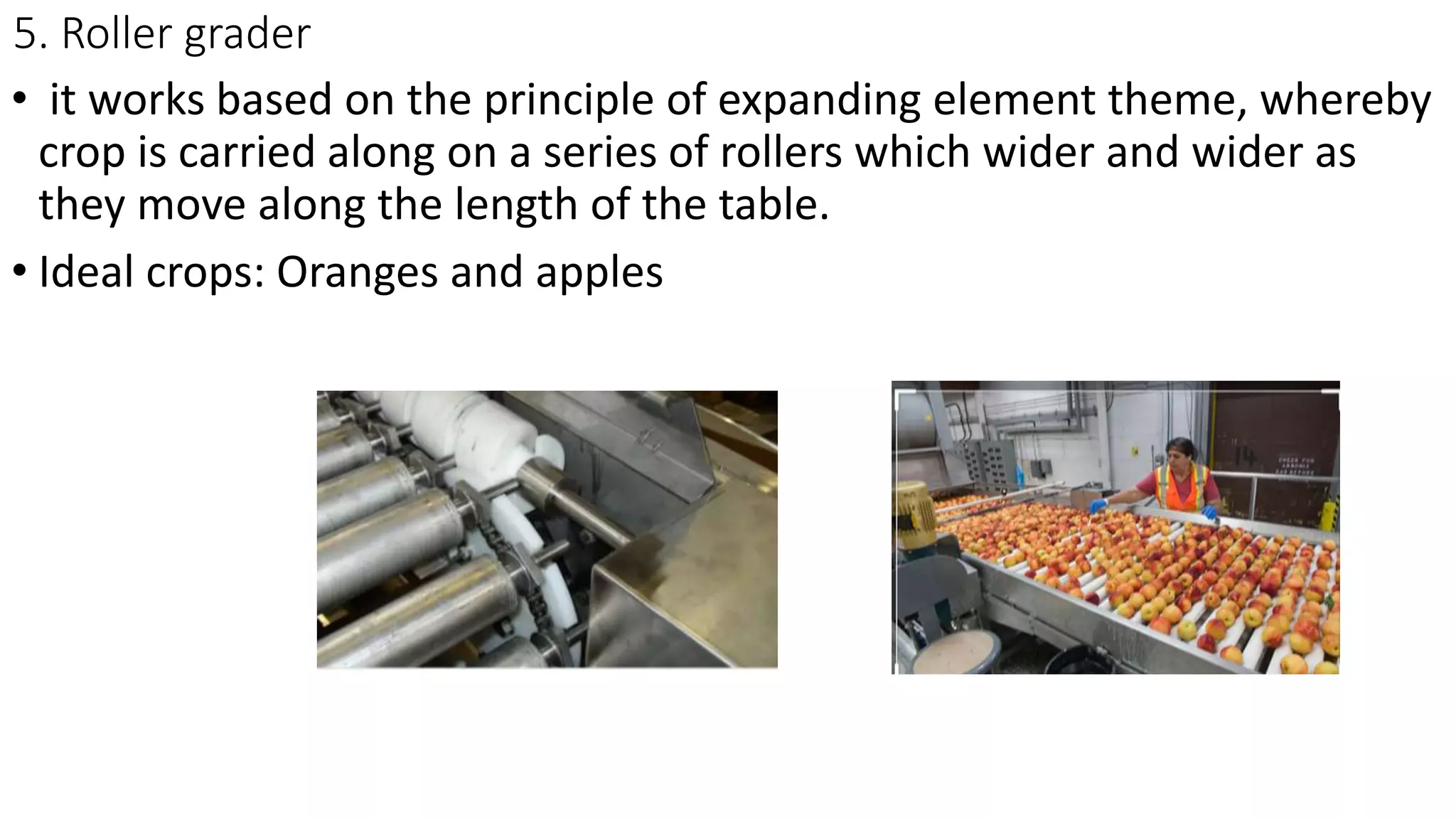
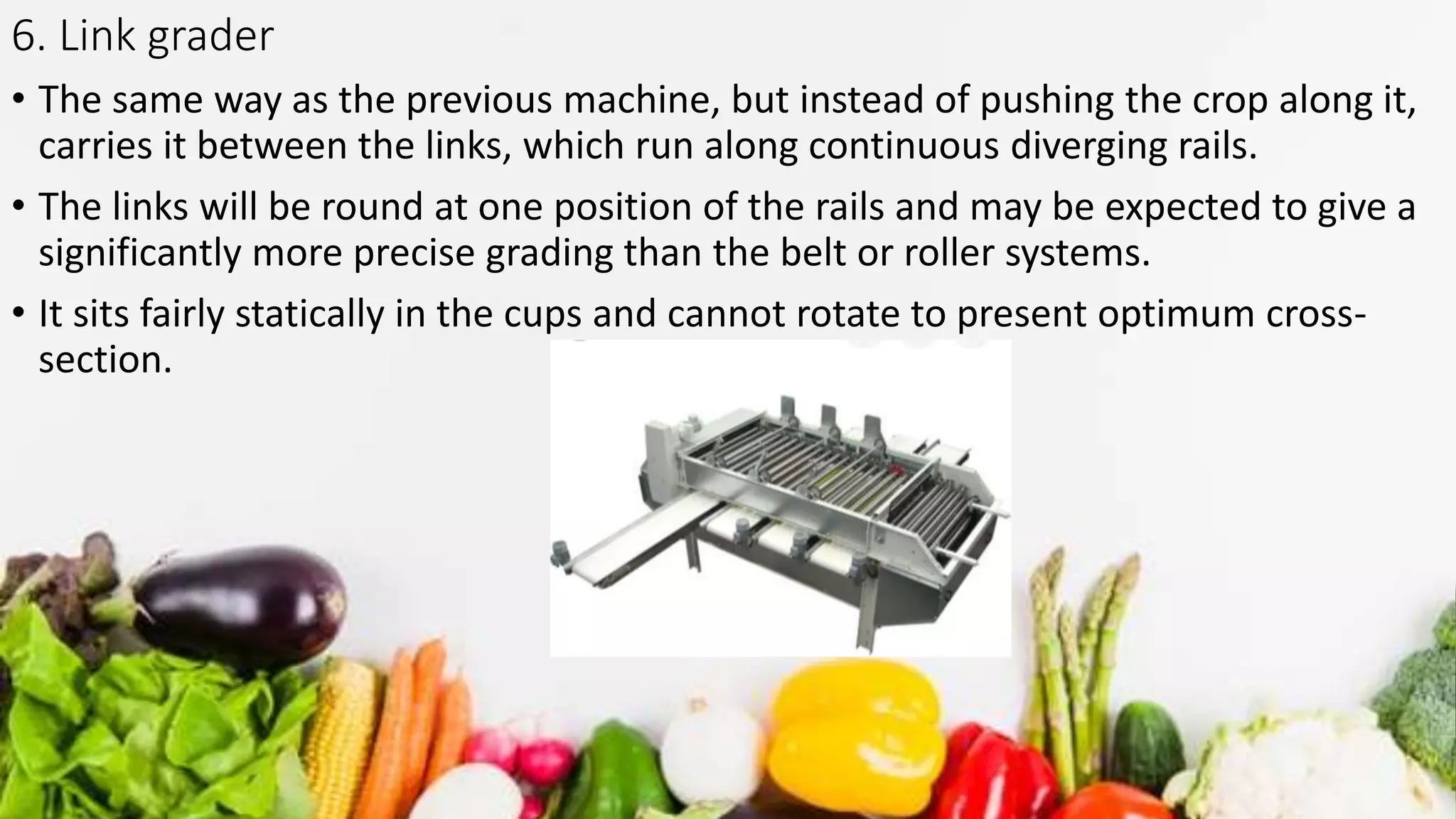
5. Roller grader
• it works based on the principle of expanding element theme, whereby
crop is carried along on a series of rollers which wider and wider as
they move along the length of the table.
• Ideal crops: Oranges and apples
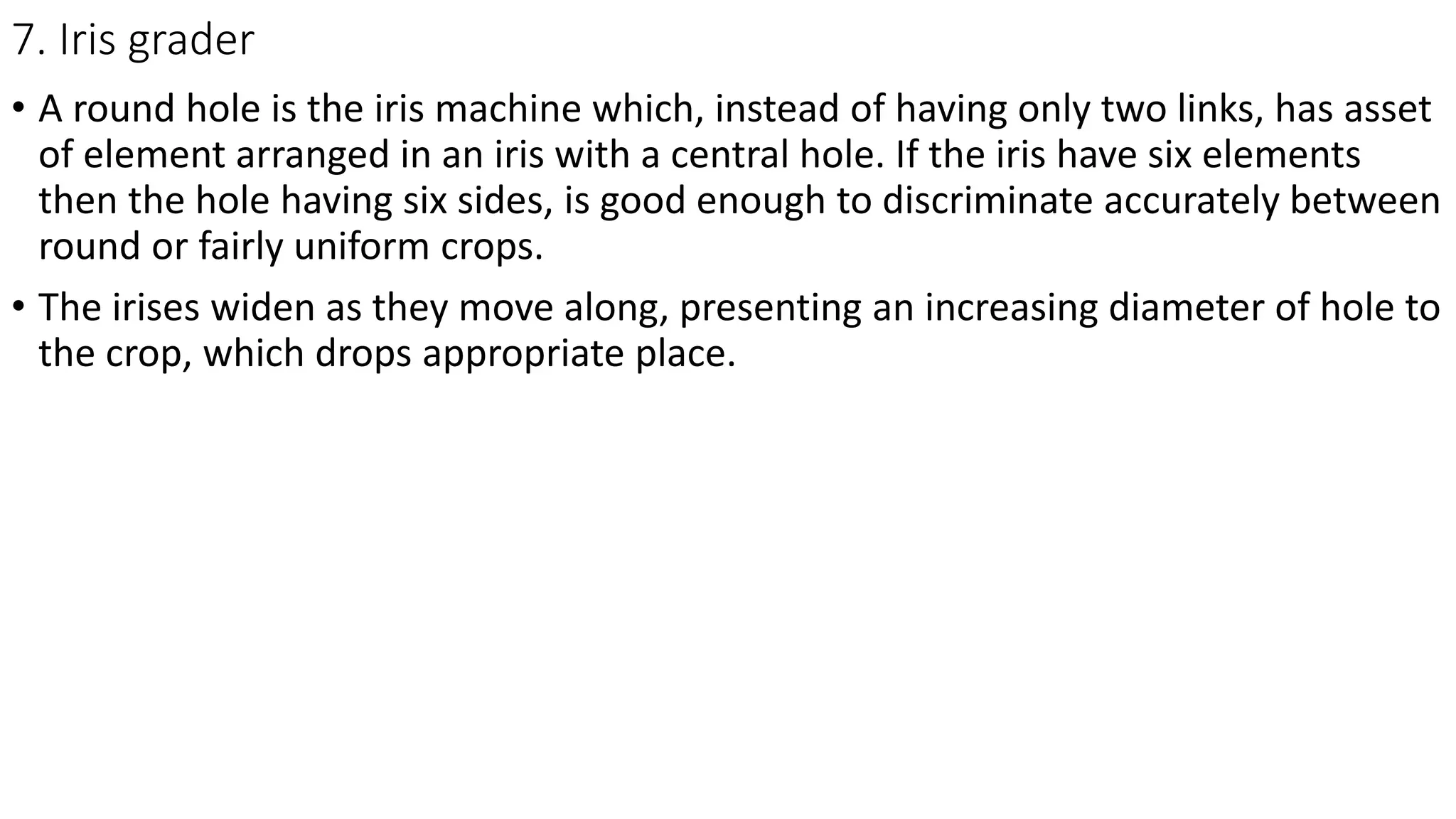
6. Link grader
• The same way as the previous machine, but instead of pushing the crop along it,
carries it between the links, which run along continuous diverging rails.
• The links will be round at one position of the rails and may be expected to give a
significantly more precise grading than the belt or roller systems.
• It sits fairly statically in the cups and cannot rotate to present optimum cross-
section.
7. Iris grader
• A round hole is the iris machine which, instead of having only two links, has asset
of element arranged in an iris with a central hole. If the iris have six elements
then the hole having six sides, is good enough to discriminate accurately between
round or fairly uniform crops.
• The irises widen as they move along, presenting an increasing diameter of hole to
the crop, which drops appropriate place.
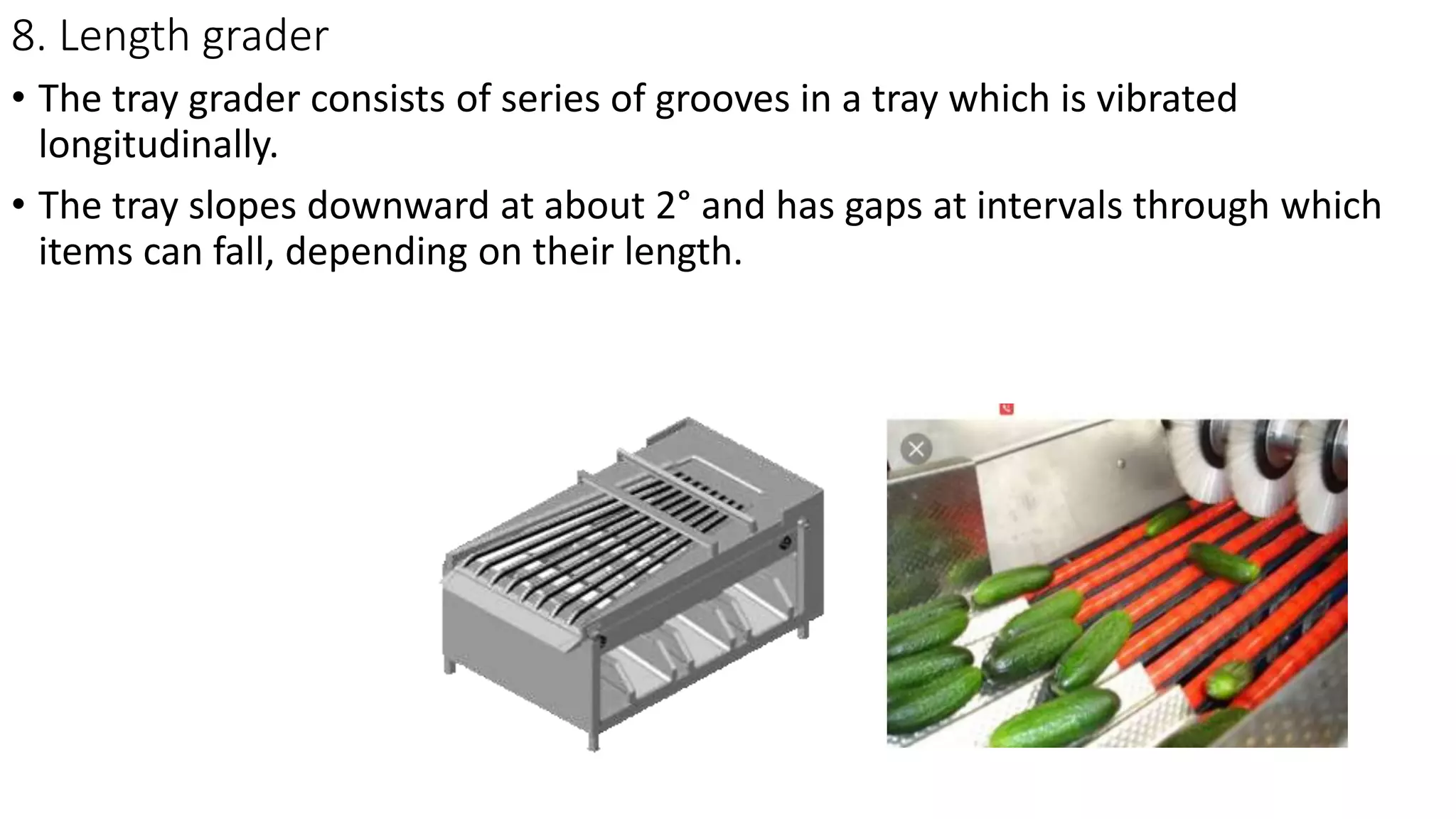
8. Length grader
• The tray grader consists of series of grooves in a tray which is vibrated
longitudinally.
• The tray slopes downward at about 2° and has gaps at intervals through which
items can fall, depending on their length.
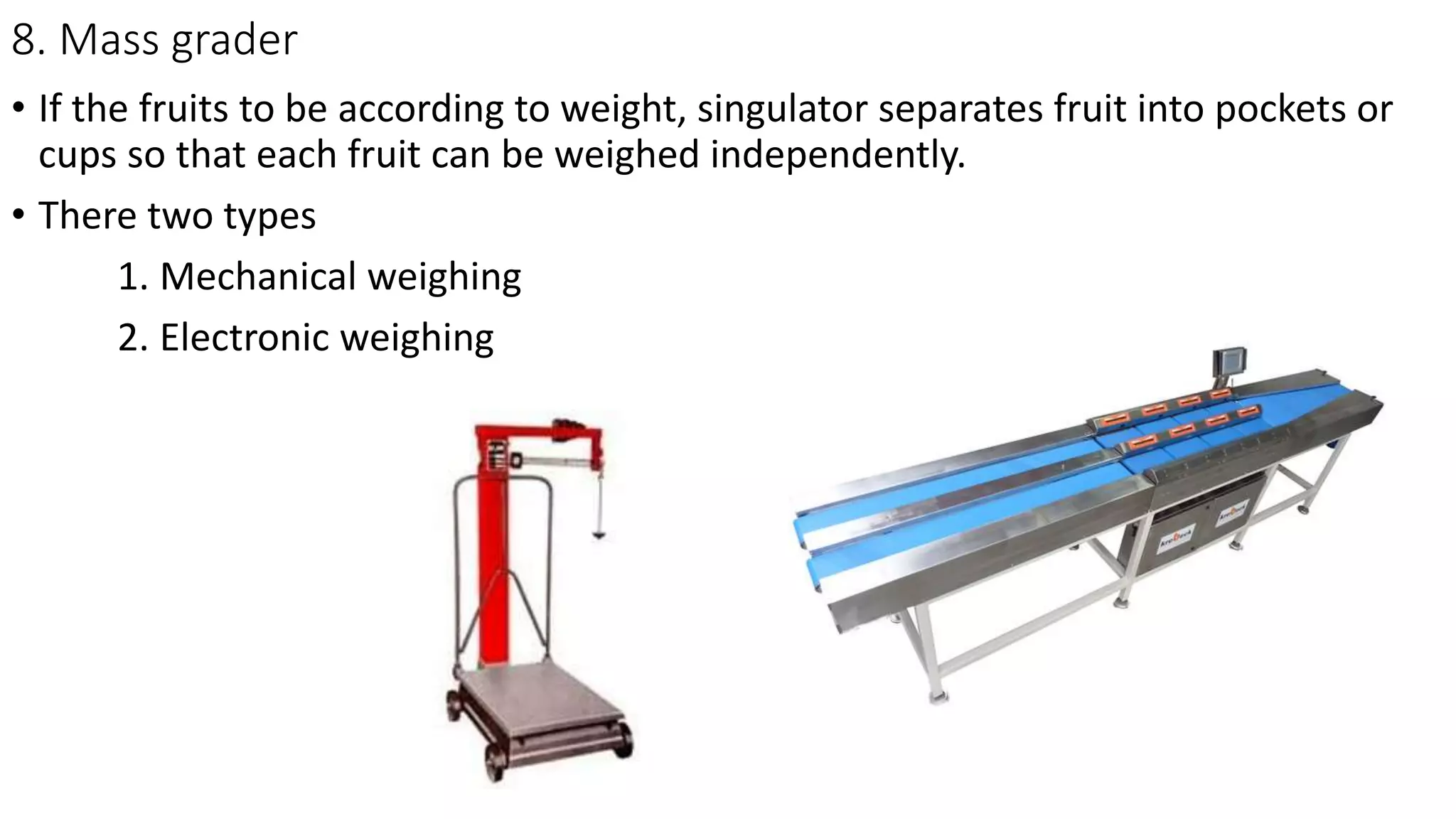
8. Mass grader
• If the fruits to be according to weight, singulator separates fruit into pockets or
cups so that each fruit can be weighed independently.
• There two types
1. Mechanical weighing
2. Electronic weighing
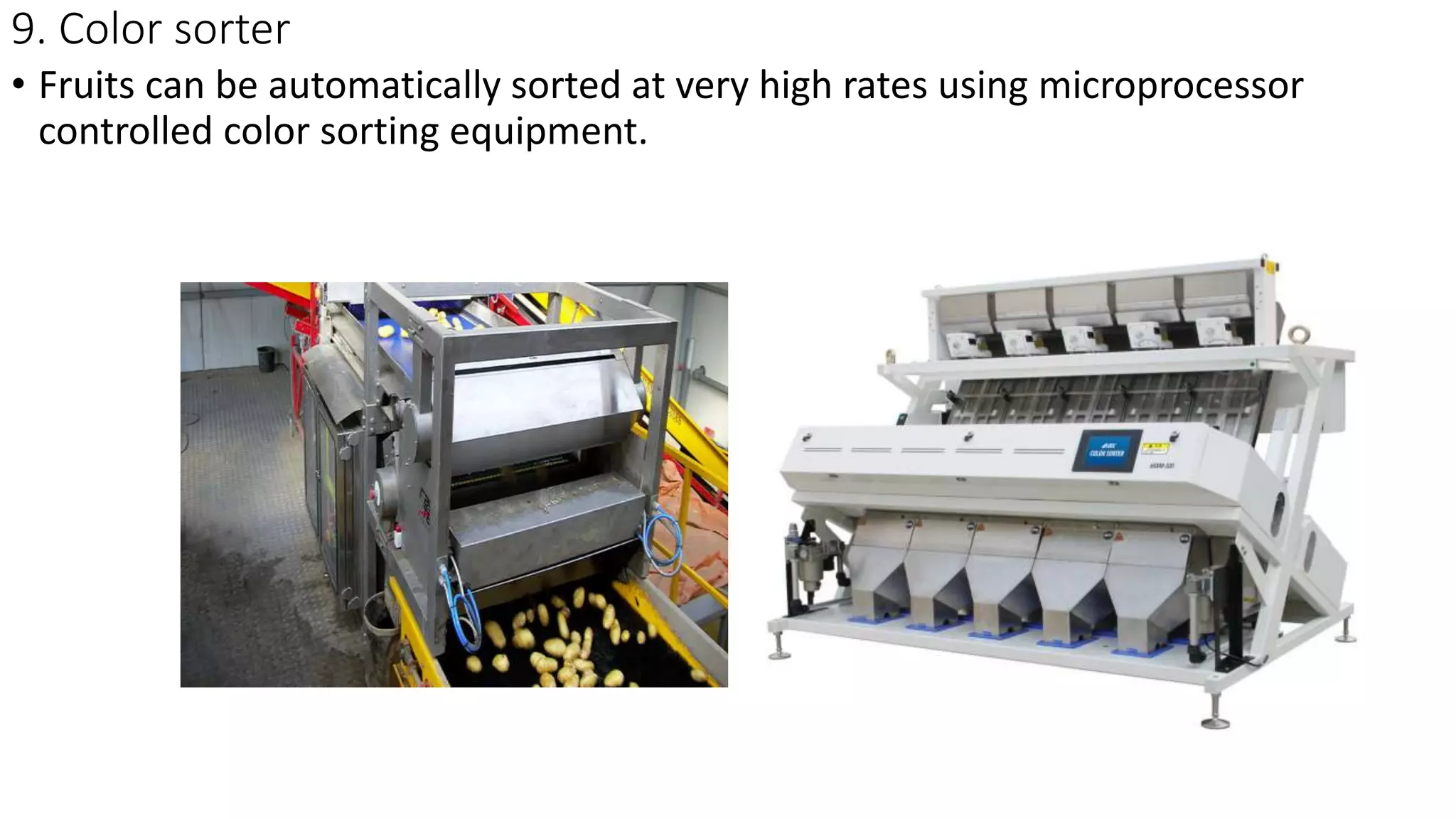
9. Color sorter
• Fruits can be automatically sorted at very high rates using microprocessor
controlled color sorting equipment.
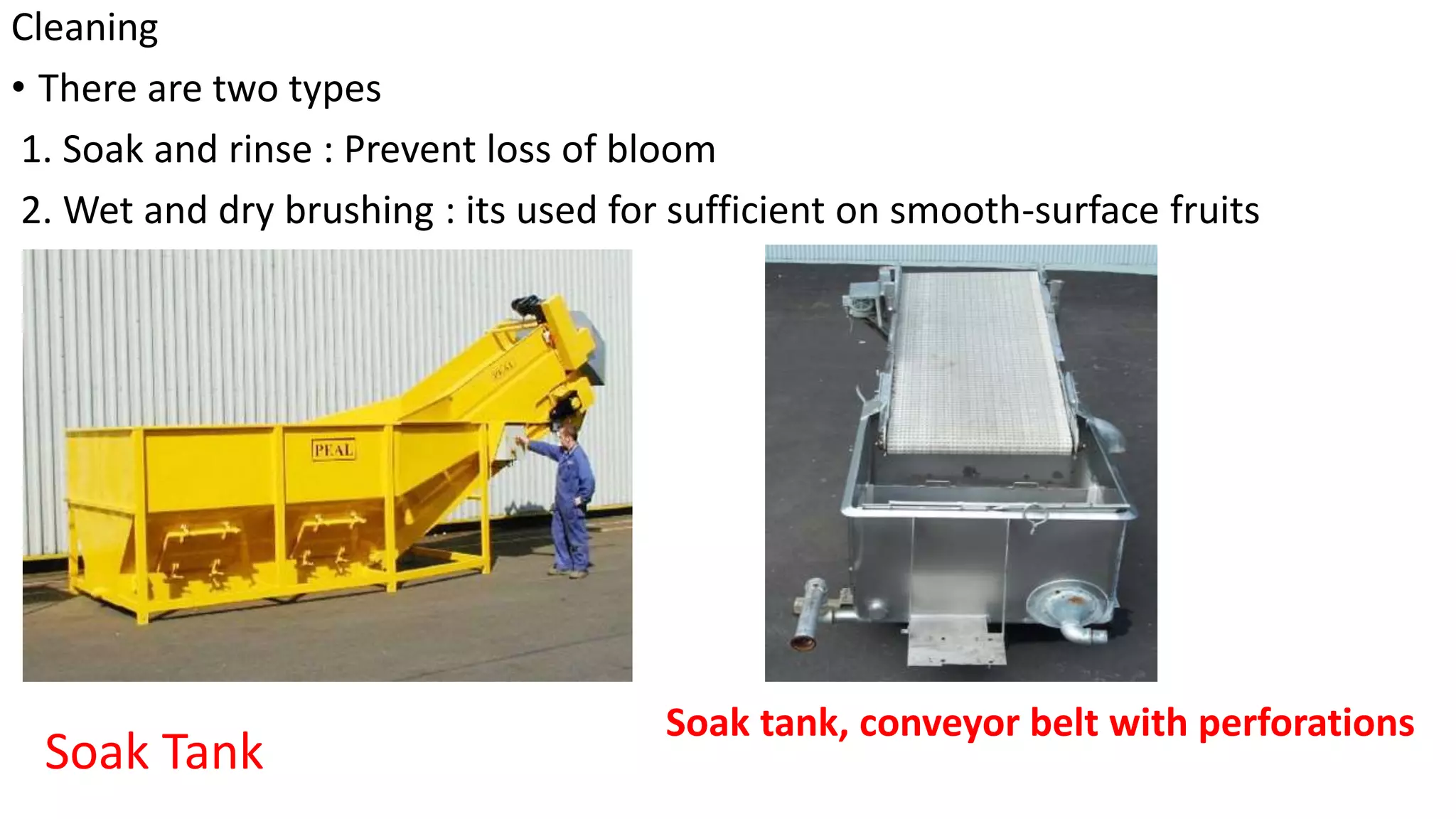
Cleaning
• There are two types
1. Soak and rinse : Prevent loss of bloom
2. Wet and dry brushing : its used for sufficient on smooth-surface fruits
Soak Tank
Soak tank, conveyor belt with perforations
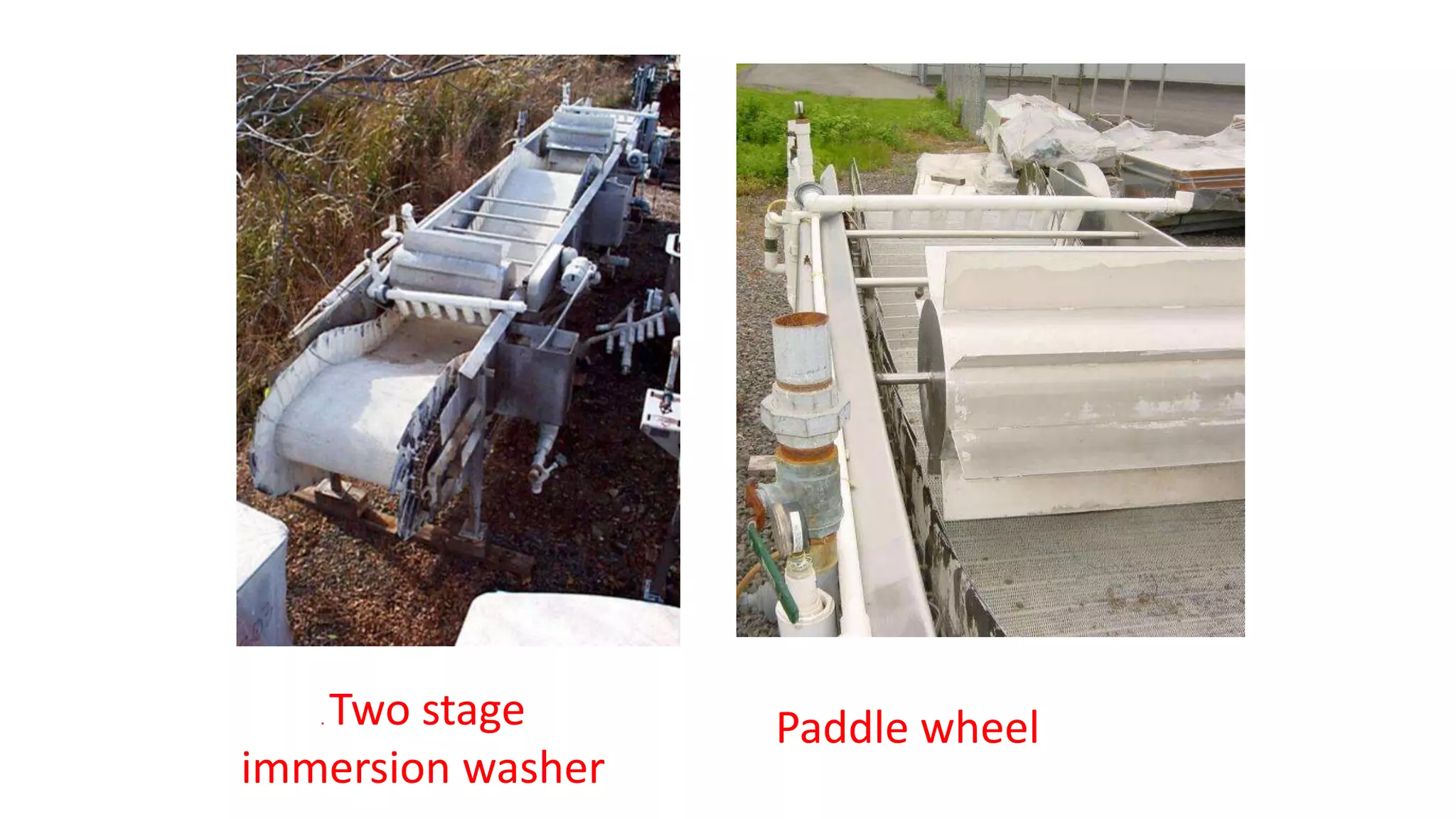
. Two stage
immersion washer
Paddle wheel
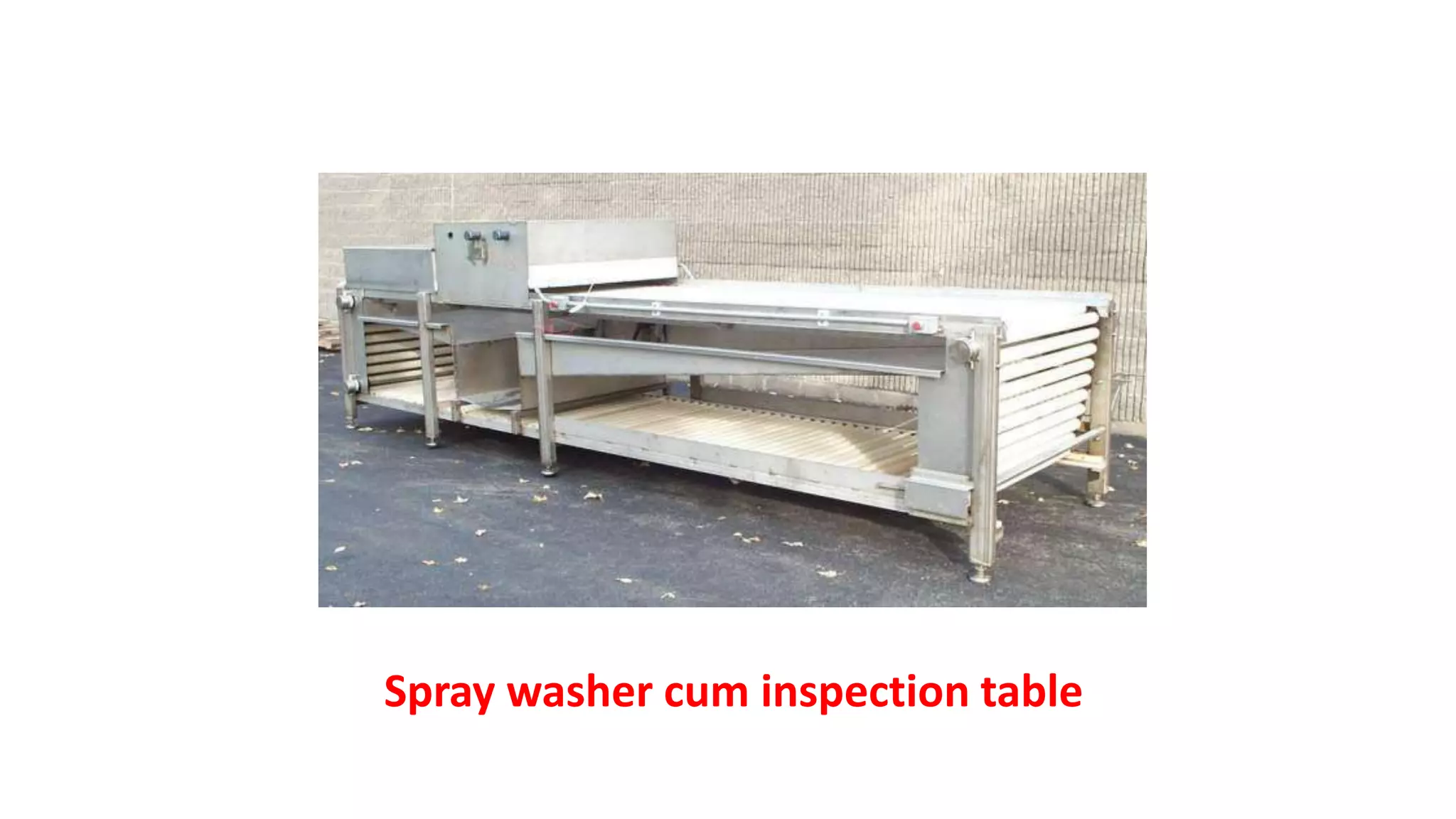
Spray washer cum inspection table
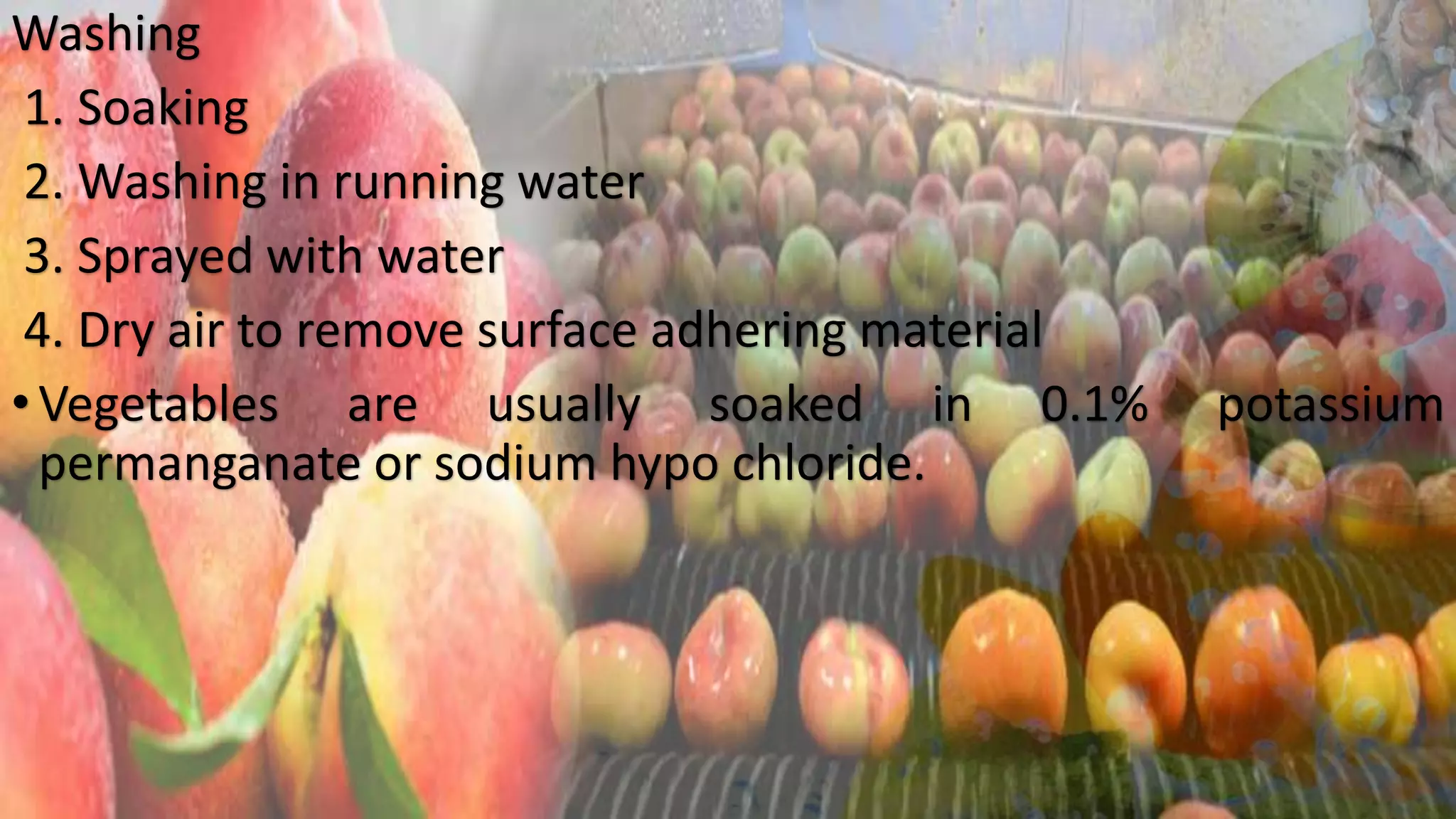
Washing
1. Soaking
2. Washing in running water
3. Sprayed with water
4. Dry air to remove surface adhering material
•Vegetables are usually soaked in 0.1% potassium
permanganate or sodium hypo chloride.
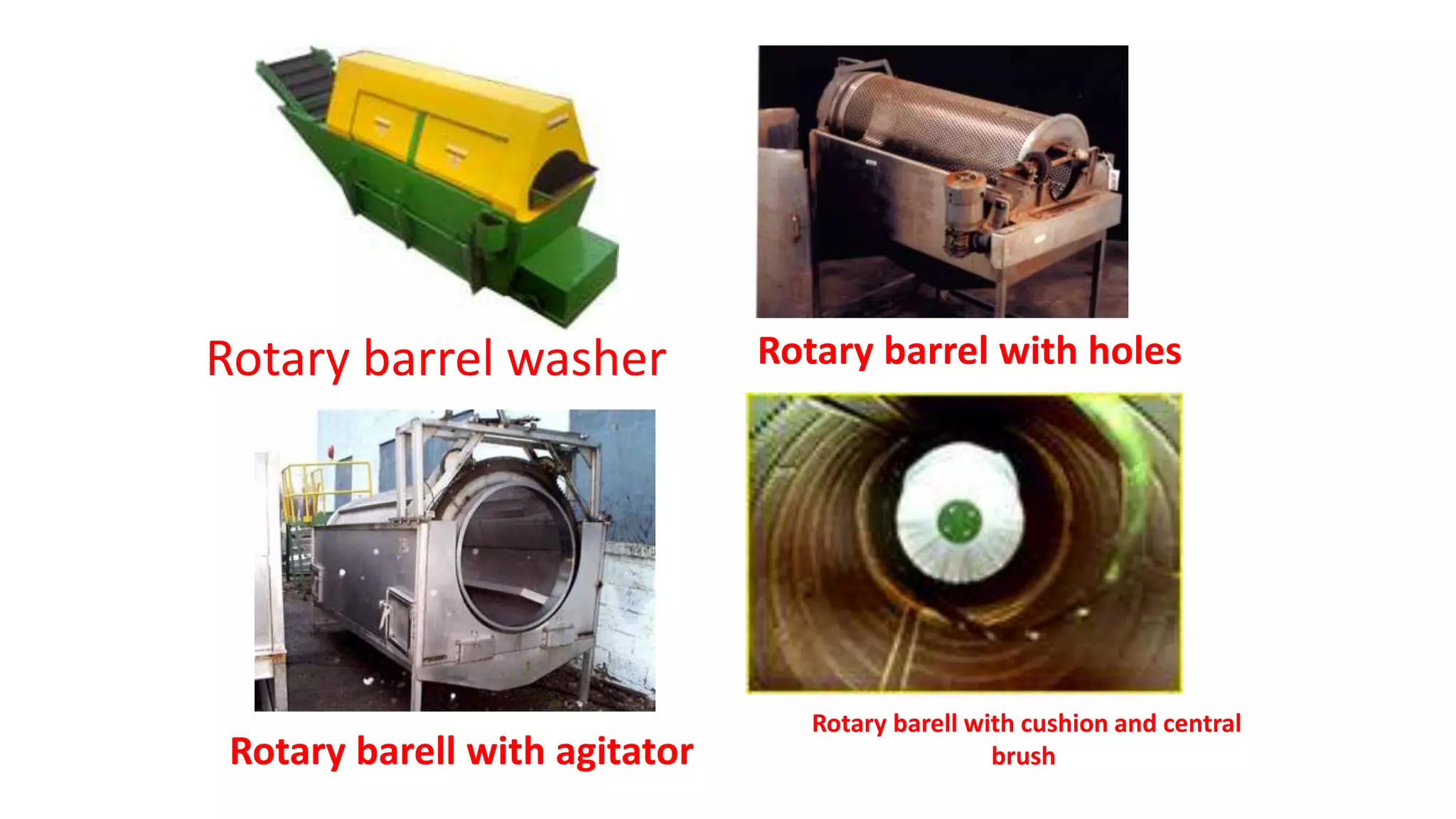
Rotary barrel with holesRotary barrel washer
Rotary barell with agitator
Rotary barell with cushion and central
brush
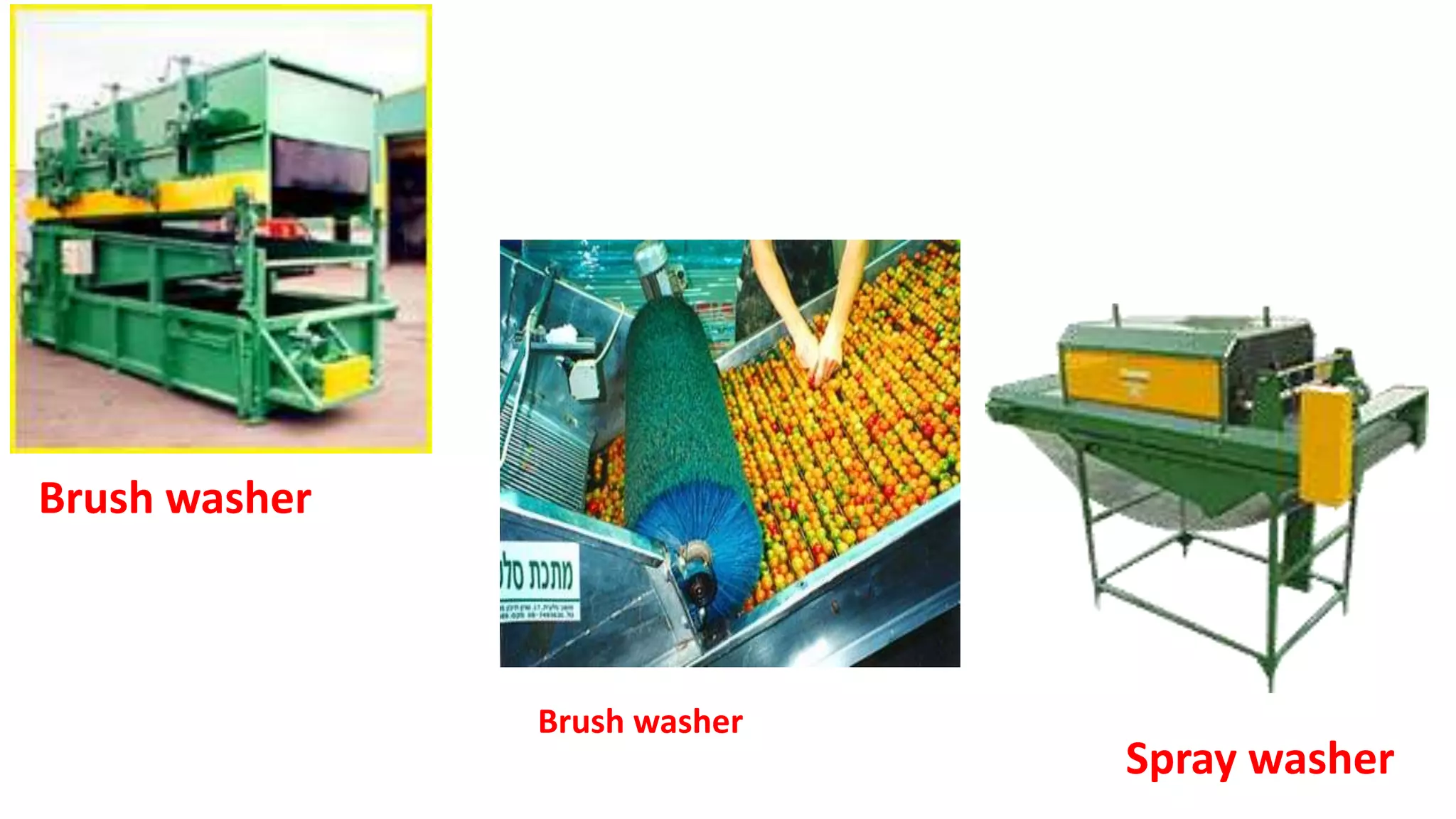
Spray washer
Brush washer
Brush washer
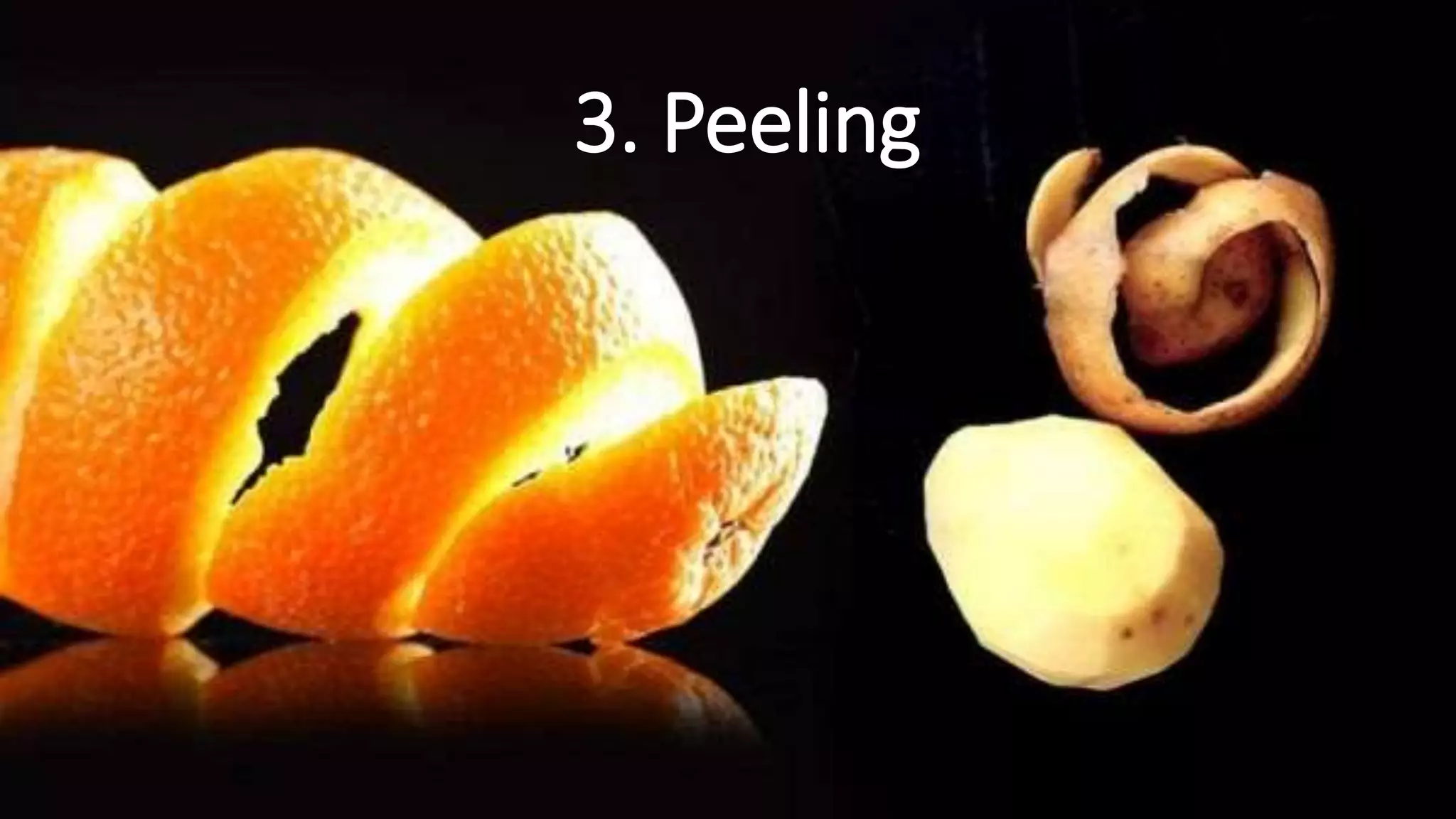
3. Peeling
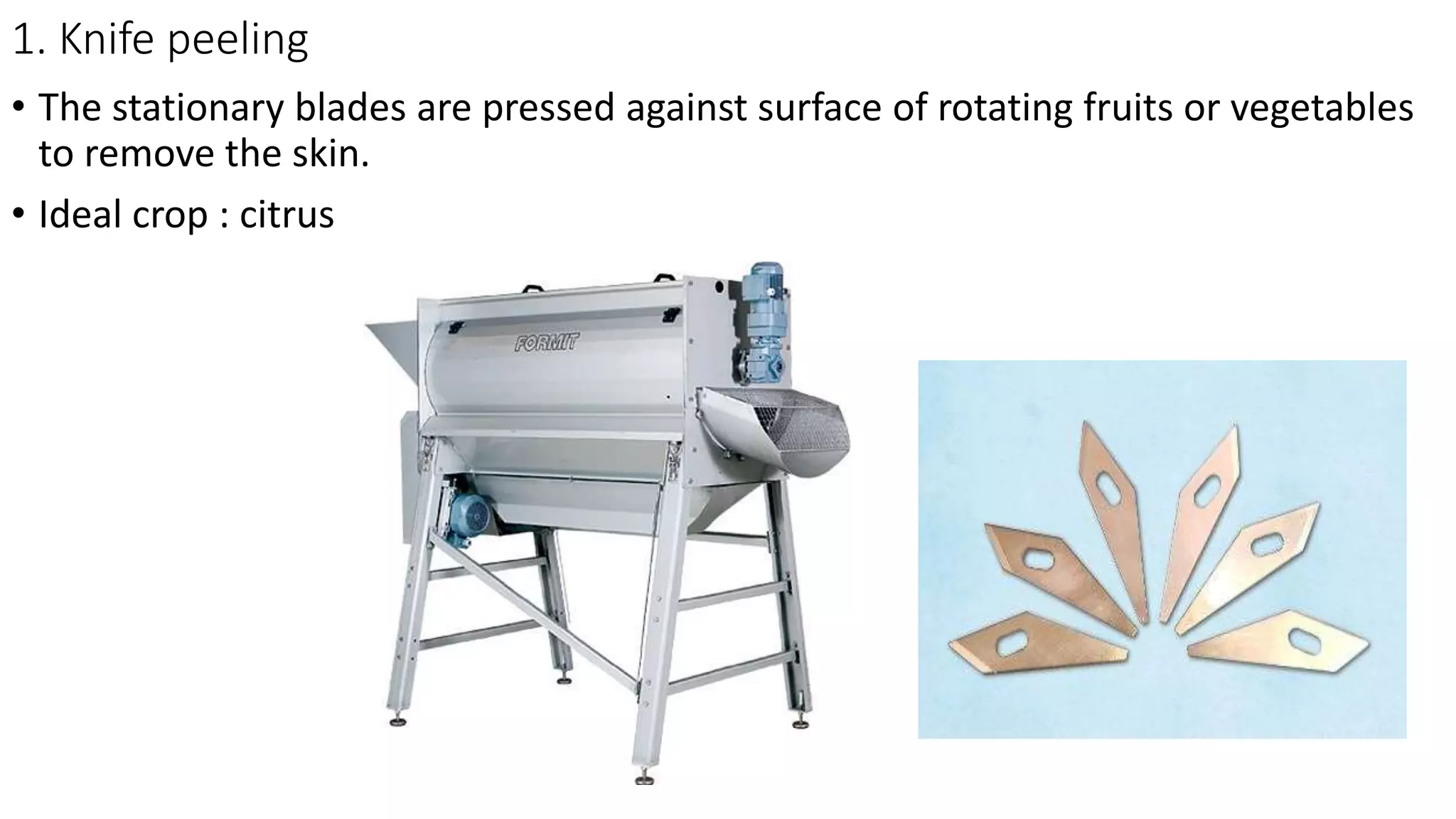
1. Knife peeling
• The stationary blades are pressed against surface of rotating fruits or vegetables
to remove the skin.
• Ideal crop : citrus
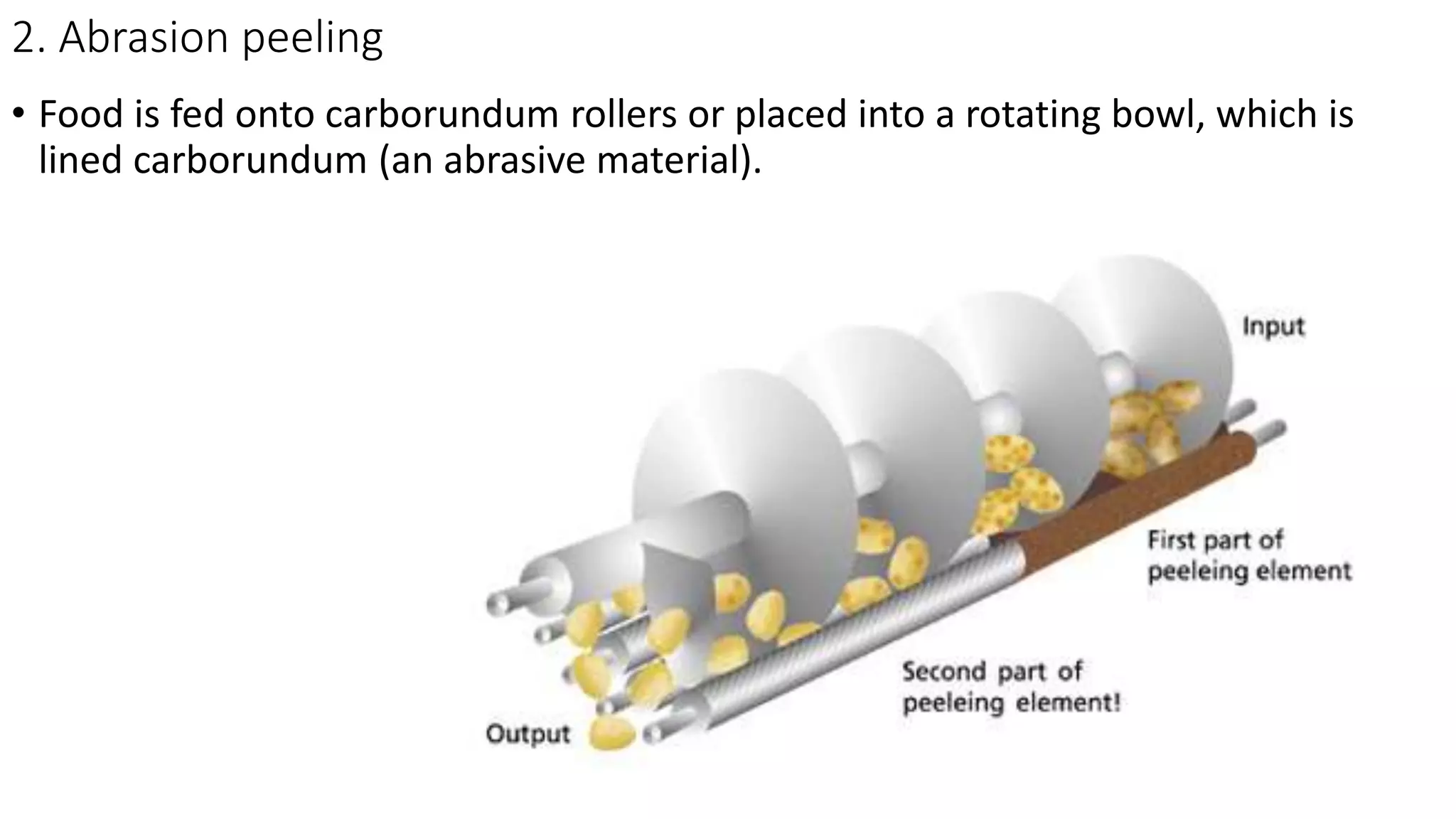
2. Abrasion peeling
• Food is fed onto carborundum rollers or placed into a rotating bowl, which is
lined carborundum (an abrasive material).
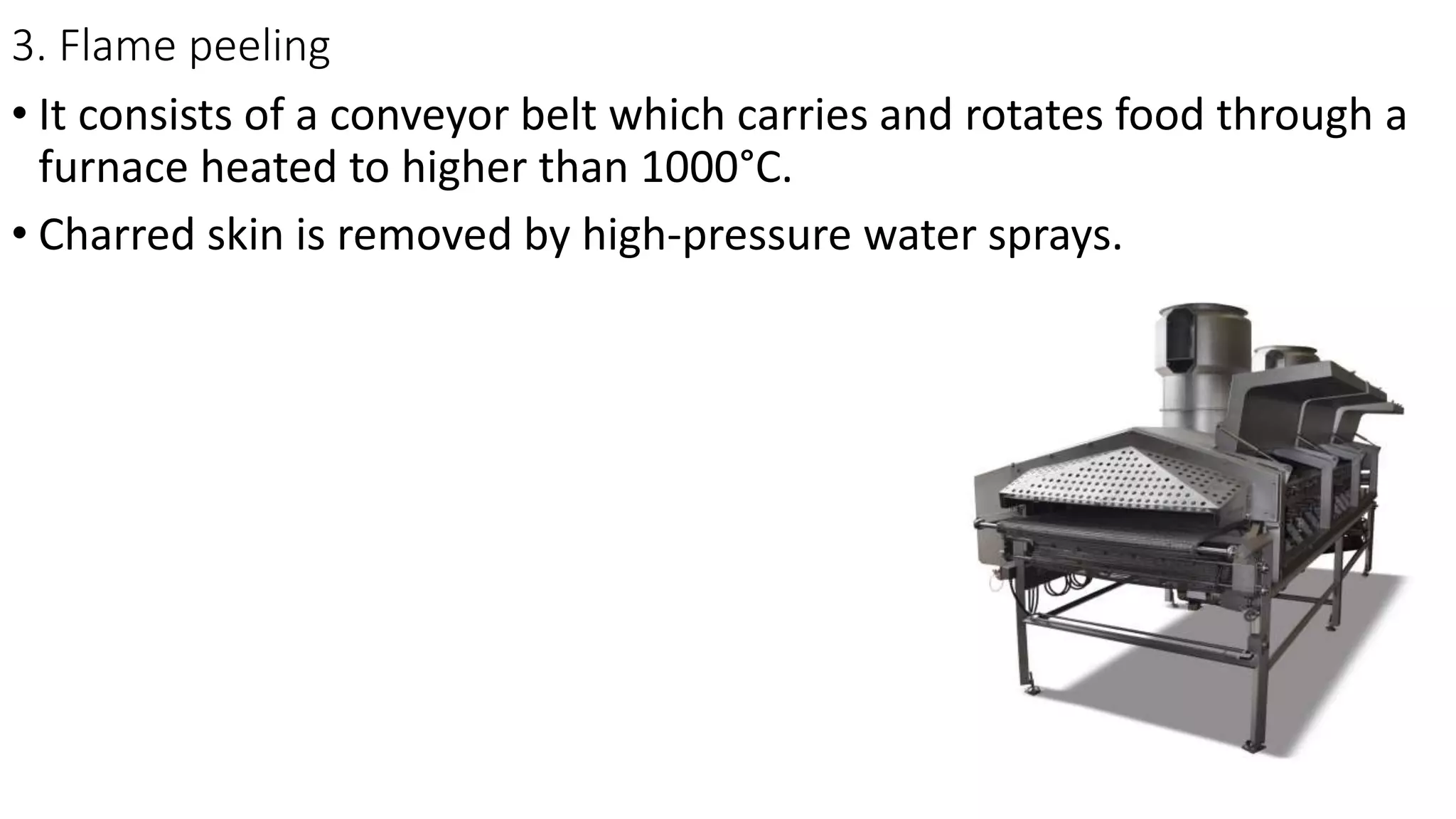
3. Flame peeling
• It consists of a conveyor belt which carries and rotates food through a
furnace heated to higher than 1000°C.
• Charred skin is removed by high-pressure water sprays.
4. Flash steam peeling
• Fruits and vegetables are fed in batches into a pressure vessel which is rotated at
4-6 revolution per min.
• High pressure steam at 1500kPa is introduced and all food surfaces are exposed
to steam by rotation of vessel for a pre-determined time which differs according
to type of fruit.
• Texture and color are preserved and high temperature causes rapid heating of
surface but low thermal conductivity and product is not cooked.
5. Lye peeling
• Fruit is passed through a 1-2% dilute solution (NaOH, KOH)
• Lye solution is heated to 100 to 120°C, its softens skin, and skin is then removed
by high-pressure water sprays.
• Not ideal : Root crops (bleaching).
• Skin can be removed two method
1. Water sprays
2. Rubber disc or rollers
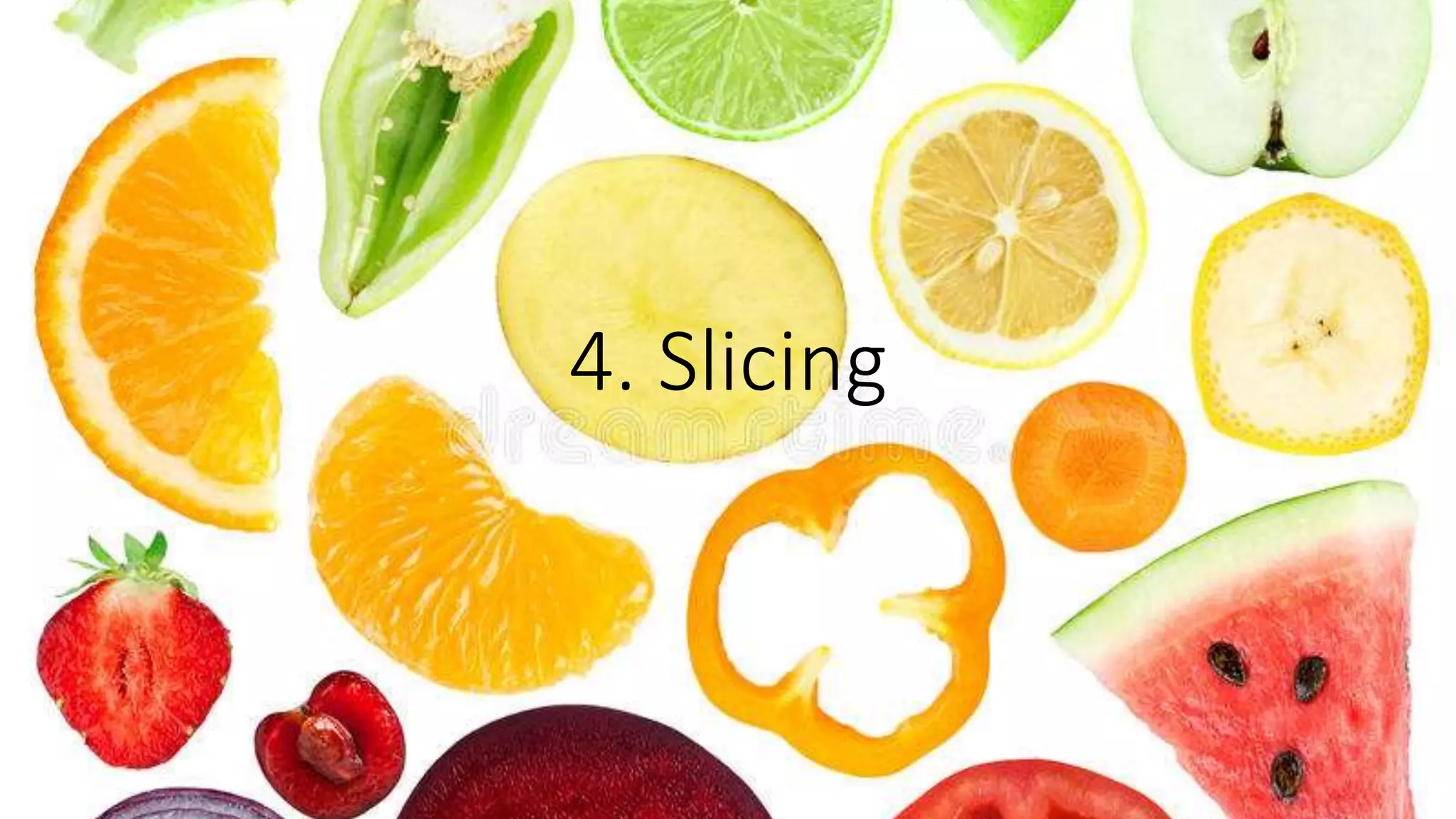
4. Slicing
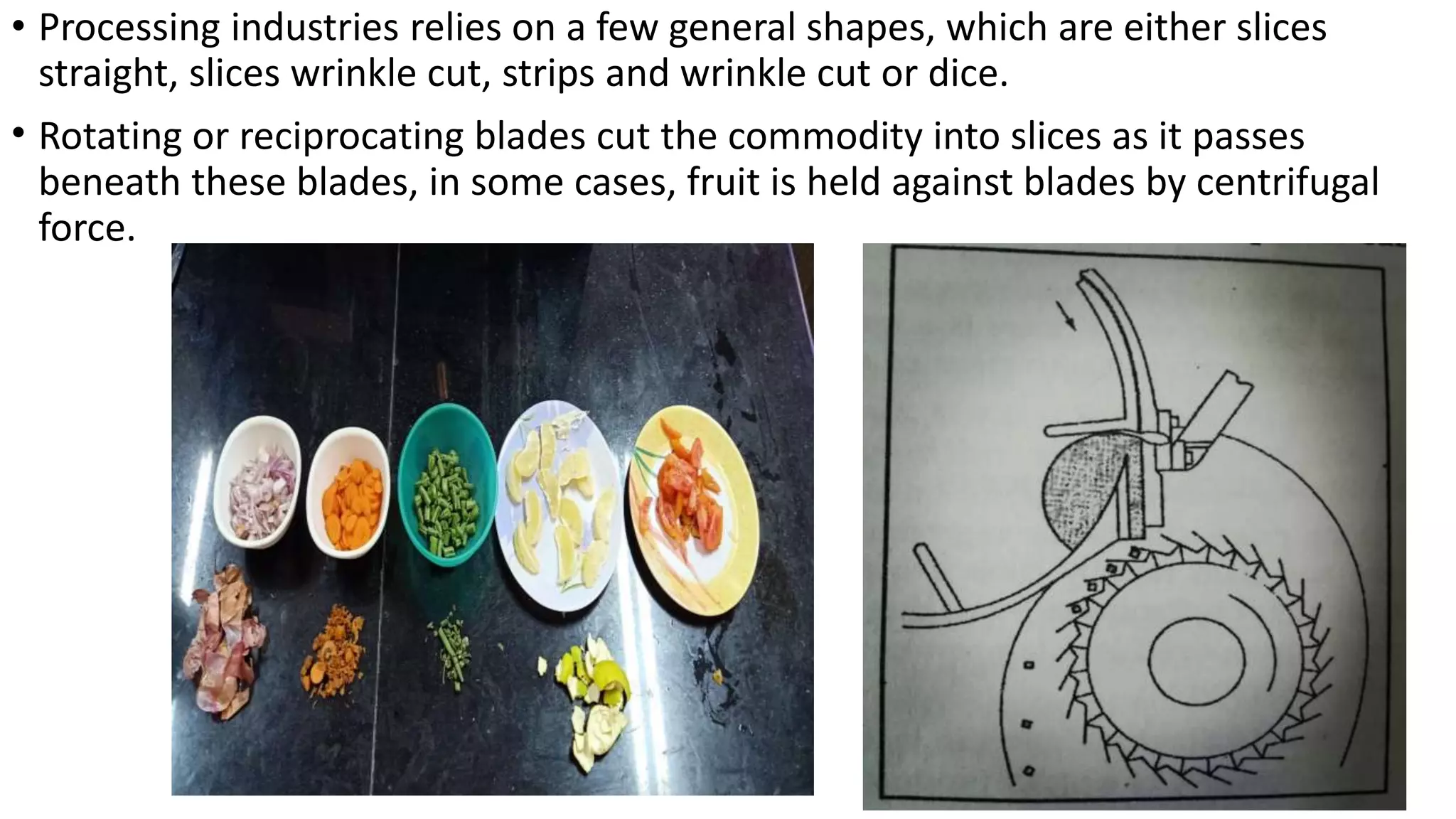
• Processing industries relies on a few general shapes, which are either slices
straight, slices wrinkle cut, strips and wrinkle cut or dice.
• Rotating or reciprocating blades cut the commodity into slices as it passes
beneath these blades, in some cases, fruit is held against blades by centrifugal
force.
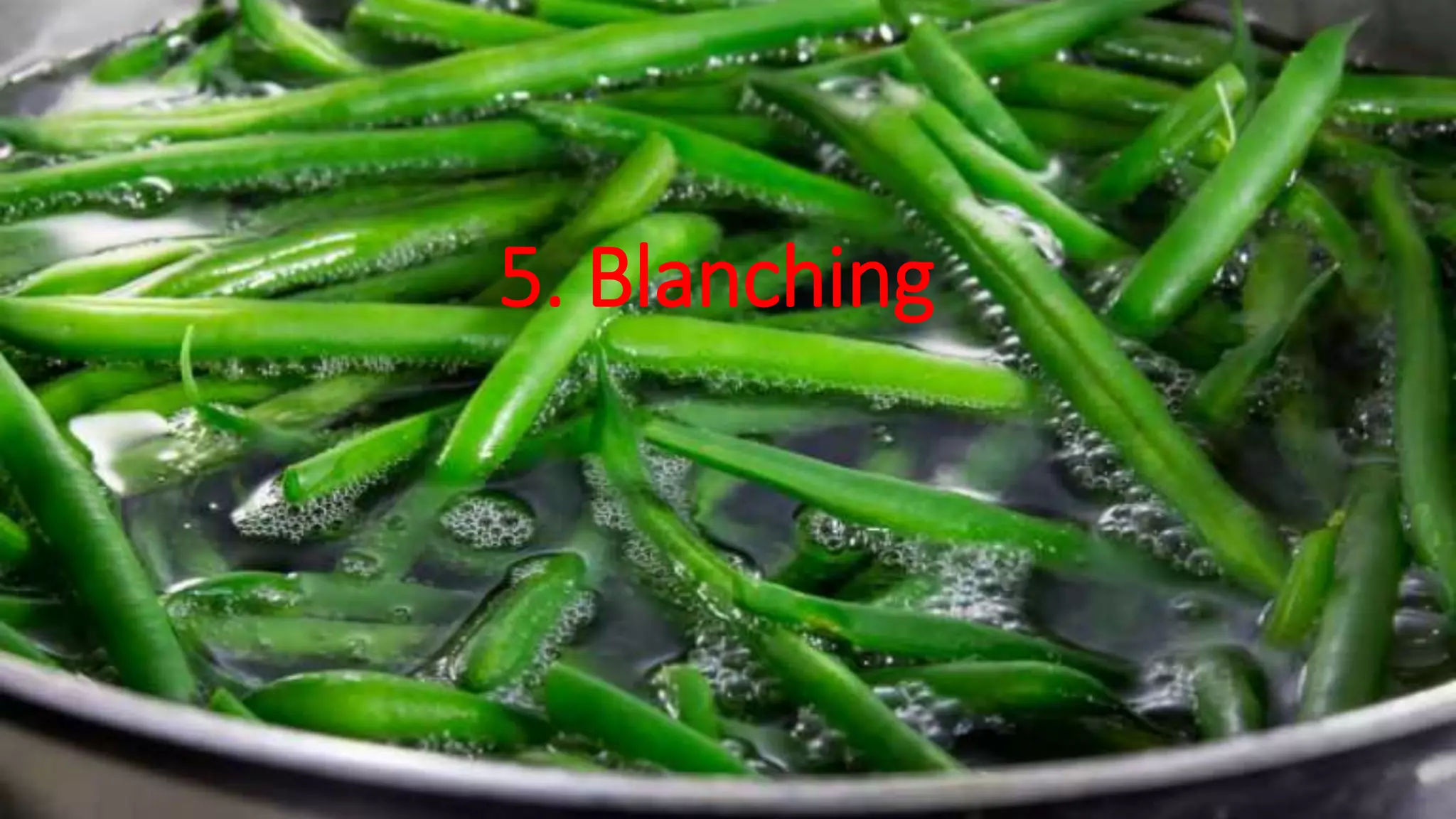
5. Blanching
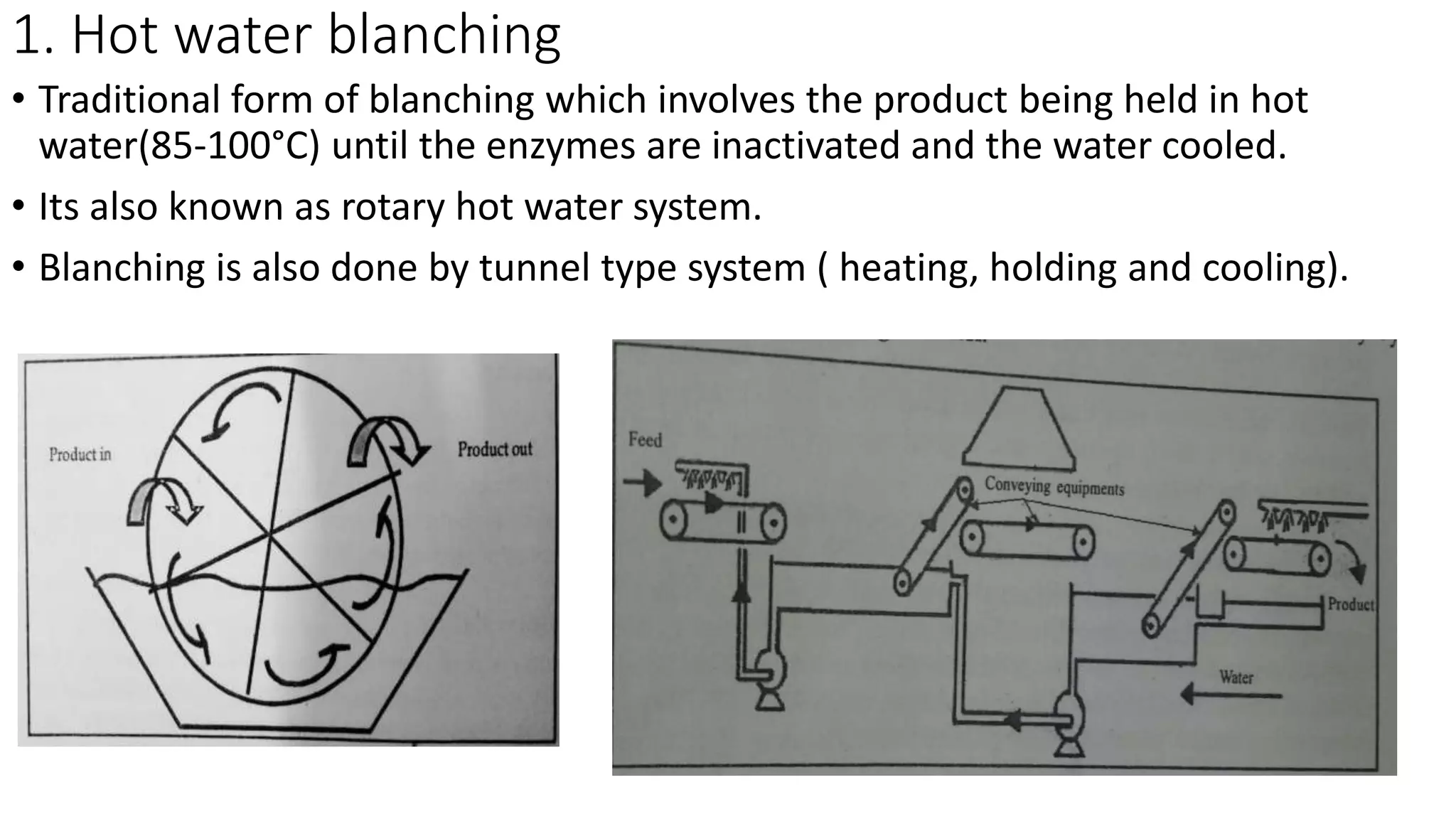
1. Hot water blanching
• Traditional form of blanching which involves the product being held in hot
water(85-100°C) until the enzymes are inactivated and the water cooled.
• Its also known as rotary hot water system.
• Blanching is also done by tunnel type system ( heating, holding and cooling).
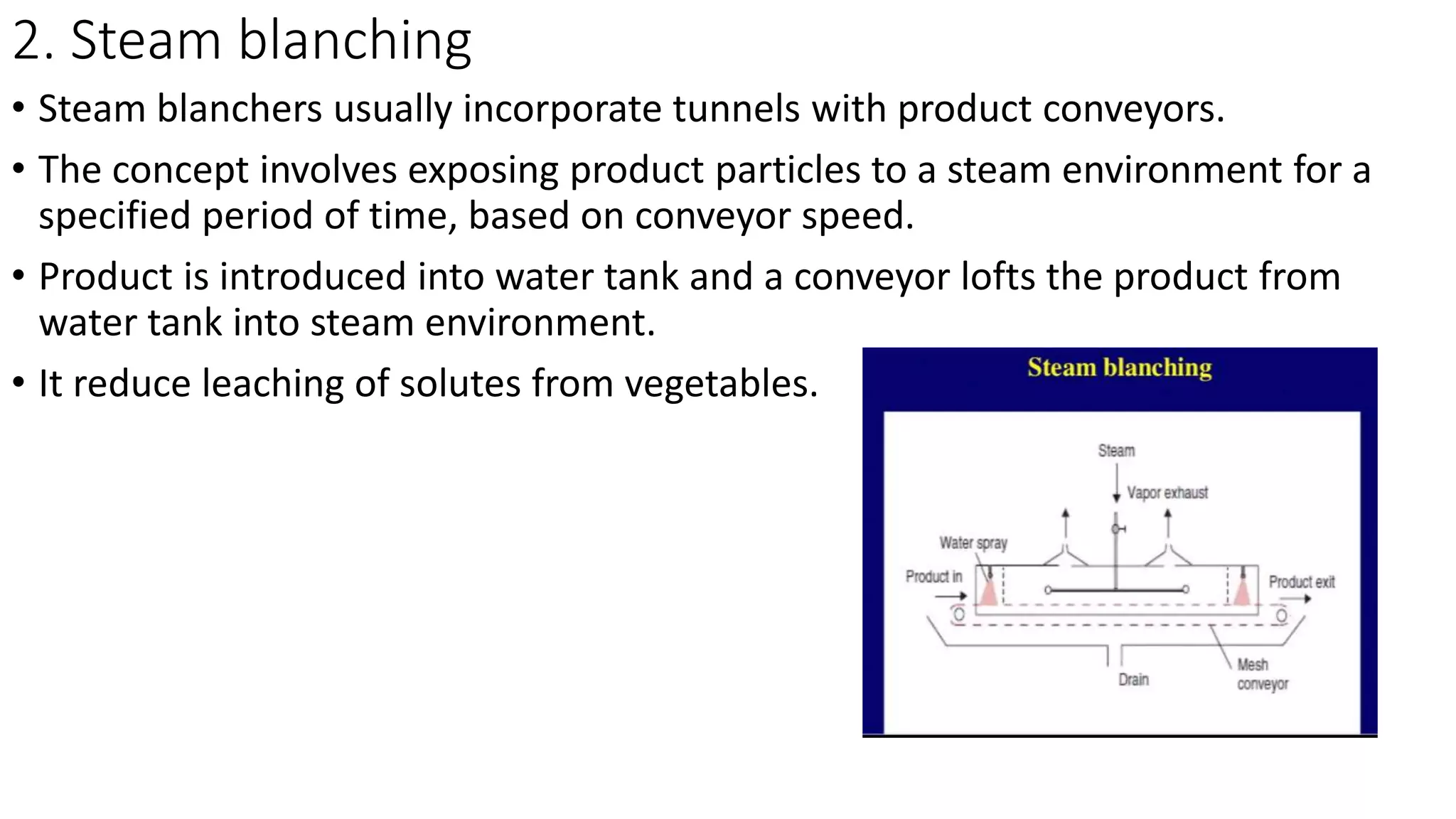
2. Steam blanching
• Steam blanchers usually incorporate tunnels with product conveyors.
• The concept involves exposing product particles to a steam environment for a
specified period of time, based on conveyor speed.
• Product is introduced into water tank and a conveyor lofts the product from
water tank into steam environment.
• It reduce leaching of solutes from vegetables.
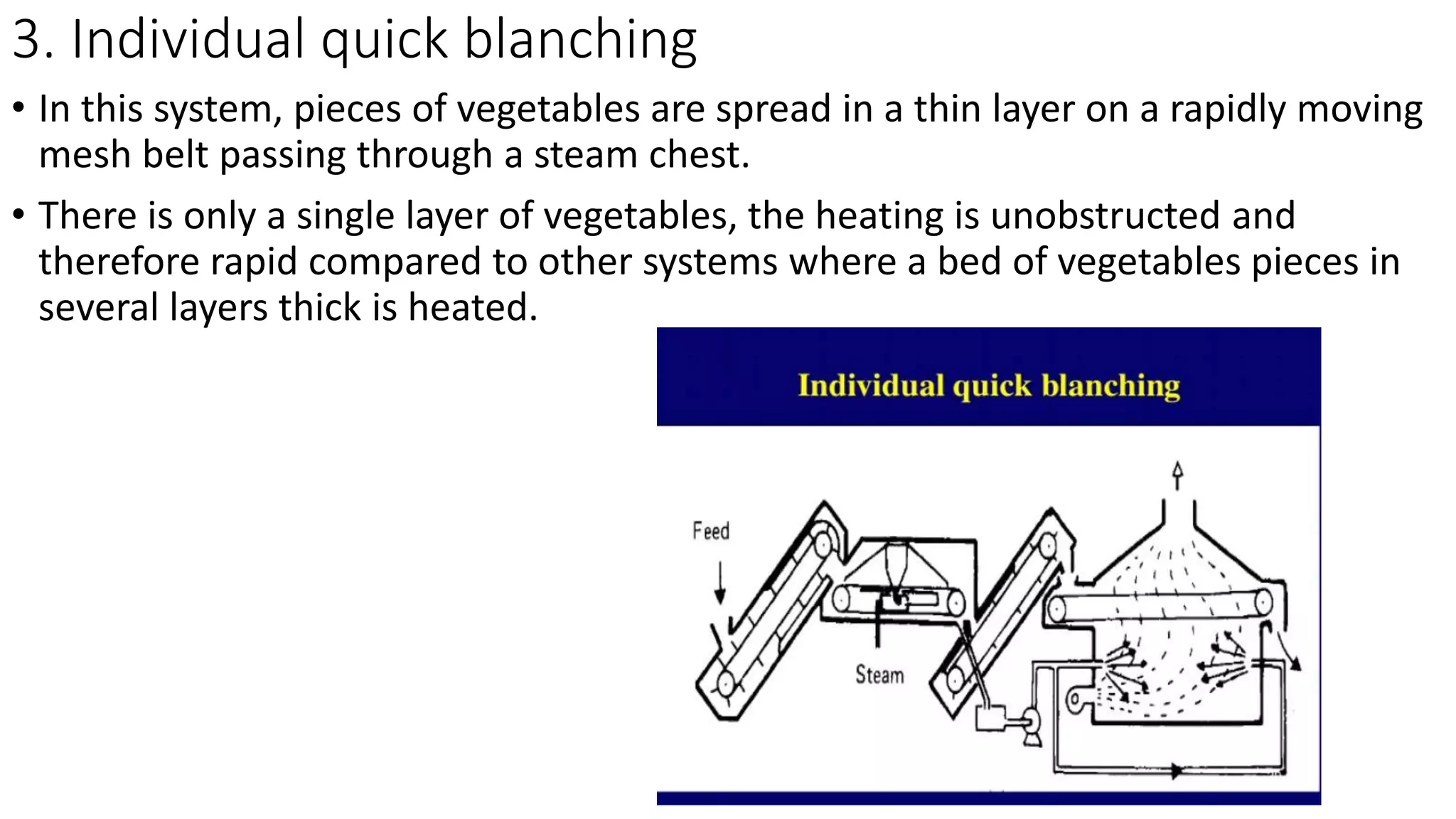
3. Individual quick blanching
• In this system, pieces of vegetables are spread in a thin layer on a rapidly moving
mesh belt passing through a steam chest.
• There is only a single layer of vegetables, the heating is unobstructed and
therefore rapid compared to other systems where a bed of vegetables pieces in
several layers thick is heated.
4. Vacuum steam blanching
• Vacuum steam blanching is carried out in an end-over-end conical jacketed
cooker.
• Vegetables are loaded into cooker and a slow rotation started as pressure is
reduced to about 10 kPa.
• Vacuum is broken with saturated steam and the vessel brought to atmospheric
pressure, which is held for about one minute.
• Then vacuum cooled by again reducing pressure in vessel.
5. In-can blanching
• Can is overfilled with washed materials and then fill the can with near boiling
water.
• After about 30 sec, the fruit had shrunk to fill the can and sufficient gas had been
removed to give an adequate vacuum for canning.
• Ideal crop: peas
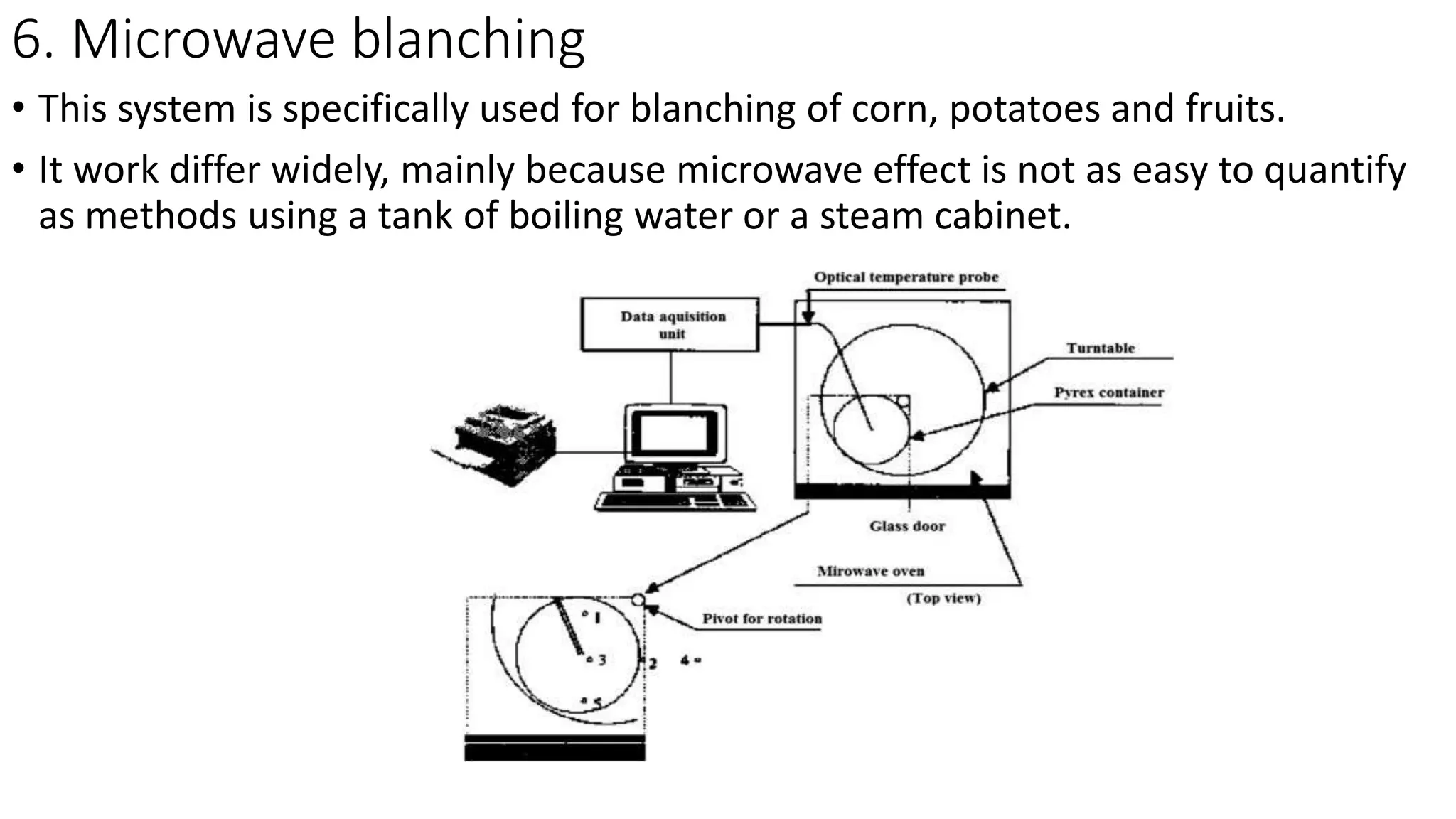
6. Microwave blanching
• This system is specifically used for blanching of corn, potatoes and fruits.
• It work differ widely, mainly because microwave effect is not as easy to quantify
as methods using a tank of boiling water or a steam cabinet.
7.Hot gas blanching
• Vegetables are heated with a mixture of steam and flue
gases from natural gas burners.
• Advantage of the system is to reduce amount of
effluent.
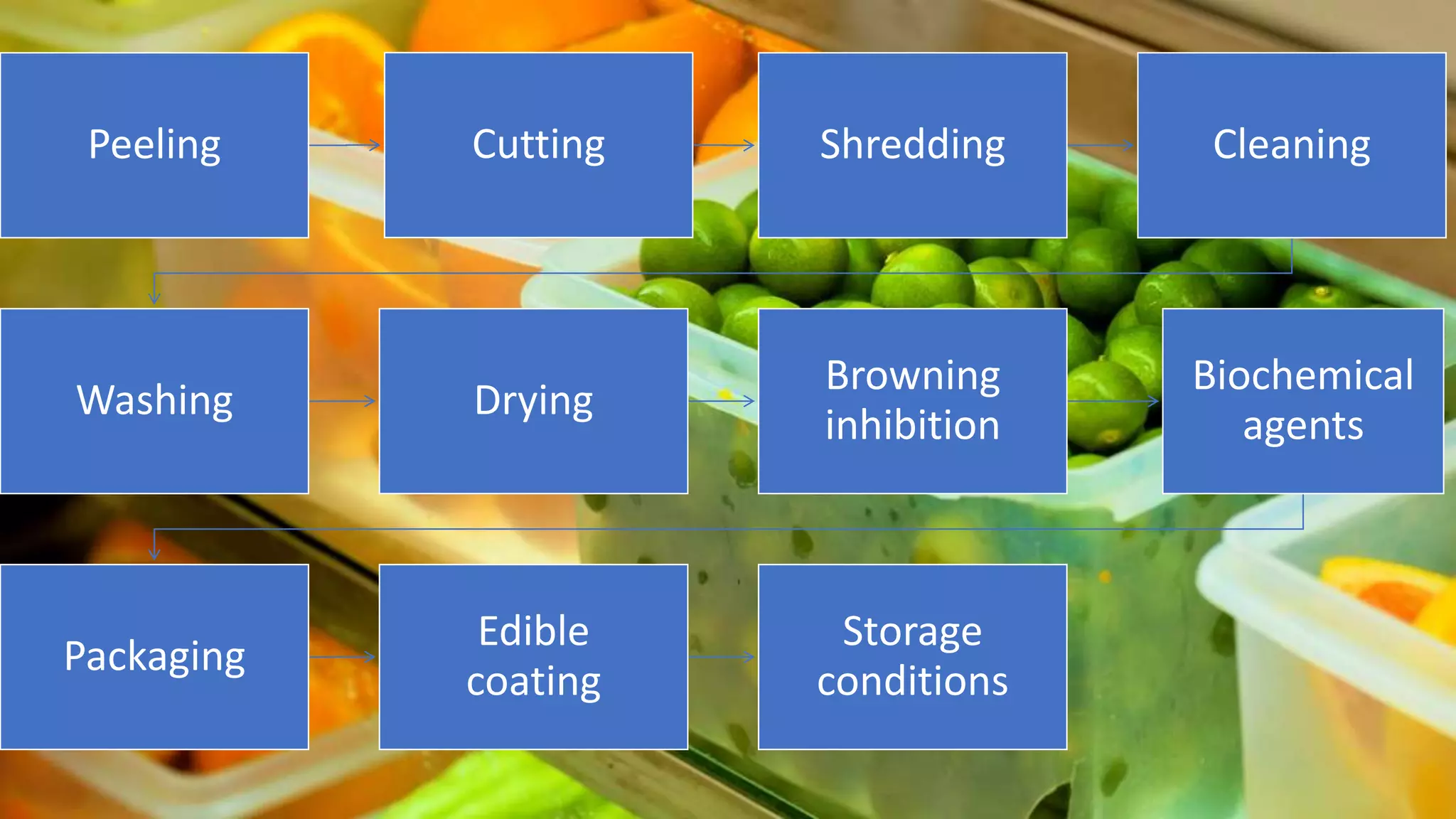
Peeling Cutting Shredding Cleaning
Washing Drying
Browning
inhibition
Biochemical
agents
Packaging
Edible
coating
Storage
conditions
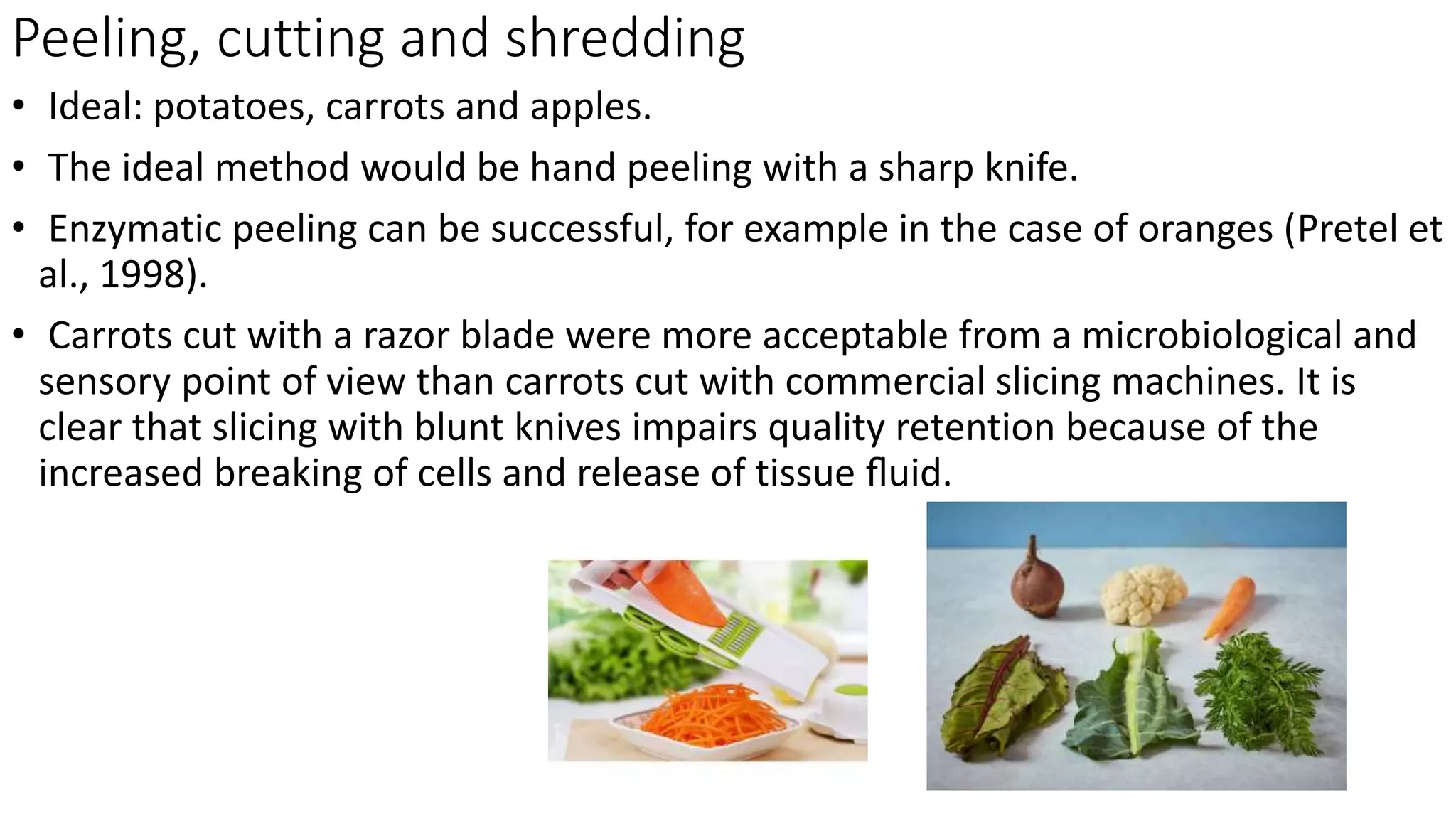
Peeling, cutting and shredding
• Ideal: potatoes, carrots and apples.
• The ideal method would be hand peeling with a sharp knife.
• Enzymatic peeling can be successful, for example in the case of oranges (Pretel et
al., 1998).
• Carrots cut with a razor blade were more acceptable from a microbiological and
sensory point of view than carrots cut with commercial slicing machines. It is
clear that slicing with blunt knives impairs quality retention because of the
increased breaking of cells and release of tissue fluid.
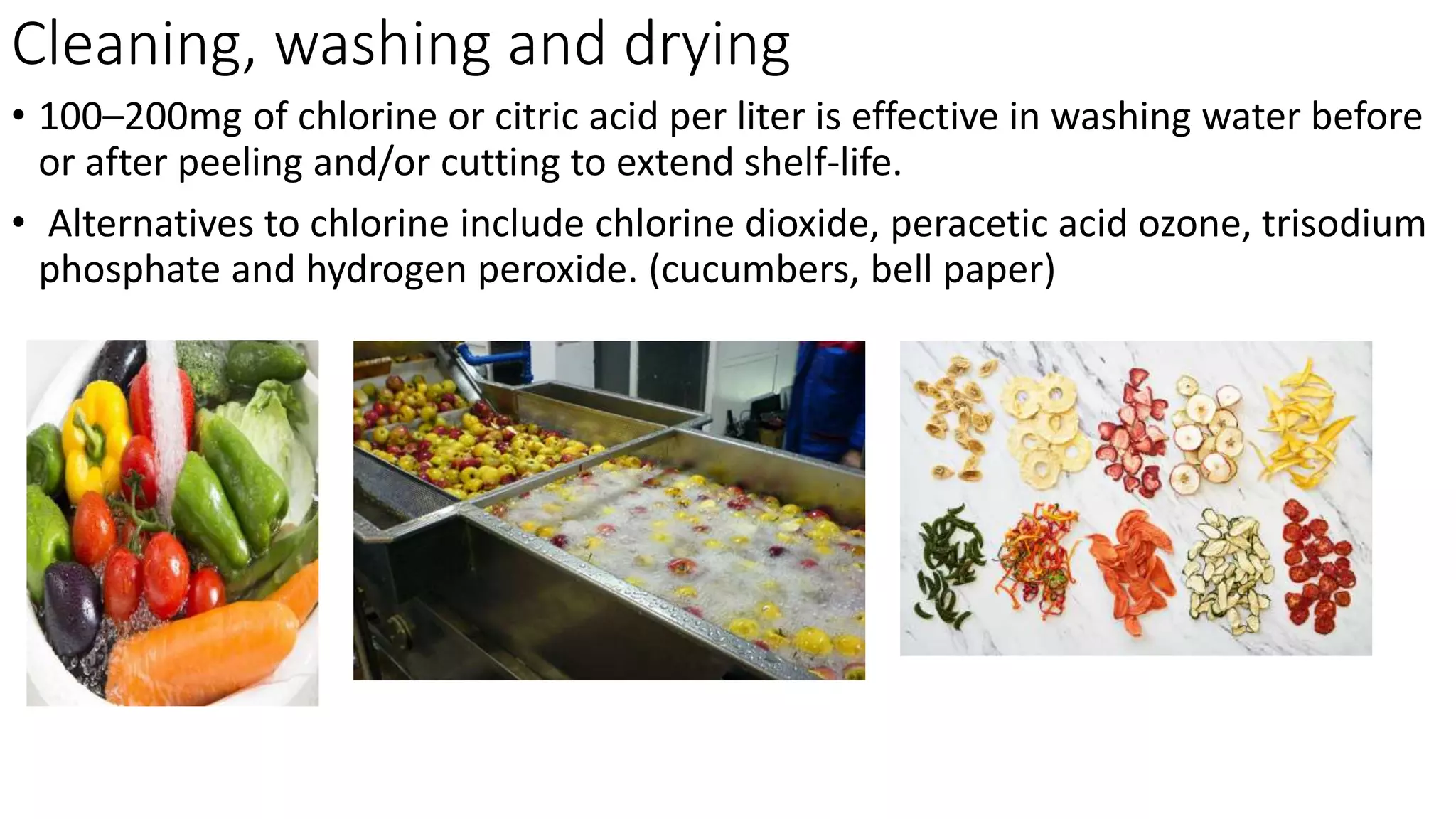
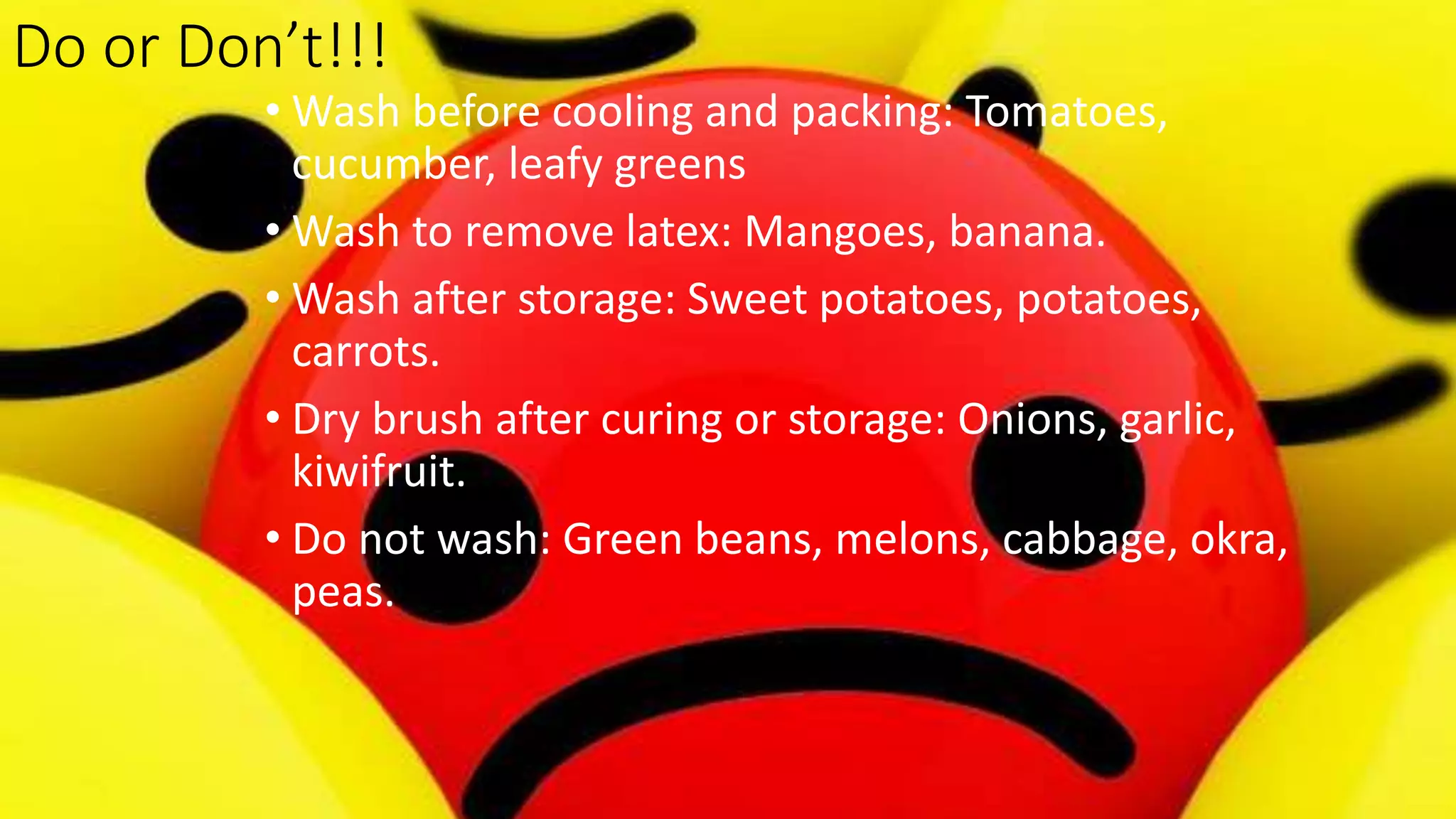
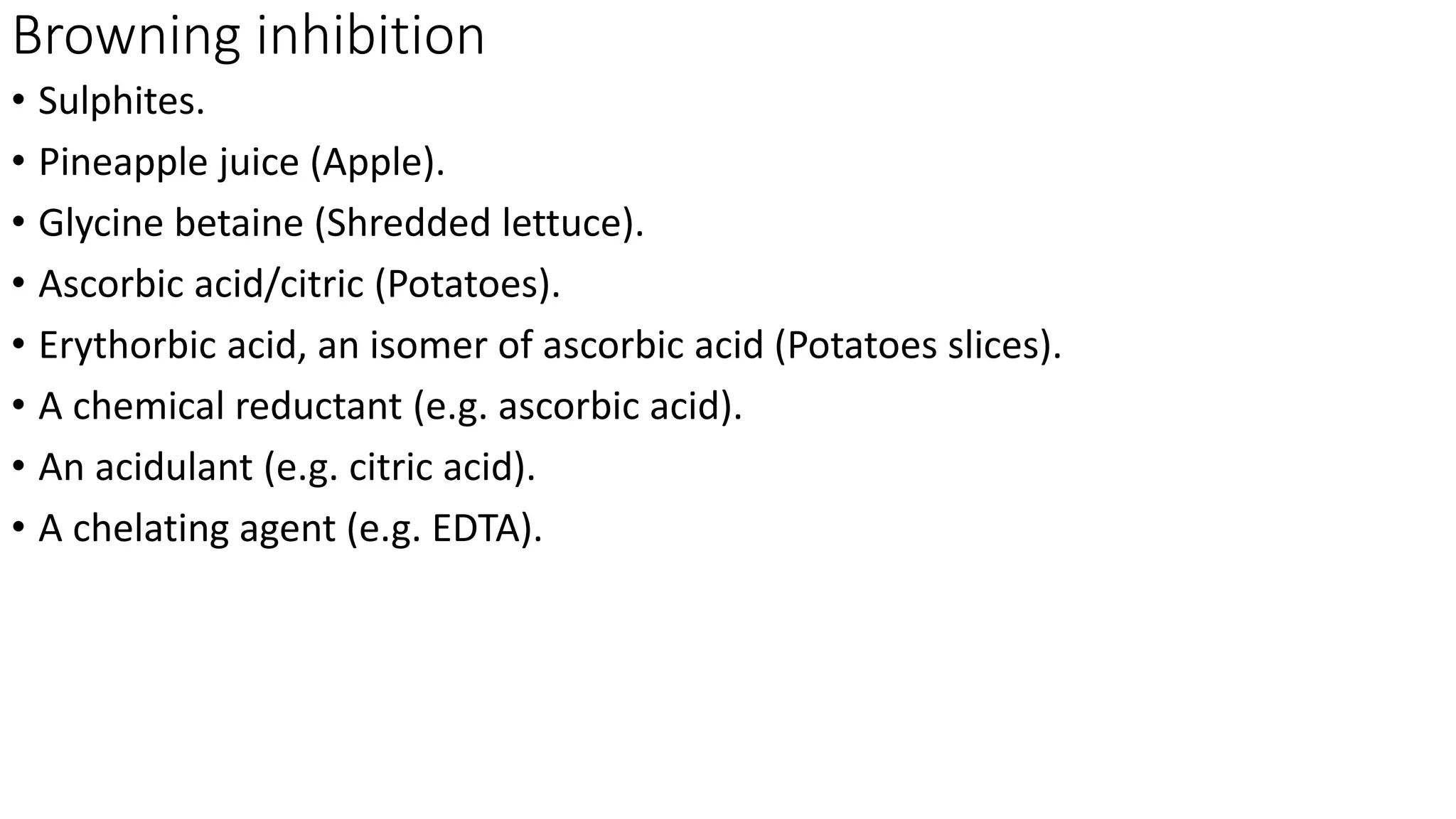
Cleaning, washing and drying
• 100–200mg of chlorine or citric acid per liter is effective in washing water before
or after peeling and/or cutting to extend shelf-life.
• Alternatives to chlorine include chlorine dioxide, peracetic acid ozone, trisodium
phosphate and hydrogen peroxide. (cucumbers, bell paper)
Do or Don’t!!!
• Wash before cooling and packing: Tomatoes,
cucumber, leafy greens
• Wash to remove latex: Mangoes, banana.
• Wash after storage: Sweet potatoes, potatoes,
carrots.
• Dry brush after curing or storage: Onions, garlic,
kiwifruit.
• Do not wash: Green beans, melons, cabbage, okra,
peas.
Browning inhibition
• Sulphites.
• Pineapple juice (Apple).
• Glycine betaine (Shredded lettuce).
• Ascorbic acid/citric (Potatoes).
• Erythorbic acid, an isomer of ascorbic acid (Potatoes slices).
• A chemical reductant (e.g. ascorbic acid).
• An acidulant (e.g. citric acid).
• A chelating agent (e.g. EDTA).
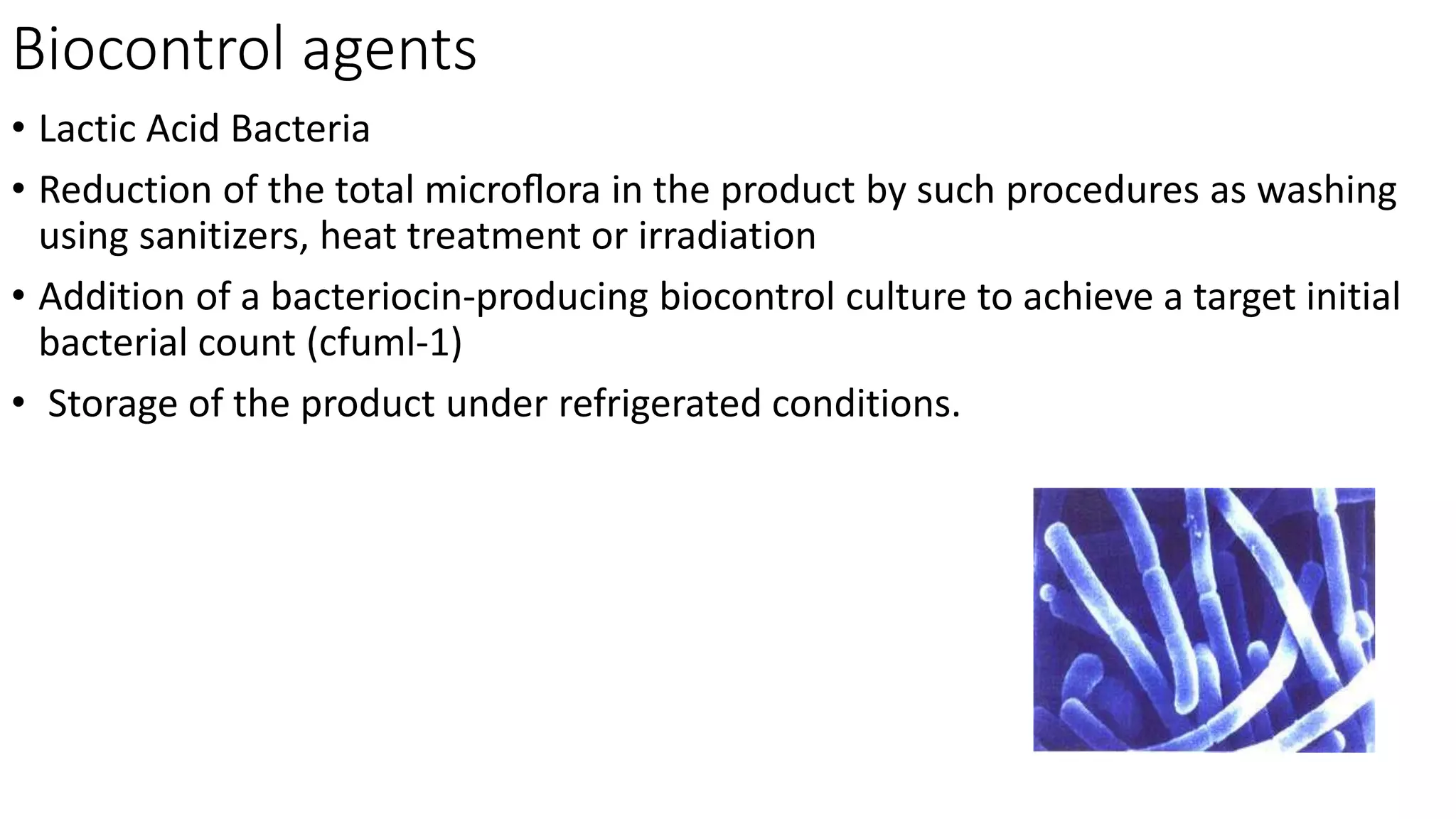
Biocontrol agents
• Lactic Acid Bacteria
• Reduction of the total microflora in the product by such procedures as washing
using sanitizers, heat treatment or irradiation
• Addition of a bacteriocin-producing biocontrol culture to achieve a target initial
bacterial count (cfuml-1)
• Storage of the product under refrigerated conditions.
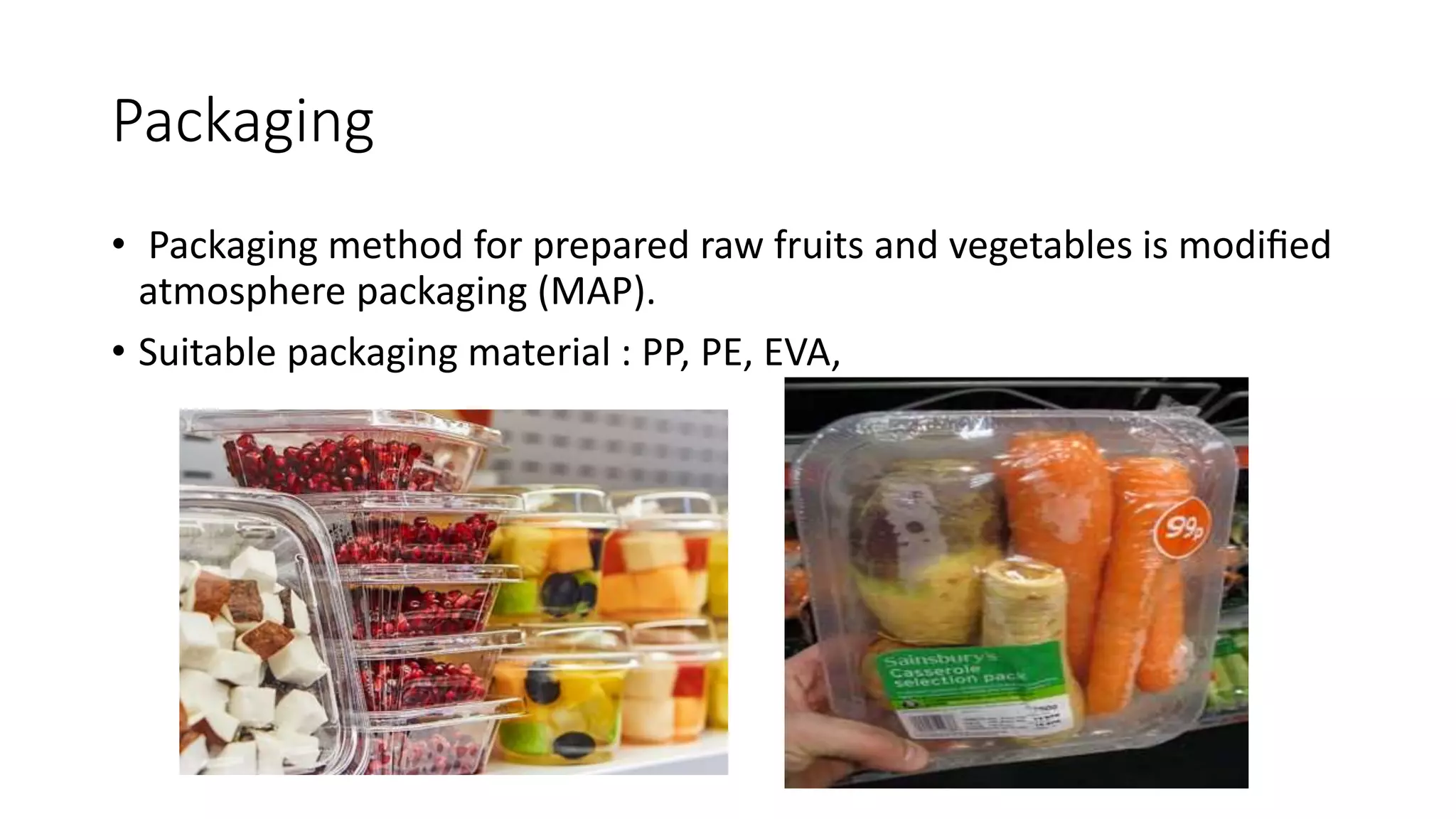
Packaging
• Packaging method for prepared raw fruits and vegetables is modified
atmosphere packaging (MAP).
• Suitable packaging material : PP, PE, EVA,
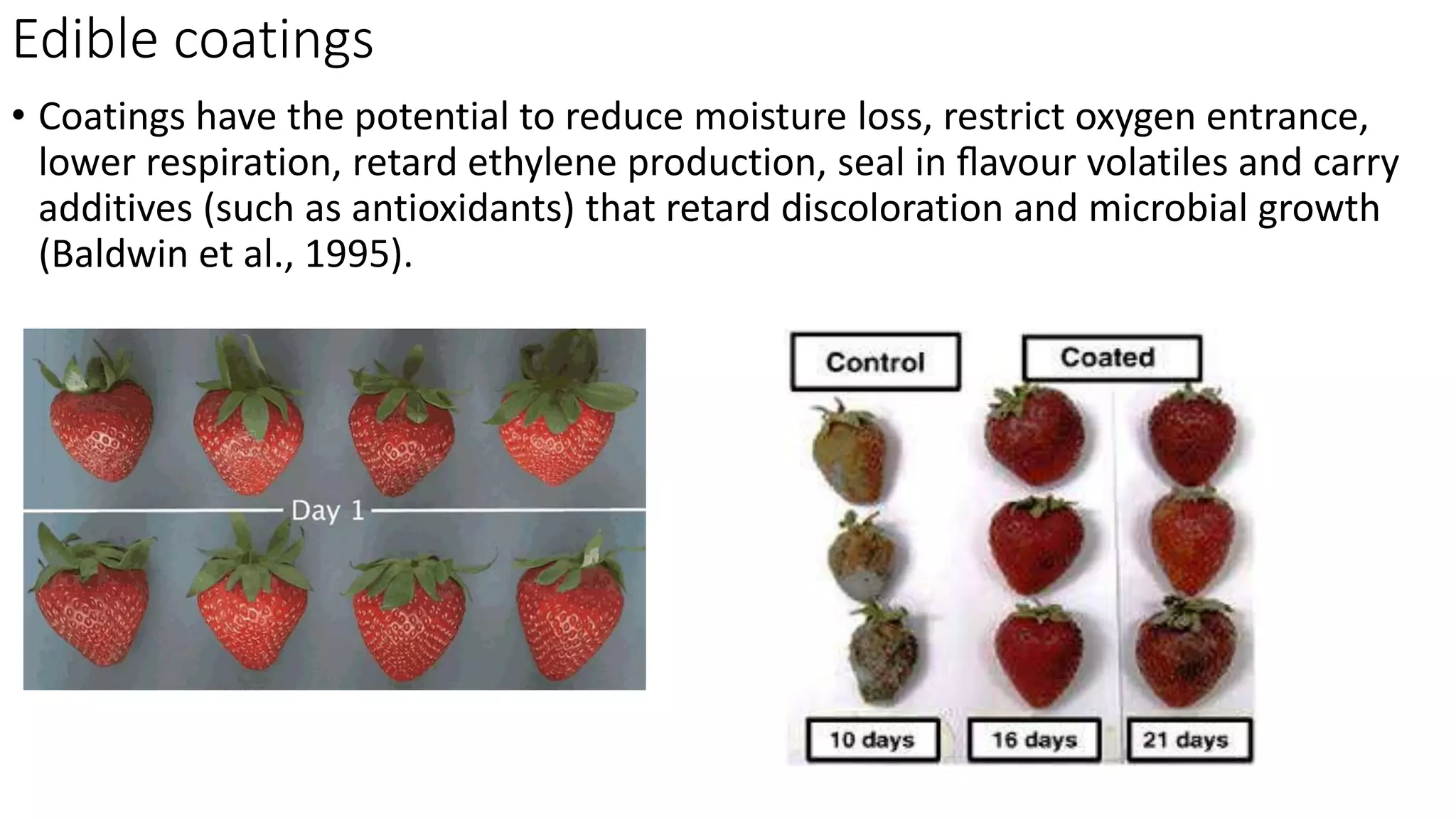
Edible coatings
• Coatings have the potential to reduce moisture loss, restrict oxygen entrance,
lower respiration, retard ethylene production, seal in flavour volatiles and carry
additives (such as antioxidants) that retard discoloration and microbial growth
(Baldwin et al., 1995).
Storage conditions
• Processing, transport, display and intermediate storage should all be at the same
low temperature (preferably 2–4°C).
The following procedure should follow if MAP used for increasing shelf-life.
• a minimum heat treatment such as 90°C for 10min.
• a pH of 5 or less throughout the food.
• a salt level of 3.5% (aqueous) throughout the food.
• aw, water activity value of 0.97 or less throughout the food.
• any combination of heat and preservative factors which has been shown to
prevent growth of toxin production by C. botulinum.
Primary  and minimal processing of fruits and vegetables

Primary and minimal processing of fruits and vegetables

  • 2.
    Primary processing and Minimalprocessing By, Mamatha Rani R PhD(FST) 2019672804
  • 3.
    Primary processing offruits and vegetables Grading Sorting Cleaning Slicing Peeling Washing Blanching
  • 4.
  • 5.
    Difference between gradingand sorting Grading Sorting Fruits and vegetables are categorized to difference in their weight, size, color, maturity etc. Undesirable type of fruits i.e. diseased, damaged, deformed are removed. Done to fetch better price in the market. Done primarily to reduce spread of infection to other fruits
  • 6.
    Sorting and Grading •Machine • Manual • Sorting by size
  • 7.
    Sorting by size •Some crops produce inconsistent results if sorted by weight. • Fruits moves through sorter and passes over or rolls along a continuously enlarging exit orifice until it is able to fall through into appropriate container. • There three types of sizing 1. Manual sizing 2. Dimensions sizers 3. Weight sizers
  • 8.
    1. Manual sorting •Fruit must be rotated so that sorters can see entire fruit surface, and sorters should not exceed the distance between tips of the fingers and rear of the elbow. • Height of the working surface should be about 10-150mm below bottom of elbow in normal working position. • Ideal crops: Apples, pears, and peaches.
  • 9.
    2. Dimension sizers •These use a number of systems including diverging belts or rollers, separating rolls, cups, or brushes, perforated belts or chain mesh with holes of different sizes for the fruit to drop through. • Sizing systems remove the smallest first and progressively lager sizes as the fruit moves along.
  • 10.
    3. Weight Sizers •This is used primarily for those fruits which tend to be elongated such as avocados and delicious apples, or of nonuniform shape. • All fruits are automatically weighed as they move along a conveyor in individual cups. • As each reaches its weight area the cup is tripped and the fruit is delivered to the proper packing bin.
  • 11.
  • 12.
    Mechanical graders 1. Screengrader : • Vibration on belt ensures that any item smaller than the hole size of belt will drop through on to a chute or crosswise conveyor below. • It typically have two or three belts, with smaller one coming first to allow smaller size to be removed first. • This is a fairly harsh method of grading and this is not suitable for apples, peaches
  • 13.
    SCREEN GRADERS Three stagescreen type grader Screens Produce on screen grader
  • 14.
    2. Diverging beltgrader : • Crop is conveyed along a narrow channel which increase in width as it travels along until it is so wide that fruit drops through by gravity onto a belt or chute below. • Channels can be formed from a pair of belts and are round-sectioned, endless polyethylene or other flexible plastic. • Ideal crops : tomatoes, citrus. • Not ideal : Spring onions, leeks.
  • 15.
    Expanding aperture gravityfed IIHR Fruit Grader DIVERGENT APERTURE GRADER
  • 16.
    Expanding opening doublebelt grader (PAU. Ludhiana) Expanding opening single belt grader (CIPHET, Ludhiana) DIVERGENT APERTURE GRADER
  • 17.
    3. Pommelo sorter: •It composed of a rectangular chute made of plywood, padded with foam to prevent bruising. • Fruits is dumped into octagonal platform at top of chute then allowed to roll, one by one down toward a series of constrictions. • Larger fruits are caught in first constriction, medium is second, and small is last. • Sizing is the fastest when five workers are stationed at sorter.
  • 18.
    4. Rotary cylindergrader • The first cylinder has smallest diameter holes, and the fifth has the largest holes. • Care should be taken that the distance of the drop is as short as possible to prevent bruising. This equipment works the best with round commodities.
  • 19.
    5. Roller grader •it works based on the principle of expanding element theme, whereby crop is carried along on a series of rollers which wider and wider as they move along the length of the table. • Ideal crops: Oranges and apples
  • 20.
    6. Link grader •The same way as the previous machine, but instead of pushing the crop along it, carries it between the links, which run along continuous diverging rails. • The links will be round at one position of the rails and may be expected to give a significantly more precise grading than the belt or roller systems. • It sits fairly statically in the cups and cannot rotate to present optimum cross- section.
  • 21.
    7. Iris grader •A round hole is the iris machine which, instead of having only two links, has asset of element arranged in an iris with a central hole. If the iris have six elements then the hole having six sides, is good enough to discriminate accurately between round or fairly uniform crops. • The irises widen as they move along, presenting an increasing diameter of hole to the crop, which drops appropriate place.
  • 22.
    8. Length grader •The tray grader consists of series of grooves in a tray which is vibrated longitudinally. • The tray slopes downward at about 2° and has gaps at intervals through which items can fall, depending on their length.
  • 23.
    8. Mass grader •If the fruits to be according to weight, singulator separates fruit into pockets or cups so that each fruit can be weighed independently. • There two types 1. Mechanical weighing 2. Electronic weighing
  • 24.
    9. Color sorter •Fruits can be automatically sorted at very high rates using microprocessor controlled color sorting equipment.
  • 25.
    Cleaning • There aretwo types 1. Soak and rinse : Prevent loss of bloom 2. Wet and dry brushing : its used for sufficient on smooth-surface fruits Soak Tank Soak tank, conveyor belt with perforations
  • 26.
    . Two stage immersionwasher Paddle wheel
  • 27.
    Spray washer cuminspection table
  • 28.
    Washing 1. Soaking 2. Washingin running water 3. Sprayed with water 4. Dry air to remove surface adhering material •Vegetables are usually soaked in 0.1% potassium permanganate or sodium hypo chloride.
  • 29.
    Rotary barrel withholesRotary barrel washer Rotary barell with agitator Rotary barell with cushion and central brush
  • 30.
  • 31.
  • 32.
    1. Knife peeling •The stationary blades are pressed against surface of rotating fruits or vegetables to remove the skin. • Ideal crop : citrus
  • 33.
    2. Abrasion peeling •Food is fed onto carborundum rollers or placed into a rotating bowl, which is lined carborundum (an abrasive material).
  • 34.
    3. Flame peeling •It consists of a conveyor belt which carries and rotates food through a furnace heated to higher than 1000°C. • Charred skin is removed by high-pressure water sprays.
  • 35.
    4. Flash steampeeling • Fruits and vegetables are fed in batches into a pressure vessel which is rotated at 4-6 revolution per min. • High pressure steam at 1500kPa is introduced and all food surfaces are exposed to steam by rotation of vessel for a pre-determined time which differs according to type of fruit. • Texture and color are preserved and high temperature causes rapid heating of surface but low thermal conductivity and product is not cooked.
  • 36.
    5. Lye peeling •Fruit is passed through a 1-2% dilute solution (NaOH, KOH) • Lye solution is heated to 100 to 120°C, its softens skin, and skin is then removed by high-pressure water sprays. • Not ideal : Root crops (bleaching). • Skin can be removed two method 1. Water sprays 2. Rubber disc or rollers
  • 37.
  • 38.
    • Processing industriesrelies on a few general shapes, which are either slices straight, slices wrinkle cut, strips and wrinkle cut or dice. • Rotating or reciprocating blades cut the commodity into slices as it passes beneath these blades, in some cases, fruit is held against blades by centrifugal force.
  • 39.
  • 40.
    1. Hot waterblanching • Traditional form of blanching which involves the product being held in hot water(85-100°C) until the enzymes are inactivated and the water cooled. • Its also known as rotary hot water system. • Blanching is also done by tunnel type system ( heating, holding and cooling).
  • 41.
    2. Steam blanching •Steam blanchers usually incorporate tunnels with product conveyors. • The concept involves exposing product particles to a steam environment for a specified period of time, based on conveyor speed. • Product is introduced into water tank and a conveyor lofts the product from water tank into steam environment. • It reduce leaching of solutes from vegetables.
  • 42.
    3. Individual quickblanching • In this system, pieces of vegetables are spread in a thin layer on a rapidly moving mesh belt passing through a steam chest. • There is only a single layer of vegetables, the heating is unobstructed and therefore rapid compared to other systems where a bed of vegetables pieces in several layers thick is heated.
  • 43.
    4. Vacuum steamblanching • Vacuum steam blanching is carried out in an end-over-end conical jacketed cooker. • Vegetables are loaded into cooker and a slow rotation started as pressure is reduced to about 10 kPa. • Vacuum is broken with saturated steam and the vessel brought to atmospheric pressure, which is held for about one minute. • Then vacuum cooled by again reducing pressure in vessel.
  • 44.
    5. In-can blanching •Can is overfilled with washed materials and then fill the can with near boiling water. • After about 30 sec, the fruit had shrunk to fill the can and sufficient gas had been removed to give an adequate vacuum for canning. • Ideal crop: peas
  • 45.
    6. Microwave blanching •This system is specifically used for blanching of corn, potatoes and fruits. • It work differ widely, mainly because microwave effect is not as easy to quantify as methods using a tank of boiling water or a steam cabinet.
  • 46.
    7.Hot gas blanching •Vegetables are heated with a mixture of steam and flue gases from natural gas burners. • Advantage of the system is to reduce amount of effluent.
  • 49.
    Peeling Cutting ShreddingCleaning Washing Drying Browning inhibition Biochemical agents Packaging Edible coating Storage conditions
  • 50.
    Peeling, cutting andshredding • Ideal: potatoes, carrots and apples. • The ideal method would be hand peeling with a sharp knife. • Enzymatic peeling can be successful, for example in the case of oranges (Pretel et al., 1998). • Carrots cut with a razor blade were more acceptable from a microbiological and sensory point of view than carrots cut with commercial slicing machines. It is clear that slicing with blunt knives impairs quality retention because of the increased breaking of cells and release of tissue fluid.
  • 51.
    Cleaning, washing anddrying • 100–200mg of chlorine or citric acid per liter is effective in washing water before or after peeling and/or cutting to extend shelf-life. • Alternatives to chlorine include chlorine dioxide, peracetic acid ozone, trisodium phosphate and hydrogen peroxide. (cucumbers, bell paper)
  • 52.
    Do or Don’t!!! •Wash before cooling and packing: Tomatoes, cucumber, leafy greens • Wash to remove latex: Mangoes, banana. • Wash after storage: Sweet potatoes, potatoes, carrots. • Dry brush after curing or storage: Onions, garlic, kiwifruit. • Do not wash: Green beans, melons, cabbage, okra, peas.
  • 53.
    Browning inhibition • Sulphites. •Pineapple juice (Apple). • Glycine betaine (Shredded lettuce). • Ascorbic acid/citric (Potatoes). • Erythorbic acid, an isomer of ascorbic acid (Potatoes slices). • A chemical reductant (e.g. ascorbic acid). • An acidulant (e.g. citric acid). • A chelating agent (e.g. EDTA).
  • 54.
    Biocontrol agents • LacticAcid Bacteria • Reduction of the total microflora in the product by such procedures as washing using sanitizers, heat treatment or irradiation • Addition of a bacteriocin-producing biocontrol culture to achieve a target initial bacterial count (cfuml-1) • Storage of the product under refrigerated conditions.
  • 55.
    Packaging • Packaging methodfor prepared raw fruits and vegetables is modified atmosphere packaging (MAP). • Suitable packaging material : PP, PE, EVA,
  • 56.
    Edible coatings • Coatingshave the potential to reduce moisture loss, restrict oxygen entrance, lower respiration, retard ethylene production, seal in flavour volatiles and carry additives (such as antioxidants) that retard discoloration and microbial growth (Baldwin et al., 1995).
  • 57.
    Storage conditions • Processing,transport, display and intermediate storage should all be at the same low temperature (preferably 2–4°C). The following procedure should follow if MAP used for increasing shelf-life. • a minimum heat treatment such as 90°C for 10min. • a pH of 5 or less throughout the food. • a salt level of 3.5% (aqueous) throughout the food. • aw, water activity value of 0.97 or less throughout the food. • any combination of heat and preservative factors which has been shown to prevent growth of toxin production by C. botulinum.