Fighting Advanced Persistent Threats
      (APT) with Open Source Tools


Congreso de Seguridad ~ Rooted CON’2010
What is APT?

•  The US Air Force invented the term in 2006

•  APT refers to advanced techniques used to
   gain access to an intelligence objective to
   gather the needed information to execute
   specific objectives.


Congreso de Seguridad ~ Rooted CON’2010          2
APT characteristics

•  Advanced: The intruder can exploit publicly
   known vulnerabilities but the attackers also
   are highly skilled and well funded and can
   research and exploit new vulnerabilities.
•  Persistent: the attacker wants to accomplish a
   mission that can take place over months.
•  Threat: Dedicated organized groups are
   behind the attack motivated by political,
   economical or military reasons.

Congreso de Seguridad ~ Rooted CON’2010             3
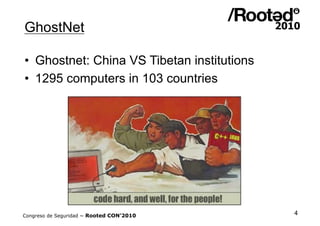
GhostNet

•  Ghostnet: China VS Tibetan institutions
•  1295 computers in 103 countries


Congreso de Seguridad ~ Rooted CON’2010      4
Aurora Attack

•  Coordinated attack against Google, Adobe,
   Juniper and 30 other companies.

•  Exploits a zero-day vulnerability in Microsoft
   Internet Explorer (CVE-2010-0249)

•  Installs Trojan.Hydraq.


Congreso de Seguridad ~ Rooted CON’2010             5
Trojan.Hydraq

•  Standard Trojan, not too sophisticated.

•  No anti-debugging, No anti-analysis tricks.

•  Uses spaghetti code to make code analysis
   more difficult. (Easily analized with IDA)

•  Previous versions of Trojan.Hydraq observed
   6 month previous to Aurora Attack.
Congreso de Seguridad ~ Rooted CON’2010          6
Trojan.Hydraq

•  Files:
     – %System%[RANDOM].dll: Main backdoor
       registered as a service.
     – %System%acelpvc.dll: Remote access
       capabilities (VNC).
     – %System%VedioDriver.dll: Helps monitoring
       keyboard and mouse activity.


Congreso de Seguridad ~ Rooted CON’2010             7
Trojan.Hydraq

•  Capabilities:

     – Command execution

     – Download additional files

     – System operations (halt, clean log files…)

     – Service, registry control.


Congreso de Seguridad ~ Rooted CON’2010             8
Trojan.Hydraq

•  C&C communication:
     – Encrypted protocol on port 443 (not SSL)
       [ ff ff ff ff ff ff 00 00 fe ff ff ff ff ff ff ff ff ff 88 ff ]


          Source: McAfee Labs

Congreso de Seguridad ~ Rooted CON’2010                                  9
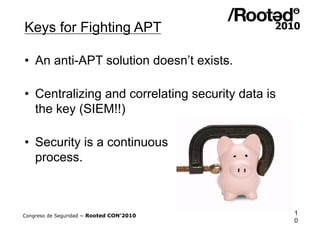
Keys for Fighting APT

•  An anti-APT solution doesn’t exists.

•  Centralizing and correlating security data is
   the key (SIEM!!)

•  Security is a continuous
   process.


Congreso de Seguridad ~ Rooted CON’2010            1
                                                   0
Intrusion

•  Examples:
     – An email with a PDF or Office document that
       exploits a vulnerability (Maybe 0-day).
•  Countermeasures:
     – Patch Management and Auditing (Openvas +
       OVAL).
     – Policy Auditing (Openvas – Ossec checks).
          •  Is Adobe Javascript support disabled?
          •  Internet Explorer Security Configuration


Congreso de Seguridad ~ Rooted CON’2010                 1
                                                        1
Setting Up

•  Examples:
     – Backdoor and Rootkit installation, system
       modification, privilege escalation.

•  Countermeasures:
     – Log monitoring: Ossec, Snare.
     – Integrity Monitoring: Ossec
          •  Registry changes.
          •  File creation/modifications
          •  Service registration and process creation.

Congreso de Seguridad ~ Rooted CON’2010                   1
                                                          2
Network Activity

•  Examples:
     – C&C communication, cover channels, updated
       downloads…

•  Countermeasures:
     – IDS/IPS technology (Snort, Suricata). Ej: Packed
       binary download.
     – Deep Packet Inspection (OpenDPI). Ej: Non SSL
       traffic over port 443.


Congreso de Seguridad ~ Rooted CON’2010                   1
                                                          3
Network Activity

•  Netflow Data : Nfdump + Nfsen (plugins).
     – AS and Country data.
          •  Alert on suspicious AS’s (reputation) – Fire project
               – http://www.maliciousnetworks.org/index.php


     – Identify traffic patterns:

          •  Mutiple clients sending high amount of data to an
             external server.

          •  Regurarly client connections to external servers (even
             after hours)
Congreso de Seguridad ~ Rooted CON’2010                               1
                                                                      4
Advanced techniques

•  Create an APT trap
     – Information Gathering
          •  Collect suspicious content from Corporate Mail Server.
          •  Create false accounts.
     – Automatic analysis framework
          •  Analize obtained information
               – Check for exploits/javascript on .pdf, .xls, .doc files.
          •  Extract the involved binary
          •  Automatic sandbox/analysis environment.
          •  Compare obtained patterns with your SIEM data.

Congreso de Seguridad ~ Rooted CON’2010                                     1
                                                                            5
Advanced techniques

•  Analize obtained data
     – The goal is to identify malicious content an extract
       the involved binary.
     – Tools:
          •  Didier Stevens pdf tools
          •  SpiderMonkey
          •  Libemu
          •  JsUnpack
          •  Malzilla
          •  Wepawet

Congreso de Seguridad ~ Rooted CON’2010                       1
                                                              6
Advanced techniques

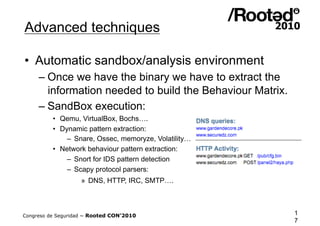
•  Automatic sandbox/analysis environment
     – Once we have the binary we have to extract the
       information needed to build the Behaviour Matrix.
     – SandBox execution:
          •  Qemu, VirtualBox, Bochs….
          •  Dynamic pattern extraction:
               –  Snare, Ossec, memoryze, Volatility…
          •  Network behaviour pattern extraction:
               –  Snort for IDS pattern detection
               –  Scapy protocol parsers:
                    »  DNS, HTTP, IRC, SMTP….


Congreso de Seguridad ~ Rooted CON’2010                    1
                                                           7
Advanced techniques

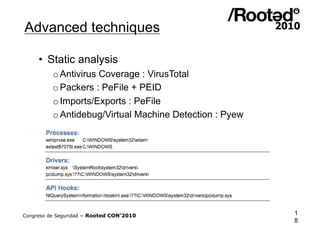
     •  Static analysis
          o Antivirus Coverage : VirusTotal
          o Packers : PeFile + PEID
          o Imports/Exports : PeFile
          o Antidebug/Virtual Machine Detection : Pyew


Congreso de Seguridad ~ Rooted CON’2010                  1
                                                         8
Advanced techniques

     •  Build the behaviour matrix, example:
     [ Process_Creation, test.exe]
     [ DNS_Query, www.securedz.com]
     [ HTTP_Request, POST, /panel2/haya.php]
     [ Driver_Loaded, wowsub.sys]
     [ IDS_Pattern, Snort, 2008576]


Congreso de Seguridad ~ Rooted CON’2010        1
                                               9
Advanced techniques

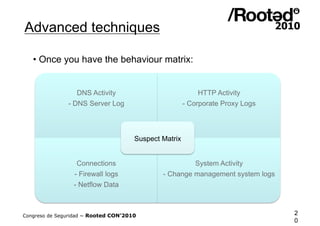
   • Once you have the behaviour matrix:


                  DNS Activity                             HTTP Activity
               - DNS Server Log                        - Corporate Proxy Logs


                                      Suspect Matrix


                  Connections                             System Activity
                 - Firewall logs              - Change management system logs
                 - Netflow Data


Congreso de Seguridad ~ Rooted CON’2010                                         2
                                                                                0
Jaime Blasco
        jaime.blasco@alienvault.com

              http://twitter.com/jaimeblascob


Congreso de Seguridad ~ Rooted CON’2010

Jaime Blasco - Fighting Advanced Persistent Threat (APT) with Open Source Tools [RootedCON 2010]

  • 1.
    Fighting Advanced PersistentThreats (APT) with Open Source Tools Congreso de Seguridad ~ Rooted CON’2010
  • 2.
    What is APT? • The US Air Force invented the term in 2006 •  APT refers to advanced techniques used to gain access to an intelligence objective to gather the needed information to execute specific objectives. Congreso de Seguridad ~ Rooted CON’2010 2
  • 3.
    APT characteristics •  Advanced:The intruder can exploit publicly known vulnerabilities but the attackers also are highly skilled and well funded and can research and exploit new vulnerabilities. •  Persistent: the attacker wants to accomplish a mission that can take place over months. •  Threat: Dedicated organized groups are behind the attack motivated by political, economical or military reasons. Congreso de Seguridad ~ Rooted CON’2010 3
  • 4.
    GhostNet •  Ghostnet: ChinaVS Tibetan institutions •  1295 computers in 103 countries Congreso de Seguridad ~ Rooted CON’2010 4
  • 5.
    Aurora Attack •  Coordinatedattack against Google, Adobe, Juniper and 30 other companies. •  Exploits a zero-day vulnerability in Microsoft Internet Explorer (CVE-2010-0249) •  Installs Trojan.Hydraq. Congreso de Seguridad ~ Rooted CON’2010 5
  • 6.
    Trojan.Hydraq •  Standard Trojan,not too sophisticated. •  No anti-debugging, No anti-analysis tricks. •  Uses spaghetti code to make code analysis more difficult. (Easily analized with IDA) •  Previous versions of Trojan.Hydraq observed 6 month previous to Aurora Attack. Congreso de Seguridad ~ Rooted CON’2010 6
  • 7.
    Trojan.Hydraq •  Files: – %System%[RANDOM].dll: Main backdoor registered as a service. – %System%acelpvc.dll: Remote access capabilities (VNC). – %System%VedioDriver.dll: Helps monitoring keyboard and mouse activity. Congreso de Seguridad ~ Rooted CON’2010 7
  • 8.
    Trojan.Hydraq •  Capabilities: – Command execution – Download additional files – System operations (halt, clean log files…) – Service, registry control. Congreso de Seguridad ~ Rooted CON’2010 8
  • 9.
    Trojan.Hydraq •  C&C communication: – Encrypted protocol on port 443 (not SSL) [ ff ff ff ff ff ff 00 00 fe ff ff ff ff ff ff ff ff ff 88 ff ] Source: McAfee Labs Congreso de Seguridad ~ Rooted CON’2010 9
  • 10.
    Keys for FightingAPT •  An anti-APT solution doesn’t exists. •  Centralizing and correlating security data is the key (SIEM!!) •  Security is a continuous process. Congreso de Seguridad ~ Rooted CON’2010 1 0
  • 11.
    Intrusion •  Examples: – An email with a PDF or Office document that exploits a vulnerability (Maybe 0-day). •  Countermeasures: – Patch Management and Auditing (Openvas + OVAL). – Policy Auditing (Openvas – Ossec checks). •  Is Adobe Javascript support disabled? •  Internet Explorer Security Configuration Congreso de Seguridad ~ Rooted CON’2010 1 1
  • 12.
    Setting Up •  Examples: – Backdoor and Rootkit installation, system modification, privilege escalation. •  Countermeasures: – Log monitoring: Ossec, Snare. – Integrity Monitoring: Ossec •  Registry changes. •  File creation/modifications •  Service registration and process creation. Congreso de Seguridad ~ Rooted CON’2010 1 2
  • 13.
    Network Activity •  Examples: – C&C communication, cover channels, updated downloads… •  Countermeasures: – IDS/IPS technology (Snort, Suricata). Ej: Packed binary download. – Deep Packet Inspection (OpenDPI). Ej: Non SSL traffic over port 443. Congreso de Seguridad ~ Rooted CON’2010 1 3
  • 14.
    Network Activity •  NetflowData : Nfdump + Nfsen (plugins). – AS and Country data. •  Alert on suspicious AS’s (reputation) – Fire project – http://www.maliciousnetworks.org/index.php – Identify traffic patterns: •  Mutiple clients sending high amount of data to an external server. •  Regurarly client connections to external servers (even after hours) Congreso de Seguridad ~ Rooted CON’2010 1 4
  • 15.
    Advanced techniques •  Createan APT trap – Information Gathering •  Collect suspicious content from Corporate Mail Server. •  Create false accounts. – Automatic analysis framework •  Analize obtained information – Check for exploits/javascript on .pdf, .xls, .doc files. •  Extract the involved binary •  Automatic sandbox/analysis environment. •  Compare obtained patterns with your SIEM data. Congreso de Seguridad ~ Rooted CON’2010 1 5
  • 16.
    Advanced techniques •  Analizeobtained data – The goal is to identify malicious content an extract the involved binary. – Tools: •  Didier Stevens pdf tools •  SpiderMonkey •  Libemu •  JsUnpack •  Malzilla •  Wepawet Congreso de Seguridad ~ Rooted CON’2010 1 6
  • 17.
    Advanced techniques •  Automaticsandbox/analysis environment – Once we have the binary we have to extract the information needed to build the Behaviour Matrix. – SandBox execution: •  Qemu, VirtualBox, Bochs…. •  Dynamic pattern extraction: –  Snare, Ossec, memoryze, Volatility… •  Network behaviour pattern extraction: –  Snort for IDS pattern detection –  Scapy protocol parsers: »  DNS, HTTP, IRC, SMTP…. Congreso de Seguridad ~ Rooted CON’2010 1 7
  • 18.
    Advanced techniques •  Static analysis o Antivirus Coverage : VirusTotal o Packers : PeFile + PEID o Imports/Exports : PeFile o Antidebug/Virtual Machine Detection : Pyew Congreso de Seguridad ~ Rooted CON’2010 1 8
  • 19.
    Advanced techniques •  Build the behaviour matrix, example: [ Process_Creation, test.exe] [ DNS_Query, www.securedz.com] [ HTTP_Request, POST, /panel2/haya.php] [ Driver_Loaded, wowsub.sys] [ IDS_Pattern, Snort, 2008576] Congreso de Seguridad ~ Rooted CON’2010 1 9
  • 20.
    Advanced techniques • Once you have the behaviour matrix: DNS Activity HTTP Activity - DNS Server Log - Corporate Proxy Logs Suspect Matrix Connections System Activity - Firewall logs - Change management system logs - Netflow Data Congreso de Seguridad ~ Rooted CON’2010 2 0
  • 21.
    Jaime Blasco jaime.blasco@alienvault.com http://twitter.com/jaimeblascob Congreso de Seguridad ~ Rooted CON’2010