Security Intelligence:
Advanced Persistent Threats

     An Ethical Hacker’s View


                           Peter Wood
                        Chief Executive Officer
                    First•Base Technologies LLP
Who is Peter Wood?


      Worked in computers & electronics since 1969
      Founded First Base in 1989 (one of the first ethical hacking firms)
      CEO First Base Technologies LLP
      Social engineer & penetration tester
      Conference speaker and security ‘expert’

      Member of ISACA Security Advisory Group
      Vice Chair of BCS Information Risk Management and Audit Group
      UK Chair, Corporate Executive Programme

      FBCS, CITP, CISSP, MIEEE, M.Inst.ISP
      Registered BCS Security Consultant
      Member of ACM, ISACA, ISSA, Mensa


Slide 2                                                              © First Base Technologies 2012
Security Intelligence and This Presentation


          “SI is a recognition of the evolution of sophisticated adversaries, the
          study of that evolution, and the application of this information in an
          actionable way to the defence of systems, networks, and data. In
          short, it is threat-focused defence, or as I occasionally refer to it,
          intelligence-driven response.

          The “intelligence” in intelligence-driven response is the information
          acquired about one's adversaries, or collectively the threat landscape.
          Each industry has a different threat landscape, and each organisation
          in each industry has a different risk profile, even to the same
          adversary.

          Understanding one's threat environment is collecting actionable
          information on known threat actors for computer network defence,
          whether that action is purely detection or detection with prevention.”
                            Source: Mike Cloppert http://computer-forensics.sans.org/blog/
Slide 3                                                             © First Base Technologies 2012
Agenda


          • APT Primer

          • Case Studies

          • Entry Points

          • Prevention and Detection


Slide 4                            © First Base Technologies 2012
Agenda


          • APT Primer

          • Case Studies

          • Entry Points

          • Prevention and Detection


Slide 5                            © First Base Technologies 2012
Advanced Persistent Threat (APT)


          • “An advanced and normally clandestine means to gain
            continual, persistent intelligence on an individual, or group of
            individuals” [Wikipedia]

          • “… a sophisticated, mercurial way that advanced attackers can
            break into systems, not get caught, keeping long-term access
            to exfiltrate data at will.” [McAfee]

          • “… a sophisticated and organized cyber attack to access and
            steal information from compromised computers.” [MANDIANT]


Slide 6                                                     © First Base Technologies 2012
Advanced, Persistent, Threat


          • They combine multiple attack methodologies and tools in
            order to reach and compromise their target

          • The attack is conducted through continuous monitoring and
            interaction in order to achieve the defined objectives

          • It does not mean a barrage of constant attacks and malware
            updates - in fact, a “low-and-slow” approach is usually more
            successful

          • There is a level of coordinated human involvement in the
            attack, rather than a mindless and automated piece of code

          • The operators have a specific objective and are skilled,
            motivated, organized and well funded


Slide 7                                                   © First Base Technologies 2012
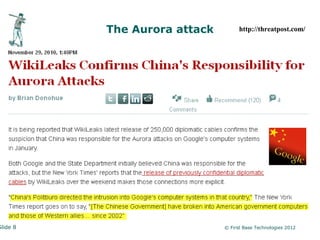
The Aurora attack         http://threatpost.com/


Slide 8                       © First Base Technologies 2012
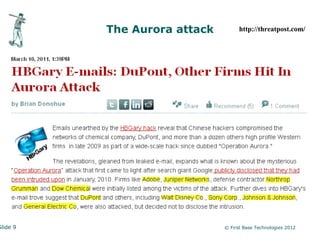
The Aurora attack         http://threatpost.com/


Slide 9                       © First Base Technologies 2012
The Aurora attack
                  http://trailofbits.com/2010/01/24/one-exploit-should-not-ruin-your-day/


           If you have done or been around any high-level incident response,
           you would know that these advanced persistent threats have been
           going on in various sectors for years.
           Nor is it a new development that the attackers used an 0day client-
           side exploit along with targeted social engineering as their initial
           access vector.
           What is brand new is the fact that a number of large companies
           have voluntarily gone public with the fact that they were victims to
           a targeted attack.
           And this is the most important lesson: targeted attacks do exist and
           happen to a number of industries besides the usual ones like credit
           card processors and e-commerce shops.
                                                                   Dino Dai Zovi

Slide 10                                                                  © First Base Technologies 2012
Agenda


           • APT Primer

           • Case Studies

           • Entry Points

           • Prevention and Detection


Slide 11                            © First Base Technologies 2012
Slide 12                                               © First Base Technologies 2012
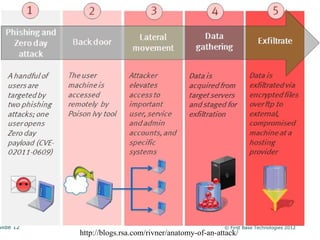
           http://blogs.rsa.com/rivner/anatomy-of-an-attack/
The RSA attack

           1.   Research public information about employees
           2.   Select low-value targets
           3.   Spear phishing email “2011 Recruitment Plan” with.xls
                attachment
           4.   Spreadhseet contains 0day exploit that installs backdoor
                through Flash vulnerability
                (Backdoor is Poison Ivy variant RAT reverse-connected)
           1.   Digital shoulder surf & harvest credentials
           2.   Performed privilege escalation
           3.   Target and compromise high-value accounts
           4.   Copy data from target servers
           5.   Move data to staging servers and aggregate, compress and
                encrypt it
           6.   FTP to external staging server at compromised hosting site
           7.   Finally pull data from hosted server and remove traces

Slide 13                                                  © First Base Technologies 2012
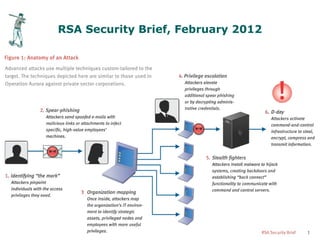
RSA Security Brief, February 2012


Slide 14                             © First Base Technologies 2012
Agenda


           • APT Primer

           • Case Studies

           • Entry Points

           • Prevention and Detection


Slide 15                            © First Base Technologies 2012
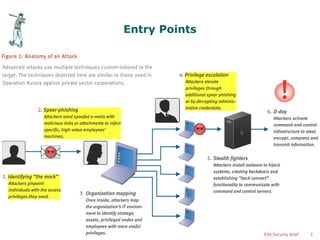
Entry Points


Slide 16                  © First Base Technologies 2012
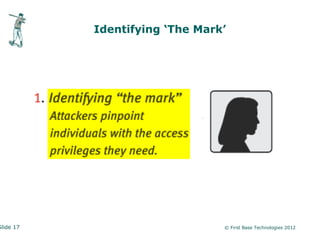
Identifying ‘The Mark’


Slide 17                        © First Base Technologies 2012
Social Networking


Slide 18                       © First Base Technologies 2012
Slide 19   © First Base Technologies 2012
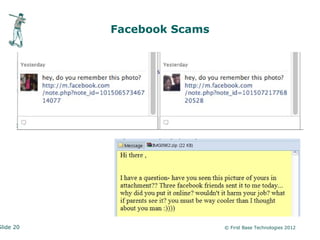
Facebook Scams


Slide 20                    © First Base Technologies 2012
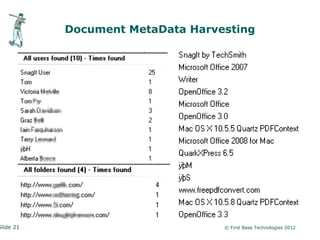
Document MetaData Harvesting


Slide 21                          © First Base Technologies 2012
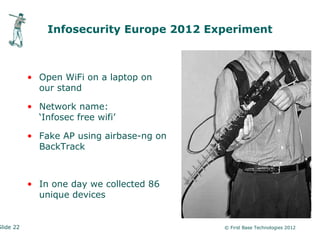
Infosecurity Europe 2012 Experiment


           • Open WiFi on a laptop on
             our stand

           • Network name:
             ‘Infosec free wifi’

           • Fake AP using airbase-ng on
             BackTrack


           • In one day we collected 86
             unique devices


Slide 22                                   © First Base Technologies 2012
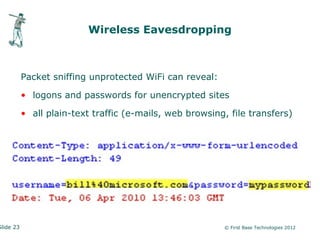
Wireless Eavesdropping


           Packet sniffing unprotected WiFi can reveal:

           • logons and passwords for unencrypted sites

           • all plain-text traffic (e-mails, web browsing, file transfers)


Slide 23                                                  © First Base Technologies 2012
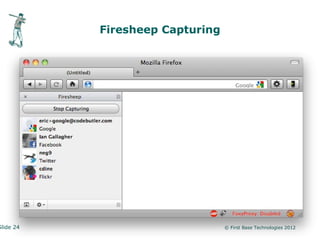
Firesheep Capturing


Slide 24                         © First Base Technologies 2012
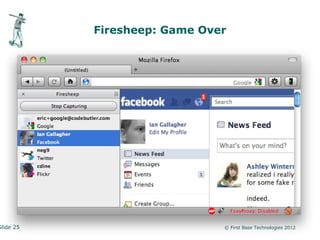
Firesheep: Game Over


Slide 25                      © First Base Technologies 2012
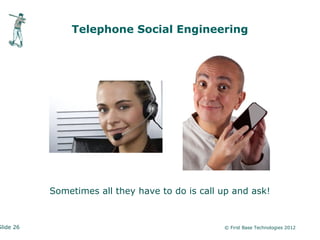
Telephone Social Engineering


           Sometimes all they have to do is call up and ask!


Slide 26                                         © First Base Technologies 2012
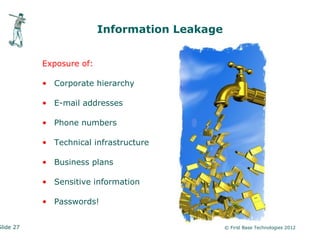
Information Leakage


           Exposure of:

           • Corporate hierarchy

           • E-mail addresses

           • Phone numbers

           • Technical infrastructure

           • Business plans

           • Sensitive information

           • Passwords!


Slide 27                                        © First Base Technologies 2012
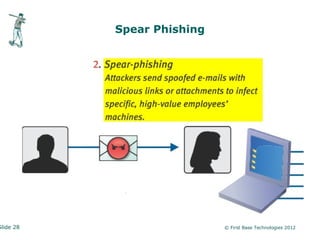
Spear Phishing


Slide 28                    © First Base Technologies 2012
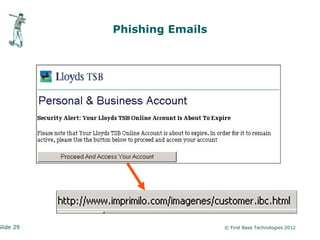
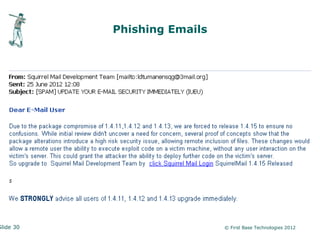
Phishing Emails


Slide 29                     © First Base Technologies 2012
Phishing Emails


Slide 30                     © First Base Technologies 2012
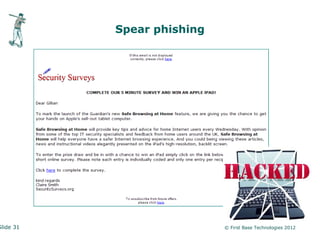
Spear phishing


Slide 31                    © First Base Technologies 2012
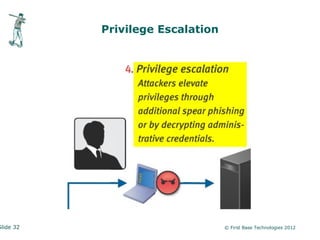
Privilege Escalation


Slide 32                          © First Base Technologies 2012
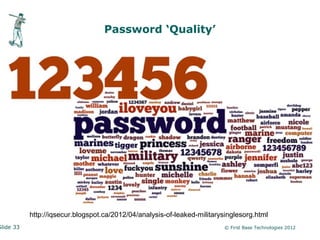
Password ‘Quality’


           http://iqsecur.blogspot.ca/2012/04/analysis-of-leaked-militarysinglesorg.html
Slide 33                                                                 © First Base Technologies 2012
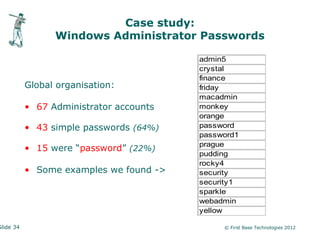
Case study:
                 Windows Administrator Passwords

                                         admin5
                                         crystal
                                         finance
           Global organisation:          friday
                                         macadmin
           • 67 Administrator accounts   monkey
                                         orange
           • 43 simple passwords (64%)   password
                                         password1
                                         prague
           • 15 were “password” (22%)
                                         pudding
                                         rocky4
           • Some examples we found ->   security
                                         security1
                                         sparkle
                                         webadmin
                                         yellow

Slide 34                                      © First Base Technologies 2012
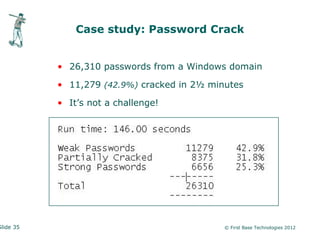
Case study: Password Crack


           • 26,310 passwords from a Windows domain

           • 11,279 (42.9%) cracked in 2½ minutes

           • It’s not a challenge!


Slide 35                                     © First Base Technologies 2012
Password Issues


           • Passwords based on dictionary words and names
           • Service accounts with simple/stupid passwords
           • Other easy-to-guess passwords
           • Little or no use of passphrases
           • Password policies not tailored to specific
             environments (e.g. Windows LM hash problem)
           • Old fashioned rules no longer apply
             (rainbow tables, parallel cracking,
             video processors)
           • Just general ignorance and apathy?
           • One password to rule them all …

Slide 36                                             © First Base Technologies 2012
Agenda


           • APT Primer

           • Case Studies

           • Entry Points

           • Prevention and Detection


Slide 37                         © First Base Technologies 2012
Identifying “The Mark”:
                            Social Networking


           • Don’t reveal personal or sensitive information in social
              networking sites or blogs

           • Set the privacy options in social networking sites

           • Don’t discuss confidential information online

           • Don’t ‘friend’ people you don’t know


           Remember – what goes on the Internet, stays on the Internet!


Slide 38                                                     © First Base Technologies 2012
Identifying “The Mark”:
                     Telephone Social Engineering


           • If you receive a suspicious phone call, hang up and call back
             on a number you know is legitimate

           • Never reveal personal or sensitive information in response to
             a phone call unless you have verified the caller

           • Don’t answer questions about your organisation or
             colleagues unless it’s your job to do so

           • Report any phone calls that you suspect might be social
             engineering attacks


Slide 39                                                   © First Base Technologies 2012
Identifying “The Mark”:
                          Public and Open WiFi


           • Remember: open and WEP-encrypted WiFi networks are
             visible to almost anyone

           • Never use public WiFi for sensitive information

           • Don’t use the same password for web sites and for corporate
             systems

           • Make sure your email connections are encrypted


Slide 40                                                   © First Base Technologies 2012
Spear Phishing


           • Never reveal personal or sensitive information in response to
             an email, no matter who appears to have sent it

           • If you receive an email that appears suspicious, call the
             person or organisation in the ‘From’ field before you respond
             or open any attached files

           • Never click links in an email message that requests personal
             or sensitive information. Enter the web address into your
             browser instead

           • Report any email that you suspect might be a spear phishing
             campaign within your company

Slide 41                                                   © First Base Technologies 2012
Privilege Escalation


           • Don’t use passwords based on dictionary words and names

           • Use complex passphrases for service accounts

           • Tailor password policies to specific environments
             (e.g. Windows vs. web sites)

           • Remember: old fashioned rules no longer apply
             (rainbow tables, parallel cracking, video processors)

           • Never re-use passwords: “one password to rule them all …”


Slide 42                                                   © First Base Technologies 2012
Think Like an Attacker!


           Hacking is a way of thinking:
              - A hacker is someone who thinks outside the box
              - It's someone who discards conventional wisdom, and does
                something else instead
              - It's someone who looks at the edge and wonders what's
                beyond
              - It's someone who sees a set of rules and wonders what
                happens if you don't follow them
                                                              [Bruce Schneier]


           Hacking applies to all aspects of life - not just computers


Slide 43                                                © First Base Technologies 2012
The Human Firewall


           The money you spent on security products, patching systems
           and conducting audits could be wasted if you don’t prevent
           social engineering attacks …


                        Invest in
             Marketing security awareness
                           and
              Intelligent, practical policies
Slide 44                                                  © First Base Technologies 2012
Need more information?


       Peter Wood
    Chief Executive Officer
First•Base Technologies LLP

  peterw@firstbase.co.uk

     http://firstbase.co.uk
    http://white-hats.co.uk
    http://peterwood.com

    Blog: fpws.blogspot.com
      Twitter: peterwoodx

Security Intelligence: Advanced Persistent Threats

  • 1.
    Security Intelligence: Advanced PersistentThreats An Ethical Hacker’s View Peter Wood Chief Executive Officer First•Base Technologies LLP
  • 2.
    Who is PeterWood? Worked in computers & electronics since 1969 Founded First Base in 1989 (one of the first ethical hacking firms) CEO First Base Technologies LLP Social engineer & penetration tester Conference speaker and security ‘expert’ Member of ISACA Security Advisory Group Vice Chair of BCS Information Risk Management and Audit Group UK Chair, Corporate Executive Programme FBCS, CITP, CISSP, MIEEE, M.Inst.ISP Registered BCS Security Consultant Member of ACM, ISACA, ISSA, Mensa Slide 2 © First Base Technologies 2012
  • 3.
    Security Intelligence andThis Presentation “SI is a recognition of the evolution of sophisticated adversaries, the study of that evolution, and the application of this information in an actionable way to the defence of systems, networks, and data. In short, it is threat-focused defence, or as I occasionally refer to it, intelligence-driven response. The “intelligence” in intelligence-driven response is the information acquired about one's adversaries, or collectively the threat landscape. Each industry has a different threat landscape, and each organisation in each industry has a different risk profile, even to the same adversary. Understanding one's threat environment is collecting actionable information on known threat actors for computer network defence, whether that action is purely detection or detection with prevention.” Source: Mike Cloppert http://computer-forensics.sans.org/blog/ Slide 3 © First Base Technologies 2012
  • 4.
    Agenda • APT Primer • Case Studies • Entry Points • Prevention and Detection Slide 4 © First Base Technologies 2012
  • 5.
    Agenda • APT Primer • Case Studies • Entry Points • Prevention and Detection Slide 5 © First Base Technologies 2012
  • 6.
    Advanced Persistent Threat(APT) • “An advanced and normally clandestine means to gain continual, persistent intelligence on an individual, or group of individuals” [Wikipedia] • “… a sophisticated, mercurial way that advanced attackers can break into systems, not get caught, keeping long-term access to exfiltrate data at will.” [McAfee] • “… a sophisticated and organized cyber attack to access and steal information from compromised computers.” [MANDIANT] Slide 6 © First Base Technologies 2012
  • 7.
    Advanced, Persistent, Threat • They combine multiple attack methodologies and tools in order to reach and compromise their target • The attack is conducted through continuous monitoring and interaction in order to achieve the defined objectives • It does not mean a barrage of constant attacks and malware updates - in fact, a “low-and-slow” approach is usually more successful • There is a level of coordinated human involvement in the attack, rather than a mindless and automated piece of code • The operators have a specific objective and are skilled, motivated, organized and well funded Slide 7 © First Base Technologies 2012
  • 8.
    The Aurora attack http://threatpost.com/ Slide 8 © First Base Technologies 2012
  • 9.
    The Aurora attack http://threatpost.com/ Slide 9 © First Base Technologies 2012
  • 10.
    The Aurora attack http://trailofbits.com/2010/01/24/one-exploit-should-not-ruin-your-day/ If you have done or been around any high-level incident response, you would know that these advanced persistent threats have been going on in various sectors for years. Nor is it a new development that the attackers used an 0day client- side exploit along with targeted social engineering as their initial access vector. What is brand new is the fact that a number of large companies have voluntarily gone public with the fact that they were victims to a targeted attack. And this is the most important lesson: targeted attacks do exist and happen to a number of industries besides the usual ones like credit card processors and e-commerce shops. Dino Dai Zovi Slide 10 © First Base Technologies 2012
  • 11.
    Agenda • APT Primer • Case Studies • Entry Points • Prevention and Detection Slide 11 © First Base Technologies 2012
  • 12.
    Slide 12 © First Base Technologies 2012 http://blogs.rsa.com/rivner/anatomy-of-an-attack/
  • 13.
    The RSA attack 1. Research public information about employees 2. Select low-value targets 3. Spear phishing email “2011 Recruitment Plan” with.xls attachment 4. Spreadhseet contains 0day exploit that installs backdoor through Flash vulnerability (Backdoor is Poison Ivy variant RAT reverse-connected) 1. Digital shoulder surf & harvest credentials 2. Performed privilege escalation 3. Target and compromise high-value accounts 4. Copy data from target servers 5. Move data to staging servers and aggregate, compress and encrypt it 6. FTP to external staging server at compromised hosting site 7. Finally pull data from hosted server and remove traces Slide 13 © First Base Technologies 2012
  • 14.
    RSA Security Brief,February 2012 Slide 14 © First Base Technologies 2012
  • 15.
    Agenda • APT Primer • Case Studies • Entry Points • Prevention and Detection Slide 15 © First Base Technologies 2012
  • 16.
    Entry Points Slide 16 © First Base Technologies 2012
  • 17.
    Identifying ‘The Mark’ Slide17 © First Base Technologies 2012
  • 18.
    Social Networking Slide 18 © First Base Technologies 2012
  • 19.
    Slide 19 © First Base Technologies 2012
  • 20.
    Facebook Scams Slide 20 © First Base Technologies 2012
  • 21.
    Document MetaData Harvesting Slide21 © First Base Technologies 2012
  • 22.
    Infosecurity Europe 2012Experiment • Open WiFi on a laptop on our stand • Network name: ‘Infosec free wifi’ • Fake AP using airbase-ng on BackTrack • In one day we collected 86 unique devices Slide 22 © First Base Technologies 2012
  • 23.
    Wireless Eavesdropping Packet sniffing unprotected WiFi can reveal: • logons and passwords for unencrypted sites • all plain-text traffic (e-mails, web browsing, file transfers) Slide 23 © First Base Technologies 2012
  • 24.
    Firesheep Capturing Slide 24 © First Base Technologies 2012
  • 25.
    Firesheep: Game Over Slide25 © First Base Technologies 2012
  • 26.
    Telephone Social Engineering Sometimes all they have to do is call up and ask! Slide 26 © First Base Technologies 2012
  • 27.
    Information Leakage Exposure of: • Corporate hierarchy • E-mail addresses • Phone numbers • Technical infrastructure • Business plans • Sensitive information • Passwords! Slide 27 © First Base Technologies 2012
  • 28.
    Spear Phishing Slide 28 © First Base Technologies 2012
  • 29.
    Phishing Emails Slide 29 © First Base Technologies 2012
  • 30.
    Phishing Emails Slide 30 © First Base Technologies 2012
  • 31.
    Spear phishing Slide 31 © First Base Technologies 2012
  • 32.
    Privilege Escalation Slide 32 © First Base Technologies 2012
  • 33.
    Password ‘Quality’ http://iqsecur.blogspot.ca/2012/04/analysis-of-leaked-militarysinglesorg.html Slide 33 © First Base Technologies 2012
  • 34.
    Case study: Windows Administrator Passwords admin5 crystal finance Global organisation: friday macadmin • 67 Administrator accounts monkey orange • 43 simple passwords (64%) password password1 prague • 15 were “password” (22%) pudding rocky4 • Some examples we found -> security security1 sparkle webadmin yellow Slide 34 © First Base Technologies 2012
  • 35.
    Case study: PasswordCrack • 26,310 passwords from a Windows domain • 11,279 (42.9%) cracked in 2½ minutes • It’s not a challenge! Slide 35 © First Base Technologies 2012
  • 36.
    Password Issues • Passwords based on dictionary words and names • Service accounts with simple/stupid passwords • Other easy-to-guess passwords • Little or no use of passphrases • Password policies not tailored to specific environments (e.g. Windows LM hash problem) • Old fashioned rules no longer apply (rainbow tables, parallel cracking, video processors) • Just general ignorance and apathy? • One password to rule them all … Slide 36 © First Base Technologies 2012
  • 37.
    Agenda • APT Primer • Case Studies • Entry Points • Prevention and Detection Slide 37 © First Base Technologies 2012
  • 38.
    Identifying “The Mark”: Social Networking • Don’t reveal personal or sensitive information in social networking sites or blogs • Set the privacy options in social networking sites • Don’t discuss confidential information online • Don’t ‘friend’ people you don’t know Remember – what goes on the Internet, stays on the Internet! Slide 38 © First Base Technologies 2012
  • 39.
    Identifying “The Mark”: Telephone Social Engineering • If you receive a suspicious phone call, hang up and call back on a number you know is legitimate • Never reveal personal or sensitive information in response to a phone call unless you have verified the caller • Don’t answer questions about your organisation or colleagues unless it’s your job to do so • Report any phone calls that you suspect might be social engineering attacks Slide 39 © First Base Technologies 2012
  • 40.
    Identifying “The Mark”: Public and Open WiFi • Remember: open and WEP-encrypted WiFi networks are visible to almost anyone • Never use public WiFi for sensitive information • Don’t use the same password for web sites and for corporate systems • Make sure your email connections are encrypted Slide 40 © First Base Technologies 2012
  • 41.
    Spear Phishing • Never reveal personal or sensitive information in response to an email, no matter who appears to have sent it • If you receive an email that appears suspicious, call the person or organisation in the ‘From’ field before you respond or open any attached files • Never click links in an email message that requests personal or sensitive information. Enter the web address into your browser instead • Report any email that you suspect might be a spear phishing campaign within your company Slide 41 © First Base Technologies 2012
  • 42.
    Privilege Escalation • Don’t use passwords based on dictionary words and names • Use complex passphrases for service accounts • Tailor password policies to specific environments (e.g. Windows vs. web sites) • Remember: old fashioned rules no longer apply (rainbow tables, parallel cracking, video processors) • Never re-use passwords: “one password to rule them all …” Slide 42 © First Base Technologies 2012
  • 43.
    Think Like anAttacker! Hacking is a way of thinking: - A hacker is someone who thinks outside the box - It's someone who discards conventional wisdom, and does something else instead - It's someone who looks at the edge and wonders what's beyond - It's someone who sees a set of rules and wonders what happens if you don't follow them [Bruce Schneier] Hacking applies to all aspects of life - not just computers Slide 43 © First Base Technologies 2012
  • 44.
    The Human Firewall The money you spent on security products, patching systems and conducting audits could be wasted if you don’t prevent social engineering attacks … Invest in Marketing security awareness and Intelligent, practical policies Slide 44 © First Base Technologies 2012
  • 45.
    Need more information? Peter Wood Chief Executive Officer First•Base Technologies LLP peterw@firstbase.co.uk http://firstbase.co.uk http://white-hats.co.uk http://peterwood.com Blog: fpws.blogspot.com Twitter: peterwoodx

Editor's Notes

  • #4 Mike Cloppert is a senior member of Lockheed Martin's Computer Incident Response Team. He has lectured for various audiences including SANS, IEEE, the annual DC3 CyberCrime Convention, and teaches an introductory class on cryptography. His current work consists of security intelligence analysis and development of new tools and techniques for incident response. Michael holds a BS in computer engineering, an MS in computer science, has earned GCIA (#592) and GCFA (#711) gold certifications alongside various others, and is a professional member of ACM and IEEE.
  • #24 Many people don’t understand that wireless networking is like a wired hub – there is no packet switching, so anyone connected to an open wireless access point can see everyone else’s traffic. Again discovering how to do this isn’t hard and the tools are free. A criminal attacker could be sitting some distance away with a directional antenna and watching everything on the unprotected network.
  • #25 When logging into a website you usually start by submitting your username and password. The server then checks to see if an account matching this information exists and if so, replies back to you with a "cookie" which is used by your browser for all subsequent requests. It's extremely common for websites to protect your password by encrypting the initial login, but surprisingly uncommon for websites to encrypt everything else. This leaves the cookie (and the user) vulnerable. HTTP session hijacking (sometimes called "sidejacking") is when an attacker gets a hold of a user's cookie, allowing them to do anything the user can do on a particular website. On an open wireless network, cookies are basically shouted through the air, making these attacks extremely easy. This is a widely known problem that has been talked about to death, yet very popular websites continue to fail at protecting their users. The only effective fix for this problem is full end-to-end encryption, known on the web as HTTPS or SSL. Facebook is constantly rolling out new "privacy" features in an endless attempt to quell the screams of unhappy users, but what's the point when someone can just take over an account entirely? Twitter forced all third party developers to use OAuth then immediately released (and promoted) a new version of their insecure website. When it comes to user privacy, SSL is the elephant in the room. After installing the extension you'll see a new sidebar. Connect to any busy open wifi network and click the big "Start Capturing" button. Then wait. As soon as anyone on the network visits an insecure website known to Firesheep, their name and photo will be displayed.
  • #26 Double-click on someone, and you're instantly logged in as them. That's it. Firesheep is free, open source, and is available now for Mac OS X and Windows. Linux support is on the way. Websites have a responsibility to protect the people who depend on their services. They've been ignoring this responsibility for too long, and it's time for everyone to demand a more secure web. My hope is that Firesheep will help the users win.
  • #28 PETE: And also, just like the Smartphone, before you do anything else on a social network I want you to protect your ID and your personal information. Because of the “delusion of free”. Because you think the Internet is this wonderful, benign, philanthropic supermarket, run by Willy Wonka, where the price tag of everything is zero-point-zero, please-help-yourself. So you may not wonder why this social media outfit wants you to stuff its archives with all your personal information, all your preferences, all your loves and likes and loathings. But what’s going to happen, with your help, is they publish all your info them throughout the known universe. And thus, shrewd cold callers on the planet Zog will have access to all of that sweet intelligence plus your email and phone number. A reminder. What are you? FRANK: I am the product.