The Exploit Intelligence Project


                Dan Guido
         SOURCE Boston, 04/20/2011


             https://www.isecpartners.com
Intro and Agenda
 I work for iSEC Partners
    NYC, Seattle, SF – specialize in Application Security
    I don’t have a product to sell you


 Today, I’m going to be sharing data and my analysis
  of attacker capabilities and methods
    An informed defense is more effective and less costly


 EIP shows that intelligence-driven, threat-focused
  approaches to security are practical and effective


                                                             2
WARNING!

 The commentary is really important for
             this talk.

If you’re a reporter, please contact me and
 I’ll be happy to provide that commentary
      for any section you’re interested in:

       dguido@isecpartners.com


                                              3
We Have An Analysis Problem
Or, you’re counting the wrong beans!
Let’s Talk About Vulnerabilities


                                                  5
        *IBM X-Force 2010 Trend and Risk Report
How many vulnerabilities did
you have to pay attention to in 2010?


                                        6
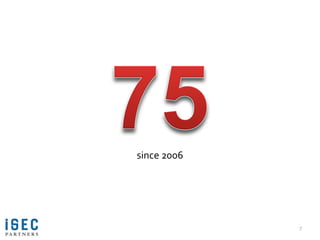
since 2006


             7
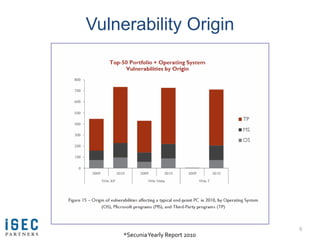
Vulnerability Origin


                                   8
     *Secunia Yearly Report 2010
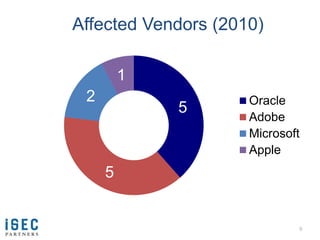
Affected Vendors (2010)

         1
 2                   Oracle
             5
                     Adobe
                     Microsoft
                     Apple
     5


                             9
Wheel of Vulnerability Fortune


                                                              10
     *Secunia: The Security Exposure of Software Portfolios
Where or how were massively exploited
    vulnerabilities first discovered in 2010?
6


5


4


3


2


1


0

    Targeted   ZDI   Prominent    Personal    Known     Discovered
     Attacks         Researcher   Website    Behavior   by Malware


                                                                     11
Google Chrome is Insecure!


                                                         12
    *Bit 9 Research Report: Top Vulnerable Apps – 2010
How many vulnerabilities were
massively exploited in Google Chrome in 2010?


                                                13
Are we doing something wrong?
Yes, you’re doing it backwards!
We Have to Start at Attacks

  1.                 2.            3.


 Where do bad guys get their info from?
 How do bad guys view the new vulns that come out?
 How effective are my defenses against this attacker?


                                                         15
Maslow’s Internet Threat Hierarchy

 # of Attacks         Data Lost

      APT                IP

  Targeted             $$$

    Mass               Banking
                      Credentials
   Malware
Mass Malware
How does it work?
Kill Chain Model
 Systematic model for evaluating intrusions
    Helps us objectively evaluate attacker capabilities
    Align defense to specific processes an attacker takes


 Typically used as a model to defend against APT
    Evolves beyond response at point of compromise
    Assumes unfixable vulnerabilities


 First described by Mike Cloppert


                                                             18
Recon


        19
Weaponization


                                    20
5-20 exploits, $200-$2000 dollars
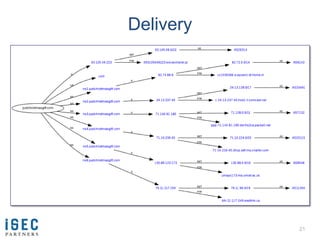
Delivery


           21
Exploitation


               22
Installation


               23
Command and Control


                      24
Actions on Objectives


                        25
Leads to Cyber Pompeii
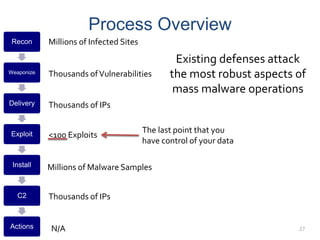
Process Overview
 Recon      Millions of Infected Sites

                                                 Existing defenses attack
Weaponize   Thousands of Vulnerabilities        the most robust aspects of
                                                 mass malware operations
Delivery    Thousands of IPs

                                         The last point that you
Exploit     <100 Exploits
                                         have control of your data

 Install    Millions of Malware Samples


  C2        Thousands of IPs


Actions     N/A                                                         27
Going on the Offensive
Exploit Kit Popularity (2011)


                                29
          *ThreatGRID Data
Exploit Kit Popularity

 AVG Threat Labs
 Malware Domain List
 Krebs on Security
 Malware Intelligence
 Contagio Dump
 Malware Tracker
 M86 Security
 …
Data Sources
 Blackhole                      LuckySploit
 Bleeding Life                  Phoenix
 CrimePack                         2.5, 2.4, 2.3, 2.2, 2.1, 2.0

    3.1.3, 3.0, 2.2.8, 2.2.1    SEO Sploit pack
 Eleonore                       Siberia
    1.6, 1.4.4, 1.4.1, 1.3.2    Unique Pack
 Fragus                         WebAttacker
 JustExploit                    YES
 Liberty                        Zombie
    2.1.0, 1.0.7
Data Processing

 Decode                             Relate
   Jsunpack                            SHODAN HQ
       Generic JS Unpacker                   Python API for ExploitDB,
    Decodeby.us                                MSF, CVE
       PHP De-obfuscation
                                     Live Testing
                                        Vmware
 Detect
                                        Windows XP/7
   YARA Project
       Generic scanning engine


              Note: All free tools except VMWare/Windows
Jsunpack/YARA Rules
rule IEStyle
{
    meta:
      ref = “CVE-2009-3672”
      hide = true
      impact = 8
    strings:
      $trigger1 = “getElementsByTagName” nocase fullword
      $trigger2 = “style” nocase fullword
      $trigger3 = “outerhtml” nocase fullword
    condition:
      all of them
}

                                                           33
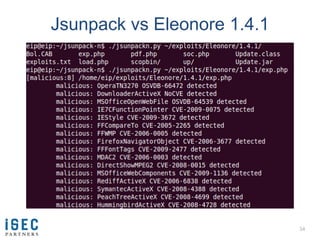
Jsunpack vs Eleonore 1.4.1


                             34
vuln_search.py
 CVE                         Metasploit
    Name                       Authors
    ID                         Description
                                ID
                                Name
 Exploit DB
                                Rank
    Author
    Date
    ID                       References
    Name                        Vendor URLs (ex. MSB)
                                 ZDI
                                 Other Notable URLs


               Powered by:
Sample Results: CVE-2010-1818
 Exploit DB
      08/30/2010
      Ruben Santamarta
      Apple QuickTime "_Marshaled_pUnk" Backdoor
      14843
 Metasploit
      Ruben Santamarta, jduck
      Apple QuickTime 7.6.7 _Marshaled_pUnk Code Execution
      “… exploits a memory trust issue in Quicktime…”
      exploit/windows/browser/apple_quicktime_marshaled_punk
      Rank: Great
 Refs
    http://reversemode.com/index.php?option=com_content&task=
     view&id=69&Itemid=1
    OSVDB-67705


                                                                 36
Recap


Mapping of Exploit Kits -> CVEs + Metadata


                                             37
Targeting Trends
Java from 2008 to Present
Targeting Trends
 Java, Round One
   12-08 – Prominent researcher finds CVE-2008-5353
   08-09 – Wins a Pwnie (researcher interest runs high)
   08-09 – ZDI submissions start trickling out
   11-09 – 1 kit incorporates CVE-2008-5353


                                                           39
Java, Round Two
 11-09 – ZDI publishes 2nd batch of Java vulns
    CVE-2009-3867


 01-10 – Three kits integrate 1st and 2nd vulns
    CVE-2008-5353 and CVE-2009-3867


 04-10 – 3rd batch of researcher disclosures
    CVE-2010-0886, CVE-2010-0840, CVE-2010-0842


 Back and forth between researchers/malware keeps
  interest in Java running high

                                                     40
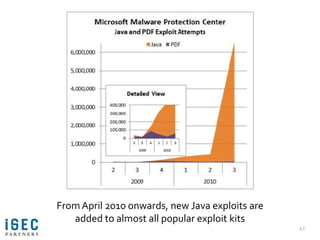
From April 2010 onwards, new Java exploits are
   added to almost all popular exploit kits
                                                 41
Java Today
 Popularity
    11 out of 15 kits include at least one Java exploit (73%)
    7 out of 15 kits include more than one (46%)


 Where did this trend come from?
    Who followed who? The malware or research community?
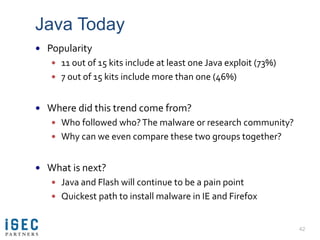
    Why can we even compare these two groups together?


 What is next?
    Java and Flash will continue to be a pain point
    Quickest path to install malware in IE and Firefox


                                                                 42
The New Trend: more exploits are being rapidly
repurposed from targeted attack campaigns in 2010-2011
6


5


4


3


2


1


0

    Targeted   ZDI   Prominent    Personal    Known     Silent Patch
     Attacks         Researcher   Website    Behavior


                                                                       43
Capabilities Assessment
If we only had a time machine
Optimized Defense
 Jan 1, 2009 – what can we put in place to mitigate all
  exploits for the next two years?
    Restrictions: no patching allowed


 2009 recap
    Internet Explorer 7, Firefox 3.0
    Adobe Reader 9
    Java, Quicktime, Flash, Office 2007
    Windows XP SP3


 Dataset represents 27 exploits


                                                           45
Slice and Dice


   Memory
                                      Logic
  Corruption
                                       (8)
     (19)


Partition exploits based on mitigation options
                                                 46
19 Memory Corruption Exploits
 5 unique targets
    IE, Flash, Reader, Java, Firefox, Opera


 Do I have my sysadmins adhere to patch schedules or
  have them test and enable DEP in four applications?
    Patch schedules: Monthly, Quarterly, Ad-hoc
    Two years: 60+ patches in these apps


 I choose Data Execution Prevention (DEP)
    Good choice! It mitigates 14 exploits.


                                                        47
8 Logic Flaws
 4 unique targets
    Java, Reader, IE, Firefox, FoxIt


 Do we have a business case to justify getting
  repeatedly compromised by mass malware?
    No? Remove Java from the Internet Zone in IE
    Configure Reader to prompt on JS execution
    “Disallow opening of non-PDF file attachments”


 This leaves two exploits, one in IE and one in FF


                                                      48
Most Severe Exploits 2009-2010
           IE         Help Center XSS

        Firefox        SessionStore

        Reader            libTIFF

        Reader         CoolType SING

       Flash (IE)       newfunction

     Quicktime (IE)   _Marshaled_pUnk

         Java          getSoundBank

                                        49
Enhanced Mitigation Experience Toolkit
 Microsoft utility that adds obstacles to exploitation
    On XP: DEP, SEHOP, Null Page, Heap Spray, EAT filter
    Distributed as an MSI, controlled via CLI or Registry


 Apply it to one application at a time
    Harden legacy applications
    Temporary protections against known zero-day
    Permanent protections against highly targeted apps


 http://blogs.technet.com/cfs-
  file.ashx/__key/CommunityServer-Components-
  PostAttachments/00-03-35-03-78/Users-Guide.pdf


                                                             50
Most Severe Exploits 2009-2010


            IE                   Help Center XSS

         Firefox                   SessionStore


      The Firefox exploit is only in one kit. We can
     make an informed decision about the amount
                of risk we are assuming.


                                                       51
Intelligence-Driven Mitigations
 Easy mitigations (22 out of 27 exploits)
    DEP on IE, Firefox, and Reader
    No Java in the Internet Zone
    Disallow opening of non-PDF file attachments


 Hard mitigations (all the rest)
    EMET on IE and Reader, the two most attacked apps
    Upgrade to IE8 for that pesky Help Center XSS
    Disallow Firefox, patch it, or accept the risk


 Extremely limited susceptibility going forward


                                                         52
Taking It Further
    Mass malware exploits are:
       1. Result of users browsing internet sites
       2. Shortest path to install malware w/ a single exploit


                   Google                  DEP               Sandbox
                   Chrome                 Bypass             Escape


Malicious                                  DEP
                      IE8
 HTML                                     Bypass


                 IE7, Plugins,
                                                              Install
                 Java, Flash,
                                                             SpyEye
                      etc.
                                                                        53
            *DDZ – Memory Corruption, Exploitation and You
Google Chrome Frame


  “X-UA-Compatible: chrome=1”   54
Google Chrome Frame
 Internet sites standardized around HTML/JS
    This is why you don’t need IE6 or IE7 at home


 For internet sites, add HTTP header w/ Bluecoat
    Browser is sandboxed
    Uses auto-updated Google version of Flash
    No other plugins are loaded


 Maintain whitelist of internet sites that need IE
    Typically, established vendor relationships


 All intranet websites will load with IE as usual
 Seamless to the user, mitigates all exploits in use


                                                        55
Maslow’s Internet Threat Hierarchy

        # of Attacks                 Data Lost

              APT                       IP

         Targeted                     $$$

Now you’re ready to defend against    Banking
    more advanced attackers          Credentials
Intelligence-Driven Conclusions
 Don’t wait to act with Flash and Java
 Pay attention to targeted attack disclosures in 2011

 Force malware authors to use multiple exploits
    Seriously consider Google Chrome Frame

 Are your consultants/MSSPs/scanners evaluating
  vulnerabilities the same way that attackers are?

 Intelligence-Driven Response
    Informed defense is more effective and less costly
    Threat-focused security is practical
    Attack data is necessary to adequately model your risk


                                                              57
Thanks
 Rcecoder, Mila Parkour, Francois Paget, Adam Meyers
    Exploit Pack Table on Contagio Dump & Exploit Kit Source


 Mike Cloppert and Dino Dai Zovi
    Inspiration, ideas, and encouragement


 Chris Clark
    Getting started with the research process at iSEC


 John Matherly
    Creating SHODAN and fixing my bugs


 Dean De Beer
    ThreatGRID data, screenshots, and background material


                                                                58
References and Q&A
 Updates with more data at SummerCon, 6/10

 Related Presentations (online)
    Memory Corruption, Exploitation, and You – DDZ
    Intelligence-Driven Response to APT – M. Cloppert
    Any Mandiant Presentation

 Related Presentations (at SOURCE)
    2011 Verizon Data Breach Report, Hutton
    Fuel for Pwnage, Diaz and Mieres
    Dino Dai Zovi Keynote

 dguido@isecpartners.com


                                                         59
Appendix
Frequently Asked Question #1
 Q: What do you think about network detections?


 A: Apply the same analysis process (kill chain) to the
  adversary you care about and determine major
  source of overlaps in intrusions. You may find better
  indicators than simply IP addresses.
    ie., “Hey, all the malicious domains attacking me are
     registered with the same whois data.”
    or, “All the domains that compromise me have low
     TTL values in common.”
    See some of Mike Cloppert’s writings
    See ThreatGRID when it comes out


                                                             61
Frequently Asked Question #2
 Q: How can we keep up with this data? You did a
  point in time assessment, but I want this going
  forward.

 A: This analysis process and data should be picked up
  by the security industry and used effectively. AV
  companies have been doing you a disservice by not
  doing this in the past. They should start now.


                                                          62
Frequently Asked Question #3
   Q: Aren’t you cheating by saying we should use EMET to mitigate past
    exploits?
   A:
      If we were smart enough to enable mitigations like DEP, we would have had
       a solid 1.5 years where we weren’t affected by mass malware mem
       corruption exploits at all, buying us a huge amount of time to investigate
       other mitigations techniques.
      The exploits that EMET was needed for came after the tool was released in
       Oct 2009. If you had someone performing this analysis, you could have
       observed the exploits that bypassed DEP and responded the same way I did.
       Intelligence gathering is not a static process, we have to continue collecting
       and responding to new information.
      There are more ways to use this intelligence. For instance, since we know
       that Flash and targeted attacks are so rapidly incorporated into mass
       exploitation campaigns, we would have known on April 11th that CVE-2011-
       0611 would be a significant issue. The patch came out on April 15th, but I
       doubt many orgs patched over the weekend or enabled other mitigating
       options before it was massively exploited on April 18th. With this data in
       hand, they would have realized the seriousness of the original event on the
       11th.


                                                                                        63
Frequently Asked Question #4
 Q: Future analysis?
 A:
    How [exactly] do researcher disclosures correlate with
       massive exploitation?
      Are the number of bugs exploited as zero-day
       increasing? Why?
      Do researchers follow zero-day disclosure trends or
       vice-versa?
      Exactly how much exploit code is modified from public
       PoC’s before being integrated into a kit?
      Expect new results some time in June


                                                              64

Dan Guido SOURCE Boston 2011

  • 1.
    The Exploit IntelligenceProject Dan Guido SOURCE Boston, 04/20/2011 https://www.isecpartners.com
  • 2.
    Intro and Agenda I work for iSEC Partners  NYC, Seattle, SF – specialize in Application Security  I don’t have a product to sell you  Today, I’m going to be sharing data and my analysis of attacker capabilities and methods  An informed defense is more effective and less costly  EIP shows that intelligence-driven, threat-focused approaches to security are practical and effective 2
  • 3.
    WARNING! The commentaryis really important for this talk. If you’re a reporter, please contact me and I’ll be happy to provide that commentary for any section you’re interested in: dguido@isecpartners.com 3
  • 4.
    We Have AnAnalysis Problem Or, you’re counting the wrong beans!
  • 5.
    Let’s Talk AboutVulnerabilities 5 *IBM X-Force 2010 Trend and Risk Report
  • 6.
    How many vulnerabilitiesdid you have to pay attention to in 2010? 6
  • 7.
  • 8.
    Vulnerability Origin 8 *Secunia Yearly Report 2010
  • 9.
    Affected Vendors (2010) 1 2 Oracle 5 Adobe Microsoft Apple 5 9
  • 10.
    Wheel of VulnerabilityFortune 10 *Secunia: The Security Exposure of Software Portfolios
  • 11.
    Where or howwere massively exploited vulnerabilities first discovered in 2010? 6 5 4 3 2 1 0 Targeted ZDI Prominent Personal Known Discovered Attacks Researcher Website Behavior by Malware 11
  • 12.
    Google Chrome isInsecure! 12 *Bit 9 Research Report: Top Vulnerable Apps – 2010
  • 13.
    How many vulnerabilitieswere massively exploited in Google Chrome in 2010? 13
  • 14.
    Are we doingsomething wrong? Yes, you’re doing it backwards!
  • 15.
    We Have toStart at Attacks 1. 2. 3.  Where do bad guys get their info from?  How do bad guys view the new vulns that come out?  How effective are my defenses against this attacker? 15
  • 16.
    Maslow’s Internet ThreatHierarchy # of Attacks Data Lost APT IP Targeted $$$ Mass Banking Credentials Malware
  • 17.
  • 18.
    Kill Chain Model Systematic model for evaluating intrusions  Helps us objectively evaluate attacker capabilities  Align defense to specific processes an attacker takes  Typically used as a model to defend against APT  Evolves beyond response at point of compromise  Assumes unfixable vulnerabilities  First described by Mike Cloppert 18
  • 19.
  • 20.
    Weaponization 20 5-20 exploits, $200-$2000 dollars
  • 21.
  • 22.
  • 23.
  • 24.
  • 25.
  • 26.
  • 27.
    Process Overview Recon Millions of Infected Sites Existing defenses attack Weaponize Thousands of Vulnerabilities the most robust aspects of mass malware operations Delivery Thousands of IPs The last point that you Exploit <100 Exploits have control of your data Install Millions of Malware Samples C2 Thousands of IPs Actions N/A 27
  • 28.
    Going on theOffensive
  • 29.
    Exploit Kit Popularity(2011) 29 *ThreatGRID Data
  • 30.
    Exploit Kit Popularity AVG Threat Labs  Malware Domain List  Krebs on Security  Malware Intelligence  Contagio Dump  Malware Tracker  M86 Security  …
  • 31.
    Data Sources  Blackhole  LuckySploit  Bleeding Life  Phoenix  CrimePack  2.5, 2.4, 2.3, 2.2, 2.1, 2.0  3.1.3, 3.0, 2.2.8, 2.2.1  SEO Sploit pack  Eleonore  Siberia  1.6, 1.4.4, 1.4.1, 1.3.2  Unique Pack  Fragus  WebAttacker  JustExploit  YES  Liberty  Zombie  2.1.0, 1.0.7
  • 32.
    Data Processing  Decode  Relate  Jsunpack  SHODAN HQ  Generic JS Unpacker  Python API for ExploitDB,  Decodeby.us MSF, CVE  PHP De-obfuscation  Live Testing  Vmware  Detect  Windows XP/7  YARA Project  Generic scanning engine Note: All free tools except VMWare/Windows
  • 33.
    Jsunpack/YARA Rules rule IEStyle { meta: ref = “CVE-2009-3672” hide = true impact = 8 strings: $trigger1 = “getElementsByTagName” nocase fullword $trigger2 = “style” nocase fullword $trigger3 = “outerhtml” nocase fullword condition: all of them } 33
  • 34.
  • 35.
    vuln_search.py  CVE  Metasploit  Name  Authors  ID  Description  ID  Name  Exploit DB  Rank  Author  Date  ID  References  Name  Vendor URLs (ex. MSB)  ZDI  Other Notable URLs Powered by:
  • 36.
    Sample Results: CVE-2010-1818 Exploit DB  08/30/2010  Ruben Santamarta  Apple QuickTime "_Marshaled_pUnk" Backdoor  14843  Metasploit  Ruben Santamarta, jduck  Apple QuickTime 7.6.7 _Marshaled_pUnk Code Execution  “… exploits a memory trust issue in Quicktime…”  exploit/windows/browser/apple_quicktime_marshaled_punk  Rank: Great  Refs  http://reversemode.com/index.php?option=com_content&task= view&id=69&Itemid=1  OSVDB-67705 36
  • 37.
    Recap Mapping of ExploitKits -> CVEs + Metadata 37
  • 38.
  • 39.
    Targeting Trends  Java,Round One  12-08 – Prominent researcher finds CVE-2008-5353  08-09 – Wins a Pwnie (researcher interest runs high)  08-09 – ZDI submissions start trickling out  11-09 – 1 kit incorporates CVE-2008-5353 39
  • 40.
    Java, Round Two 11-09 – ZDI publishes 2nd batch of Java vulns  CVE-2009-3867  01-10 – Three kits integrate 1st and 2nd vulns  CVE-2008-5353 and CVE-2009-3867  04-10 – 3rd batch of researcher disclosures  CVE-2010-0886, CVE-2010-0840, CVE-2010-0842  Back and forth between researchers/malware keeps interest in Java running high 40
  • 41.
    From April 2010onwards, new Java exploits are added to almost all popular exploit kits 41
  • 42.
    Java Today  Popularity  11 out of 15 kits include at least one Java exploit (73%)  7 out of 15 kits include more than one (46%)  Where did this trend come from?  Who followed who? The malware or research community?  Why can we even compare these two groups together?  What is next?  Java and Flash will continue to be a pain point  Quickest path to install malware in IE and Firefox 42
  • 43.
    The New Trend:more exploits are being rapidly repurposed from targeted attack campaigns in 2010-2011 6 5 4 3 2 1 0 Targeted ZDI Prominent Personal Known Silent Patch Attacks Researcher Website Behavior 43
  • 44.
    Capabilities Assessment If weonly had a time machine
  • 45.
    Optimized Defense  Jan1, 2009 – what can we put in place to mitigate all exploits for the next two years?  Restrictions: no patching allowed  2009 recap  Internet Explorer 7, Firefox 3.0  Adobe Reader 9  Java, Quicktime, Flash, Office 2007  Windows XP SP3  Dataset represents 27 exploits 45
  • 46.
    Slice and Dice Memory Logic Corruption (8) (19) Partition exploits based on mitigation options 46
  • 47.
    19 Memory CorruptionExploits  5 unique targets  IE, Flash, Reader, Java, Firefox, Opera  Do I have my sysadmins adhere to patch schedules or have them test and enable DEP in four applications?  Patch schedules: Monthly, Quarterly, Ad-hoc  Two years: 60+ patches in these apps  I choose Data Execution Prevention (DEP)  Good choice! It mitigates 14 exploits. 47
  • 48.
    8 Logic Flaws 4 unique targets  Java, Reader, IE, Firefox, FoxIt  Do we have a business case to justify getting repeatedly compromised by mass malware?  No? Remove Java from the Internet Zone in IE  Configure Reader to prompt on JS execution  “Disallow opening of non-PDF file attachments”  This leaves two exploits, one in IE and one in FF 48
  • 49.
    Most Severe Exploits2009-2010 IE Help Center XSS Firefox SessionStore Reader libTIFF Reader CoolType SING Flash (IE) newfunction Quicktime (IE) _Marshaled_pUnk Java getSoundBank 49
  • 50.
    Enhanced Mitigation ExperienceToolkit  Microsoft utility that adds obstacles to exploitation  On XP: DEP, SEHOP, Null Page, Heap Spray, EAT filter  Distributed as an MSI, controlled via CLI or Registry  Apply it to one application at a time  Harden legacy applications  Temporary protections against known zero-day  Permanent protections against highly targeted apps  http://blogs.technet.com/cfs- file.ashx/__key/CommunityServer-Components- PostAttachments/00-03-35-03-78/Users-Guide.pdf 50
  • 51.
    Most Severe Exploits2009-2010 IE Help Center XSS Firefox SessionStore The Firefox exploit is only in one kit. We can make an informed decision about the amount of risk we are assuming. 51
  • 52.
    Intelligence-Driven Mitigations  Easymitigations (22 out of 27 exploits)  DEP on IE, Firefox, and Reader  No Java in the Internet Zone  Disallow opening of non-PDF file attachments  Hard mitigations (all the rest)  EMET on IE and Reader, the two most attacked apps  Upgrade to IE8 for that pesky Help Center XSS  Disallow Firefox, patch it, or accept the risk  Extremely limited susceptibility going forward 52
  • 53.
    Taking It Further  Mass malware exploits are: 1. Result of users browsing internet sites 2. Shortest path to install malware w/ a single exploit Google DEP Sandbox Chrome Bypass Escape Malicious DEP IE8 HTML Bypass IE7, Plugins, Install Java, Flash, SpyEye etc. 53 *DDZ – Memory Corruption, Exploitation and You
  • 54.
    Google Chrome Frame “X-UA-Compatible: chrome=1” 54
  • 55.
    Google Chrome Frame Internet sites standardized around HTML/JS  This is why you don’t need IE6 or IE7 at home  For internet sites, add HTTP header w/ Bluecoat  Browser is sandboxed  Uses auto-updated Google version of Flash  No other plugins are loaded  Maintain whitelist of internet sites that need IE  Typically, established vendor relationships  All intranet websites will load with IE as usual  Seamless to the user, mitigates all exploits in use 55
  • 56.
    Maslow’s Internet ThreatHierarchy # of Attacks Data Lost APT IP Targeted $$$ Now you’re ready to defend against Banking more advanced attackers Credentials
  • 57.
    Intelligence-Driven Conclusions  Don’twait to act with Flash and Java  Pay attention to targeted attack disclosures in 2011  Force malware authors to use multiple exploits  Seriously consider Google Chrome Frame  Are your consultants/MSSPs/scanners evaluating vulnerabilities the same way that attackers are?  Intelligence-Driven Response  Informed defense is more effective and less costly  Threat-focused security is practical  Attack data is necessary to adequately model your risk 57
  • 58.
    Thanks  Rcecoder, MilaParkour, Francois Paget, Adam Meyers  Exploit Pack Table on Contagio Dump & Exploit Kit Source  Mike Cloppert and Dino Dai Zovi  Inspiration, ideas, and encouragement  Chris Clark  Getting started with the research process at iSEC  John Matherly  Creating SHODAN and fixing my bugs  Dean De Beer  ThreatGRID data, screenshots, and background material 58
  • 59.
    References and Q&A Updates with more data at SummerCon, 6/10  Related Presentations (online)  Memory Corruption, Exploitation, and You – DDZ  Intelligence-Driven Response to APT – M. Cloppert  Any Mandiant Presentation  Related Presentations (at SOURCE)  2011 Verizon Data Breach Report, Hutton  Fuel for Pwnage, Diaz and Mieres  Dino Dai Zovi Keynote  dguido@isecpartners.com 59
  • 60.
  • 61.
    Frequently Asked Question#1  Q: What do you think about network detections?  A: Apply the same analysis process (kill chain) to the adversary you care about and determine major source of overlaps in intrusions. You may find better indicators than simply IP addresses.  ie., “Hey, all the malicious domains attacking me are registered with the same whois data.”  or, “All the domains that compromise me have low TTL values in common.”  See some of Mike Cloppert’s writings  See ThreatGRID when it comes out 61
  • 62.
    Frequently Asked Question#2  Q: How can we keep up with this data? You did a point in time assessment, but I want this going forward.  A: This analysis process and data should be picked up by the security industry and used effectively. AV companies have been doing you a disservice by not doing this in the past. They should start now. 62
  • 63.
    Frequently Asked Question#3  Q: Aren’t you cheating by saying we should use EMET to mitigate past exploits?  A:  If we were smart enough to enable mitigations like DEP, we would have had a solid 1.5 years where we weren’t affected by mass malware mem corruption exploits at all, buying us a huge amount of time to investigate other mitigations techniques.  The exploits that EMET was needed for came after the tool was released in Oct 2009. If you had someone performing this analysis, you could have observed the exploits that bypassed DEP and responded the same way I did. Intelligence gathering is not a static process, we have to continue collecting and responding to new information.  There are more ways to use this intelligence. For instance, since we know that Flash and targeted attacks are so rapidly incorporated into mass exploitation campaigns, we would have known on April 11th that CVE-2011- 0611 would be a significant issue. The patch came out on April 15th, but I doubt many orgs patched over the weekend or enabled other mitigating options before it was massively exploited on April 18th. With this data in hand, they would have realized the seriousness of the original event on the 11th. 63
  • 64.
    Frequently Asked Question#4  Q: Future analysis?  A:  How [exactly] do researcher disclosures correlate with massive exploitation?  Are the number of bugs exploited as zero-day increasing? Why?  Do researchers follow zero-day disclosure trends or vice-versa?  Exactly how much exploit code is modified from public PoC’s before being integrated into a kit?  Expect new results some time in June 64