Malware Paradox
Persistent Cross Interface Attacks
          Aditya K Sood, Richard J Enbody
               Michigan State University
                                                       1
    Soodadit [at] msu.edu | adi_ks [at] secniche.org
Disclaimer


Vulnerabilities and attacks discussed in this talk is a part of my PhD research. We follow a
responsible disclosure pattern in revealing vulnerabilities to vendors.

This is all for education purposes only.

A sincere thanks to my adviser Mr. Richard J Enbody for guiding me at every step.


                                                                                           2
About Me


    Founder , SECNICHE Security Labs.
           http://www.secniche.org
           PhD Candidate at Michigan State University.

    Worked previously for COSEINC as Senior Security Researcher and Security
     Consultant for KPMG

    Author for HITB EZine, Hakin9 ,ELSEVIER, ISSA, ISACA, USENIX Journals.
    Likes to do Bug Hunting and Malware dissection.
    Released Advisories to Forefront Companies.
    Active Speaker at Security Conferences including RSA etc.

    Blog: http://zeroknock.blogspot.com


                                                                                3
Agenda


    Web 2.0 and Malware
    Malware through Network Devices with Web Interfaces
    Cross Interface Attack Details
    Release Vulnerability and Case Study
    Conclusion


                                                           4
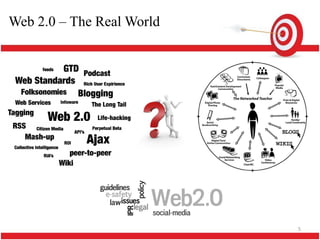
Web 2.0 – The Real World


                           5
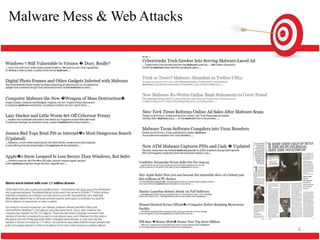
Malware Mess & Web Attacks


                             6
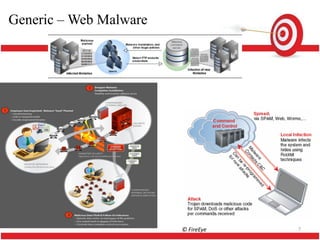
Generic – Web Malware Cycle !


                           © FireEye   7
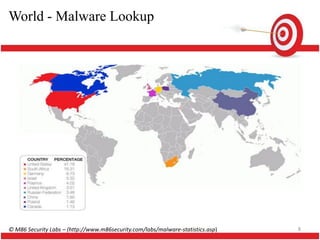
World - Malware Lookup


© M86 Security Labs – (http://www.m86security.com/labs/malware-statistics.asp)   8

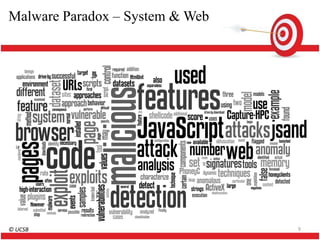
Malware Paradox – System & Web


© UCSB                           9
Malware Trends


Financial abuse and mass identity theft

 The mass destructor – Botnet infection and zombie hosts

 Exploiting the link dependency – Pay Per click hijacking

 Traffic manipulation – Open redirect vulnerabilities at large scale

 Spywares , crypto virology , ransom ware etc

 Distributed Denial of Service – The service death game , extortion

 Industry change semantics – Malware activation change line

 Infection through browsers and portable gadgets – the biggest step

 Exploiting anti virus loopholes
                                                                        10
Malware Contributing Issues

Publicly available malware source code

 Unpatched vulnerabilities and loosely coupled patches

 Demand of underground services and self exposure

 Global surveillance mode and information stealing in the wild

 Software discrepancies and inherited design flaws such as Browsers.

 Exploitation at web level is easy. It opens a door to System Level Fallacies.

 Inappropriate security solutions deployed and irrelevant security paradigm

 Botnet Infection – The easy way to launch diversified attack


                                                                                  11
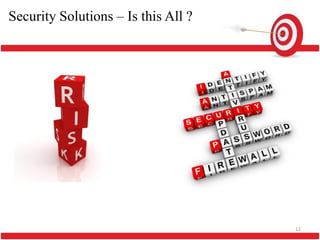
Security Solutions – Is this All ?


                                     12
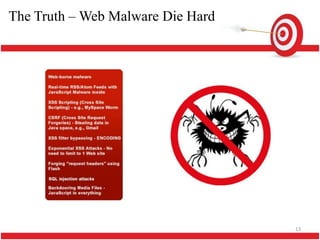
The Truth – Web Malware Die Hard


                                   13
Breaking the Limits !


        Websites are Infected with Malware so as Web Servers – Right !

   Is it possible to Infect Peripheral Network Devices !

        (Firewalls, DiskStation Managers, Storage Devices, Routers etc)

                                                                          14
Yes ! Network Devices are Prone to Malware


 Network devices having web interface for administration

 Inappropriate Web Interface design

 Misconception ! Web Interface is just used for administration !

 Vulnerability in Web adminisatrion panels

 Open FTP and Telnet Login Consoles

 Exploiting the default nature of protocol such as FTP and Telnet


                                                                     15
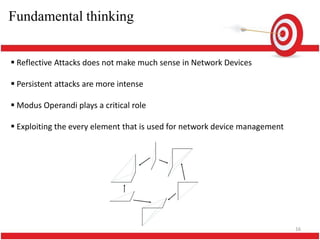
Fundamental thinking


 Reflective Attacks does not make much sense in Network Devices

 Persistent attacks are more intense

 Modus Operandi plays a critical role

 Exploiting the every element that is used for network device management


                                                                            16
Application Bad Design


 Source of major Vulnerabilities in real time world
   • Design issues are repetitive in nature.
   • Successful exploitation results in malware and code execution


                                                                     17
Understanding – Cross Interface Attack


                                         18
Cross Interface Attack - Base


 Is this a Cross Site Scripting Attack ?

 What exactly is Cross Interface Attack ?

 Cross Interface Attack
     • It uses backend login consoles to inject payload in vulnerable websites.
     • Exploits the default nature of FTP /Telnet Protocol
     • Vulnerability in log storage modules
     • Attacks are persistent in nature
     • Payloads are designed using same XSS injection

 Entry point for exploitation is different from XSS.
    XSS  Entry point is from web to web
    CIA  Entry point is from backend login console to website

                                                                                  19
Cross Interface Attack – Threat


 Remote Command Execution through CSRF: This type of vulnerability addresses
 the remote code execution behavior

 Malware Infections – Executing payloads to conduct Drive by Download Attacks

 Information Stealing

 Tuning Network device into attack pot


                                                                           20
Cross Interface Attack – (CIA)


 Hardware devices using admin interfaces.

 Admin interfaces : { Web, FTP, Telnet}

 Do we require all admin interfaces ?
        • If web admin is allowed, so what about backend consoles!
        • Is URL restriction a good practice?
        • Is it advantageous to have backend consoles?
        • Does access control serves well?

 CIA targets FTP/Telnet admin consoles.

 Step by step developing an attack surface.

 Hardware devices – firewalls, disk stations, management systems etc
                                                                        21
Attack Launch Pad


 Attack base and considerations
       • Presence of FTP/Telnet admin login console

       • Hardware appliances have default error logging mechanism

       • Log interfaces are served in HTML without filtering

       • A bad design practice from security point of view

       • Protocol such as FTP/Telnet default nature helps in information
       gathering


                                                                           22
Attack Launch Pad


 FTP Protocol Truth
       • Collective username and password authentication

       • Followed to avoid enumeration of user accounts

       • No check on login attempts. No check on characters.

       • Usually, accessible widely.

       • Do you think access control is required?


                                                               23
Attack Launch Pad


 Attacking and testing
        Gathering information about allowed characters
        No aim to get authenticated
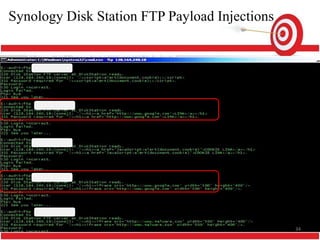
            • FTP 530 Login Incorrect is what we require.
        Malicious payloads are used as username and password
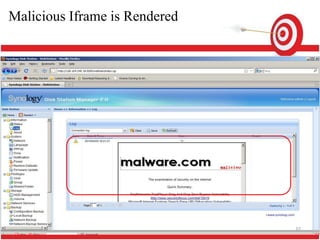
            • Injections / Scripts / Iframes / DOM Calls / Persistent Payloads
            • Inject what ever you want !
            • Good point for triggering CSRF attacks
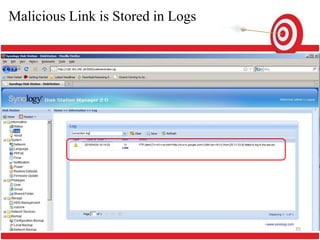
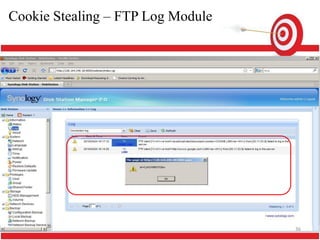
        Of-course , Authentication failure. Error gets logged.
        Payloads become persistent. It can be reflective.
        Bad design practice – Unencoded / Unfiltered HTML rendering
            • Inappropriate web logging mechanism
        Viola ! Something happens.


                                                                                 24
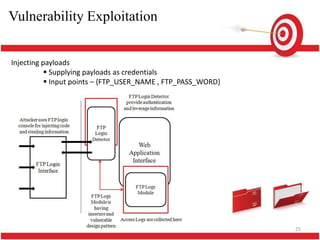
Vulnerability Exploitation


Injecting payloads
            Supplying payloads as credentials
            Input points – {FTP_USER_NAME , FTP_PASS_WORD}


                                                              25
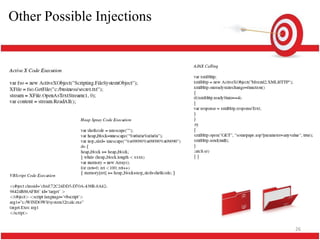
Other Possible Injections


                            26
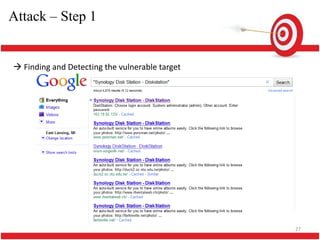
Attack – Step 1


 Finding and Detecting the vulnerable target


                                                27
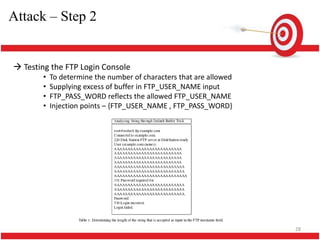
Attack – Step 2


 Testing the FTP Login Console
       •   To determine the number of characters that are allowed
       •   Supplying excess of buffer in FTP_USER_NAME input
       •   FTP_PASS_WORD reflects the allowed FTP_USER_NAME
       •   Injection points – {FTP_USER_NAME , FTP_PASS_WORD}


                                                                    28
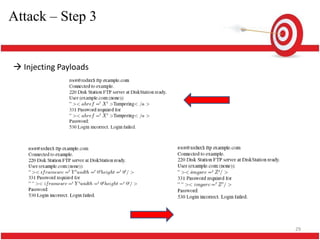
Attack – Step 3


 Injecting Payloads


                       29
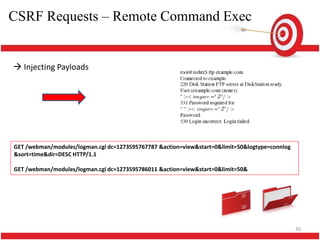
CSRF Requests – Remote Command Exec


 Injecting Payloads


GET /webman/modules/logman.cgi dc=1273595767787 &action=view&start=0&limit=50&logtype=connlog
&sort=time&dir=DESC HTTP/1.1

GET /webman/modules/logman.cgi dc=1273595786011 &action=view&start=0&limit=50&


                                                                                                30
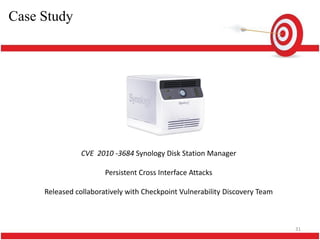
Case Study


                CVE 2010 -3684 Synology Disk Station Manager

                       Persistent Cross Interface Attacks

     Released collaboratively with Checkpoint Vulnerability Discovery Team


                                                                             31
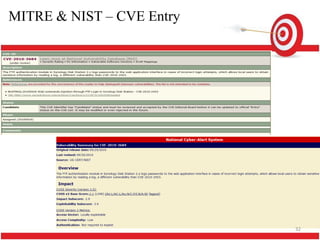
MITRE & NIST – CVE Entry


                           32
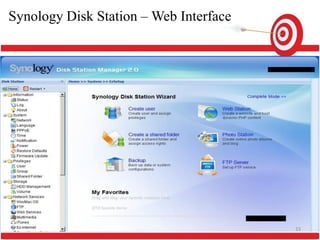
Synology Disk Station – Web Interface


                                        33
Synology Disk Station FTP Payload Injections


                                               34
Malicious Link is Stored in Logs


                                   35
Cookie Stealing – FTP Log Module


                                   36
Malicious Iframe is Rendered


                               37
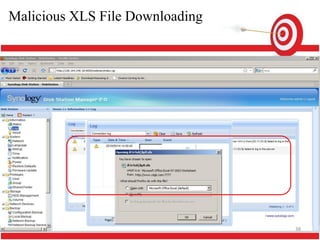
Malicious XLS File Downloading


                                 38
Effective Steps


 The FTP login consoles or the user verification module should scrutinize the
string parameter before verifying the user. A whitelist approach should be
followed at the protocol level to reduce the impact of exploitation.

 The applied design principle should be simplicity to avoid complexity that can
obscure vulnerabilities. For example, FTP logs should be rendered in a more
customized environment considering the access to a number of clients.

 The content should be sniffed to avoid the usage of malicious input thereby
defining the Content-Type appropriately.


                                                                                 39
Questions and Queries ?


                          40
Thanks


         AVAR 2010 (http://www.aavar.org/avar2010 )
         SecNiche Security (http://www.secniche.org )


                                                        41

13th Symposium of Association of Anti Virus Asia Researchers (AAVAR 2010) conference

  • 1.
    Malware Paradox Persistent CrossInterface Attacks Aditya K Sood, Richard J Enbody Michigan State University 1 Soodadit [at] msu.edu | adi_ks [at] secniche.org
  • 2.
    Disclaimer Vulnerabilities and attacksdiscussed in this talk is a part of my PhD research. We follow a responsible disclosure pattern in revealing vulnerabilities to vendors. This is all for education purposes only. A sincere thanks to my adviser Mr. Richard J Enbody for guiding me at every step. 2
  • 3.
    About Me  Founder , SECNICHE Security Labs.  http://www.secniche.org  PhD Candidate at Michigan State University.  Worked previously for COSEINC as Senior Security Researcher and Security Consultant for KPMG  Author for HITB EZine, Hakin9 ,ELSEVIER, ISSA, ISACA, USENIX Journals.  Likes to do Bug Hunting and Malware dissection.  Released Advisories to Forefront Companies.  Active Speaker at Security Conferences including RSA etc.  Blog: http://zeroknock.blogspot.com 3
  • 4.
    Agenda  Web 2.0 and Malware  Malware through Network Devices with Web Interfaces  Cross Interface Attack Details  Release Vulnerability and Case Study  Conclusion 4
  • 5.
    Web 2.0 –The Real World 5
  • 6.
    Malware Mess &Web Attacks 6
  • 7.
    Generic – WebMalware Cycle ! © FireEye 7
  • 8.
    World - MalwareLookup © M86 Security Labs – (http://www.m86security.com/labs/malware-statistics.asp) 8
  • 9.
    Malware Paradox –System & Web © UCSB 9
  • 10.
    Malware Trends Financial abuseand mass identity theft  The mass destructor – Botnet infection and zombie hosts  Exploiting the link dependency – Pay Per click hijacking  Traffic manipulation – Open redirect vulnerabilities at large scale  Spywares , crypto virology , ransom ware etc  Distributed Denial of Service – The service death game , extortion  Industry change semantics – Malware activation change line  Infection through browsers and portable gadgets – the biggest step  Exploiting anti virus loopholes 10
  • 11.
    Malware Contributing Issues Publiclyavailable malware source code  Unpatched vulnerabilities and loosely coupled patches  Demand of underground services and self exposure  Global surveillance mode and information stealing in the wild  Software discrepancies and inherited design flaws such as Browsers.  Exploitation at web level is easy. It opens a door to System Level Fallacies.  Inappropriate security solutions deployed and irrelevant security paradigm  Botnet Infection – The easy way to launch diversified attack 11
  • 12.
    Security Solutions –Is this All ? 12
  • 13.
    The Truth –Web Malware Die Hard 13
  • 14.
    Breaking the Limits! Websites are Infected with Malware so as Web Servers – Right ! Is it possible to Infect Peripheral Network Devices ! (Firewalls, DiskStation Managers, Storage Devices, Routers etc) 14
  • 15.
    Yes ! NetworkDevices are Prone to Malware  Network devices having web interface for administration  Inappropriate Web Interface design  Misconception ! Web Interface is just used for administration !  Vulnerability in Web adminisatrion panels  Open FTP and Telnet Login Consoles  Exploiting the default nature of protocol such as FTP and Telnet 15
  • 16.
    Fundamental thinking  ReflectiveAttacks does not make much sense in Network Devices  Persistent attacks are more intense  Modus Operandi plays a critical role  Exploiting the every element that is used for network device management 16
  • 17.
    Application Bad Design Source of major Vulnerabilities in real time world • Design issues are repetitive in nature. • Successful exploitation results in malware and code execution 17
  • 18.
    Understanding – CrossInterface Attack 18
  • 19.
    Cross Interface Attack- Base  Is this a Cross Site Scripting Attack ?  What exactly is Cross Interface Attack ?  Cross Interface Attack • It uses backend login consoles to inject payload in vulnerable websites. • Exploits the default nature of FTP /Telnet Protocol • Vulnerability in log storage modules • Attacks are persistent in nature • Payloads are designed using same XSS injection  Entry point for exploitation is different from XSS. XSS  Entry point is from web to web CIA  Entry point is from backend login console to website 19
  • 20.
    Cross Interface Attack– Threat  Remote Command Execution through CSRF: This type of vulnerability addresses the remote code execution behavior  Malware Infections – Executing payloads to conduct Drive by Download Attacks  Information Stealing  Tuning Network device into attack pot 20
  • 21.
    Cross Interface Attack– (CIA)  Hardware devices using admin interfaces.  Admin interfaces : { Web, FTP, Telnet}  Do we require all admin interfaces ? • If web admin is allowed, so what about backend consoles! • Is URL restriction a good practice? • Is it advantageous to have backend consoles? • Does access control serves well?  CIA targets FTP/Telnet admin consoles.  Step by step developing an attack surface.  Hardware devices – firewalls, disk stations, management systems etc 21
  • 22.
    Attack Launch Pad Attack base and considerations • Presence of FTP/Telnet admin login console • Hardware appliances have default error logging mechanism • Log interfaces are served in HTML without filtering • A bad design practice from security point of view • Protocol such as FTP/Telnet default nature helps in information gathering 22
  • 23.
    Attack Launch Pad FTP Protocol Truth • Collective username and password authentication • Followed to avoid enumeration of user accounts • No check on login attempts. No check on characters. • Usually, accessible widely. • Do you think access control is required? 23
  • 24.
    Attack Launch Pad Attacking and testing  Gathering information about allowed characters  No aim to get authenticated • FTP 530 Login Incorrect is what we require.  Malicious payloads are used as username and password • Injections / Scripts / Iframes / DOM Calls / Persistent Payloads • Inject what ever you want ! • Good point for triggering CSRF attacks  Of-course , Authentication failure. Error gets logged.  Payloads become persistent. It can be reflective.  Bad design practice – Unencoded / Unfiltered HTML rendering • Inappropriate web logging mechanism  Viola ! Something happens. 24
  • 25.
    Vulnerability Exploitation Injecting payloads  Supplying payloads as credentials  Input points – {FTP_USER_NAME , FTP_PASS_WORD} 25
  • 26.
  • 27.
    Attack – Step1  Finding and Detecting the vulnerable target 27
  • 28.
    Attack – Step2  Testing the FTP Login Console • To determine the number of characters that are allowed • Supplying excess of buffer in FTP_USER_NAME input • FTP_PASS_WORD reflects the allowed FTP_USER_NAME • Injection points – {FTP_USER_NAME , FTP_PASS_WORD} 28
  • 29.
    Attack – Step3  Injecting Payloads 29
  • 30.
    CSRF Requests –Remote Command Exec  Injecting Payloads GET /webman/modules/logman.cgi dc=1273595767787 &action=view&start=0&limit=50&logtype=connlog &sort=time&dir=DESC HTTP/1.1 GET /webman/modules/logman.cgi dc=1273595786011 &action=view&start=0&limit=50& 30
  • 31.
    Case Study CVE 2010 -3684 Synology Disk Station Manager Persistent Cross Interface Attacks Released collaboratively with Checkpoint Vulnerability Discovery Team 31
  • 32.
    MITRE & NIST– CVE Entry 32
  • 33.
    Synology Disk Station– Web Interface 33
  • 34.
    Synology Disk StationFTP Payload Injections 34
  • 35.
    Malicious Link isStored in Logs 35
  • 36.
    Cookie Stealing –FTP Log Module 36
  • 37.
  • 38.
    Malicious XLS FileDownloading 38
  • 39.
    Effective Steps  TheFTP login consoles or the user verification module should scrutinize the string parameter before verifying the user. A whitelist approach should be followed at the protocol level to reduce the impact of exploitation.  The applied design principle should be simplicity to avoid complexity that can obscure vulnerabilities. For example, FTP logs should be rendered in a more customized environment considering the access to a number of clients.  The content should be sniffed to avoid the usage of malicious input thereby defining the Content-Type appropriately. 39
  • 40.
  • 41.
    Thanks AVAR 2010 (http://www.aavar.org/avar2010 ) SecNiche Security (http://www.secniche.org ) 41