CIS 166 Highline Community College
           February 2013
     Advanced persistent threat (APT) usually refers to a group, such
      as a foreign government, with both the capability and the intent to
      persistently and effectively target a specific entity.
     The term is commonly used to refer to cyber threats, in particular
      that of Internet-enabled espionage using a variety of intelligence
      gathering techniques to access sensitive information, but applies
      equally to other threats such as that of traditional espionage or
      attack.
     Other recognized attack vectors include infected media, supply
      chain compromise, and social engineering. Individuals, such as an
      individual hacker, are not usually referred to as an APT as they
      rarely have the resources to be both advanced and persistent even
      if they are intent on gaining access to, or attacking, a specific
      target
Source: http://en.wikipedia.org/wiki/Advanced_persistent_threat
   Bodmer, Kilger, Carpenter and Jones defined the following APT
    criteria:
       Objectives - The end goal of the threat, your adversary
       Timeliness - The time spent probing and accessing your system
       Resources - The level of knowledge and tools used in the event (skills and
        methods will weigh on this point)
       Risk tolerance - The extent the threat will go to remain undetected
       Skills and methods - The tools and techniques used throughout the event
       Actions - The precise actions of a threat or numerous threats
       Attack origination points - The number of points where the event
        originated
       Numbers involved in the attack - How many internal and external systems
        were involved in the event, and how many people's systems have different
        influence/importance weights
       Knowledge source - The ability to discern any information regarding any
        of the specific threats through online information gathering (you might be
        surprised by what you can find by a little proactive)
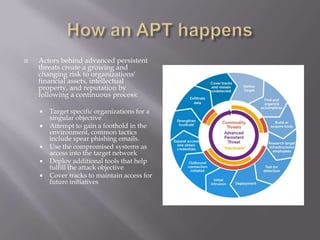
   Actors behind advanced persistent
    threats create a growing and
    changing risk to organizations'
    financial assets, intellectual
    property, and reputation by
    following a continuous process:

       Target specific organizations for a
        singular objective
       Attempt to gain a foothold in the
        environment, common tactics
        include spear phishing emails.
       Use the compromised systems as
        access into the target network
       Deploy additional tools that help
        fulfill the attack objective
       Cover tracks to maintain access for
        future initiatives
   Maltego
       Develop a method and standard to identify targets
        within an organization that we can social engineer
   Metasploit
       So we can write URL’s, PDF’s and other items to
        send to our target within an organization
       So we can “hack into a system” leaving behind a
        username and password for access later on
   ZenMap/NMAP
       So we can identify weak targets on a network
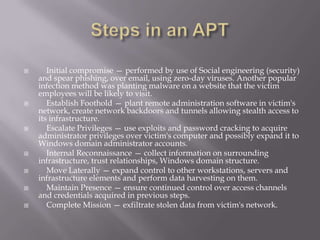
      Initial compromise — performed by use of Social engineering (security)
    and spear phishing, over email, using zero-day viruses. Another popular
    infection method was planting malware on a website that the victim
    employees will be likely to visit.
      Establish Foothold — plant remote administration software in victim's
    network, create network backdoors and tunnels allowing stealth access to
    its infrastructure.
      Escalate Privileges — use exploits and password cracking to acquire
    administrator privileges over victim's computer and possibly expand it to
    Windows domain administrator accounts.
      Internal Reconnaissance — collect information on surrounding
    infrastructure, trust relationships, Windows domain structure.
      Move Laterally — expand control to other workstations, servers and
    infrastructure elements and perform data harvesting on them.
      Maintain Presence — ensure continued control over access channels
    and credentials acquired in previous steps.
      Complete Mission — exfiltrate stolen data from victim's network.
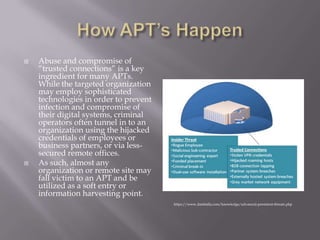
   Abuse and compromise of
    “trusted connections” is a key
    ingredient for many APTs.
    While the targeted organization
    may employ sophisticated
    technologies in order to prevent
    infection and compromise of
    their digital systems, criminal
    operators often tunnel in to an
    organization using the hijacked
    credentials of employees or
    business partners, or via less-
    secured remote offices.
   As such, almost any
    organization or remote site may
    fall victim to an APT and be
    utilized as a soft entry or
    information harvesting point.
                                       https://www.damballa.com/knowledge/advanced-persistent-threats.php
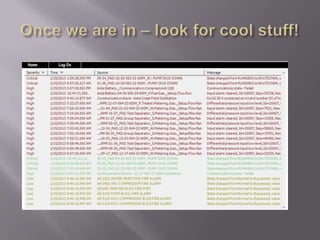
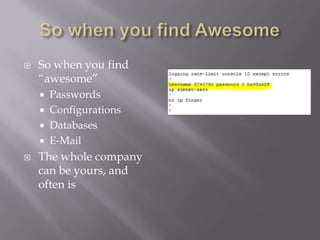
   So when you find
    “awesome”
     Passwords
     Configurations
     Databases
     E-Mail
   The whole company
    can be yours, and
    often is
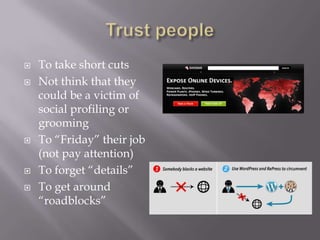
   To take short cuts
   Not think that they
    could be a victim of
    social profiling or
    grooming
   To “Friday” their job
    (not pay attention)
   To forget “details”
   To get around
    “roadblocks”
   APT sign No. 1: Increase in elevated log-ons late at night
   APTs rapidly escalate from compromising a single
    computer to taking over the whole environment. They do
    this by reading an authentication database, stealing
    credentials, and reusing them.
   They learn which user (or service) accounts have elevated
    privileges and permissions, then go through those accounts
    to compromise assets within the environment. Often, a high
    volume of elevated log-ons occur at night because the
    attackers live on the other side of the world. If you suddenly
    notice a high volume of elevated log-ons while the
    legitimate work crew is at home, start to worry.
   Source: http://www.infoworld.com/d/security/5-signs-
    youve-been-hit-advanced-persistent-threat-
    204941?page=0,0#sthash.SouQCZzM.dpuf
   APT sign No. 2: Finding widespread backdoor Trojans
   APT hackers often install backdoor Trojan programs on
    compromised computers within the exploited environment.
    They do this to ensure they can always get back in, even if
    the captured log-on credentials get changed when the victim
    gets a clue. Another related trait: Once discovered, APT
    hackers don't go away like normal attackers. Why should
    they? They own computers in your environment, and you
    aren't likely to see them in a court of law.
   These days, Trojans deployed through social engineering
    provide the avenue through which most companies are
    exploited. They are fairly common in every environment --
    and they proliferate in APT attacks.
   Source: http://www.infoworld.com/d/security/5-signs-
    youve-been-hit-advanced-persistent-threat-
    204941?page=0,0#sthash.SouQCZzM.dpuf
   APT sign No. 3: Unexpected information flows
   If I could pick the single best way to detect APT activities, this
    would be it: Look for large, unexpected flows of data from internal
    origination points to other internal computers or to external
    computers. It could be server to server, server to client, or network
    to network.
   Those data flows may also be limited, but targeted -- such as
    someone picking up email from a foreign country. I wish every
    email client had the ability to show where the latest user logged in
    to pick up email and where the last message was accessed. Gmail
    and some other cloud email systems already offer this.
   Of course, in order to detect a possible APT, you have to
    understand what your data flows look like before your
    environment is compromised. Start now and learn your baselines.
   Source: http://www.infoworld.com/d/security/5-signs-youve-
    been-hit-advanced-persistent-threat-
    204941?page=0,0#sthash.SouQCZzM.dpuf
   APT sign No. 4: Discovering unexpected data
    bundles
   APTs often aggregate stolen data to internal
    collection points before moving it outside. Look for
    large (we're talking gigabytes, not megabytes)
    chunks of data appearing in places where that data
    should not be, especially if compressed in archive
    formats not normally used by your company.
   Source:
    http://www.infoworld.com/d/security/5-signs-
    youve-been-hit-advanced-persistent-threat-
    204941?page=0,1#sthash.Jw5b5REJ.dpuf
   APT sign No. 5: Detecting pass-the-hash hacking
    tools
   Although APTs don't always use pass-the-hash
    attack tools, they frequently pop up. Strangely,
    after using them, hackers often forget to delete
    them. If you find pass-the-hash attack tools
    hanging around, it's OK to panic a little or at least
    consider them as evidence that should be
    investigated further.
   Source:
    http://www.infoworld.com/d/security/5-signs-
    youve-been-hit-advanced-persistent-threat-
    204941?page=0,1#sthash.Jw5b5REJ.dpuf
   All the tools you used in this class help you
    understand more about APT
     If you know how to do it, you know what to look for
     If you know what to look for you know how to
      protect your company
     If you know how to protect your company, you are
      going to be one awesome Information Security
      Engineer

Understanding advanced persistent threats (APT)

  • 1.
    CIS 166 HighlineCommunity College February 2013
  • 2.
    Advanced persistent threat (APT) usually refers to a group, such as a foreign government, with both the capability and the intent to persistently and effectively target a specific entity.  The term is commonly used to refer to cyber threats, in particular that of Internet-enabled espionage using a variety of intelligence gathering techniques to access sensitive information, but applies equally to other threats such as that of traditional espionage or attack.  Other recognized attack vectors include infected media, supply chain compromise, and social engineering. Individuals, such as an individual hacker, are not usually referred to as an APT as they rarely have the resources to be both advanced and persistent even if they are intent on gaining access to, or attacking, a specific target Source: http://en.wikipedia.org/wiki/Advanced_persistent_threat
  • 3.
    Bodmer, Kilger, Carpenter and Jones defined the following APT criteria:  Objectives - The end goal of the threat, your adversary  Timeliness - The time spent probing and accessing your system  Resources - The level of knowledge and tools used in the event (skills and methods will weigh on this point)  Risk tolerance - The extent the threat will go to remain undetected  Skills and methods - The tools and techniques used throughout the event  Actions - The precise actions of a threat or numerous threats  Attack origination points - The number of points where the event originated  Numbers involved in the attack - How many internal and external systems were involved in the event, and how many people's systems have different influence/importance weights  Knowledge source - The ability to discern any information regarding any of the specific threats through online information gathering (you might be surprised by what you can find by a little proactive)
  • 4.
    Actors behind advanced persistent threats create a growing and changing risk to organizations' financial assets, intellectual property, and reputation by following a continuous process:  Target specific organizations for a singular objective  Attempt to gain a foothold in the environment, common tactics include spear phishing emails.  Use the compromised systems as access into the target network  Deploy additional tools that help fulfill the attack objective  Cover tracks to maintain access for future initiatives
  • 5.
    Maltego  Develop a method and standard to identify targets within an organization that we can social engineer  Metasploit  So we can write URL’s, PDF’s and other items to send to our target within an organization  So we can “hack into a system” leaving behind a username and password for access later on  ZenMap/NMAP  So we can identify weak targets on a network
  • 6.
    Initial compromise — performed by use of Social engineering (security) and spear phishing, over email, using zero-day viruses. Another popular infection method was planting malware on a website that the victim employees will be likely to visit.  Establish Foothold — plant remote administration software in victim's network, create network backdoors and tunnels allowing stealth access to its infrastructure.  Escalate Privileges — use exploits and password cracking to acquire administrator privileges over victim's computer and possibly expand it to Windows domain administrator accounts.  Internal Reconnaissance — collect information on surrounding infrastructure, trust relationships, Windows domain structure.  Move Laterally — expand control to other workstations, servers and infrastructure elements and perform data harvesting on them.  Maintain Presence — ensure continued control over access channels and credentials acquired in previous steps.  Complete Mission — exfiltrate stolen data from victim's network.
  • 8.
    Abuse and compromise of “trusted connections” is a key ingredient for many APTs. While the targeted organization may employ sophisticated technologies in order to prevent infection and compromise of their digital systems, criminal operators often tunnel in to an organization using the hijacked credentials of employees or business partners, or via less- secured remote offices.  As such, almost any organization or remote site may fall victim to an APT and be utilized as a soft entry or information harvesting point. https://www.damballa.com/knowledge/advanced-persistent-threats.php
  • 10.
    So when you find “awesome”  Passwords  Configurations  Databases  E-Mail  The whole company can be yours, and often is
  • 11.
    To take short cuts  Not think that they could be a victim of social profiling or grooming  To “Friday” their job (not pay attention)  To forget “details”  To get around “roadblocks”
  • 13.
    APT sign No. 1: Increase in elevated log-ons late at night  APTs rapidly escalate from compromising a single computer to taking over the whole environment. They do this by reading an authentication database, stealing credentials, and reusing them.  They learn which user (or service) accounts have elevated privileges and permissions, then go through those accounts to compromise assets within the environment. Often, a high volume of elevated log-ons occur at night because the attackers live on the other side of the world. If you suddenly notice a high volume of elevated log-ons while the legitimate work crew is at home, start to worry.  Source: http://www.infoworld.com/d/security/5-signs- youve-been-hit-advanced-persistent-threat- 204941?page=0,0#sthash.SouQCZzM.dpuf
  • 14.
    APT sign No. 2: Finding widespread backdoor Trojans  APT hackers often install backdoor Trojan programs on compromised computers within the exploited environment. They do this to ensure they can always get back in, even if the captured log-on credentials get changed when the victim gets a clue. Another related trait: Once discovered, APT hackers don't go away like normal attackers. Why should they? They own computers in your environment, and you aren't likely to see them in a court of law.  These days, Trojans deployed through social engineering provide the avenue through which most companies are exploited. They are fairly common in every environment -- and they proliferate in APT attacks.  Source: http://www.infoworld.com/d/security/5-signs- youve-been-hit-advanced-persistent-threat- 204941?page=0,0#sthash.SouQCZzM.dpuf
  • 15.
    APT sign No. 3: Unexpected information flows  If I could pick the single best way to detect APT activities, this would be it: Look for large, unexpected flows of data from internal origination points to other internal computers or to external computers. It could be server to server, server to client, or network to network.  Those data flows may also be limited, but targeted -- such as someone picking up email from a foreign country. I wish every email client had the ability to show where the latest user logged in to pick up email and where the last message was accessed. Gmail and some other cloud email systems already offer this.  Of course, in order to detect a possible APT, you have to understand what your data flows look like before your environment is compromised. Start now and learn your baselines.  Source: http://www.infoworld.com/d/security/5-signs-youve- been-hit-advanced-persistent-threat- 204941?page=0,0#sthash.SouQCZzM.dpuf
  • 16.
    APT sign No. 4: Discovering unexpected data bundles  APTs often aggregate stolen data to internal collection points before moving it outside. Look for large (we're talking gigabytes, not megabytes) chunks of data appearing in places where that data should not be, especially if compressed in archive formats not normally used by your company.  Source: http://www.infoworld.com/d/security/5-signs- youve-been-hit-advanced-persistent-threat- 204941?page=0,1#sthash.Jw5b5REJ.dpuf
  • 17.
    APT sign No. 5: Detecting pass-the-hash hacking tools  Although APTs don't always use pass-the-hash attack tools, they frequently pop up. Strangely, after using them, hackers often forget to delete them. If you find pass-the-hash attack tools hanging around, it's OK to panic a little or at least consider them as evidence that should be investigated further.  Source: http://www.infoworld.com/d/security/5-signs- youve-been-hit-advanced-persistent-threat- 204941?page=0,1#sthash.Jw5b5REJ.dpuf
  • 18.
    All the tools you used in this class help you understand more about APT  If you know how to do it, you know what to look for  If you know what to look for you know how to protect your company  If you know how to protect your company, you are going to be one awesome Information Security Engineer

Editor's Notes

  • #10 http://www.youtube.com/watch?v=6p7FqSav6Ho&feature=player_embedded
  • #13 http://www.youtube.com/watch?v=bTiAuFGs0oM&feature=player_embedded