Modern Malware and
Threats
Martin Čmelík
www.security-portal.cz
Moderní malware a možnosti obrany, Hotel Panorama, Praha - 28.05.2015
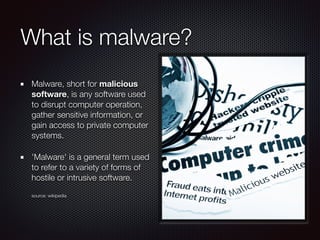
What is malware?
Malware, short for malicious
software, is any software used
to disrupt computer operation,
gather sensitive information, or
gain access to private computer
systems.
'Malware' is a general term used
to refer to a variety of forms of
hostile or intrusive software.


source: wikipedia
Text
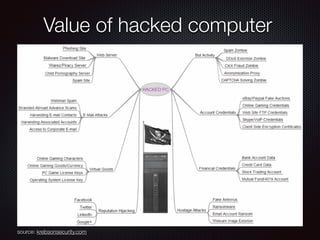
Value of hacked computer
source: krebsonsecurity.com
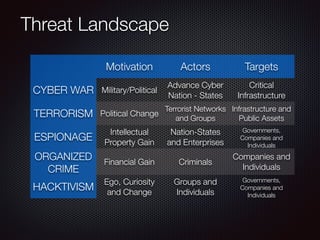
Threat Landscape
Motivation Actors Targets
CYBER WAR Military/Political
Advance Cyber
Nation - States
Critical
Infrastructure
TERRORISM Political Change
Terrorist Networks
and Groups
Infrastructure and
Public Assets
ESPIONAGE
Intellectual
Property Gain
Nation-States
and Enterprises
Governments,
Companies and
Individuals
ORGANIZED
CRIME
Financial Gain Criminals
Companies and
Individuals
HACKTIVISM
Ego, Curiosity
and Change
Groups and
Individuals
Governments,
Companies and
Individuals
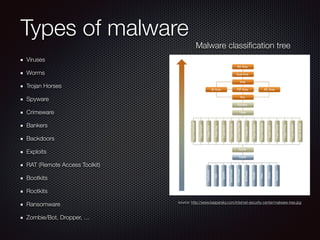
Types of malware
Viruses
Worms
Trojan Horses
Spyware
Crimeware
Bankers
Backdoors
Exploits
RAT (Remote Access Toolkit)
Bootkits
Rootkits
Ransomware
Zombie/Bot, Dropper, …
source: http://www.kaspersky.com/internet-security-center/malware-tree.jpg
Malware classification tree
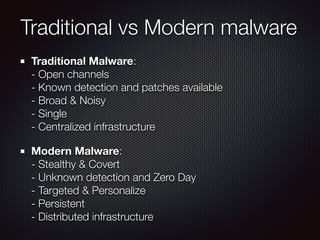
Traditional vs Modern malware
Traditional Malware:

- Open channels

- Known detection and patches available

- Broad & Noisy

- Single

- Centralized infrastructure
Modern Malware:

- Stealthy & Covert

- Unknown detection and Zero Day

- Targeted & Personalize

- Persistent

- Distributed infrastructure
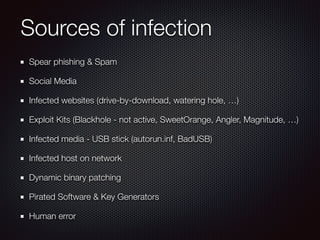
Sources of infection
Spear phishing & Spam
Social Media
Infected websites (drive-by-download, watering hole, …)
Exploit Kits (Blackhole - not active, SweetOrange, Angler, Magnitude, …)
Infected media - USB stick (autorun.inf, BadUSB)
Infected host on network
Dynamic binary patching
Pirated Software & Key Generators
Human error
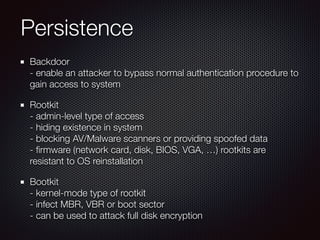
Persistence
Backdoor

- enable an attacker to bypass normal authentication procedure to
gain access to system
Rootkit

- admin-level type of access

- hiding existence in system

- blocking AV/Malware scanners or providing spoofed data

- firmware (network card, disk, BIOS, VGA, …) rootkits are
resistant to OS reinstallation
Bootkit

- kernel-mode type of rootkit

- infect MBR, VBR or boot sector

- can be used to attack full disk encryption
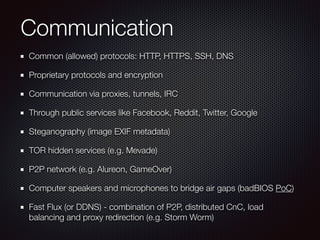
Communication
Common (allowed) protocols: HTTP, HTTPS, SSH, DNS
Proprietary protocols and encryption
Communication via proxies, tunnels, IRC
Through public services like Facebook, Reddit, Twitter, Google
Steganography (image EXIF metadata)
TOR hidden services (e.g. Mevade)
P2P network (e.g. Alureon, GameOver)
Computer speakers and microphones to bridge air gaps (badBIOS PoC)
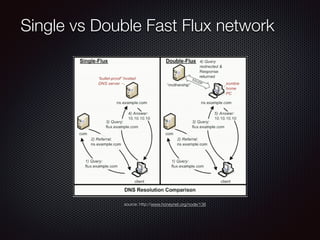
Fast Flux (or DDNS) - combination of P2P, distributed CnC, load
balancing and proxy redirection (e.g. Storm Worm)
Single vs Double Fast Flux network
source: http://www.honeynet.org/node/136
Bredolab Botnet
source: http://securelist.com/analysis/publications/36335/end-of-the-line-for-the-bredolab-botnet/
Anti-Detection techniques
Obfuscation - deliberate act of creating source or machine code that is difficult for humans
to understand.
Packers - comparable to obfuscation. Uses executable data compression algorithm and
combine compressed data with decompression code into single executable. Still could
provide quite good results when you will combine more of them together.
Olygomorphic code - randomly selecting each piece of the decryptor from several
predefined alternatives (+,-,/,XOR). Limited to just a few hundred different decryptors.
Polymorphic code - uses polymorphic engine to mutate while keeping original algorithm
intact. Code changes encryptor/decryptor each time it runs, but the function will remain
same.
Metamorphic code - no part of malware stays the same. Metamorphic viruses often
translate their own binary code into a temporary representation, editing the temporary
representation of themselves and then translate the edited form back to machine code
again.
Steganography - concealment of information within computer files (images, videos, …).
Used sporadically at this time, but seems to be weapon of choice for droppers which can
download and extract from image/youtube video/whatever malware payload.
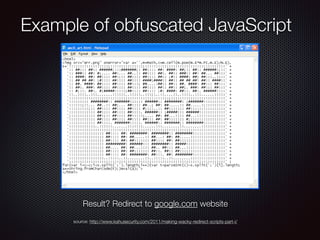
Example of obfuscated JavaScript
Result? Redirect to google.com website
source: http://www.kahusecurity.com/2011/making-wacky-redirect-scripts-part-i/
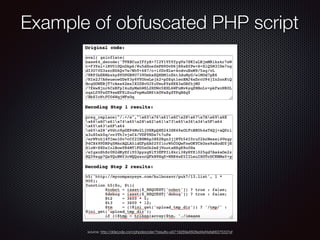
Example of obfuscated PHP script
source: http://ddecode.com/phpdecoder/?results=e0719289a4608ed4ef4efa66375337ef
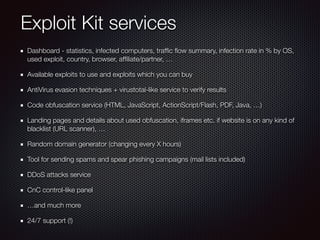
Exploit Kit services
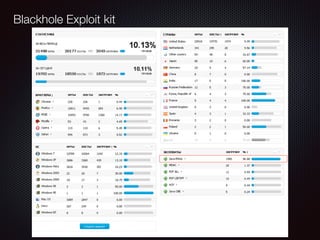
Dashboard - statistics, infected computers, traffic flow summary, infection rate in % by OS,
used exploit, country, browser, affiliate/partner, …
Available exploits to use and exploits which you can buy
AntiVirus evasion techniques + virustotal-like service to verify results
Code obfuscation service (HTML, JavaScript, ActionScript/Flash, PDF, Java, …)
Landing pages and details about used obfuscation, iframes etc. if website is on any kind of
blacklist (URL scanner), …
Random domain generator (changing every X hours)
Tool for sending spams and spear phishing campaigns (mail lists included)
DDoS attacks service
CnC control-like panel
…and much more
24/7 support (!)
Blackhole Exploit kit
Threat Detection
and Mitigation
Malware analysis
Static (code) Analysis - signature (virustotal.com) and string analysis,
reverse engineering performed using disassemblers (e.g. IDA Pro,
OllyDbg), debuggers and decompilers. Analysis without running the
code.

RE is time consuming
Dynamic (behavioral) Analysis - executing malware in sandboxed/
virtualized OS environment and looking how malware behaves
(monitoring system/library calls). What has been changed in system,
which connection attempts been made, which files created, etc.

Quick method which can detect APT attacks, spear phishing
campaigns and 0day exploits.
Memory Analysis - simple rule: malware must run, if it runs, it has to
be in memory. Dumping memory and searching for malicious artifacts
(e.g. Volatility Framework, Memoryze).
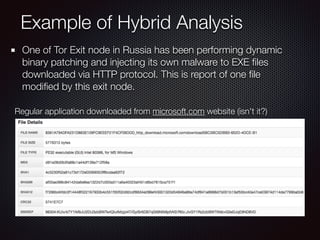
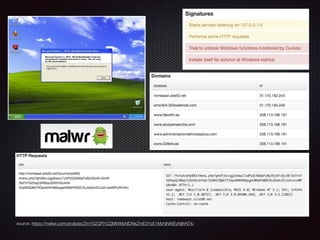
Example of Hybrid Analysis
One of Tor Exit node in Russia has been performing dynamic
binary patching and injecting its own malware to EXE files
downloaded via HTTP protocol. This is report of one file
modified by this exit node.
Regular application downloaded from microsoft.com website (isn't it?)
source: https://malwr.com/analysis/ZmY0ZGFlY2ZjMWMzNDNkZmE3YzE1MzhjNWEyNjlhNTk/
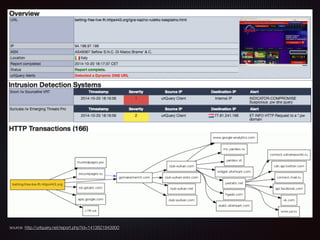
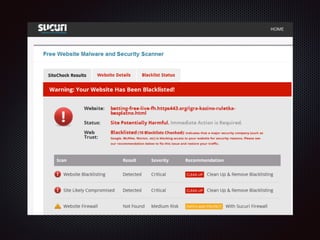
Analyzing Web-Based malware
urlQuery.net is a free online
service for testing and
analyzing URLs, helping with
identification of malicious
content on websites. The
main focus of urlQuery is to
find and detect suspicious
and malicious content on
webpages, to help improve
the security industry and
make the internet a safer
place.
source: http://urlquery.net/report.php?id=1413821943900
General Recommendations
have a good antivirus on computers and servers
have HIPS on computers and servers
IPS on the core of the network with Anti-Malware and Anti-Botnet engine can
help a lot. Even if engine wouldn't be able detect malicious file itself, it can
recognize communication to CnC servers by deep packet inspection or by
monitoring of DNS requests.
If you can use appliances which can recognize specific applications in network
flow. Strict policies allowing communication just from known applications can
mitigate malware infection and communication to CnC as well.
Correlate all security events and audit logs in robust SIEM solution
Invest money in good employees. Someone has to read and understand the
output of logs and SIEM events.
General Recommendations
Every piece of network equipment has to be properly setup and
secured. Starting with switches and ending with personal computers.
All systems has to be regularly updated
Strict policies and new technologies for malware detection has to be
enforced in order to avoid contact with malware distribution websites
and mail attachments coming from spear phishing and spam
campaigns.
…in best case uninstall Adobe Reader, Adobe Flash and Java
Consider OS level hardening

Windows - EMET (The Enhanced Mitigation Experience Toolkit)

Linux - SELinux, Grsecurity
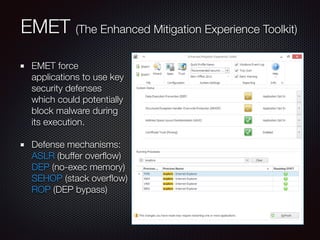
EMET (The Enhanced Mitigation Experience Toolkit)
EMET force
applications to use key
security defenses
which could potentially
block malware during
its execution.
Defense mechanisms:

ASLR (buffer overflow)

DEP (no-exec memory)

SEHOP (stack overflow)

ROP (DEP bypass)
Are you still hungry?
Flame - most complex, sophisticated and interesting piece of malware
(developed by US and Israel)
Dexter - POS malware with ability to search credit card information in
memory (Target data breach - 40 million credit cards)
Gapz - dropper using non-standard technique for code injection, bypassing
security software
The Mask - targets government, diplomatic offices and embassies, oil and
gas companies, research organizations and activists (state sponsored
malware)
Recommended sources

http://blog.kaspersky.com/

http://nakedsecurity.sophos.com/

http://www.welivesecurity.com/
Questions?
Thank you!
Martin Čmelík

~ security consultant ~

martin.cmelik (at) gmail.com
www.linkedin.com/in/martincmelik


www.security-portal.cz | www.securix.org | www.security-session.cz

Modern Malware and Threats

  • 1.
    Modern Malware and Threats MartinČmelík www.security-portal.cz Moderní malware a možnosti obrany, Hotel Panorama, Praha - 28.05.2015
  • 2.
    What is malware? Malware,short for malicious software, is any software used to disrupt computer operation, gather sensitive information, or gain access to private computer systems. 'Malware' is a general term used to refer to a variety of forms of hostile or intrusive software.
 
 source: wikipedia
  • 3.
    Text Value of hackedcomputer source: krebsonsecurity.com
  • 4.
    Threat Landscape Motivation ActorsTargets CYBER WAR Military/Political Advance Cyber Nation - States Critical Infrastructure TERRORISM Political Change Terrorist Networks and Groups Infrastructure and Public Assets ESPIONAGE Intellectual Property Gain Nation-States and Enterprises Governments, Companies and Individuals ORGANIZED CRIME Financial Gain Criminals Companies and Individuals HACKTIVISM Ego, Curiosity and Change Groups and Individuals Governments, Companies and Individuals
  • 5.
    Types of malware Viruses Worms TrojanHorses Spyware Crimeware Bankers Backdoors Exploits RAT (Remote Access Toolkit) Bootkits Rootkits Ransomware Zombie/Bot, Dropper, … source: http://www.kaspersky.com/internet-security-center/malware-tree.jpg Malware classification tree
  • 6.
    Traditional vs Modernmalware Traditional Malware:
 - Open channels
 - Known detection and patches available
 - Broad & Noisy
 - Single
 - Centralized infrastructure Modern Malware:
 - Stealthy & Covert
 - Unknown detection and Zero Day
 - Targeted & Personalize
 - Persistent
 - Distributed infrastructure
  • 7.
    Sources of infection Spearphishing & Spam Social Media Infected websites (drive-by-download, watering hole, …) Exploit Kits (Blackhole - not active, SweetOrange, Angler, Magnitude, …) Infected media - USB stick (autorun.inf, BadUSB) Infected host on network Dynamic binary patching Pirated Software & Key Generators Human error
  • 8.
    Persistence Backdoor
 - enable anattacker to bypass normal authentication procedure to gain access to system Rootkit
 - admin-level type of access
 - hiding existence in system
 - blocking AV/Malware scanners or providing spoofed data
 - firmware (network card, disk, BIOS, VGA, …) rootkits are resistant to OS reinstallation Bootkit
 - kernel-mode type of rootkit
 - infect MBR, VBR or boot sector
 - can be used to attack full disk encryption
  • 9.
    Communication Common (allowed) protocols:HTTP, HTTPS, SSH, DNS Proprietary protocols and encryption Communication via proxies, tunnels, IRC Through public services like Facebook, Reddit, Twitter, Google Steganography (image EXIF metadata) TOR hidden services (e.g. Mevade) P2P network (e.g. Alureon, GameOver) Computer speakers and microphones to bridge air gaps (badBIOS PoC) Fast Flux (or DDNS) - combination of P2P, distributed CnC, load balancing and proxy redirection (e.g. Storm Worm)
  • 10.
    Single vs DoubleFast Flux network source: http://www.honeynet.org/node/136
  • 11.
  • 12.
    Anti-Detection techniques Obfuscation -deliberate act of creating source or machine code that is difficult for humans to understand. Packers - comparable to obfuscation. Uses executable data compression algorithm and combine compressed data with decompression code into single executable. Still could provide quite good results when you will combine more of them together. Olygomorphic code - randomly selecting each piece of the decryptor from several predefined alternatives (+,-,/,XOR). Limited to just a few hundred different decryptors. Polymorphic code - uses polymorphic engine to mutate while keeping original algorithm intact. Code changes encryptor/decryptor each time it runs, but the function will remain same. Metamorphic code - no part of malware stays the same. Metamorphic viruses often translate their own binary code into a temporary representation, editing the temporary representation of themselves and then translate the edited form back to machine code again. Steganography - concealment of information within computer files (images, videos, …). Used sporadically at this time, but seems to be weapon of choice for droppers which can download and extract from image/youtube video/whatever malware payload.
  • 13.
    Example of obfuscatedJavaScript Result? Redirect to google.com website source: http://www.kahusecurity.com/2011/making-wacky-redirect-scripts-part-i/
  • 14.
    Example of obfuscatedPHP script source: http://ddecode.com/phpdecoder/?results=e0719289a4608ed4ef4efa66375337ef
  • 15.
    Exploit Kit services Dashboard- statistics, infected computers, traffic flow summary, infection rate in % by OS, used exploit, country, browser, affiliate/partner, … Available exploits to use and exploits which you can buy AntiVirus evasion techniques + virustotal-like service to verify results Code obfuscation service (HTML, JavaScript, ActionScript/Flash, PDF, Java, …) Landing pages and details about used obfuscation, iframes etc. if website is on any kind of blacklist (URL scanner), … Random domain generator (changing every X hours) Tool for sending spams and spear phishing campaigns (mail lists included) DDoS attacks service CnC control-like panel …and much more 24/7 support (!)
  • 16.
  • 17.
  • 18.
    Malware analysis Static (code)Analysis - signature (virustotal.com) and string analysis, reverse engineering performed using disassemblers (e.g. IDA Pro, OllyDbg), debuggers and decompilers. Analysis without running the code.
 RE is time consuming Dynamic (behavioral) Analysis - executing malware in sandboxed/ virtualized OS environment and looking how malware behaves (monitoring system/library calls). What has been changed in system, which connection attempts been made, which files created, etc.
 Quick method which can detect APT attacks, spear phishing campaigns and 0day exploits. Memory Analysis - simple rule: malware must run, if it runs, it has to be in memory. Dumping memory and searching for malicious artifacts (e.g. Volatility Framework, Memoryze).
  • 19.
    Example of HybridAnalysis One of Tor Exit node in Russia has been performing dynamic binary patching and injecting its own malware to EXE files downloaded via HTTP protocol. This is report of one file modified by this exit node. Regular application downloaded from microsoft.com website (isn't it?)
  • 20.
  • 21.
    Analyzing Web-Based malware urlQuery.netis a free online service for testing and analyzing URLs, helping with identification of malicious content on websites. The main focus of urlQuery is to find and detect suspicious and malicious content on webpages, to help improve the security industry and make the internet a safer place.
  • 22.
  • 24.
    General Recommendations have agood antivirus on computers and servers have HIPS on computers and servers IPS on the core of the network with Anti-Malware and Anti-Botnet engine can help a lot. Even if engine wouldn't be able detect malicious file itself, it can recognize communication to CnC servers by deep packet inspection or by monitoring of DNS requests. If you can use appliances which can recognize specific applications in network flow. Strict policies allowing communication just from known applications can mitigate malware infection and communication to CnC as well. Correlate all security events and audit logs in robust SIEM solution Invest money in good employees. Someone has to read and understand the output of logs and SIEM events.
  • 25.
    General Recommendations Every pieceof network equipment has to be properly setup and secured. Starting with switches and ending with personal computers. All systems has to be regularly updated Strict policies and new technologies for malware detection has to be enforced in order to avoid contact with malware distribution websites and mail attachments coming from spear phishing and spam campaigns. …in best case uninstall Adobe Reader, Adobe Flash and Java Consider OS level hardening
 Windows - EMET (The Enhanced Mitigation Experience Toolkit)
 Linux - SELinux, Grsecurity
  • 26.
    EMET (The EnhancedMitigation Experience Toolkit) EMET force applications to use key security defenses which could potentially block malware during its execution. Defense mechanisms:
 ASLR (buffer overflow)
 DEP (no-exec memory)
 SEHOP (stack overflow)
 ROP (DEP bypass)
  • 27.
    Are you stillhungry? Flame - most complex, sophisticated and interesting piece of malware (developed by US and Israel) Dexter - POS malware with ability to search credit card information in memory (Target data breach - 40 million credit cards) Gapz - dropper using non-standard technique for code injection, bypassing security software The Mask - targets government, diplomatic offices and embassies, oil and gas companies, research organizations and activists (state sponsored malware) Recommended sources
 http://blog.kaspersky.com/
 http://nakedsecurity.sophos.com/
 http://www.welivesecurity.com/
  • 28.
  • 29.
    Thank you! Martin Čmelík
 ~security consultant ~
 martin.cmelik (at) gmail.com www.linkedin.com/in/martincmelik
 
 www.security-portal.cz | www.securix.org | www.security-session.cz