
FACTOR ANALYSIS
Presented by
JAGPAL
DFK-1306
Department of Fish Processing
Technology
INTRODUCTION
 Factor analysis is a statistical method used to study the
dimensionality of a set of variables.
 collection of methods used to examine how underlying
constructs influence the responses on a number of
measured variables
 In factor analysis, latent variables represent unobserved
constructs and are referred to as factors or dimensions
TYPES OF FACTOR ANALYSIS
 Exploratory analysis (EFA) attempts to discover the nature of
the constructs infusing a set of responses.
 Confirmatory factor analysis (CFA) tests whether a specified
set of constructs is infusing responses in a predicted way
EXPLORATORY FACTOR ANALYSIS (EFA)
 Used to explore the dimensionality of a measurement instrument
by finding the smallest number of interpretable factors needed to
explain the correlations among a set of variables
 Exploratory in the sense that it places no structure on the linear
relationships between the observed variables and the factors but
only specifies the number of latent variables
 EFA can be performed in SAS using proc factor.
 PCA can be performed in SAS using proc princomp,
 PCA can be performed in SPSS using the Analyze/Data
reduction/Factor analysis
 EFA cannot actually be performed in SPSS
 However, we can simply use component scores for the same
purposes as you would typically use for EFA.
OBJECTIVES OF EFA
The primary objectives of an EFA are to determine
1. The number of common factors infusing a set of
measures.
2. The strength of the relationship between each
factor and each observed measure.
STEPS IN EFA
 Collect and explore data: choose relevant
variables.
 Obtain the correlation matrix
 Select the number of factors for inclusion.
 Extract initial set of factors.
 Rotate factors to a normal solution.
 Interpret factor structure.
 Construct factor scores for further analysis.
 Construct scales and use in further analysis
CONFIRMATORY FACTOR ANALYSIS (CFA)
 Used to study how well a hypothesized factor model
fits a new sample from the same population or a
sample from a different population characterized by
allowing restrictions on the parameters of the model
 CFA has strong links to structural equation modeling, a
relatively nonstandard area of statistics.
 Much more difficult to perform a CFA than it is to
perform an EFA.
 A CFA requires a larger sample size than an EFA, because the CFA
produces inferential statistics
 CFA can be perfomed in SAS using proc calis, but cannot be
performed in SPSS.
 However, SPSS does produce another software package called
AMOS which will perform CFA.
 CFA are also commonly analyzed using LISREL.
 The exact sample size necessary will vary heavily with the number
of measures and factors in the model, but you can expect to require
around 200 subjects for a standard model.
OBJECTIVES OF CFA
 The primary objective of a CFA is to determine
 The ability of a predefined factor model to fit
an observed set of data.
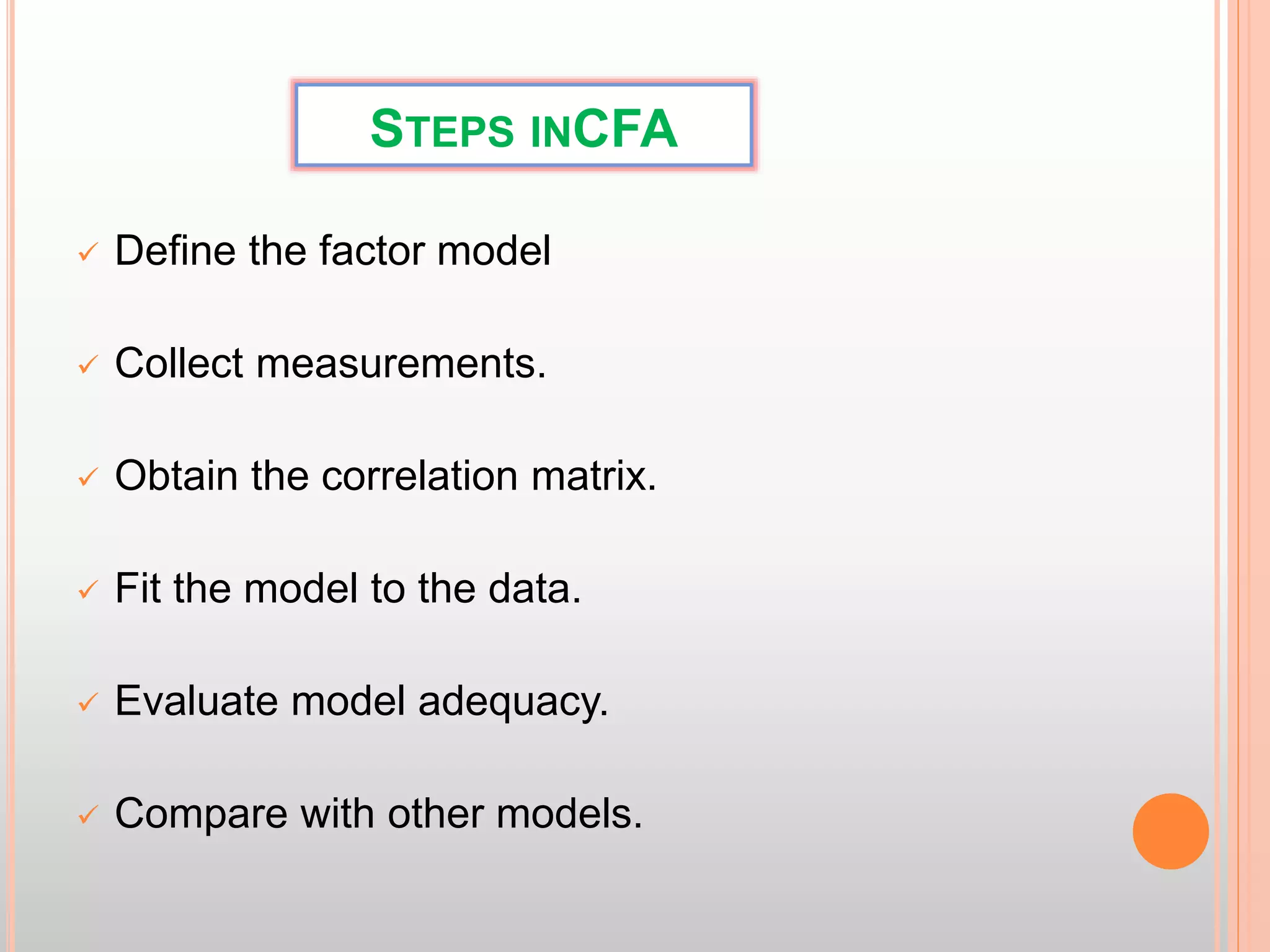
STEPS INCFA
 Define the factor model
 Collect measurements.
 Obtain the correlation matrix.
 Fit the model to the data.
 Evaluate model adequacy.
 Compare with other models.
USES OF CFA
 Establish the validity of a single factor model.
 Compare the ability of two different models to account
for the same set of data
 Test the significance of a specific factor loading
 Test the relationship between two or more factor
loadings.
 Test whether a set of factors are correlated or
uncorrelated
 Assess the convergent and discriminate validity of a set
of measures
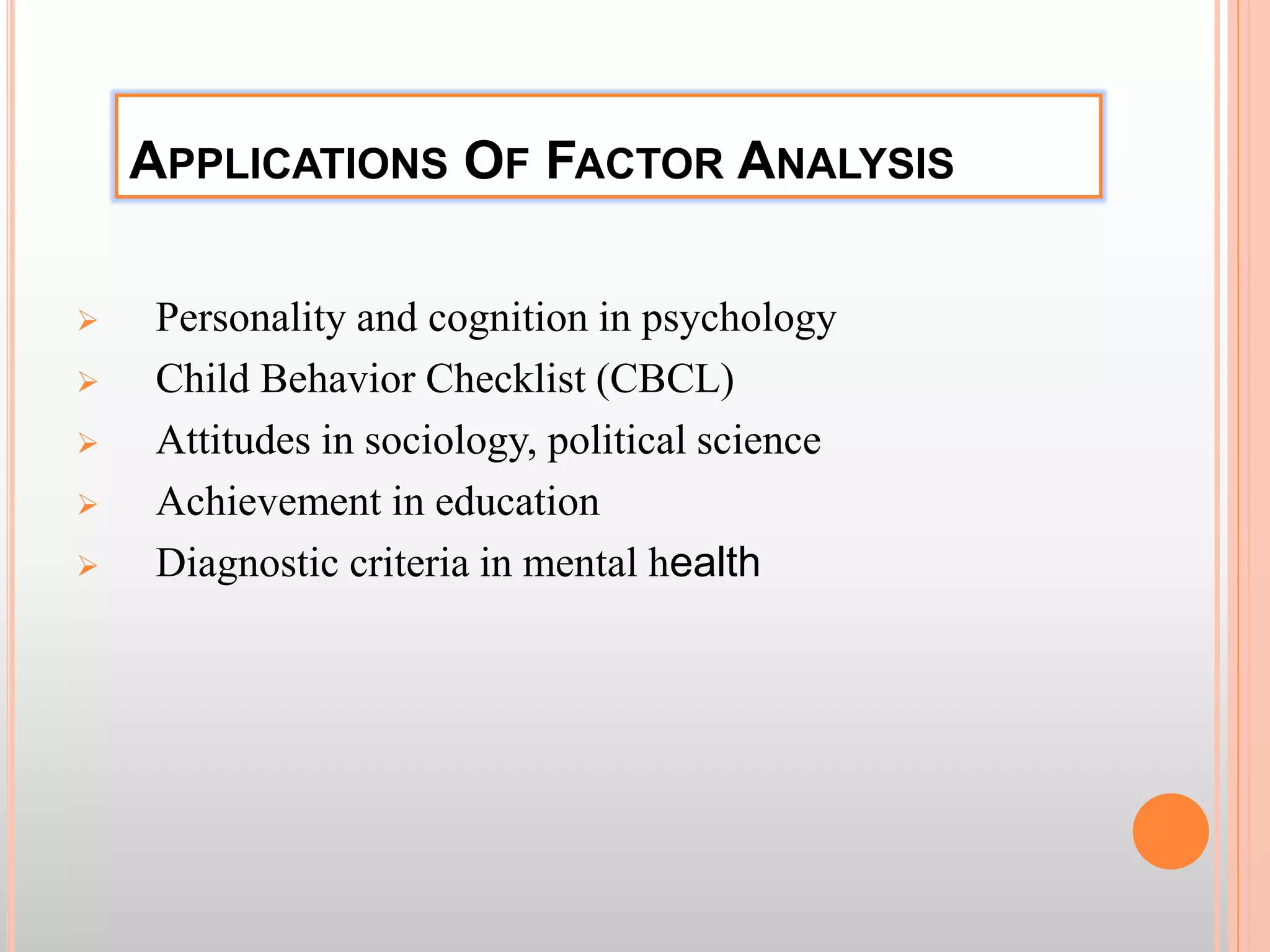
APPLICATIONS OF FACTOR ANALYSIS
 Personality and cognition in psychology
 Child Behavior Checklist (CBCL)
 Attitudes in sociology, political science
 Achievement in education
 Diagnostic criteria in mental health
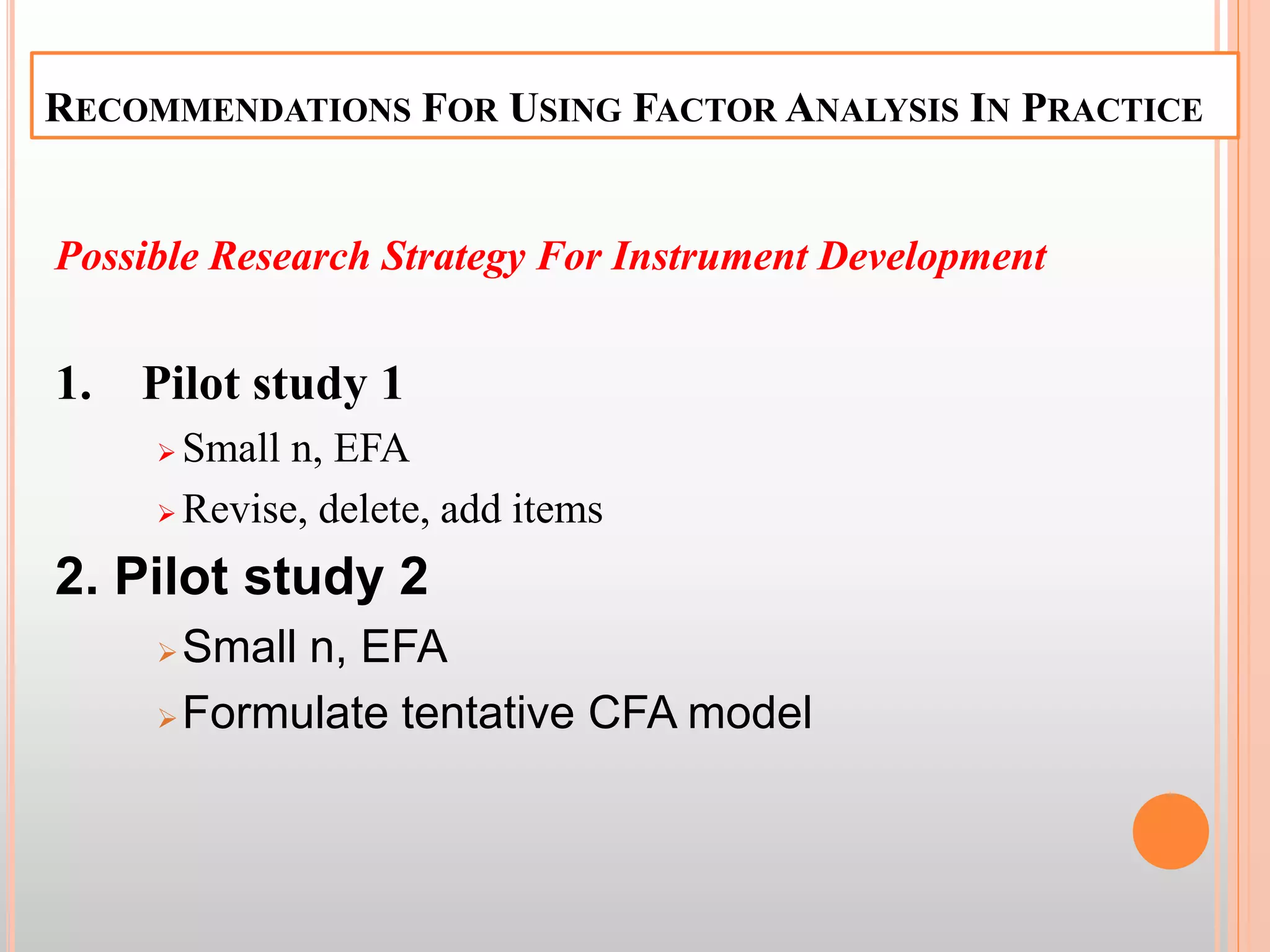
RECOMMENDATIONS FOR USING FACTOR ANALYSIS IN PRACTICE
Possible Research Strategy For Instrument Development
1. Pilot study 1
 Small n, EFA
 Revise, delete, add items
2. Pilot study 2
Small n, EFA
Formulate tentative CFA model
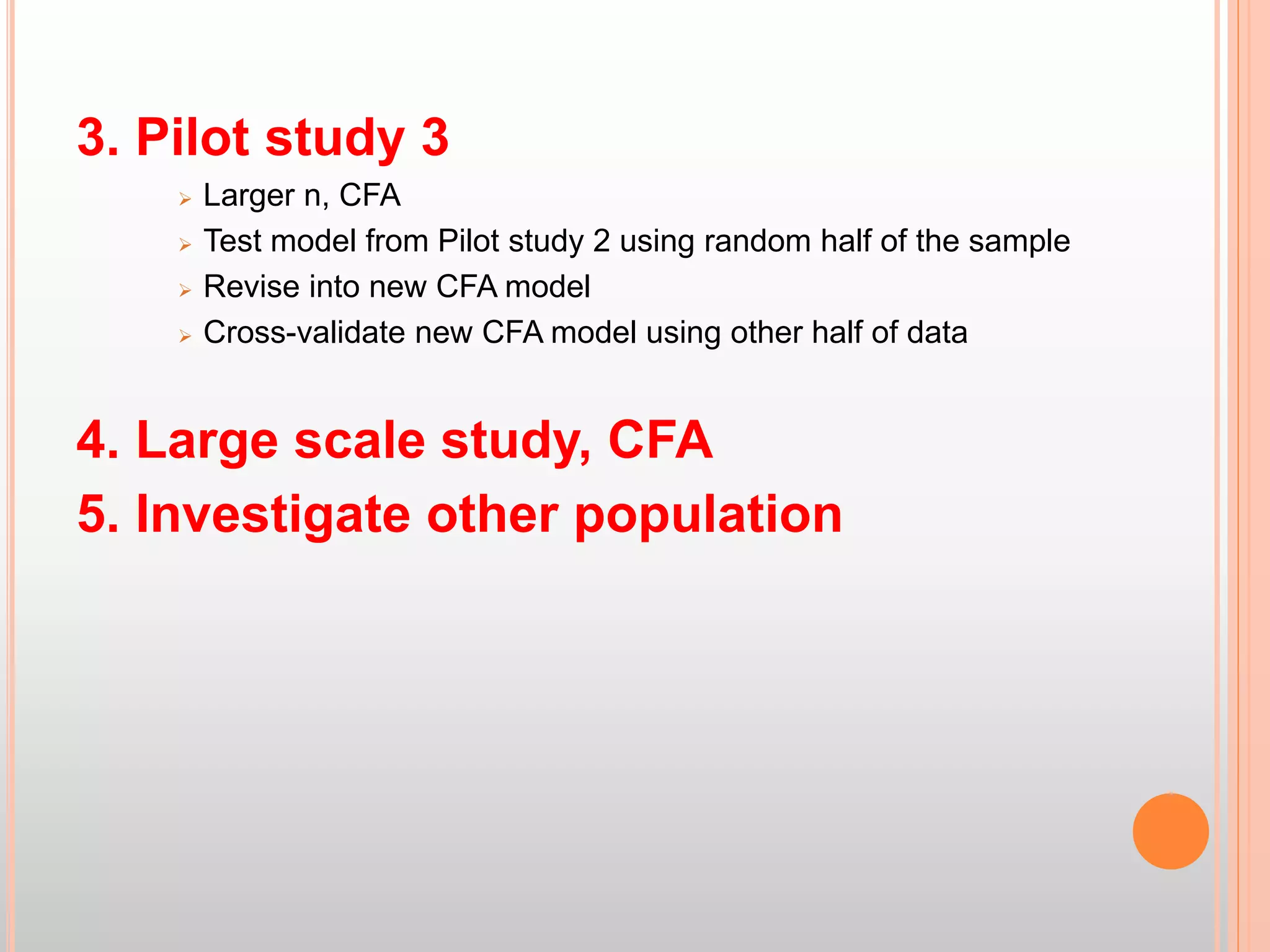
3. Pilot study 3
 Larger n, CFA
 Test model from Pilot study 2 using random half of the sample
 Revise into new CFA model
 Cross-validate new CFA model using other half of data
4. Large scale study, CFA
5. Investigate other population
Factor analysis

Factor analysis

  • 1.
  • 2.
    INTRODUCTION  Factor analysisis a statistical method used to study the dimensionality of a set of variables.  collection of methods used to examine how underlying constructs influence the responses on a number of measured variables  In factor analysis, latent variables represent unobserved constructs and are referred to as factors or dimensions
  • 3.
    TYPES OF FACTORANALYSIS  Exploratory analysis (EFA) attempts to discover the nature of the constructs infusing a set of responses.  Confirmatory factor analysis (CFA) tests whether a specified set of constructs is infusing responses in a predicted way
  • 4.
    EXPLORATORY FACTOR ANALYSIS(EFA)  Used to explore the dimensionality of a measurement instrument by finding the smallest number of interpretable factors needed to explain the correlations among a set of variables  Exploratory in the sense that it places no structure on the linear relationships between the observed variables and the factors but only specifies the number of latent variables
  • 5.
     EFA canbe performed in SAS using proc factor.  PCA can be performed in SAS using proc princomp,  PCA can be performed in SPSS using the Analyze/Data reduction/Factor analysis  EFA cannot actually be performed in SPSS  However, we can simply use component scores for the same purposes as you would typically use for EFA.
  • 6.
    OBJECTIVES OF EFA Theprimary objectives of an EFA are to determine 1. The number of common factors infusing a set of measures. 2. The strength of the relationship between each factor and each observed measure.
  • 7.
    STEPS IN EFA Collect and explore data: choose relevant variables.  Obtain the correlation matrix  Select the number of factors for inclusion.  Extract initial set of factors.  Rotate factors to a normal solution.  Interpret factor structure.  Construct factor scores for further analysis.  Construct scales and use in further analysis
  • 8.
    CONFIRMATORY FACTOR ANALYSIS(CFA)  Used to study how well a hypothesized factor model fits a new sample from the same population or a sample from a different population characterized by allowing restrictions on the parameters of the model  CFA has strong links to structural equation modeling, a relatively nonstandard area of statistics.  Much more difficult to perform a CFA than it is to perform an EFA.
  • 9.
     A CFArequires a larger sample size than an EFA, because the CFA produces inferential statistics  CFA can be perfomed in SAS using proc calis, but cannot be performed in SPSS.  However, SPSS does produce another software package called AMOS which will perform CFA.  CFA are also commonly analyzed using LISREL.  The exact sample size necessary will vary heavily with the number of measures and factors in the model, but you can expect to require around 200 subjects for a standard model.
  • 10.
    OBJECTIVES OF CFA The primary objective of a CFA is to determine  The ability of a predefined factor model to fit an observed set of data.
  • 11.
    STEPS INCFA  Definethe factor model  Collect measurements.  Obtain the correlation matrix.  Fit the model to the data.  Evaluate model adequacy.  Compare with other models.
  • 12.
    USES OF CFA Establish the validity of a single factor model.  Compare the ability of two different models to account for the same set of data  Test the significance of a specific factor loading  Test the relationship between two or more factor loadings.  Test whether a set of factors are correlated or uncorrelated  Assess the convergent and discriminate validity of a set of measures
  • 13.
    APPLICATIONS OF FACTORANALYSIS  Personality and cognition in psychology  Child Behavior Checklist (CBCL)  Attitudes in sociology, political science  Achievement in education  Diagnostic criteria in mental health
  • 14.
    RECOMMENDATIONS FOR USINGFACTOR ANALYSIS IN PRACTICE Possible Research Strategy For Instrument Development 1. Pilot study 1  Small n, EFA  Revise, delete, add items 2. Pilot study 2 Small n, EFA Formulate tentative CFA model
  • 15.
    3. Pilot study3  Larger n, CFA  Test model from Pilot study 2 using random half of the sample  Revise into new CFA model  Cross-validate new CFA model using other half of data 4. Large scale study, CFA 5. Investigate other population

Editor's Notes

  • #10 AMOS- Analysis of Moment structure LISREL- linear structural relationship and factor analysis