An Overview:
Exploratory Factor Analysis
Daniel Briggs
North Carolina State University
January 2016
An Initial Look
Exploratory factor analysis (EFA) is a statistical
tool used to uncover the underlying structure of
a relatively large set of variables.
It serves to identify the underlying relationships
between measured variables and identify a set
of latent variables that are shaped by these
measured variables.
What are these latent variables?
These are variables that are not directly
observed, but are inferred.
They can be both physical or abstract in
nature and are commonly referred to as
hidden or hypothetical variables.
In the case of EFA latent variables
represent “shared” variance, or the
degree to which variables move together.
Why EFA?
 Allows investigation of factor structures, or how variables are grouped based
on strong correlations.
 Help to understand response patterns in observed variables.
 Places no structure on the linear relationships between the observed variables
and on the linear relationships between the observed variables and the factors.
 Structure is an arrangement and organization of interrelated elements in an
object or system.
 Determine the quality of a measurement instrument by identifying variables
that are poor factor indicators and factors that are poorly measured.
Assumptions
 Normality
 The variables have normal distributions
 In particular, we want to verify that skewness ≤ |2| and kurtosis ≤ |7|
 Linearity between variables
 Factorability
 We want to see correlation between items
 There should be some degree of collinearity among variables but not too much such that we
can still identify latent variables
 Sample size
 Sample size should be large.
 A common estimator for sufficient sample size is a large subject to variable ratio (N/k)
 The bare minimum for pilot study purposes has been reported as low as 3:1
Checking Factorability
Inter-item correlations (correlation matrix) - are
there at least several sizable correlations e.g., >
|.5|?
Anti-image correlation matrix diagonals - they
should be > ~.5.
Measures of sampling adequacy (MSAs):
Kaiser-Meyer-Olkin (KMO) (should be .5) and
Bartlett's test of sphericity (should be significant)
Fitting Procedures
Fitting procedures are used to estimate the
factor loadings and unique variances of the
model.
Factor loadings are the regression
coefficients between items and factors and
measure the influence of a common factor
on a measured variable.
All of this begins with an initial extraction.
Determine Number of Factors
 Issue of parsimony versus sufficiency. Overfactoring versus underfactoring.
 Researcher’s intuition
 Scree plot
 Compute the eigenvalues for the correlation matrix and plot them from smallest to largest.
 The number of eigenvalues before the last substantial drop is the number of factors.
 Eigenvalues (K1)
 Compute the eigenvalues for the correlation matrix and determine how many are greater than one.
 The number of eigenvalues greater than one corresponds to the number of factors.
 Parallel Analysis
 Create a random dataset with the same numbers of observations and variables as the original data.
 A correlation matrix is computed from the randomly generated dataset and then eigenvalues of the correlation matrix
are computed
 When the eigenvalues from the random data are larger then the eigenvalues from the initial data set then you know
that the components or factors are mostly random noise.
Extraction Methods
 Principal Axis Factoring (PAF)
 Considers only common variance.
 Seeks least number of factors that can account for the common variance (correlation) of a set
of variables.
 Removes the uniqueness or unexplained variability from the model.
 Principal Components Analysis (PCA)
 Considers all of the available variance.
 Seeks a linear combination of variables such that maximum variance is extracted.
 Maximum Likelihood (ML)
 Maximizes differences between factors.
 Most statistically robust
Rotation
 Variables load onto factors at different levels. We measure this with factor loadings.
 Factor loadings represent how much a factor affects a variable in factor analysis.
Values close to -1 and 1 indicate strong influence. Values close to 0 indicate a weak
effect.
 After factor extraction we may notice that we have difficulty interpreting and
naming the factors/components on the basis of their factor loadings.
 A solution for this difficulty is factor rotation. Factor rotation alters the pattern of
the factor loadings, and hence can improve interpretation.
Rotation: Types
 Orthogonal
 Orthogonal rotations constrain factors to be uncorrelated.
 An advantage of orthogonal rotation is its simplicity and conceptual clarity.
 Often there is a theoretical basis for expecting correlations amongst factors.
 Oblique
 Oblique rotations permit correlations among factors, though the factors thus identified
may not correlate.
 An advantage of oblique rotation is that it produces solutions with better simple
structure.
Visualizing Rotation
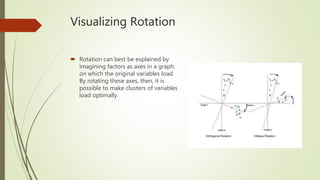
 Rotation can best be explained by
imagining factors as axes in a graph,
on which the original variables load.
By rotating these axes, then, it is
possible to make clusters of variables
load optimally.

EFA

  • 1.
    An Overview: Exploratory FactorAnalysis Daniel Briggs North Carolina State University January 2016
  • 2.
    An Initial Look Exploratoryfactor analysis (EFA) is a statistical tool used to uncover the underlying structure of a relatively large set of variables. It serves to identify the underlying relationships between measured variables and identify a set of latent variables that are shaped by these measured variables.
  • 3.
    What are theselatent variables? These are variables that are not directly observed, but are inferred. They can be both physical or abstract in nature and are commonly referred to as hidden or hypothetical variables. In the case of EFA latent variables represent “shared” variance, or the degree to which variables move together.
  • 4.
    Why EFA?  Allowsinvestigation of factor structures, or how variables are grouped based on strong correlations.  Help to understand response patterns in observed variables.  Places no structure on the linear relationships between the observed variables and on the linear relationships between the observed variables and the factors.  Structure is an arrangement and organization of interrelated elements in an object or system.  Determine the quality of a measurement instrument by identifying variables that are poor factor indicators and factors that are poorly measured.
  • 5.
    Assumptions  Normality  Thevariables have normal distributions  In particular, we want to verify that skewness ≤ |2| and kurtosis ≤ |7|  Linearity between variables  Factorability  We want to see correlation between items  There should be some degree of collinearity among variables but not too much such that we can still identify latent variables  Sample size  Sample size should be large.  A common estimator for sufficient sample size is a large subject to variable ratio (N/k)  The bare minimum for pilot study purposes has been reported as low as 3:1
  • 6.
    Checking Factorability Inter-item correlations(correlation matrix) - are there at least several sizable correlations e.g., > |.5|? Anti-image correlation matrix diagonals - they should be > ~.5. Measures of sampling adequacy (MSAs): Kaiser-Meyer-Olkin (KMO) (should be .5) and Bartlett's test of sphericity (should be significant)
  • 7.
    Fitting Procedures Fitting proceduresare used to estimate the factor loadings and unique variances of the model. Factor loadings are the regression coefficients between items and factors and measure the influence of a common factor on a measured variable. All of this begins with an initial extraction.
  • 8.
    Determine Number ofFactors  Issue of parsimony versus sufficiency. Overfactoring versus underfactoring.  Researcher’s intuition  Scree plot  Compute the eigenvalues for the correlation matrix and plot them from smallest to largest.  The number of eigenvalues before the last substantial drop is the number of factors.  Eigenvalues (K1)  Compute the eigenvalues for the correlation matrix and determine how many are greater than one.  The number of eigenvalues greater than one corresponds to the number of factors.  Parallel Analysis  Create a random dataset with the same numbers of observations and variables as the original data.  A correlation matrix is computed from the randomly generated dataset and then eigenvalues of the correlation matrix are computed  When the eigenvalues from the random data are larger then the eigenvalues from the initial data set then you know that the components or factors are mostly random noise.
  • 9.
    Extraction Methods  PrincipalAxis Factoring (PAF)  Considers only common variance.  Seeks least number of factors that can account for the common variance (correlation) of a set of variables.  Removes the uniqueness or unexplained variability from the model.  Principal Components Analysis (PCA)  Considers all of the available variance.  Seeks a linear combination of variables such that maximum variance is extracted.  Maximum Likelihood (ML)  Maximizes differences between factors.  Most statistically robust
  • 10.
    Rotation  Variables loadonto factors at different levels. We measure this with factor loadings.  Factor loadings represent how much a factor affects a variable in factor analysis. Values close to -1 and 1 indicate strong influence. Values close to 0 indicate a weak effect.  After factor extraction we may notice that we have difficulty interpreting and naming the factors/components on the basis of their factor loadings.  A solution for this difficulty is factor rotation. Factor rotation alters the pattern of the factor loadings, and hence can improve interpretation.
  • 11.
    Rotation: Types  Orthogonal Orthogonal rotations constrain factors to be uncorrelated.  An advantage of orthogonal rotation is its simplicity and conceptual clarity.  Often there is a theoretical basis for expecting correlations amongst factors.  Oblique  Oblique rotations permit correlations among factors, though the factors thus identified may not correlate.  An advantage of oblique rotation is that it produces solutions with better simple structure.
  • 12.
    Visualizing Rotation  Rotationcan best be explained by imagining factors as axes in a graph, on which the original variables load. By rotating these axes, then, it is possible to make clusters of variables load optimally.

Editor's Notes

  • #7 Bartlett’s test of sphericity tests the covariance matrix against the null hypothesis that the covariance matrix is the identity matrix KMO measures proportion among variables that might be common variance
  • #10 Biggest difference between PAF and PCA is PAF accounts for covariation whereas PCA accounts for total variance (common and unique).