Mediation analysis
Practical statistics for practical people
Who uses
mediation
analysis?
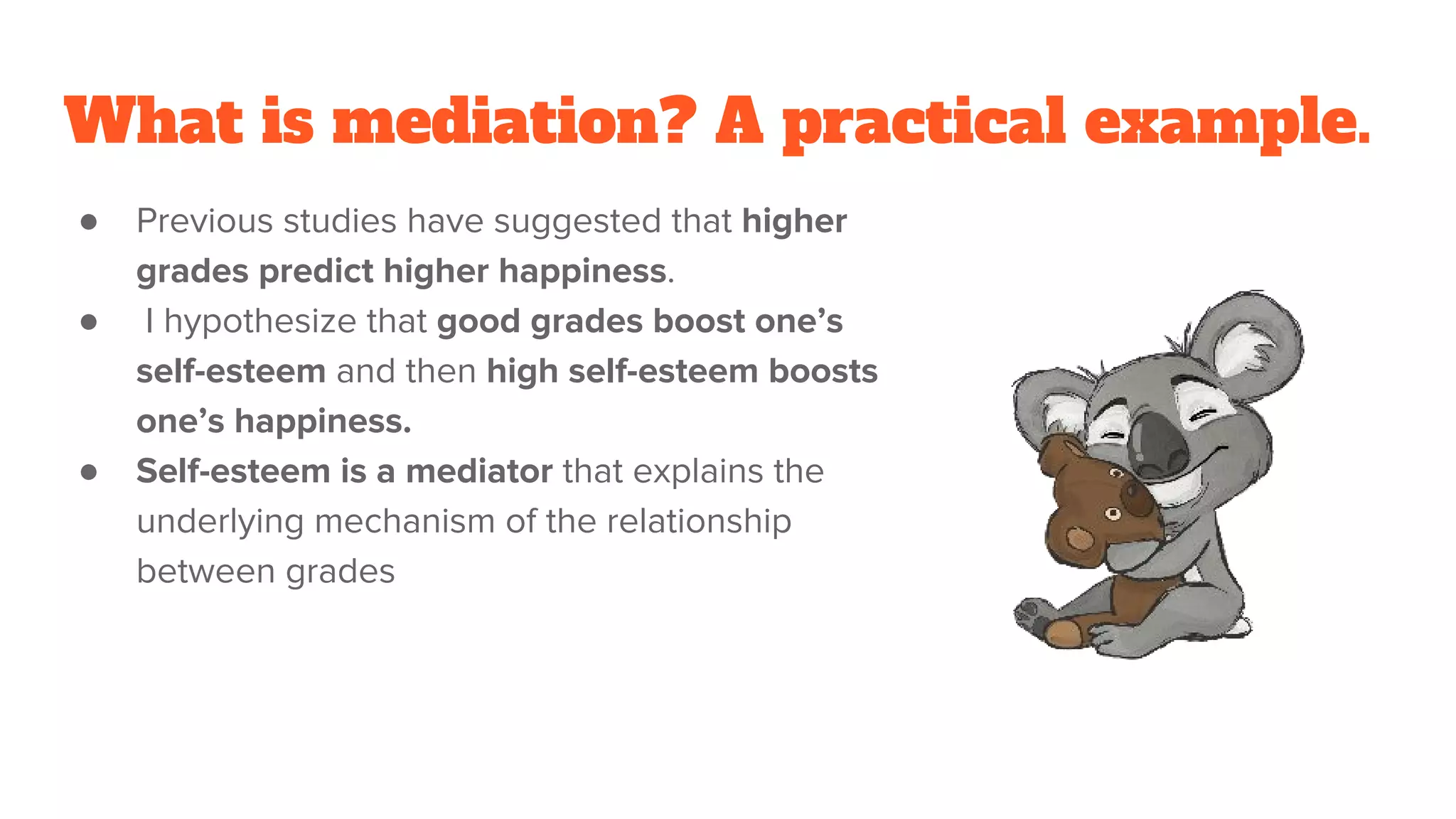
What is mediation? A practical example.
● Previous studies have suggested that higher
grades predict higher happiness.
● I hypothesize that good grades boost one’s
self-esteem and then high self-esteem boosts
one’s happiness.
● Self-esteem is a mediator that explains the
underlying mechanism of the relationship
between grades
What is mediation? A practical example.
● A gene’s final produce is proteins
● A gene is transcribed into mRNA.
● Could mRNA mediate the production of Protein from a DNA sequence?
What is mediation? A practical example.
● The way you were parented influences your
confidence in parenting.
● How you were parented influences your confidence
and self-esteem.
● Could your self-esteem and feelings of confidence
influence your confidence parenting? Self-esteem
would be a mediator between how you were
parented and your confidence in parenting.
Mediation analysis in a nutshell
Baron and Kenny’s step for mediation analysis
● Step 1: Check that X is a significant predictor for Y
● Step 2: Check that X is a significant predictor for M
● Step 3: Regress X and M on Y and check that
○ M is a significant predictor of Y
○ X’s predicting power has reduced
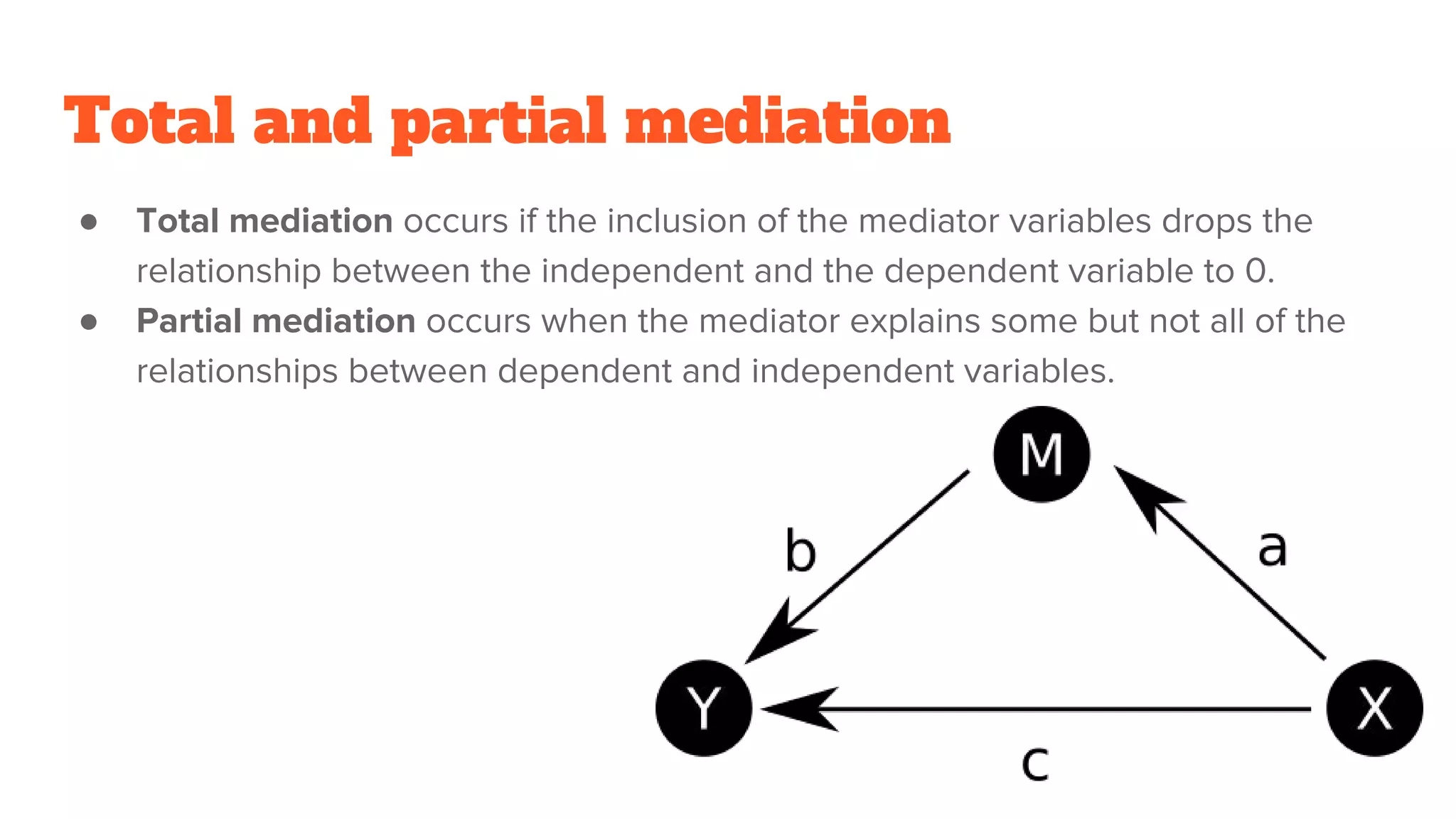
Total and partial mediation
● Total mediation occurs if the inclusion of the mediator variables drops the
relationship between the independent and the dependent variable to 0.
● Partial mediation occurs when the mediator explains some but not all of the
relationships between dependent and independent variables.
Direct, indirect and total effects
● The direct effect corresponds to coefficient c.
● The indirect effect corresponds to the change in magnitude of the effect of X
on Y after controlling for the mediator
○ Indirect effect = (c’ - c) = ab
● The total effect is the sum of the direct effect and indirect effect:
○ Total effect = c + ab
The Sobel test and bootstrapping
● The Sobel test assesses the
significance of the indirect effect
○ ab / sigma
● The normality assumption only holds
for large samples.
● The relationship (c - c’) = ab only holds
if the samples to estimate c’ and c, a
and b are identical.
● Estimation of the significance of
effects can be done by bootstrap.
How about
moderation?
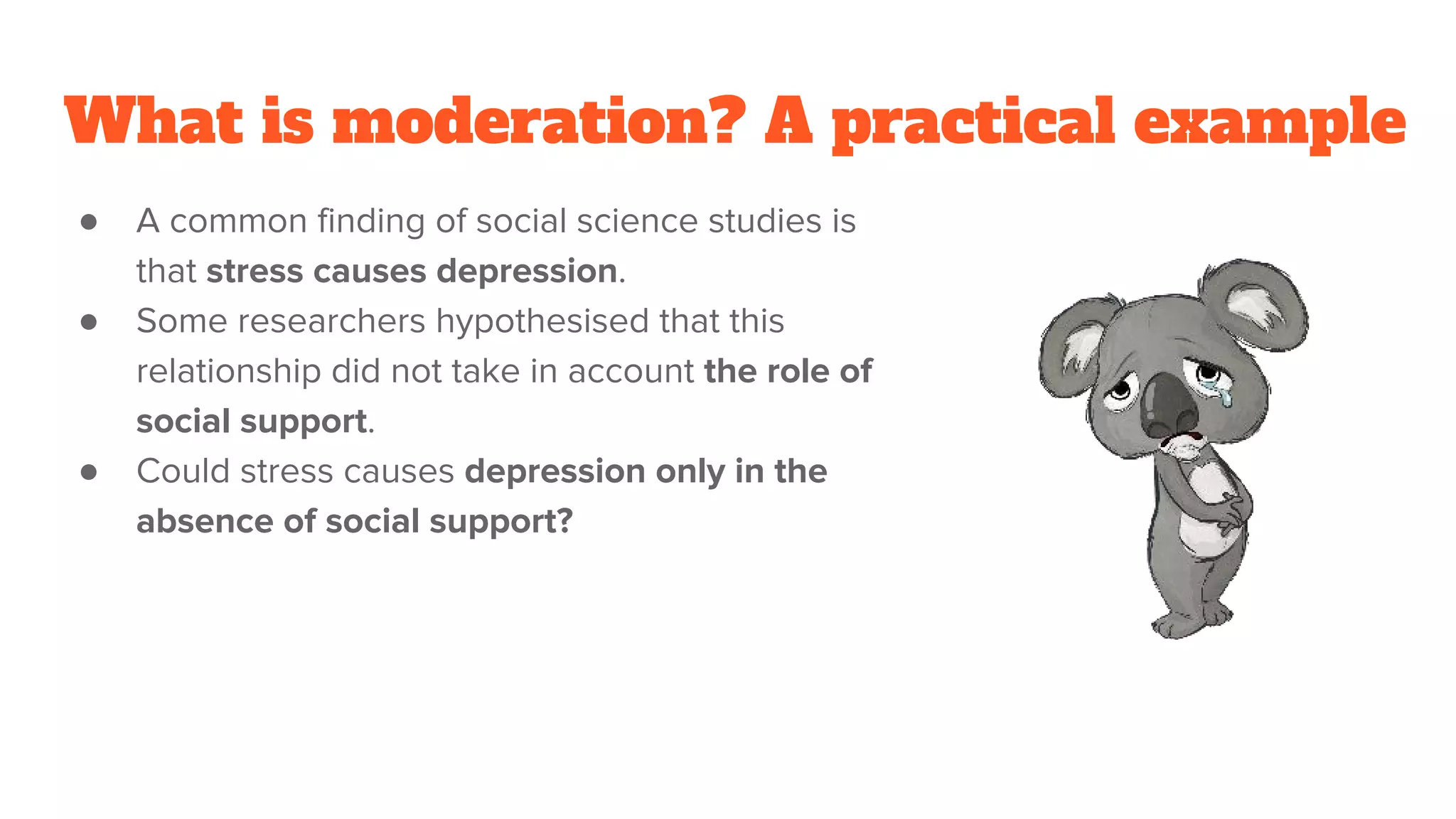
What is moderation? A practical example
● A common finding of social science studies is
that stress causes depression.
● Some researchers hypothesised that this
relationship did not take in account the role of
social support.
● Could stress causes depression only in the
absence of social support?
What is moderation? A practical example
● Step 1: A gene’s DNA is transcribed into mRNA.
● Step 2: mRNA is translated into protein.
● Could methylation of the promoter of the
gene moderate the expression of this gene?
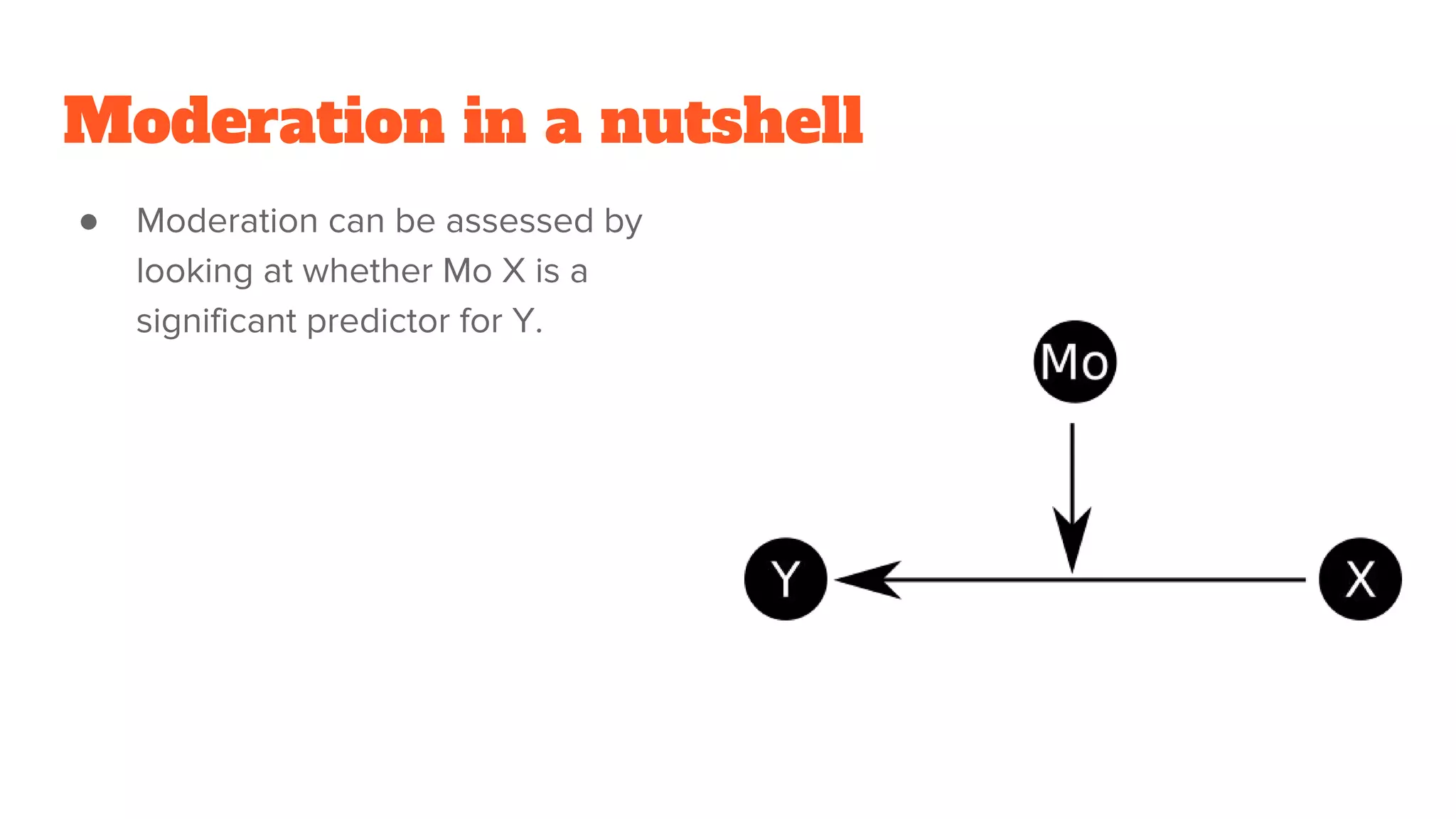
Moderation in a nutshell
● Moderation can be assessed by
looking at whether Mo X is a
significant predictor for Y.
Moderation: a practical example
● Parenting respect has a protective effect
against mental illness and delinquency.
● Could that effect be dependant on gender?
Let’s spice things up a bit…
Limitation of mediation analysis
● It is important to have strong theoretical support of the presence of
potentially mediating variables before exploring the relationship.
○ This is ultimately only a correlation analysis.
● One must be able to manipulate the proposed mediator in an acceptable and
ethical fashion.
○ Including without affecting the outcome.
● Confounding where competing variables are:
○ Alternative potential mediators
○ Unmeasured cause of the dependant variable
○ Variables with causal effects of both independent and dependent variable.
○ If your graph is wrong, you will ultimately fail at assessing any causal effect.
Counter arguments to the limitation
● Temporal precedence
○ If the independant variable precedes the dependent
variable, it supports the directionality
● Non spuriousness and /or no confounds:
○ One should identify other variables and prove they
are not confounding
The end

Mediation analysis

  • 1.
  • 2.
  • 3.
    What is mediation?A practical example. ● Previous studies have suggested that higher grades predict higher happiness. ● I hypothesize that good grades boost one’s self-esteem and then high self-esteem boosts one’s happiness. ● Self-esteem is a mediator that explains the underlying mechanism of the relationship between grades
  • 4.
    What is mediation?A practical example. ● A gene’s final produce is proteins ● A gene is transcribed into mRNA. ● Could mRNA mediate the production of Protein from a DNA sequence?
  • 5.
    What is mediation?A practical example. ● The way you were parented influences your confidence in parenting. ● How you were parented influences your confidence and self-esteem. ● Could your self-esteem and feelings of confidence influence your confidence parenting? Self-esteem would be a mediator between how you were parented and your confidence in parenting.
  • 6.
    Mediation analysis ina nutshell Baron and Kenny’s step for mediation analysis ● Step 1: Check that X is a significant predictor for Y ● Step 2: Check that X is a significant predictor for M ● Step 3: Regress X and M on Y and check that ○ M is a significant predictor of Y ○ X’s predicting power has reduced
  • 7.
    Total and partialmediation ● Total mediation occurs if the inclusion of the mediator variables drops the relationship between the independent and the dependent variable to 0. ● Partial mediation occurs when the mediator explains some but not all of the relationships between dependent and independent variables.
  • 8.
    Direct, indirect andtotal effects ● The direct effect corresponds to coefficient c. ● The indirect effect corresponds to the change in magnitude of the effect of X on Y after controlling for the mediator ○ Indirect effect = (c’ - c) = ab ● The total effect is the sum of the direct effect and indirect effect: ○ Total effect = c + ab
  • 9.
    The Sobel testand bootstrapping ● The Sobel test assesses the significance of the indirect effect ○ ab / sigma ● The normality assumption only holds for large samples. ● The relationship (c - c’) = ab only holds if the samples to estimate c’ and c, a and b are identical. ● Estimation of the significance of effects can be done by bootstrap.
  • 10.
  • 11.
    What is moderation?A practical example ● A common finding of social science studies is that stress causes depression. ● Some researchers hypothesised that this relationship did not take in account the role of social support. ● Could stress causes depression only in the absence of social support?
  • 12.
    What is moderation?A practical example ● Step 1: A gene’s DNA is transcribed into mRNA. ● Step 2: mRNA is translated into protein. ● Could methylation of the promoter of the gene moderate the expression of this gene?
  • 13.
    Moderation in anutshell ● Moderation can be assessed by looking at whether Mo X is a significant predictor for Y.
  • 14.
    Moderation: a practicalexample ● Parenting respect has a protective effect against mental illness and delinquency. ● Could that effect be dependant on gender?
  • 15.
  • 16.
    Limitation of mediationanalysis ● It is important to have strong theoretical support of the presence of potentially mediating variables before exploring the relationship. ○ This is ultimately only a correlation analysis. ● One must be able to manipulate the proposed mediator in an acceptable and ethical fashion. ○ Including without affecting the outcome. ● Confounding where competing variables are: ○ Alternative potential mediators ○ Unmeasured cause of the dependant variable ○ Variables with causal effects of both independent and dependent variable. ○ If your graph is wrong, you will ultimately fail at assessing any causal effect.
  • 17.
    Counter arguments tothe limitation ● Temporal precedence ○ If the independant variable precedes the dependent variable, it supports the directionality ● Non spuriousness and /or no confounds: ○ One should identify other variables and prove they are not confounding
  • 18.