CONFIRMATORY FACTOR
ANALYSIS (CFA)
STATISTICAL ANALYSIS
Dr. Hina Jalal
@AKsEAina; @EduTainment; hinansari23@gmail.com
In statistics, confirmatory factor analysis is a special form of factor analysis, most commonly used in social
research. It is used to test whether measures of a construct are consistent with a researcher's understanding of
the nature of that construct. Wikipedia.
Confirmatory factor analysis (CFA) is a multivariate statistical procedure that is used to test how well the
measured variables represent the number of constructs.
Assumptions
The assumptions of a CFA include multivariate normality, a sufficient sample size (n >200), the correct a priori
model specification, and data must come from a random sample.
Confirmatory factor analysis
Dr. Hina Jalal (@AKsEAina; @EduTainment; hinansari23@gmail.com)
Difference
between CFA
and EFA
Confirmatory factor analysis (CFA) and exploratory
factor analysis (EFA) are similar techniques, but in
exploratory factor analysis (EFA), data is simply
explored and provides information about the numbers
of factors required to represent the data. In
exploratory factor analysis, all measured variables are
related to every latent variable. But in confirmatory
factor analysis (CFA), researchers can specify the
number of factors required in the data and which
measured variable is related to which latent
variable. Confirmatory factor analysis (CFA) is a tool
that is used to confirm or reject the measurement
theory.
Dr. Hina Jalal (@AKsEAina; @EduTainment; hinansari23@gmail.com)
General Purpose – Procedure
Defining individual construct: First, we have to define the individual constructs. The first step involves the procedure that
defines constructs theoretically. This involves a pretest to evaluate the construct items, and a confirmatory test of the
measurement model that is conducted using confirmatory factor analysis (CFA), etc.
Developing the overall measurement model theory: In confirmatory factor analysis (CFA), we should consider the
concept of unidimensionality between construct error variance and within construct error variance. At least four
and three items per constructs should be present in the research.
Designing a study to produce the empirical results: The measurement model must be specified. Most commonly, the
value of one loading estimate should be one per construct. Two methods are available for identification; the first is rank
condition, and the second is order condition.
Assessing the measurement model validity: Assessing the measurement model validity occurs when the theoretical
measurement model is compared with the reality model to see how well the data fits. To check the measurement model
validity, the number of the indicator helps us. For example, the factor loading latent variable should be greater than
0.7. Chi-square test and other goodness of fit statistics like RMR, GFI, NFI, RMSEA, SIC, BIC, etc., are some key indicators
help in measuring the model validity.
Dr. Hina Jalal (@AKsEAina; @EduTainment; hinansari23@gmail.com)
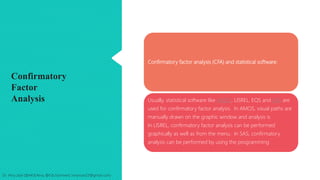
Confirmatory factor analysis (CFA) and statistical software:
Usually, statistical software like AMOS, LISREL, EQS and SAS are
used for confirmatory factor analysis. In AMOS, visual paths are
manually drawn on the graphic window and analysis is
In LISREL, confirmatory factor analysis can be performed
graphically as well as from the menu. In SAS, confirmatory
analysis can be performed by using the programming
Confirmatory
Factor
Analysis
Dr. Hina Jalal (@AKsEAina; @EduTainment; hinansari23@gmail.com)
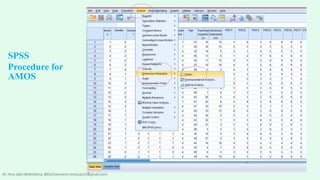
SPSS
Procedure for
AMOS
Dr. Hina Jalal (@AKsEAina; @EduTainment; hinansari23@gmail.com)
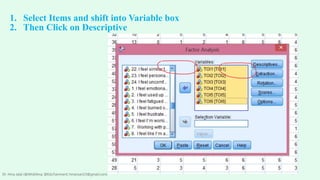
1. Select Items and shift into Variable box
2. Then Click on Descriptive
Dr. Hina Jalal (@AKsEAina; @EduTainment; hinansari23@gmail.com)
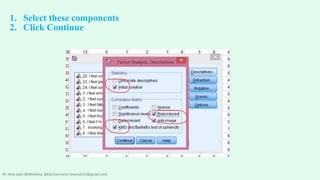
1. Select these components
2. Click Continue
Dr. Hina Jalal (@AKsEAina; @EduTainment; hinansari23@gmail.com)
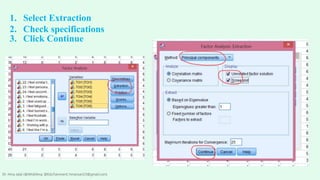
1. Select Extraction
2. Check specifications
3. Click Continue
Dr. Hina Jalal (@AKsEAina; @EduTainment; hinansari23@gmail.com)
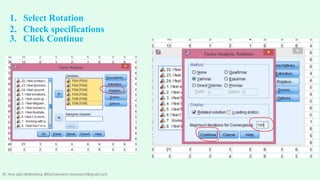
1. Select Rotation
2. Check specifications
3. Click Continue
Dr. Hina Jalal (@AKsEAina; @EduTainment; hinansari23@gmail.com)
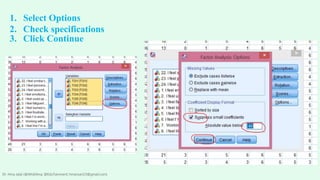
1. Select Options
2. Check specifications
3. Click Continue
Dr. Hina Jalal (@AKsEAina; @EduTainment; hinansari23@gmail.com)
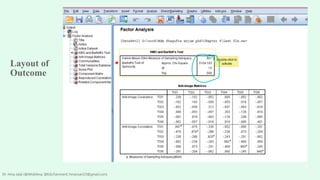
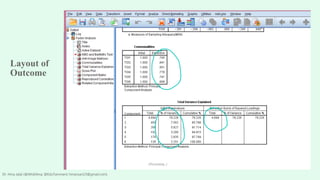
Layout of
Outcome
Dr. Hina Jalal (@AKsEAina; @EduTainment; hinansari23@gmail.com)
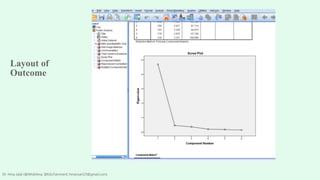
Layout of
Outcome
Dr. Hina Jalal (@AKsEAina; @EduTainment; hinansari23@gmail.com)
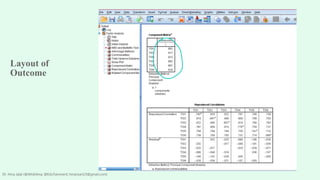
Layout of
Outcome
Dr. Hina Jalal (@AKsEAina; @EduTainment; hinansari23@gmail.com)
Layout of
Outcome
Dr. Hina Jalal (@AKsEAina; @EduTainment; hinansari23@gmail.com)

Confirmatory factor analysis (cfa)

  • 1.
    CONFIRMATORY FACTOR ANALYSIS (CFA) STATISTICALANALYSIS Dr. Hina Jalal @AKsEAina; @EduTainment; hinansari23@gmail.com
  • 2.
    In statistics, confirmatoryfactor analysis is a special form of factor analysis, most commonly used in social research. It is used to test whether measures of a construct are consistent with a researcher's understanding of the nature of that construct. Wikipedia. Confirmatory factor analysis (CFA) is a multivariate statistical procedure that is used to test how well the measured variables represent the number of constructs. Assumptions The assumptions of a CFA include multivariate normality, a sufficient sample size (n >200), the correct a priori model specification, and data must come from a random sample. Confirmatory factor analysis Dr. Hina Jalal (@AKsEAina; @EduTainment; hinansari23@gmail.com)
  • 3.
    Difference between CFA and EFA Confirmatoryfactor analysis (CFA) and exploratory factor analysis (EFA) are similar techniques, but in exploratory factor analysis (EFA), data is simply explored and provides information about the numbers of factors required to represent the data. In exploratory factor analysis, all measured variables are related to every latent variable. But in confirmatory factor analysis (CFA), researchers can specify the number of factors required in the data and which measured variable is related to which latent variable. Confirmatory factor analysis (CFA) is a tool that is used to confirm or reject the measurement theory. Dr. Hina Jalal (@AKsEAina; @EduTainment; hinansari23@gmail.com)
  • 4.
    General Purpose –Procedure Defining individual construct: First, we have to define the individual constructs. The first step involves the procedure that defines constructs theoretically. This involves a pretest to evaluate the construct items, and a confirmatory test of the measurement model that is conducted using confirmatory factor analysis (CFA), etc. Developing the overall measurement model theory: In confirmatory factor analysis (CFA), we should consider the concept of unidimensionality between construct error variance and within construct error variance. At least four and three items per constructs should be present in the research. Designing a study to produce the empirical results: The measurement model must be specified. Most commonly, the value of one loading estimate should be one per construct. Two methods are available for identification; the first is rank condition, and the second is order condition. Assessing the measurement model validity: Assessing the measurement model validity occurs when the theoretical measurement model is compared with the reality model to see how well the data fits. To check the measurement model validity, the number of the indicator helps us. For example, the factor loading latent variable should be greater than 0.7. Chi-square test and other goodness of fit statistics like RMR, GFI, NFI, RMSEA, SIC, BIC, etc., are some key indicators help in measuring the model validity. Dr. Hina Jalal (@AKsEAina; @EduTainment; hinansari23@gmail.com)
  • 5.
    Confirmatory factor analysis(CFA) and statistical software: Usually, statistical software like AMOS, LISREL, EQS and SAS are used for confirmatory factor analysis. In AMOS, visual paths are manually drawn on the graphic window and analysis is In LISREL, confirmatory factor analysis can be performed graphically as well as from the menu. In SAS, confirmatory analysis can be performed by using the programming Confirmatory Factor Analysis Dr. Hina Jalal (@AKsEAina; @EduTainment; hinansari23@gmail.com)
  • 6.
    SPSS Procedure for AMOS Dr. HinaJalal (@AKsEAina; @EduTainment; hinansari23@gmail.com)
  • 7.
    1. Select Itemsand shift into Variable box 2. Then Click on Descriptive Dr. Hina Jalal (@AKsEAina; @EduTainment; hinansari23@gmail.com)
  • 8.
    1. Select thesecomponents 2. Click Continue Dr. Hina Jalal (@AKsEAina; @EduTainment; hinansari23@gmail.com)
  • 9.
    1. Select Extraction 2.Check specifications 3. Click Continue Dr. Hina Jalal (@AKsEAina; @EduTainment; hinansari23@gmail.com)
  • 10.
    1. Select Rotation 2.Check specifications 3. Click Continue Dr. Hina Jalal (@AKsEAina; @EduTainment; hinansari23@gmail.com)
  • 11.
    1. Select Options 2.Check specifications 3. Click Continue Dr. Hina Jalal (@AKsEAina; @EduTainment; hinansari23@gmail.com)
  • 12.
    Layout of Outcome Dr. HinaJalal (@AKsEAina; @EduTainment; hinansari23@gmail.com)
  • 13.
    Layout of Outcome Dr. HinaJalal (@AKsEAina; @EduTainment; hinansari23@gmail.com)
  • 14.
    Layout of Outcome Dr. HinaJalal (@AKsEAina; @EduTainment; hinansari23@gmail.com)
  • 15.
    Layout of Outcome Dr. HinaJalal (@AKsEAina; @EduTainment; hinansari23@gmail.com)