Educational Thoughts of
J.Krishnamurthy
By
M.VIJAYALAKSHMI
Assistant Professor
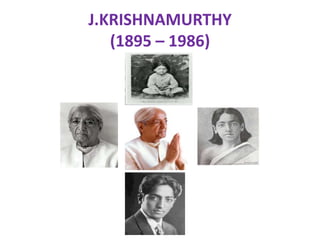
J.KRISHNAMURTHY
(1895 – 1986)
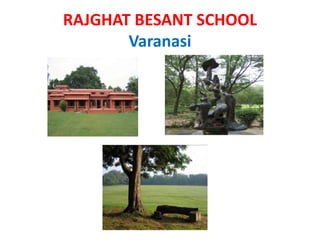
RAJGHAT BESANT SCHOOL
Varanasi
BRIEF LIFE SKETCH
• Affectionately referred to a “Krishnaji”, “J.K”,
etc
• Born in May 12th, 1895 at Madanapalle, a
small town in Andhra Pradesh as one among
the eight children of a traditional Hindu
Family
• Early age lost his mother
• At the age of 14 he joined his father – actively
involved in the functioning of Theosophical
Society at Adayar, Chennai
• Madam Annie Beasent – bring him up
• At the age of 16, he authored the book, “At the
feet of Guru”
• He knew English, Spanish, French and Italian
languages
• His scholarship was vast, his philosophy was
really deep and his thinking was original
• His lectures used to be well attended
• He made the listeners ponder over his inner self
• He wrote what he spoke, in a simple truthful
manner
• He is a great scholar, philosopher
and an original, genuine thinker
• He was a great orator and also a
writer
• The books by him were the result
and outcome of his speeches
• Unhappy with the present systems
of education
J.K.’s EDUCATIONAL PHILOSOPHY
• His essay ‘The Noisy Child and Silent Mind’
• Noisy Children become silent when they do
something
• Education should strive for inner peace and
hence bliss
• Learning – sources like nature and psychology
of human being
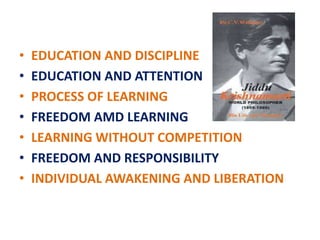
• EDUCATION AND DISCIPLINE
• EDUCATION AND ATTENTION
• PROCESS OF LEARNING
• FREEDOM AMD LEARNING
• LEARNING WITHOUT COMPETITION
• FREEDOM AND RESPONSIBILITY
• INDIVIDUAL AWAKENING AND LIBERATION
• According to J.K ,
“Freedom in learning means that
the learner has got the capacity
to independently observe
everything around him, and
examine all ideas without any
pressure or compulsion”
ESSENCE OF J.K.PHILOSOPHY
“Change should come from
you; from within you;
because you are the seed
of change”
System of Education
• Opposed any established system and also the
system of education which was narrow
• Should bring about total development of the
individual
• Towards this end should strive for inner peace
and bliss
• His ideas on education – in little profound
book titled – “Letter to School” – Vols. 1 and 2
School
• Place of learning
• To cultivate good mind, certain amount of
discipline must exist
• Try to secure an inward grasp of what is being
said
• Attention is necessary to comprehend – to be
voluntary
• learning demands application and order
• Freedom is the essence of thinking
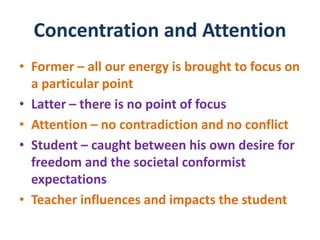
Concentration and Attention
• Former – all our energy is brought to focus on
a particular point
• Latter – there is no point of focus
• Attention – no contradiction and no conflict
• Student – caught between his own desire for
freedom and the societal conformist
expectations
• Teacher influences and impacts the student
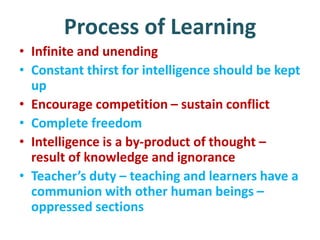
Process of Learning
• Infinite and unending
• Constant thirst for intelligence should be kept
up
• Encourage competition – sustain conflict
• Complete freedom
• Intelligence is a by-product of thought –
result of knowledge and ignorance
• Teacher’s duty – teaching and learners have a
communion with other human beings –
oppressed sections
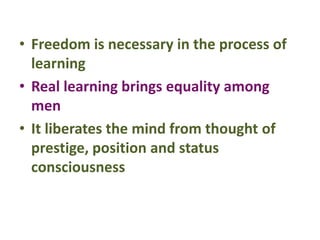
• Freedom is necessary in the process of
learning
• Real learning brings equality among
men
• It liberates the mind from thought of
prestige, position and status
consciousness
THANK YOU

J. krishnamurthy

  • 1.
  • 2.
  • 3.
  • 4.
    BRIEF LIFE SKETCH •Affectionately referred to a “Krishnaji”, “J.K”, etc • Born in May 12th, 1895 at Madanapalle, a small town in Andhra Pradesh as one among the eight children of a traditional Hindu Family • Early age lost his mother • At the age of 14 he joined his father – actively involved in the functioning of Theosophical Society at Adayar, Chennai
  • 5.
    • Madam AnnieBeasent – bring him up • At the age of 16, he authored the book, “At the feet of Guru” • He knew English, Spanish, French and Italian languages • His scholarship was vast, his philosophy was really deep and his thinking was original • His lectures used to be well attended • He made the listeners ponder over his inner self • He wrote what he spoke, in a simple truthful manner
  • 6.
    • He isa great scholar, philosopher and an original, genuine thinker • He was a great orator and also a writer • The books by him were the result and outcome of his speeches • Unhappy with the present systems of education
  • 7.
    J.K.’s EDUCATIONAL PHILOSOPHY •His essay ‘The Noisy Child and Silent Mind’ • Noisy Children become silent when they do something • Education should strive for inner peace and hence bliss • Learning – sources like nature and psychology of human being
  • 8.
    • EDUCATION ANDDISCIPLINE • EDUCATION AND ATTENTION • PROCESS OF LEARNING • FREEDOM AMD LEARNING • LEARNING WITHOUT COMPETITION • FREEDOM AND RESPONSIBILITY • INDIVIDUAL AWAKENING AND LIBERATION
  • 9.
    • According toJ.K , “Freedom in learning means that the learner has got the capacity to independently observe everything around him, and examine all ideas without any pressure or compulsion”
  • 10.
    ESSENCE OF J.K.PHILOSOPHY “Changeshould come from you; from within you; because you are the seed of change”
  • 11.
    System of Education •Opposed any established system and also the system of education which was narrow • Should bring about total development of the individual • Towards this end should strive for inner peace and bliss • His ideas on education – in little profound book titled – “Letter to School” – Vols. 1 and 2
  • 12.
    School • Place oflearning • To cultivate good mind, certain amount of discipline must exist • Try to secure an inward grasp of what is being said • Attention is necessary to comprehend – to be voluntary • learning demands application and order • Freedom is the essence of thinking
  • 13.
    Concentration and Attention •Former – all our energy is brought to focus on a particular point • Latter – there is no point of focus • Attention – no contradiction and no conflict • Student – caught between his own desire for freedom and the societal conformist expectations • Teacher influences and impacts the student
  • 14.
    Process of Learning •Infinite and unending • Constant thirst for intelligence should be kept up • Encourage competition – sustain conflict • Complete freedom • Intelligence is a by-product of thought – result of knowledge and ignorance • Teacher’s duty – teaching and learners have a communion with other human beings – oppressed sections
  • 15.
    • Freedom isnecessary in the process of learning • Real learning brings equality among men • It liberates the mind from thought of prestige, position and status consciousness
  • 16.