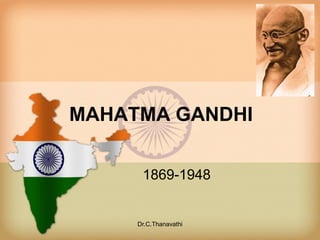
MAHATMA GANDHI
1869-1948
Dr.C.Thanavathi
• Mohandas Karamchand Gandhi was born
on 2 October 1869 in Porbandar, a coastal
town in present-day Gujarat, India. His
father, Karamchand Gandhi (1822–1885),
who belonged to the Hindu Modh
community, was the diwan (Prime
Minister) of Porbander state, a small
princely state in the Kathiawar Agency of
British India.
Dr.C.Thanavathi
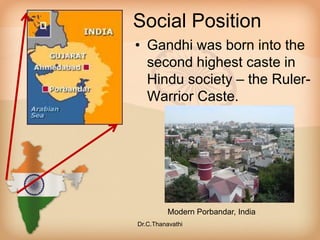
Social Position
• Gandhi was born into the
second highest caste in
Hindu society – the Ruler-
Warrior Caste.
Modern Porbandar, India
Dr.C.Thanavathi
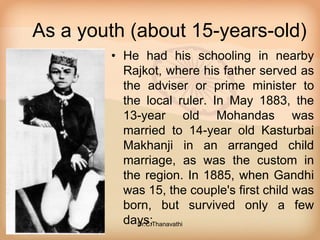
As a youth (about 15-years-old)
• He had his schooling in nearby
Rajkot, where his father served as
the adviser or prime minister to
the local ruler. In May 1883, the
13-year old Mohandas was
married to 14-year old Kasturbai
Makhanji in an arranged child
marriage, as was the custom in
the region. In 1885, when Gandhi
was 15, the couple's first child was
born, but survived only a few
days;Dr.C.Thanavathi
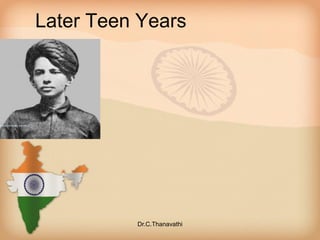
Later Teen Years
Dr.C.Thanavathi
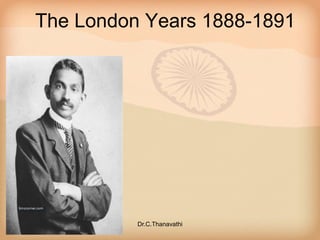
The London Years 1888-1891
Dr.C.Thanavathi
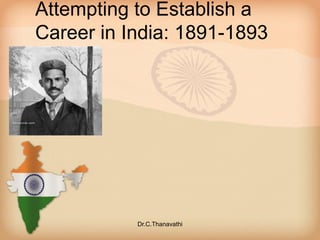
Attempting to Establish a
Career in India: 1891-1893
Dr.C.Thanavathi
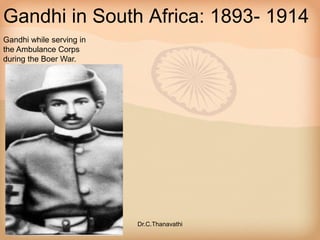
Gandhi in South Africa: 1893- 1914
Gandhi while serving in
the Ambulance Corps
during the Boer War.
Dr.C.Thanavathi
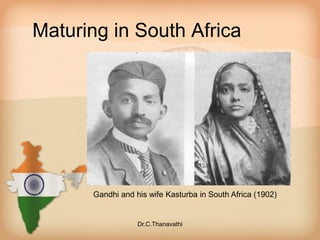
Maturing in South Africa
Gandhi and his wife Kasturba in South Africa (1902)
Dr.C.Thanavathi
The South
Africa Years
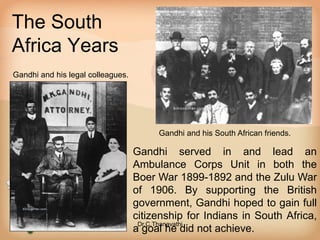
Gandhi and his legal colleagues.
Gandhi and his South African friends.
Gandhi served in and lead an
Ambulance Corps Unit in both the
Boer War 1899-1892 and the Zulu War
of 1906. By supporting the British
government, Gandhi hoped to gain full
citizenship for Indians in South Africa,
a goal he did not achieve.
Dr.C.Thanavathi
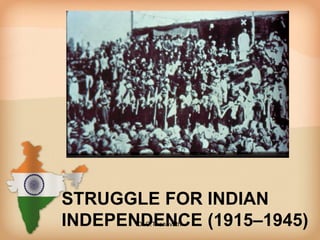
STRUGGLE FOR INDIAN
INDEPENDENCE (1915–1945)Dr.C.Thanavathi
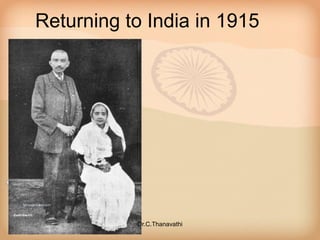
Returning to India in 1915
Dr.C.Thanavathi
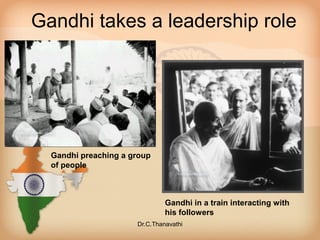
Gandhi takes a leadership role
Gandhi preaching a group
of people
Gandhi in a train interacting with
his followers
Dr.C.Thanavathi
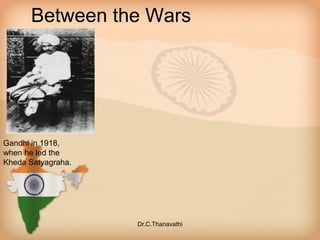
Between the Wars
Gandhi in 1918,
when he led the
Kheda Satyagraha.
Dr.C.Thanavathi
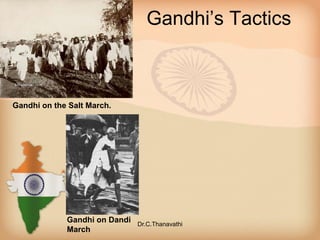
Gandhi’s Tactics
Gandhi on the Salt March.
Gandhi on Dandi
March
Dr.C.Thanavathi
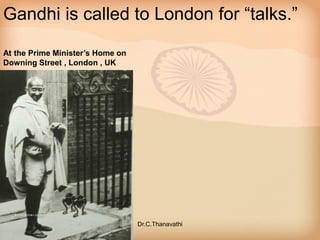
Gandhi is called to London for “talks.”
At the Prime Minister’s Home on
Downing Street , London , UK
Dr.C.Thanavathi
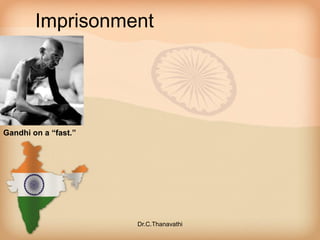
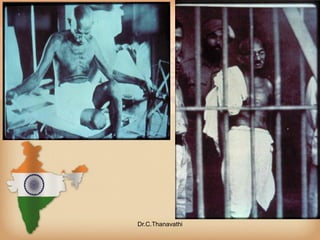
Imprisonment
Gandhi on a “fast.”
Dr.C.Thanavathi
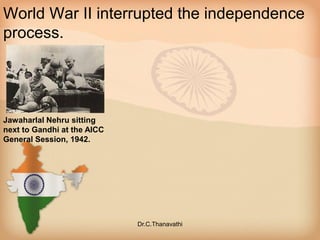
World War II interrupted the independence
process.
Jawaharlal Nehru sitting
next to Gandhi at the AICC
General Session, 1942.
Dr.C.Thanavathi
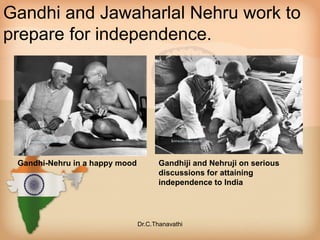
Gandhi and Jawaharlal Nehru work to
prepare for independence.
Gandhi-Nehru in a happy mood Gandhiji and Nehruji on serious
discussions for attaining
independence to India
Dr.C.Thanavathi
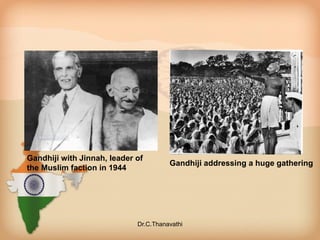
Gandhiji with Jinnah, leader of
the Muslim faction in 1944
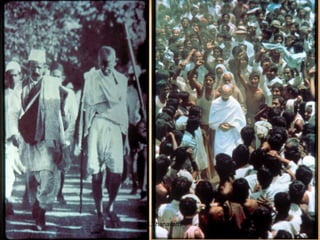
Gandhiji addressing a huge gathering
Dr.C.Thanavathi
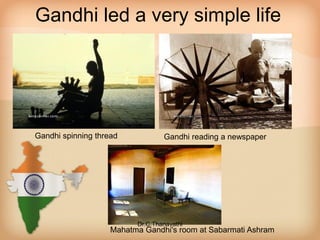
Gandhi led a very simple life
Gandhi spinning thread Gandhi reading a newspaper
Mahatma Gandhi's room at Sabarmati Ashram
Dr.C.Thanavathi
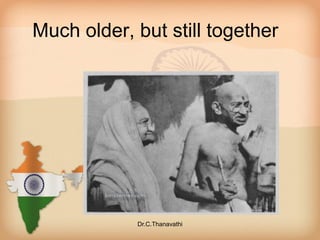
Much older, but still together
Dr.C.Thanavathi
Independence
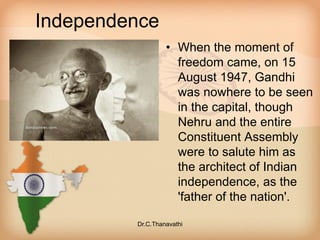
• When the moment of
freedom came, on 15
August 1947, Gandhi
was nowhere to be seen
in the capital, though
Nehru and the entire
Constituent Assembly
were to salute him as
the architect of Indian
independence, as the
'father of the nation'.
Dr.C.Thanavathi
Dr.C.Thanavathi
Dr.C.Thanavathi
Dr.C.Thanavathi
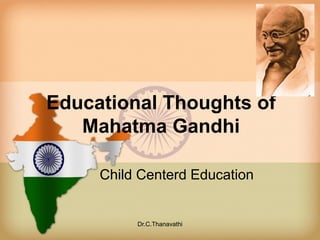
Educational Thoughts of
Mahatma Gandhi
Child Centerd Education
Dr.C.Thanavathi
Introduction
• Great Leader, a practical philosopher, and
an educational thinker
• His philosophy of education was the
outcome of his long experiences of
political, social, and economic life of the
country.
• The first Indian who advocated a scheme
of education based upon the essential
values of Indian culture and civilization.
Dr.C.Thanavathi
Meaning of Education
• Literacy is neither the beginning nor the
end of education. This is only a means
through which man or woman can be
educated.
• By education I mean an all round drawing
out of the best in child and man - body,
mind, and spirit. This is only a means
through which man and woman can be
educated.
Dr.C.Thanavathi
Meaning of Education
• EDUCATION IS DEVELOPMENT
 all round
 drawing out the best
• EDUCATION IS NOT LITERACY
 literacy is just a means of education.
 the development of head, heart, hand and health
 true education is that which draws out and
stimulates the spiritual, intellectual and physical
faculties of the children.
Dr.C.Thanavathi
AIMS OF EDUCATION
Gandhiji has divided educational aims into
two categories as under:
• Immediate aims of education.
• Ultimate aims of education.
Dr.C.Thanavathi
Immediate Aims of Gandhian
Education
1. Vocational aim
2. Cultural aim
3. Character aim
4. Perfect development aim
5. Liberation aim
6. Dignity of labour
7. Training for leadership
8. Social and individual aim
Dr.C.Thanavathi
ULTIMATE AIM OF EDUCATION
• to realize God
• self realization
• development of the moral character,
development of the whole- all were
directed towards the realization of the
ultimate reality- the merger of the finite
being into the infinite.
Dr.C.Thanavathi
Gandhi’s Views on Education
1. Objectives of education:
2. Education through craft:
3. Curriculum:
1. Basic craft – Agriculture, Spinning, Weaving etc.
2. Mother – tongue.
3. Mathematics – useful for craft and community life.
4. Social studies – social and economic life of the
community, culture the community, history of craft etc.
5. General science – nature study, zoology, physiology,
hygiene, physical culture, anatomy etc.
6. Drawing and music.
Dr.C.Thanavathi
Methods of Teaching:
• To achieve mental development, training of senses and parts of the
body should be given.
• Reading should precede the teaching of writing.
• Before teaching of alphabets, art training should be given.
• More opportunities should be given for learning by doing.
• Encouragement should be given to learning by experience.
• Correlation should be established in the teaching methods and
learning experiences.
• Mother tongue to be the medium of instruction.
• Productive craft as the basic of all education.
• Teaching through creative and productive activities.
• Learning by living, service and participation, self – experience.
• Lecture, questioning and discussion method.
• Oral instruction to personal study.
• All syllabi should be woven around vocational training.
Dr.C.Thanavathi
Role of Teacher:
• a model of behavior an image of society
• teachers to teach by example
• no corporal punishment
• well trained, proficient, man of knowledge, faith action
and devotion
• a symbol of values, well disciplined, a unique
personality, cultured and having a good mentality.
• be polite, pious, and having sea of knowledge.
• a psychologist, a philosophies, a historian, a technologist
in the matters of knowledge.
• a guide, mentor, and guru
Dr.C.Thanavathi
Concept of Discipline:
• self – control
• inner discipline
• self - discipline in life
• productive citizen, a worker and a parent
• useful and responsible citizen
Dr.C.Thanavathi
Basic Education
• scheme of education after many trials and
experiments over a period of 40 years.
• known as Basic education or Wardha scheme
of education or Nai Talim or new education or
Buniyandi Shiksha.
• it is intimately related with the basic needs and
interest of Indian children
• related to the people living the villages
• to enable a student to acquire the desired fruit
through his or her own actions.
Dr.C.Thanavathi
Features of basic education:
• The core aim of basic education is to help students to
develop self sufficiency.
• Basic education laid a strong emphasis on manual work.
• There should be free, compulsory and universal
education within the age group 7 to 14.
• It envisages providing education through the medium of
craft or productive work so that the child gains
economic self reliance for his life.
• The medium of education should be mother tongue.
• Education should develop human values in the child.
Dr.C.Thanavathi
Features of basic education:
• It is aimed to achieve the harmonious development of
the child’s body, mind heart and soul.
• In basic scheme education is imparted through some
local craft or productive work.
• The basic education is self supported through some
productive work.
• It is geared to create useful, responsible and dynamic
citizens.
• Play is an essential part of basic education.
• Subjects are taught in correlation with craft, with
environment and with other subject.
Dr.C.Thanavathi
Evaluation of Basic Education
Merits
• life centred education.
• suited to our needs, requirements, genius, and aspirations for the future.
• greater concreteness and reality to the knowledge acquired by children.
• It synthesized the individual and social aims of education.
• It was a need based education which curtailed rural unemployment.
• highly practical as it starts with action rather than reflection.
• the needs, interests and aptitude of the child. Thus it is essentially child
centred.
• nationalist in setting, idealist in nature and pragmatic on one hand while
social in purpose and spiritual in intent on the other hand.
• non theoretical and as such it enables the student to undertake independent
action.
• provides for the inculcation of an attitude of truth in children.
Dr.C.Thanavathi
Demerits
• The over emphasis on crafts and productive activity has often been
criticized as child labour.
• It neglects education in terms of personality development and
development higher mental abilities.
• resulted in enormous wastage of material as small children are not
in a position to produce anything worth – while.
• Schools would degrade as trade centres.
• It may arrest the child’s spontaneous development.
• The call for correlation becomes forced and unnatural.
• overlooked the possibilities of higher intellectual development of
children.
• To serve as a medium for education the basic craft selected must
answer the test of universality.
• Making handicraft as nucleus of teaching will amount to throwing the
country further behind in this age of science and technology.
• It is not up to the aspirations of the new generation of a digitalized
world.
Dr.C.Thanavathi
GANDHIJI’S CONTRIBUTIONS TO EDUCATION
• comprehensive and practical system of education suited
to genius of our country.
• constructive and human system integrated with needs
and ideals of national life.
• to advocate the large scale use of handicraft, not only as
a productive work but as a pivot round which the
teaching of different subjects should be undertaken.
• practical scheme of education based on the principles of
equity, social justice, non – violence, human dignity,
economic well being and cultural self respect.
• very broad - based concept of education describing it as
all round development of human personality.
• recommended immediate and ultimate aims of education
which are in accordance with the Indian socio political,
economic, cultural and social aim of education.Dr.C.Thanavathi
• practical and broad based curriculum. Integrated
curriculum which is psychologically sound.
• The method of teaching suggested by Gandhiji is highly
pragmatic and pedagogically sound.
• educational model was not only holistic and practical; it
was highly decentralized and integrated.
• revived India’s economic, social and cultural life through
the instrumentality of a handicraft.
• The basic scheme of education was a practical solution
for rural unemployment.
• Gandhiji succeeded in presenting a type of education
which can provide the necessary economic self
sufficiency and self reliance.
Dr.C.Thanavathi
GANDHI’S PUBLICATIONS ON
EDUCATION
Ø Basic education.
Ø Medium of instruction.
Ø Tasks before Indian students.
Ø To the students.
Ø Towards new education.
Ø True education Gandhi wrote extensively
on education in ‘Harijan’.
Dr.C.Thanavathi
Relevance of Gandhi’s views on
education in the modern contest
• relating school education to the needs of the
society.
• Learning while earning
• the learning of craft
• curriculum of the present day schools that work
experience and socially useful productive work
find an important place.
• proper development of the early stages of the
life.
• mother tongue
Dr.C.Thanavathi
Conclusion
How would you classify Gandhi’s
educational philosophy?
Idealistic?
Naturalistic?
Pragmatic?
Dr.C.Thanavathi
Dr.C.Thanavathi
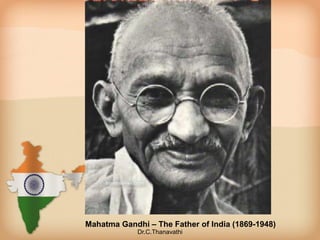
Mahatma Gandhi – The Father of India (1869-1948)
Dr.C.Thanavathi