Educational Philosophies of
Sri Aurobindo
By
M.VIJAYALAKSHMI
Assistant Professor
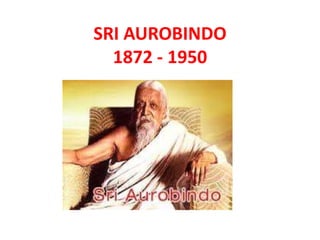
SRI AUROBINDO
1872 - 1950
BRIEF LIFE – SKETCH
• Sri Aurobindo – Born in Calcutta on 15th
August in 1872
• At the age of 7 – went to England and live
there for 14 years
• Latin, Greek, French, German, Italian and
Spanish
• Brilliant and Passed I.C.S.
• Returned to 1893 and joined Baroda College
as lecturer
• Cultural and literary activities
• Learnt Sanskrit, Marathi, Gujarathi and
Bengali
• Began Yoga in 1904
• Spiritual experiences
• In 1905 joined Political movement
• Started the journal “Bandemataram’
• Arrested in 1908, remained in a jail for a year
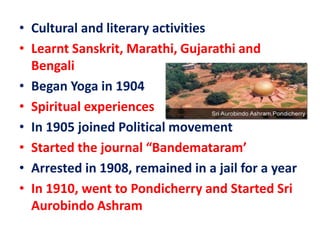
• In 1910, went to Pondicherry and Started Sri
Aurobindo Ashram
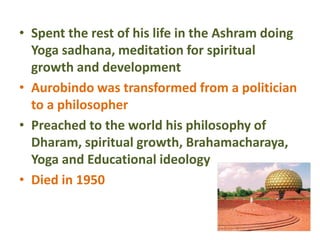
• Spent the rest of his life in the Ashram doing
Yoga sadhana, meditation for spiritual
growth and development
• Aurobindo was transformed from a politician
to a philosopher
• Preached to the world his philosophy of
Dharam, spiritual growth, Brahamacharaya,
Yoga and Educational ideology
• Died in 1950
PHILOSOPHY OF EDUCATION
• Based on spiritual penance, practice of yoga
and brahmacharya
• Main aid of a teacher is his conscience
• Conscience has four stages namely –
1. Consciousness - Citta
2. Mind - Manas
3. Intelligence - Buddhi
4. Knowledge - Supra-normal Faculties
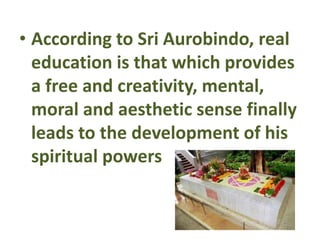
• According to Sri Aurobindo, real
education is that which provides
a free and creativity, mental,
moral and aesthetic sense finally
leads to the development of his
spiritual powers
BASIC PRINCIPLES OF
EDUCATIONAL PHILOSOPHY
• Medium of mother-tongue
• Child centred
• According to the mental aptitudes and
psychological needs of the child
• Develop to the full the latent powers of the
child
• Achieve the physical purification of child
• Develop consciousness
• Train the senses of child
• Develop the soul substance of an individual
• Brahmacharya should be the basic
foundation of education
• Subjects of education should be interesting
• Develop all the faculties of child to make him
a complete man
• There should be religious thing in education
otherwise it will spread corruption
CONCEPT OF EDUCATION
• Should be in accordance with the
needs of our real modern life
• Should create dynamic citizens –
to meet the real needs of
modern complex life
AIMS OF EDUCATION
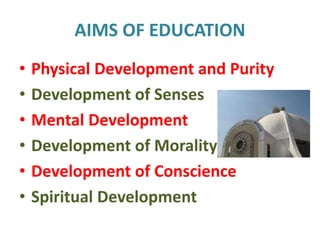
• Physical Development and Purity
• Development of Senses
• Mental Development
• Development of Morality
• Development of Conscience
• Spiritual Development
CURRICULUM
• Should be interesting
• Should include all those subjects which
promote mental and spiritual development
• Subjects of curriculum should be able to
motivate children
• Should involve creativity of life and
constructive capacities
• Should motivate children towards the
attainment of knowledge of the whole world
Subjects in the Curriculum for the
different stages of education
PRIMARY STAGE SECONDARY STAGE UNIVERSITY STAGE VOCATIONAL
EDUCATION
MOTHER-TONGUE
ENGLISH
FRENCH
LITERATURE
NATIONAL HISTORY
ART
PAINTING
GENERAL SCIENCE
SOCIAL STUDIES
ARITHMETIC
MOTHER-TONGUE
ENGLISH
FRENCH
ARITHMETIC
ART
CHEMISTRY
PHYSICS
BOTANY
PHYSIOLOGY
HEALTH EDUCATION
SOCIAL STUDIES
INDIAN AND WESTERN
PHILOSOPHY ,
HISTORY OF
CIVILIZATION ,
ENGLISH LITERATURE
FRENCH LITERATURE
SOCIOLOGY
PSYCHOLOGY
HISTORY OF SCIENCE
CHEMISTRY
PHYSICS
BOTANY,
INTERNATIONAL
RELATIONS AND
INTEGRATION.
ARTS
PAINTING
PHOTOGRAPHY
SEWING
SCULPTURAL
DRAWING,
TYPE
SHORTHAND
COTTAGE
INDUSTRIES,
CARPENTARY
MECHANICAL AND
ELECTRICAL
ENGINEERING,
NURSING
INDIAN AND
EUROPEAN MUSIC,
DRAMATIZATION
METHODS OF TEACHING
• Freedom of child
• Love and sympathy for the child
• Education through mother-tongue
• Education according to interests of the child
• Education through self-experience
• Emphasis of learning by doing
• Education through co-operation
• Education according to the Nature of child
PLACE OF CHILD
• Education should satisfy the
needs and interests of a child
and
• Develop his personality
according to these powers to
achieve full and complete
development
PLACE OF TEACHER
• Helper and guide
• His business is to suggest
• He only shows him how to perfect his
instruments of knowledge
• Helps him and encourages him in the
process
• He shows him how to acquire knowledge
that is within, where it lies and how it can
be habituated to rise to the surface
ASHRAM SCHOOL
• In Pondicherry – Mother in 1943 opened
the school for Aurobindo’s disciples
• From primary to High School and then
to Sri Aurobindo International Centre of
Education in 1952
• 3 sections – Nursery, Middle and Higher
and Advanced Centre
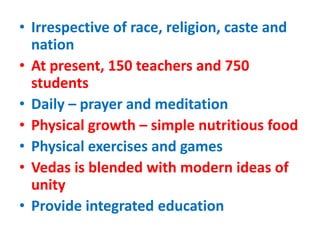
• Irrespective of race, religion, caste and
nation
• At present, 150 teachers and 750
students
• Daily – prayer and meditation
• Physical growth – simple nutritious food
• Physical exercises and games
• Vedas is blended with modern ideas of
unity
• Provide integrated education
THANK YOU

Sri aurobindo

  • 1.
    Educational Philosophies of SriAurobindo By M.VIJAYALAKSHMI Assistant Professor
  • 2.
  • 3.
    BRIEF LIFE –SKETCH • Sri Aurobindo – Born in Calcutta on 15th August in 1872 • At the age of 7 – went to England and live there for 14 years • Latin, Greek, French, German, Italian and Spanish • Brilliant and Passed I.C.S. • Returned to 1893 and joined Baroda College as lecturer
  • 4.
    • Cultural andliterary activities • Learnt Sanskrit, Marathi, Gujarathi and Bengali • Began Yoga in 1904 • Spiritual experiences • In 1905 joined Political movement • Started the journal “Bandemataram’ • Arrested in 1908, remained in a jail for a year • In 1910, went to Pondicherry and Started Sri Aurobindo Ashram
  • 5.
    • Spent therest of his life in the Ashram doing Yoga sadhana, meditation for spiritual growth and development • Aurobindo was transformed from a politician to a philosopher • Preached to the world his philosophy of Dharam, spiritual growth, Brahamacharaya, Yoga and Educational ideology • Died in 1950
  • 6.
    PHILOSOPHY OF EDUCATION •Based on spiritual penance, practice of yoga and brahmacharya • Main aid of a teacher is his conscience • Conscience has four stages namely – 1. Consciousness - Citta 2. Mind - Manas 3. Intelligence - Buddhi 4. Knowledge - Supra-normal Faculties
  • 7.
    • According toSri Aurobindo, real education is that which provides a free and creativity, mental, moral and aesthetic sense finally leads to the development of his spiritual powers
  • 8.
    BASIC PRINCIPLES OF EDUCATIONALPHILOSOPHY • Medium of mother-tongue • Child centred • According to the mental aptitudes and psychological needs of the child • Develop to the full the latent powers of the child • Achieve the physical purification of child • Develop consciousness
  • 9.
    • Train thesenses of child • Develop the soul substance of an individual • Brahmacharya should be the basic foundation of education • Subjects of education should be interesting • Develop all the faculties of child to make him a complete man • There should be religious thing in education otherwise it will spread corruption
  • 10.
    CONCEPT OF EDUCATION •Should be in accordance with the needs of our real modern life • Should create dynamic citizens – to meet the real needs of modern complex life
  • 11.
    AIMS OF EDUCATION •Physical Development and Purity • Development of Senses • Mental Development • Development of Morality • Development of Conscience • Spiritual Development
  • 12.
    CURRICULUM • Should beinteresting • Should include all those subjects which promote mental and spiritual development • Subjects of curriculum should be able to motivate children • Should involve creativity of life and constructive capacities • Should motivate children towards the attainment of knowledge of the whole world
  • 13.
    Subjects in theCurriculum for the different stages of education PRIMARY STAGE SECONDARY STAGE UNIVERSITY STAGE VOCATIONAL EDUCATION MOTHER-TONGUE ENGLISH FRENCH LITERATURE NATIONAL HISTORY ART PAINTING GENERAL SCIENCE SOCIAL STUDIES ARITHMETIC MOTHER-TONGUE ENGLISH FRENCH ARITHMETIC ART CHEMISTRY PHYSICS BOTANY PHYSIOLOGY HEALTH EDUCATION SOCIAL STUDIES INDIAN AND WESTERN PHILOSOPHY , HISTORY OF CIVILIZATION , ENGLISH LITERATURE FRENCH LITERATURE SOCIOLOGY PSYCHOLOGY HISTORY OF SCIENCE CHEMISTRY PHYSICS BOTANY, INTERNATIONAL RELATIONS AND INTEGRATION. ARTS PAINTING PHOTOGRAPHY SEWING SCULPTURAL DRAWING, TYPE SHORTHAND COTTAGE INDUSTRIES, CARPENTARY MECHANICAL AND ELECTRICAL ENGINEERING, NURSING INDIAN AND EUROPEAN MUSIC, DRAMATIZATION
  • 14.
    METHODS OF TEACHING •Freedom of child • Love and sympathy for the child • Education through mother-tongue • Education according to interests of the child • Education through self-experience • Emphasis of learning by doing • Education through co-operation • Education according to the Nature of child
  • 15.
    PLACE OF CHILD •Education should satisfy the needs and interests of a child and • Develop his personality according to these powers to achieve full and complete development
  • 16.
    PLACE OF TEACHER •Helper and guide • His business is to suggest • He only shows him how to perfect his instruments of knowledge • Helps him and encourages him in the process • He shows him how to acquire knowledge that is within, where it lies and how it can be habituated to rise to the surface
  • 17.
    ASHRAM SCHOOL • InPondicherry – Mother in 1943 opened the school for Aurobindo’s disciples • From primary to High School and then to Sri Aurobindo International Centre of Education in 1952 • 3 sections – Nursery, Middle and Higher and Advanced Centre
  • 18.
    • Irrespective ofrace, religion, caste and nation • At present, 150 teachers and 750 students • Daily – prayer and meditation • Physical growth – simple nutritious food • Physical exercises and games • Vedas is blended with modern ideas of unity • Provide integrated education
  • 19.