EXPLOSION WELDING
Er. Sushant Bhatt, Lecturer, Deptt. Of Mechanical Engg. (IDS)
Email: sushantbhatt.ids@srmu.ac.in
Er. Arvind Verma, HoD, Deptt. Of Mechanical Engg. (IDS)
Email: hod.dip.me@srmu.ac.in
Shri Ramswaroop Memorial University, Barabanki, 225003
“Explosion welding is a
solid state welding
process in which
coalescence is effected
by high-velocity
movement together of
the parts to be joined
produced by a
controlled
detonation.”
EXPLOSION WELDING
 This process does not include molten state during
welding the different parts of metal which have to
be welded.
 It is the process in which two or more dissimilar
metals are joined by accelerating one part at high
speed by the use of chemical explosions through
controlled detonations or explosion.
 This process does not require any filler material to
weld metals.
 This process is too advantageous like it does not
affect the properties of the metal and does not melt
etc.
EXPLOSION WELDING
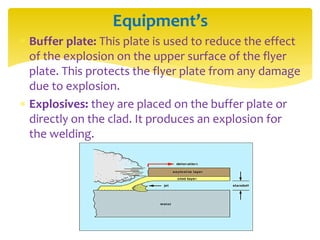
 Base plate (Backer): This plate remains stationary it
provides support and it helps in reducing or
minimizing the damage at the time of detonation.
 Flyer plate (Clad): This plate gets welded on the
base plate. It is situated at the parallel of the base
plate or at the angle at which the base plate is
inclined.
 Standoff distance: It is a very important factor
considered for EW. It is the distance between the
flyer plate and the base plate.
Equipment’s
 Buffer plate: This plate is used to reduce the effect
of the explosion on the upper surface of the flyer
plate. This protects the flyer plate from any damage
due to explosion.
 Explosives: they are placed on the buffer plate or
directly on the clad. It produces an explosion for
the welding.
Equipment’s
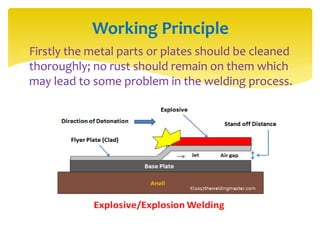
 Firstly the metal parts or plates should be cleaned
thoroughly; no rust should remain on them which
may lead to some problem in the welding process.
Working Principle
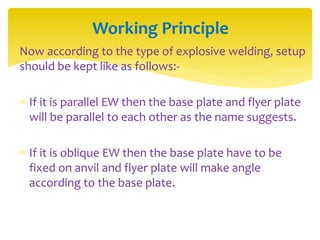
Now according to the type of explosive welding, setup
should be kept like as follows:-
 If it is parallel EW then the base plate and flyer plate
will be parallel to each other as the name suggests.
 If it is oblique EW then the base plate have to be
fixed on anvil and flyer plate will make angle
according to the base plate.
Working Principle
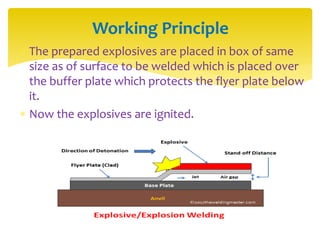
 The prepared explosives are placed in box of same
size as of surface to be welded which is placed over
the buffer plate which protects the flyer plate below
it.
 Now the explosives are ignited.
Working Principle
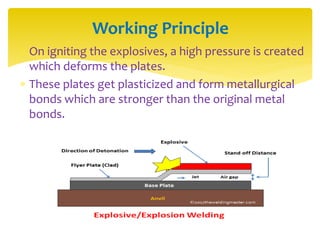
 On igniting the explosives, a high pressure is created
which deforms the plates.
 These plates get plasticized and form metallurgical
bonds which are stronger than the original metal
bonds.
Working Principle
Advantages:
 It is able to weld many dissimilar metals.
 This process is very simple; no high skills are
required to operate it.
 Extremely large surfaces can be bonded or welded.
 There is no effect on parent properties of the metal
after welding, they are unchanged.
 Very small quantity of explosives is used in
explosive welding process.
 In this process no molten state of metal is included;
metal is only plasticized to join other part.
Advantages and Disadvantages
Disadvantages:
 It can weld only ductile metal with high
toughness.
 The geometries welded are limited to simple
designs– flat, cylindrical, conical.
 Higher safety precautions involved due to
explosives used.
 The use of explosives in industrial areas will
be restricted by the noise and ground
vibrations caused by the explosion.
Advantages and Disadvantages
 It is used to weld large structure sheets of aluminium
to stainless steel.
 It is used to weld cylindrical component like pipe,
concentric cylinder, tube etc.
 Join dissimilar metals which cannot be welded by
other welding process.
 For joining cooling fan etc.
 Joining of pipes and tubes.
 Joining of dissimilar metals can be done for eg –
Aluminium to steel, Cu to stainless steel, Titanium
alloys to Cr – Ni steel, Tungsten to Steel, etc.
APPLICATIONS
 A Textbook of Welding Technology by O.P. Khanna.
 Welding Science and Technology by Md. Ibrahim
Khan.
 https://www.theweldingmaster.com
 https://www.mech4study.com
 https://www.safetyandhealthmagazine.com
 https://images.app.goo.gl/TRh3g2CpTqKt4P7YA
References
THANK
YOU

Iwt unit 5 explosive welding sushant bhatt

  • 1.
    EXPLOSION WELDING Er. SushantBhatt, Lecturer, Deptt. Of Mechanical Engg. (IDS) Email: sushantbhatt.ids@srmu.ac.in Er. Arvind Verma, HoD, Deptt. Of Mechanical Engg. (IDS) Email: hod.dip.me@srmu.ac.in Shri Ramswaroop Memorial University, Barabanki, 225003
  • 2.
    “Explosion welding isa solid state welding process in which coalescence is effected by high-velocity movement together of the parts to be joined produced by a controlled detonation.” EXPLOSION WELDING
  • 3.
     This processdoes not include molten state during welding the different parts of metal which have to be welded.  It is the process in which two or more dissimilar metals are joined by accelerating one part at high speed by the use of chemical explosions through controlled detonations or explosion.  This process does not require any filler material to weld metals.  This process is too advantageous like it does not affect the properties of the metal and does not melt etc. EXPLOSION WELDING
  • 4.
     Base plate(Backer): This plate remains stationary it provides support and it helps in reducing or minimizing the damage at the time of detonation.  Flyer plate (Clad): This plate gets welded on the base plate. It is situated at the parallel of the base plate or at the angle at which the base plate is inclined.  Standoff distance: It is a very important factor considered for EW. It is the distance between the flyer plate and the base plate. Equipment’s
  • 5.
     Buffer plate:This plate is used to reduce the effect of the explosion on the upper surface of the flyer plate. This protects the flyer plate from any damage due to explosion.  Explosives: they are placed on the buffer plate or directly on the clad. It produces an explosion for the welding. Equipment’s
  • 6.
     Firstly themetal parts or plates should be cleaned thoroughly; no rust should remain on them which may lead to some problem in the welding process. Working Principle
  • 7.
    Now according tothe type of explosive welding, setup should be kept like as follows:-  If it is parallel EW then the base plate and flyer plate will be parallel to each other as the name suggests.  If it is oblique EW then the base plate have to be fixed on anvil and flyer plate will make angle according to the base plate. Working Principle
  • 8.
     The preparedexplosives are placed in box of same size as of surface to be welded which is placed over the buffer plate which protects the flyer plate below it.  Now the explosives are ignited. Working Principle
  • 9.
     On ignitingthe explosives, a high pressure is created which deforms the plates.  These plates get plasticized and form metallurgical bonds which are stronger than the original metal bonds. Working Principle
  • 10.
    Advantages:  It isable to weld many dissimilar metals.  This process is very simple; no high skills are required to operate it.  Extremely large surfaces can be bonded or welded.  There is no effect on parent properties of the metal after welding, they are unchanged.  Very small quantity of explosives is used in explosive welding process.  In this process no molten state of metal is included; metal is only plasticized to join other part. Advantages and Disadvantages
  • 11.
    Disadvantages:  It canweld only ductile metal with high toughness.  The geometries welded are limited to simple designs– flat, cylindrical, conical.  Higher safety precautions involved due to explosives used.  The use of explosives in industrial areas will be restricted by the noise and ground vibrations caused by the explosion. Advantages and Disadvantages
  • 12.
     It isused to weld large structure sheets of aluminium to stainless steel.  It is used to weld cylindrical component like pipe, concentric cylinder, tube etc.  Join dissimilar metals which cannot be welded by other welding process.  For joining cooling fan etc.  Joining of pipes and tubes.  Joining of dissimilar metals can be done for eg – Aluminium to steel, Cu to stainless steel, Titanium alloys to Cr – Ni steel, Tungsten to Steel, etc. APPLICATIONS
  • 13.
     A Textbookof Welding Technology by O.P. Khanna.  Welding Science and Technology by Md. Ibrahim Khan.  https://www.theweldingmaster.com  https://www.mech4study.com  https://www.safetyandhealthmagazine.com  https://images.app.goo.gl/TRh3g2CpTqKt4P7YA References
  • 14.