Frictional Welding
Group 13
• 150131A
• 150089B
• 150466E
• 150473X
• 150358B
What is frictional welding
 Solid state welding process
 Use relative motion and high force to create frictional heat
at the weld face up to the points were plasticized
 After that intermixing at the welding face and end up with
joint
 Actually it is not a welding process, a forging process.
 Processes are categorized by the types of relative motion
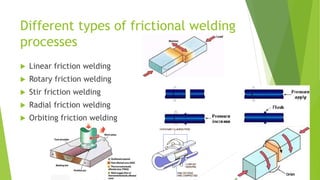
Different types of frictional welding
processes
 Linear friction welding
 Rotary friction welding
 Stir friction welding
 Radial friction welding
 Orbiting friction welding
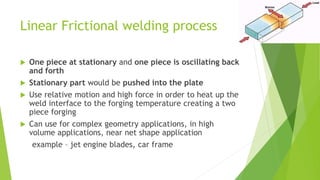
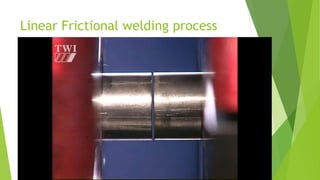
Linear Frictional welding process
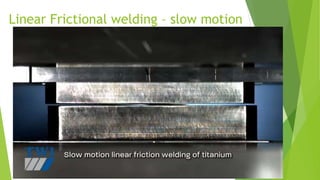
 One piece at stationary and one piece is oscillating back
and forth
 Stationary part would be pushed into the plate
 Use relative motion and high force in order to heat up the
weld interface to the forging temperature creating a two
piece forging
 Can use for complex geometry applications, in high
volume applications, near net shape application
example – jet engine blades, car frame
Linear Frictional welding process
Linear Frictional welding – slow motion
Rotary friction
welding process
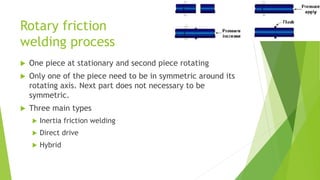
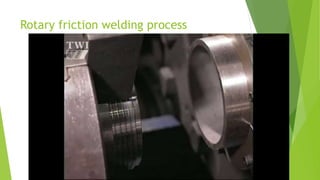
 One piece at stationary and second piece rotating
 Only one of the piece need to be in symmetric around its
rotating axis. Next part does not necessary to be
symmetric.
 Three main types
 Inertia friction welding
 Direct drive
 Hybrid
Rotary friction welding process
Stir frictional welding process
 Both work pieces are stationary
 Work pieces could be metal or extrusion
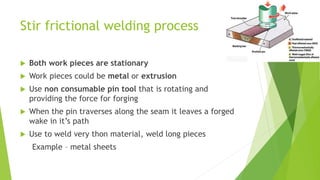
 Use non consumable pin tool that is rotating and
providing the force for forging
 When the pin traverses along the seam it leaves a forged
wake in it’s path
 Use to weld very thon material, weld long pieces
Example – metal sheets
Stir frictional welding process
Radial frictional welding process
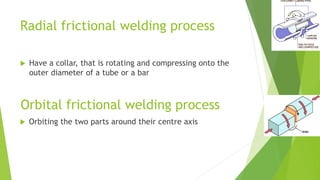
 Have a collar, that is rotating and compressing onto the
outer diameter of a tube or a bar
Orbital frictional welding process
 Orbiting the two parts around their centre axis
Advantages
 Simplicity of operation
 Less time required
 Low surface impurities and oxide films
 Compare to resistance butt welding produce improved welds
 Narrower heat affected zone. Heat affected area is small
compared to the flash welding
 Strong weld for all geometries
 Can joint dissimilar materials
Disadvantages
 Process is restricted to flat and angular welds
 Use joining for small parts
 In case of tube welding process, get complicated
 In high carbon steel, it is difficult to remove flash
 Require heavy rigid machine due to high thrust pressure
Applications
 Automobile – Bimetallic engine valves, universal joint yoke
 Aerospace – turbine blade joining, seamless joining
 Consumer – hand tool
 Medical – stainless steel
 Marine - turbines
 Mining and drilling – twist drills
 Hydraulic equipment
References
 http://www.twi-global.com/technical-
knowledge/published-papers/friction-and-forge-welding-
processes-for-the-automotive-industry-september-1999/
 http://www.mtiwelding.com
Any
Questions?

Frictional welding

  • 1.
    Frictional Welding Group 13 •150131A • 150089B • 150466E • 150473X • 150358B
  • 2.
    What is frictionalwelding  Solid state welding process  Use relative motion and high force to create frictional heat at the weld face up to the points were plasticized  After that intermixing at the welding face and end up with joint  Actually it is not a welding process, a forging process.  Processes are categorized by the types of relative motion
  • 3.
    Different types offrictional welding processes  Linear friction welding  Rotary friction welding  Stir friction welding  Radial friction welding  Orbiting friction welding
  • 4.
    Linear Frictional weldingprocess  One piece at stationary and one piece is oscillating back and forth  Stationary part would be pushed into the plate  Use relative motion and high force in order to heat up the weld interface to the forging temperature creating a two piece forging  Can use for complex geometry applications, in high volume applications, near net shape application example – jet engine blades, car frame
  • 5.
  • 6.
  • 7.
    Rotary friction welding process One piece at stationary and second piece rotating  Only one of the piece need to be in symmetric around its rotating axis. Next part does not necessary to be symmetric.  Three main types  Inertia friction welding  Direct drive  Hybrid
  • 8.
  • 9.
    Stir frictional weldingprocess  Both work pieces are stationary  Work pieces could be metal or extrusion  Use non consumable pin tool that is rotating and providing the force for forging  When the pin traverses along the seam it leaves a forged wake in it’s path  Use to weld very thon material, weld long pieces Example – metal sheets
  • 10.
  • 11.
    Radial frictional weldingprocess  Have a collar, that is rotating and compressing onto the outer diameter of a tube or a bar Orbital frictional welding process  Orbiting the two parts around their centre axis
  • 12.
    Advantages  Simplicity ofoperation  Less time required  Low surface impurities and oxide films  Compare to resistance butt welding produce improved welds  Narrower heat affected zone. Heat affected area is small compared to the flash welding  Strong weld for all geometries  Can joint dissimilar materials
  • 13.
    Disadvantages  Process isrestricted to flat and angular welds  Use joining for small parts  In case of tube welding process, get complicated  In high carbon steel, it is difficult to remove flash  Require heavy rigid machine due to high thrust pressure
  • 14.
    Applications  Automobile –Bimetallic engine valves, universal joint yoke  Aerospace – turbine blade joining, seamless joining  Consumer – hand tool  Medical – stainless steel  Marine - turbines  Mining and drilling – twist drills  Hydraulic equipment
  • 15.
  • 16.

Editor's Notes

  • #3 Forging – is the application of thermal and mechanical energy to steel billets or ingots to cause the material to change shape while in a solid state. - make or shape a metal by heating it in a fire or furnace and hammering it Welding – joining together metal parts by heating the surface to the point of melting, and uniting them by pressing, hammering Solid state welding – welding process which produces coalescence (combine together) at temperature essentially below the melting point of the base material being joined, without addition of brazing filler metal. Solid state welding examples – Friction, Ultrasonic, Diffusion, Explosive
  • #4 Most common in use – Linear, Rotational, Stir welding processes Less common in use – Radial, orbiting Types are selected by considering geometry and material Basic geometry 1. bar to bar – inertia friction or hybrid friction – come under rotary 2. tube to tube – can use any method, large diameter use inertia or hybrid 3. tube to bar – inertia, hybrid, direct drive for small parts 4. bar to plate – direct drive, inertia, hybrid 5. tube to plate - interia
  • #5 2nd point additional - because of pushing into the plate will create enough heat at the weld interface to forge the two parts together In car frame application – allow to reduce the mass that goes into the frame
  • #8 When bar is significantly large, the amount of torque is increased, will cause electric motor to stall-- larger flywheel needed to overcome that torque peek Spindle bearings don’t like to be able to take force while rotating. That problems cause to birth the inertia friction welding Applications are varies with geometry, types of materials, One part should penetrate another one in order to get a successful weld Weld sheet and tube use inertia friction welding Weld two bars use direct drive welding – use electric motor to continuous energy applying methods, because the centre of the shafts have no relative motion Hybrid welding use both inertia and direct drive – have constant energy side of the direct drive process, using electric motor adding energy at the beginning, end with the flywheels and a fixed storage energy
  • #9 Continuous drive friction welding
  • #10 That pin is penetrate into the material should little shorter than the depth of material and as this is rotating it Can weld top and bottom in the case of this hollow extrusion Weld hollow extrusions in friction welding without using fusion welding. If use fusion welding, get melting, that means re-solidification, which is going to weaken the parent material. To get same strength fusion welding need more welding materials at the welding section. So adds mass. Stir welding can get same strength without adding more materials.
  • #13 Resistance butt welding is used to join components of similar cross section by making a weld across the entire section in a single operation. Heat is produced in the weld region by resistance to the passage of the welding current through the parts, which are held under a present end force. As the material heats, the force forges the soft material to consolidate and complete the joint. Flash welding is a type of resistance welding that does not use any filler metals