Explosive Welding
Introduction
Principle of Explosion Welding
 Salient Features of Explosion Welding
 Explosives Materials
 Advantages & Disadvantages
 Applications
Contents
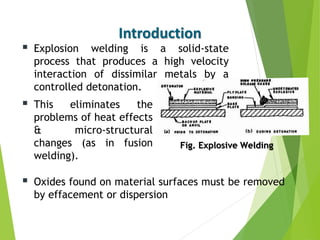
 Explosion welding is a solid-state
process that produces a high velocity
interaction of dissimilar metals by a
controlled detonation.
Introduction
 This eliminates the
problems of heat effects
& micro-structural
changes (as in fusion
welding).
 Oxides found on material surfaces must be removed
by effacement or dispersion
Fig. Explosive Welding
Principle of Explosion
 Cladder metal can be placed parallel or inclined
to the base plate.
 Explosive material is distributed over top of
cladder metal.
 Upon detonation, cladder plate collides with
base plate to form weld.
 Waves are generated so due to mechanical
bonding joining takes place.
 A single detonation cap can be used to ignite
the explosive.
Placement of Cladder metal-parallel
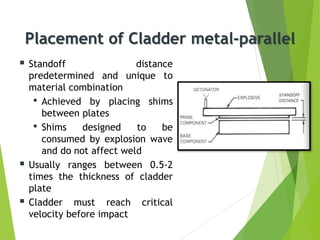
 Standoff distance
predetermined and unique to
material combination
• Achieved by placing shims
between plates
• Shims designed to be
consumed by explosion wave
and do not affect weld
 Usually ranges between 0.5-2
times the thickness of cladder
plate
 Cladder must reach critical
velocity before impact
Salient Features
 The high velocities are promoted by carefully
detonated explosives.
 The process can be done in vacuum to reduce
sound & blast.
 Typical impact pressure are millions of psi.
 Well suited to metals that are prone to brittle
joints when heat welded such as,
• Al on steel
• Ti on steel
 Typical explosive forms
• Plastic flexible sheer
• Cord
• Pressed shapes
• Cast shapes
• Powder/granular
 Detonation velocity is a function of
• Explosive type
• Composition of explosive
• Thickness of explosive layer
Assuring a Good weld
 Three types of Detonation wave welds:
• Shock wave develops if sonic velocity is greater
than 120% of material sonic velocity (type 1)
• Detached shock wave results when detonation
velocity is between 100% and 120% of material
sonic velocity (type 2)
• No shock wave is produced if detonation velocity
is less than material sonic velocity (type 3)
Explosive material
 High velocity (4572-7620 m/s)
• Trinitrotoluene (TNT)
• Cyclotrimethylenetrinitramine (RDX)
• Pentaerythritol Tetranitrate (PETN)
• Datasheet
• Primacord
 Mid-low velocity (1524-4572 m/s)
• Ammonium nitrate
• Ammonium perchlorate
• Amatol
• Nitroguonidine
• Dynamites
• Diluted PETN
Advantages of Explosion Welding
• Very large work pieces can be welded.
• (Al + Steel) materials can be welded.
• Can bond many dissimilar, normally unweldable
metals.
• Material melting temperatures and coefficients of
thermal expansion differences do not affect the final
product.
• Process is compact, portable, and easy to maintain.
• Welding can be achieved quickly over large areas.
• No need for surface penetration.
• Backer plate has no size limits.
• Inexpensive.
• The strength of the weld joint is equal to or greater
than the strength of the weaker of two metals joined.
• No heat-affected zone (HAZ).
Disadvantages of Explosion Welding
• Metals must have high enough impact resistance and
ductility
• The geometries welded must be simple-flat,
cylindrical, conical
• The cladding plate can’t be too large
• Noise & blast can require worker protection, vacuum
chambers, buried in sand/water.
Applications
• Cladding of base metals with thinner alloys e.g.
cladding of Ti with mild steel.
• Seam and lap welds.
• Reinforcing aerospace materials with dissimilar metal
ribs.
• Heat exchangers.
• Tubular transition joints.
• Used as a repair tool for repairing leaking tube-to-
tube sheet joints.
• Spot welding.
• Flat plates.
• Joining of pipes in socket joints.
Common industries that use Explosion Welding
• Petroleum Refining
• Chemical Processing
• Hydrometallurgy
• Aluminum Smelting
• Shipbuilding
• Electrochemical
• Oil & Gas
• Power Generation
• Cryogenic Processing
• Pulp & Paper
• Air conditioning &
Chillers
• Metal Production
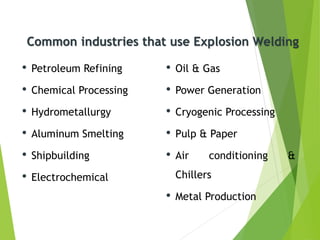
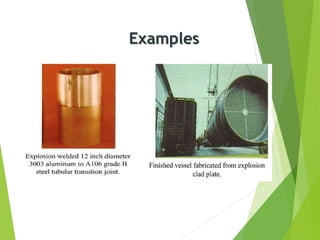
Examples
Examples
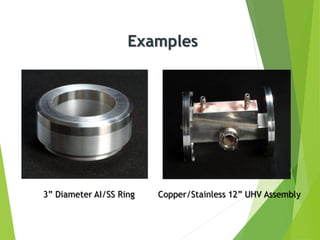
3” Diameter AI/SS Ring Copper/Stainless 12” UHV Assembly
Explosionwelding

Explosionwelding

  • 1.
  • 2.
    Introduction Principle of ExplosionWelding  Salient Features of Explosion Welding  Explosives Materials  Advantages & Disadvantages  Applications Contents
  • 3.
     Explosion weldingis a solid-state process that produces a high velocity interaction of dissimilar metals by a controlled detonation. Introduction  This eliminates the problems of heat effects & micro-structural changes (as in fusion welding).  Oxides found on material surfaces must be removed by effacement or dispersion Fig. Explosive Welding
  • 4.
    Principle of Explosion Cladder metal can be placed parallel or inclined to the base plate.  Explosive material is distributed over top of cladder metal.  Upon detonation, cladder plate collides with base plate to form weld.  Waves are generated so due to mechanical bonding joining takes place.  A single detonation cap can be used to ignite the explosive.
  • 5.
    Placement of Claddermetal-parallel  Standoff distance predetermined and unique to material combination • Achieved by placing shims between plates • Shims designed to be consumed by explosion wave and do not affect weld  Usually ranges between 0.5-2 times the thickness of cladder plate  Cladder must reach critical velocity before impact
  • 6.
    Salient Features  Thehigh velocities are promoted by carefully detonated explosives.  The process can be done in vacuum to reduce sound & blast.  Typical impact pressure are millions of psi.  Well suited to metals that are prone to brittle joints when heat welded such as, • Al on steel • Ti on steel
  • 7.
     Typical explosiveforms • Plastic flexible sheer • Cord • Pressed shapes • Cast shapes • Powder/granular  Detonation velocity is a function of • Explosive type • Composition of explosive • Thickness of explosive layer
  • 8.
    Assuring a Goodweld  Three types of Detonation wave welds: • Shock wave develops if sonic velocity is greater than 120% of material sonic velocity (type 1) • Detached shock wave results when detonation velocity is between 100% and 120% of material sonic velocity (type 2) • No shock wave is produced if detonation velocity is less than material sonic velocity (type 3)
  • 9.
    Explosive material  Highvelocity (4572-7620 m/s) • Trinitrotoluene (TNT) • Cyclotrimethylenetrinitramine (RDX) • Pentaerythritol Tetranitrate (PETN) • Datasheet • Primacord  Mid-low velocity (1524-4572 m/s) • Ammonium nitrate • Ammonium perchlorate • Amatol • Nitroguonidine • Dynamites • Diluted PETN
  • 10.
    Advantages of ExplosionWelding • Very large work pieces can be welded. • (Al + Steel) materials can be welded. • Can bond many dissimilar, normally unweldable metals. • Material melting temperatures and coefficients of thermal expansion differences do not affect the final product. • Process is compact, portable, and easy to maintain.
  • 11.
    • Welding canbe achieved quickly over large areas. • No need for surface penetration. • Backer plate has no size limits. • Inexpensive. • The strength of the weld joint is equal to or greater than the strength of the weaker of two metals joined. • No heat-affected zone (HAZ).
  • 12.
    Disadvantages of ExplosionWelding • Metals must have high enough impact resistance and ductility • The geometries welded must be simple-flat, cylindrical, conical • The cladding plate can’t be too large • Noise & blast can require worker protection, vacuum chambers, buried in sand/water.
  • 13.
    Applications • Cladding ofbase metals with thinner alloys e.g. cladding of Ti with mild steel. • Seam and lap welds. • Reinforcing aerospace materials with dissimilar metal ribs. • Heat exchangers. • Tubular transition joints. • Used as a repair tool for repairing leaking tube-to- tube sheet joints. • Spot welding. • Flat plates. • Joining of pipes in socket joints.
  • 14.
    Common industries thatuse Explosion Welding • Petroleum Refining • Chemical Processing • Hydrometallurgy • Aluminum Smelting • Shipbuilding • Electrochemical • Oil & Gas • Power Generation • Cryogenic Processing • Pulp & Paper • Air conditioning & Chillers • Metal Production
  • 15.
  • 16.
    Examples 3” Diameter AI/SSRing Copper/Stainless 12” UHV Assembly