





HOT ISOSTATIC
PRESSING
CONTENTS
▪ INTRODUCTION
▪ NEED
▪ PROCESS
▪ EQUIPMENTS
▪ ADVANTAGES AND LIMITATION
▪ REFERENCE
INTRODUCTION
▪ Hot isostatic pressing (HIP) is a powder metallurgy technique
▪ HIP is used to reduce the porosity of metals and increase the density ofmany
ceramic materials
▪ This improves the material's mechanical properties and workability
▪ Process uses the combination of high temperatures and high pressures todensify
engineering ceramics and hard metals
▪ Pressures of up to 207 MPa (30,000 psi) may be used with the temperatureof
operation being as high as 2000°C (3,632°F)
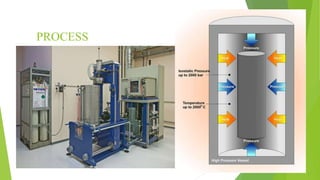
▪ Typically, an inert gas (Argon or Nitrogen) is used within the pressure vesselto
ensure that pressure is applied uniformly from all sides (IsostaticPressure)
NEED FOR HIP
Influence of porosity (density) on impact strength
and tensile strength of P/M materials.
The effect of porosity on fatique strength
NEED FOR HIP
▪ Permissible porosity depends on application field
▪ Higher loads call for higher density
▪ Conventional P/M technology (press- and -sinter technology) in most cases
doesn`t enable to achieve full density.
▪ Hot consolidation processes (hot pressing, HIP, extrusion etc) enable to produce full-
density or near full-density or near full-density powdermaterials/products
▪ The primary use of HIP is to increase the density of the material and increasethe
strength and reliability of the components
HIP
▪ In hot isostatic pressing (HIP), the container is made of a high-melting-point sheet
metal and the pressurizing medium is a high-temperature inertgas
▪ Originally Helium and now Argon is used as pressurizingmedium
▪ Total pressure = pressure due to heating + applied pressure(dependent onload)
▪ Pressure vessel requires high fatigue and creep resistance.
▪ Should be immune to heating, dwell and cooling periods, coolant/failure of cooling
system.
PROCESS
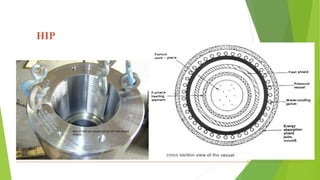
HIP
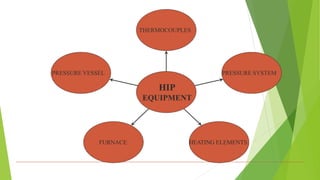
THERMOCOUPLES
PRESSURE SYSTEM
HEATING ELEMENTSFURNACE
PRESSURE VESSEL
HIP
EQUIPMENT
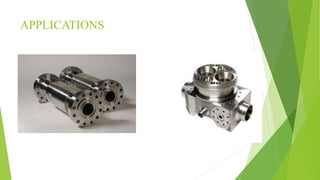
APPLICATIONS
▪ Silicon Nitride Ball Bearings
▪ BodyArmour
▪ Zirconia and Alumina Dentalimplants
▪ Multi-Layer Capacitors
▪ Downhole Oilfield Components
▪ Sputtering Targets
APPLICATIONS
ADVANTAGES
▪ Materials/products of higher performance
▪ The HIP is near-net shape process
▪ Lower unit costs of large parts and production volumes of small-weightparts
▪ Produces fully dense compacts of uniform grain structure anddensity
▪ Decreased scatter and recovery of defectiveparts.
▪ Improved ductility and impact strength.
▪ Fine grains
LIMITATIONS
▪ Materials/products of higher performance
▪ The HIP is near-net shape process
▪ Lower unit costs of large parts and production volumes of small-weightparts
▪ Produces fully dense compacts of uniform grain structure anddensity

Hot isostatic pressing

  • 1.
  • 2.
    CONTENTS ▪ INTRODUCTION ▪ NEED ▪PROCESS ▪ EQUIPMENTS ▪ ADVANTAGES AND LIMITATION ▪ REFERENCE
  • 3.
    INTRODUCTION ▪ Hot isostaticpressing (HIP) is a powder metallurgy technique ▪ HIP is used to reduce the porosity of metals and increase the density ofmany ceramic materials ▪ This improves the material's mechanical properties and workability ▪ Process uses the combination of high temperatures and high pressures todensify engineering ceramics and hard metals ▪ Pressures of up to 207 MPa (30,000 psi) may be used with the temperatureof operation being as high as 2000°C (3,632°F) ▪ Typically, an inert gas (Argon or Nitrogen) is used within the pressure vesselto ensure that pressure is applied uniformly from all sides (IsostaticPressure)
  • 4.
    NEED FOR HIP Influenceof porosity (density) on impact strength and tensile strength of P/M materials. The effect of porosity on fatique strength
  • 5.
    NEED FOR HIP ▪Permissible porosity depends on application field ▪ Higher loads call for higher density ▪ Conventional P/M technology (press- and -sinter technology) in most cases doesn`t enable to achieve full density. ▪ Hot consolidation processes (hot pressing, HIP, extrusion etc) enable to produce full- density or near full-density or near full-density powdermaterials/products ▪ The primary use of HIP is to increase the density of the material and increasethe strength and reliability of the components
  • 6.
    HIP ▪ In hotisostatic pressing (HIP), the container is made of a high-melting-point sheet metal and the pressurizing medium is a high-temperature inertgas ▪ Originally Helium and now Argon is used as pressurizingmedium ▪ Total pressure = pressure due to heating + applied pressure(dependent onload) ▪ Pressure vessel requires high fatigue and creep resistance. ▪ Should be immune to heating, dwell and cooling periods, coolant/failure of cooling system.
  • 7.
  • 8.
  • 9.
  • 10.
    APPLICATIONS ▪ Silicon NitrideBall Bearings ▪ BodyArmour ▪ Zirconia and Alumina Dentalimplants ▪ Multi-Layer Capacitors ▪ Downhole Oilfield Components ▪ Sputtering Targets
  • 11.
  • 12.
    ADVANTAGES ▪ Materials/products ofhigher performance ▪ The HIP is near-net shape process ▪ Lower unit costs of large parts and production volumes of small-weightparts ▪ Produces fully dense compacts of uniform grain structure anddensity ▪ Decreased scatter and recovery of defectiveparts. ▪ Improved ductility and impact strength. ▪ Fine grains
  • 13.
    LIMITATIONS ▪ Materials/products ofhigher performance ▪ The HIP is near-net shape process ▪ Lower unit costs of large parts and production volumes of small-weightparts ▪ Produces fully dense compacts of uniform grain structure anddensity