PR 8592 WELDING TECHNOLOGY -UNIT -3
P.VENGALA KUMAR ME.,MBA
TF/MECHANICAL ENGG.,
UNIVERSITY VOC COLLEGE OF ENGINEERING
VENGALAKUMAR ME,MBA 1
UNIT III SOLID STATE WELDING
PROCESSES
• Cold welding,
• Diffusion bonding,
• Explosive welding,
• Hot pressure welding,
• Roll welding
• Ultrasonic welding,
• Friction welding,
• Forge welding,
VENGALAKUMAR ME,MBA 2
Cold welding or contact welding
• Cold welding or contact welding is a solid-
state welding process in which joining takes
place without fusion/heating at the interface of
the two parts to be welded.
• Unlike in the fusion-welding processes,
no liquid or molten phase is present in the
joint.
VENGALAKUMAR ME,MBA 3
VENGALAKUMAR ME,MBA 4
• Cold welding was first recognized as a general
materials phenomenon in the 1940s. It was then
discovered that two clean, flat surfaces of
similar metal would strongly adhere if brought
into contact under vacuum. Newly discovered
micro and nano-scale cold welding has already
shown great potential in the latest nano
fabrication processes.
DIFFUSION WELDING
-INTRODUCTION
• It is a solid state welding technique used in metal
working, capable of joining similar and dissimilar
metals.
• It operates on the principle of solid state diffusion,
wherein the atoms of two solid, metallic surfaces
intersperse themselves overtime.
VENGALAKUMAR ME,MBA 5
VENGALAKUMAR ME,MBA 6
WORKING PRINCIPLE
• Diffusion means movement of molecules or atoms
from high concentration region to low concentration
region.
• This is fundamental principle of diffusion welding.
• In this welding process both the welding plates are
placed one over other in high pressure and
temperature for a long period of time.
• This high pressure force starts diffusion between
interface surfaces.
• This diffusion can be accelerated by the application
of high temperature.
VENGALAKUMAR ME,MBA 7
• The temperature range is about 50-60% of melting
temperature.
• This whole process takes place in vacuum or in inert
environment which protects the welding plates form
oxidation.
• Moderate pressure of about 10MPa is applied to
carefully cleaned surfaces of the workpiece at an
elevated temperature below the melting point.
VENGALAKUMAR ME,MBA 8
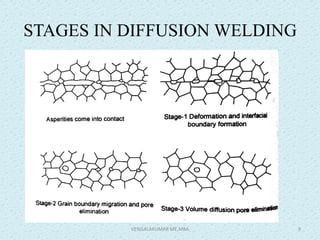
STAGES IN DIFFUSION WELDING
VENGALAKUMAR ME,MBA 9
ADVANTAGES
• Plastic deformation at surface is minimal.
• Dissimilar materials may be welded.
• There is no limitation in the thickness of the
workpieces.
• Welds of high quality obtained.
DISADVANTAGES
• It is a time consuming process due to low
productivity.
• Time required for diffusion can range from seconds to
hours.
• It requires relatively high initial investment in
equipment.
VENGALAKUMAR ME,MBA 10
APPLICATION
• It is used in joining of high strength and refractory
metals based on titanium in aerospace and nuclear
industries.
• Diffusion welding is most commonly used to join
sheet metal structures in nuclear and electronics
industries.
VENGALAKUMAR ME,MBA 11
EXPLOSIVE WELDING-INTRODUCTION
Explosive welding (EXW) is a solid state
welding process that uses a controlled
application of large pressure generated by the
detonation of applied explosives.
 In explosive welding parts are metallurgically
bonded as a result of oblique impact pressure
exerted on them by a controlled detonation of
an explosive change.
The following teams are frequently uses in the
explosive welding.
VENGALAKUMAR ME,MBA 12
VENGALAKUMAR ME,MBA 13
Specification details
• Cladding metal or Cladder -Thinner plate,
direct contact with the explosive, Shielded by
flyer plate from the explosive
• Flyer plate - sacrificial plate placed between
cladder and explosive, it protect the cladder
metal.
• Inner layer - thin metal layer which sometime
placed between cladder and base plate to
enhance joining.
VENGALAKUMAR ME,MBA 14
Specification details
• Base plate or backer – This plate that the cladder
is being joining.
• Anvil – surface on which backer rests during the
joining operation.
• Standoff - The distance between cladder and base
plate prior to the joining operation.
• Bond window – The range of process variable
such as velocity, dynamic bend and standoff
distance that result in a successful weld.
• Bonding operation – The detonation of the
explosive which result in the weld.
VENGALAKUMAR ME,MBA 15
PREPARATION:
• The first step of the cladding operation is the
preparation of the two surfaces that are to be
bonded together.
• These surfaces are ground or polished to
achieve a uniform surface finish with a
roughness, dependent upon the metals
combination and thicknesses.
VENGALAKUMAR ME,MBA 16
BONDING OPERATION:
• The explosive composition and type is selected
to yield a specific energy release and a specific
detonation rate
• The speed at which the detonation front travels
across the explosive layer.
• The detonation rate must be subsonic to the
acoustic velocities of the metals.
VENGALAKUMAR ME,MBA 17
BONDING OPERATION
• The explosive, which is generally granular, is
uniformly distributed on the cladding plate
surface filling the containment frame.
• It is ignited at a predetermined point on the
plate surface using a high velocity explosive
booster.
• The detonation travels away from the initiation
point and across the plate surface at the
specified detonation rate.
VENGALAKUMAR ME,MBA 18
BONDING OPERATION
• The gas expansion of the explosive detonation
accelerates the cladding plate across the
standoff gap resulting in an angular collision at
the specified collision velocity.
• These pressures travel away from the collision
point at the acoustic velocity of the metals.
VENGALAKUMAR ME,MBA 19
• Since the collision is moving forward at a
subsonic rate, pressures are created at the
immediately approaching adjacent surfaces,
which are sufficient to spall a thin layer of metal
from each surface and eject it away in a jet.
• The surface contaminants, oxides and impurities
are stripped away in the jet.
• Although there is much heat generated in the
explosive detonation, there is no time for heat
transfer to the metals.
• The result is an ideal metal-metal bond without
melting or diffusion.
VENGALAKUMAR ME,MBA 20
Cladding and Base metals
• Copper to steel
• Nickel to steel
• Aluminum to steel
• Tungsten to steel
• Copper to aluminum
VENGALAKUMAR ME,MBA 21
TYPES OF EXPLOSIVE WAVES
Deflagration
Detonation
VENGALAKUMAR ME,MBA 22
Deflagration
• Deflagrations travel at subsonic velocity
depending on the rates of chemical reaction,
thermal diffusion and mass diffusion.
• Typical deflagrations are gas-air mixture in a
gas stove, fuel-air mixture in an internal
combustion engine and gunpowder in a firearm
or pyrotechnic device.
.
VENGALAKUMAR ME,MBA 23
Detonation
• A detonation travel at supersonic velocity
exceeding the sonic velocity of the understand
explosive.
• The detonation wave consists of shock front
compresses heats the explosive following by
region of rapid chemical reaction
VENGALAKUMAR ME,MBA 24
Advantages
• It ensures high quality bonding such as high strength,
no distortions, no porosity.
• No change of the metal microstructure.
• There is no diffusion.
• Only, minor melting occur.
• Large surfaces may be welding.
• It is less costly.
• Surface preparation is not required .
• Explosive welding is much suited to cladding
application.
VENGALAKUMAR ME,MBA 25
Limitations
• Brittle materials cannot be welded.
Thickness of flyer plate may be limited.
Safety and security aspects of storage and
using explosive are difficult.
• Metals must have high enough impact
resistance and ductility.
• The geometrics welded must be simple in the
shape of flat, cylinder and conical shapes.
Noise and blast.
VENGALAKUMAR ME,MBA 26
Application
• This process is applied to welding of tubes and
tube plate in heat exchangers, feed water
heaters and boiler tubes to clad tube plate.
• It is used manufacturing clad tubes and pipes,
pressure vessels, aerospace structure, heat
exchanger, bi metal sliding, ship structure and
weld transition.
• It is used fixing cooling fins.
VENGALAKUMAR ME,MBA 27
HOT PRESSURE WELDING PROCESS
VENGALAKUMAR ME,MBA 28
INTRODUCTION
• Hot pressure welding is a solid state welding process
which produces coalescence of materials with heat
and the application of pressure sufficient to produce
macro deformation of the base metal.
VENGALAKUMAR ME,MBA 29
VENGALAKUMAR ME,MBA 30
WORKING PRINCIPLE
• Hot pressure welding is similar to both friction
welding and flash welding although the source of
heating is different. The surface should be machined
square and cleaned for obtaining the best result.
• Some beveling is used to control the amount of upset.
The process can be performed by a manual operation.
VENGALAKUMAR ME,MBA 31
• The materials to be welded must exhibit hot
ductility or forgeability. Castiron cannot be hot
pressure welded.
• The materials commonly joined by hot
pressure welding are carbon steels, low alloy
steels and cretain nonferrous metals. some
dissimilar materials combination are weldable
by hot pressure welding.
VENGALAKUMAR ME,MBA 32
VENGALAKUMAR ME,MBA 33
ADVANTAGES
• Welding process is simple.
• It needs simple joint preparation.
• Low cost equipment.
• It ensures quick weld production.
• There is no filler metal.
DISADVANTAGES
• Not all metals are weldable.
• It is not easily automated.
• Length of cycle is dependent on time for heating.
• Only simple sections are readily butt weldable.
VENGALAKUMAR ME,MBA 34
APPLICATIONS
• It is used in aerospace industry.
• It is used in plastic welding.
• It is used for producing medical devices.
• It is used in automotive industries.
• It is used in ship building.
VENGALAKUMAR ME,MBA 35
ROLL WELDING
.• Roll welding is a solid state welding process in which
pressure sufficient to cause coalescence is applied by
mean of rolls, either with or without external heat.
• If the welding is done without applying heat, is called
cold roll welding and if the heat is used for welding, it
is called hot roll welding.
• This process is similar to forge welding except the
pressure applied by means of rolls rather then by means
of hammer blows.
• Coalescence occurs at the interface between two parts
by means of diffusion at the faying surface
VENGALAKUMAR ME,MBA 36
VENGALAKUMAR ME,MBA 37
• Parts to be welded should be ductile and free
of work hardening.
Before the welding is carried out, the surface
to be joined should be cleaned.
• If the part to be welded are small, the pressure
applied by rolls is done by using simple hand
operated tools.
VENGALAKUMAR ME,MBA 38
• For heavier sizes of parts, power presses are
apply pressure.
Only of the major uses of this process is the
cladding of mild or low-alloy steel with a high
- alloy materials such as stainless steel.
• It is also used for making bimetallic materials
for the instrument industry.
VENGALAKUMAR ME,MBA 39
Advantages
.• Metals such as soft aluminum, copper, gold
and silver can be easily welded by roll welded.
The operation is easy and it used simple
equipment.
• There is no need of using flux and filler metal.
• It is smooth and clean process.
• Less time is required.
VENGALAKUMAR ME,MBA 40
Limitation
• It needs extreme pressure to perform the
welding process.
• The cost of equipment is high.
• Weld quality is less as compared to fusion
welding.
• It is limited to welding of flat shapes
VENGALAKUMAR ME,MBA 41
Applications
• It is used in cladding of stainless steel to mild
steel for corrosion resistance.
• It is used in making bimetallic strips.
• Roll welding is used to produce sandwich
strips to convert it into coins
VENGALAKUMAR ME,MBA 42
Ultrasonic welding
• Ultrasonic welding is an industrial technique
wherebyhighfrequency ultrasonic acoustic vibr
ations are locally applied to workpieces being
held together under pressure to create a solid-
state weld.
• It is commonly used for plastics and metals,
and especially for joining dissimilar materials.
VENGALAKUMAR ME,MBA 43
Ultrasonic welding
VENGALAKUMAR ME,MBA 44
Friction Stir Welding (FSW)
• Friction Stir Welding (FSW), was invented by W.
Thomas and his colleagues at The Welding
Institute (TWI), UK, in 1991
• Friction stir welding (FSW) is a solid-state joining
process that uses a non-consumable tool to join
two facing workpieces without melting the
workpiece material.
• Heat is generated by friction between the rotating
tool and the workpiece material, which leads to a
softened region near the FSW tool.
VENGALAKUMAR ME,MBA 45
• While the tool is traversed along the joint line,
it mechanically intermixes the two pieces of
metal, and forges the hot and softened metal
by the mechanical pressure, which is applied
by the tool, much like joining clay, or dough.
• FSW is capable of joining aluminium alloys,
cooper alloys, titanium alloys, mild steel,
stainless steel and magnesium alloys.
VENGALAKUMAR ME,MBA 46
MATERIALS USED IN FSW:
Alluminum and aluminum alloy.
Steel and steel alloy.
Cast iron materials.
Copper and bronze.
All ferrous materials and their alloys.
PARAMETER:
Welding speed (mm/min) 10 - 100
Tool rotation speed (RPM) 600 -1200
VENGALAKUMAR ME,MBA 47
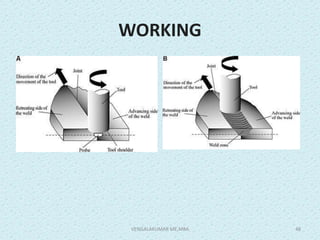
WORKING
VENGALAKUMAR ME,MBA 48
WORKING
• A rotating cylindrical tool with a profiled probe is fed
into a butt joint between two clamped workpieces, until
the shoulder, which has a larger diameter than the pin,
touches the surface of the workpieces.
• The probe is slightly shorter than the weld depth
required, with the tool shoulder riding a top the work
surface. After a short dwell time, the tool is moved
forward along the joint line at the pre-set welding
speed.
• Frictional heat is generated between the wear-resistant
tool and the work pieces.
VENGALAKUMAR ME,MBA 49
• This heat, along with that generated by the mechanical
mixing process and the adiabatic heat within the
material, cause the stirred materials to soften without
melting.
• As the tool is moved forward, a special profile on the
probe forces plasticised material from the leading face
to the rear, where the high forces assist in a forged
consolidation of the weld.
• This process of the tool traversing along the weld line
in a plasticised tubular shaft of metal results in severe
solid-state deformation involving dynamic
recrystallization of the base material
VENGALAKUMAR ME,MBA 50
ADVANTAGES:
1.Good mechanical properties in the as-welded condition.
2.Improved safety due to the absence of toxic fumes or the spatter of molten
material.
3.No consumables - A threaded pin made of conventional tool steel.
4.Easily automated on simple milling machines - lower setup costs and less
training.
5.Can operate in all positions (horizontal, vertical, etc.), as there is no weld
pool.
6.Generally good weld appearance and minimal thickness under/over-
matching, thus reducing the need for expensive machining after welding.
7.Can use thinner materials with same joint strength.
8.Low environmental impact.
VENGALAKUMAR ME,MBA 51
DISADVANTAGES:
1.Exit hole left when tool is withdrawn.
2.Large down forces required with heavy-duty
clamping necessary to hold the plates together.
3.Less flexible than manual and arc processes
(difficulties with thickness variations and non-
linear welds).
4.Often slower traverse rate than some fusion
welding techniques, although this may be
offset if fewer welding passes are required.
VENGALAKUMAR ME,MBA 52
APPLICATION:
1.Ship building
2.Aerospace
3.Automotive
4.Railways
5.Fabrication
6.Robotics
VENGALAKUMAR ME,MBA 53
VENGALAKUMAR ME,MBA 54
VENGALAKUMAR ME,MBA 55

Unit 3 SOLID STATE WELDING PROCESSES

  • 1.
    PR 8592 WELDINGTECHNOLOGY -UNIT -3 P.VENGALA KUMAR ME.,MBA TF/MECHANICAL ENGG., UNIVERSITY VOC COLLEGE OF ENGINEERING VENGALAKUMAR ME,MBA 1
  • 2.
    UNIT III SOLIDSTATE WELDING PROCESSES • Cold welding, • Diffusion bonding, • Explosive welding, • Hot pressure welding, • Roll welding • Ultrasonic welding, • Friction welding, • Forge welding, VENGALAKUMAR ME,MBA 2
  • 3.
    Cold welding orcontact welding • Cold welding or contact welding is a solid- state welding process in which joining takes place without fusion/heating at the interface of the two parts to be welded. • Unlike in the fusion-welding processes, no liquid or molten phase is present in the joint. VENGALAKUMAR ME,MBA 3
  • 4.
    VENGALAKUMAR ME,MBA 4 •Cold welding was first recognized as a general materials phenomenon in the 1940s. It was then discovered that two clean, flat surfaces of similar metal would strongly adhere if brought into contact under vacuum. Newly discovered micro and nano-scale cold welding has already shown great potential in the latest nano fabrication processes.
  • 5.
    DIFFUSION WELDING -INTRODUCTION • Itis a solid state welding technique used in metal working, capable of joining similar and dissimilar metals. • It operates on the principle of solid state diffusion, wherein the atoms of two solid, metallic surfaces intersperse themselves overtime. VENGALAKUMAR ME,MBA 5
  • 6.
  • 7.
    WORKING PRINCIPLE • Diffusionmeans movement of molecules or atoms from high concentration region to low concentration region. • This is fundamental principle of diffusion welding. • In this welding process both the welding plates are placed one over other in high pressure and temperature for a long period of time. • This high pressure force starts diffusion between interface surfaces. • This diffusion can be accelerated by the application of high temperature. VENGALAKUMAR ME,MBA 7
  • 8.
    • The temperaturerange is about 50-60% of melting temperature. • This whole process takes place in vacuum or in inert environment which protects the welding plates form oxidation. • Moderate pressure of about 10MPa is applied to carefully cleaned surfaces of the workpiece at an elevated temperature below the melting point. VENGALAKUMAR ME,MBA 8
  • 9.
    STAGES IN DIFFUSIONWELDING VENGALAKUMAR ME,MBA 9
  • 10.
    ADVANTAGES • Plastic deformationat surface is minimal. • Dissimilar materials may be welded. • There is no limitation in the thickness of the workpieces. • Welds of high quality obtained. DISADVANTAGES • It is a time consuming process due to low productivity. • Time required for diffusion can range from seconds to hours. • It requires relatively high initial investment in equipment. VENGALAKUMAR ME,MBA 10
  • 11.
    APPLICATION • It isused in joining of high strength and refractory metals based on titanium in aerospace and nuclear industries. • Diffusion welding is most commonly used to join sheet metal structures in nuclear and electronics industries. VENGALAKUMAR ME,MBA 11
  • 12.
    EXPLOSIVE WELDING-INTRODUCTION Explosive welding(EXW) is a solid state welding process that uses a controlled application of large pressure generated by the detonation of applied explosives.  In explosive welding parts are metallurgically bonded as a result of oblique impact pressure exerted on them by a controlled detonation of an explosive change. The following teams are frequently uses in the explosive welding. VENGALAKUMAR ME,MBA 12
  • 13.
  • 14.
    Specification details • Claddingmetal or Cladder -Thinner plate, direct contact with the explosive, Shielded by flyer plate from the explosive • Flyer plate - sacrificial plate placed between cladder and explosive, it protect the cladder metal. • Inner layer - thin metal layer which sometime placed between cladder and base plate to enhance joining. VENGALAKUMAR ME,MBA 14
  • 15.
    Specification details • Baseplate or backer – This plate that the cladder is being joining. • Anvil – surface on which backer rests during the joining operation. • Standoff - The distance between cladder and base plate prior to the joining operation. • Bond window – The range of process variable such as velocity, dynamic bend and standoff distance that result in a successful weld. • Bonding operation – The detonation of the explosive which result in the weld. VENGALAKUMAR ME,MBA 15
  • 16.
    PREPARATION: • The firststep of the cladding operation is the preparation of the two surfaces that are to be bonded together. • These surfaces are ground or polished to achieve a uniform surface finish with a roughness, dependent upon the metals combination and thicknesses. VENGALAKUMAR ME,MBA 16
  • 17.
    BONDING OPERATION: • Theexplosive composition and type is selected to yield a specific energy release and a specific detonation rate • The speed at which the detonation front travels across the explosive layer. • The detonation rate must be subsonic to the acoustic velocities of the metals. VENGALAKUMAR ME,MBA 17
  • 18.
    BONDING OPERATION • Theexplosive, which is generally granular, is uniformly distributed on the cladding plate surface filling the containment frame. • It is ignited at a predetermined point on the plate surface using a high velocity explosive booster. • The detonation travels away from the initiation point and across the plate surface at the specified detonation rate. VENGALAKUMAR ME,MBA 18
  • 19.
    BONDING OPERATION • Thegas expansion of the explosive detonation accelerates the cladding plate across the standoff gap resulting in an angular collision at the specified collision velocity. • These pressures travel away from the collision point at the acoustic velocity of the metals. VENGALAKUMAR ME,MBA 19
  • 20.
    • Since thecollision is moving forward at a subsonic rate, pressures are created at the immediately approaching adjacent surfaces, which are sufficient to spall a thin layer of metal from each surface and eject it away in a jet. • The surface contaminants, oxides and impurities are stripped away in the jet. • Although there is much heat generated in the explosive detonation, there is no time for heat transfer to the metals. • The result is an ideal metal-metal bond without melting or diffusion. VENGALAKUMAR ME,MBA 20
  • 21.
    Cladding and Basemetals • Copper to steel • Nickel to steel • Aluminum to steel • Tungsten to steel • Copper to aluminum VENGALAKUMAR ME,MBA 21
  • 22.
    TYPES OF EXPLOSIVEWAVES Deflagration Detonation VENGALAKUMAR ME,MBA 22
  • 23.
    Deflagration • Deflagrations travelat subsonic velocity depending on the rates of chemical reaction, thermal diffusion and mass diffusion. • Typical deflagrations are gas-air mixture in a gas stove, fuel-air mixture in an internal combustion engine and gunpowder in a firearm or pyrotechnic device. . VENGALAKUMAR ME,MBA 23
  • 24.
    Detonation • A detonationtravel at supersonic velocity exceeding the sonic velocity of the understand explosive. • The detonation wave consists of shock front compresses heats the explosive following by region of rapid chemical reaction VENGALAKUMAR ME,MBA 24
  • 25.
    Advantages • It ensureshigh quality bonding such as high strength, no distortions, no porosity. • No change of the metal microstructure. • There is no diffusion. • Only, minor melting occur. • Large surfaces may be welding. • It is less costly. • Surface preparation is not required . • Explosive welding is much suited to cladding application. VENGALAKUMAR ME,MBA 25
  • 26.
    Limitations • Brittle materialscannot be welded. Thickness of flyer plate may be limited. Safety and security aspects of storage and using explosive are difficult. • Metals must have high enough impact resistance and ductility. • The geometrics welded must be simple in the shape of flat, cylinder and conical shapes. Noise and blast. VENGALAKUMAR ME,MBA 26
  • 27.
    Application • This processis applied to welding of tubes and tube plate in heat exchangers, feed water heaters and boiler tubes to clad tube plate. • It is used manufacturing clad tubes and pipes, pressure vessels, aerospace structure, heat exchanger, bi metal sliding, ship structure and weld transition. • It is used fixing cooling fins. VENGALAKUMAR ME,MBA 27
  • 28.
    HOT PRESSURE WELDINGPROCESS VENGALAKUMAR ME,MBA 28
  • 29.
    INTRODUCTION • Hot pressurewelding is a solid state welding process which produces coalescence of materials with heat and the application of pressure sufficient to produce macro deformation of the base metal. VENGALAKUMAR ME,MBA 29
  • 30.
  • 31.
    WORKING PRINCIPLE • Hotpressure welding is similar to both friction welding and flash welding although the source of heating is different. The surface should be machined square and cleaned for obtaining the best result. • Some beveling is used to control the amount of upset. The process can be performed by a manual operation. VENGALAKUMAR ME,MBA 31
  • 32.
    • The materialsto be welded must exhibit hot ductility or forgeability. Castiron cannot be hot pressure welded. • The materials commonly joined by hot pressure welding are carbon steels, low alloy steels and cretain nonferrous metals. some dissimilar materials combination are weldable by hot pressure welding. VENGALAKUMAR ME,MBA 32
  • 33.
  • 34.
    ADVANTAGES • Welding processis simple. • It needs simple joint preparation. • Low cost equipment. • It ensures quick weld production. • There is no filler metal. DISADVANTAGES • Not all metals are weldable. • It is not easily automated. • Length of cycle is dependent on time for heating. • Only simple sections are readily butt weldable. VENGALAKUMAR ME,MBA 34
  • 35.
    APPLICATIONS • It isused in aerospace industry. • It is used in plastic welding. • It is used for producing medical devices. • It is used in automotive industries. • It is used in ship building. VENGALAKUMAR ME,MBA 35
  • 36.
    ROLL WELDING .• Rollwelding is a solid state welding process in which pressure sufficient to cause coalescence is applied by mean of rolls, either with or without external heat. • If the welding is done without applying heat, is called cold roll welding and if the heat is used for welding, it is called hot roll welding. • This process is similar to forge welding except the pressure applied by means of rolls rather then by means of hammer blows. • Coalescence occurs at the interface between two parts by means of diffusion at the faying surface VENGALAKUMAR ME,MBA 36
  • 37.
  • 38.
    • Parts tobe welded should be ductile and free of work hardening. Before the welding is carried out, the surface to be joined should be cleaned. • If the part to be welded are small, the pressure applied by rolls is done by using simple hand operated tools. VENGALAKUMAR ME,MBA 38
  • 39.
    • For heaviersizes of parts, power presses are apply pressure. Only of the major uses of this process is the cladding of mild or low-alloy steel with a high - alloy materials such as stainless steel. • It is also used for making bimetallic materials for the instrument industry. VENGALAKUMAR ME,MBA 39
  • 40.
    Advantages .• Metals suchas soft aluminum, copper, gold and silver can be easily welded by roll welded. The operation is easy and it used simple equipment. • There is no need of using flux and filler metal. • It is smooth and clean process. • Less time is required. VENGALAKUMAR ME,MBA 40
  • 41.
    Limitation • It needsextreme pressure to perform the welding process. • The cost of equipment is high. • Weld quality is less as compared to fusion welding. • It is limited to welding of flat shapes VENGALAKUMAR ME,MBA 41
  • 42.
    Applications • It isused in cladding of stainless steel to mild steel for corrosion resistance. • It is used in making bimetallic strips. • Roll welding is used to produce sandwich strips to convert it into coins VENGALAKUMAR ME,MBA 42
  • 43.
    Ultrasonic welding • Ultrasonicwelding is an industrial technique wherebyhighfrequency ultrasonic acoustic vibr ations are locally applied to workpieces being held together under pressure to create a solid- state weld. • It is commonly used for plastics and metals, and especially for joining dissimilar materials. VENGALAKUMAR ME,MBA 43
  • 44.
  • 45.
    Friction Stir Welding(FSW) • Friction Stir Welding (FSW), was invented by W. Thomas and his colleagues at The Welding Institute (TWI), UK, in 1991 • Friction stir welding (FSW) is a solid-state joining process that uses a non-consumable tool to join two facing workpieces without melting the workpiece material. • Heat is generated by friction between the rotating tool and the workpiece material, which leads to a softened region near the FSW tool. VENGALAKUMAR ME,MBA 45
  • 46.
    • While thetool is traversed along the joint line, it mechanically intermixes the two pieces of metal, and forges the hot and softened metal by the mechanical pressure, which is applied by the tool, much like joining clay, or dough. • FSW is capable of joining aluminium alloys, cooper alloys, titanium alloys, mild steel, stainless steel and magnesium alloys. VENGALAKUMAR ME,MBA 46
  • 47.
    MATERIALS USED INFSW: Alluminum and aluminum alloy. Steel and steel alloy. Cast iron materials. Copper and bronze. All ferrous materials and their alloys. PARAMETER: Welding speed (mm/min) 10 - 100 Tool rotation speed (RPM) 600 -1200 VENGALAKUMAR ME,MBA 47
  • 48.
  • 49.
    WORKING • A rotatingcylindrical tool with a profiled probe is fed into a butt joint between two clamped workpieces, until the shoulder, which has a larger diameter than the pin, touches the surface of the workpieces. • The probe is slightly shorter than the weld depth required, with the tool shoulder riding a top the work surface. After a short dwell time, the tool is moved forward along the joint line at the pre-set welding speed. • Frictional heat is generated between the wear-resistant tool and the work pieces. VENGALAKUMAR ME,MBA 49
  • 50.
    • This heat,along with that generated by the mechanical mixing process and the adiabatic heat within the material, cause the stirred materials to soften without melting. • As the tool is moved forward, a special profile on the probe forces plasticised material from the leading face to the rear, where the high forces assist in a forged consolidation of the weld. • This process of the tool traversing along the weld line in a plasticised tubular shaft of metal results in severe solid-state deformation involving dynamic recrystallization of the base material VENGALAKUMAR ME,MBA 50
  • 51.
    ADVANTAGES: 1.Good mechanical propertiesin the as-welded condition. 2.Improved safety due to the absence of toxic fumes or the spatter of molten material. 3.No consumables - A threaded pin made of conventional tool steel. 4.Easily automated on simple milling machines - lower setup costs and less training. 5.Can operate in all positions (horizontal, vertical, etc.), as there is no weld pool. 6.Generally good weld appearance and minimal thickness under/over- matching, thus reducing the need for expensive machining after welding. 7.Can use thinner materials with same joint strength. 8.Low environmental impact. VENGALAKUMAR ME,MBA 51
  • 52.
    DISADVANTAGES: 1.Exit hole leftwhen tool is withdrawn. 2.Large down forces required with heavy-duty clamping necessary to hold the plates together. 3.Less flexible than manual and arc processes (difficulties with thickness variations and non- linear welds). 4.Often slower traverse rate than some fusion welding techniques, although this may be offset if fewer welding passes are required. VENGALAKUMAR ME,MBA 52
  • 53.
  • 54.
  • 55.