NIKHIL ANAND SRIVASTAVA
3RD YEAR
MECHANICAL ENGG.
Explosion Welding
Basics
 Explosion welding is a solid-state process that
produces a high velocity interaction of dissimilar
metals by a controlled detonation
 Oxides found on material surfaces must be removed
by effacement or dispersion
 Surface atoms of two joining metals must come into
intimate contact to achieve metallic bond
Advantages
 No heat-affected zone (HAZ)
 Only minor melting
 Material melting temperatures and coefficients of
thermal expansion differences do not affect the final
product
 The shock front compresses and heats the explosive
material which exceeds the sonic velocity of
undetonated explosives
Component Terminology
 Base component
 Joined to cladder
 Remains stationary
 Supported by anvil
 Cladding metal
 Thin plate in direct contact with explosives
 Can be shielded by flyer plate
 Flyer plate
 Sacrificial plate placed between explosive material and
cladder plate
 Used to protect cladder metal
 Interlayer
 Thin metal layer
 Enhances joining of cladder to base plate
 Anvil
 Surface of which the backer rests during explosion
 Standoff
 Distance between cladder and base plate before explosion
 Bond Window
 A range of variable in process such as velocity, dynamic
bend, and standoff distance that result in successful weld
 Bonding Operation
 Detonation of explosives that result in a weld
Principle of Explosion
 Cladder metal can be placed parallel or inclined to
the base plate
 Explosive material is distributed over top of cladder
metal
 Upon detonation, cladder plate collides with base
plate to form weld
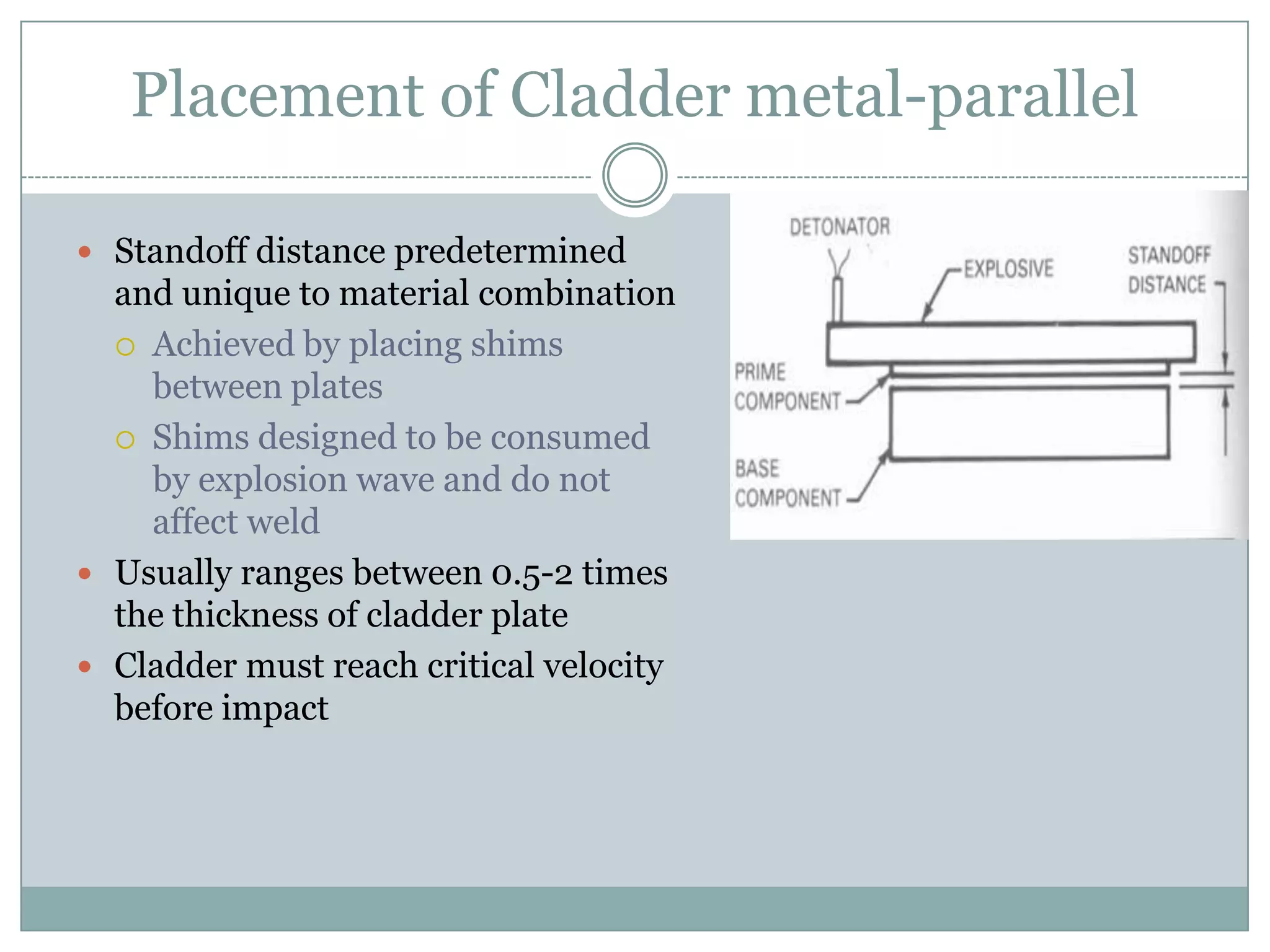
Placement of Cladder metal-parallel
 Standoff distance predetermined
and unique to material combination
 Achieved by placing shims
between plates
 Shims designed to be consumed
by explosion wave and do not
affect weld
 Usually ranges between 0.5-2 times
the thickness of cladder plate
 Cladder must reach critical velocity
before impact
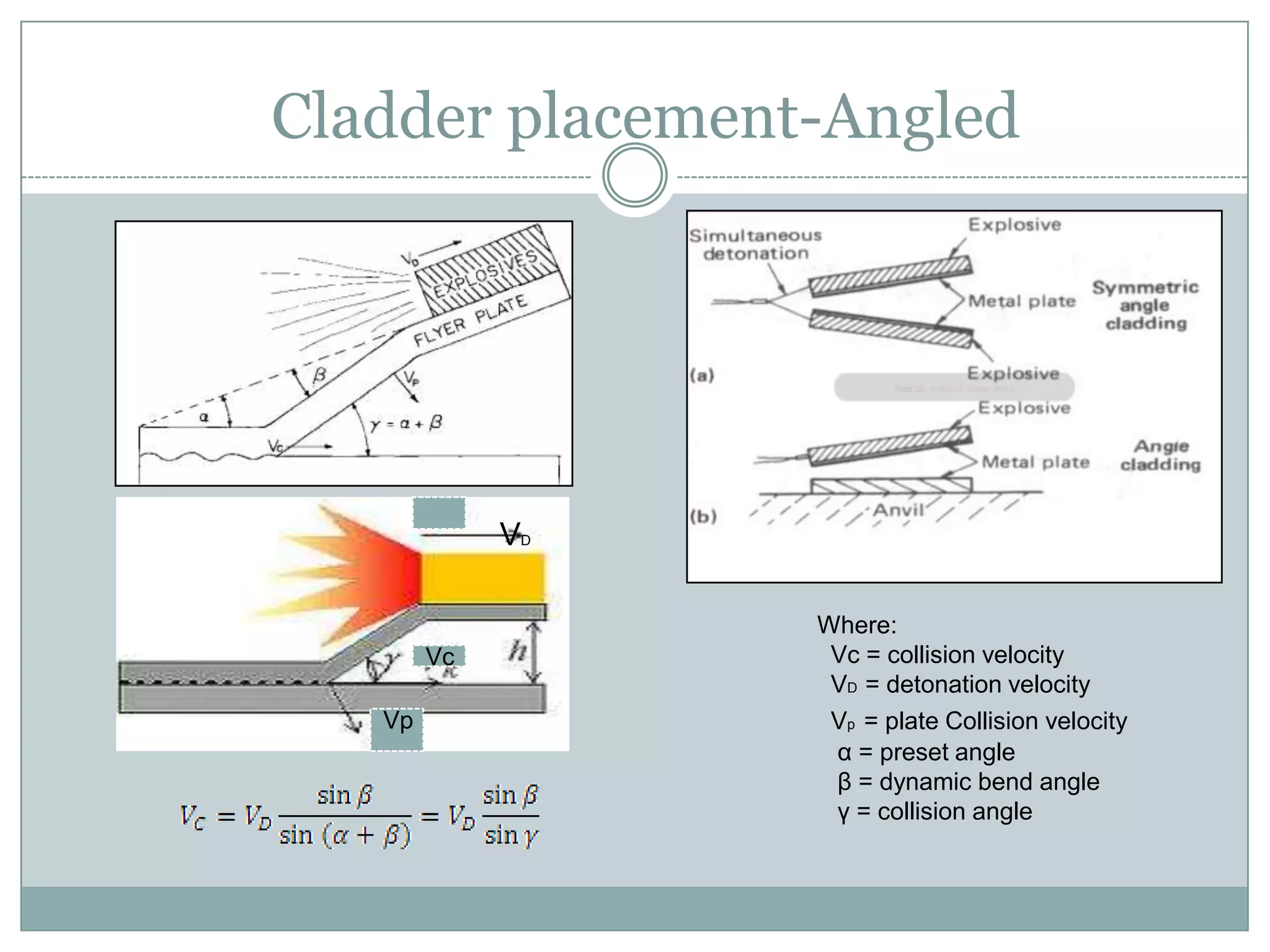
Cladder placement-Angled
Where:
Vc = collision velocity
VD = detonation velocity
Vp = plate Collision velocity
α = preset angle
β = dynamic bend angle
γ = collision angle
Vc
VD
Vp
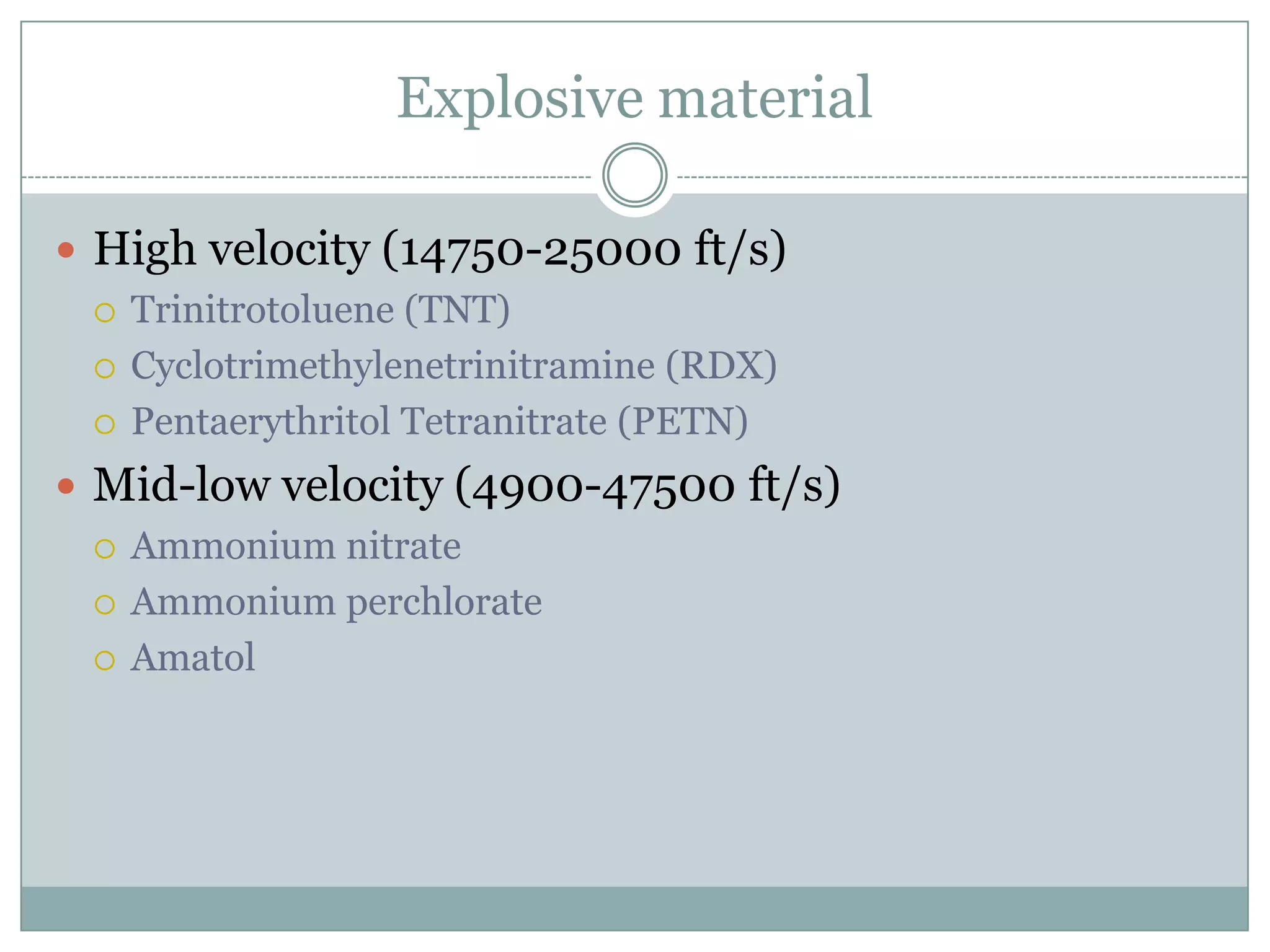
Explosive material
 High velocity (14750-25000 ft/s)
 Trinitrotoluene (TNT)
 Cyclotrimethylenetrinitramine (RDX)
 Pentaerythritol Tetranitrate (PETN)
 Mid-low velocity (4900-47500 ft/s)
 Ammonium nitrate
 Ammonium perchlorate
 Amatol
Assuring a good weld
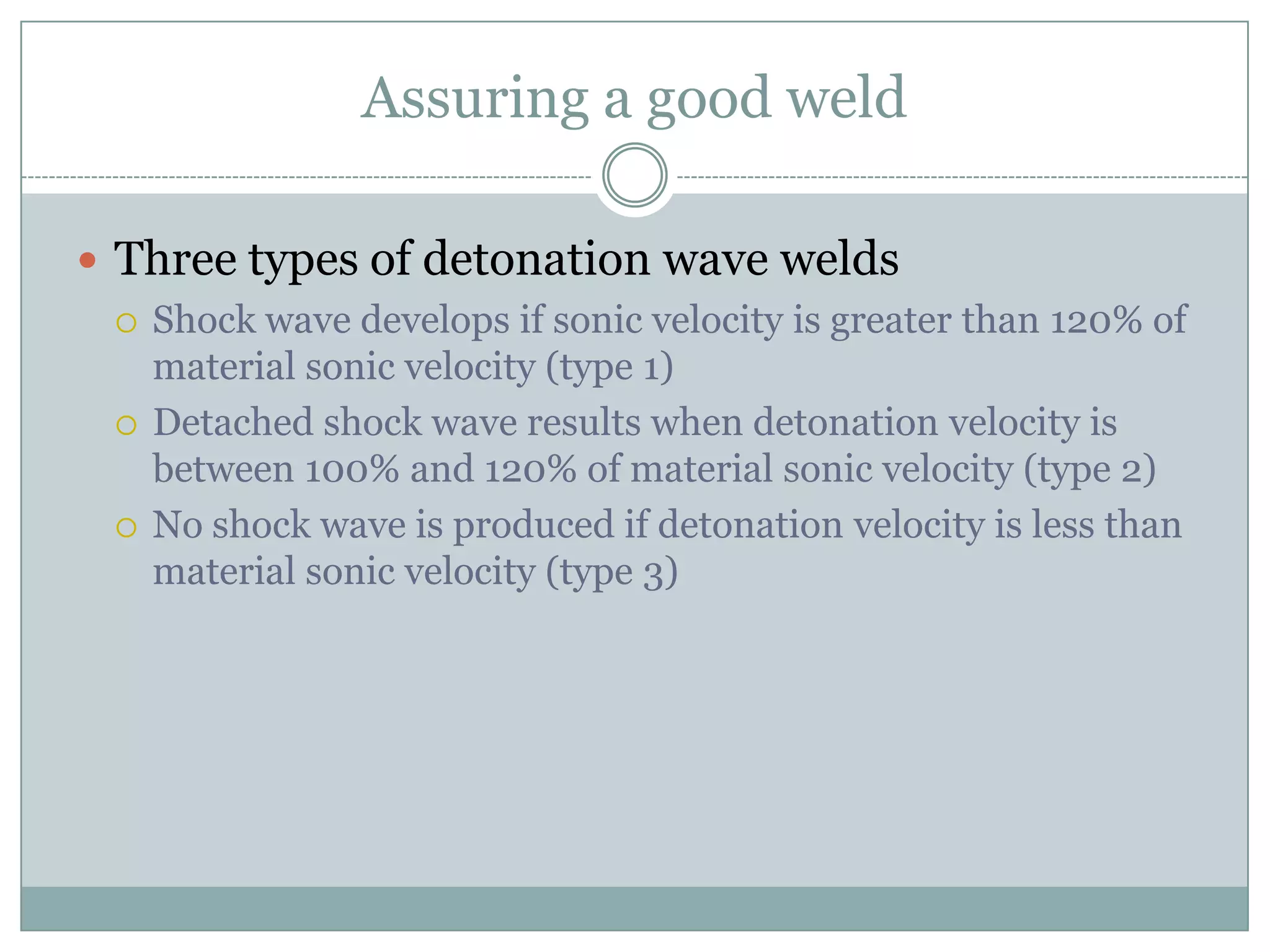
 Three types of detonation wave welds
 Shock wave develops if sonic velocity is greater than 120% of
material sonic velocity (type 1)
 Detached shock wave results when detonation velocity is
between 100% and 120% of material sonic velocity (type 2)
 No shock wave is produced if detonation velocity is less than
material sonic velocity (type 3)
Assuring a good weld
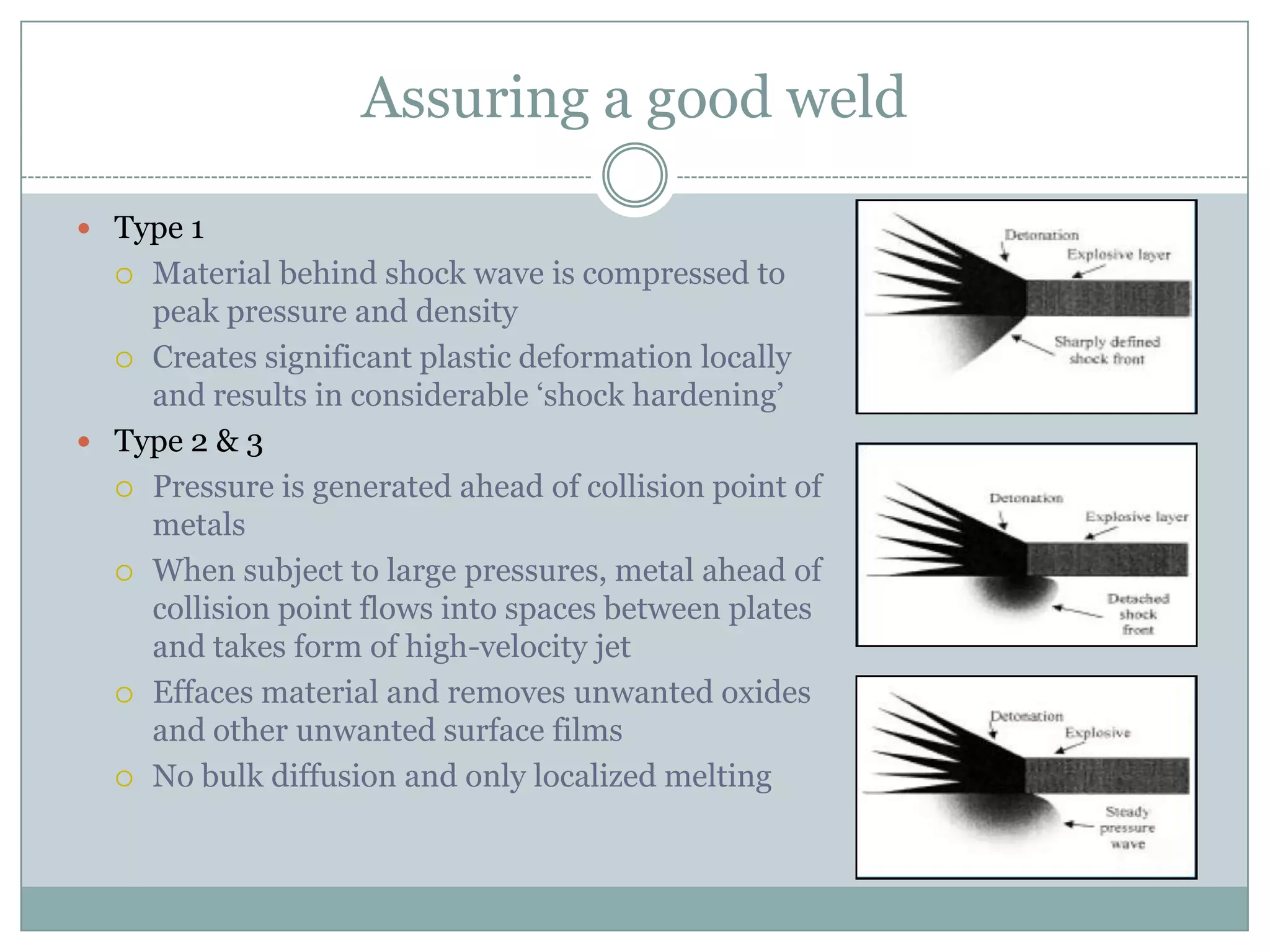
 Type 1
 Material behind shock wave is compressed to
peak pressure and density
 Creates significant plastic deformation locally
and results in considerable „shock hardening‟
 Type 2 & 3
 Pressure is generated ahead of collision point of
metals
 When subject to large pressures, metal ahead of
collision point flows into spaces between plates
and takes form of high-velocity jet
 Effaces material and removes unwanted oxides
and other unwanted surface films
 No bulk diffusion and only localized melting
Assuring a good weld
 Detonation velocity is a function of
 Explosive type
 Composition of explosive
 Thickness of explosive layer
 Can be found in tables
Assuring a good weld
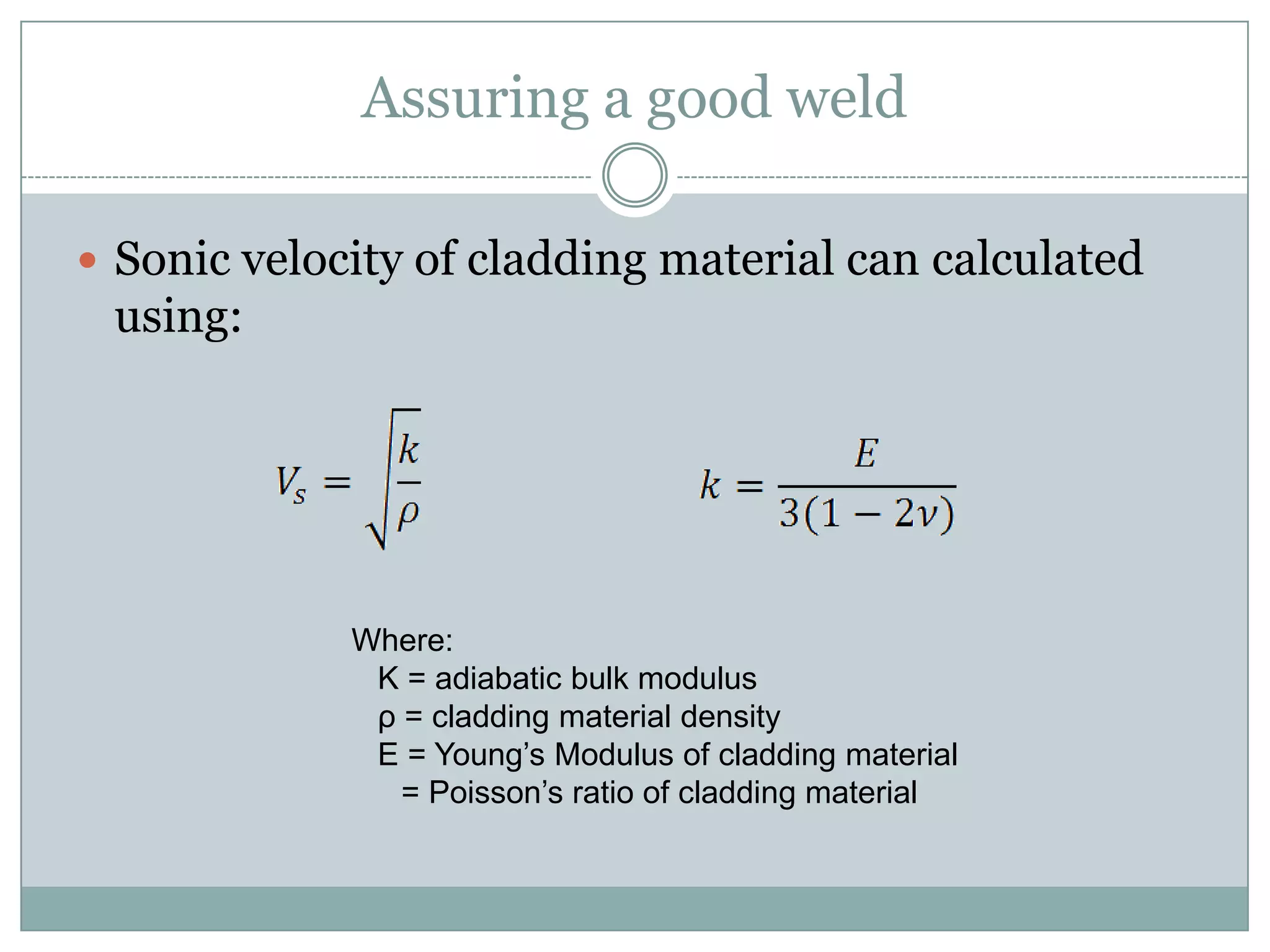
 Sonic velocity of cladding material can calculated
using:
Where:
K = adiabatic bulk modulus
ρ = cladding material density
E = Young’s Modulus of cladding material
= Poisson’s ratio of cladding material
Applications
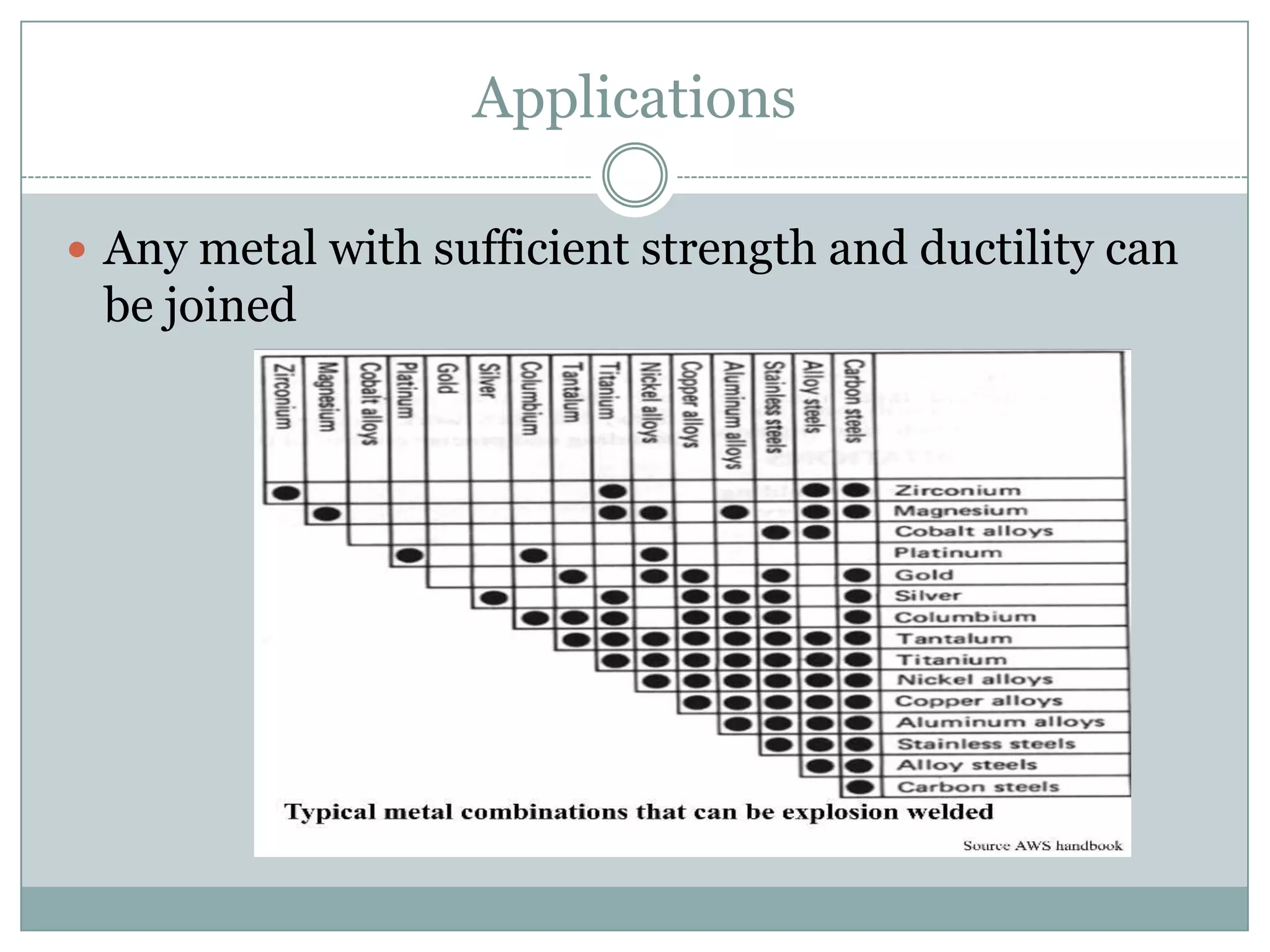
 Any metal with sufficient strength and ductility can
be joined
Applications
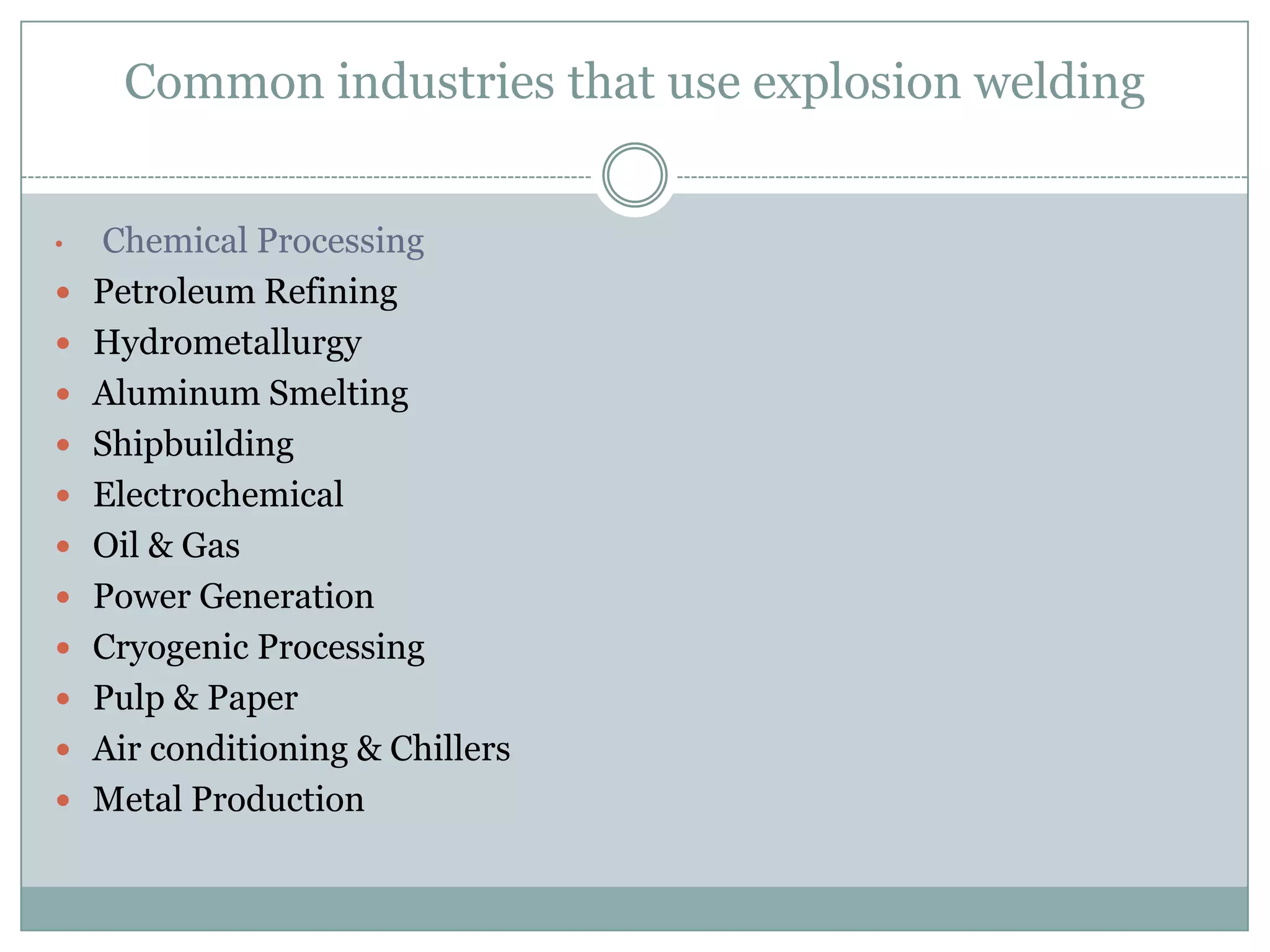
 Can weld large areas of metal
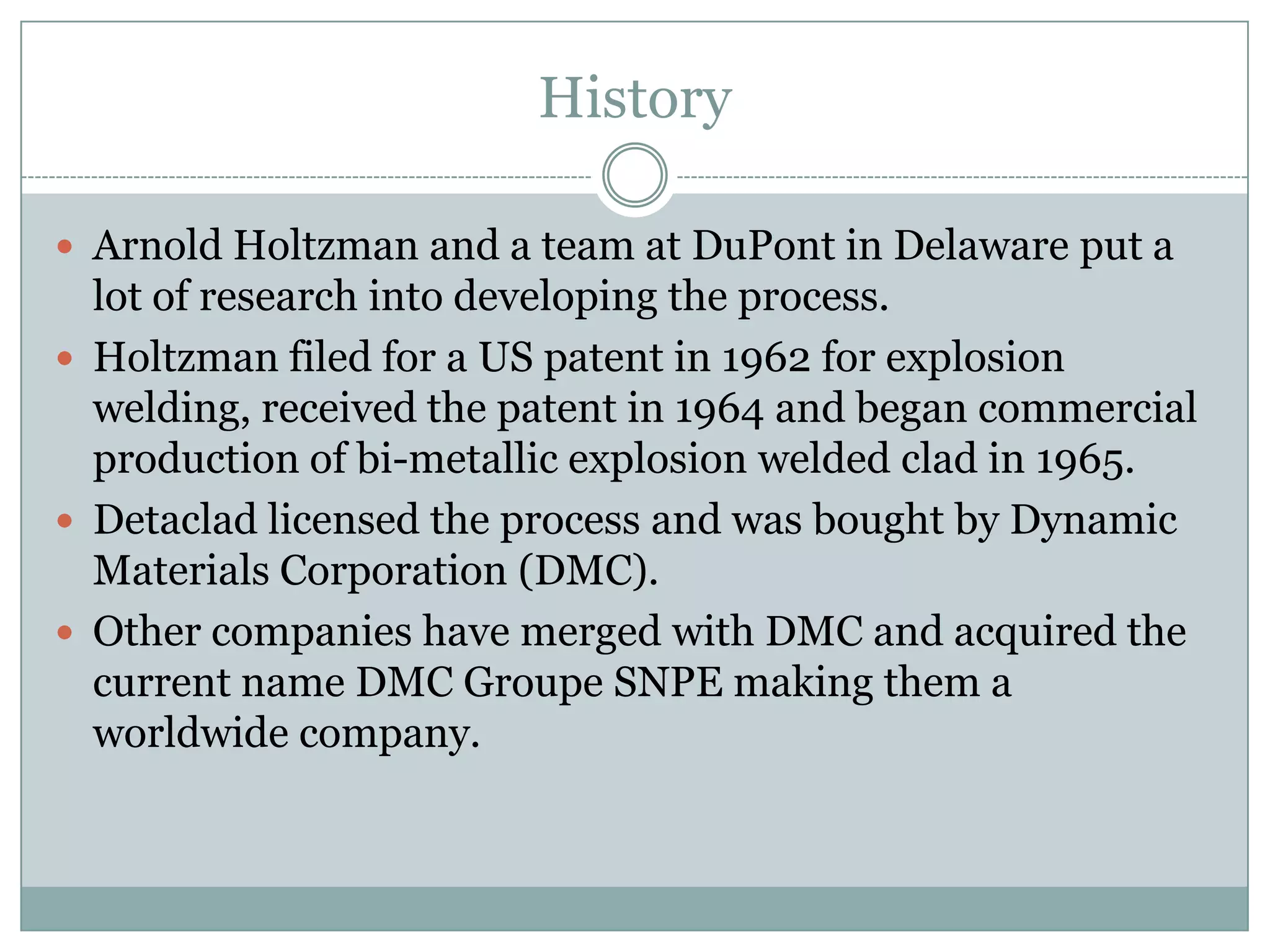
 Can weld inside and outside surfaces of pipes
 Transition joints can be made
History
 Arnold Holtzman and a team at DuPont in Delaware put a
lot of research into developing the process.
 Holtzman filed for a US patent in 1962 for explosion
welding, received the patent in 1964 and began commercial
production of bi-metallic explosion welded clad in 1965.
 Detaclad licensed the process and was bought by Dynamic
Materials Corporation (DMC).
 Other companies have merged with DMC and acquired the
current name DMC Groupe SNPE making them a
worldwide company.
Common industries that use explosion welding
• Chemical Processing
 Petroleum Refining
 Hydrometallurgy
 Aluminum Smelting
 Shipbuilding
 Electrochemical
 Oil & Gas
 Power Generation
 Cryogenic Processing
 Pulp & Paper
 Air conditioning & Chillers
 Metal Production
Examples
Examples
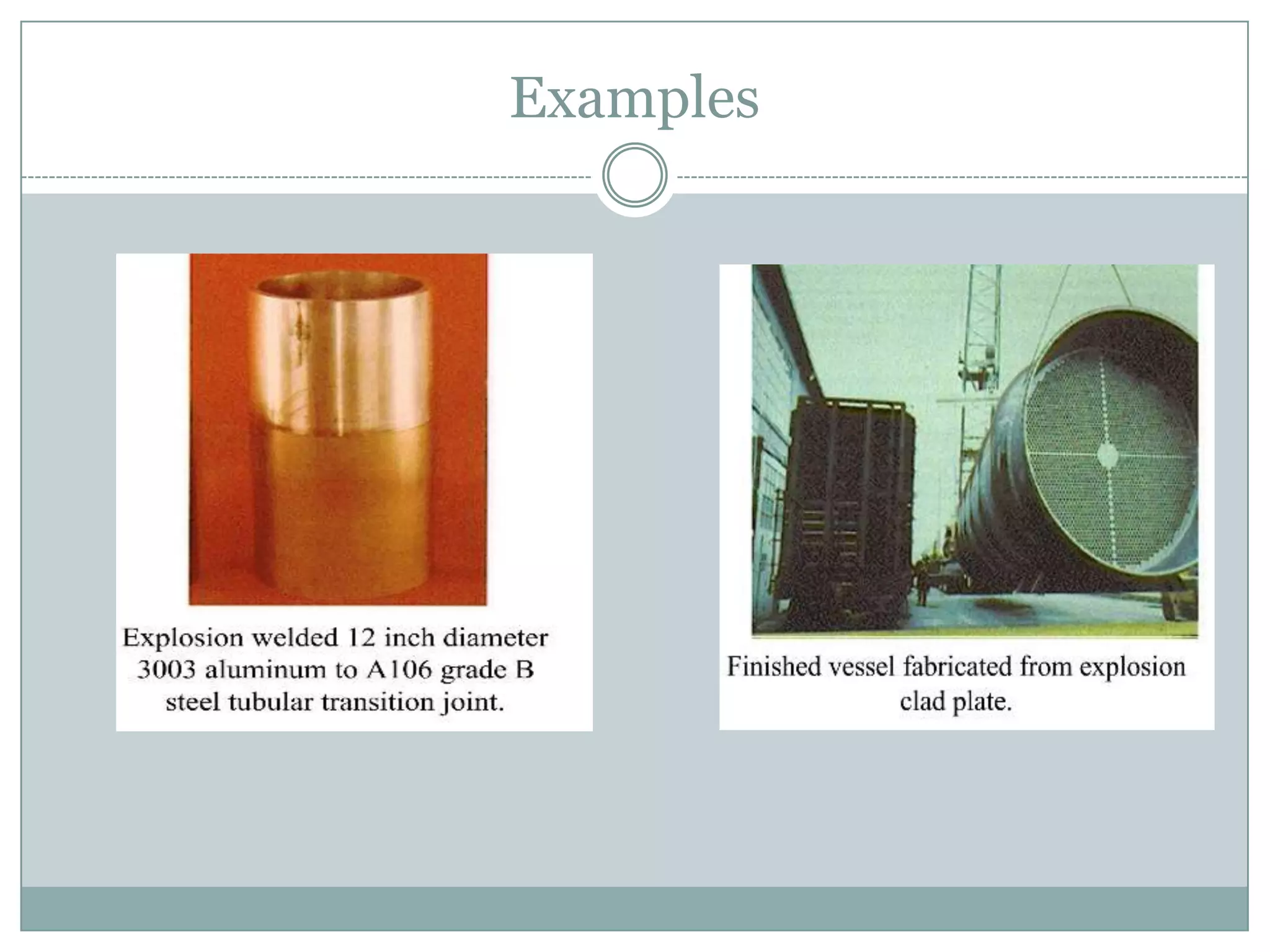
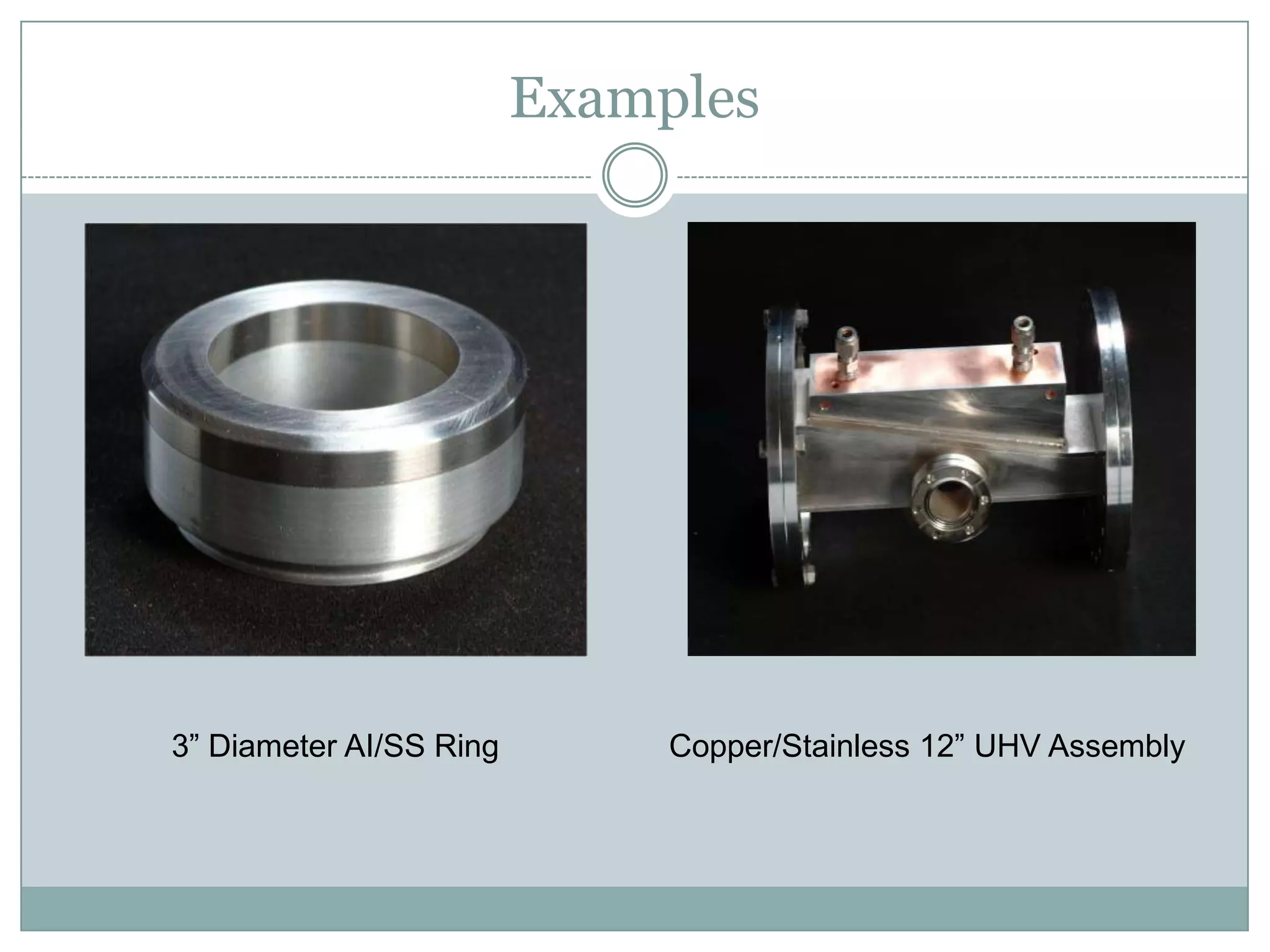
3” Diameter AI/SS Ring Copper/Stainless 12” UHV Assembly
Examples
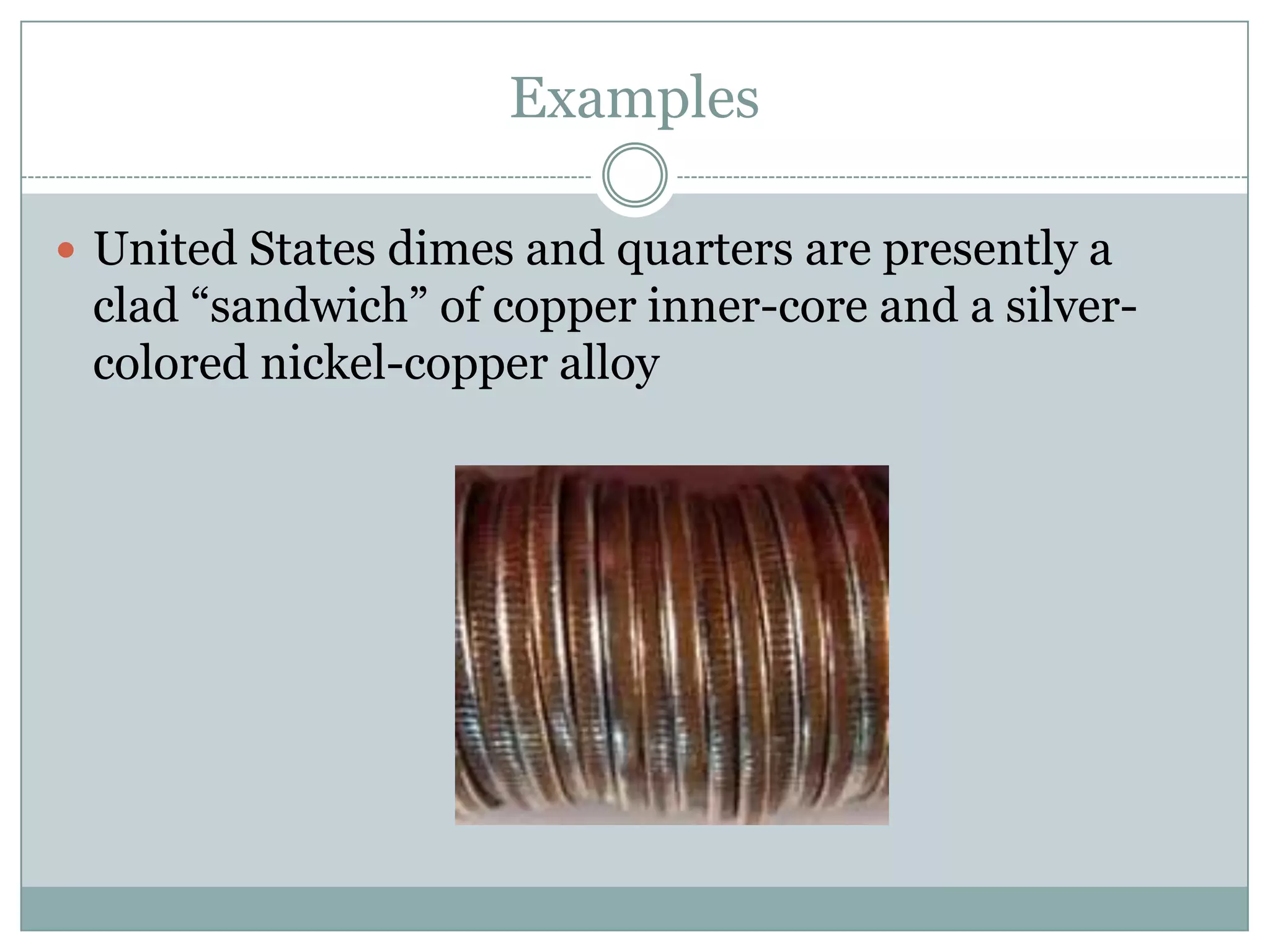
 United States dimes and quarters are presently a
clad “sandwich” of copper inner-core and a silver-
colored nickel-copper alloy

Explosion welding - Nikhil

  • 1.
    NIKHIL ANAND SRIVASTAVA 3RDYEAR MECHANICAL ENGG. Explosion Welding
  • 2.
    Basics  Explosion weldingis a solid-state process that produces a high velocity interaction of dissimilar metals by a controlled detonation  Oxides found on material surfaces must be removed by effacement or dispersion  Surface atoms of two joining metals must come into intimate contact to achieve metallic bond
  • 3.
    Advantages  No heat-affectedzone (HAZ)  Only minor melting  Material melting temperatures and coefficients of thermal expansion differences do not affect the final product  The shock front compresses and heats the explosive material which exceeds the sonic velocity of undetonated explosives
  • 4.
    Component Terminology  Basecomponent  Joined to cladder  Remains stationary  Supported by anvil  Cladding metal  Thin plate in direct contact with explosives  Can be shielded by flyer plate
  • 5.
     Flyer plate Sacrificial plate placed between explosive material and cladder plate  Used to protect cladder metal  Interlayer  Thin metal layer  Enhances joining of cladder to base plate  Anvil  Surface of which the backer rests during explosion
  • 6.
     Standoff  Distancebetween cladder and base plate before explosion  Bond Window  A range of variable in process such as velocity, dynamic bend, and standoff distance that result in successful weld  Bonding Operation  Detonation of explosives that result in a weld
  • 7.
    Principle of Explosion Cladder metal can be placed parallel or inclined to the base plate  Explosive material is distributed over top of cladder metal  Upon detonation, cladder plate collides with base plate to form weld
  • 8.
    Placement of Claddermetal-parallel  Standoff distance predetermined and unique to material combination  Achieved by placing shims between plates  Shims designed to be consumed by explosion wave and do not affect weld  Usually ranges between 0.5-2 times the thickness of cladder plate  Cladder must reach critical velocity before impact
  • 9.
    Cladder placement-Angled Where: Vc =collision velocity VD = detonation velocity Vp = plate Collision velocity α = preset angle β = dynamic bend angle γ = collision angle Vc VD Vp
  • 10.
    Explosive material  Highvelocity (14750-25000 ft/s)  Trinitrotoluene (TNT)  Cyclotrimethylenetrinitramine (RDX)  Pentaerythritol Tetranitrate (PETN)  Mid-low velocity (4900-47500 ft/s)  Ammonium nitrate  Ammonium perchlorate  Amatol
  • 11.
    Assuring a goodweld  Three types of detonation wave welds  Shock wave develops if sonic velocity is greater than 120% of material sonic velocity (type 1)  Detached shock wave results when detonation velocity is between 100% and 120% of material sonic velocity (type 2)  No shock wave is produced if detonation velocity is less than material sonic velocity (type 3)
  • 12.
    Assuring a goodweld  Type 1  Material behind shock wave is compressed to peak pressure and density  Creates significant plastic deformation locally and results in considerable „shock hardening‟  Type 2 & 3  Pressure is generated ahead of collision point of metals  When subject to large pressures, metal ahead of collision point flows into spaces between plates and takes form of high-velocity jet  Effaces material and removes unwanted oxides and other unwanted surface films  No bulk diffusion and only localized melting
  • 13.
    Assuring a goodweld  Detonation velocity is a function of  Explosive type  Composition of explosive  Thickness of explosive layer  Can be found in tables
  • 14.
    Assuring a goodweld  Sonic velocity of cladding material can calculated using: Where: K = adiabatic bulk modulus ρ = cladding material density E = Young’s Modulus of cladding material = Poisson’s ratio of cladding material
  • 15.
    Applications  Any metalwith sufficient strength and ductility can be joined
  • 16.
    Applications  Can weldlarge areas of metal  Can weld inside and outside surfaces of pipes  Transition joints can be made
  • 17.
    History  Arnold Holtzmanand a team at DuPont in Delaware put a lot of research into developing the process.  Holtzman filed for a US patent in 1962 for explosion welding, received the patent in 1964 and began commercial production of bi-metallic explosion welded clad in 1965.  Detaclad licensed the process and was bought by Dynamic Materials Corporation (DMC).  Other companies have merged with DMC and acquired the current name DMC Groupe SNPE making them a worldwide company.
  • 18.
    Common industries thatuse explosion welding • Chemical Processing  Petroleum Refining  Hydrometallurgy  Aluminum Smelting  Shipbuilding  Electrochemical  Oil & Gas  Power Generation  Cryogenic Processing  Pulp & Paper  Air conditioning & Chillers  Metal Production
  • 19.
  • 20.
    Examples 3” Diameter AI/SSRing Copper/Stainless 12” UHV Assembly
  • 21.
    Examples  United Statesdimes and quarters are presently a clad “sandwich” of copper inner-core and a silver- colored nickel-copper alloy

Editor's Notes

  • #18 US locations: colorado, pennsylvania, connecticut.Europe locations: France, Germany, Sweden