EXPLOSIVE WELDING ON CONCENTRIC CYLINDER’S
Presented by:
Agastya sai manihar.P,
CB.ENP2MFG20004.
Under the guidance of :
Shanmugasundaram .A
18ME651
Advonced Casting & welding technology
Periodical 2
Content’s
 Introduction
 Process
 Mechanism & Equipment
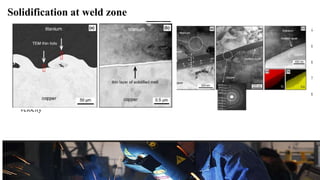
 Bonding interface
 Morphology of weld interface
 Solidification at weld zone
 Merit’s & Demerits
 Applications
 Conclusion & Future scope
 Reference’
Introduction
• Welding is the process of joining the two metals with help of fusion.
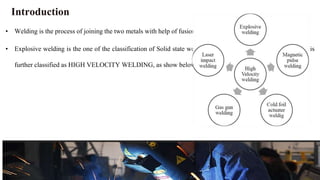
• Explosive welding is the one of the classification of Solid state welding under SOLID STATE WELDING it is
further classified as HIGH VELOCITY WELDING, as show below:
Introduction (CONT)
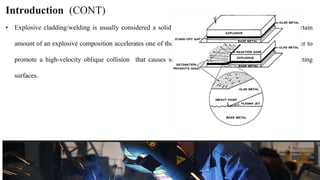
• Explosive cladding/welding is usually considered a solid state process. in which the detonation of a certain
amount of an explosive composition accelerates one of the materials to be welded against the other in order to
promote a high-velocity oblique collision that causes severe, but localized, plastic flow at the interacting
surfaces.
Explosive welding
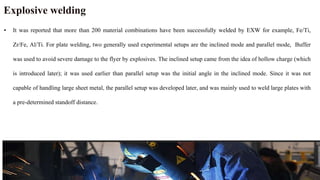
• It was reported that more than 200 material combinations have been successfully welded by EXW for example, Fe/Ti,
Zr/Fe, Al/Ti. For plate welding, two generally used experimental setups are the inclined mode and parallel mode, Buffer
was used to avoid severe damage to the flyer by explosives. The inclined setup came from the idea of hollow charge (which
is introduced later); it was used earlier than parallel setup was the initial angle in the inclined mode. Since it was not
capable of handling large sheet metal, the parallel setup was developed later, and was mainly used to weld large plates with
a pre-determined standoff distance.
Mechanism & Equipment
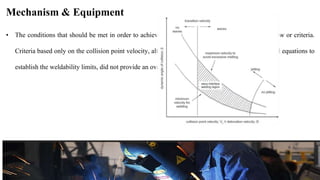
• The conditions that should be met in order to achieve good welds is called the weldability window or criteria.
Criteria based only on the collision point velocity, although allowing the development of empirical equations to
establish the weldability limits, did not provide an overall picture of the process.
Mechanism & Equipment (CONT)
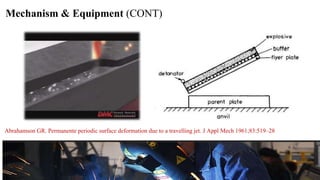
Abrahamson GR. Permanente periodic surface deformation due to a travelling jet. J Appl Mech 1961;83:519–28
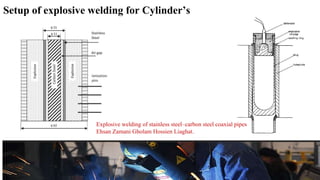
Setup of explosive welding for Cylinder’s
Explosive welding of stainless steel–carbon steel coaxial pipes
Ehsan Zamani Gholam Hossien Liaghat.
Bonding interface
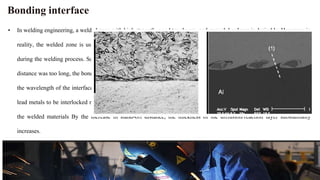
• In welding engineering, a welded zone with high strength, good toughness, and enough hardness is desirable. However, in
reality, the welded zone is usually weakest welded part, since the microstructure at the welding zone keeps evolving
during the welding process. Some defects may appear at the welded zone during the welding process. When the applied
distance was too long, the bonding interface seemed to be linear at a short distance due to a larger wavelength. Increasing
the wavelength of the interface increased the bonding surface area of the plates. Increasing the stand-off distance would
lead metals to be interlocked mechanically. Subsequently, as a result, mechanical locking improved the joint strength of
the welded materials By the increase in stand-off distance, the thickness of the diffusion/reaction layer substantially
increases.
Bonding interface (CONT)
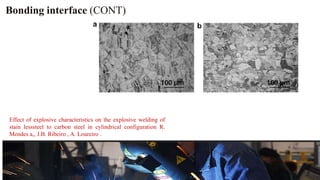
Effect of explosive characteristics on the explosive welding of
stain lesssteel to carbon steel in cylindrical configuration R.
Mendes a,, J.B. Ribeiro , A. Loureiro .
Morphology at weld interface:
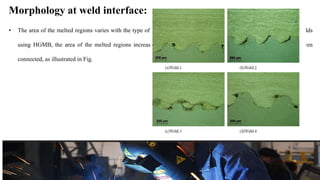
• The area of the melted regions varies with the type of sensitizer and also with the collision point velocity. For the welds
using HGMB, the area of the melted regions increases as Vc increases . Melted zones of successive waves are even
connected, as illustrated in Fig.
Morphology at weld interface (CONT)
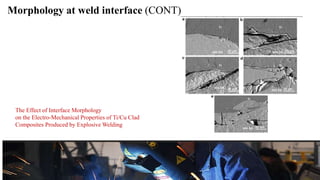
The Effect of Interface Morphology
on the Electro-Mechanical Properties of Ti/Cu Clad
Composites Produced by Explosive Welding
Solidification at weld zone
• A feature typical for EXW metals is the formation of a liquid phase at the interface. The effect of this
phenomenon on the mechanical properties of the clad is ambiguous. On the one hand, an increase in strength
is expected due to the formation of intermetallic phases (high hardness). On the other hand, crack formation
within the zones of solidified melt has a detrimental effect on the mechanical properties of the clad. The
present work documents that the volume fraction of large solidified melt zones increases as the detonation
velocity
Merits
• Very large work pieces can be weld
• (Al+ Steel) materials can be weld
• Can bond many dissimilar, normally unwedable materials
• The strength of the weld joint is greater than the weaker metals joined
• No heat affected zone
Demerits
• Metals must have high impact resistance & ductility
• The geometries weld must be simple –flat, cylindrical, Conical
• The cladding plate can’t be too large
• Noise of the blast can require worker protection , Vacuum chambers, buried in sand /water.
Applications
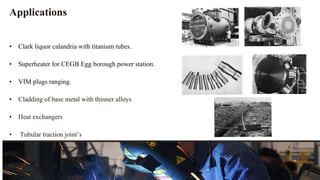
• Clark liquor calandria with titanium tubes.
• Superheater for CEGB Egg borough power station.
• VIM plugs ranging.
• Cladding of base metal with thinner alloys
• Heat exchangers
• Tubular traction joint’s
Conclusion
• It can be seen that explosive welding has a very limited, albeit useful, application. In general, it can be used to weld
very simple, flat, and cylindrical surfaces, but it cannot be used for welding surfaces with sharp transitions in section as
the reflection of shock waves from these discontinuities would cause failure. However, the process is already being
exploited successfully for large plate cladding of one metal on another, particularly for large tubeplates of heat
exchangers and for producing cladded plate for pressure-vessel construction. It has also found application in the
welding of tubes to tubeplates for heat exchangers, and for the plugging of faulty tubes in heat exchangers particularly
in conventional and nuclear power plants
Reference’s
• Rinehart J, Pearson J. Behavior of metals under impulsive loads. Cleveland, Ohio: Aerican Society for Metals; 1954.
• Ryabov VR, Dobrushin LD, Moon Jung-Gi. Welding of bimetals: welding and allied processes. Kiev: E.O. Paton
Electric Welding Institute; 2003.
• Abrahamson GR. Permanente periodic surface deformation due to a travelling jet. J Appl Mech 1961;83:519–28.
• Effect of explosive characteristics on the explosive welding of stainlesssteel to carbon steel in cylindrical configuration
R. Mendes a,, J.B. Ribeiro , A. Loureiro .
• Explosive welding of stainless steel–carbon steel coaxial pipes Ehsan Zamani Gholam Hossien Liaghat.
• Experimental investigation of explosive welding of cp-titanium/AISI 304 stainless steel S.A.A. Akbari Mousavi , P.
Farhadi Sartangi.
• Three-layered SS321/AA1050/AA5083 explosive welds: Effect of PWHT on the interface evolution and its mechanical
strength Hesam Pouraliakbar a, Gholamreza Khalaj b,, Mohammad Reza Jandaghi c, Ali Fadaei b, Mohammadreza
Khanzadeh Ghareh-Shiran d, Sang Hun Shim a, Sun Ig Hong
Explosive welding

Explosive welding

  • 1.
    EXPLOSIVE WELDING ONCONCENTRIC CYLINDER’S Presented by: Agastya sai manihar.P, CB.ENP2MFG20004. Under the guidance of : Shanmugasundaram .A 18ME651 Advonced Casting & welding technology Periodical 2
  • 2.
    Content’s  Introduction  Process Mechanism & Equipment  Bonding interface  Morphology of weld interface  Solidification at weld zone  Merit’s & Demerits  Applications  Conclusion & Future scope  Reference’
  • 3.
    Introduction • Welding isthe process of joining the two metals with help of fusion. • Explosive welding is the one of the classification of Solid state welding under SOLID STATE WELDING it is further classified as HIGH VELOCITY WELDING, as show below:
  • 4.
    Introduction (CONT) • Explosivecladding/welding is usually considered a solid state process. in which the detonation of a certain amount of an explosive composition accelerates one of the materials to be welded against the other in order to promote a high-velocity oblique collision that causes severe, but localized, plastic flow at the interacting surfaces.
  • 5.
    Explosive welding • Itwas reported that more than 200 material combinations have been successfully welded by EXW for example, Fe/Ti, Zr/Fe, Al/Ti. For plate welding, two generally used experimental setups are the inclined mode and parallel mode, Buffer was used to avoid severe damage to the flyer by explosives. The inclined setup came from the idea of hollow charge (which is introduced later); it was used earlier than parallel setup was the initial angle in the inclined mode. Since it was not capable of handling large sheet metal, the parallel setup was developed later, and was mainly used to weld large plates with a pre-determined standoff distance.
  • 6.
    Mechanism & Equipment •The conditions that should be met in order to achieve good welds is called the weldability window or criteria. Criteria based only on the collision point velocity, although allowing the development of empirical equations to establish the weldability limits, did not provide an overall picture of the process.
  • 7.
    Mechanism & Equipment(CONT) Abrahamson GR. Permanente periodic surface deformation due to a travelling jet. J Appl Mech 1961;83:519–28
  • 8.
    Setup of explosivewelding for Cylinder’s Explosive welding of stainless steel–carbon steel coaxial pipes Ehsan Zamani Gholam Hossien Liaghat.
  • 9.
    Bonding interface • Inwelding engineering, a welded zone with high strength, good toughness, and enough hardness is desirable. However, in reality, the welded zone is usually weakest welded part, since the microstructure at the welding zone keeps evolving during the welding process. Some defects may appear at the welded zone during the welding process. When the applied distance was too long, the bonding interface seemed to be linear at a short distance due to a larger wavelength. Increasing the wavelength of the interface increased the bonding surface area of the plates. Increasing the stand-off distance would lead metals to be interlocked mechanically. Subsequently, as a result, mechanical locking improved the joint strength of the welded materials By the increase in stand-off distance, the thickness of the diffusion/reaction layer substantially increases.
  • 10.
    Bonding interface (CONT) Effectof explosive characteristics on the explosive welding of stain lesssteel to carbon steel in cylindrical configuration R. Mendes a,, J.B. Ribeiro , A. Loureiro .
  • 11.
    Morphology at weldinterface: • The area of the melted regions varies with the type of sensitizer and also with the collision point velocity. For the welds using HGMB, the area of the melted regions increases as Vc increases . Melted zones of successive waves are even connected, as illustrated in Fig.
  • 12.
    Morphology at weldinterface (CONT) The Effect of Interface Morphology on the Electro-Mechanical Properties of Ti/Cu Clad Composites Produced by Explosive Welding
  • 13.
    Solidification at weldzone • A feature typical for EXW metals is the formation of a liquid phase at the interface. The effect of this phenomenon on the mechanical properties of the clad is ambiguous. On the one hand, an increase in strength is expected due to the formation of intermetallic phases (high hardness). On the other hand, crack formation within the zones of solidified melt has a detrimental effect on the mechanical properties of the clad. The present work documents that the volume fraction of large solidified melt zones increases as the detonation velocity
  • 14.
    Merits • Very largework pieces can be weld • (Al+ Steel) materials can be weld • Can bond many dissimilar, normally unwedable materials • The strength of the weld joint is greater than the weaker metals joined • No heat affected zone
  • 15.
    Demerits • Metals musthave high impact resistance & ductility • The geometries weld must be simple –flat, cylindrical, Conical • The cladding plate can’t be too large • Noise of the blast can require worker protection , Vacuum chambers, buried in sand /water.
  • 16.
    Applications • Clark liquorcalandria with titanium tubes. • Superheater for CEGB Egg borough power station. • VIM plugs ranging. • Cladding of base metal with thinner alloys • Heat exchangers • Tubular traction joint’s
  • 17.
    Conclusion • It canbe seen that explosive welding has a very limited, albeit useful, application. In general, it can be used to weld very simple, flat, and cylindrical surfaces, but it cannot be used for welding surfaces with sharp transitions in section as the reflection of shock waves from these discontinuities would cause failure. However, the process is already being exploited successfully for large plate cladding of one metal on another, particularly for large tubeplates of heat exchangers and for producing cladded plate for pressure-vessel construction. It has also found application in the welding of tubes to tubeplates for heat exchangers, and for the plugging of faulty tubes in heat exchangers particularly in conventional and nuclear power plants
  • 18.
    Reference’s • Rinehart J,Pearson J. Behavior of metals under impulsive loads. Cleveland, Ohio: Aerican Society for Metals; 1954. • Ryabov VR, Dobrushin LD, Moon Jung-Gi. Welding of bimetals: welding and allied processes. Kiev: E.O. Paton Electric Welding Institute; 2003. • Abrahamson GR. Permanente periodic surface deformation due to a travelling jet. J Appl Mech 1961;83:519–28. • Effect of explosive characteristics on the explosive welding of stainlesssteel to carbon steel in cylindrical configuration R. Mendes a,, J.B. Ribeiro , A. Loureiro . • Explosive welding of stainless steel–carbon steel coaxial pipes Ehsan Zamani Gholam Hossien Liaghat. • Experimental investigation of explosive welding of cp-titanium/AISI 304 stainless steel S.A.A. Akbari Mousavi , P. Farhadi Sartangi. • Three-layered SS321/AA1050/AA5083 explosive welds: Effect of PWHT on the interface evolution and its mechanical strength Hesam Pouraliakbar a, Gholamreza Khalaj b,, Mohammad Reza Jandaghi c, Ali Fadaei b, Mohammadreza Khanzadeh Ghareh-Shiran d, Sang Hun Shim a, Sun Ig Hong