Metal Joining Process
Tribhuvan University
Institute of Engineering (IOE)
Himalaya College of Engineering
Prepared By: Er. Amrit Tiwari
Lecturer
Himalaya College of Engineering
“Brazing, soldering, welding and adhesive bonding of materials”.
Metal Joining process includes welding, brazing, soldering, adhesive bonding of
materials.
• Produce permanent joint between the parts to be assembled.
• Cannot be separated easily by application of forces.
• Used to assemble many parts to make a system.
1. Brazing and Soldering: Melting of filler rod only
• Brazing: higher temperature
brass filler
strong
• Soldering: lower temp
tin-lead filler
weak
2. Welding: Melting of filler rod and base metals
BRAZING
• It is a joining process in which a filler metal is melted and distributed by capillary
action between the faying (contact) surfaces of the metal parts being joined.
• In brazing, the filler metal has a melting temperature above 450°C, but below the
melting point of base metals to be joined.
• Join produced by this welding is stronger than soldering.
• This process offers better corrosion resistance.
• Filler used in brazing include Cu and Cu alloys, silver alloys and Al alloys.
• In this process heating is done by torch, furnace, induction, resistance techniques.
Applications:
1)Automobile – Joining Tubes
2) Pipe/Tubing joining (HVAC)
3) Electrical equipment - joining wires
4) Jewelry Making
BRAZING
SOLDERING
• Soldering is similar to brazing and can be defined as a joining process in which a filler metal
with melting point not exceeding 450°C is melted and distributed by capillary action between
the faying surfaces of the metal parts being joined.
• As in brazing, no melting of the base metals occurs, but the filler metal wets and combines
with the base metal to form a metallurgical bond.
• Filler metal, called Solder, is added to the joint, which distributes itself between the closely
fitting parts.
• Strength of the joint is weak
• Corrosion resistance is less
SOLDER: Alloys of Tin and Lead.
Applications:
1) Printed Circuit Board (PCB) manufacture
2) Pipe joining (copper pipe)
Easy to solder: copper, silver, gold
Difficult to solder: aluminum, stainless steels
SOLDERING
WELDING
• Welding is a metal joining process in which two or more parts are joined or coalesced at
their contacting surfaces by suitable application of heat or/and pressure.
• Some times, welding is done just by applying heat alone, with no pressure applied.
• In some cases, both heat and pressure are applied; and in other cases only pressure is
applied, without any external heat.
• In some welding processes a filler material is added to facilitate coalescence(Joining).
• Welded joint can be stronger than the parent materials if a proper filler metal is used that
has strength properties better than that of parent base material and if defectless welding
is done.
WELDING
• Welding is a metal joining process in which two or more parts are joined or coalesced at
their contacting surfaces by suitable application of heat or/and pressure.
• Some times, welding is done just by applying heat alone, with no pressure applied.
• In some cases, both heat and pressure are applied; and in other cases only pressure is
applied, without any external heat.
• In some welding processes a filler material is added to facilitate coalescence(Joining).
• Welded joint can be stronger than the parent materials if a proper filler metal is used that
has strength properties better than that of parent base material and if defectless welding
is done.
Classification of Welding processes
• Arc Welding
1)Tungsten Inert gas (TIG)arc welding
2)Metallic Inert gas(MIG) arc welding
3)Shielded metal arc welding(SMAW)
4)Submerged arc welding
5)Plasma arc welding
6)Flux cored arc welding(FCAW)
• Resistance Welding
1)Spot welding
2)Seam welding
3)Projection welding
4)Resistance butt welding
• Gas Welding
1)Oxy-acetylene welding
2) Oxy-hydrogen welding
3)Air -acetylene welding
4)Pressure Gas welding
• Thermo Chemical Welding Process
1)Thermit welding
2)Atomic hydrogen welding
• Radiant Energy Welding Process
1)Electron beam welding
2)Laser beam welding.
Arc Welding
Types of welding:
Welding processes can be broadly classified into
(i) fusion(non-pressure) welding
• apply of heat to melt the base metals
• filler metal is added in many fusion wielding process
• Types: Arc welding, Gas welding, electron beam welding, laser welding
(ii) solid state welding(pressure welding)
• application of pressure only or a combination of heat and pressure.
• if heat is used, the temperature in process is less than melting point of metals
• No filler metal is utilized
• Types: Diffusion welding, Friction welding, Ultrasonic Welding
Arc Welding Process
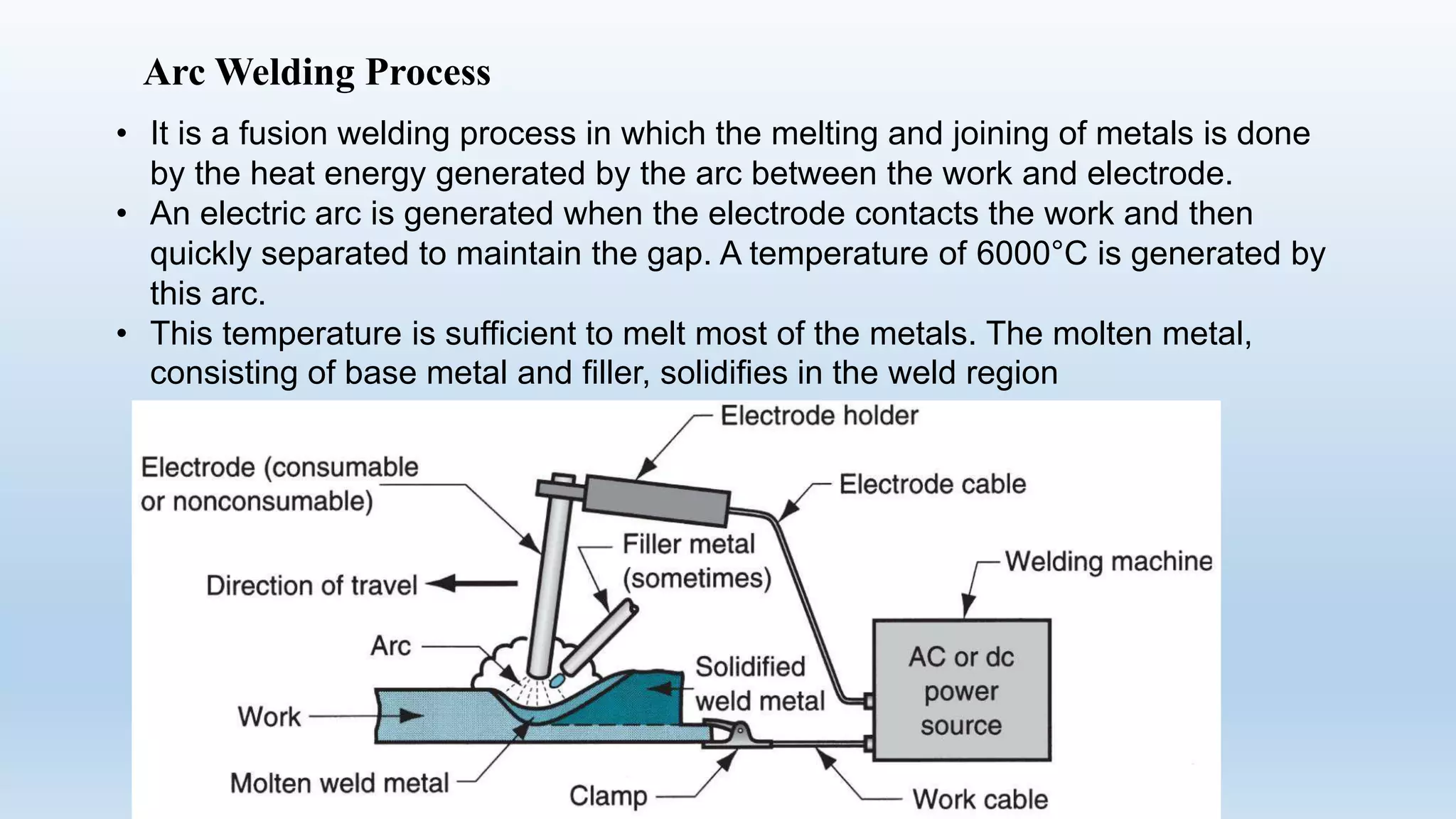
• It is a fusion welding process in which the melting and joining of metals is done
by the heat energy generated by the arc between the work and electrode.
• An electric arc is generated when the electrode contacts the work and then
quickly separated to maintain the gap. A temperature of 6000°C is generated by
this arc.
• This temperature is sufficient to melt most of the metals. The molten metal,
consisting of base metal and filler, solidifies in the weld region
Electrodes
• Two types of electrodes are used: consumable and non-consumable
Arc shielding
Shielding gas: covers the arc, electrode tip and weld pool from external atmosphere. The
metals being joined are chemically reactive to oxygen, nitrogen, and hydrogen in
the atmosphere. So the shielding is done with a blanket of gas or flux, or both, which inhibit
exposure of the weld metal to air.
Common shielding gas: Argon, Helium
Flux:
Used mainly to protect the weld region from formation of oxides and other
unwanted contaminants, or to dissolve them and facilitate removal.
During welding, the flux melts and covers the weld region giving protection and it
should be removed by brushing as it is hardened.
Power source in arc welding:
Both AC and DC can be used; DC is advantageous as better arc control is possible
Arc welding Polarity
Straight Polarity:
• Work on Positive terminal and Electrode in Negative terminal
• 2/3rd of the total arc heat is generated near base plate and rest is generated at electrode tip.
• Proper fusion of the base metal can be achieved easily. So it eliminates the lack of fusion and lack of
penetration defects.
• Metals with high melting temperature (such as stainless steel, titanium) can be suitably joined
Reversed Polarity:
• Work on Negative terminal and electrode in positive terminal
• 2/3rd of the total arc heat is generated at electrode tip and rest is generated near base plate.
• Due to less heat generation near base plate, incomplete fusion of the base plate may occur.
• Metals with low melting temperature (such as copper, aluminum) can be suitably joined.
Shielded metal arc welding (SMAW):
• In this process, a consumable electrode consisting of a filler metal rod which
is coated with chemicals that provide flux and shielding, is used.
• Generally the filler metal has chemical composition very close to base metal.
• Filler rod coating: Coating consists of powdered cellulose (cotton and wood
powders) mixed with oxides, carbonates, combined using a silicate binder.
This coating provides protective layer to the weld pool and stabilizes the arc.
• Applications: ship building, construction, machine structures etc.
• Materials: grades of steel, stainless steel etc. are welded. Al, Cu, Ti alloys are
not welding using SMAW.
• Disadvantages: repeated change of electrodes, current maintained in typical
range
Shielded metal arc welding (SMAW)
Standardization of Welding Electrodes
(American Welding Society) AWS Classification
• “E” in E8018 stands for flux covered electrode as used in Metal Manual Arc Welding
• “80” in E8018 indicates that the weld metal will have a minimum tensile strength of 80 KSI (kilo
pounds per sq. inch)
• “1” in E8018 means that the welding can be done in flat, overhead, horizontal and vertical
(upwards)
• “8” in in E8018 tells that it has a low hydrogen, iron powder medium coating.
THANK YOU
Submerged arc welding (SAW):
Gas metal arc welding (GMAW) OR (MIG)
Gas Tungsten Arc Welding (GTAW):
Gas welding / Oxyfuel gas welding
-In this process, various fuels are mixed with oxygen and burnt to perform welding. Eg:
Oxyacetylene welding
Oxyacetylene welding (OAW):
In this case, welding is performed by a flame formed by the combustion of oxygen and acetylene.
The flame comes from a torch. A filler rod coated with flux is used sometimes which prevents
oxidation, creating a better joint.
Acetylene is a famous fuel because it is capable of generating a high temperature.
The chemical reaction between oxygen and acetylene happens at two stages as given below.
(First stage; inner core)
The products of first reaction are combustible and second reaction occurs as,
(second stage; outer envelope)
When both oxygen and acetylene are mixed in ratio of 1:1, then neutral flame .The outer
envelope delivers a temperature of 1250°C and inner core has approx. 3200°C.
The first stage reaction is seen as the inner cone of the flame (bright white colour), while the
second stage reaction is seen in the outer envelope (colorless but with tinges ranging from
blue to orange). The temperature is very high at the inner core which is approx. 3200°C.
Oxy-acetylene flames
1. Neutral Flame:
Equal volume of Oxygen and
Acetylene
Welding of steels, cast Iron,
Copper, Aluminum
2. Oxidizing Flame:
• Excess of Oxygen
• Welding of Brass and
Bronze
3. Reducing or Carburizing flame
• Excess of Acetylene
• Welding of Molten metal, a
certain alloys, Non-
Ferous,hard surfacing
materials such as Satellite
Types of flames
1)Neutral flame
It is produced when the ratio of oxygen to acetylene, in the mixture leaving the torch,
is almost exactly one-to-one. It’s termed ”neutral” because it will usually have no
chemical effect on the metal being welded. It will not oxidize the weld metal; it will
not cause an increase in the carbon content of the weld metal.
2)Excess acetylene flame/ Carburising flame
As its name implies, is created when the proportion of acetylene in the mixture is
higher than that required to produce the neutral flame. Used on steel, it will cause an
increase in the carbon content of the weld metal.
3)Oxidizing flame
results from burning a mixture which contains more oxygen than required for a neutral
flame. It will oxidize or ”burn” some of the metal being welded.
Butt joint Corner joint Lap joint Tee joint Edge joint
Types of Weld joint
Types of Welds
• The type of weld depends on the joint.
• As shown in fig. weld may be a bead weld, fillet weld, plug weld,
groove weld, spot weld or seam weld
Welding Positions
• 1 = Flat Position
• 2 = Horizontal Position
• 3 = Vertical Position
• 4 = Overhead Position
• F = Fillet Weld
• G = Groove Weld
Comparison between Welding, soldering and brazing
Electrical Hazards
• High voltage can kill
• Do not operate with covers removed
• Disconnect input power before servicing
• Do not touch electrically live parts ,electrical shock can kill
• Do not touch electrode with skin or wet clothing
• Insulate yourself from work and ground
Flumes & Gases
• Welding may produce hazardous fumes & gases
• leaking gases may cause injury or death
• Use ventilation to keep air breathing zone clear & comfortable
• Do not weld or cut near flammables
Safety in Welding
Fire or Explosion
• Remove flammable materials from the work area
• Keep a fire extinguisher in the work area
• Wear fire retardant clothing & a hat when welding
• Do not weld on containers which have held combustible materials or closed containers of any
kind
Safety in Welding

Metal Joining Process- Welding, Brazing and Soldering

  • 1.
    Metal Joining Process TribhuvanUniversity Institute of Engineering (IOE) Himalaya College of Engineering Prepared By: Er. Amrit Tiwari Lecturer Himalaya College of Engineering “Brazing, soldering, welding and adhesive bonding of materials”.
  • 2.
    Metal Joining processincludes welding, brazing, soldering, adhesive bonding of materials. • Produce permanent joint between the parts to be assembled. • Cannot be separated easily by application of forces. • Used to assemble many parts to make a system. 1. Brazing and Soldering: Melting of filler rod only • Brazing: higher temperature brass filler strong • Soldering: lower temp tin-lead filler weak 2. Welding: Melting of filler rod and base metals
  • 3.
    BRAZING • It isa joining process in which a filler metal is melted and distributed by capillary action between the faying (contact) surfaces of the metal parts being joined. • In brazing, the filler metal has a melting temperature above 450°C, but below the melting point of base metals to be joined. • Join produced by this welding is stronger than soldering. • This process offers better corrosion resistance. • Filler used in brazing include Cu and Cu alloys, silver alloys and Al alloys. • In this process heating is done by torch, furnace, induction, resistance techniques.
  • 4.
    Applications: 1)Automobile – JoiningTubes 2) Pipe/Tubing joining (HVAC) 3) Electrical equipment - joining wires 4) Jewelry Making BRAZING
  • 5.
    SOLDERING • Soldering issimilar to brazing and can be defined as a joining process in which a filler metal with melting point not exceeding 450°C is melted and distributed by capillary action between the faying surfaces of the metal parts being joined. • As in brazing, no melting of the base metals occurs, but the filler metal wets and combines with the base metal to form a metallurgical bond. • Filler metal, called Solder, is added to the joint, which distributes itself between the closely fitting parts. • Strength of the joint is weak • Corrosion resistance is less SOLDER: Alloys of Tin and Lead.
  • 6.
    Applications: 1) Printed CircuitBoard (PCB) manufacture 2) Pipe joining (copper pipe) Easy to solder: copper, silver, gold Difficult to solder: aluminum, stainless steels SOLDERING
  • 7.
    WELDING • Welding isa metal joining process in which two or more parts are joined or coalesced at their contacting surfaces by suitable application of heat or/and pressure. • Some times, welding is done just by applying heat alone, with no pressure applied. • In some cases, both heat and pressure are applied; and in other cases only pressure is applied, without any external heat. • In some welding processes a filler material is added to facilitate coalescence(Joining). • Welded joint can be stronger than the parent materials if a proper filler metal is used that has strength properties better than that of parent base material and if defectless welding is done.
  • 8.
    WELDING • Welding isa metal joining process in which two or more parts are joined or coalesced at their contacting surfaces by suitable application of heat or/and pressure. • Some times, welding is done just by applying heat alone, with no pressure applied. • In some cases, both heat and pressure are applied; and in other cases only pressure is applied, without any external heat. • In some welding processes a filler material is added to facilitate coalescence(Joining). • Welded joint can be stronger than the parent materials if a proper filler metal is used that has strength properties better than that of parent base material and if defectless welding is done.
  • 9.
    Classification of Weldingprocesses • Arc Welding 1)Tungsten Inert gas (TIG)arc welding 2)Metallic Inert gas(MIG) arc welding 3)Shielded metal arc welding(SMAW) 4)Submerged arc welding 5)Plasma arc welding 6)Flux cored arc welding(FCAW) • Resistance Welding 1)Spot welding 2)Seam welding 3)Projection welding 4)Resistance butt welding • Gas Welding 1)Oxy-acetylene welding 2) Oxy-hydrogen welding 3)Air -acetylene welding 4)Pressure Gas welding • Thermo Chemical Welding Process 1)Thermit welding 2)Atomic hydrogen welding • Radiant Energy Welding Process 1)Electron beam welding 2)Laser beam welding.
  • 10.
  • 11.
    Types of welding: Weldingprocesses can be broadly classified into (i) fusion(non-pressure) welding • apply of heat to melt the base metals • filler metal is added in many fusion wielding process • Types: Arc welding, Gas welding, electron beam welding, laser welding (ii) solid state welding(pressure welding) • application of pressure only or a combination of heat and pressure. • if heat is used, the temperature in process is less than melting point of metals • No filler metal is utilized • Types: Diffusion welding, Friction welding, Ultrasonic Welding
  • 12.
    Arc Welding Process •It is a fusion welding process in which the melting and joining of metals is done by the heat energy generated by the arc between the work and electrode. • An electric arc is generated when the electrode contacts the work and then quickly separated to maintain the gap. A temperature of 6000°C is generated by this arc. • This temperature is sufficient to melt most of the metals. The molten metal, consisting of base metal and filler, solidifies in the weld region
  • 13.
    Electrodes • Two typesof electrodes are used: consumable and non-consumable Arc shielding Shielding gas: covers the arc, electrode tip and weld pool from external atmosphere. The metals being joined are chemically reactive to oxygen, nitrogen, and hydrogen in the atmosphere. So the shielding is done with a blanket of gas or flux, or both, which inhibit exposure of the weld metal to air. Common shielding gas: Argon, Helium Flux: Used mainly to protect the weld region from formation of oxides and other unwanted contaminants, or to dissolve them and facilitate removal. During welding, the flux melts and covers the weld region giving protection and it should be removed by brushing as it is hardened. Power source in arc welding: Both AC and DC can be used; DC is advantageous as better arc control is possible
  • 14.
    Arc welding Polarity StraightPolarity: • Work on Positive terminal and Electrode in Negative terminal • 2/3rd of the total arc heat is generated near base plate and rest is generated at electrode tip. • Proper fusion of the base metal can be achieved easily. So it eliminates the lack of fusion and lack of penetration defects. • Metals with high melting temperature (such as stainless steel, titanium) can be suitably joined Reversed Polarity: • Work on Negative terminal and electrode in positive terminal • 2/3rd of the total arc heat is generated at electrode tip and rest is generated near base plate. • Due to less heat generation near base plate, incomplete fusion of the base plate may occur. • Metals with low melting temperature (such as copper, aluminum) can be suitably joined.
  • 15.
    Shielded metal arcwelding (SMAW): • In this process, a consumable electrode consisting of a filler metal rod which is coated with chemicals that provide flux and shielding, is used. • Generally the filler metal has chemical composition very close to base metal. • Filler rod coating: Coating consists of powdered cellulose (cotton and wood powders) mixed with oxides, carbonates, combined using a silicate binder. This coating provides protective layer to the weld pool and stabilizes the arc. • Applications: ship building, construction, machine structures etc. • Materials: grades of steel, stainless steel etc. are welded. Al, Cu, Ti alloys are not welding using SMAW. • Disadvantages: repeated change of electrodes, current maintained in typical range
  • 16.
    Shielded metal arcwelding (SMAW)
  • 17.
    Standardization of WeldingElectrodes (American Welding Society) AWS Classification • “E” in E8018 stands for flux covered electrode as used in Metal Manual Arc Welding • “80” in E8018 indicates that the weld metal will have a minimum tensile strength of 80 KSI (kilo pounds per sq. inch) • “1” in E8018 means that the welding can be done in flat, overhead, horizontal and vertical (upwards) • “8” in in E8018 tells that it has a low hydrogen, iron powder medium coating.
  • 19.
  • 20.
  • 21.
    Gas metal arcwelding (GMAW) OR (MIG)
  • 22.
    Gas Tungsten ArcWelding (GTAW):
  • 23.
    Gas welding /Oxyfuel gas welding -In this process, various fuels are mixed with oxygen and burnt to perform welding. Eg: Oxyacetylene welding Oxyacetylene welding (OAW): In this case, welding is performed by a flame formed by the combustion of oxygen and acetylene. The flame comes from a torch. A filler rod coated with flux is used sometimes which prevents oxidation, creating a better joint. Acetylene is a famous fuel because it is capable of generating a high temperature.
  • 24.
    The chemical reactionbetween oxygen and acetylene happens at two stages as given below. (First stage; inner core) The products of first reaction are combustible and second reaction occurs as, (second stage; outer envelope)
  • 25.
    When both oxygenand acetylene are mixed in ratio of 1:1, then neutral flame .The outer envelope delivers a temperature of 1250°C and inner core has approx. 3200°C. The first stage reaction is seen as the inner cone of the flame (bright white colour), while the second stage reaction is seen in the outer envelope (colorless but with tinges ranging from blue to orange). The temperature is very high at the inner core which is approx. 3200°C.
  • 27.
    Oxy-acetylene flames 1. NeutralFlame: Equal volume of Oxygen and Acetylene Welding of steels, cast Iron, Copper, Aluminum 2. Oxidizing Flame: • Excess of Oxygen • Welding of Brass and Bronze 3. Reducing or Carburizing flame • Excess of Acetylene • Welding of Molten metal, a certain alloys, Non- Ferous,hard surfacing materials such as Satellite
  • 28.
    Types of flames 1)Neutralflame It is produced when the ratio of oxygen to acetylene, in the mixture leaving the torch, is almost exactly one-to-one. It’s termed ”neutral” because it will usually have no chemical effect on the metal being welded. It will not oxidize the weld metal; it will not cause an increase in the carbon content of the weld metal. 2)Excess acetylene flame/ Carburising flame As its name implies, is created when the proportion of acetylene in the mixture is higher than that required to produce the neutral flame. Used on steel, it will cause an increase in the carbon content of the weld metal. 3)Oxidizing flame results from burning a mixture which contains more oxygen than required for a neutral flame. It will oxidize or ”burn” some of the metal being welded.
  • 29.
    Butt joint Cornerjoint Lap joint Tee joint Edge joint Types of Weld joint
  • 30.
    Types of Welds •The type of weld depends on the joint. • As shown in fig. weld may be a bead weld, fillet weld, plug weld, groove weld, spot weld or seam weld
  • 31.
    Welding Positions • 1= Flat Position • 2 = Horizontal Position • 3 = Vertical Position • 4 = Overhead Position • F = Fillet Weld • G = Groove Weld
  • 32.
    Comparison between Welding,soldering and brazing
  • 33.
    Comparison between Welding,soldering and brazing
  • 34.
    Electrical Hazards • Highvoltage can kill • Do not operate with covers removed • Disconnect input power before servicing • Do not touch electrically live parts ,electrical shock can kill • Do not touch electrode with skin or wet clothing • Insulate yourself from work and ground Flumes & Gases • Welding may produce hazardous fumes & gases • leaking gases may cause injury or death • Use ventilation to keep air breathing zone clear & comfortable • Do not weld or cut near flammables Safety in Welding
  • 35.
    Fire or Explosion •Remove flammable materials from the work area • Keep a fire extinguisher in the work area • Wear fire retardant clothing & a hat when welding • Do not weld on containers which have held combustible materials or closed containers of any kind Safety in Welding