ULTRASONIC WELDING
Er. Sushant Bhatt, Lecturer, Deptt. Of Mechanical Engg. (IDS)
Email: sushantbhatt.ids@srmu.ac.in
Er. Arvind Verma, HoD, Deptt. Of Mechanical Engg. (IDS)
Email: hod.dip.me@srmu.ac.in
Shri Ramswaroop Memorial University, Barabanki, 225003
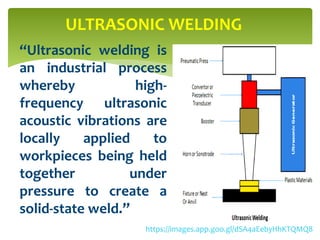
“Ultrasonic welding is
an industrial process
whereby high-
frequency ultrasonic
acoustic vibrations are
locally applied to
workpieces being held
together under
pressure to create a
solid-state weld.”
https://images.app.goo.gl/dSA4aEebyHhKTQMQ8
ULTRASONIC WELDING
 A Press: It is used to apply pressure on the two
plastic pieces to be joined. It may be of pneumatic
or electric driven type.
 Nest or anvil or fixture: It is a clamping device that
is used to hold and clamp the two plastic pieces
together.
 An Ultrasonic Stack: It consists of the three
components, a converter or piezoelectric
transducer, a booster and a horn or sonotrode.
These three elements are tuned to work on
resonate frequency of 15 kHz, 20 kHz, 30 kHz, 35
kHz or 40 kHz.
Equipment’s
 Converter: It converts the electrical signals into high-
frequency mechanical vibration and it does so through
the piezoelectric effect.
 Booster: It modifies the amplitude of vibration
mechanically.
 Horn or Sonotrode: It vibrates at high frequency and
transmits the mechanical vibration to the two pieces to
be welded. The horn is made of titanium or aluminium.
 An Ultrasonic Generator: It generates and delivers high-
frequency electrical signals matching the resonance
frequency of the stack.
 Controller: It is used to control the movement of the
press and delivery of the ultrasonic energy.
Equipment’s
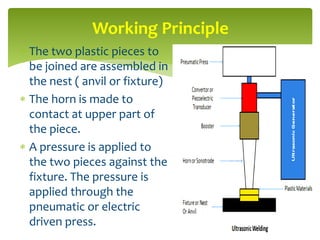
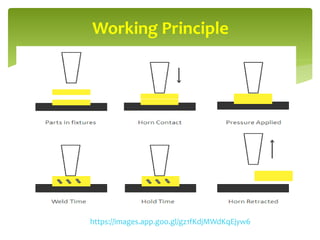
 The two plastic pieces to
be joined are assembled in
the nest ( anvil or fixture)
 The horn is made to
contact at upper part of
the piece.
 A pressure is applied to
the two pieces against the
fixture. The pressure is
applied through the
pneumatic or electric
driven press.
Working Principle
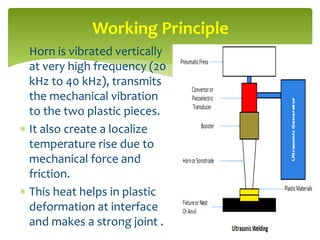
 Horn is vibrated vertically
at very high frequency (20
kHz to 40 kHz), transmits
the mechanical vibration
to the two plastic pieces.
 It also create a localize
temperature rise due to
mechanical force and
friction.
 This heat helps in plastic
deformation at interface
and makes a strong joint .
Working Principle
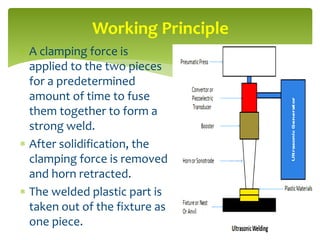
 A clamping force is
applied to the two pieces
for a predetermined
amount of time to fuse
them together to form a
strong weld.
 After solidification, the
clamping force is removed
and horn retracted.
 The welded plastic part is
taken out of the fixture as
one piece.
Working Principle
Working Principle
https://images.app.goo.gl/gz1fKdjMWdKqEjyw6
Advantages:
 It is a fast welding process.
 It has Quick drying time i.e. the pieces do not
remain for a long time in the fixtures to dry
 It can be easily automated.
 It produces a clean and precise joint.
 It exhibits clean weld sites and does not
require and touch-up work.
 It produces a low thermal impact on the
materials.
Advantages and Disadvantages
Disadvantages:
 It cannot be used to produce large joints
(greater than 250 x 300 mm).
 It requires specially designed joints, so it can
make tip contact during the welding process.
 High tooling cost for the fixtures.
 The ultrasonic welding process is restricted
to the lap joints.
Advantages and Disadvantages
 This welding is used in fabrication of nuclear reactor
components.
 It is used in automotive industry for key, head lamp
parts, button and switches etc.
 Ultrasonic is used in electronic industries like
armature winding, switches etc.
 This is clean welding process so it is used in medical
industries to make parts like filters, masks etc.
APPLICATIONS
 A Textbook of Welding Technology by O.P. Khanna.
 Welding Science and Technology by Md. Ibrahim
Khan.
 https://www.theweldingmaster.com
 https://www.mech4study.com
 https://www.safetyandhealthmagazine.com
 https://images.app.goo.gl/TRh3g2CpTqKt4P7YA
References
THANK
YOU

Iwt unit 5 ultrasonic welding

  • 1.
    ULTRASONIC WELDING Er. SushantBhatt, Lecturer, Deptt. Of Mechanical Engg. (IDS) Email: sushantbhatt.ids@srmu.ac.in Er. Arvind Verma, HoD, Deptt. Of Mechanical Engg. (IDS) Email: hod.dip.me@srmu.ac.in Shri Ramswaroop Memorial University, Barabanki, 225003
  • 2.
    “Ultrasonic welding is anindustrial process whereby high- frequency ultrasonic acoustic vibrations are locally applied to workpieces being held together under pressure to create a solid-state weld.” https://images.app.goo.gl/dSA4aEebyHhKTQMQ8 ULTRASONIC WELDING
  • 3.
     A Press:It is used to apply pressure on the two plastic pieces to be joined. It may be of pneumatic or electric driven type.  Nest or anvil or fixture: It is a clamping device that is used to hold and clamp the two plastic pieces together.  An Ultrasonic Stack: It consists of the three components, a converter or piezoelectric transducer, a booster and a horn or sonotrode. These three elements are tuned to work on resonate frequency of 15 kHz, 20 kHz, 30 kHz, 35 kHz or 40 kHz. Equipment’s
  • 4.
     Converter: Itconverts the electrical signals into high- frequency mechanical vibration and it does so through the piezoelectric effect.  Booster: It modifies the amplitude of vibration mechanically.  Horn or Sonotrode: It vibrates at high frequency and transmits the mechanical vibration to the two pieces to be welded. The horn is made of titanium or aluminium.  An Ultrasonic Generator: It generates and delivers high- frequency electrical signals matching the resonance frequency of the stack.  Controller: It is used to control the movement of the press and delivery of the ultrasonic energy. Equipment’s
  • 5.
     The twoplastic pieces to be joined are assembled in the nest ( anvil or fixture)  The horn is made to contact at upper part of the piece.  A pressure is applied to the two pieces against the fixture. The pressure is applied through the pneumatic or electric driven press. Working Principle
  • 6.
     Horn isvibrated vertically at very high frequency (20 kHz to 40 kHz), transmits the mechanical vibration to the two plastic pieces.  It also create a localize temperature rise due to mechanical force and friction.  This heat helps in plastic deformation at interface and makes a strong joint . Working Principle
  • 7.
     A clampingforce is applied to the two pieces for a predetermined amount of time to fuse them together to form a strong weld.  After solidification, the clamping force is removed and horn retracted.  The welded plastic part is taken out of the fixture as one piece. Working Principle
  • 8.
  • 9.
    Advantages:  It isa fast welding process.  It has Quick drying time i.e. the pieces do not remain for a long time in the fixtures to dry  It can be easily automated.  It produces a clean and precise joint.  It exhibits clean weld sites and does not require and touch-up work.  It produces a low thermal impact on the materials. Advantages and Disadvantages
  • 10.
    Disadvantages:  It cannotbe used to produce large joints (greater than 250 x 300 mm).  It requires specially designed joints, so it can make tip contact during the welding process.  High tooling cost for the fixtures.  The ultrasonic welding process is restricted to the lap joints. Advantages and Disadvantages
  • 11.
     This weldingis used in fabrication of nuclear reactor components.  It is used in automotive industry for key, head lamp parts, button and switches etc.  Ultrasonic is used in electronic industries like armature winding, switches etc.  This is clean welding process so it is used in medical industries to make parts like filters, masks etc. APPLICATIONS
  • 12.
     A Textbookof Welding Technology by O.P. Khanna.  Welding Science and Technology by Md. Ibrahim Khan.  https://www.theweldingmaster.com  https://www.mech4study.com  https://www.safetyandhealthmagazine.com  https://images.app.goo.gl/TRh3g2CpTqKt4P7YA References
  • 13.