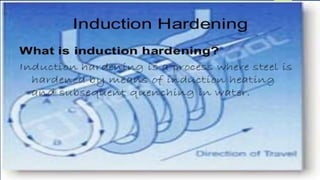
INDUCTION HARDENING
&
FLAME HARDENING
BY:-
SACHIN DEV ( GME/SL/14/4608 )
ANKIT KUMAR ( GME/SL/14/4609 )
ABHISHEK KUMAR ( GME/SL/14/4617 )
SHIVAM SONI ( GME/SL/14/4621 )
ABHISHEK SINGH ( GME/SL/14/4601 )
ASHISH PRAJAPATI (GME/SL/14/4606)
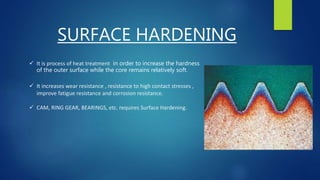
SURFACE HARDENING
 It is process of heat treatment in order to increase the hardness
of the outer surface while the core remains relatively soft.
 It increases wear resistance , resistance to high contact stresses ,
improve fatigue resistance and corrosion resistance.
 CAM, RING GEAR, BEARINGS, etc. requires Surface Hardening.
SOME COMMON SURFACE HARDENING TECHNIQUES
• INDUCTION HARDENING
• FLAME HARDENING
• LASER BEAM HARDENING
• ELECTRON BEAM HARDENING
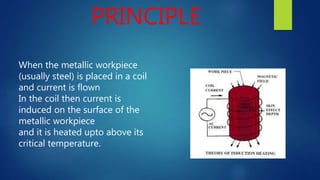
PRINCIPLE
When the metallic workpiece
(usually steel) is placed in a coil
and current is flown
In the coil then current is
induced on the surface of the
metallic workpiece
and it is heated upto above its
critical temperature.
WHY CHOOSE INDUCTION HARDENING ?
• Has much faster heating rate than other methods.
• Provides for more control over outcome
- Less distortion of workpiece
- Easy control of hardness depth
• Heating can be localized for surface hardening
- Allows the core metal to be unaffected
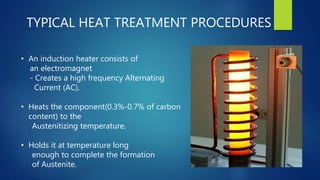
TYPICAL HEAT TREATMENT PROCEDURES
• An induction heater consists of
an electromagnet
- Creates a high frequency Alternating
Current (AC).
• Heats the component(0.3%-0.7% of carbon
content) to the
Austenitizing temperature.
• Holds it at temperature long
enough to complete the formation
of Austenite.
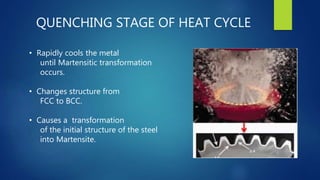
QUENCHING STAGE OF HEAT CYCLE
• Rapidly cools the metal
until Martensitic transformation
occurs.
• Changes structure from
FCC to BCC.
• Causes a transformation
of the initial structure of the steel
into Martensite.
VARIATION OF DEPTH VS FREQUENCY
Where,
d=depth of hardening
p=resistivity
f = frequency
For Deep Hardening a prolonged low frequency
Heating should be employed and vice-versa.
ADVANTAGES
• Fast process
• No Scaling or Decarburisation
• Minimum chances of distortion
• Selectively Hardening
• Ease control of hardness depth
• High wear and fatigue resistance
DISADVANTAGES
• Equipment is more costly
FLAME HARDENING
• It is a rapid high intensity heating, economical
method for selectively hardening specific areas
on the surface of a part followed by an
appropriate quenching method.
• Uses direct impingement of an oxy-acetylene
gas flame onto a defined surface area.
• Used to treat components such as gears,
shafts, cams, crankshafts, camshafts, etc.
TYPES OF FLAME HARDENING
• STATIONARY FLAME HARDENING:- requires specified area to be heated
• PROGRESSIVE FLAME HARDENING:- integrated quench capability
• SPIN FLAME HARDENING:- requires specified area to spin in front of flame head
• COMBINATION FLAME HARDENING:- couples the progressive and spinning methods
HEAT TREATMENT PROCEDURES
• It may be a single torch with a
specially designed head that
automatically indexes and heats the
work material.
• Large parts such as gears or machine
toolways with sizes or shapes that
would make furnace heat treatment
impractical, are easily flame hardened.
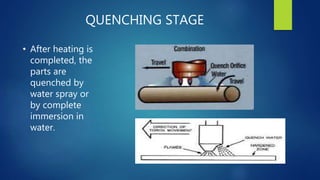
QUENCHING STAGE
• After heating is
completed, the
parts are
quenched by
water spray or
by complete
immersion in
water.
DEPTH OF HARDENED LAYER DEPENDS ON FOLLOWING
PARAMETERS
• Distance between gas flames and the component surface.
• Gas pressure and ratio.
• Rate of travel of flame head or component.
• Type, volume and application of quench.
ADVANTAGES
• Fast process
• Less distortion surface
• Selectively hardening
• Faster localized cooling rates
DISADVANTAGES
• Some oxidation or decarburization may occur as compared to induction hardening.
• Explosive fuel gases have to be used cautiously.
QUESTIONS ?
Induction Hardening and Flame Hardening

Induction Hardening and Flame Hardening

  • 1.
    INDUCTION HARDENING & FLAME HARDENING BY:- SACHINDEV ( GME/SL/14/4608 ) ANKIT KUMAR ( GME/SL/14/4609 ) ABHISHEK KUMAR ( GME/SL/14/4617 ) SHIVAM SONI ( GME/SL/14/4621 ) ABHISHEK SINGH ( GME/SL/14/4601 ) ASHISH PRAJAPATI (GME/SL/14/4606)
  • 2.
    SURFACE HARDENING  Itis process of heat treatment in order to increase the hardness of the outer surface while the core remains relatively soft.  It increases wear resistance , resistance to high contact stresses , improve fatigue resistance and corrosion resistance.  CAM, RING GEAR, BEARINGS, etc. requires Surface Hardening.
  • 3.
    SOME COMMON SURFACEHARDENING TECHNIQUES • INDUCTION HARDENING • FLAME HARDENING • LASER BEAM HARDENING • ELECTRON BEAM HARDENING
  • 5.
    PRINCIPLE When the metallicworkpiece (usually steel) is placed in a coil and current is flown In the coil then current is induced on the surface of the metallic workpiece and it is heated upto above its critical temperature.
  • 6.
    WHY CHOOSE INDUCTIONHARDENING ? • Has much faster heating rate than other methods. • Provides for more control over outcome - Less distortion of workpiece - Easy control of hardness depth • Heating can be localized for surface hardening - Allows the core metal to be unaffected
  • 7.
    TYPICAL HEAT TREATMENTPROCEDURES • An induction heater consists of an electromagnet - Creates a high frequency Alternating Current (AC). • Heats the component(0.3%-0.7% of carbon content) to the Austenitizing temperature. • Holds it at temperature long enough to complete the formation of Austenite.
  • 8.
    QUENCHING STAGE OFHEAT CYCLE • Rapidly cools the metal until Martensitic transformation occurs. • Changes structure from FCC to BCC. • Causes a transformation of the initial structure of the steel into Martensite.
  • 9.
    VARIATION OF DEPTHVS FREQUENCY Where, d=depth of hardening p=resistivity f = frequency For Deep Hardening a prolonged low frequency Heating should be employed and vice-versa.
  • 10.
    ADVANTAGES • Fast process •No Scaling or Decarburisation • Minimum chances of distortion • Selectively Hardening • Ease control of hardness depth • High wear and fatigue resistance DISADVANTAGES • Equipment is more costly
  • 11.
    FLAME HARDENING • Itis a rapid high intensity heating, economical method for selectively hardening specific areas on the surface of a part followed by an appropriate quenching method. • Uses direct impingement of an oxy-acetylene gas flame onto a defined surface area. • Used to treat components such as gears, shafts, cams, crankshafts, camshafts, etc.
  • 12.
    TYPES OF FLAMEHARDENING • STATIONARY FLAME HARDENING:- requires specified area to be heated • PROGRESSIVE FLAME HARDENING:- integrated quench capability • SPIN FLAME HARDENING:- requires specified area to spin in front of flame head • COMBINATION FLAME HARDENING:- couples the progressive and spinning methods
  • 13.
    HEAT TREATMENT PROCEDURES •It may be a single torch with a specially designed head that automatically indexes and heats the work material. • Large parts such as gears or machine toolways with sizes or shapes that would make furnace heat treatment impractical, are easily flame hardened.
  • 14.
    QUENCHING STAGE • Afterheating is completed, the parts are quenched by water spray or by complete immersion in water.
  • 15.
    DEPTH OF HARDENEDLAYER DEPENDS ON FOLLOWING PARAMETERS • Distance between gas flames and the component surface. • Gas pressure and ratio. • Rate of travel of flame head or component. • Type, volume and application of quench.
  • 16.
    ADVANTAGES • Fast process •Less distortion surface • Selectively hardening • Faster localized cooling rates DISADVANTAGES • Some oxidation or decarburization may occur as compared to induction hardening. • Explosive fuel gases have to be used cautiously.
  • 17.