IP Addresses
• Structure of an IP address
• Subnetting
• CIDR
• IP Version 6 addresses
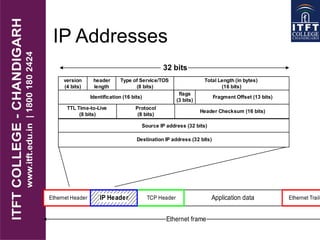
IP Addresses
Application dataTCP HeaderEthernet Header Ethernet Traile
Ethernet frame
IP Header
version
(4 bits)
header
length
Type of Service/TOS
(8 bits)
Total Length (in bytes)
(16 bits)
Identification (16 bits)
flags
(3 bits)
Fragment Offset (13 bits)
Source IP address (32 bits)
Destination IP address (32 bits)
TTL Time-to-Live
(8 bits)
Protocol
(8 bits)
Header Checksum (16 bits)
32 bits
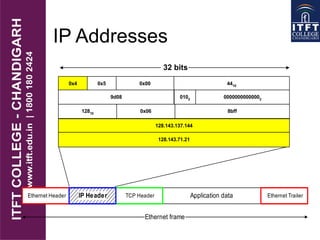
IP Addresses
Application dataTCP HeaderEthernet Header Ethernet Trailer
Ethernet frame
IP Header
0x4 0x5 0x00 4410
9d08 0102 00000000000002
128.143.137.144
128.143.71.21
12810 0x06 8bff
32 bits
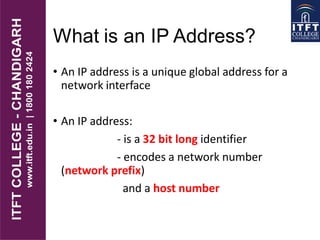
What is an IP Address?
• An IP address is a unique global address for a
network interface
• An IP address:
- is a 32 bit long identifier
- encodes a network number
(network prefix)
and a host number
Dotted Decimal Notation
• IP addresses are written in a so-called dotted
decimal notation
• Each byte is identified by a decimal number in
the range [0..255]:
• Example:
1000111110000000 10001001 10010000
1st Byte
= 128
2nd Byte
= 143
3rd Byte
= 137
4th Byte
= 144
128.143.137.144
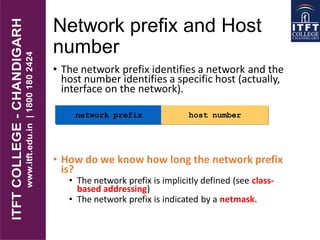
• The network prefix identifies a network and the
host number identifies a specific host (actually,
interface on the network).
• How do we know how long the network prefix
is?
• The network prefix is implicitly defined (see class-
based addressing)
• The network prefix is indicated by a netmask.
Network prefix and Host
number
network prefix host number
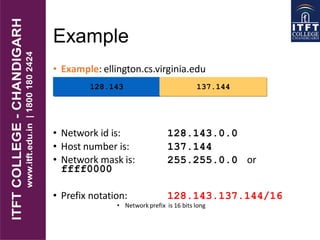
• Example: ellington.cs.virginia.edu
• Network id is: 128.143.0.0
• Host number is: 137.144
• Network mask is: 255.255.0.0 or
ffff0000
• Prefix notation: 128.143.137.144/16
• Network prefix is 16 bits long
Example
128.143 137.144
Subnetting
Subnetting
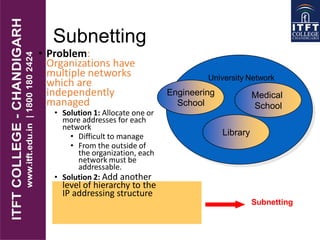
• Problem:
Organizations have
multiple networks
which are
independently
managed
• Solution 1: Allocate one or
more addresses for each
network
• Difficult to manage
• From the outside of
the organization, each
network must be
addressable.
• Solution 2: Add another
level of hierarchy to the
IP addressing structure
University Network
Medical
School
Library
Engineering
School
Basic Idea of Subnetting
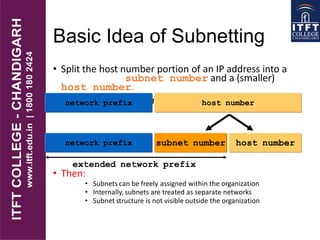
• Split the host number portion of an IP address into a
subnet number and a (smaller)
host number.
• Result is a 3-layer hierarchy
• Then:
• Subnets can be freely assigned within the organization
• Internally, subnets are treated as separate networks
• Subnet structure is not visible outside the organization
network prefix host number
subnet numbernetwork prefix host number
extended network prefix
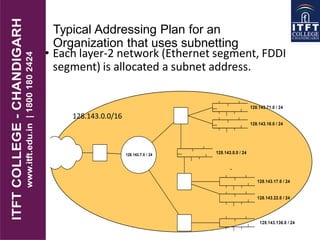
• Each layer-2 network (Ethernet segment, FDDI
segment) is allocated a subnet address.
128.143.17.0 / 24
128.143.71.0 / 24
128.143.7.0 / 24
128.143.16.0 / 24
128.143.8.0 / 24
128.143.22.0 / 24
128.143.136.0 / 24
Typical Addressing Plan for an
Organization that uses subnetting
128.143.0.0/16
Advantages of Subnetting
• With subnetting, IP addresses use a 3-layer hierarchy:
• Network
• Subnet
• Host
• Improves efficiency of IP addresses by not consuming
an entire address space for each physical network.
• Reduces router complexity. Since external routers do
not know about subnetting, the complexity of routing
tables at external routers is reduced.
• Note: Length of the subnet mask need not be
identical at all subnetworks.

ITFT - IP adressing

  • 1.
    IP Addresses • Structureof an IP address • Subnetting • CIDR • IP Version 6 addresses
  • 2.
    IP Addresses Application dataTCPHeaderEthernet Header Ethernet Traile Ethernet frame IP Header version (4 bits) header length Type of Service/TOS (8 bits) Total Length (in bytes) (16 bits) Identification (16 bits) flags (3 bits) Fragment Offset (13 bits) Source IP address (32 bits) Destination IP address (32 bits) TTL Time-to-Live (8 bits) Protocol (8 bits) Header Checksum (16 bits) 32 bits
  • 3.
    IP Addresses Application dataTCPHeaderEthernet Header Ethernet Trailer Ethernet frame IP Header 0x4 0x5 0x00 4410 9d08 0102 00000000000002 128.143.137.144 128.143.71.21 12810 0x06 8bff 32 bits
  • 4.
    What is anIP Address? • An IP address is a unique global address for a network interface • An IP address: - is a 32 bit long identifier - encodes a network number (network prefix) and a host number
  • 5.
    Dotted Decimal Notation •IP addresses are written in a so-called dotted decimal notation • Each byte is identified by a decimal number in the range [0..255]: • Example: 1000111110000000 10001001 10010000 1st Byte = 128 2nd Byte = 143 3rd Byte = 137 4th Byte = 144 128.143.137.144
  • 6.
    • The networkprefix identifies a network and the host number identifies a specific host (actually, interface on the network). • How do we know how long the network prefix is? • The network prefix is implicitly defined (see class- based addressing) • The network prefix is indicated by a netmask. Network prefix and Host number network prefix host number
  • 7.
    • Example: ellington.cs.virginia.edu •Network id is: 128.143.0.0 • Host number is: 137.144 • Network mask is: 255.255.0.0 or ffff0000 • Prefix notation: 128.143.137.144/16 • Network prefix is 16 bits long Example 128.143 137.144
  • 8.
    Subnetting Subnetting • Problem: Organizations have multiplenetworks which are independently managed • Solution 1: Allocate one or more addresses for each network • Difficult to manage • From the outside of the organization, each network must be addressable. • Solution 2: Add another level of hierarchy to the IP addressing structure University Network Medical School Library Engineering School
  • 9.
    Basic Idea ofSubnetting • Split the host number portion of an IP address into a subnet number and a (smaller) host number. • Result is a 3-layer hierarchy • Then: • Subnets can be freely assigned within the organization • Internally, subnets are treated as separate networks • Subnet structure is not visible outside the organization network prefix host number subnet numbernetwork prefix host number extended network prefix
  • 10.
    • Each layer-2network (Ethernet segment, FDDI segment) is allocated a subnet address. 128.143.17.0 / 24 128.143.71.0 / 24 128.143.7.0 / 24 128.143.16.0 / 24 128.143.8.0 / 24 128.143.22.0 / 24 128.143.136.0 / 24 Typical Addressing Plan for an Organization that uses subnetting 128.143.0.0/16
  • 11.
    Advantages of Subnetting •With subnetting, IP addresses use a 3-layer hierarchy: • Network • Subnet • Host • Improves efficiency of IP addresses by not consuming an entire address space for each physical network. • Reduces router complexity. Since external routers do not know about subnetting, the complexity of routing tables at external routers is reduced. • Note: Length of the subnet mask need not be identical at all subnetworks.