CS 352
Network Layer: Intro
CS 352, Lecture 14.1
http://www.cs.rutgers.edu/~sn624/352
Srinivas Narayana
1
Transport
Application
Transport
Network
Host-to-Net
…
FTP HTTP SMTP DNS
TCP UDP
IP
802.11 X.25 ATM
HTTPS
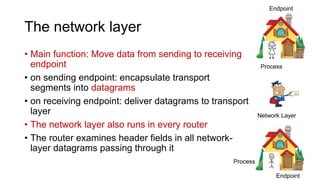
The network layer
• Main function: Move data from sending to receiving
endpoint
• on sending endpoint: encapsulate transport
segments into datagrams
• on receiving endpoint: deliver datagrams to transport
layer
• The network layer also runs in every router
• The router examines header fields in all network-
layer datagrams passing through it
Network Layer
Process
Endpoint
Process
Endpoint
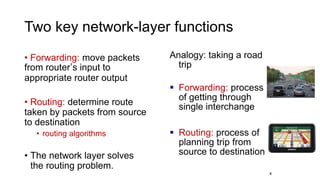
Two key network-layer functions
• Forwarding: move packets
from router’s input to
appropriate router output
• Routing: determine route
taken by packets from source
to destination
• routing algorithms
• The network layer solves
the routing problem.
Analogy: taking a road
trip
 Forwarding: process
of getting through
single interchange
 Routing: process of
planning trip from
source to destination
4
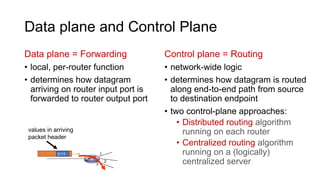
Data plane and Control Plane
Data plane = Forwarding
• local, per-router function
• determines how datagram
arriving on router input port is
forwarded to router output port
Control plane = Routing
• network-wide logic
• determines how datagram is routed
along end-to-end path from source
to destination endpoint
• two control-plane approaches:
• Distributed routing algorithm
running on each router
• Centralized routing algorithm
running on a (logically)
centralized server
0111
values in arriving
packet header
1
2
3
CS 352
Internet Addressing
CS 352, Lecture 14.2
http://www.cs.rutgers.edu/~sn624/352
Srinivas Narayana
7
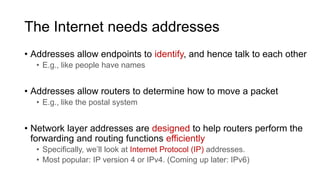
The Internet needs addresses
• Addresses allow endpoints to identify, and hence talk to each other
• E.g., like people have names
• Addresses allow routers to determine how to move a packet
• E.g., like the postal system
• Network layer addresses are designed to help routers perform the
forwarding and routing functions efficiently
• Specifically, we’ll look at Internet Protocol (IP) addresses.
• Most popular: IP version 4 or IPv4. (Coming up later: IPv6)
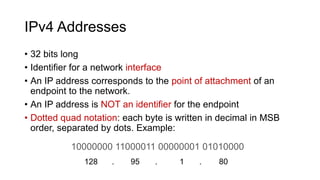
IPv4 Addresses
• 32 bits long
• Identifier for a network interface
• An IP address corresponds to the point of attachment of an
endpoint to the network.
• An IP address is NOT an identifier for the endpoint
• Dotted quad notation: each byte is written in decimal in MSB
order, separated by dots. Example:
10000000 11000011 00000001 01010000
128 95 1 80
. . .
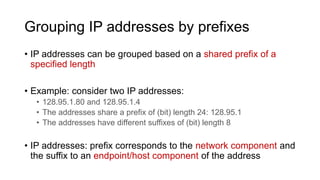
Grouping IP addresses by prefixes
• IP addresses can be grouped based on a shared prefix of a
specified length
• Example: consider two IP addresses:
• 128.95.1.80 and 128.95.1.4
• The addresses share a prefix of (bit) length 24: 128.95.1
• The addresses have different suffixes of (bit) length 8
• IP addresses: prefix corresponds to the network component and
the suffix to an endpoint/host component of the address
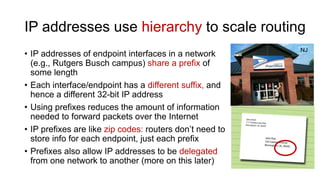
IP addresses use hierarchy to scale routing
• IP addresses of endpoint interfaces in a network
(e.g., Rutgers Busch campus) share a prefix of
some length
• Each interface/endpoint has a different suffix, and
hence a different 32-bit IP address
• Using prefixes reduces the amount of information
needed to forward packets over the Internet
• IP prefixes are like zip codes: routers don’t need to
store info for each endpoint, just each prefix
• Prefixes also allow IP addresses to be delegated
from one network to another (more on this later)
NJ
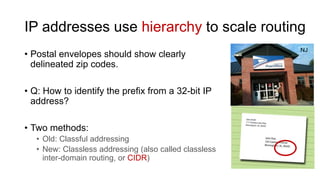
IP addresses use hierarchy to scale routing
• Postal envelopes should show clearly
delineated zip codes.
• Q: How to identify the prefix from a 32-bit IP
address?
• Two methods:
• Old: Classful addressing
• New: Classless addressing (also called classless
inter-domain routing, or CIDR)
NJ
Classful IPv4 addressing
0 Net
32 bits
Host
10 Net Host
110 Net Host
1110 Multicast address
1111 Reserved
A
B
C
D
E
Class
0.x.x.x – 127.x.x.x
128.x.x.x – 191.x.x.x
192.x.x.x – 223.x.x.x
224.x.x.x – 239.x.x.x
240.x.x.x – 255.x.x.x
8 bit
prefix
16 bit
prefix
24 bit
prefix
Destination is a group of hosts
Unicast: single endpoint dest
First octet of IP address gives
you the prefix length.
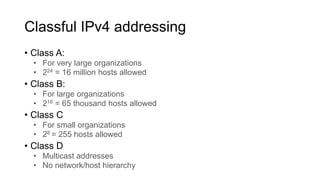
Classful IPv4 addressing
• Class A:
• For very large organizations
• 224 = 16 million hosts allowed
• Class B:
• For large organizations
• 216 = 65 thousand hosts allowed
• Class C
• For small organizations
• 28 = 255 hosts allowed
• Class D
• Multicast addresses
• No network/host hierarchy
Problems with classful addressing
• IP prefixes are allocated to organizations (e.g., Rutgers) by
Internet Registry organizations (e.g., ARIN, in North America)
• Many organizations required something bigger than class C
address, but smaller than a class A (or even B) address
• However, the Internet was running out of class B addresses
• Too many networks required multiple class C addresses
• Not enough nets in class A for large + medium organizations
• Key issue: Classful addressing is too coarse-grained: The
addressing strategy must allow for greater diversity of network
sizes
Classless IPv4 addressing
(CIDR)
Classless IPv4 addressing
• Also called classless inter-domain routing (CIDR)
• Key idea: Network component of the address (ie: prefix) can
have any length (usually from 8—32)
• Address format: a.b.c.d/x, where x is the prefix length
• Customary to use 0s for all suffix bits
11001000 00010111 00010000 00000000
network
part
host
part
200.23.16.0/23
CIDR
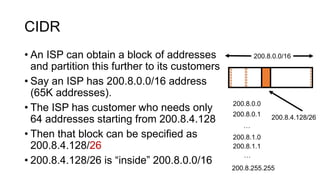
• An ISP can obtain a block of addresses
and partition this further to its customers
• Say an ISP has 200.8.0.0/16 address
(65K addresses).
• The ISP has customer who needs only
64 addresses starting from 200.8.4.128
• Then that block can be specified as
200.8.4.128/26
• 200.8.4.128/26 is “inside” 200.8.0.0/16
200.8.0.0/16
200.8.4.128/26
200.8.0.0
200.8.0.1
200.8.1.0
…
200.8.1.1
…
200.8.255.255
Netmask (or subnet mask)
• An alternative to denote the IP prefix length of an organization
• 32 bits: a 1-bit denotes a prefix bit position. 0 is the host part.
11001000 00010111 00010000 00000000
network
part
host
part
200.23.16.0/23
11111111 11111111 11111110 00000000
network part
of mask
Host part
of mask
Netmask: 255.255.254.0
Detecting addresses from same network
• Given IP addresses A and B, and netmask M.
1. Compute logical AND (A & M).
2. Compute logical AND (B & M).
3. If (A & M) == (B & M) then A and B are
on the same subnet.
• Ex: A = 165.230.82.52, B = 165.230.24.93, M = 255.255.128.0
• A and B are in the same network according to the netmask
• A & M == B & M == 165.230.0.0
Finding your own IP address(es)
• A small demo
network-addressing.pptx

network-addressing.pptx

  • 1.
    CS 352 Network Layer:Intro CS 352, Lecture 14.1 http://www.cs.rutgers.edu/~sn624/352 Srinivas Narayana 1
  • 2.
  • 3.
    The network layer •Main function: Move data from sending to receiving endpoint • on sending endpoint: encapsulate transport segments into datagrams • on receiving endpoint: deliver datagrams to transport layer • The network layer also runs in every router • The router examines header fields in all network- layer datagrams passing through it Network Layer Process Endpoint Process Endpoint
  • 4.
    Two key network-layerfunctions • Forwarding: move packets from router’s input to appropriate router output • Routing: determine route taken by packets from source to destination • routing algorithms • The network layer solves the routing problem. Analogy: taking a road trip  Forwarding: process of getting through single interchange  Routing: process of planning trip from source to destination 4
  • 5.
    Data plane andControl Plane Data plane = Forwarding • local, per-router function • determines how datagram arriving on router input port is forwarded to router output port Control plane = Routing • network-wide logic • determines how datagram is routed along end-to-end path from source to destination endpoint • two control-plane approaches: • Distributed routing algorithm running on each router • Centralized routing algorithm running on a (logically) centralized server 0111 values in arriving packet header 1 2 3
  • 7.
    CS 352 Internet Addressing CS352, Lecture 14.2 http://www.cs.rutgers.edu/~sn624/352 Srinivas Narayana 7
  • 8.
    The Internet needsaddresses • Addresses allow endpoints to identify, and hence talk to each other • E.g., like people have names • Addresses allow routers to determine how to move a packet • E.g., like the postal system • Network layer addresses are designed to help routers perform the forwarding and routing functions efficiently • Specifically, we’ll look at Internet Protocol (IP) addresses. • Most popular: IP version 4 or IPv4. (Coming up later: IPv6)
  • 9.
    IPv4 Addresses • 32bits long • Identifier for a network interface • An IP address corresponds to the point of attachment of an endpoint to the network. • An IP address is NOT an identifier for the endpoint • Dotted quad notation: each byte is written in decimal in MSB order, separated by dots. Example: 10000000 11000011 00000001 01010000 128 95 1 80 . . .
  • 10.
    Grouping IP addressesby prefixes • IP addresses can be grouped based on a shared prefix of a specified length • Example: consider two IP addresses: • 128.95.1.80 and 128.95.1.4 • The addresses share a prefix of (bit) length 24: 128.95.1 • The addresses have different suffixes of (bit) length 8 • IP addresses: prefix corresponds to the network component and the suffix to an endpoint/host component of the address
  • 11.
    IP addresses usehierarchy to scale routing • IP addresses of endpoint interfaces in a network (e.g., Rutgers Busch campus) share a prefix of some length • Each interface/endpoint has a different suffix, and hence a different 32-bit IP address • Using prefixes reduces the amount of information needed to forward packets over the Internet • IP prefixes are like zip codes: routers don’t need to store info for each endpoint, just each prefix • Prefixes also allow IP addresses to be delegated from one network to another (more on this later) NJ
  • 12.
    IP addresses usehierarchy to scale routing • Postal envelopes should show clearly delineated zip codes. • Q: How to identify the prefix from a 32-bit IP address? • Two methods: • Old: Classful addressing • New: Classless addressing (also called classless inter-domain routing, or CIDR) NJ
  • 13.
  • 14.
    Classful IPv4 addressing 0Net 32 bits Host 10 Net Host 110 Net Host 1110 Multicast address 1111 Reserved A B C D E Class 0.x.x.x – 127.x.x.x 128.x.x.x – 191.x.x.x 192.x.x.x – 223.x.x.x 224.x.x.x – 239.x.x.x 240.x.x.x – 255.x.x.x 8 bit prefix 16 bit prefix 24 bit prefix Destination is a group of hosts Unicast: single endpoint dest Unicast: single endpoint dest Unicast: single endpoint dest First octet of IP address gives you the prefix length.
  • 15.
    Classful IPv4 addressing •Class A: • For very large organizations • 224 = 16 million hosts allowed • Class B: • For large organizations • 216 = 65 thousand hosts allowed • Class C • For small organizations • 28 = 255 hosts allowed • Class D • Multicast addresses • No network/host hierarchy
  • 16.
    Problems with classfuladdressing • IP prefixes are allocated to organizations (e.g., Rutgers) by Internet Registry organizations (e.g., ARIN, in North America) • Many organizations required something bigger than class C address, but smaller than a class A (or even B) address • However, the Internet was running out of class B addresses • Too many networks required multiple class C addresses • Not enough nets in class A for large + medium organizations • Key issue: Classful addressing is too coarse-grained: The addressing strategy must allow for greater diversity of network sizes
  • 17.
  • 18.
    Classless IPv4 addressing •Also called classless inter-domain routing (CIDR) • Key idea: Network component of the address (ie: prefix) can have any length (usually from 8—32) • Address format: a.b.c.d/x, where x is the prefix length • Customary to use 0s for all suffix bits 11001000 00010111 00010000 00000000 network part host part 200.23.16.0/23
  • 19.
    CIDR • An ISPcan obtain a block of addresses and partition this further to its customers • Say an ISP has 200.8.0.0/16 address (65K addresses). • The ISP has customer who needs only 64 addresses starting from 200.8.4.128 • Then that block can be specified as 200.8.4.128/26 • 200.8.4.128/26 is “inside” 200.8.0.0/16 200.8.0.0/16 200.8.4.128/26 200.8.0.0 200.8.0.1 200.8.1.0 … 200.8.1.1 … 200.8.255.255
  • 20.
    Netmask (or subnetmask) • An alternative to denote the IP prefix length of an organization • 32 bits: a 1-bit denotes a prefix bit position. 0 is the host part. 11001000 00010111 00010000 00000000 network part host part 200.23.16.0/23 11111111 11111111 11111110 00000000 network part of mask Host part of mask Netmask: 255.255.254.0
  • 21.
    Detecting addresses fromsame network • Given IP addresses A and B, and netmask M. 1. Compute logical AND (A & M). 2. Compute logical AND (B & M). 3. If (A & M) == (B & M) then A and B are on the same subnet. • Ex: A = 165.230.82.52, B = 165.230.24.93, M = 255.255.128.0 • A and B are in the same network according to the netmask • A & M == B & M == 165.230.0.0
  • 22.
    Finding your ownIP address(es) • A small demo