IP-V-4 ADDRESSING
R. Mangena
Harare Zimbabwe- Computer Engin
• IP address is an address having information about how to reach a
specific host, especially outside the LAN
• Internet Protocol Version 4 (IPv4) is the fourth revision of the Internet
Protocol and a widely used protocol in data communication over
different kinds of networks. IPv4 is a connectionless protocol used in
packet-switched layer networks, such as Ethernet. It provides the
logical connection between network devices by providing identification
for each device. There are many ways to configure IPv4 with all kinds
of devices – including manual and automatic configurations –
depending on the network type.
• IPv4 is based on the best-effort model. This model guarantees neither
delivery nor avoidance of duplicate delivery; these aspects are handled
WHAT IS IPV4 ADDRESS
• IPv4 addresses are 32-bit numbers that are
typically displayed in dotted decimal notation.
UNDERSTANDING IPV4
ADDRESSING
A 32-bit address contains two primary parts:
• The network prefix
• The host number.
All hosts within a single network share the same network
address. Each host also has an address that uniquely
identifies it. Depending on the scope of the network and
the type of device, the address is either globally or locally
unique. Devices that are visible to users outside the
network (webservers, for example) must have a globally
unique IP address. Devices that are visible only within the
network must have locally unique IP addresses.
UNDERSTANDING IPV4
ADDRESSING
• IP addresses are assigned by a central numbering
authority called the Internet Assigned Numbers
Authority (IANA). IANA ensures that addresses are
globally unique where needed and has a large
address space reserved for use by devices not
visible outside their own networks.
SECTIONS OF IP ADDRESSING
•IPv4 Classful Addressing
•IPv4 Dotted Decimal Notation
•IPv4 Subnetting
•IPv4 Variable-Length Subnet Masks
IPV4 CLASSFUL ADDRESSING
• To provide flexibility in the number of addresses
distributed to networks of different sizes, 4-octet (32-
bit) IP addresses were originally divided into three
different categories or classes: class A, class B, and
class C. Each address class specifies a different
number of bits for its network prefix and host
number:
IPV4 CLASSFUL ADDRESSING
CLASSES
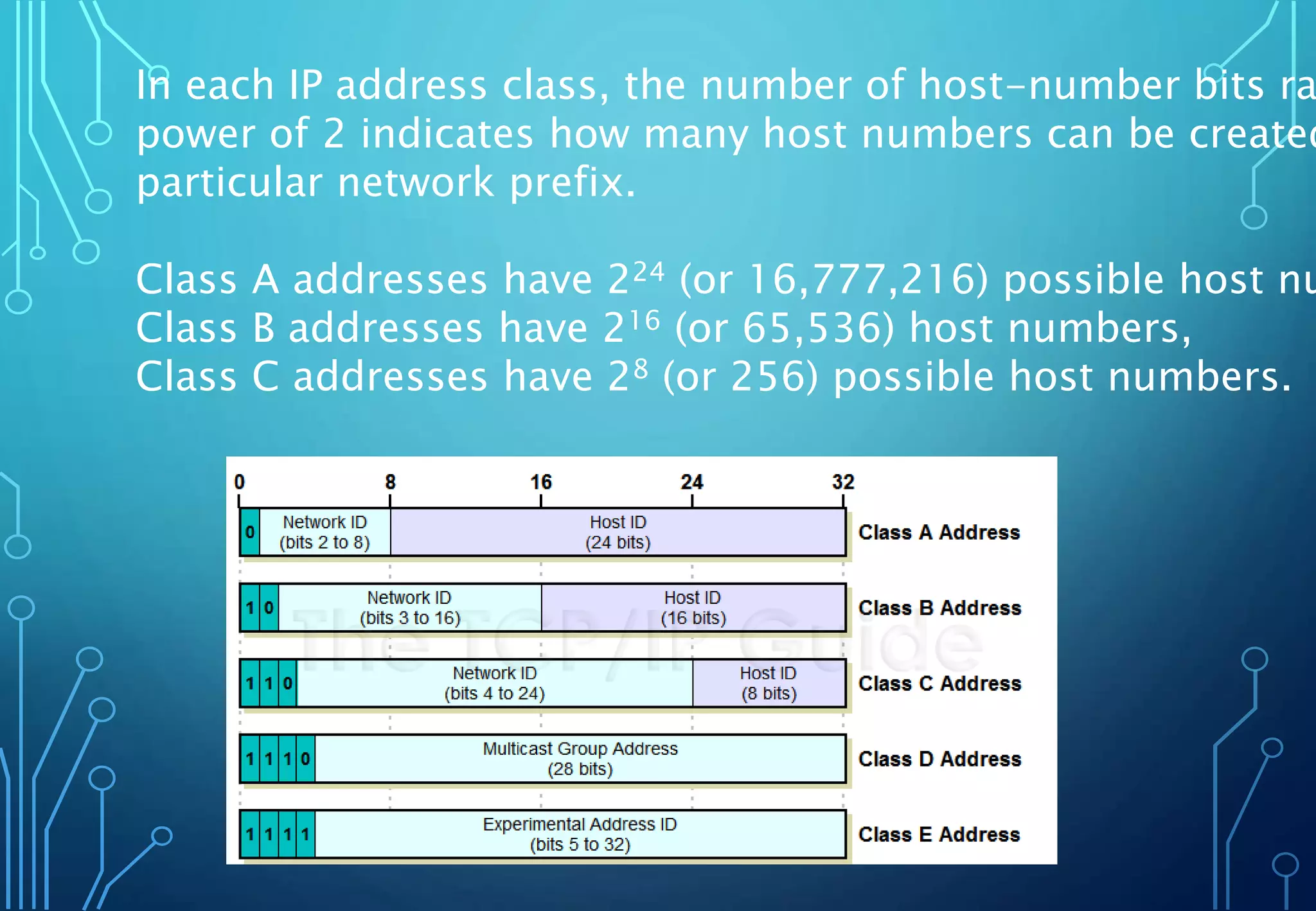
• Class A IP addresses, where the 1st bit is 0,
encompass the range of 0.0.0.0 to 127.255.255.255.
This class is for large networks and has 8 bits for
network and 24 bits for hosts.
• Class B IP addresses, where the 1st two bits are 10,
are in the range of 128.0.0.0 to 191.255.255.255.
This class is for medium networks and has 16 bits for
network and 16 bits for hosts.
• Class C IP addresses, where the 1st three bits are
110, are in the range of 192.0.0.0 to
223.255.255.255. This class is for smaller networks
In each IP address class, the number of host-number bits ra
power of 2 indicates how many host numbers can be created
particular network prefix.
Class A addresses have 224 (or 16,777,216) possible host nu
Class B addresses have 216 (or 65,536) host numbers,
Class C addresses have 28 (or 256) possible host numbers.
• Prior to the introduction of IPv6 as a solution to
the internet’s running out of addresses, the idea of
opening the class E addresses was hotly debated.
While forming the basis for IP address assignment,
the system of IP address classes described here is
generally bypassed today by use of Classless Inter-
Domain Routing (CIDR) addressing.
IPV4 DOTTED DECIMAL
NOTATION
The 32-bit IPv4 addresses are most often expressed in
dotted decimal notation, in which each octet (or byte) is
treated as a separate number. Within an octet (32BIT), the
rightmost bit represents 20 (or 1), increasing to the left until
the first bit in the octet is 27 (or 128). Following are IP
addresses in binary format and their dotted decimal
equivalents:
11010000 01100010 11000000 10101010 =
208.98.192.170
01110110 00001111 11110000 01010101 =
IPV4 SUBNETTING
• Because of the physical and architectural limitations on the
size of networks, you often must break large networks into
smaller subnetworks. Within a network, each wire or ring
requires its own network number and identifying subnet
address.
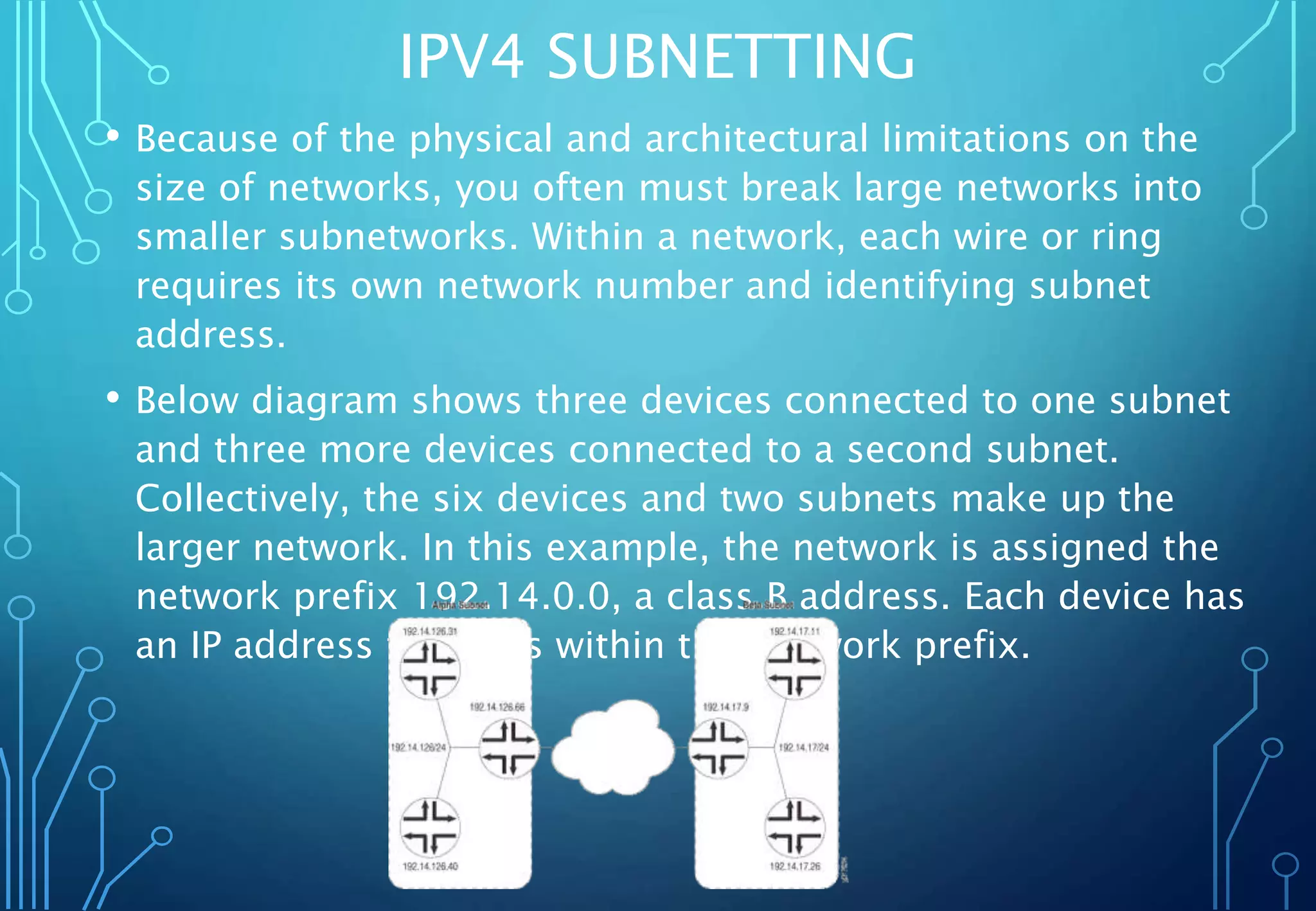
• Below diagram shows three devices connected to one subnet
and three more devices connected to a second subnet.
Collectively, the six devices and two subnets make up the
larger network. In this example, the network is assigned the
network prefix 192.14.0.0, a class B address. Each device has
an IP address that falls within this network prefix.
• In addition to sharing a network prefix (the first two octets),
the devices on each subnet share a third octet. The third
octet identifies the subnet. All devices on a subnet must
have the same subnet address. In this case, the alpha
subnet has the IP address 192.14.126.0 and the beta
subnet has the IP address 192.14.17.0.
• The subnet address 192.14.17.0 can be represented as
follows in binary notation:
• 11000000 . 00001110 . 00010001 . xxxxxxxx
• Because the first 24 bits in the 32-bit address identify the
subnet, the last 8 bits are not significant. To indicate the
subnet, the address is written as 192.14.17.0/24(or
just 192.14.17/24). The /24 is the subnet mask (sometimes
shown as 255.255.255.0).
IPV4 VARIABLE-LENGTH SUBNET
MASKS
• Traditionally, subnets were divided by address class. Subnets had
either 8, 16, or 24 significant bits, corresponding to 224, 216, or 28
possible hosts. As a result, an entire /16 subnet had to be allocated
for a network that required only 400 addresses, wasting 65,136 (216
– 400 = 65,136) addresses.
• To help allocate address spaces more efficiently, variable-length
subnet masks (VLSMs) were introduced. Using VLSM, network
architects can allocate more precisely the number of addresses
required for a particular subnet.
• For example, suppose a network with the prefix 192.14.17/24 is
divided into two smaller subnets, one consisting of 18 devices and
the other of 46 devices.
• To accommodate 18 devices, the first subnet must
have 25 (32) host numbers. Having 5 bits assigned
to the host number leaves 27 bits of the 32-bit
address for the subnet. The IP address of the first
subnet is therefore 192.14.17.128/27, or the
following in binary notation:
• 11000000 . 00001110 . 00010001 . 100xxxxx
• The subnet mask includes 27 significant digits.
• To create the second subnet of 46 devices, the network
must accommodate 26 (64) host numbers. The IP
address of the second subnet is 192.14.17.64/26, or
11000000 . 00001110 . 00010001 . 01xxxxxx
• By assigning address bits within the larger /24 subnet
mask, you create two smaller subnets that use the
allocated address space more efficiently.

Ray ipv4 addresses

  • 1.
    IP-V-4 ADDRESSING R. Mangena HarareZimbabwe- Computer Engin
  • 2.
    • IP addressis an address having information about how to reach a specific host, especially outside the LAN • Internet Protocol Version 4 (IPv4) is the fourth revision of the Internet Protocol and a widely used protocol in data communication over different kinds of networks. IPv4 is a connectionless protocol used in packet-switched layer networks, such as Ethernet. It provides the logical connection between network devices by providing identification for each device. There are many ways to configure IPv4 with all kinds of devices – including manual and automatic configurations – depending on the network type. • IPv4 is based on the best-effort model. This model guarantees neither delivery nor avoidance of duplicate delivery; these aspects are handled
  • 3.
    WHAT IS IPV4ADDRESS • IPv4 addresses are 32-bit numbers that are typically displayed in dotted decimal notation.
  • 4.
    UNDERSTANDING IPV4 ADDRESSING A 32-bitaddress contains two primary parts: • The network prefix • The host number. All hosts within a single network share the same network address. Each host also has an address that uniquely identifies it. Depending on the scope of the network and the type of device, the address is either globally or locally unique. Devices that are visible to users outside the network (webservers, for example) must have a globally unique IP address. Devices that are visible only within the network must have locally unique IP addresses.
  • 5.
    UNDERSTANDING IPV4 ADDRESSING • IPaddresses are assigned by a central numbering authority called the Internet Assigned Numbers Authority (IANA). IANA ensures that addresses are globally unique where needed and has a large address space reserved for use by devices not visible outside their own networks.
  • 6.
    SECTIONS OF IPADDRESSING •IPv4 Classful Addressing •IPv4 Dotted Decimal Notation •IPv4 Subnetting •IPv4 Variable-Length Subnet Masks
  • 7.
    IPV4 CLASSFUL ADDRESSING •To provide flexibility in the number of addresses distributed to networks of different sizes, 4-octet (32- bit) IP addresses were originally divided into three different categories or classes: class A, class B, and class C. Each address class specifies a different number of bits for its network prefix and host number:
  • 8.
    IPV4 CLASSFUL ADDRESSING CLASSES •Class A IP addresses, where the 1st bit is 0, encompass the range of 0.0.0.0 to 127.255.255.255. This class is for large networks and has 8 bits for network and 24 bits for hosts. • Class B IP addresses, where the 1st two bits are 10, are in the range of 128.0.0.0 to 191.255.255.255. This class is for medium networks and has 16 bits for network and 16 bits for hosts. • Class C IP addresses, where the 1st three bits are 110, are in the range of 192.0.0.0 to 223.255.255.255. This class is for smaller networks
  • 9.
    In each IPaddress class, the number of host-number bits ra power of 2 indicates how many host numbers can be created particular network prefix. Class A addresses have 224 (or 16,777,216) possible host nu Class B addresses have 216 (or 65,536) host numbers, Class C addresses have 28 (or 256) possible host numbers.
  • 10.
    • Prior tothe introduction of IPv6 as a solution to the internet’s running out of addresses, the idea of opening the class E addresses was hotly debated. While forming the basis for IP address assignment, the system of IP address classes described here is generally bypassed today by use of Classless Inter- Domain Routing (CIDR) addressing.
  • 11.
    IPV4 DOTTED DECIMAL NOTATION The32-bit IPv4 addresses are most often expressed in dotted decimal notation, in which each octet (or byte) is treated as a separate number. Within an octet (32BIT), the rightmost bit represents 20 (or 1), increasing to the left until the first bit in the octet is 27 (or 128). Following are IP addresses in binary format and their dotted decimal equivalents: 11010000 01100010 11000000 10101010 = 208.98.192.170 01110110 00001111 11110000 01010101 =
  • 12.
    IPV4 SUBNETTING • Becauseof the physical and architectural limitations on the size of networks, you often must break large networks into smaller subnetworks. Within a network, each wire or ring requires its own network number and identifying subnet address. • Below diagram shows three devices connected to one subnet and three more devices connected to a second subnet. Collectively, the six devices and two subnets make up the larger network. In this example, the network is assigned the network prefix 192.14.0.0, a class B address. Each device has an IP address that falls within this network prefix.
  • 13.
    • In additionto sharing a network prefix (the first two octets), the devices on each subnet share a third octet. The third octet identifies the subnet. All devices on a subnet must have the same subnet address. In this case, the alpha subnet has the IP address 192.14.126.0 and the beta subnet has the IP address 192.14.17.0. • The subnet address 192.14.17.0 can be represented as follows in binary notation: • 11000000 . 00001110 . 00010001 . xxxxxxxx • Because the first 24 bits in the 32-bit address identify the subnet, the last 8 bits are not significant. To indicate the subnet, the address is written as 192.14.17.0/24(or just 192.14.17/24). The /24 is the subnet mask (sometimes shown as 255.255.255.0).
  • 14.
    IPV4 VARIABLE-LENGTH SUBNET MASKS •Traditionally, subnets were divided by address class. Subnets had either 8, 16, or 24 significant bits, corresponding to 224, 216, or 28 possible hosts. As a result, an entire /16 subnet had to be allocated for a network that required only 400 addresses, wasting 65,136 (216 – 400 = 65,136) addresses. • To help allocate address spaces more efficiently, variable-length subnet masks (VLSMs) were introduced. Using VLSM, network architects can allocate more precisely the number of addresses required for a particular subnet. • For example, suppose a network with the prefix 192.14.17/24 is divided into two smaller subnets, one consisting of 18 devices and the other of 46 devices.
  • 15.
    • To accommodate18 devices, the first subnet must have 25 (32) host numbers. Having 5 bits assigned to the host number leaves 27 bits of the 32-bit address for the subnet. The IP address of the first subnet is therefore 192.14.17.128/27, or the following in binary notation: • 11000000 . 00001110 . 00010001 . 100xxxxx
  • 16.
    • The subnetmask includes 27 significant digits. • To create the second subnet of 46 devices, the network must accommodate 26 (64) host numbers. The IP address of the second subnet is 192.14.17.64/26, or 11000000 . 00001110 . 00010001 . 01xxxxxx • By assigning address bits within the larger /24 subnet mask, you create two smaller subnets that use the allocated address space more efficiently.