MADE BY-
RAMAKANT TYAGI
 What is an IP address
 Dotted decimal notation
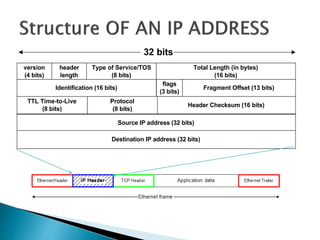
 Structure of an IP address
 Network prefix and Host number
 IP ADDRESS classification
 Problems with IP classification
 Sub netting
 IP Version 6 addresses
 An IP address is a unique global address for a
network interface
 It designates the specific location of a device
on the network
 An IP address:
- is a 32 bit long identifier
- encodes a network number
(network prefix)
and a host number
 IP addresses are written in a so-called dotted
decimal notation
 Each byte is identified by a decimal number in
the range [0..255]:
 Example:
10000000 10001111 10001001 10010000
1st Byte
= 128
2nd Byte
= 143
3rd Byte
= 137
4th Byte
= 144
128.143.137.144
version
(4 bits)
header
length
Type of Service/TOS
(8 bits)
Total Length (in bytes)
(16 bits)
Identification (16 bits)
flags
(3 bits)
Fragment Offset (13 bits)
Source IP address (32 bits)
Destination IP address (32 bits)
TTL Time-to-Live
(8 bits)
Protocol
(8 bits)
Header Checksum (16 bits)
32 bits
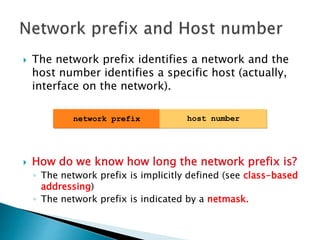
 The network prefix identifies a network and the
host number identifies a specific host (actually,
interface on the network).
 How do we know how long the network prefix is?
◦ The network prefix is implicitly defined (see class-based
addressing)
◦ The network prefix is indicated by a netmask.
network prefix host number
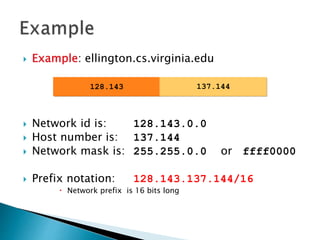
 Example: ellington.cs.virginia.edu
 Network id is: 128.143.0.0
 Host number is: 137.144
 Network mask is: 255.255.0.0 or ffff0000
 Prefix notation: 128.143.137.144/16
 Network prefix is 16 bits long
128.143 137.144
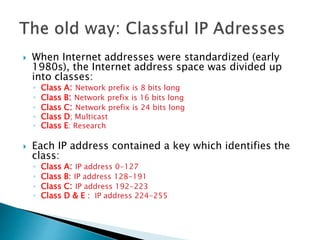
 When Internet addresses were standardized (early
1980s), the Internet address space was divided up
into classes:
◦ Class A: Network prefix is 8 bits long
◦ Class B: Network prefix is 16 bits long
◦ Class C: Network prefix is 24 bits long
◦ Class D; Multicast
◦ Class E: Research
 Each IP address contained a key which identifies the
class:
◦ Class A: IP address 0-127
◦ Class B: IP address 128-191
◦ Class C: IP address 192-223
◦ Class D & E : IP address 224-255
 The original classful address scheme had a
number of problems
Problem 1. Too few network addresses for
large networks
◦ Class A and Class B addresses are gone
Problem 2. Two-layer hierarchy is not
appropriate for large networks with Class A
and Class B addresses.
◦ Fix #1: Subnetting
Problem 3. Inflexible. Assume a company
requires 2,000 addresses
◦ Class A and B addresses are overkill
◦ Class C address is insufficient (requires 8 Class C
addresses)
◦ Fix #2: Classless Interdomain Routing (CIDR)
Problem 4: Exploding Routing Tables: Routing
on the backbone Internet needs to have an
entry for each network address. In 1993, the
size of the routing tables started to outgrow
the capacity of routers.
◦ Fix #2: Classless Interdomain Routing (CIDR)
Problem 5. The Internet is going to outgrow
the 32-bit addresses
◦ Fix #3: IP Version 6
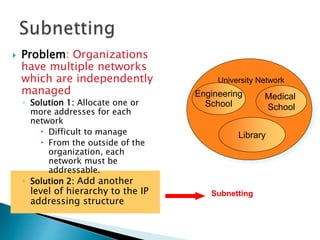
Subnetting
 Problem: Organizations
have multiple networks
which are independently
managed
◦ Solution 1: Allocate one or
more addresses for each
network
 Difficult to manage
 From the outside of the
organization, each
network must be
addressable.
◦ Solution 2: Add another
level of hierarchy to the IP
addressing structure
University Network
Medical
School
Library
Engineering
School
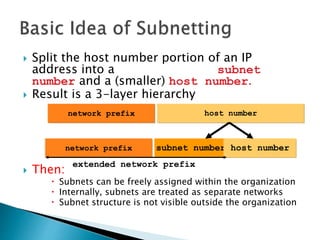
 Split the host number portion of an IP
address into a subnet
number and a (smaller) host number.
 Result is a 3-layer hierarchy
 Then:
 Subnets can be freely assigned within the organization
 Internally, subnets are treated as separate networks
 Subnet structure is not visible outside the organization
network prefix host number
subnet numbernetwork prefix host number
extended network prefix
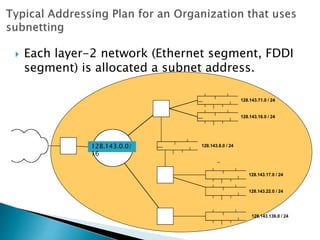
 Each layer-2 network (Ethernet segment, FDDI
segment) is allocated a subnet address.
128.143.17.0 / 24
128.143.71.0 / 24
128.143.7.0 / 24
128.143.16.0 / 24
128.143.8.0 / 24
128.143.22.0 / 24
128.143.136.0 / 24
128.143.0.0/
16
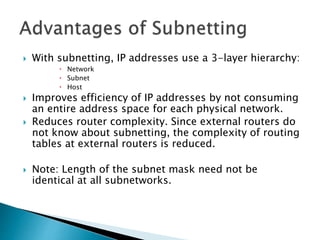
 With subnetting, IP addresses use a 3-layer hierarchy:
 Network
 Subnet
 Host
 Improves efficiency of IP addresses by not consuming
an entire address space for each physical network.
 Reduces router complexity. Since external routers do
not know about subnetting, the complexity of routing
tables at external routers is reduced.
 Note: Length of the subnet mask need not be
identical at all subnetworks.
 IP Version 6
◦ Is the successor to the currently used IPv4
◦ Specification completed in 1994
◦ Makes improvements to IPv4 (no revolutionary
changes)
 One (not the only !) feature of IPv6 is a
significant increase in size of the IP address
to 128 bits (16 bytes)
 IPv6 will solve – for the foreseeable future – the
problems with IP addressing
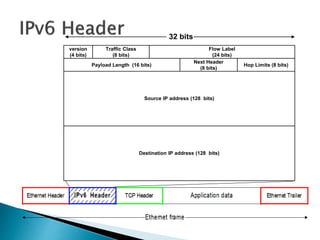
version
(4 bits)
Traffic Class
(8 bits)
Flow Label
(24 bits)
Payload Length (16 bits)
Next Header
(8 bits)
Hop Limits (8 bits)
Source IP address (128 bits)
32 bits
Destination IP address (128 bits)
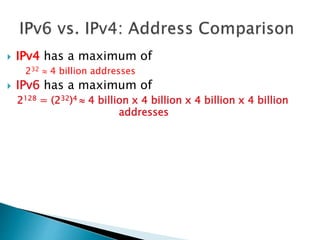
 IPv4 has a maximum of
232  4 billion addresses
 IPv6 has a maximum of
2128 = (232)4  4 billion x 4 billion x 4 billion x 4 billion
addresses
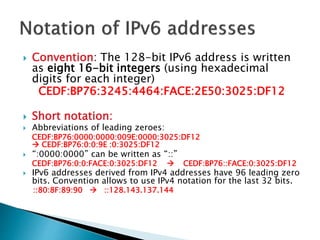
 Convention: The 128-bit IPv6 address is written
as eight 16-bit integers (using hexadecimal
digits for each integer)
CEDF:BP76:3245:4464:FACE:2E50:3025:DF12
 Short notation:
 Abbreviations of leading zeroes:
CEDF:BP76:0000:0000:009E:0000:3025:DF12
 CEDF:BP76:0:0:9E :0:3025:DF12
 “:0000:0000” can be written as “::”
CEDF:BP76:0:0:FACE:0:3025:DF12  CEDF:BP76::FACE:0:3025:DF12
 IPv6 addresses derived from IPv4 addresses have 96 leading zero
bits. Convention allows to use IPv4 notation for the last 32 bits.
::80:8F:89:90  ::128.143.137.144
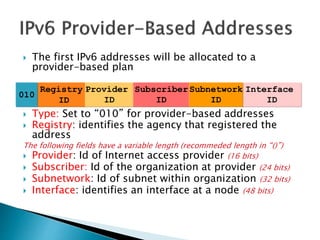
 The first IPv6 addresses will be allocated to a
provider-based plan
 Type: Set to “010” for provider-based addresses
 Registry: identifies the agency that registered the
address
The following fields have a variable length (recommeded length in “()”)
 Provider: Id of Internet access provider (16 bits)
 Subscriber: Id of the organization at provider (24 bits)
 Subnetwork: Id of subnet within organization (32 bits)
 Interface: identifies an interface at a node (48 bits)
Registry
ID
Provider
ID
010
Subscriber
ID
Interface
ID
Subnetwork
ID
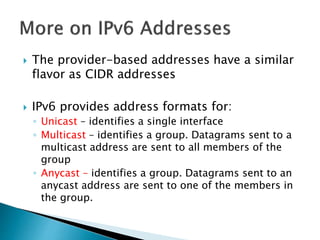
 The provider-based addresses have a similar
flavor as CIDR addresses
 IPv6 provides address formats for:
◦ Unicast – identifies a single interface
◦ Multicast – identifies a group. Datagrams sent to a
multicast address are sent to all members of the
group
◦ Anycast – identifies a group. Datagrams sent to an
anycast address are sent to one of the members in
the group.
Ramakant tyagi presentation on ip addressing

Ramakant tyagi presentation on ip addressing

  • 1.
  • 2.
     What isan IP address  Dotted decimal notation  Structure of an IP address  Network prefix and Host number  IP ADDRESS classification  Problems with IP classification  Sub netting  IP Version 6 addresses
  • 3.
     An IPaddress is a unique global address for a network interface  It designates the specific location of a device on the network  An IP address: - is a 32 bit long identifier - encodes a network number (network prefix) and a host number
  • 4.
     IP addressesare written in a so-called dotted decimal notation  Each byte is identified by a decimal number in the range [0..255]:  Example: 10000000 10001111 10001001 10010000 1st Byte = 128 2nd Byte = 143 3rd Byte = 137 4th Byte = 144 128.143.137.144
  • 5.
    version (4 bits) header length Type ofService/TOS (8 bits) Total Length (in bytes) (16 bits) Identification (16 bits) flags (3 bits) Fragment Offset (13 bits) Source IP address (32 bits) Destination IP address (32 bits) TTL Time-to-Live (8 bits) Protocol (8 bits) Header Checksum (16 bits) 32 bits
  • 6.
     The networkprefix identifies a network and the host number identifies a specific host (actually, interface on the network).  How do we know how long the network prefix is? ◦ The network prefix is implicitly defined (see class-based addressing) ◦ The network prefix is indicated by a netmask. network prefix host number
  • 7.
     Example: ellington.cs.virginia.edu Network id is: 128.143.0.0  Host number is: 137.144  Network mask is: 255.255.0.0 or ffff0000  Prefix notation: 128.143.137.144/16  Network prefix is 16 bits long 128.143 137.144
  • 8.
     When Internetaddresses were standardized (early 1980s), the Internet address space was divided up into classes: ◦ Class A: Network prefix is 8 bits long ◦ Class B: Network prefix is 16 bits long ◦ Class C: Network prefix is 24 bits long ◦ Class D; Multicast ◦ Class E: Research  Each IP address contained a key which identifies the class: ◦ Class A: IP address 0-127 ◦ Class B: IP address 128-191 ◦ Class C: IP address 192-223 ◦ Class D & E : IP address 224-255
  • 9.
     The originalclassful address scheme had a number of problems Problem 1. Too few network addresses for large networks ◦ Class A and Class B addresses are gone Problem 2. Two-layer hierarchy is not appropriate for large networks with Class A and Class B addresses. ◦ Fix #1: Subnetting
  • 10.
    Problem 3. Inflexible.Assume a company requires 2,000 addresses ◦ Class A and B addresses are overkill ◦ Class C address is insufficient (requires 8 Class C addresses) ◦ Fix #2: Classless Interdomain Routing (CIDR)
  • 11.
    Problem 4: ExplodingRouting Tables: Routing on the backbone Internet needs to have an entry for each network address. In 1993, the size of the routing tables started to outgrow the capacity of routers. ◦ Fix #2: Classless Interdomain Routing (CIDR)
  • 12.
    Problem 5. TheInternet is going to outgrow the 32-bit addresses ◦ Fix #3: IP Version 6
  • 13.
    Subnetting  Problem: Organizations havemultiple networks which are independently managed ◦ Solution 1: Allocate one or more addresses for each network  Difficult to manage  From the outside of the organization, each network must be addressable. ◦ Solution 2: Add another level of hierarchy to the IP addressing structure University Network Medical School Library Engineering School
  • 14.
     Split thehost number portion of an IP address into a subnet number and a (smaller) host number.  Result is a 3-layer hierarchy  Then:  Subnets can be freely assigned within the organization  Internally, subnets are treated as separate networks  Subnet structure is not visible outside the organization network prefix host number subnet numbernetwork prefix host number extended network prefix
  • 15.
     Each layer-2network (Ethernet segment, FDDI segment) is allocated a subnet address. 128.143.17.0 / 24 128.143.71.0 / 24 128.143.7.0 / 24 128.143.16.0 / 24 128.143.8.0 / 24 128.143.22.0 / 24 128.143.136.0 / 24 128.143.0.0/ 16
  • 16.
     With subnetting,IP addresses use a 3-layer hierarchy:  Network  Subnet  Host  Improves efficiency of IP addresses by not consuming an entire address space for each physical network.  Reduces router complexity. Since external routers do not know about subnetting, the complexity of routing tables at external routers is reduced.  Note: Length of the subnet mask need not be identical at all subnetworks.
  • 17.
     IP Version6 ◦ Is the successor to the currently used IPv4 ◦ Specification completed in 1994 ◦ Makes improvements to IPv4 (no revolutionary changes)  One (not the only !) feature of IPv6 is a significant increase in size of the IP address to 128 bits (16 bytes)  IPv6 will solve – for the foreseeable future – the problems with IP addressing
  • 18.
    version (4 bits) Traffic Class (8bits) Flow Label (24 bits) Payload Length (16 bits) Next Header (8 bits) Hop Limits (8 bits) Source IP address (128 bits) 32 bits Destination IP address (128 bits)
  • 19.
     IPv4 hasa maximum of 232  4 billion addresses  IPv6 has a maximum of 2128 = (232)4  4 billion x 4 billion x 4 billion x 4 billion addresses
  • 20.
     Convention: The128-bit IPv6 address is written as eight 16-bit integers (using hexadecimal digits for each integer) CEDF:BP76:3245:4464:FACE:2E50:3025:DF12  Short notation:  Abbreviations of leading zeroes: CEDF:BP76:0000:0000:009E:0000:3025:DF12  CEDF:BP76:0:0:9E :0:3025:DF12  “:0000:0000” can be written as “::” CEDF:BP76:0:0:FACE:0:3025:DF12  CEDF:BP76::FACE:0:3025:DF12  IPv6 addresses derived from IPv4 addresses have 96 leading zero bits. Convention allows to use IPv4 notation for the last 32 bits. ::80:8F:89:90  ::128.143.137.144
  • 21.
     The firstIPv6 addresses will be allocated to a provider-based plan  Type: Set to “010” for provider-based addresses  Registry: identifies the agency that registered the address The following fields have a variable length (recommeded length in “()”)  Provider: Id of Internet access provider (16 bits)  Subscriber: Id of the organization at provider (24 bits)  Subnetwork: Id of subnet within organization (32 bits)  Interface: identifies an interface at a node (48 bits) Registry ID Provider ID 010 Subscriber ID Interface ID Subnetwork ID
  • 22.
     The provider-basedaddresses have a similar flavor as CIDR addresses  IPv6 provides address formats for: ◦ Unicast – identifies a single interface ◦ Multicast – identifies a group. Datagrams sent to a multicast address are sent to all members of the group ◦ Anycast – identifies a group. Datagrams sent to an anycast address are sent to one of the members in the group.