SUBNETTINGDeveloped by Peter Smith
Peter Smith2Subnetting A network has its own unique address, such as a Class B network with the address 172.20.0.0 which has all zeroes in the host portion of the address.From the basic definitions of a Class B network & the default Class B subnet mask, you know that this network can be created as a single network that contains 65,534 individual hosts.
Peter Smith3SubnettingThrough the use of subnetting, the network from the previous slide can be logically divided into subnets with fewer hosts on each subnetwork.It does not improve the available shared bandwidth, but it cuts down on the amount of broadcast traffic generated over the entire network as well.
Peter Smith4Broadcast DomainA broadcast is a message that every node on a network or subnetwork receives & examines.Generally speaking, routers do not propagate broadcasts, which is one of the benefits of installing a router in the first place.
Peter Smith5Broadcast DomainFlooded broadcasts (those with the nominal broadcast address of 255.255.255.255) are not forwarded by the router & are considered local traffic only.Directed broadcasts, which contain all 1’s in the Host portion of the IP address, are addressed to a specific subnetwork & are allowed to pass.
Peter Smith6SubnettingThe 2 primary benefits of subnetting are: Fewer IP addresses, often as few as one, are needed to provide addressing to a network & subnetting.Subnetting usually results in smaller routing tables in routers beyond the local internetwork.
Peter Smith7SubnettingExample of subnetting:  when the network administrator divides the 172.20.0.0 network into 5 smaller networks – 172.20.1.0, 172.20.2.0, 172.20.3.0, 172.20.4.0 & 172.20.5.0 – the outside world stills sees the network as 172.20.0.0, but the internal routers now break the network addressing into the 5 smaller subnetworks.
Peter Smith8SubnettingIn the example, only a single IP address is used to reference the network &  instead of 5 network addresses, only one network reference is included in the routing tables of routers on other networks.
Peter Smith9Borrowing BitsThe key concept in subnetting is borrowing bits from the host portion of the network to create a subnetwork.Rules govern this borrowing, ensuring that some bits are left for a Host ID.For each IP address class, only a certain number of bits can be borrowed from the host portion for use in the subnet mask.
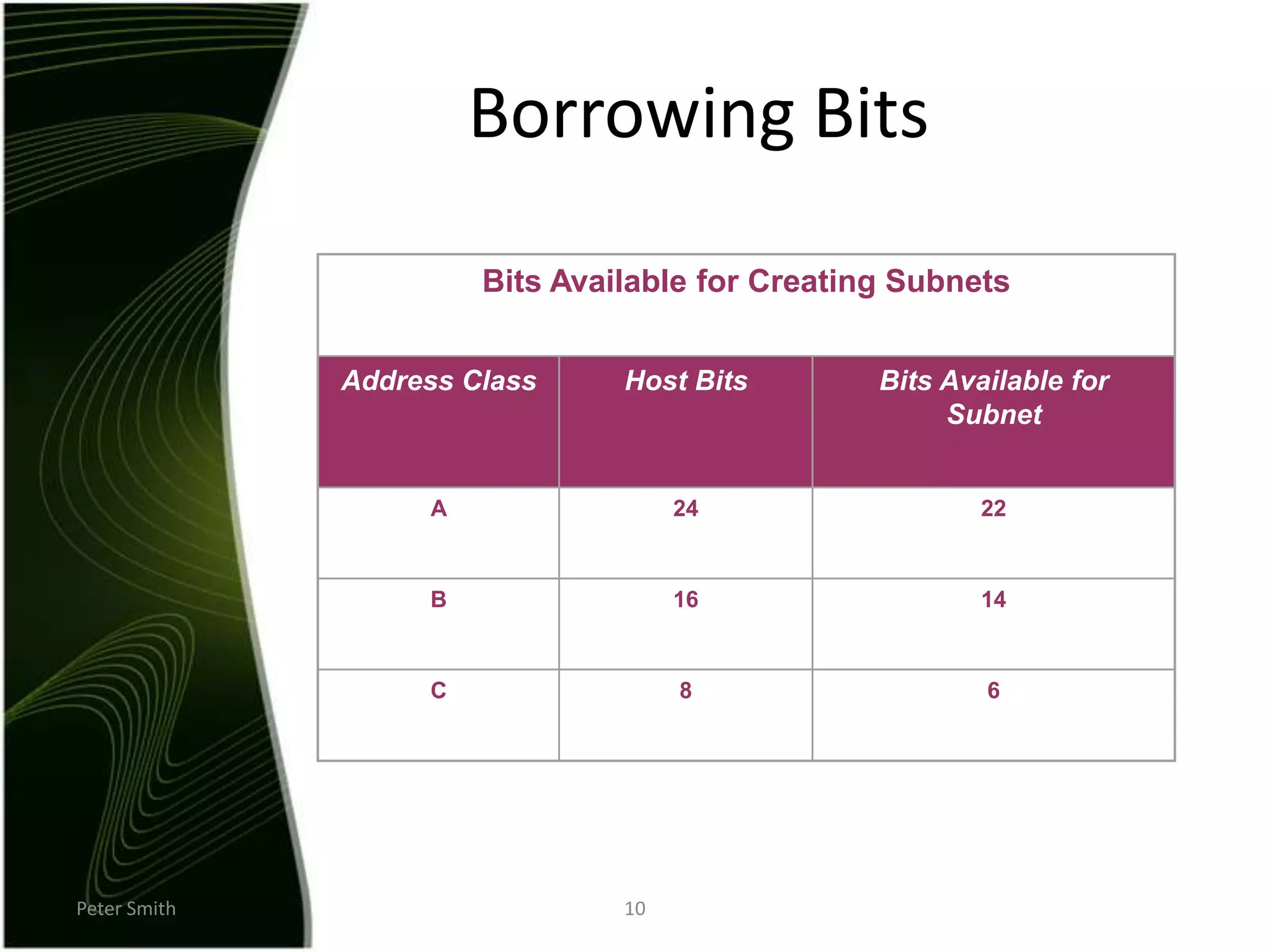
Peter Smith10Bits Available for Creating SubnetsAddress ClassHost BitsBits Available for SubnetA2422B1614C86Borrowing Bits
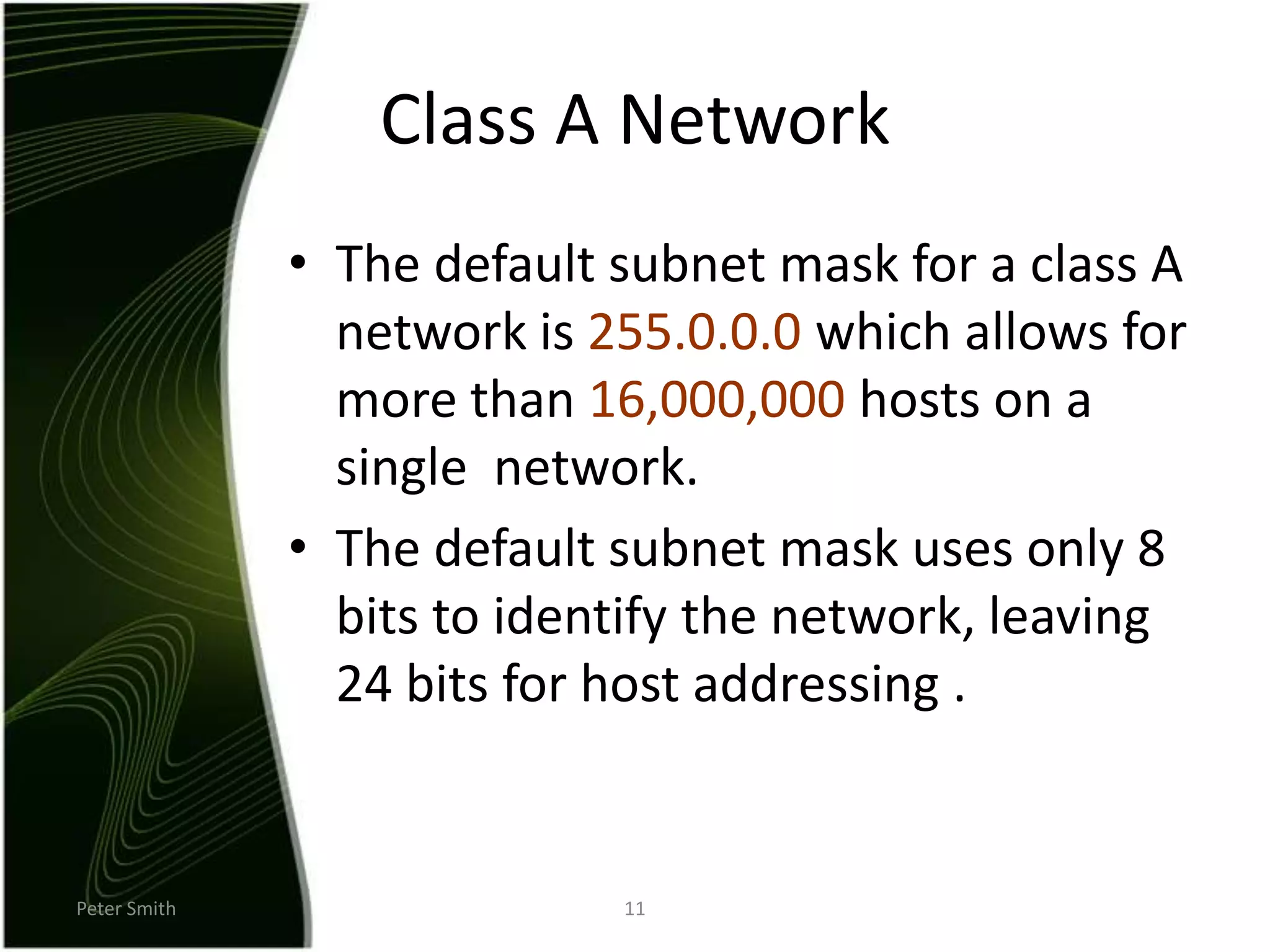
Peter Smith11Class A NetworkThe default subnet mask for a class A network is 255.0.0.0 which allows for more than 16,000,000 hosts on a single  network.The default subnet mask uses only 8 bits to identify the network, leaving 24 bits for host addressing .
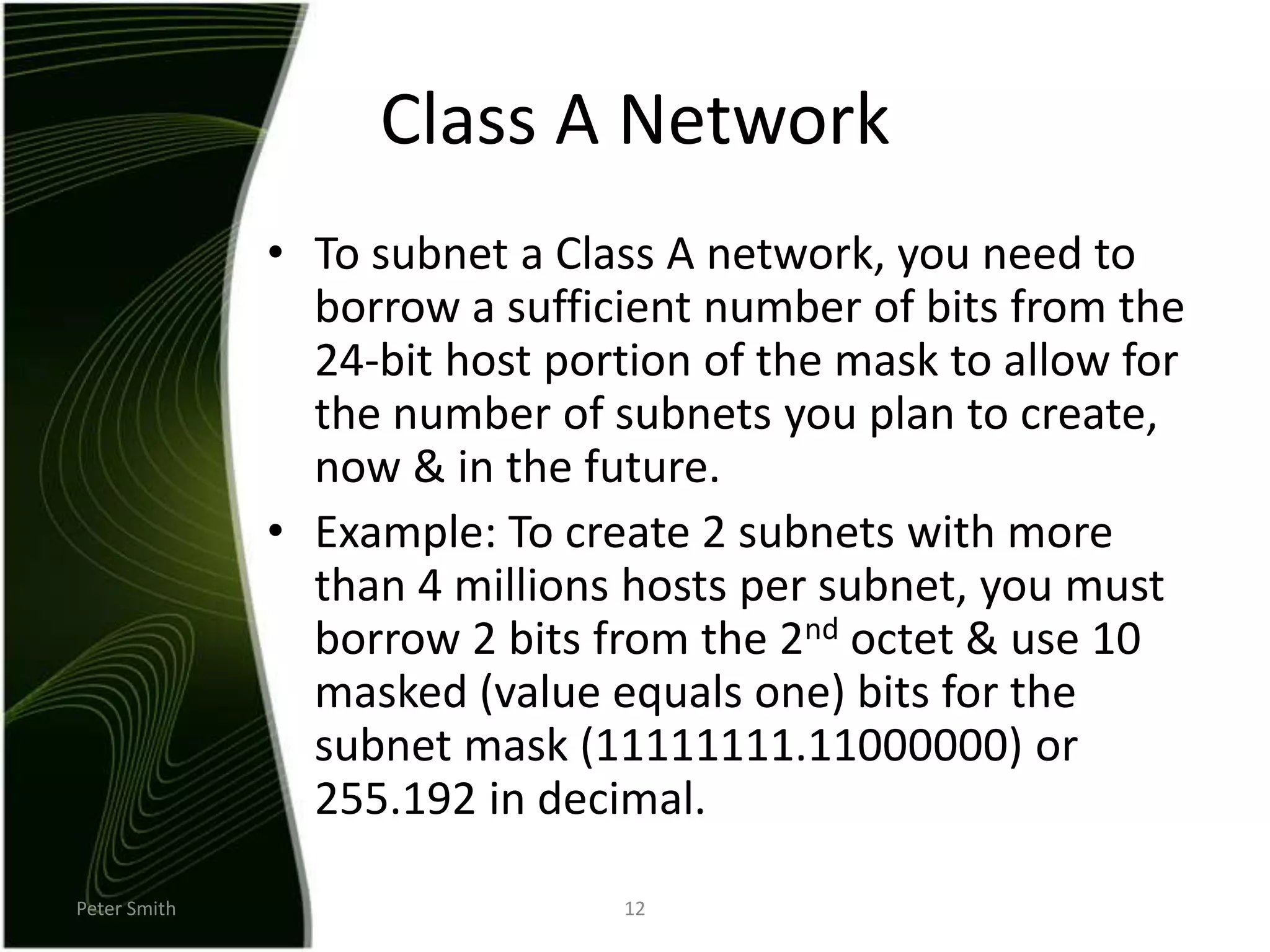
Peter Smith12Class A NetworkTo subnet a Class A network, you need to borrow a sufficient number of bits from the 24-bit host portion of the mask to allow for the number of subnets you plan to create, now & in the future.Example: To create 2 subnets with more than 4 millions hosts per subnet, you must borrow 2 bits from the 2nd octet & use 10 masked (value equals one) bits for the subnet mask (11111111.11000000) or 255.192 in decimal.
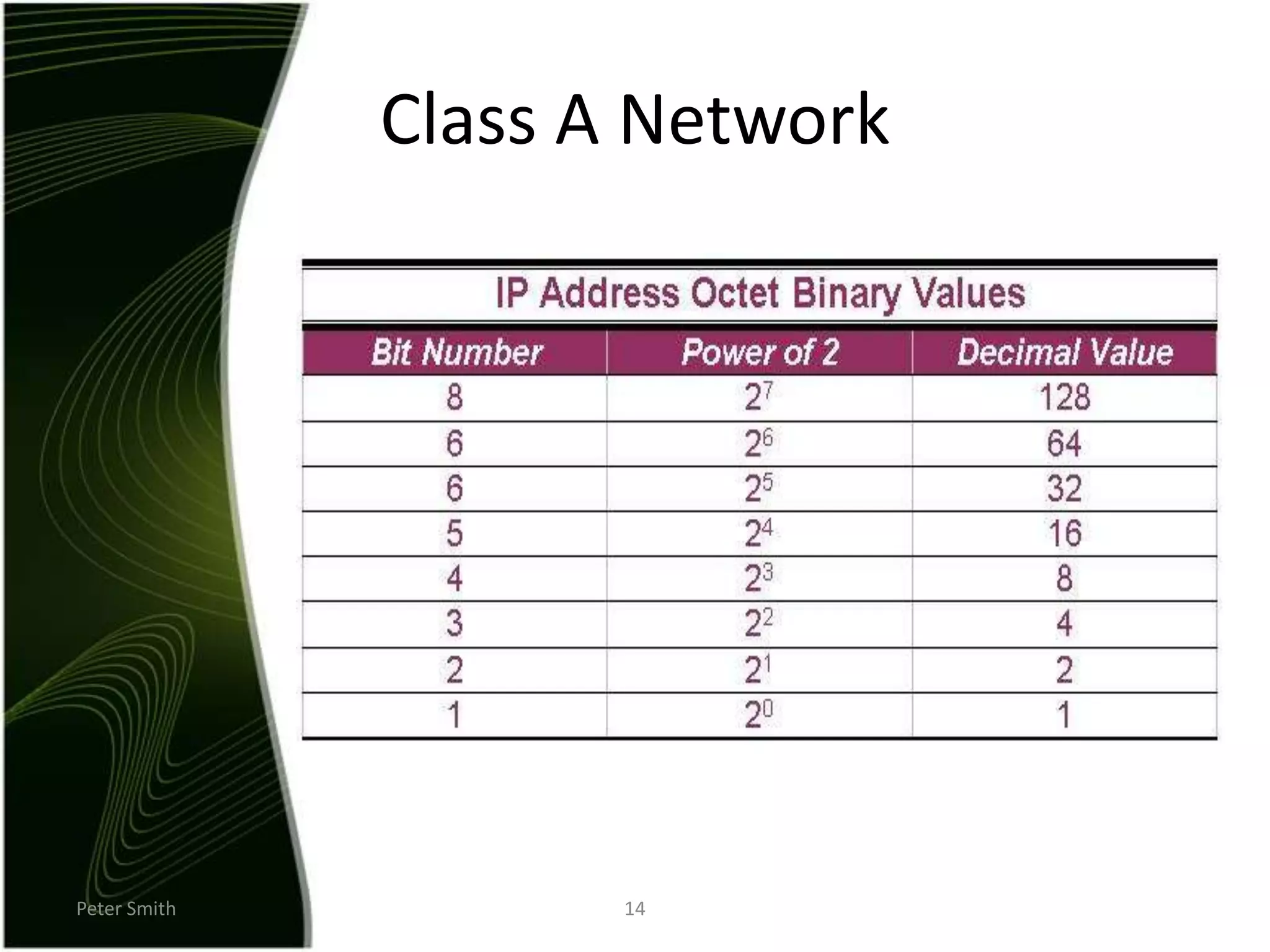
Peter Smith13Class A NetworkKeep in mind that each of the 8-bit octets has binary place values.When you borrow bits from the Host ID portion of the standard mask, you don’t change the value of the bits, only how they are grouped & used.
Peter Smith14Class A Network
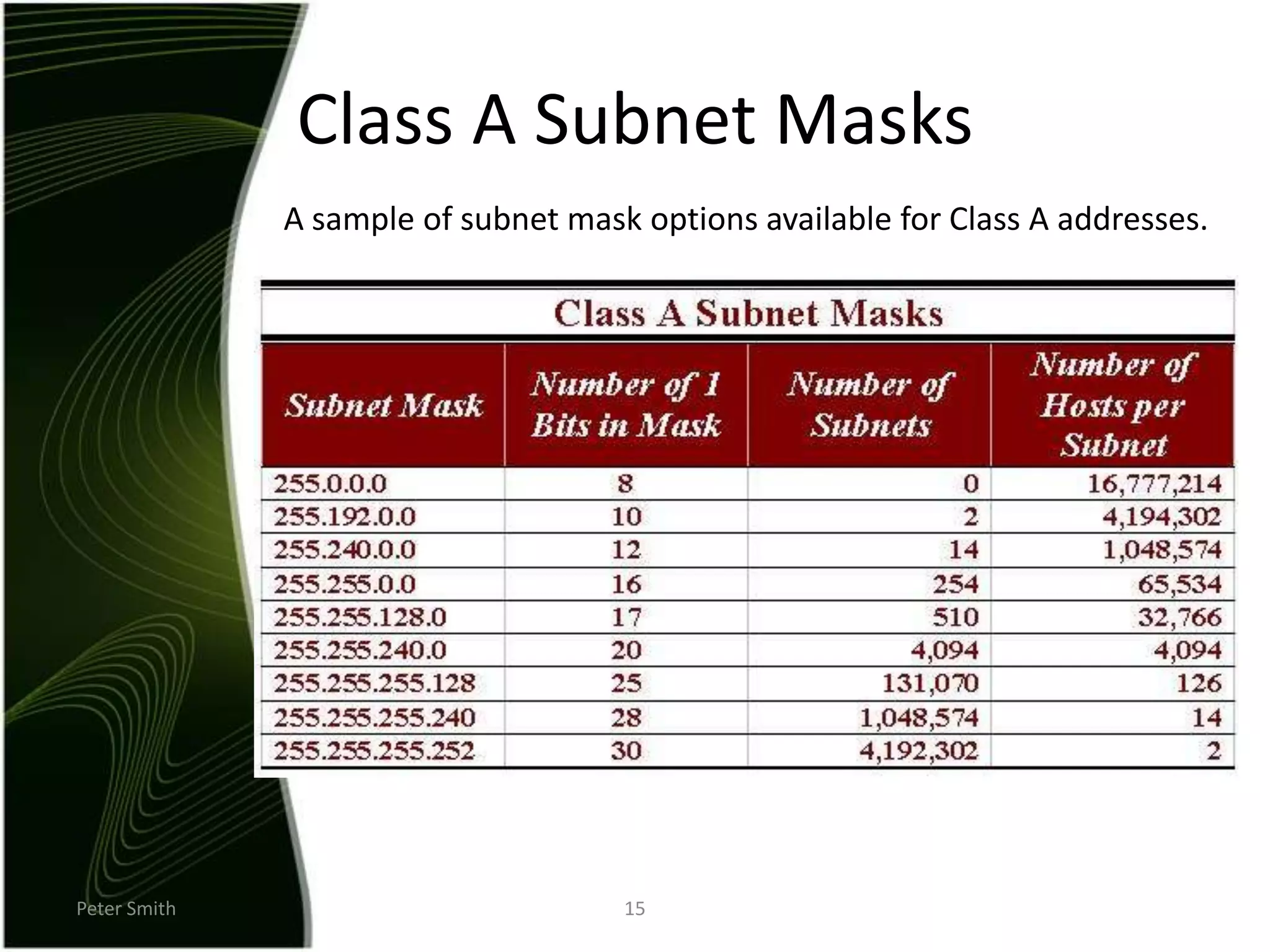
Peter Smith15Class A Subnet MasksA sample of subnet mask options available for Class A addresses.
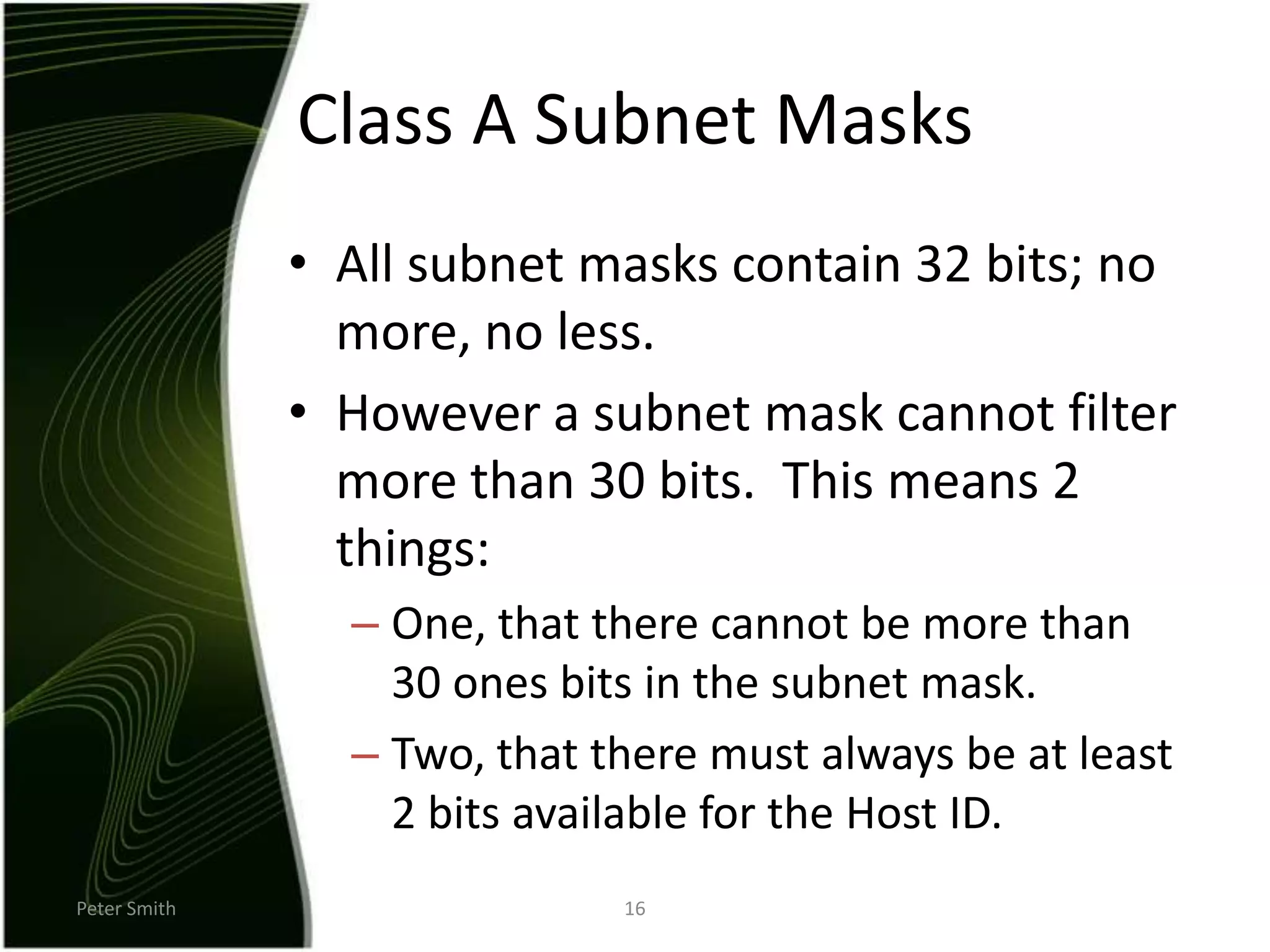
Peter Smith16Class A Subnet MasksAll subnet masks contain 32 bits; no more, no less.However a subnet mask cannot filter more than 30 bits.  This means 2 things:One, that there cannot be more than 30 ones bits in the subnet mask.Two, that there must always be at least 2 bits available for the Host ID.
Peter Smith17Class A Subnet MasksRemember that the addresses with all ones (broadcast address) & all zeroes (local network) cannot be used as they have special meanings.
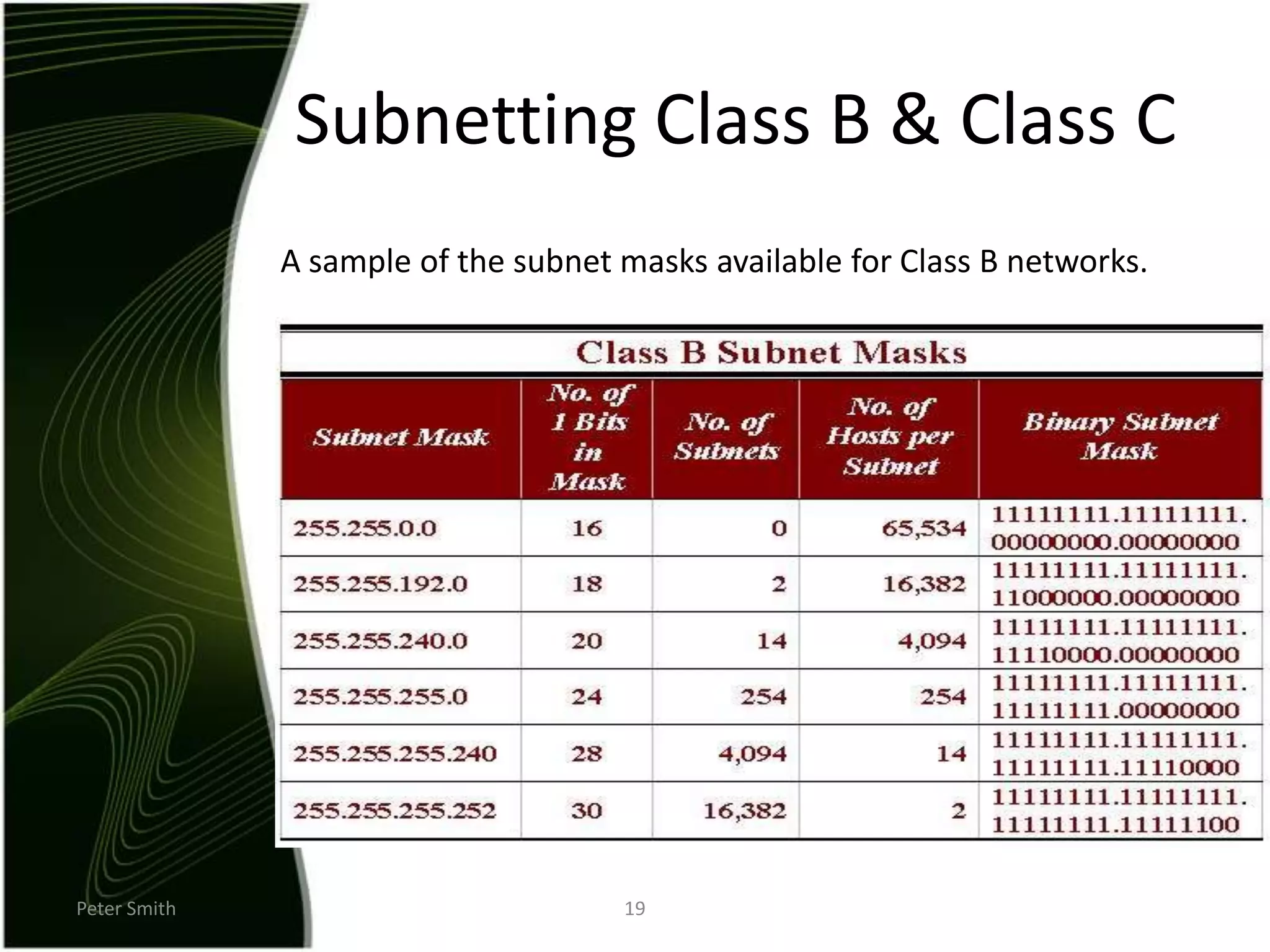
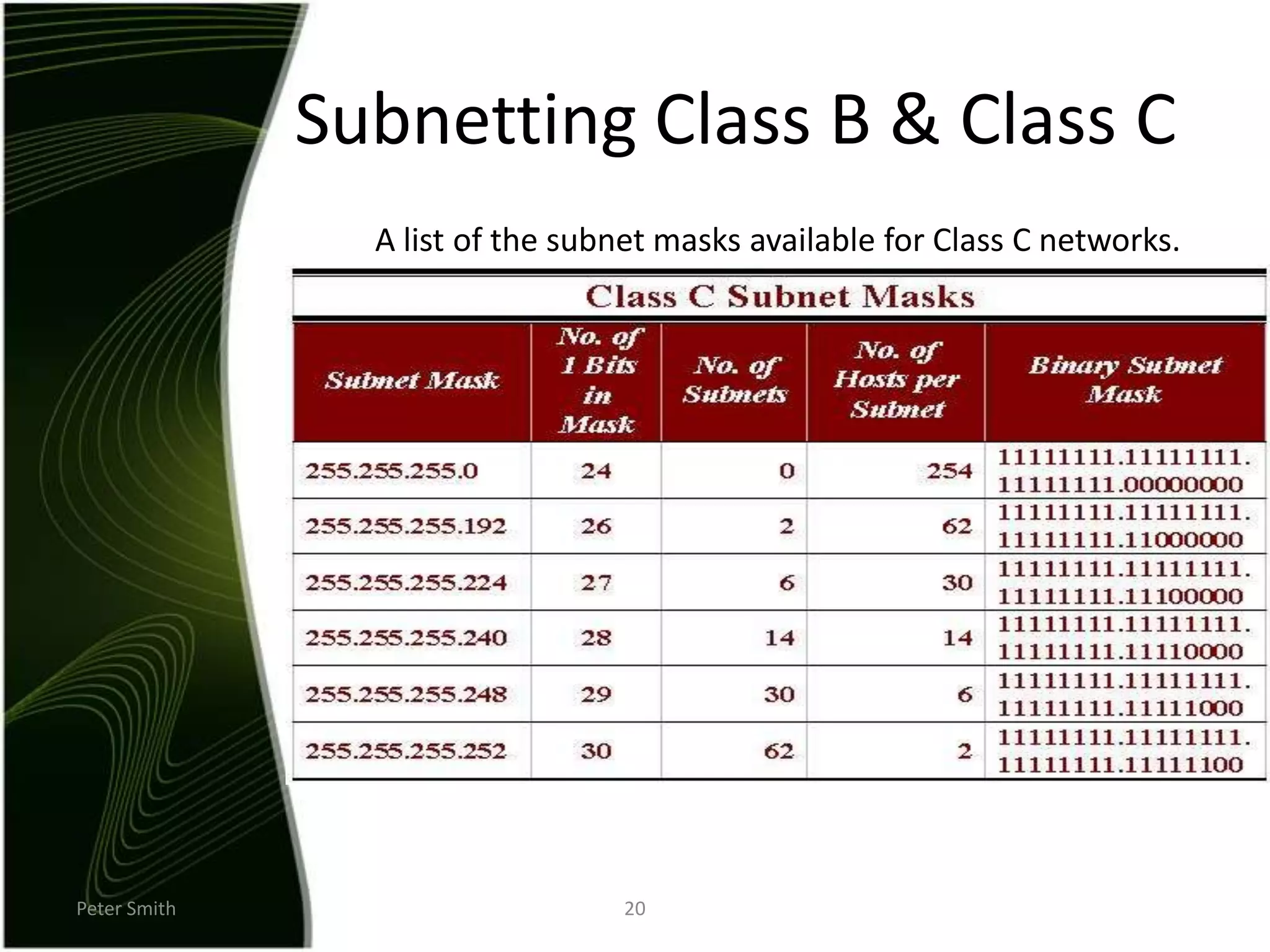
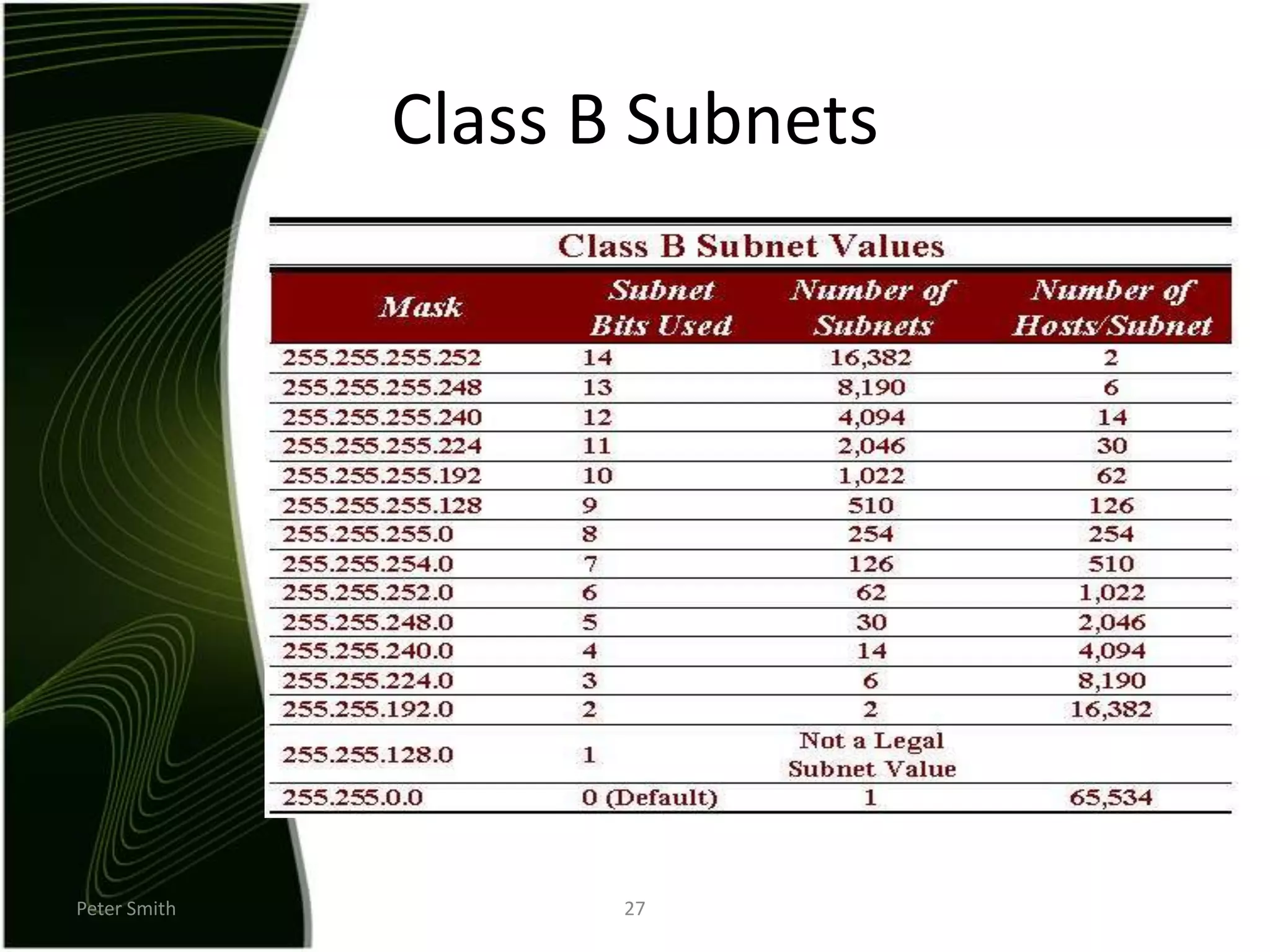
Peter Smith18Subnetting Class B & Class CThe table from “Class A Subnet Masks” is similar to the tables used for Class B & Class C IP addresses & subnet masks.The only differences are that you have fewer options (due to a fewer number of bits available) & that you’re much more likely to work with Class B & Class C networks in real life.
Peter Smith19Subnetting Class B & Class CA sample of the subnet masks available for Class B networks.
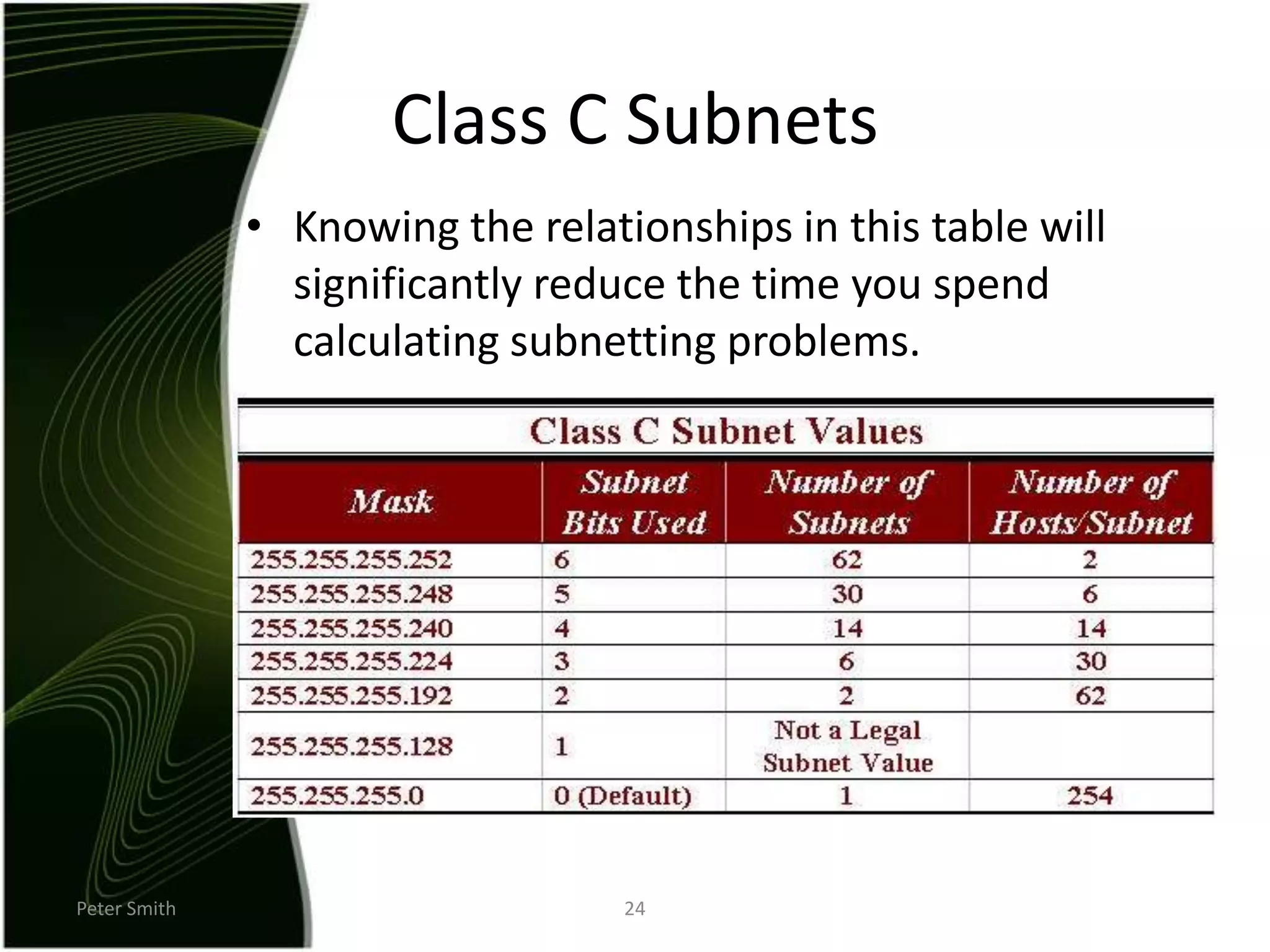
Peter Smith20Subnetting Class B & Class CA list of the subnet masks available for Class C networks.
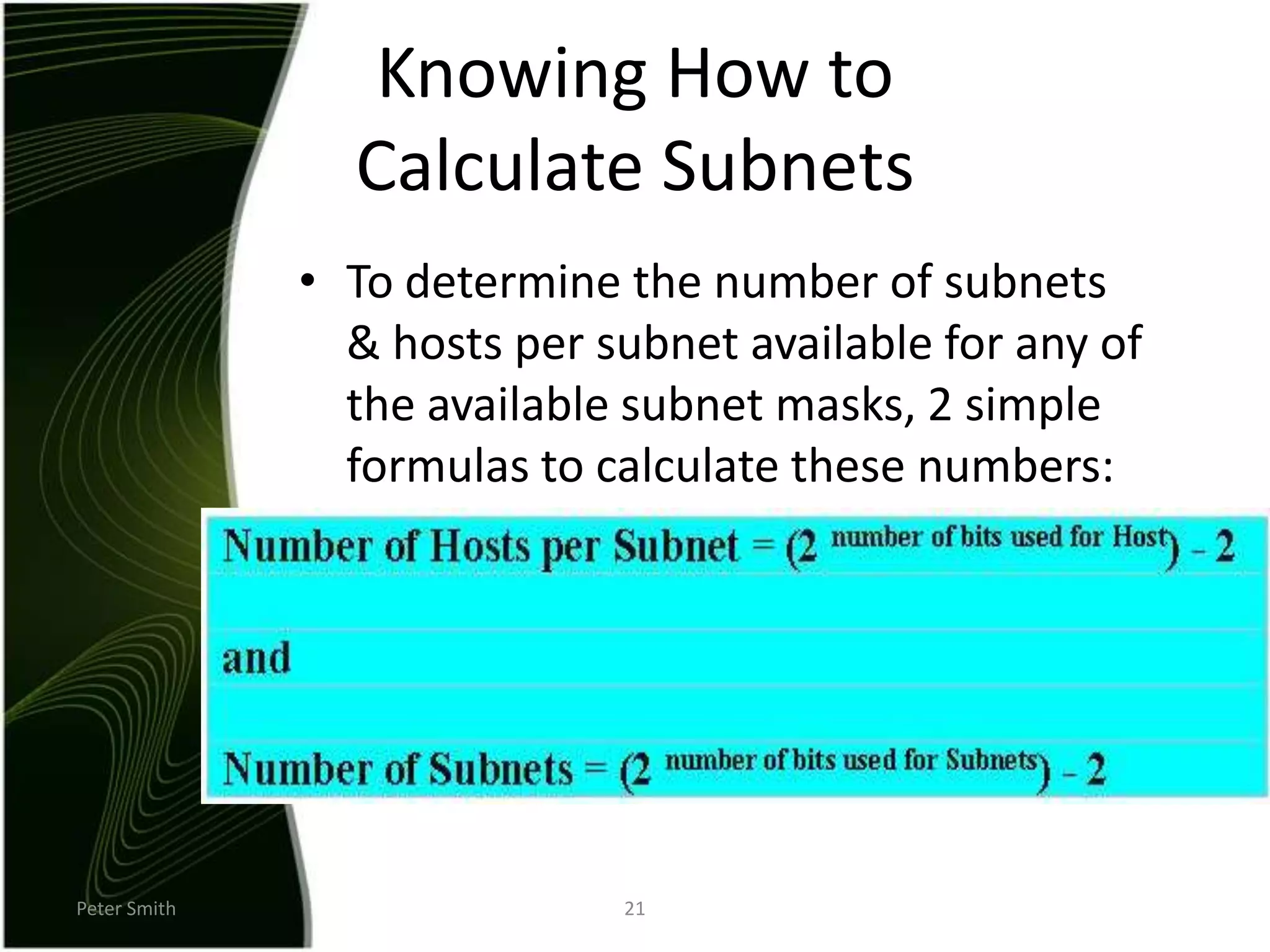
Peter Smith21Knowing How to Calculate SubnetsTo determine the number of subnets & hosts per subnet available for any of the available subnet masks, 2 simple formulas to calculate these numbers:
Peter Smith22Knowing How to Calculate SubnetsAlthough the 2 formulas look identical, the key is to remember the number you’re trying to calculate, hosts or subnets.Eg., suppose you are asked to determine the number of subnets available & the number of hosts available on each subnet on the network 192.168.1.0   
Peter Smith23Knowing How to Calculate SubnetsUsing the subnet & hosts formulas, the answers are easily calculated.  Of course, you must know your powers of 2 to calculate the answers.
Peter Smith24Class C SubnetsKnowing the relationships in this table will significantly reduce the time you spend calculating subnetting problems.
Peter Smith25Class C Subnets (Cont.)To determine the total length of the subnet mask, add 24 to the number of borrowed (subnet) bits.
Peter Smith26Class B SubnetsTo calculate the number of subnets & hosts available from a Class B subnet mask, you use the same host & subnet formulas described for calculating Class C values.Using these formulas I have constructed a table that contains the Class B subnet & host values.
Peter Smith27Class B Subnets

Subnetting

  • 1.
  • 2.
    Peter Smith2Subnetting Anetwork has its own unique address, such as a Class B network with the address 172.20.0.0 which has all zeroes in the host portion of the address.From the basic definitions of a Class B network & the default Class B subnet mask, you know that this network can be created as a single network that contains 65,534 individual hosts.
  • 3.
    Peter Smith3SubnettingThrough theuse of subnetting, the network from the previous slide can be logically divided into subnets with fewer hosts on each subnetwork.It does not improve the available shared bandwidth, but it cuts down on the amount of broadcast traffic generated over the entire network as well.
  • 4.
    Peter Smith4Broadcast DomainAbroadcast is a message that every node on a network or subnetwork receives & examines.Generally speaking, routers do not propagate broadcasts, which is one of the benefits of installing a router in the first place.
  • 5.
    Peter Smith5Broadcast DomainFloodedbroadcasts (those with the nominal broadcast address of 255.255.255.255) are not forwarded by the router & are considered local traffic only.Directed broadcasts, which contain all 1’s in the Host portion of the IP address, are addressed to a specific subnetwork & are allowed to pass.
  • 6.
    Peter Smith6SubnettingThe 2primary benefits of subnetting are: Fewer IP addresses, often as few as one, are needed to provide addressing to a network & subnetting.Subnetting usually results in smaller routing tables in routers beyond the local internetwork.
  • 7.
    Peter Smith7SubnettingExample ofsubnetting: when the network administrator divides the 172.20.0.0 network into 5 smaller networks – 172.20.1.0, 172.20.2.0, 172.20.3.0, 172.20.4.0 & 172.20.5.0 – the outside world stills sees the network as 172.20.0.0, but the internal routers now break the network addressing into the 5 smaller subnetworks.
  • 8.
    Peter Smith8SubnettingIn theexample, only a single IP address is used to reference the network & instead of 5 network addresses, only one network reference is included in the routing tables of routers on other networks.
  • 9.
    Peter Smith9Borrowing BitsThekey concept in subnetting is borrowing bits from the host portion of the network to create a subnetwork.Rules govern this borrowing, ensuring that some bits are left for a Host ID.For each IP address class, only a certain number of bits can be borrowed from the host portion for use in the subnet mask.
  • 10.
    Peter Smith10Bits Availablefor Creating SubnetsAddress ClassHost BitsBits Available for SubnetA2422B1614C86Borrowing Bits
  • 11.
    Peter Smith11Class ANetworkThe default subnet mask for a class A network is 255.0.0.0 which allows for more than 16,000,000 hosts on a single network.The default subnet mask uses only 8 bits to identify the network, leaving 24 bits for host addressing .
  • 12.
    Peter Smith12Class ANetworkTo subnet a Class A network, you need to borrow a sufficient number of bits from the 24-bit host portion of the mask to allow for the number of subnets you plan to create, now & in the future.Example: To create 2 subnets with more than 4 millions hosts per subnet, you must borrow 2 bits from the 2nd octet & use 10 masked (value equals one) bits for the subnet mask (11111111.11000000) or 255.192 in decimal.
  • 13.
    Peter Smith13Class ANetworkKeep in mind that each of the 8-bit octets has binary place values.When you borrow bits from the Host ID portion of the standard mask, you don’t change the value of the bits, only how they are grouped & used.
  • 14.
  • 15.
    Peter Smith15Class ASubnet MasksA sample of subnet mask options available for Class A addresses.
  • 16.
    Peter Smith16Class ASubnet MasksAll subnet masks contain 32 bits; no more, no less.However a subnet mask cannot filter more than 30 bits. This means 2 things:One, that there cannot be more than 30 ones bits in the subnet mask.Two, that there must always be at least 2 bits available for the Host ID.
  • 17.
    Peter Smith17Class ASubnet MasksRemember that the addresses with all ones (broadcast address) & all zeroes (local network) cannot be used as they have special meanings.
  • 18.
    Peter Smith18Subnetting ClassB & Class CThe table from “Class A Subnet Masks” is similar to the tables used for Class B & Class C IP addresses & subnet masks.The only differences are that you have fewer options (due to a fewer number of bits available) & that you’re much more likely to work with Class B & Class C networks in real life.
  • 19.
    Peter Smith19Subnetting ClassB & Class CA sample of the subnet masks available for Class B networks.
  • 20.
    Peter Smith20Subnetting ClassB & Class CA list of the subnet masks available for Class C networks.
  • 21.
    Peter Smith21Knowing Howto Calculate SubnetsTo determine the number of subnets & hosts per subnet available for any of the available subnet masks, 2 simple formulas to calculate these numbers:
  • 22.
    Peter Smith22Knowing Howto Calculate SubnetsAlthough the 2 formulas look identical, the key is to remember the number you’re trying to calculate, hosts or subnets.Eg., suppose you are asked to determine the number of subnets available & the number of hosts available on each subnet on the network 192.168.1.0 
  • 23.
    Peter Smith23Knowing Howto Calculate SubnetsUsing the subnet & hosts formulas, the answers are easily calculated. Of course, you must know your powers of 2 to calculate the answers.
  • 24.
    Peter Smith24Class CSubnetsKnowing the relationships in this table will significantly reduce the time you spend calculating subnetting problems.
  • 25.
    Peter Smith25Class CSubnets (Cont.)To determine the total length of the subnet mask, add 24 to the number of borrowed (subnet) bits.
  • 26.
    Peter Smith26Class BSubnetsTo calculate the number of subnets & hosts available from a Class B subnet mask, you use the same host & subnet formulas described for calculating Class C values.Using these formulas I have constructed a table that contains the Class B subnet & host values.
  • 27.