IP ADDRESS
INTRODUCTION
• An Internet Protocol address (IP
address) is a numerical label assigned
to each device connected to
a computer network that uses
the Internet Protocol for
communication. An IP address serves
two principal functions: host or network
interface identification and
location addressing.
FUNCTION
• An IP address serves two principal functions.
It identifies the host, or more specifically its
network interface, and it provides the
location of the host in the network, and thus
the capability of establishing a path to that
host. Its role has been characterized as
follows: "A name indicates what we seek. An
address indicates where it is. A route
indicates how to get there." The header of
each IP packet contains the IP address of
the sending host, and that of the destination
host.
IP VERSIONS• Two versions of the Internet Protocol are in common
use in the Internet today. The original version of the
Internet Protocol that was first deployed in 1983 in
the ARPANET, the predecessor of the Internet,
is Internet Protocol version 4 (IPv4).
• The rapid exhaustion of IPv4 address
space available for assignment to Internet service
providers and end user organizations by the early
1990s, prompted the Internet Engineering Task
Force (IETF) to explore new technologies to expand
the addressing capability in the Internet. The result
was a redesign of the Internet Protocol which
became eventually known as Internet Protocol
Version 6 (IPv6) in 1995. IPv6 technology was in
various testing stages until the mid-2000s, when
commercial production deployment commenced.
IPV4 ADDRESSES
• An IPv4 address has a size of 32 bits, which
limits the address space to 4294967296 (232
)
addresses. Of this number, some addresses
are reserved for special purposes such
as private networks (~18 million addresses)
and multicast addressing (~270 million
addresses).
• IPv4 addresses are usually represented
in dot-decimal notation, consisting of four
decimal numbers, each ranging from 0 to
255, separated by dots, e.g., 172.16.254.1.
Each part represents a group of 8 bits
(an octet) of the address. In some cases of
technical writing, IPv4 addresses may be
presented in various hexadecimal, octal,
or binary representations.
SUBNETTING
• IP address are divided into two parts:
the network number portion in the high-order
bits and the remaining bits called the rest
field or host identifier used for host numbering
within a network.
• In the early stages of development of the
Internet Protocol, the network number was
always the highest order octet (most significant
eight bits). Because this method allowed for
only 256 networks, it soon proved inadequate
as additional networks developed that were
independent of the existing networks already
designated by a network number. In 1981, the
addressing specification was revised with the
introduction of classful network architecture.
HISTORICAL CLASSFUL NETWORK
ARCHITECTURE
Class
Leading 
bits
Size
of network 
number bit
field
Size of rest
bit field
Number
of
networks
Number of
addresses
per
network
Start
address
End
address
A 0 8 24 128 (27
)
16777216 (
224
)
0.0.0.0
127.255.
255.255
B 10 16 16
16384 (214
)
65536 (216
)
128.0.0.
0
191.255.
255.255
C 110 24 8
2097152 (
221
)
256 (28
)
192.0.0.
0
223.255.
255.255
PRIVATE ADDRESSES
• Early network design, when global end-to-
end connectivity was envisioned for
communications with all Internet hosts,
intended that IP addresses be globally
unique. However, it was found that this was
not always necessary as private
networks developed and public address
space needed to be conserved.
• Computers not connected to the Internet,
such as factory machines that communicate
only with each other via TCP/IP, need not
have globally unique IP addresses. Today,
such private networks are widely used and
typically connect to the Internet
with network address translation (NAT), when
needed.
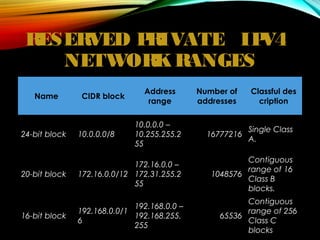
RESERVED PRIVATE IPV4
NETWORKRANGES
Name CIDR block
Address
range
Number of
addresses
Classful des
cription
24-bit block 10.0.0.0/8
10.0.0.0 –
10.255.255.2
55
16777216
Single Class
A.
20-bit block 172.16.0.0/12
172.16.0.0 –
172.31.255.2
55
1048576
Contiguous
range of 16
Class B
blocks.
16-bit block
192.168.0.0/1
6
192.168.0.0 –
192.168.255.
255
65536
Contiguous
range of 256
Class C
blocks
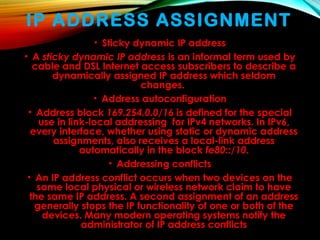
IP ADDRESS ASSIGNMENT
• Sticky dynamic IP address
• A sticky dynamic IP address is an informal term used by
cable and DSL Internet access subscribers to describe a
dynamically assigned IP address which seldom
changes. 
• Address autoconfiguration
• Address block 169.254.0.0/16 is defined for the special
use in link-local addressing  for IPv4 networks. In IPv6,
every interface, whether using static or dynamic address
assignments, also receives a local-link address
automatically in the block fe80::/10.
• Addressing conflicts
• An IP address conflict occurs when two devices on the
same local physical or wireless network claim to have
the same IP address. A second assignment of an address
generally stops the IP functionality of one or both of the
devices. Many modern operating systems notify the
administrator of IP address conflicts
ROUTING
• Unicast addressing
• The most common concept of an IP address is
in unicast addressing, available in both IPv4 and
IPv6. It normally refers to a single sender or a single
receiver, and can be used for both sending and
receiving.
• Broadcast addressing
• Broadcasting is an addressing technique available in
IPv4 to send data to all possible destinations on a
network in one transmission operation, while all
receivers capture the network packet (all-hosts
broadcast).
• Multicast addressing
• A multicast address is associated with a group of
interested receivers. In IPv4,
addresses 224.0.0.0 through 239.255.255.255 (the
former Class D addresses) are designated as
multicast addresses.
THANK YOU
• BY: LOVE MAGGO
• VIII-A
• 19

Ip address

  • 1.
  • 2.
    INTRODUCTION • An Internet Protocoladdress (IP address) is a numerical label assigned to each device connected to a computer network that uses the Internet Protocol for communication. An IP address serves two principal functions: host or network interface identification and location addressing.
  • 4.
    FUNCTION • An IPaddress serves two principal functions. It identifies the host, or more specifically its network interface, and it provides the location of the host in the network, and thus the capability of establishing a path to that host. Its role has been characterized as follows: "A name indicates what we seek. An address indicates where it is. A route indicates how to get there." The header of each IP packet contains the IP address of the sending host, and that of the destination host.
  • 5.
    IP VERSIONS• Two versionsof the Internet Protocol are in common use in the Internet today. The original version of the Internet Protocol that was first deployed in 1983 in the ARPANET, the predecessor of the Internet, is Internet Protocol version 4 (IPv4). • The rapid exhaustion of IPv4 address space available for assignment to Internet service providers and end user organizations by the early 1990s, prompted the Internet Engineering Task Force (IETF) to explore new technologies to expand the addressing capability in the Internet. The result was a redesign of the Internet Protocol which became eventually known as Internet Protocol Version 6 (IPv6) in 1995. IPv6 technology was in various testing stages until the mid-2000s, when commercial production deployment commenced.
  • 6.
    IPV4 ADDRESSES • AnIPv4 address has a size of 32 bits, which limits the address space to 4294967296 (232 ) addresses. Of this number, some addresses are reserved for special purposes such as private networks (~18 million addresses) and multicast addressing (~270 million addresses). • IPv4 addresses are usually represented in dot-decimal notation, consisting of four decimal numbers, each ranging from 0 to 255, separated by dots, e.g., 172.16.254.1. Each part represents a group of 8 bits (an octet) of the address. In some cases of technical writing, IPv4 addresses may be presented in various hexadecimal, octal, or binary representations.
  • 7.
    SUBNETTING • IP addressare divided into two parts: the network number portion in the high-order bits and the remaining bits called the rest field or host identifier used for host numbering within a network. • In the early stages of development of the Internet Protocol, the network number was always the highest order octet (most significant eight bits). Because this method allowed for only 256 networks, it soon proved inadequate as additional networks developed that were independent of the existing networks already designated by a network number. In 1981, the addressing specification was revised with the introduction of classful network architecture.
  • 8.
    HISTORICAL CLASSFUL NETWORK ARCHITECTURE Class Leading  bits Size of network  number bit field Sizeof rest bit field Number of networks Number of addresses per network Start address End address A 0 8 24 128 (27 ) 16777216 ( 224 ) 0.0.0.0 127.255. 255.255 B 10 16 16 16384 (214 ) 65536 (216 ) 128.0.0. 0 191.255. 255.255 C 110 24 8 2097152 ( 221 ) 256 (28 ) 192.0.0. 0 223.255. 255.255
  • 9.
    PRIVATE ADDRESSES • Earlynetwork design, when global end-to- end connectivity was envisioned for communications with all Internet hosts, intended that IP addresses be globally unique. However, it was found that this was not always necessary as private networks developed and public address space needed to be conserved. • Computers not connected to the Internet, such as factory machines that communicate only with each other via TCP/IP, need not have globally unique IP addresses. Today, such private networks are widely used and typically connect to the Internet with network address translation (NAT), when needed.
  • 10.
    RESERVED PRIVATE IPV4 NETWORKRANGES NameCIDR block Address range Number of addresses Classful des cription 24-bit block 10.0.0.0/8 10.0.0.0 – 10.255.255.2 55 16777216 Single Class A. 20-bit block 172.16.0.0/12 172.16.0.0 – 172.31.255.2 55 1048576 Contiguous range of 16 Class B blocks. 16-bit block 192.168.0.0/1 6 192.168.0.0 – 192.168.255. 255 65536 Contiguous range of 256 Class C blocks
  • 11.
    IP ADDRESS ASSIGNMENT •Sticky dynamic IP address • A sticky dynamic IP address is an informal term used by cable and DSL Internet access subscribers to describe a dynamically assigned IP address which seldom changes.  • Address autoconfiguration • Address block 169.254.0.0/16 is defined for the special use in link-local addressing  for IPv4 networks. In IPv6, every interface, whether using static or dynamic address assignments, also receives a local-link address automatically in the block fe80::/10. • Addressing conflicts • An IP address conflict occurs when two devices on the same local physical or wireless network claim to have the same IP address. A second assignment of an address generally stops the IP functionality of one or both of the devices. Many modern operating systems notify the administrator of IP address conflicts
  • 12.
    ROUTING • Unicast addressing •The most common concept of an IP address is in unicast addressing, available in both IPv4 and IPv6. It normally refers to a single sender or a single receiver, and can be used for both sending and receiving. • Broadcast addressing • Broadcasting is an addressing technique available in IPv4 to send data to all possible destinations on a network in one transmission operation, while all receivers capture the network packet (all-hosts broadcast). • Multicast addressing • A multicast address is associated with a group of interested receivers. In IPv4, addresses 224.0.0.0 through 239.255.255.255 (the former Class D addresses) are designated as multicast addresses.
  • 13.
    THANK YOU • BY:LOVE MAGGO • VIII-A • 19