IT 802DMobile CommunicationsPart 3Debasis Das
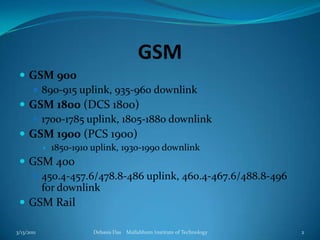
GSMGSM 900890-915 uplink, 935-960 downlinkGSM 1800 (DCS 1800)1700-1785 uplink, 1805-1880 downlinkGSM 1900 (PCS 1900)1850-1910 uplink, 1930-1990 downlinkGSM 400450.4-457.6/478.8-486 uplink, 460.4-467.6/488.8-496 for downlinkGSM Rail3/13/2011Debasis Das    Mallabhum Institute of Technology2
Mobile ServicesBearer ServicesTele servicesSupplementary Services3/13/2011Debasis Das    Mallabhum Institute of Technology3
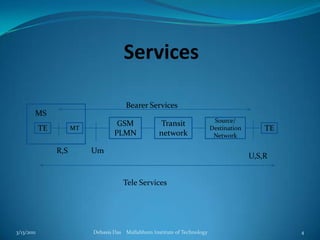
Services3/13/2011Debasis Das    Mallabhum Institute of Technology4Bearer ServicesMSGSMPLMNTransit networkSource/Destination NetworkTEMTTER,SUmU,S,RTele Services
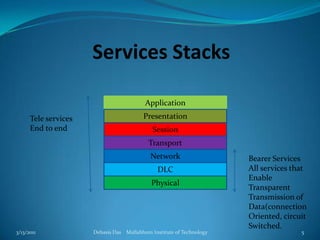
Services Stacks3/13/2011Debasis Das    Mallabhum Institute of Technology5ApplicationPresentationTele servicesEnd to endSessionTransportNetworkBearer ServicesAll services that EnableTransparent Transmission ofData(connection Oriented, circuit Switched.DLCPhysical
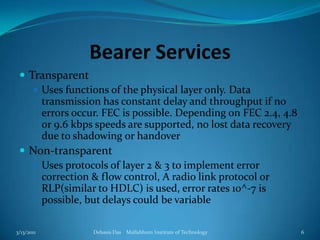
Bearer ServicesTransparentUses functions of the physical layer only. Data transmission has constant delay and throughput if no  errors occur. FEC is possible. Depending on FEC 2.4, 4.8 or 9.6 kbps speeds are supported, no lost data recovery due to shadowing or handoverNon-transparentUses protocols of layer 2 & 3 to implement error correction & flow control, A radio link protocol or RLP(similar to HDLC) is used, error rates 10^-7 is possible, but delays could be variable3/13/2011Debasis Das    Mallabhum Institute of Technology6
Bear ServicesSeveral bearer services are specified that use transparent and non transparent servicesPSTN, ISDN and PSPDN (X.25) are used for internetworkingData transmission can be full duplex 1.2, 2.4, 4.8 and 9.6 kbps and asynchronous full duplex 300 to 9.6 kbps3/13/2011Debasis Das    Mallabhum Institute of Technology7
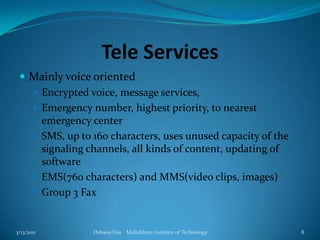
Tele ServicesMainly voice orientedEncrypted voice, message services, Emergency number, highest priority, to nearest emergency centerSMS, up to 160 characters, uses unused capacity of the signaling channels, all kinds of content, updating of softwareEMS(760 characters) and MMS(video clips, images)Group 3 Fax3/13/2011Debasis Das    Mallabhum Institute of Technology8
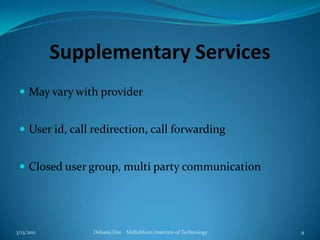
Supplementary ServicesMay vary with providerUser id, call redirection, call forwardingClosed user group, multi party communication3/13/2011Debasis Das    Mallabhum Institute of Technology9
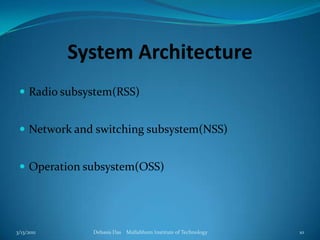
System ArchitectureRadio subsystem(RSS)Network and switching subsystem(NSS)Operation subsystem(OSS)3/13/2011Debasis Das    Mallabhum Institute of Technology10
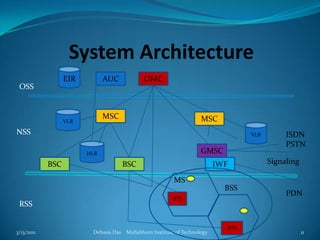
System Architecture3/13/2011Debasis Das    Mallabhum Institute of Technology11EIROMCAUCOSSMSCVLRMSCVLRNSSISDNPSTNHLRGMSCSignalingBSCBSCIWFMSBSSPDNBTSRSSBTS
Radio Subsystem(RSS)Radio specific entitiesMobile stationBase station subsystem(BSS)“A” interface connects the RSS to NSS“O” interface for connection to OSSA interface is circuit switched, PCM 30 systems30x 64 kbps connectionsO interface is SS7, management data to/fro RSS3/13/2011Debasis Das    Mallabhum Institute of Technology12
Base Station SubsystemA  base station controller controls(BSC) multiple base station subsystems(BSS)BSS contains several base transceiver stations(BTS)All functions required to maintain radio communication to MS is carried out by BSSCoding/decoding of voice, rate adaptation to/fro wireless network part, etc.3/13/2011Debasis Das    Mallabhum Institute of Technology13
Base Transceiver StationsBTS contains all radio equipmentAntenna, signal processing, amplifiersConnects to MS through a Um interface. The ISDN U interface for mobile useConnects to BSC through Abis interfaceUm  contains all the mechanisms for wireless transmission such as TDMA, FDMA etc.The Abis interface contains 16 or 64 kbps connections3/13/2011Debasis Das    Mallabhum Institute of Technology14
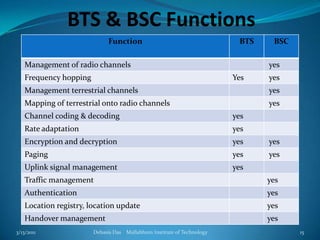
BTS & BSC Functions3/13/2011Debasis Das    Mallabhum Institute of Technology15
Mobile Station(MS)All user equipment and software needed for communicationHardware, software , subscriber identity module(SIM), stores user specific data relevant to GSMSIM contains an International mobile equipment identity(IMEI)Usually contains card type, serial number, ,subscribed services, PIN,  PIN unblocking key, authentication key ki, international mobile subscriber identity(IMSI)Dynamic information when logged into GSM system, such as cipher key Kc and TMSI or temporary mobile subscriber identity(TMSI) and location area identification(LAI) are stored The MS can have many other interfaces and vendor specific features.3/13/2011Debasis Das    Mallabhum Institute of Technology16
Network & Switching Subsystem(NSS)Connects RSS with standard public networksPerforms handovers between different BSSsHas functions for localization of usersSupports charging, accounting, and roaming of users between different providers in different countriesSubsystems includeMobile services switching center(MSC)Home location register(HLR)Visitor location register(VLR)3/13/2011Debasis Das    Mallabhum Institute of Technology17
MSCThe fixed backbone network nodes. Connections to other MSCs and BSCs are set up through theseManages several BSC in a particular geographic locationA gateway MSC(GMSC) has connections to other public networks such as PSTN, ISDNCan also connect to public data networks(PDN) through inter working functions (IWF)3/13/2011Debasis Das    Mallabhum Institute of Technology18
More on MSCUses the standard signaling system 7 or the SS7 for all aspects of control signaling for digital networks that includesReliable routing and delivery of control messages for establishing and monitoring of callsSS7 providesNumber portability, free phone, tool/collect calls, credit calls, call forwarding, 3-way calling etc.MSC also provides functionality for supplementary services like call forwarding, multi-party calls, reverse charging etc.3/13/2011Debasis Das    Mallabhum Institute of Technology19
Home Location register(HLR)Database for all user relevant data Static information like mobile subscriber ISDN number(MSISDN), services subscribed and IMSIDynamic information like  current location area(LA), mobile subscriber roaming number(MSRN), current VLR and MSC, when a MS leaves LA, the info is updatedOnly one set of user home information is maintained in for any user for any user worldwideSome information may need to meet real time criteria3/13/2011Debasis Das    Mallabhum Institute of Technology20
Visitor Location Register(VLR)Dynamic database for relevant information for the MS user in LA associated with the MSCTypically, MSISDN, IMSI, HLR address etc.VLR copies the information from the HLR3/13/2011Debasis Das    Mallabhum Institute of Technology21
Operation Subsystem(OSS)Consists of the following subsystemsOperation and maintenance center(OMC)Authentication center (AuC)Equipment identity center(EIR)3/13/2011Debasis Das    Mallabhum Institute of Technology22
OMCMonitors and controls all other entities via O interface (SS7 & X.25). Typical functions includeTraffic monitoring, status reports, subscriber and security management, accounting and billingUses “telecommunication management network” as standardized by ITU-T3/13/2011Debasis Das    Mallabhum Institute of Technology23
Authentication center(AuC)Contains algorithms for authentication, as well as keys for encryption and generates the values needed for user authentication in HLRAuC may actually be located in a special protected part of  HLR3/13/2011Debasis Das    Mallabhum Institute of Technology24

It802 d mobilecommunicationspart3

  • 1.
  • 2.
    GSMGSM 900890-915 uplink,935-960 downlinkGSM 1800 (DCS 1800)1700-1785 uplink, 1805-1880 downlinkGSM 1900 (PCS 1900)1850-1910 uplink, 1930-1990 downlinkGSM 400450.4-457.6/478.8-486 uplink, 460.4-467.6/488.8-496 for downlinkGSM Rail3/13/2011Debasis Das Mallabhum Institute of Technology2
  • 3.
    Mobile ServicesBearer ServicesTeleservicesSupplementary Services3/13/2011Debasis Das Mallabhum Institute of Technology3
  • 4.
    Services3/13/2011Debasis Das Mallabhum Institute of Technology4Bearer ServicesMSGSMPLMNTransit networkSource/Destination NetworkTEMTTER,SUmU,S,RTele Services
  • 5.
    Services Stacks3/13/2011Debasis Das Mallabhum Institute of Technology5ApplicationPresentationTele servicesEnd to endSessionTransportNetworkBearer ServicesAll services that EnableTransparent Transmission ofData(connection Oriented, circuit Switched.DLCPhysical
  • 6.
    Bearer ServicesTransparentUses functionsof the physical layer only. Data transmission has constant delay and throughput if no errors occur. FEC is possible. Depending on FEC 2.4, 4.8 or 9.6 kbps speeds are supported, no lost data recovery due to shadowing or handoverNon-transparentUses protocols of layer 2 & 3 to implement error correction & flow control, A radio link protocol or RLP(similar to HDLC) is used, error rates 10^-7 is possible, but delays could be variable3/13/2011Debasis Das Mallabhum Institute of Technology6
  • 7.
    Bear ServicesSeveral bearerservices are specified that use transparent and non transparent servicesPSTN, ISDN and PSPDN (X.25) are used for internetworkingData transmission can be full duplex 1.2, 2.4, 4.8 and 9.6 kbps and asynchronous full duplex 300 to 9.6 kbps3/13/2011Debasis Das Mallabhum Institute of Technology7
  • 8.
    Tele ServicesMainly voiceorientedEncrypted voice, message services, Emergency number, highest priority, to nearest emergency centerSMS, up to 160 characters, uses unused capacity of the signaling channels, all kinds of content, updating of softwareEMS(760 characters) and MMS(video clips, images)Group 3 Fax3/13/2011Debasis Das Mallabhum Institute of Technology8
  • 9.
    Supplementary ServicesMay varywith providerUser id, call redirection, call forwardingClosed user group, multi party communication3/13/2011Debasis Das Mallabhum Institute of Technology9
  • 10.
    System ArchitectureRadio subsystem(RSS)Networkand switching subsystem(NSS)Operation subsystem(OSS)3/13/2011Debasis Das Mallabhum Institute of Technology10
  • 11.
    System Architecture3/13/2011Debasis Das Mallabhum Institute of Technology11EIROMCAUCOSSMSCVLRMSCVLRNSSISDNPSTNHLRGMSCSignalingBSCBSCIWFMSBSSPDNBTSRSSBTS
  • 12.
    Radio Subsystem(RSS)Radio specificentitiesMobile stationBase station subsystem(BSS)“A” interface connects the RSS to NSS“O” interface for connection to OSSA interface is circuit switched, PCM 30 systems30x 64 kbps connectionsO interface is SS7, management data to/fro RSS3/13/2011Debasis Das Mallabhum Institute of Technology12
  • 13.
    Base Station SubsystemA base station controller controls(BSC) multiple base station subsystems(BSS)BSS contains several base transceiver stations(BTS)All functions required to maintain radio communication to MS is carried out by BSSCoding/decoding of voice, rate adaptation to/fro wireless network part, etc.3/13/2011Debasis Das Mallabhum Institute of Technology13
  • 14.
    Base Transceiver StationsBTScontains all radio equipmentAntenna, signal processing, amplifiersConnects to MS through a Um interface. The ISDN U interface for mobile useConnects to BSC through Abis interfaceUm contains all the mechanisms for wireless transmission such as TDMA, FDMA etc.The Abis interface contains 16 or 64 kbps connections3/13/2011Debasis Das Mallabhum Institute of Technology14
  • 15.
    BTS & BSCFunctions3/13/2011Debasis Das Mallabhum Institute of Technology15
  • 16.
    Mobile Station(MS)All userequipment and software needed for communicationHardware, software , subscriber identity module(SIM), stores user specific data relevant to GSMSIM contains an International mobile equipment identity(IMEI)Usually contains card type, serial number, ,subscribed services, PIN, PIN unblocking key, authentication key ki, international mobile subscriber identity(IMSI)Dynamic information when logged into GSM system, such as cipher key Kc and TMSI or temporary mobile subscriber identity(TMSI) and location area identification(LAI) are stored The MS can have many other interfaces and vendor specific features.3/13/2011Debasis Das Mallabhum Institute of Technology16
  • 17.
    Network & SwitchingSubsystem(NSS)Connects RSS with standard public networksPerforms handovers between different BSSsHas functions for localization of usersSupports charging, accounting, and roaming of users between different providers in different countriesSubsystems includeMobile services switching center(MSC)Home location register(HLR)Visitor location register(VLR)3/13/2011Debasis Das Mallabhum Institute of Technology17
  • 18.
    MSCThe fixed backbonenetwork nodes. Connections to other MSCs and BSCs are set up through theseManages several BSC in a particular geographic locationA gateway MSC(GMSC) has connections to other public networks such as PSTN, ISDNCan also connect to public data networks(PDN) through inter working functions (IWF)3/13/2011Debasis Das Mallabhum Institute of Technology18
  • 19.
    More on MSCUsesthe standard signaling system 7 or the SS7 for all aspects of control signaling for digital networks that includesReliable routing and delivery of control messages for establishing and monitoring of callsSS7 providesNumber portability, free phone, tool/collect calls, credit calls, call forwarding, 3-way calling etc.MSC also provides functionality for supplementary services like call forwarding, multi-party calls, reverse charging etc.3/13/2011Debasis Das Mallabhum Institute of Technology19
  • 20.
    Home Location register(HLR)Databasefor all user relevant data Static information like mobile subscriber ISDN number(MSISDN), services subscribed and IMSIDynamic information like current location area(LA), mobile subscriber roaming number(MSRN), current VLR and MSC, when a MS leaves LA, the info is updatedOnly one set of user home information is maintained in for any user for any user worldwideSome information may need to meet real time criteria3/13/2011Debasis Das Mallabhum Institute of Technology20
  • 21.
    Visitor Location Register(VLR)Dynamicdatabase for relevant information for the MS user in LA associated with the MSCTypically, MSISDN, IMSI, HLR address etc.VLR copies the information from the HLR3/13/2011Debasis Das Mallabhum Institute of Technology21
  • 22.
    Operation Subsystem(OSS)Consists ofthe following subsystemsOperation and maintenance center(OMC)Authentication center (AuC)Equipment identity center(EIR)3/13/2011Debasis Das Mallabhum Institute of Technology22
  • 23.
    OMCMonitors and controlsall other entities via O interface (SS7 & X.25). Typical functions includeTraffic monitoring, status reports, subscriber and security management, accounting and billingUses “telecommunication management network” as standardized by ITU-T3/13/2011Debasis Das Mallabhum Institute of Technology23
  • 24.
    Authentication center(AuC)Contains algorithmsfor authentication, as well as keys for encryption and generates the values needed for user authentication in HLRAuC may actually be located in a special protected part of HLR3/13/2011Debasis Das Mallabhum Institute of Technology24