For
  MESHDYNAMICS
SYSTEM INTEGRATORS

NETWORK LAYOUT DESIGN
         AND
  ANTENNA SELECTION


                        1
NETWORK DESIGN
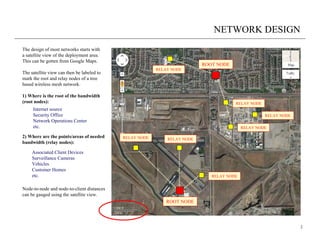
The design of most networks starts with
a satellite view of the deployment area.
This can be gotten from Google Maps.
                                                                          ROOT NODE
                                                         RELAY NODE
The satellite view can then be labeled to
mark the root and relay nodes of a tree
based wireless mesh network.

1) Where is the root of the bandwidth
(root nodes):                                                                         RELAY NODE
     Internet source
     Security Office                                                                               RELAY NODE
     Network Operations Center
     etc.                                                                                 RELAY NODE

2) Where are the points/areas of needed     RELAY NODE       RELAY NODE
bandwidth (relay nodes):

     Associated Client Devices
     Surveillance Cameras
     Vehicles
     Customer Homes
     etc.                                                                    RELAY NODE


Node-to-node and node-to-client distances
can be gauged using the satellite view.
                                                             ROOT NODE


                                                                                                                2
NODE LOCATIONS
                                                                           VEHICLE                    REMOTE
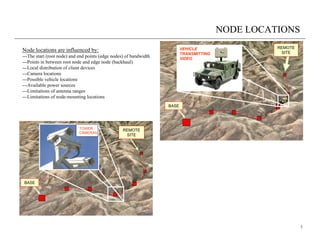
Node locations are influenced by:                                                         mesh
                                                                                                       SITE
                                                                           TRANSMITTING    dynamics


---The start (root node) and end points (edge nodes) of bandwidth          VIDEO
---Points in between root node and edge node (backhaul)
---Local distribution of client devices
---Camera locations
---Possible vehicle locations
---Available power sources
---Limitations of antenna ranges
---Limitations of node-mounting locations
                                                                    BASE


                            TOWER                  REMOTE
                            CAMERAS
                                                    SITE


 BASE


                                                                                                               3
RANGE ESTIMATION
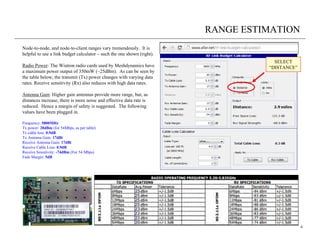
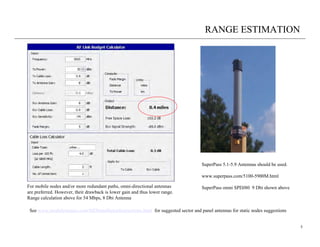
Node-to-node, and node-to-client ranges vary tremendously. It is
helpful to use a link budget calculator – such the one shown (right).
                                                                                    SELECT
Radio Power: The Wistron radio cards used by Meshdynamics have                    “DISTANCE”
a maximum power output of 350mW (~25dBm). As can be seen by
the table below, the transmit (Tx) power changes with varying data
rates. Receive sensitivity (Rx) also reduces with high data rates.

Antenna Gain: Higher gain antennas provide more range, but, as
distances increase, there is more noise and effective data rate is
reduced. Hence a margin of safety is suggested. The following
values have been plugged in.

Frequency: 5800MHz
Tx power: 20dBm (for 54Mbps, as per table)
Tx cable loss: 0.9dB
Tx Antenna Gain: 17dBi
Receive Antenna Gain: 17dBi
Receive Cable Loss: 0.9dB
Receive Sensitivity: -74dBm (For 54 Mbps)
Fade Margin: 5dB


                                                           25
                                                           25
                                                           25
                                                           25
                                                           23
                                                           22
                                                           21
                                                           20
                                                                                               4
RANGE ESTIMATION


                                                                                    SuperPass 5.1-5.9 Antennas should be used.

                                                                                    www.superpass.com/5100-5900M.html

For mobile nodes and/or more redundant paths, omni-directional antennas             SuperPass omni SPDJ80 9 Dbi shown above
are preferred. However, their drawback is lower gain and thus lower range.
Range calculation above for 54 Mbps, 8 Dbi Antenna

 See www.meshdynamics.com/MDInstallationInstructions.html for suggested sector and panel antennas for static nodes suggestions


                                                                                                                                 5
RANGE ESTIMATION
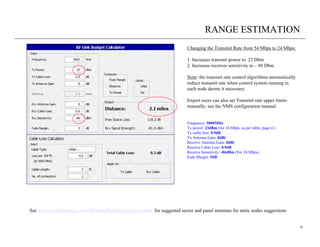
                                                                            Changing the Transmit Rate from 54 Mbps to 24 Mbps:

                                                                            1. Increases transmit power to 23 Dbm
                                                                            2. Increases receiver sensitivity to – 86 Dbm

                                                                            Note: the transmit rate control algorithms automatically
                                                                            reduce transmit rate when control system running in
                                                                            each node deems it necessary.

                                                                            Expert users can also set Transmit rate upper limits
                                                                            manually, see the NMS configuration manual.


                                                                            Frequency: 5800MHz
                                                                            Tx power: 23dBm (for 24 Mbps, as per table, page 4 )
                                                                            Tx cable loss: 0.9dB
                                                                            Tx Antenna Gain: 8dBi
                                                                            Receive Antenna Gain: 8dBi
                                                                            Receive Cable Loss: 0.9dB
                                                                            Receive Sensitivity: -86dBm (For 24 Mbps)
                                                                            Fade Margin: 5dB


See www.meshdynamics.com/MDInstallationInstructions.html for suggested sector and panel antennas for static nodes suggestions


                                                                                                                                       6
MODEL NUMBERS, ANTENNAS, AND CHANNELS

The following slides help to give an idea how to manage antennas and channels with various node model numbers.

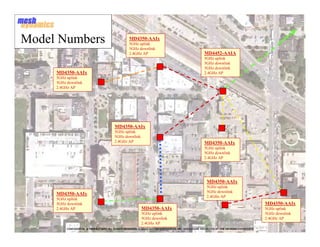
Model number selection is the first step in the design of a network. Most nodes will need an uplink, a downlink and
an AP radio. Some nodes can go without an AP radio, while others will benefit from an additional AP radio. Some
nodes do not need a downlink radio, and some may have multiple downlink radios. The following deployment
examples show scenarios where several different model numbers are used.

Antenna selection is the next step in network design. If a node has multiple AP radios, for example, it needs to be
determined where the signal from these radios need to be spread.

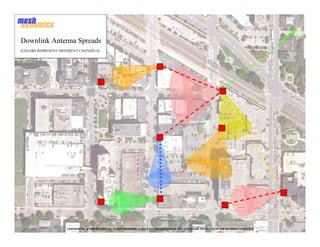
Multiple downlink radios can help the structure of a backhaul. Typically, if a node has multiple downlink radios,
directional antennas are needed on each downlink to “shoot” the downlinks’ signals to their intended child nodes.

Multiple downlink radios on root nodes will give the mesh more bandwidth; each downlink on a root node will
provide a separate channel. Again, antennas should be chosen to shoot the signal to the downlinks’ intended child
nodes.

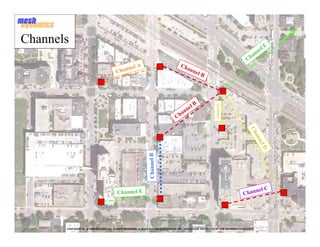
Channel usage is closely related to antenna spreads used in a deployment. It is possible to encounter signal overlap
of the same channel if antenna spreads are not chosen carefully.


                                                                                                                       7
URBAN DEPLOYMENT


                   8
Channels
                                                                                                                                       lE
                                                                                                                                     ne
                                                                                                                                   an
                                                                                                                                 Ch
                                               el A                                 Ch
                                        C hann                                         ann
                                                                                           el     B


                                                                                             lB


                                                                                                            Channel D
                                                                                        ne
                                                                                      an
                                                                                 Ch


                                                                                                                                   Ch
                                                                                                                                     an
                                                                                                                                       ne
                                                                                                                                         lD
                                                               Channel B


                                                                                                                                     el C
                                         Channel E                                                                             Chann


       CONFIDENTIAL & PROPRIETARY. ALL RIGHTS RESERVED. © 2002-2011 MESHDYNAMICS, INC. DISCLOSURE PROTECTED BY ONE OR MORE U.S PATENTS
                                                                                                                                              9
Model Numbers                                       MD4350-AAIx
                                                    5GHz uplink
                                                    5GHz downlink
                                                    2.4GHz AP                                          MD4452-AAIA
                                                                                                       5GHz uplink
                                                                                                       5GHz downlink
                                                                                                       5GHz downlink
     MD4350-AAIx                                                                                       2.4GHz AP
     5GHz uplink
     5GHz downlink
     2.4GHz AP


                                          MD4350-AAIx
                                          5GHz uplink
                                          5GHz downlink
                                          2.4GHz AP                                                    MD4350-AAIx
                                                                                                       5GHz uplink
                                                                                                       5GHz downlink
                                                                                                       2.4GHz AP


                                                                                                         MD4350-AAIx
                                                                                                         5GHz uplink
                                                                                                         5GHz downlink
     MD4350-AAIx
                                                                                                         2.4GHz AP
     5GHz uplink
     5GHz downlink                                                                                                                          MD4350-AAIx
     2.4GHz AP                                              MD4350-AAIx                                                                     5GHz uplink
                                                            5GHz uplink                                                                     5GHz downlink
                                                            5GHz downlink                                                                   2.4GHz AP
                                                            2.4GHz AP
          CONFIDENTIAL & PROPRIETARY. ALL RIGHTS RESERVED. © 2002-2011 MESHDYNAMICS, INC. DISCLOSURE PROTECTED BY ONE OR MORE U.S PATENTS
                                                                                                                                                            10
Downlink Antenna Spreads
(COLORS REPRESENT DIFFERENT CHANNELS)


                     CONFIDENTIAL & PROPRIETARY. ALL RIGHTS RESERVED. © 2002-2011 MESHDYNAMICS, INC. DISCLOSURE PROTECTED BY ONE OR MORE U.S PATENTS
                                                                                                                                                       11
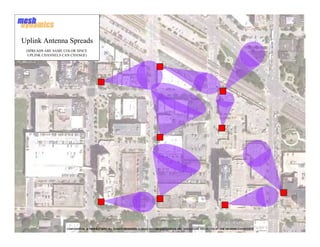
Uplink Antenna Spreads
 (SPREADS ARE SAME COLOR SINCE
  UPLINK CHANNELS CAN CHANGE)


                    CONFIDENTIAL & PROPRIETARY. ALL RIGHTS RESERVED. © 2002-2011 MESHDYNAMICS, INC. DISCLOSURE PROTECTED BY ONE OR MORE U.S PATENTS
                                                                                                                                                      12
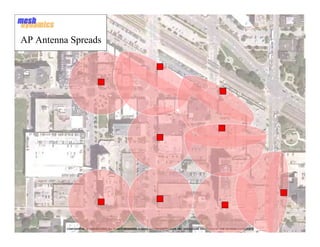
AP Antenna Spreads


          CONFIDENTIAL & PROPRIETARY. ALL RIGHTS RESERVED. © 2002-2011 MESHDYNAMICS, INC. DISCLOSURE PROTECTED BY ONE OR MORE U.S PATENTS
                                                                                                                                            13
RURAL DEPLOYMENT


                   14
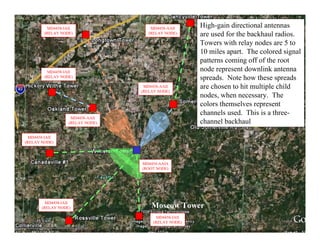
MD4458-IAII                 MD4458-AAII
                                                       High-gain directional antennas
        (RELAY NODE)                 (RELAY NODE)      are used for the backhaul radios.
                                                       Towers with relay nodes are 5 to
                                                       10 miles apart. The colored signal
                                                       patterns coming off of the root
          MD4458-IAII                                  node represent downlink antenna
        (RELAY NODE)                                   spreads. Note how these spreads
                                   MD4458-AAII         are chosen to hit multiple child
                                  (RELAY NODE)
                                                       nodes, when necessary. The
                                                       colors themselves represent
                                                       channels used. This is a three-
                    MD4458-AAII
                   (RELAY NODE)                        channel backhaul

  MD4458-IAII
(RELAY NODE)


                                  MD4454-AAIA
                                  (ROOT NODE)


         MD4458-IAII
       (RELAY NODE)                   Moscow Tower
                                         MD4458-IAII
                                       (RELAY NODE)
                                                                                        15
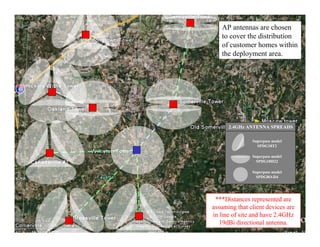
AP antennas are chosen
   to cover the distribution
   of customer homes within
   the deployment area.


      2.4GHz ANTENNA SPREADS

               Superpass model
                 SPDG18T2

               Superpass model
                 SPDG18H22

               Superpass model
                 SPDG8O-D4


 ***Distances represented are
assuming that client devices are
in line of site and have 2.4GHz
   19dBi directional antenna.
                                   16
HARBOR DEPLOYMENT


                    17
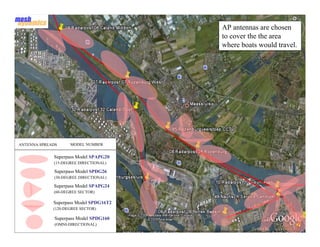
AP antennas are chosen
                                        to cover the the area
                                        where boats would travel.


ANTENNA SPREADS     MODEL NUMBER


             Superpass Model SPAPG20
             (15-DEGREE DIRECTIONAL)

             Superpass Model SPDG26
             (30-DEGREE DIRECTIONAL)

             Superpass Model SPAPG24
             (60-DEGREE SECTOR)

             Superpass Model SPDG16T2
             (120-DEGREE SECTOR)

              Superpass Model SPDG160
              (OMNI-DIRECTIONAL)
                                                                    18
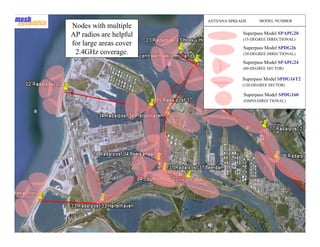
ANTENNA SPREADS     MODEL NUMBER
Nodes with multiple
AP radios are helpful                Superpass Model SPAPG20
                                     (15-DEGREE DIRECTIONAL)
for large areas cover
                                     Superpass Model SPDG26
 2.4GHz coverage.                    (30-DEGREE DIRECTIONAL)

                                     Superpass Model SPAPG24
                                     (60-DEGREE SECTOR)

                                     Superpass Model SPDG16T2
                                     (120-DEGREE SECTOR)

                                      Superpass Model SPDG160
                                      (OMNI-DIRECTIONAL)


                                                               19
RECOMMENDATIONS FOR HARBOR DEPLOYMENT
Since most nodes will be a good distance from their parent and child nodes (2km+), directional antennas should be used on the
backhaul links (Superpass model SPPJ48-BD is recommended for these links).

In some situations, a child node may have multiple parent nodes within a small horizontal angle of its view. In these situations, it is
beneficial to chose an antenna for the child node’s uplink such that the antenna’s spread hits these multiple parents.

For example, 22 Radarpost has four potential parent nodes in its site:
21 Radarpost,
29 Radarpost Erasmus,
28 Radarpost,
28 Boompjes.

In this situation, a suitable antenna for the uplink would have a horizontal spread big enough to encompass the four mentioned
locations (Superpass model SPDN6W would be suitable --it has a 30-degree H-spread, and a 14-degree V-spread).

Various model numbers are recommended for the mesh nodes…

For the root node, the MD4454-AAIA. This takes advantage of multiple-downlink technology, while also providing an AP radio.
Whichever location(s) is selected to be the root node, antennas can be selected appropriately to aim the bandwidth to surrounding
child nodes or node clusters.

For the relay nodes. The MD4458-AAII, MD4458-IAII and the MD4452-AAIA are recommended.
The MD4458-AAII provides two AP radios in addition to the backhaul radios. Antennas can be chosen for the AP radios in order to
optimize the coverage distribution in areas where this might be needed.

The MD4458-IAII is used in situations where a node is on the edge of a deployment, and the only backhaul radio needed on the
node is the uplink. The other three radios can be APs.

The MD4452-AAIA provides a second downlink radio to “shoot” the backhaul to child nodes in different locations/directions
relative to the parent node. This might be useful in the location of 10 Radarpost, for example.

                                                                                                                                          20
CAMPGROUNDS


              21
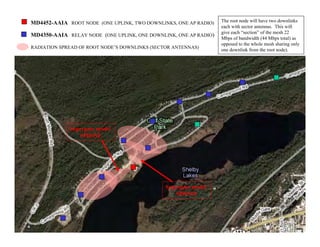
MD4452-AAIA ROOT NODE (ONE UPLINK, TWO DOWNLINKS, ONE AP RADIO)   The root node will have two downlinks
                                                                  each with sector antennas. This will
                                                                  give each “section” of the mesh 22
MD4350-AAIA RELAY NODE (ONE UPLINK, ONE DOWNLINK, ONE AP RADIO)
                                                                  Mbps of bandwidth (44 Mbps total) as
                                                                  opposed to the whole mesh sharing only
RADIATION SPREAD OF ROOT NODE’S DOWNLINKS (SECTOR ANTENNAS)
                                                                  one downlink from the root node).


             Superpass model
                SPD6NE


                                               Superpass model
                                                   SPDN6F


                                                                                                       22
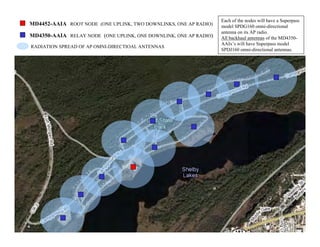
Each of the nodes will have a Superpass
MD4452-AAIA ROOT NODE (ONE UPLINK, TWO DOWNLINKS, ONE AP RADIO)   model SPDG160 omni-directional
                                                                  antenna on its AP radio.
MD4350-AAIA RELAY NODE (ONE UPLINK, ONE DOWNLINK, ONE AP RADIO)   All backhaul antennas of the MD4350-
                                                                  AAIx’s will have Superpass model
RADIATION SPREAD OF AP OMNI-DIRECTIOAL ANTENNAS
                                                                  SPDJ160 omni-directional antennas.


                                                                                                        23
SURFACE MINING DEPLOYMENT


                            24
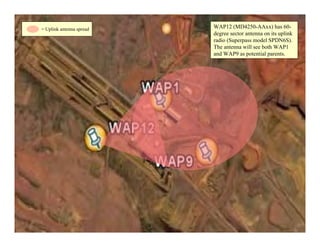
= Uplink antenna spread   WAP12 (MD4250-AAxx) has 60-
                          degree sector antenna on its uplink
                          radio (Superpass model SPDN6S).
                          The antenna will see both WAP1
                          and WAP9 as potential parents.


                                                                25
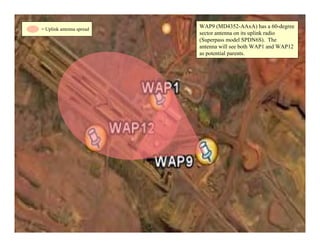
= Uplink antenna spread
                          WAP9 (MD4352-AAxA) has a 60-degree
                          sector antenna on its uplink radio
                          (Superpass model SPDN6S). The
                          antenna will see both WAP1 and WAP12
                          as potential parents.


                                                                 26
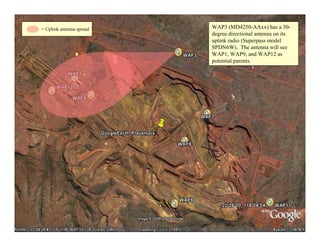
= Uplink antenna spread   WAP3 (MD4250-AAxx) has a 30-
                          degree directional antenna on its
                          uplink radio (Superpass model
                          SPDN6W). The antenna will see
                          WAP1, WAP9, and WAP12 as
                          potential parents.


                                                              27
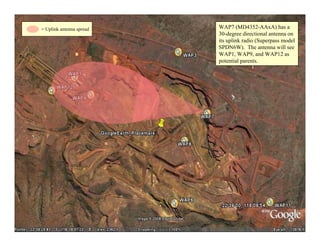
= Uplink antenna spread   WAP7 (MD4352-AAxA) has a
                          30-degree directional antenna on
                          its uplink radio (Superpass model
                          SPDN6W). The antenna will see
                          WAP1, WAP9, and WAP12 as
                          potential parents.


                                                              28
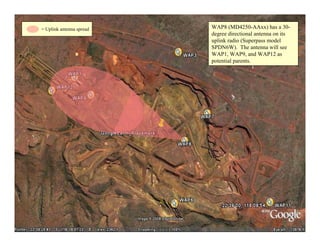
= Uplink antenna spread   WAP8 (MD4250-AAxx) has a 30-
                          degree directional antenna on its
                          uplink radio (Superpass model
                          SPDN6W). The antenna will see
                          WAP1, WAP9, and WAP12 as
                          potential parents.


                                                              29
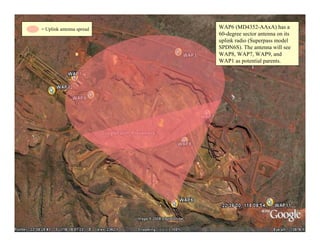
= Uplink antenna spread   WAP6 (MD4352-AAxA) has a
                          60-degree sector antenna on its
                          uplink radio (Superpass model
                          SPDN6S). The antenna will see
                          WAP8, WAP7, WAP9, and
                          WAP1 as potential parents.


                                                            30
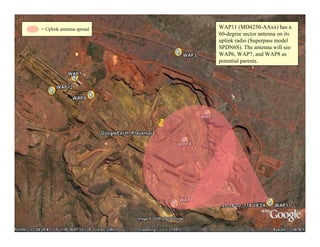
= Uplink antenna spread   WAP11 (MD4250-AAxx) has a
                          60-degree sector antenna on its
                          uplink radio (Superpass model
                          SPDN6S). The antenna will see
                          WAP6, WAP7, and WAP8 as
                          potential parents.


                                                            31
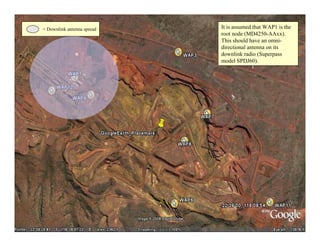
= Downlink antenna spread   It is assumed that WAP1 is the
                            root node (MD4250-AAxx).
                            This should have an omni-
                            directional antenna on its
                            downlink radio (Superpass
                            model SPDJ60).


                                                             32
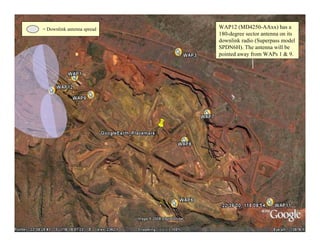
= Downlink antenna spread   WAP12 (MD4250-AAxx) has a
                            180-degree sector antenna on its
                            downlink radio (Superpass model
                            SPDN6H). The antenna will be
                            pointed away from WAPs 1 & 9.


                                                               33
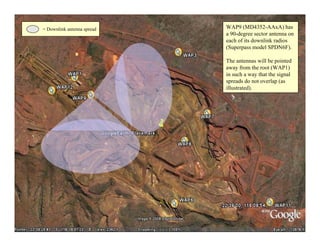
= Downlink antenna spread   WAP9 (MD4352-AAxA) has
                            a 90-degree sector antenna on
                            each of its downlink radios
                            (Superpass model SPDN6F).

                            The antennas will be pointed
                            away from the root (WAP1)
                            in such a way that the signal
                            spreads do not overlap (as
                            illustrated).


                                                            34
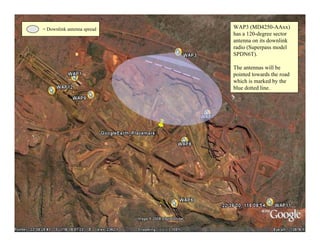
= Downlink antenna spread   WAP3 (MD4250-AAxx)
                            has a 120-degree sector
                            antenna on its downlink
                            radio (Superpass model
                            SPDN6T).

                            The antennas will be
                            pointed towards the road
                            which is marked by the
                            blue dotted line.


                                                       35
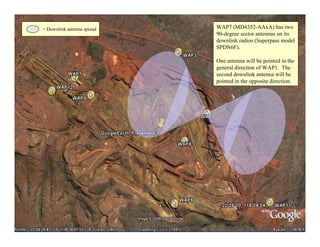
= Downlink antenna spread   WAP7 (MD4352-AAxA) has two
                            90-degree sector antennas on its
                            downlink radios (Superpass model
                            SPDN6F).

                            One antenna will be pointed in the
                            general direction of WAP1. The
                            second downlink antenna will be
                            pointed in the opposite direction.


                                                                 36
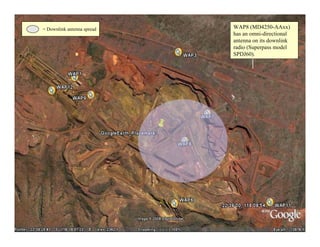
= Downlink antenna spread   WAP8 (MD4250-AAxx)
                            has an omni-directional
                            antenna on its downlink
                            radio (Superpass model
                            SPDJ60).


                                                      37
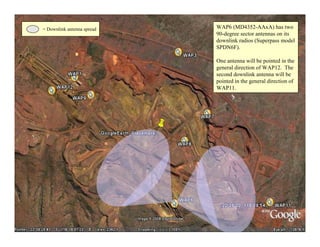
= Downlink antenna spread   WAP6 (MD4352-AAxA) has two
                            90-degree sector antennas on its
                            downlink radios (Superpass model
                            SPDN6F).

                            One antenna will be pointed in the
                            general direction of WAP12. The
                            second downlink antenna will be
                            pointed in the general direction of
                            WAP11.


                                                                  38
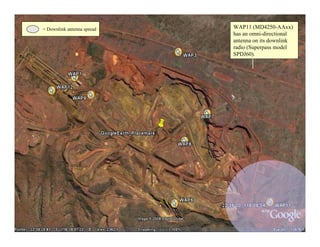
= Downlink antenna spread   WAP11 (MD4250-AAxx)
                            has an omni-directional
                            antenna on its downlink
                            radio (Superpass model
                            SPDJ60).


                                                      39
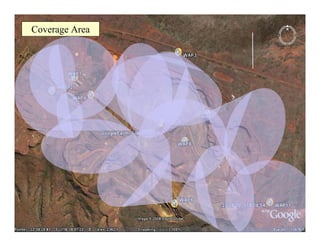
Coverage Area


                40
For more information on the MD4000 Modular Mesh Nodes,

Please visit:

www.meshdynamics.com/tech-presentations.html

Or send us an email at

techsupport@MeshDynamics.com

Thank you.


                                                         41

MeshDynamics Mesh Network Layout Design (Examples)

  • 1.
    For MESHDYNAMICS SYSTEMINTEGRATORS NETWORK LAYOUT DESIGN AND ANTENNA SELECTION 1
  • 2.
    NETWORK DESIGN The designof most networks starts with a satellite view of the deployment area. This can be gotten from Google Maps. ROOT NODE RELAY NODE The satellite view can then be labeled to mark the root and relay nodes of a tree based wireless mesh network. 1) Where is the root of the bandwidth (root nodes): RELAY NODE Internet source Security Office RELAY NODE Network Operations Center etc. RELAY NODE 2) Where are the points/areas of needed RELAY NODE RELAY NODE bandwidth (relay nodes): Associated Client Devices Surveillance Cameras Vehicles Customer Homes etc. RELAY NODE Node-to-node and node-to-client distances can be gauged using the satellite view. ROOT NODE 2
  • 3.
    NODE LOCATIONS VEHICLE REMOTE Node locations are influenced by: mesh SITE TRANSMITTING dynamics ---The start (root node) and end points (edge nodes) of bandwidth VIDEO ---Points in between root node and edge node (backhaul) ---Local distribution of client devices ---Camera locations ---Possible vehicle locations ---Available power sources ---Limitations of antenna ranges ---Limitations of node-mounting locations BASE TOWER REMOTE CAMERAS SITE BASE 3
  • 4.
    RANGE ESTIMATION Node-to-node, andnode-to-client ranges vary tremendously. It is helpful to use a link budget calculator – such the one shown (right). SELECT Radio Power: The Wistron radio cards used by Meshdynamics have “DISTANCE” a maximum power output of 350mW (~25dBm). As can be seen by the table below, the transmit (Tx) power changes with varying data rates. Receive sensitivity (Rx) also reduces with high data rates. Antenna Gain: Higher gain antennas provide more range, but, as distances increase, there is more noise and effective data rate is reduced. Hence a margin of safety is suggested. The following values have been plugged in. Frequency: 5800MHz Tx power: 20dBm (for 54Mbps, as per table) Tx cable loss: 0.9dB Tx Antenna Gain: 17dBi Receive Antenna Gain: 17dBi Receive Cable Loss: 0.9dB Receive Sensitivity: -74dBm (For 54 Mbps) Fade Margin: 5dB 25 25 25 25 23 22 21 20 4
  • 5.
    RANGE ESTIMATION SuperPass 5.1-5.9 Antennas should be used. www.superpass.com/5100-5900M.html For mobile nodes and/or more redundant paths, omni-directional antennas SuperPass omni SPDJ80 9 Dbi shown above are preferred. However, their drawback is lower gain and thus lower range. Range calculation above for 54 Mbps, 8 Dbi Antenna See www.meshdynamics.com/MDInstallationInstructions.html for suggested sector and panel antennas for static nodes suggestions 5
  • 6.
    RANGE ESTIMATION Changing the Transmit Rate from 54 Mbps to 24 Mbps: 1. Increases transmit power to 23 Dbm 2. Increases receiver sensitivity to – 86 Dbm Note: the transmit rate control algorithms automatically reduce transmit rate when control system running in each node deems it necessary. Expert users can also set Transmit rate upper limits manually, see the NMS configuration manual. Frequency: 5800MHz Tx power: 23dBm (for 24 Mbps, as per table, page 4 ) Tx cable loss: 0.9dB Tx Antenna Gain: 8dBi Receive Antenna Gain: 8dBi Receive Cable Loss: 0.9dB Receive Sensitivity: -86dBm (For 24 Mbps) Fade Margin: 5dB See www.meshdynamics.com/MDInstallationInstructions.html for suggested sector and panel antennas for static nodes suggestions 6
  • 7.
    MODEL NUMBERS, ANTENNAS,AND CHANNELS The following slides help to give an idea how to manage antennas and channels with various node model numbers. Model number selection is the first step in the design of a network. Most nodes will need an uplink, a downlink and an AP radio. Some nodes can go without an AP radio, while others will benefit from an additional AP radio. Some nodes do not need a downlink radio, and some may have multiple downlink radios. The following deployment examples show scenarios where several different model numbers are used. Antenna selection is the next step in network design. If a node has multiple AP radios, for example, it needs to be determined where the signal from these radios need to be spread. Multiple downlink radios can help the structure of a backhaul. Typically, if a node has multiple downlink radios, directional antennas are needed on each downlink to “shoot” the downlinks’ signals to their intended child nodes. Multiple downlink radios on root nodes will give the mesh more bandwidth; each downlink on a root node will provide a separate channel. Again, antennas should be chosen to shoot the signal to the downlinks’ intended child nodes. Channel usage is closely related to antenna spreads used in a deployment. It is possible to encounter signal overlap of the same channel if antenna spreads are not chosen carefully. 7
  • 8.
  • 9.
    Channels lE ne an Ch el A Ch C hann ann el B lB Channel D ne an Ch Ch an ne lD Channel B el C Channel E Chann CONFIDENTIAL & PROPRIETARY. ALL RIGHTS RESERVED. © 2002-2011 MESHDYNAMICS, INC. DISCLOSURE PROTECTED BY ONE OR MORE U.S PATENTS 9
  • 10.
    Model Numbers MD4350-AAIx 5GHz uplink 5GHz downlink 2.4GHz AP MD4452-AAIA 5GHz uplink 5GHz downlink 5GHz downlink MD4350-AAIx 2.4GHz AP 5GHz uplink 5GHz downlink 2.4GHz AP MD4350-AAIx 5GHz uplink 5GHz downlink 2.4GHz AP MD4350-AAIx 5GHz uplink 5GHz downlink 2.4GHz AP MD4350-AAIx 5GHz uplink 5GHz downlink MD4350-AAIx 2.4GHz AP 5GHz uplink 5GHz downlink MD4350-AAIx 2.4GHz AP MD4350-AAIx 5GHz uplink 5GHz uplink 5GHz downlink 5GHz downlink 2.4GHz AP 2.4GHz AP CONFIDENTIAL & PROPRIETARY. ALL RIGHTS RESERVED. © 2002-2011 MESHDYNAMICS, INC. DISCLOSURE PROTECTED BY ONE OR MORE U.S PATENTS 10
  • 11.
    Downlink Antenna Spreads (COLORSREPRESENT DIFFERENT CHANNELS) CONFIDENTIAL & PROPRIETARY. ALL RIGHTS RESERVED. © 2002-2011 MESHDYNAMICS, INC. DISCLOSURE PROTECTED BY ONE OR MORE U.S PATENTS 11
  • 12.
    Uplink Antenna Spreads (SPREADS ARE SAME COLOR SINCE UPLINK CHANNELS CAN CHANGE) CONFIDENTIAL & PROPRIETARY. ALL RIGHTS RESERVED. © 2002-2011 MESHDYNAMICS, INC. DISCLOSURE PROTECTED BY ONE OR MORE U.S PATENTS 12
  • 13.
    AP Antenna Spreads CONFIDENTIAL & PROPRIETARY. ALL RIGHTS RESERVED. © 2002-2011 MESHDYNAMICS, INC. DISCLOSURE PROTECTED BY ONE OR MORE U.S PATENTS 13
  • 14.
  • 15.
    MD4458-IAII MD4458-AAII High-gain directional antennas (RELAY NODE) (RELAY NODE) are used for the backhaul radios. Towers with relay nodes are 5 to 10 miles apart. The colored signal patterns coming off of the root MD4458-IAII node represent downlink antenna (RELAY NODE) spreads. Note how these spreads MD4458-AAII are chosen to hit multiple child (RELAY NODE) nodes, when necessary. The colors themselves represent channels used. This is a three- MD4458-AAII (RELAY NODE) channel backhaul MD4458-IAII (RELAY NODE) MD4454-AAIA (ROOT NODE) MD4458-IAII (RELAY NODE) Moscow Tower MD4458-IAII (RELAY NODE) 15
  • 16.
    AP antennas arechosen to cover the distribution of customer homes within the deployment area. 2.4GHz ANTENNA SPREADS Superpass model SPDG18T2 Superpass model SPDG18H22 Superpass model SPDG8O-D4 ***Distances represented are assuming that client devices are in line of site and have 2.4GHz 19dBi directional antenna. 16
  • 17.
  • 18.
    AP antennas arechosen to cover the the area where boats would travel. ANTENNA SPREADS MODEL NUMBER Superpass Model SPAPG20 (15-DEGREE DIRECTIONAL) Superpass Model SPDG26 (30-DEGREE DIRECTIONAL) Superpass Model SPAPG24 (60-DEGREE SECTOR) Superpass Model SPDG16T2 (120-DEGREE SECTOR) Superpass Model SPDG160 (OMNI-DIRECTIONAL) 18
  • 19.
    ANTENNA SPREADS MODEL NUMBER Nodes with multiple AP radios are helpful Superpass Model SPAPG20 (15-DEGREE DIRECTIONAL) for large areas cover Superpass Model SPDG26 2.4GHz coverage. (30-DEGREE DIRECTIONAL) Superpass Model SPAPG24 (60-DEGREE SECTOR) Superpass Model SPDG16T2 (120-DEGREE SECTOR) Superpass Model SPDG160 (OMNI-DIRECTIONAL) 19
  • 20.
    RECOMMENDATIONS FOR HARBORDEPLOYMENT Since most nodes will be a good distance from their parent and child nodes (2km+), directional antennas should be used on the backhaul links (Superpass model SPPJ48-BD is recommended for these links). In some situations, a child node may have multiple parent nodes within a small horizontal angle of its view. In these situations, it is beneficial to chose an antenna for the child node’s uplink such that the antenna’s spread hits these multiple parents. For example, 22 Radarpost has four potential parent nodes in its site: 21 Radarpost, 29 Radarpost Erasmus, 28 Radarpost, 28 Boompjes. In this situation, a suitable antenna for the uplink would have a horizontal spread big enough to encompass the four mentioned locations (Superpass model SPDN6W would be suitable --it has a 30-degree H-spread, and a 14-degree V-spread). Various model numbers are recommended for the mesh nodes… For the root node, the MD4454-AAIA. This takes advantage of multiple-downlink technology, while also providing an AP radio. Whichever location(s) is selected to be the root node, antennas can be selected appropriately to aim the bandwidth to surrounding child nodes or node clusters. For the relay nodes. The MD4458-AAII, MD4458-IAII and the MD4452-AAIA are recommended. The MD4458-AAII provides two AP radios in addition to the backhaul radios. Antennas can be chosen for the AP radios in order to optimize the coverage distribution in areas where this might be needed. The MD4458-IAII is used in situations where a node is on the edge of a deployment, and the only backhaul radio needed on the node is the uplink. The other three radios can be APs. The MD4452-AAIA provides a second downlink radio to “shoot” the backhaul to child nodes in different locations/directions relative to the parent node. This might be useful in the location of 10 Radarpost, for example. 20
  • 21.
  • 22.
    MD4452-AAIA ROOT NODE(ONE UPLINK, TWO DOWNLINKS, ONE AP RADIO) The root node will have two downlinks each with sector antennas. This will give each “section” of the mesh 22 MD4350-AAIA RELAY NODE (ONE UPLINK, ONE DOWNLINK, ONE AP RADIO) Mbps of bandwidth (44 Mbps total) as opposed to the whole mesh sharing only RADIATION SPREAD OF ROOT NODE’S DOWNLINKS (SECTOR ANTENNAS) one downlink from the root node). Superpass model SPD6NE Superpass model SPDN6F 22
  • 23.
    Each of thenodes will have a Superpass MD4452-AAIA ROOT NODE (ONE UPLINK, TWO DOWNLINKS, ONE AP RADIO) model SPDG160 omni-directional antenna on its AP radio. MD4350-AAIA RELAY NODE (ONE UPLINK, ONE DOWNLINK, ONE AP RADIO) All backhaul antennas of the MD4350- AAIx’s will have Superpass model RADIATION SPREAD OF AP OMNI-DIRECTIOAL ANTENNAS SPDJ160 omni-directional antennas. 23
  • 24.
  • 25.
    = Uplink antennaspread WAP12 (MD4250-AAxx) has 60- degree sector antenna on its uplink radio (Superpass model SPDN6S). The antenna will see both WAP1 and WAP9 as potential parents. 25
  • 26.
    = Uplink antennaspread WAP9 (MD4352-AAxA) has a 60-degree sector antenna on its uplink radio (Superpass model SPDN6S). The antenna will see both WAP1 and WAP12 as potential parents. 26
  • 27.
    = Uplink antennaspread WAP3 (MD4250-AAxx) has a 30- degree directional antenna on its uplink radio (Superpass model SPDN6W). The antenna will see WAP1, WAP9, and WAP12 as potential parents. 27
  • 28.
    = Uplink antennaspread WAP7 (MD4352-AAxA) has a 30-degree directional antenna on its uplink radio (Superpass model SPDN6W). The antenna will see WAP1, WAP9, and WAP12 as potential parents. 28
  • 29.
    = Uplink antennaspread WAP8 (MD4250-AAxx) has a 30- degree directional antenna on its uplink radio (Superpass model SPDN6W). The antenna will see WAP1, WAP9, and WAP12 as potential parents. 29
  • 30.
    = Uplink antennaspread WAP6 (MD4352-AAxA) has a 60-degree sector antenna on its uplink radio (Superpass model SPDN6S). The antenna will see WAP8, WAP7, WAP9, and WAP1 as potential parents. 30
  • 31.
    = Uplink antennaspread WAP11 (MD4250-AAxx) has a 60-degree sector antenna on its uplink radio (Superpass model SPDN6S). The antenna will see WAP6, WAP7, and WAP8 as potential parents. 31
  • 32.
    = Downlink antennaspread It is assumed that WAP1 is the root node (MD4250-AAxx). This should have an omni- directional antenna on its downlink radio (Superpass model SPDJ60). 32
  • 33.
    = Downlink antennaspread WAP12 (MD4250-AAxx) has a 180-degree sector antenna on its downlink radio (Superpass model SPDN6H). The antenna will be pointed away from WAPs 1 & 9. 33
  • 34.
    = Downlink antennaspread WAP9 (MD4352-AAxA) has a 90-degree sector antenna on each of its downlink radios (Superpass model SPDN6F). The antennas will be pointed away from the root (WAP1) in such a way that the signal spreads do not overlap (as illustrated). 34
  • 35.
    = Downlink antennaspread WAP3 (MD4250-AAxx) has a 120-degree sector antenna on its downlink radio (Superpass model SPDN6T). The antennas will be pointed towards the road which is marked by the blue dotted line. 35
  • 36.
    = Downlink antennaspread WAP7 (MD4352-AAxA) has two 90-degree sector antennas on its downlink radios (Superpass model SPDN6F). One antenna will be pointed in the general direction of WAP1. The second downlink antenna will be pointed in the opposite direction. 36
  • 37.
    = Downlink antennaspread WAP8 (MD4250-AAxx) has an omni-directional antenna on its downlink radio (Superpass model SPDJ60). 37
  • 38.
    = Downlink antennaspread WAP6 (MD4352-AAxA) has two 90-degree sector antennas on its downlink radios (Superpass model SPDN6F). One antenna will be pointed in the general direction of WAP12. The second downlink antenna will be pointed in the general direction of WAP11. 38
  • 39.
    = Downlink antennaspread WAP11 (MD4250-AAxx) has an omni-directional antenna on its downlink radio (Superpass model SPDJ60). 39
  • 40.
  • 41.
    For more informationon the MD4000 Modular Mesh Nodes, Please visit: www.meshdynamics.com/tech-presentations.html Or send us an email at techsupport@MeshDynamics.com Thank you. 41