The document proposes a self-organizing uplink-downlink optimization scheme for time-division duplex (TDD) based small cell networks. It formulates the optimization problem as a non-cooperative game where each small cell base station aims to minimize its total uplink and downlink flow delays by selecting an optimal uplink-downlink configuration. A decentralized learning algorithm is presented that allows each base station to autonomously estimate traffic loads and optimize its configuration accordingly. Simulation results show the proposed algorithm achieves significant gains in packet throughput compared to random or fixed configuration schemes, especially under asymmetric traffic loads.
![Dynamic Uplink-Downlink Optimization in
TDD-based Small Cell Networks
Mohammed S. ElBamby, Mehdi Bennis, Walid Saady and Matti Latva-aho
Centre for Wireless Communications, University of Oulu, Finland,
email: fmelbamby,bennis,matti.latva-ahog@ee.oulu.fi
yWireless@VT, Bradley Department of Electrical and Computer Engineering, Virginia Tech, Blacksburg, VA, USA, email: walids@vt.edu
Abstract—Dynamic Time-division duplex (TDD) can provide
efficient and flexible splitting of the common wireless cellular
resources between uplink (UL) and downlink (DL) users. In
this paper, the UL/DL optimization problem is formulated as a
noncooperative game among the small cell base stations (SCBSs)
in which each base station aims at minimizing its total UL and
DL flow delays. To solve this game, a self-organizing UL/DL
resource configuration scheme for TDD-based small cell networks
is proposed. Using the proposed scheme, an SCBS is able to
estimate and learn the UL and DL loads autonomously while
optimizing its UL/DL configuration accordingly. Simulations
results show that the proposed algorithm achieves significant
gains in terms of packet throughput in case of asymmetric
UL and DL traffic loads. This gain increases as the traffic
asymmetry increases, reaching up to 97% and 200% gains
relative to random and fixed duplexing schemes respectively. Our
results also show that the proposed algorithm is well- adapted
to dynamic traffic conditions and different network sizes, and
operates efficiently in case of severe cross-link interference in
which neighboring cells transmit in opposite directions.
Keywords- Dynamic-TDD; small cells; reinforcement learning;
self-organizing networks
I. INTRODUCTION
Next generation of heterogeneous networks (HetNets) are
expected to have significant variations in traffic load between
different cells and at different times. Moreover, due to the
massive increase in the use of smartphones and video stream-ing
applications [1], an asymmetric and dynamically changing
uplink (UL) and downlink (DL) traffic is expected, incurring
new types of cross-link interferences. In order to cope with
this challenge, it is necessary that the evolution of current
wireless networks is able to accommodate asymmetric UL and
DL traffic loads. While Time-division duplex (TDD) systems
[2] have the capability of handling this asymmetry, in practice,
cells operating in TDD are assumed to synchronize their UL
and DL transmissions. Otherwise, they can suffer from a new
type of interference from base stations transmitting in the
opposite direction; this is referred to as cross-link interference
[2]. Basically, there are two types of interference associated
with the asynchronous TDD operation, UL-to-DL interference
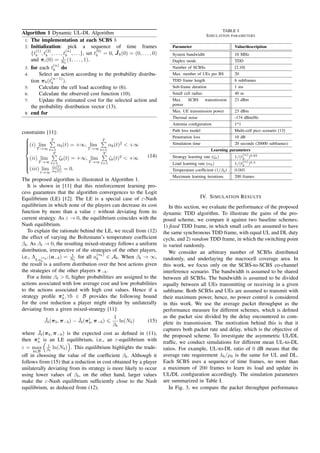
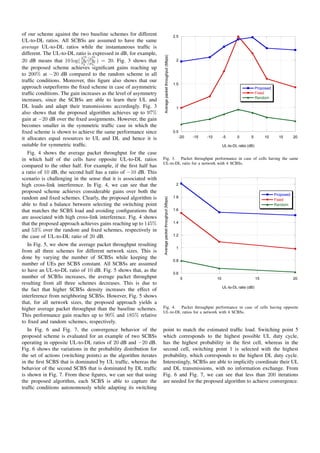
and DL-to-UL interference, as illustrated in Fig. 1.
This research is supported by the SHARING project under Finland grant
128010 and the U.S. National Science Foundation (NSF) under Grants CNS-
1253731 and CNS-1406947.
DL-to-UL interference
Ul-to-DL interference
Downlink SCBS Uplink SCBS
Fig. 1. New types of interference arising in the dynamic TDD configuration.
Dealing with cross-link interference is a key challenge for
deploying dynamic TDD-based systems [3]. For example,
time-division Long Term Evolution (TD-LTE) systems require
synchronization between base stations over an overlapping
coverage area [4]. Moreover, under small cell base station
(SCBS) deployment, this becomes more challenging [5], since
cells are more likely to have strong interference coupling,
especially in dense overlapping areas. Besides, as centralized
operation becomes difficult, small cells should self-organize
to select their optimum UL/DL configuration, as a function
of the interference levels, and users’ quality-of-service (QoS)
requirements.
The problem of dynamic UL-DL configuration in TD-LTE
systems is studied in [6]. Therein, the prospects of dynamic
TDD in TD-LTE systems are discussed and challenges are
identified, among which interference management is seen as
a major impediment. The performance of dynamic adaptation
of UL and DL in LTE picocell systems is also analyzed in
[7]. It is shown that significant gains in packet throughput are
achieved by using dynamic TDD over the synchronous TD-LTE.
The analytical modeling of UL and DL performance
under dynamic TDD is studied in [8] using tools from
stochastic geometry. A cooperative UL-DL adaptation scheme
is introduced in [9] in which two SCBSs serving one user each,
adapt their UL/DL configuration locally relying on exchanging
low-rate information.
The main contribution of this paper is to propose a dy-namic
UL/DL configuration scheme for TDD-based small
cell environments in which the objective is to minimize the
overall UL and DL delay in each cell and in a completely
autonomous manner. In particular, the problem is formulated
978-1-4799-5863-4/14/$31.00
c 2014 IEEE as a noncooprative game in which the SCBSs are the players.
arXiv:1402.7292v2 [cs.NI] 11 Sep 2014](https://image.slidesharecdn.com/0dynamicuplink-downlinkoptimization-141212114301-conversion-gate01/85/Dynamic-uplink-downlink-optimization-1-320.jpg)
![Dynamic Uplink-Downlink Optimization in
TDD-based Small Cell Networks
Mohammed S. ElBamby, Mehdi Bennis, Walid Saady and Matti Latva-aho
Centre for Wireless Communications, University of Oulu, Finland,
email: fmelbamby,bennis,matti.latva-ahog@ee.oulu.fi
yWireless@VT, Bradley Department of Electrical and Computer Engineering, Virginia Tech, Blacksburg, VA, USA, email: walids@vt.edu
Abstract—Dynamic Time-division duplex (TDD) can provide
efficient and flexible splitting of the common wireless cellular
resources between uplink (UL) and downlink (DL) users. In
this paper, the UL/DL optimization problem is formulated as a
noncooperative game among the small cell base stations (SCBSs)
in which each base station aims at minimizing its total UL and
DL flow delays. To solve this game, a self-organizing UL/DL
resource configuration scheme for TDD-based small cell networks
is proposed. Using the proposed scheme, an SCBS is able to
estimate and learn the UL and DL loads autonomously while
optimizing its UL/DL configuration accordingly. Simulations
results show that the proposed algorithm achieves significant
gains in terms of packet throughput in case of asymmetric
UL and DL traffic loads. This gain increases as the traffic
asymmetry increases, reaching up to 97% and 200% gains
relative to random and fixed duplexing schemes respectively. Our
results also show that the proposed algorithm is well- adapted
to dynamic traffic conditions and different network sizes, and
operates efficiently in case of severe cross-link interference in
which neighboring cells transmit in opposite directions.
Keywords- Dynamic-TDD; small cells; reinforcement learning;
self-organizing networks
I. INTRODUCTION
Next generation of heterogeneous networks (HetNets) are
expected to have significant variations in traffic load between
different cells and at different times. Moreover, due to the
massive increase in the use of smartphones and video stream-ing
applications [1], an asymmetric and dynamically changing
uplink (UL) and downlink (DL) traffic is expected, incurring
new types of cross-link interferences. In order to cope with
this challenge, it is necessary that the evolution of current
wireless networks is able to accommodate asymmetric UL and
DL traffic loads. While Time-division duplex (TDD) systems
[2] have the capability of handling this asymmetry, in practice,
cells operating in TDD are assumed to synchronize their UL
and DL transmissions. Otherwise, they can suffer from a new
type of interference from base stations transmitting in the
opposite direction; this is referred to as cross-link interference
[2]. Basically, there are two types of interference associated
with the asynchronous TDD operation, UL-to-DL interference
and DL-to-UL interference, as illustrated in Fig. 1.
This research is supported by the SHARING project under Finland grant
128010 and the U.S. National Science Foundation (NSF) under Grants CNS-
1253731 and CNS-1406947.
DL-to-UL interference
Ul-to-DL interference
Downlink SCBS Uplink SCBS
Fig. 1. New types of interference arising in the dynamic TDD configuration.
Dealing with cross-link interference is a key challenge for
deploying dynamic TDD-based systems [3]. For example,
time-division Long Term Evolution (TD-LTE) systems require
synchronization between base stations over an overlapping
coverage area [4]. Moreover, under small cell base station
(SCBS) deployment, this becomes more challenging [5], since
cells are more likely to have strong interference coupling,
especially in dense overlapping areas. Besides, as centralized
operation becomes difficult, small cells should self-organize
to select their optimum UL/DL configuration, as a function
of the interference levels, and users’ quality-of-service (QoS)
requirements.
The problem of dynamic UL-DL configuration in TD-LTE
systems is studied in [6]. Therein, the prospects of dynamic
TDD in TD-LTE systems are discussed and challenges are
identified, among which interference management is seen as
a major impediment. The performance of dynamic adaptation
of UL and DL in LTE picocell systems is also analyzed in
[7]. It is shown that significant gains in packet throughput are
achieved by using dynamic TDD over the synchronous TD-LTE.
The analytical modeling of UL and DL performance
under dynamic TDD is studied in [8] using tools from
stochastic geometry. A cooperative UL-DL adaptation scheme
is introduced in [9] in which two SCBSs serving one user each,
adapt their UL/DL configuration locally relying on exchanging
low-rate information.
The main contribution of this paper is to propose a dy-namic
UL/DL configuration scheme for TDD-based small
cell environments in which the objective is to minimize the
overall UL and DL delay in each cell and in a completely
autonomous manner. In particular, the problem is formulated
978-1-4799-5863-4/14/$31.00
c 2014 IEEE as a noncooprative game in which the SCBSs are the players.
arXiv:1402.7292v2 [cs.NI] 11 Sep 2014](https://image.slidesharecdn.com/0dynamicuplink-downlinkoptimization-141212114301-conversion-gate01/75/Dynamic-uplink-downlink-optimization-1-2048.jpg)
![Nf -1 switching points
...
...
1 2 3 Nf
Nf subframes
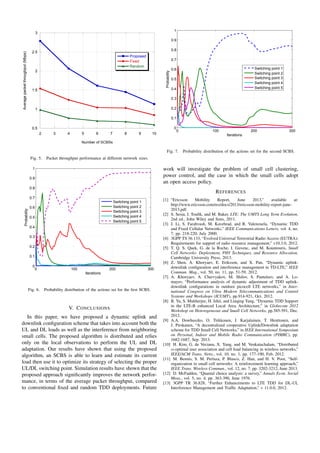
Fig. 2. Possible switching points in a TDD frame.
In this game, each SCBS learns and estimates its current
uplink and downlink delay, as a function of its traffic load,
interference levels and flow-level dynamics, relying only on
its instantaneous observations, and uses this estimated value
to update its UL/DL switching point. A decentralized and
self-organizing learning algorithm is then proposed to find an
equilibrium of the game. The proposed approach is then shown
to achieve considerable gains over fixed and random TDD de-ployments
for different network sizes. In addition, our results
show that the proposed algorithm is well-suited to small cell
environments with large traffic dynamics. Simulation results
show significant packet throughput gains in case of asymmetric
UL and DL traffic loads for the proposed algorithm. The gain
further increases as the traffic asymmetry increases, reaching
up to 97% and 200% gains relative to random and fixed
schemes respectively.
The rest of this paper is organized as follows, in Section II,
we describe the network model and formulate the problem.
Section III introduces the proposed self-organizing UL/DL
optimization scheme. Simulation results are provided in Sec-tion
IV. Finally, Section V concludes the paper.
II. SYSTEM MODEL
A. Network Model
We consider a wireless communication system consisting
of a set of small cell base stations (SCBSs) B = f1; : : : ;Bg.
We assume that a user equipment (UE) arrives at location x
within the considered geographical area according to a Poisson
arrival process with rate (x). Each UE requests either a DL
or UL file whose size follows an exponential distribution with
mean 1=(x). A closed-access policy is assumed in this work,
meaning that each SCBS has its own subscribed UEs, and
hence no handover is considered [5]. We further assume Lb
to be the coverage area of an SCBS b, where a UE at location
x is served by an SCBS b if x 2 Lb.
We assume that the system operates in TDD mode. A time
frame consists of a number of Nf subframes. A frame is
divided into two portions, UL portion and DL portion. Each
portion consists of a group of subframes dedicated to serving
either UL or DL traffic. A switching point wb is defined as
the point in which SCBS b switches from UL mode to DL
mode. There is a number of Nf 1 possible switching points
for a frame length of Nf , then wb 2 f1; : : : ;Wf g, where
Wf = Nf1, as illustrated in Fig. 2. For any of these possible
switching points, there will be at least one subframe for UL
and for DL in each frame.
B. Problem Formulation
We define the vector w = [w1;w2; : : : ;wB] as the vector
of switching points for all SCBSs in the system. Varying
switching points asynchronously in different cells may cause
opposite transmission directions in different cells which leads
to cross-link interference (i.e. UL-to-DL interference and DL-to-
UL interference). Consequently, the Signal-to-Interference-plus-
Noise-Ratio (SINR) for UL and DL, respectively, for a
receiving node at location x 2 Lb is given by:
UL
b (x) =
pUL
b hb;b(x)
2 +
P
j2BULnfbg pUL
j hj;b(x) +
P
k2BDL pDL
k hk;b(x)
; (1)
DL
b (x) =
pDL
b hb;b(x)
2 +
P
j2BUL pUL
j hj;b(x) +
P
k2BDLnfbg pDL
k hk;b(x)
; (2)
where pUL
b (pDL
b ) is the UL (DL) power from the serving
node b, pUL
j (pDL
j ) is the UL (DL) power from the interfering
node j, hm;b(x) is the channel gain, including pathloss,
between the transmitting node in SCBS b and the receiving
node in location x 2 Lb, BUL and BDL are the sets of cells
operating in UL and DL, respectively, and 2 is the noise
variance. Furthermore, the data rates of a UE at location
x 2 Lb for UL and DL, respectively, are given by:
cUL
b (x) = fb log2(1 + UL
b (x)); (3)
cDL
b (x) = fb log2(1 + DL
b (x)): (4)
where fb is the bandwidth allocated to that UE.
The system-load density at location x is defined as [10]:
%(l)
b (x) :=
(l)(x)
c(l)
b (x)
; (5)
where l 2 fUL; DLg and
(l)(x) := (l)(x)=(l)(x) is the
load density at location x.
The cell load density for cell b 2 f1; 2; : : : ;Bg is defined
as the time delay needed to serve the UL and DL traffic as
follows:
(l)
b (wb) =
1
(l)(wb)
Z
x2Lb
%(l)
b (x)dx: (6)
where l 2 fUL; DLg, (l)(wb) is the UL or DL duty cycle,
which is the fraction of time frames dedicated to either UL or
DL service within a frame, and is expressed as follows:
(l)(wb) =
8
:
wb
Wf
l = UL;
Wf wb
Wf
l = DL:
(7)](https://image.slidesharecdn.com/0dynamicuplink-downlinkoptimization-141212114301-conversion-gate01/85/Dynamic-uplink-downlink-optimization-2-320.jpg)
![Here, dividing each cell load by its respective UL or
DL duration is done in order to account for the UL/DL
effective traffic. Therefore, lower duty cycles lead to higher
delays and vice versa. Our objective is to find the vector of
switching points w that P
minimizes the overall average flow
delay by minimizing
b2B
b
1b
over the entire time frame
[10]. Therefore, we define a cost function that reflects the flow
delay average over the whole subframes within a timeframe,
calculated as follows:
J(w) =
XB
b=1
1
wb
Xwb
j=1
UL
b;j(wb)
1 UL
b;j(wb)
+
1
Wf wb
XWf
j=wb+1
DL
b;j(wb)
1 DL
b;j(wb)
!
(8)
b;j(wb) and DL
where UL
b;j(wb) are the b-th cell load densities for
the UL and DL, respectively, at subframe j as defined in (6).
Thus, we can define the following cost optimization problem:
minimize
w
J(w) (9)
subject to 0 UL
b;j(wb) 1; 8b 2 B
0 DL
b;j(wb) 1; 8b 2 B:
III. SELF-ORGANIZING UL/DL CONFIGURATION
To solve (9), we develop a distributed algorithm which
dynamically optimizes the UL/DL configuration. The goal is
to design a decentralized algorithm that selects a vector of
switching points w that minimizes the cost function in (8).
With the lack of global network information, the algorithm
must rely only on the local information available at each SCBS
to optimize an individual cost function rather than the global
cost in (8). However, the cost function for each SCBS depends
not only on its own traffic load but also on the interference
experienced from neighboring cells. Therefore, each SCBS b
should learn to estimate its cost function and use this estimated
cost function to update its strategy. Here, an SCBS’s strategy
is essentially the selection of a switching point.
In view of the interference coupling between neighboring
cells, the performance of each SCBS depends not only on
its choice of switching points, but on other SCBSs’ choices
as well. Therefore, we model this problem as a strategic
noncooperative game G =
B; fAbgb2B; fJbgb2B
where B
is the set of players (SCBSs), in which each of them selects its
action a(nb)
b from a set of actions Ab = fa(1)
b ; a(2)
b ; : : : ; a(Nb)
b g,
where Nb is the number of possible actions, which corresponds
to the number of switching points Wf in our problem. For each
BS b 2 B, the corresponding cost function can be expressed
as follows:
Jb(a(nb)
b ; ab) =
1
wb
Xwb
j=1
UL
b;j
1 UL
b;j
+
1
Wf wb
XWf
j=wb+1
DL
b;j
1 DL
b;j
(10)
where a(nb)
b is the player’s selected action and ab is the
vector of other players’ actions.
Each player b chooses an action following a mixed strategy
profile b = [b;a(1)
b
; b;a(2)
b
; : : : ;
(Nb)
b
b;a
], which is a vector of
probability distributions over the set of possible actions Ab.
Let the strategy of choosing an action a(nb)
b by player b at
a time frame t be the probability that this action is selected
b;a
(nb)
b
(t) = Pr(ab(t) = a(nb)
b ). Then, by randomizing the
action selection following their mixed-strategies, players aim
at minimizing their long-term (expected) cost functions given
by:
Jb(b;b) =
X
a2A
Jb(a(nb)
b ; ab)
YB
j=1
j;a
(nj )
j
(11)
where A = A1 AB is the space of action profiles.
In this game, each SCBS will choose the action that can
lead to minimizing its cost function Jb, given other players’
actions. We propose an algorithm that captures this behavior
by adopting the Gibbs Sampling-based probability distribution,
in which the probability of playing an action a(nb)
b can be
expressed as follows [11]:
b;a
(nb)
b
(ab) =
exp](https://image.slidesharecdn.com/0dynamicuplink-downlinkoptimization-141212114301-conversion-gate01/85/Dynamic-uplink-downlink-optimization-3-320.jpg)