
- Neelesh Srivastava
Cellular Network Basics
• There are many types of cellular services; before delving into details, focus on basics (helps
navigate the “acronym soup”)
• Cellular network/telephony is a radio-based technology; radio waves are electromagnetic
waves that antennas propagate
• Most signals are in the 850 MHz, 900 MHz, 1800 MHz, and 1900 MHz frequency bands
Cell phones operate in this frequency
range (note the logarithmic scale)
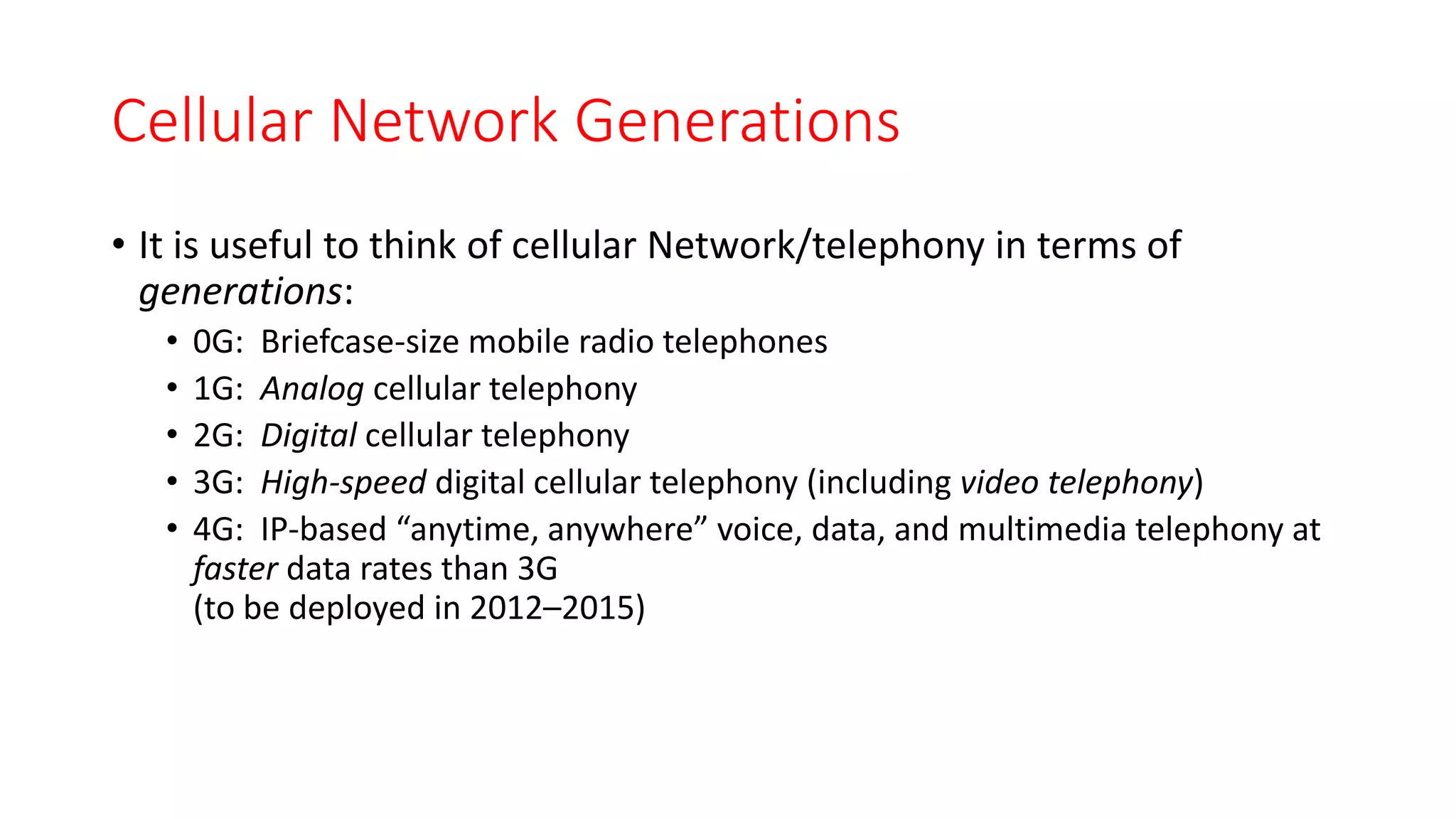
Cellular Network Generations
• It is useful to think of cellular Network/telephony in terms of
generations:
• 0G: Briefcase-size mobile radio telephones
• 1G: Analog cellular telephony
• 2G: Digital cellular telephony
• 3G: High-speed digital cellular telephony (including video telephony)
• 4G: IP-based “anytime, anywhere” voice, data, and multimedia telephony at
faster data rates than 3G
(to be deployed in 2012–2015)
Evolution of Cellular Networks
1G 2G 3G 4G2.5G
The Multiple Access Problem
• The base stations need to serve many mobile terminals at the same
time (both downlink and uplink)
• All mobiles in the cell need to transmit to the base station
• Interference among different senders and receivers
• So we need multiple access scheme
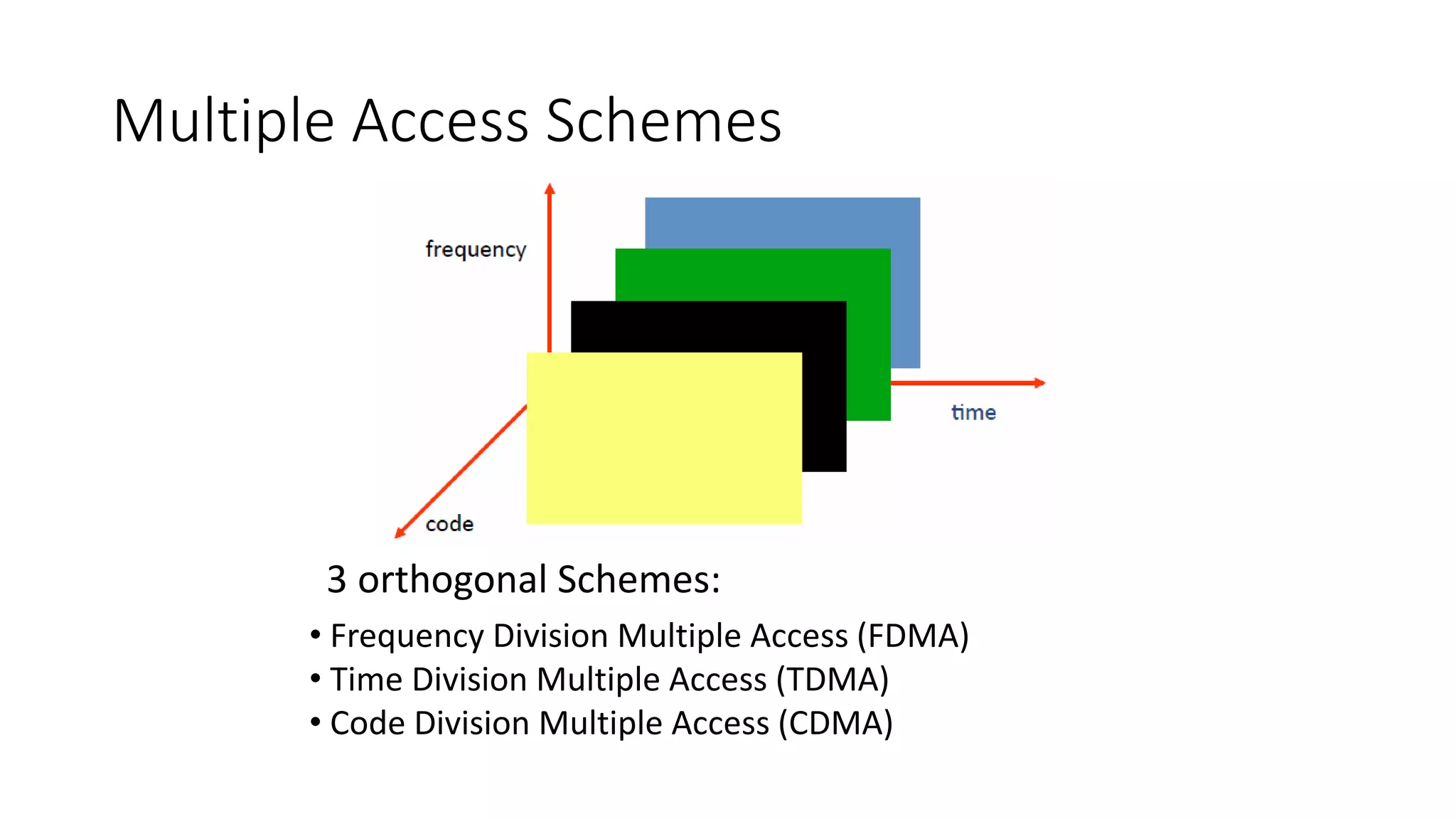
Multiple Access Schemes
• Frequency Division Multiple Access (FDMA)
• Time Division Multiple Access (TDMA)
• Code Division Multiple Access (CDMA)
3 orthogonal Schemes:
Frequency Division Multiple Access
• Each mobile is assigned a separate frequency channel for the
duration of the call
• Sufficient guard band is required to prevent adjacent channel
interference
• Usually, mobile terminals will have one downlink frequency band
and one uplink frequency band
• Different cellular network protocols use different frequencies
• Frequency is a precious and scare resource. We are running out of it
• Cognitive radio
frequency
Time Division Multiple Access
• Time is divided into slots and only one mobile terminal transmits
during each slot
• Like during the lecture, only one can talk, but others may take the floor in
turn
• Each user is given a specific slot. No competition in cellular network
• Unlike Carrier Sensing Multiple Access (CSMA) in WiFi
Guard time – signal transmitted by mobile
terminals at different locations do no arrive
at the base station at the same time
Code Division Multiple Access
• Use of orthogonal codes to separate different transmissions
• Each symbol of bit is transmitted as a larger number of bits using the user specific
code – Spreading
• Bandwidth occupied by the signal is much larger than the information transmission rate
• But all users use the same frequency band together
Orthogonal among users
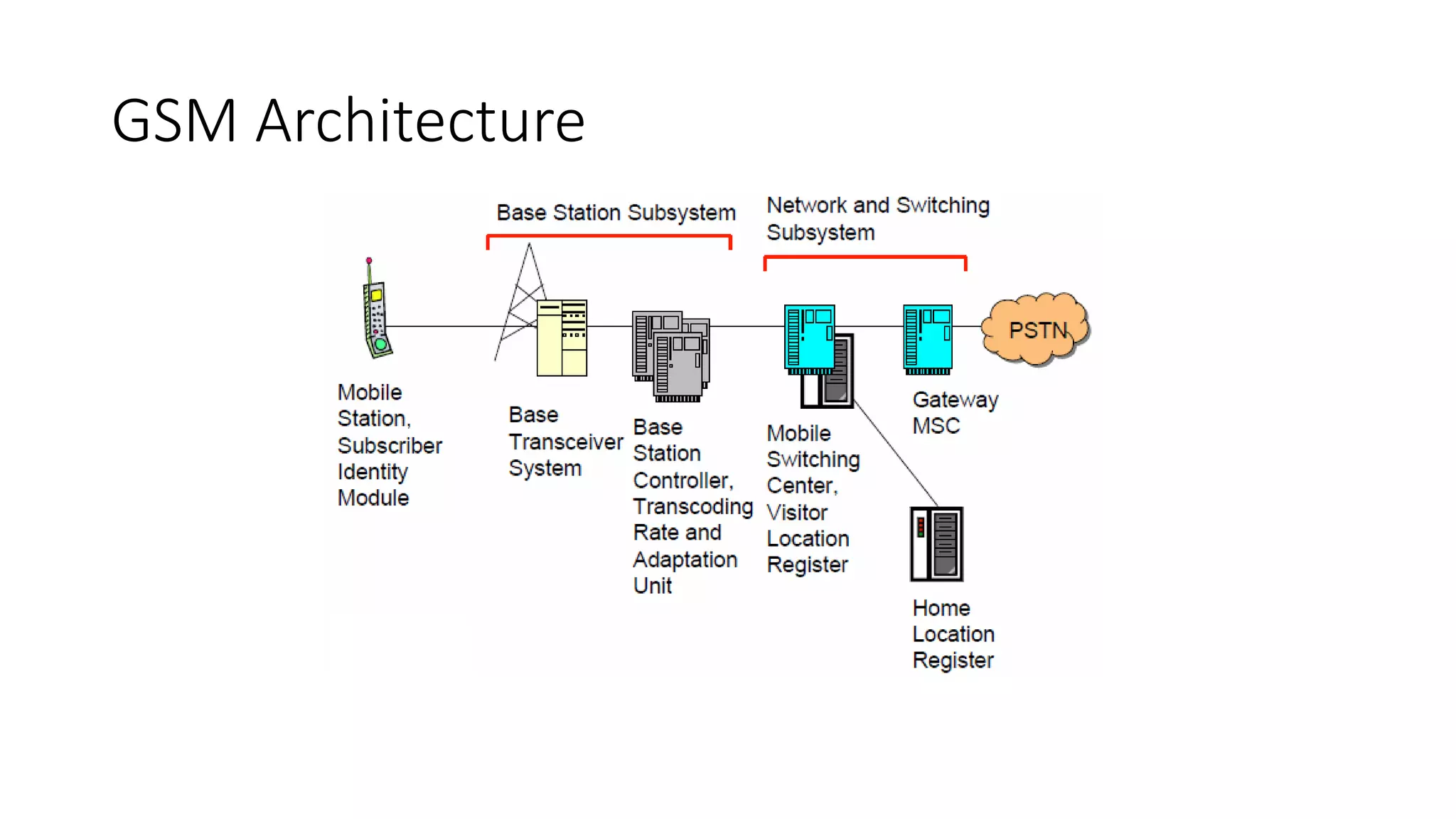
GSM Architecture
GSM Architecture
OMC
Home Location Register
AuC
Equipment ID
Network
Management
Center
BT
S
BT
S
BT
S
ME
ME
ME
Subscriber
Identity
Module
Subscriber
Identity
Module
Subscriber
Identity
Module
Base station
controller
PSTN
Mobile
switching
center
Data
communication
network
BTS = Base Transceiver Station
AuC = Authentication Center
OMC = Operation and Maintenance Center
PSTN = Public Switched Telephone Network
ME = Mobile Equipment
Source: Stallings, 313
Source: Mehrotra, 27
Visitor Location
Register
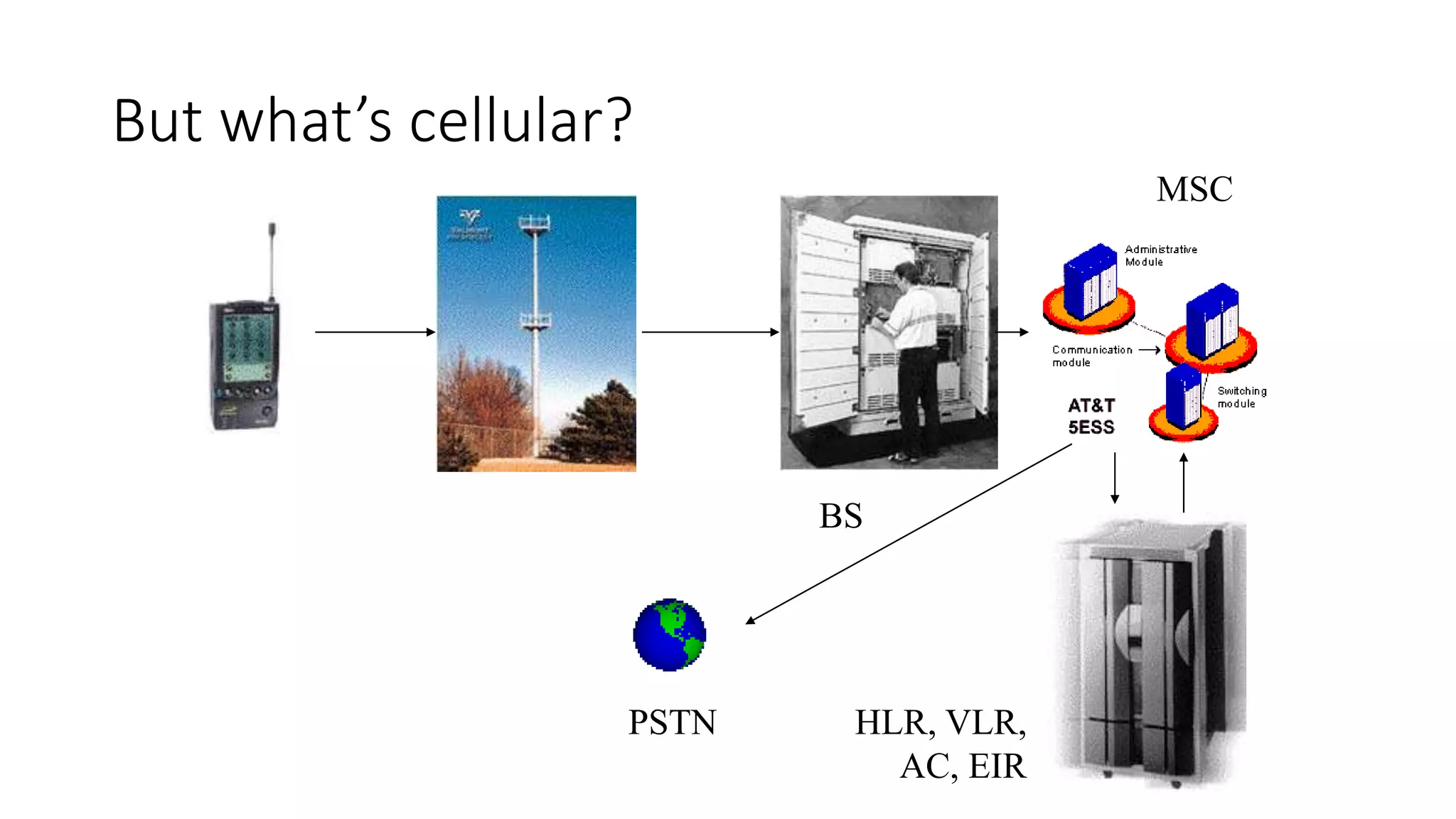
But what’s cellular?
HLR, VLR,
AC, EIR
MSC
PSTN
BS
GSM Architecture
F1 F2 F1' F2'
Frequency
1
2
3
4
5
6
7
8
45 MHz
BS Transmission
Band : 935 – 960
MHZ
MS Transmission
Band : 890 – 915
MHZ
Year Introduced 1990
Access method TDMA
Channel Bandwidth 200 kHz
Number of duplex
channels
125
Users per channel 8
Speech coding bit
rate
13 kbps
Data coding bit rate 12 kbps
Frame size 4.6 ms
SIM (Subscriber Identity Module)
Billions of Calls
Millions of Subscribers
Thousand of Different Types of Telephones
Hundreds of Countries
Dozens of Manufacturers….
And only one Card: The SIM
Source: Hillebrand, 369
http://ucables.com/products/simcards/
•Administrative data
•Security data
•Subscriber data
•Roaming data
•PLMN (Public Land Mobile Network
Implementation
SIM = Subscriber Identity Module
Central processor, clock and tone, internal bus system, keyboard (HMI)
Voice encoding Ciphering Modulation
Voice decoding
>Channel Decoding
>De-Interleaving
>Re-formatting
Deciphering
Amplifier
>Channel encoding
>Interleaving
>Burst generation
Receiver
Transmitter
Demodulation
Source: Heine, 14
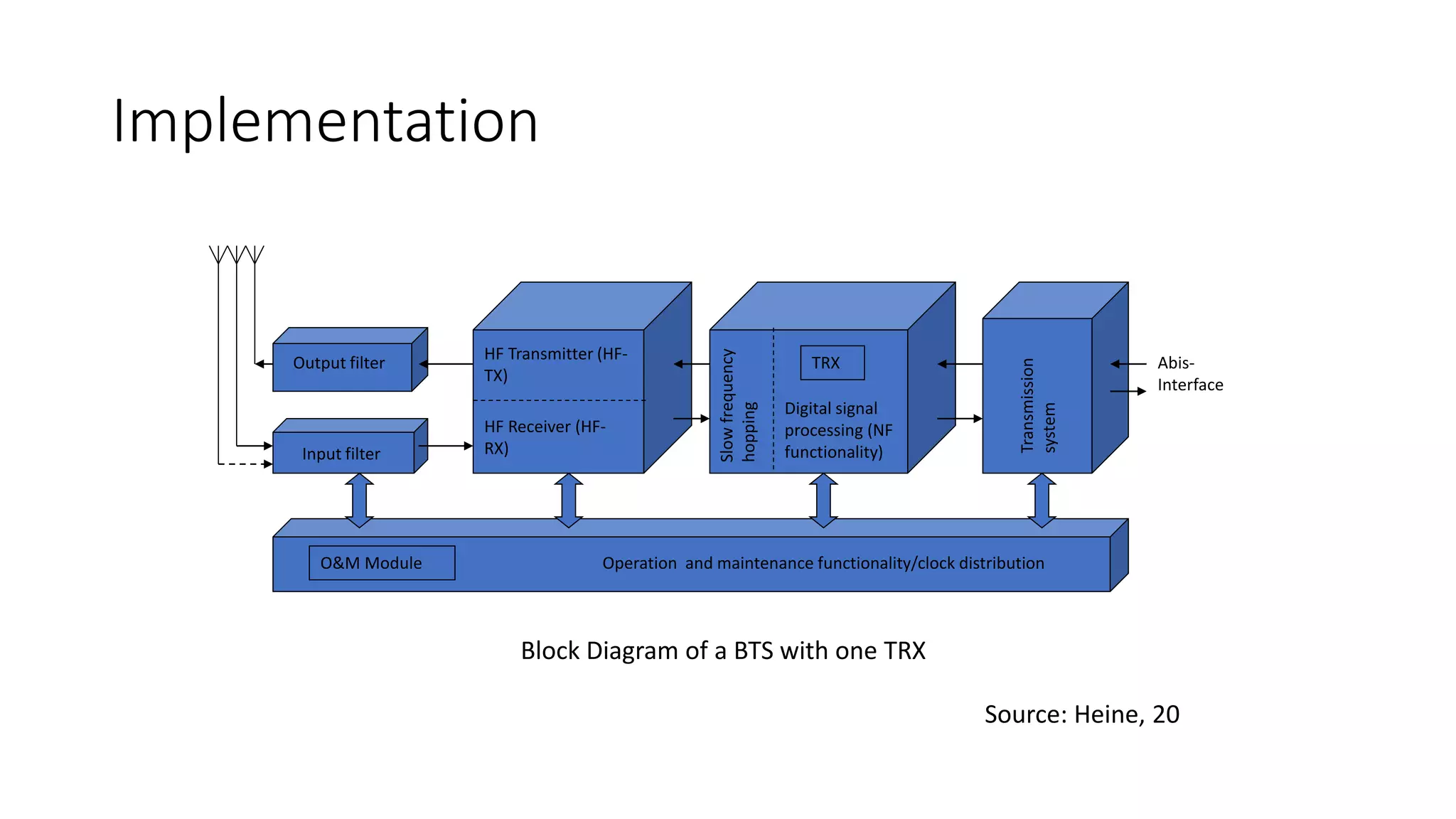
Implementation
Abis-
Interface
O&M Module Operation and maintenance functionality/clock distribution
Digital signal
processing (NF
functionality)
HF Transmitter (HF-
TX)
Input filter
Output filter
HF Receiver (HF-
RX)
Slowfrequency
hopping
Transmission
system
TRX
Block Diagram of a BTS with one TRX
Source: Heine, 20
GSM Variants
Variant Uplink
(MHz)
Downlink
(MHz)
Total
Bandwidth
Duplex-
frequency
Channels
GSM-400 451-458 and
479-486
461-468 and
489-496
Twice 14 MHz 10 MHz Twice 72
GSM-900
(primary
band)
890-915 935-960 Twice 25 MHz 45 MHz Twice 124
Extended
GSM-900
880-915 925-960 Twice 35 MHz 45 MHz Twice 174
GSM-R 876-880 921-925 Twice 4 MHz 45 MHz Twice 19
DCS-1800 1,710-1,785 1,805-1,880 Twice 75 MHz 95 MHz Twice 373
PCS-1900 1,850-1,910 1,930-1,990 Twice 60 MHz 80 MHz Twice 300
Source: Bekkers, 299
Outgoing Call
1. MS sends dialled number to BSS
2. BSS sends dialled number to MSC
3,4 MSC checks VLR if MS is allowed
the requested service.If so,MSC
asks BSS to allocate resources for
call.
5 MSC routes the call to GMSC
6 GMSC routes the call to local
exchange of called user
7, 8,
9,10 Answer back(ring back) tone is
routed from called user to MS via
GMSC,MSC,BSS
GSM Operation
Speech decoding
Channel decoding
De-interleaving
Burst Formatting
De-ciphering
DemodulationModulation
Ciphering
Burst Formatting
Interleaving
Channel Coding
Speech coding
Radio Interface
Speech Speech
13 Kbps
22.8 Kbps
22.8 Kbps
33.6 Kbps
33.6 Kbps
270.83 Kbps
Incoming Call
1. Calling a GSM
subscribers
2. Forwarding call to
GSMC
3. Signal Setup to HLR
4. 5. Request MSRN from
VLR
6. Forward responsible
MSC to GMSC
7. Forward Call to current
MSC
8. 9. Get current status of
MS
10.11. Paging of MS
12.13. MS answers
14.15. Security checks
16.17. Set up connection
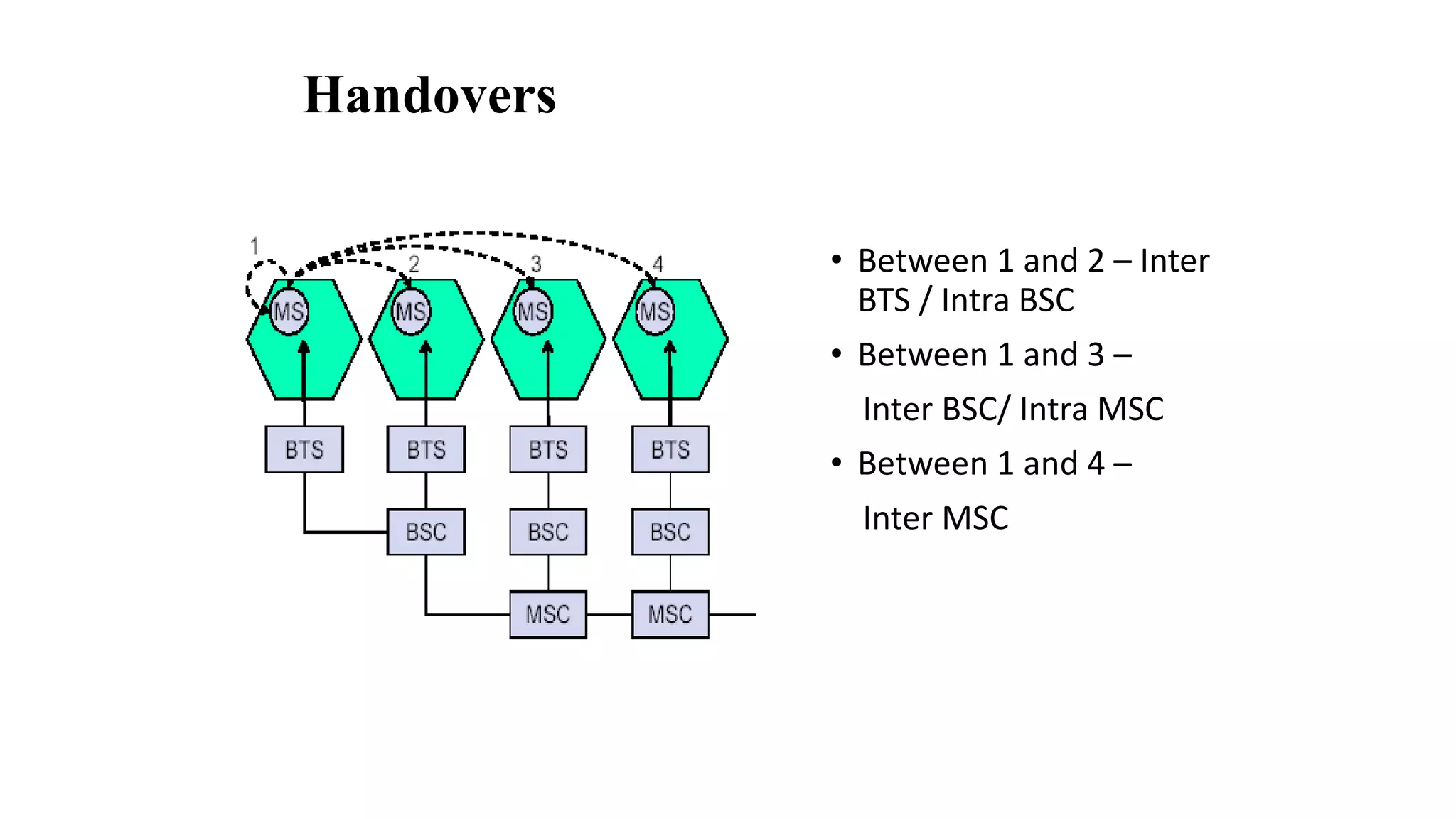
Handovers
• Between 1 and 2 – Inter
BTS / Intra BSC
• Between 1 and 3 –
Inter BSC/ Intra MSC
• Between 1 and 4 –
Inter MSC
Authentication in GSM
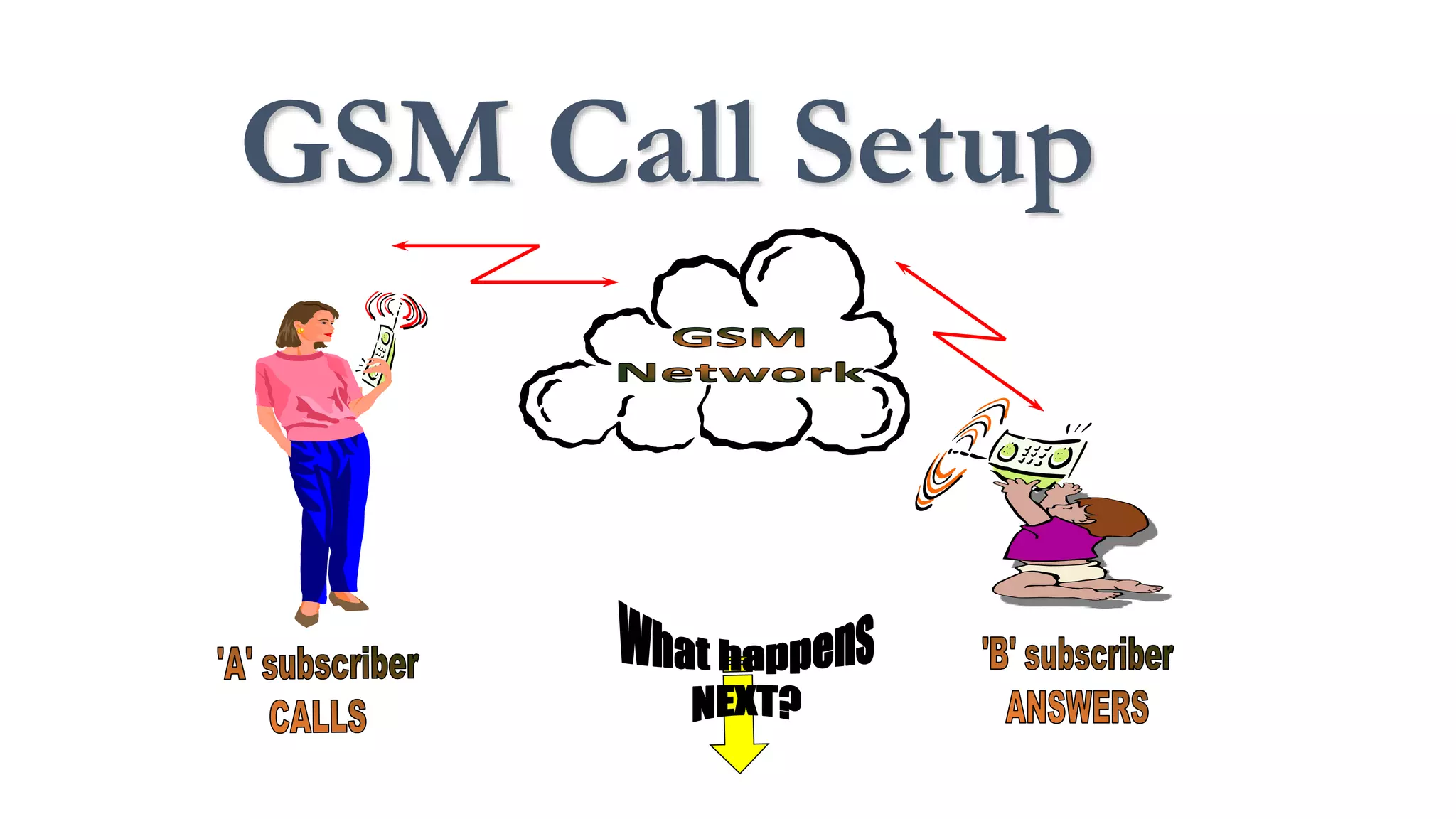
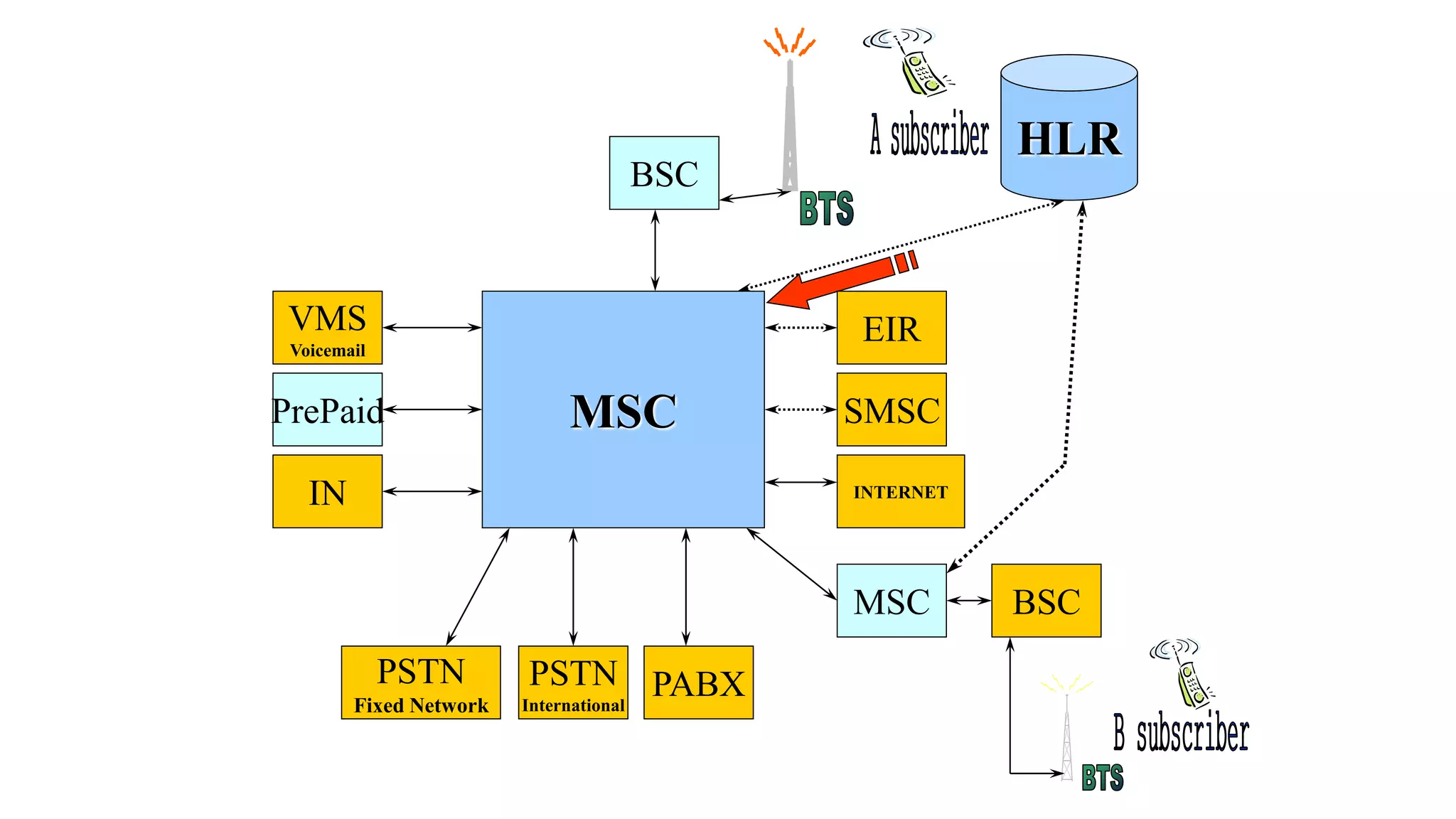
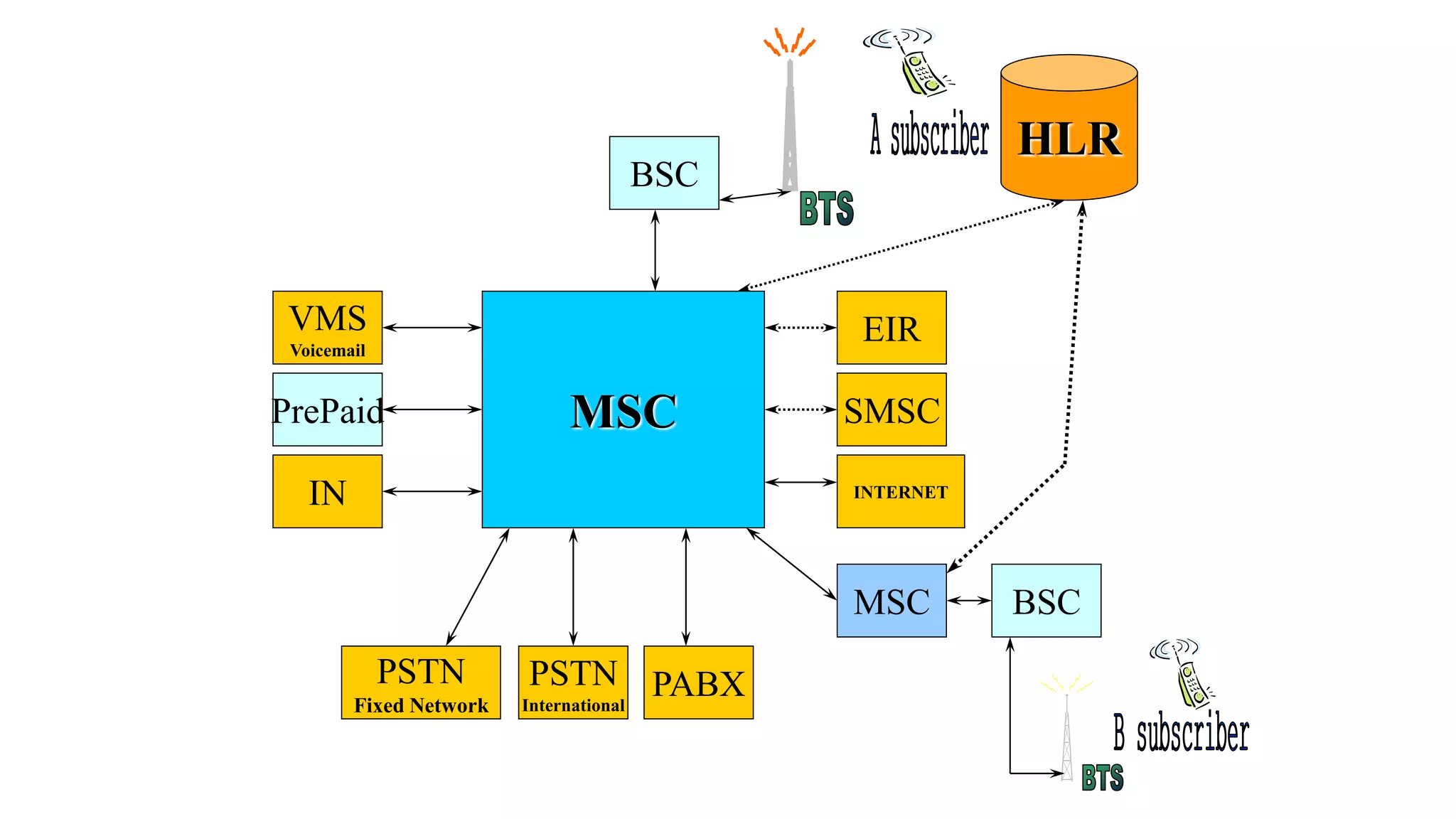
GSM Call Setup
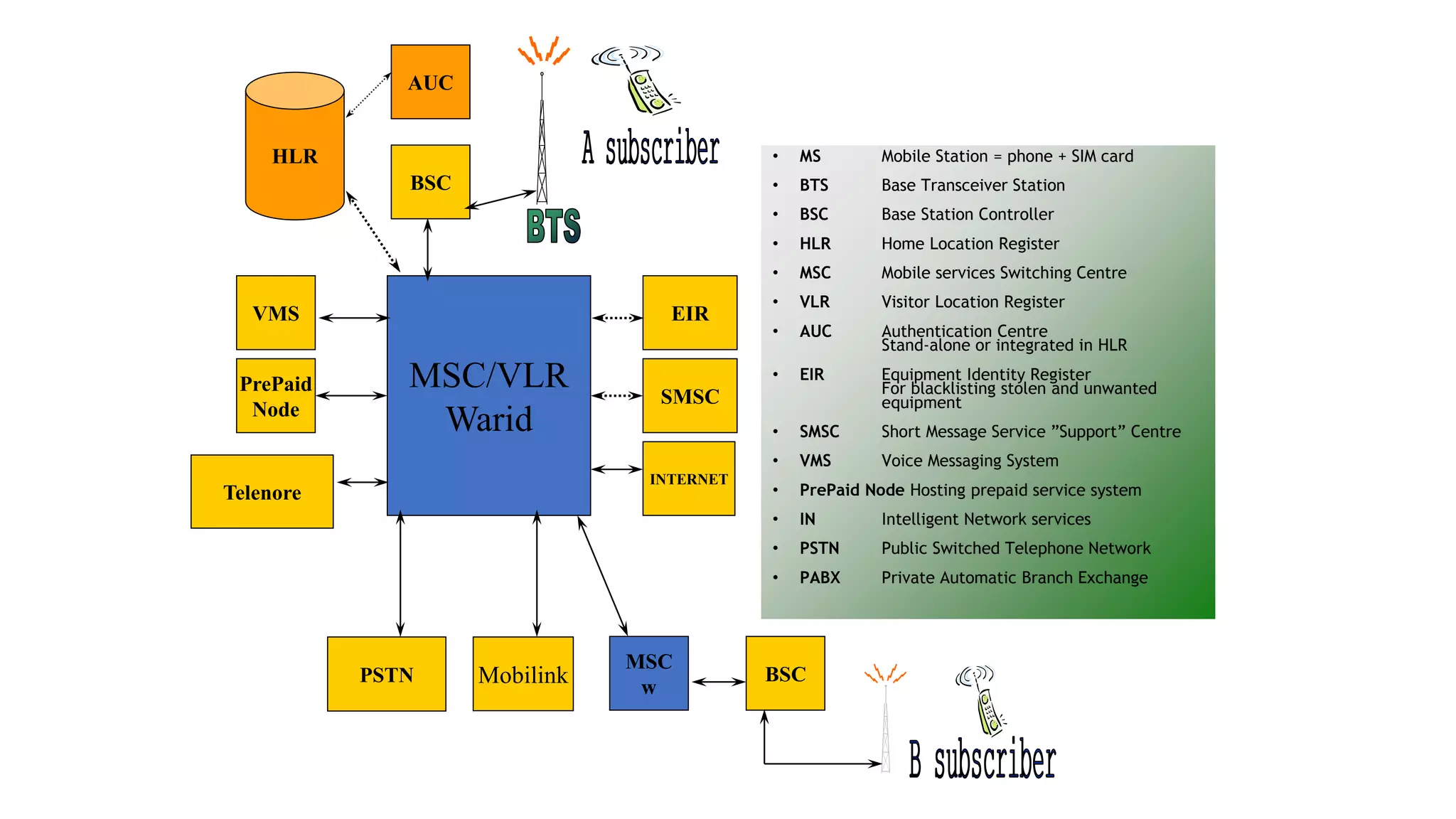
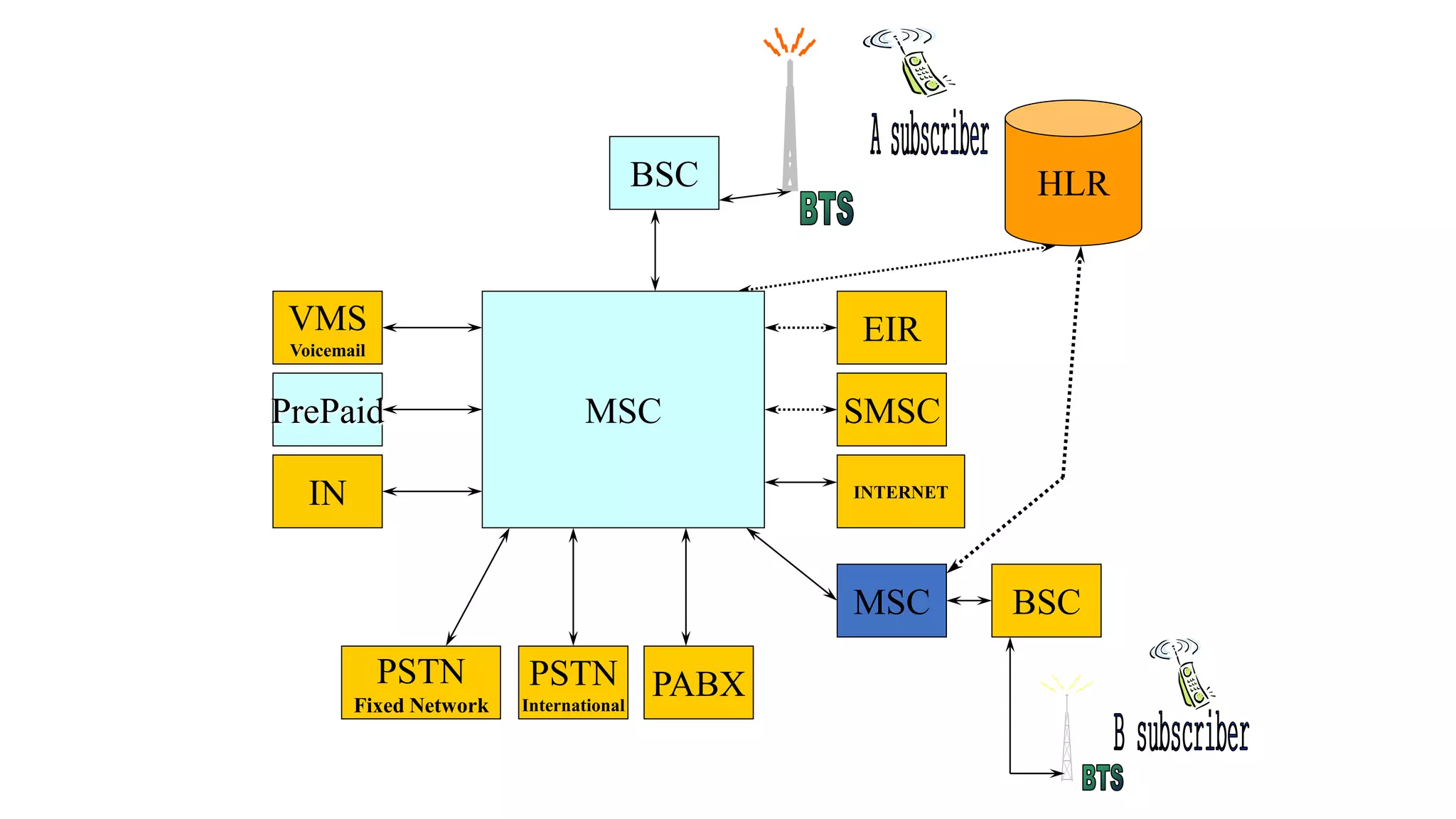
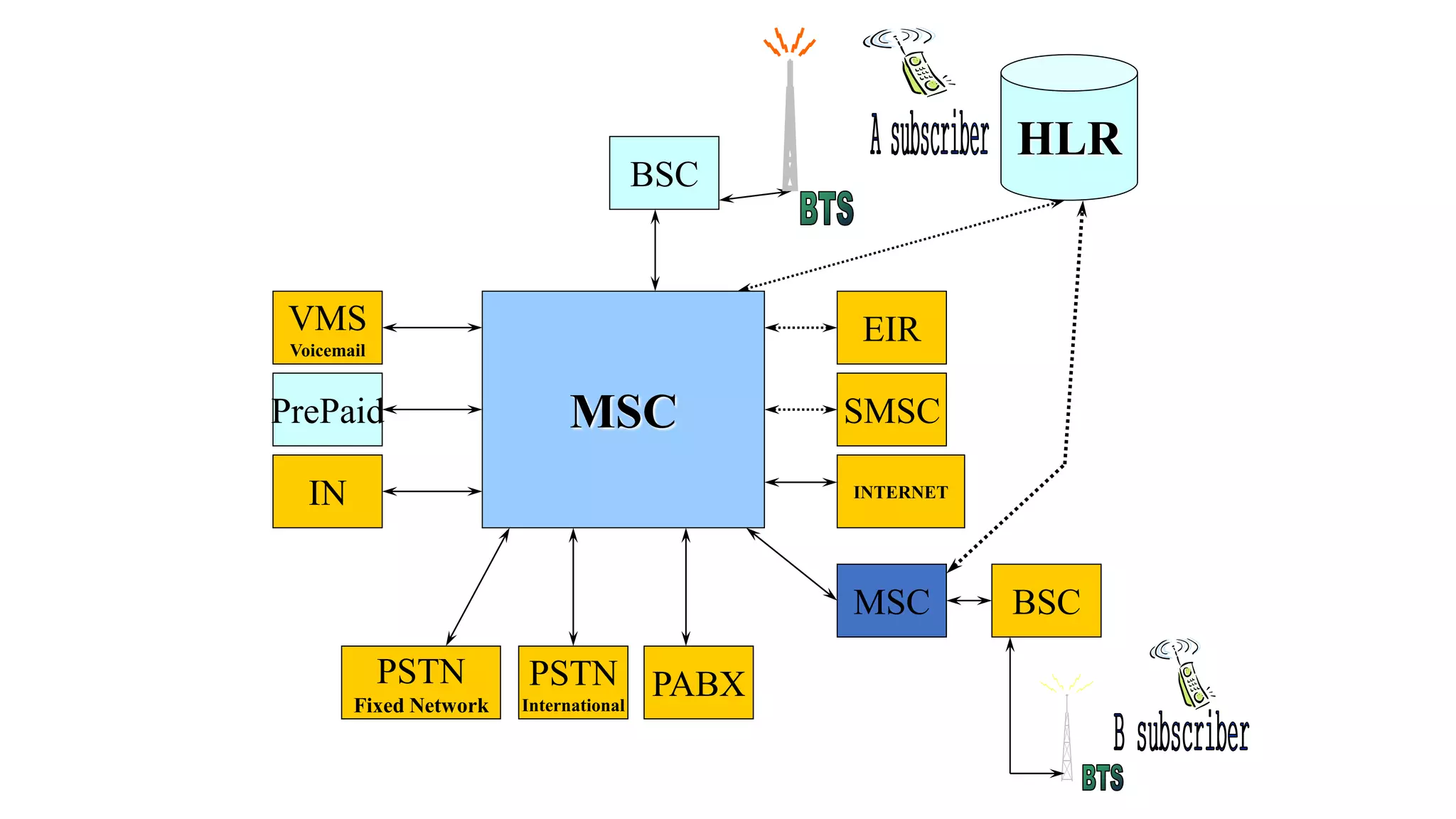
• MS Mobile Station = phone + SIM card
• BTS Base Transceiver Station
• BSC Base Station Controller
• HLR Home Location Register
• MSC Mobile services Switching Centre
• VLR Visitor Location Register
• AUC Authentication Centre
Stand-alone or integrated in HLR
• EIR Equipment Identity Register
For blacklisting stolen and unwanted
equipment
• SMSC Short Message Service ”Support” Centre
• VMS Voice Messaging System
• PrePaid Node Hosting prepaid service system
• IN Intelligent Network services
• PSTN Public Switched Telephone Network
• PABX Private Automatic Branch Exchange
MSC/VLR
Warid
Telenore
BSC
SMSC
EIR
INTERNET
MobilinkPSTN
BSC
PrePaid
Node
VMS
HLR
MSC
w
AUC
MSC SMSC
EIR
INTERNET
PABXPSTN
International
PSTN
Fixed Network
BSC
IN
PrePaid
VMS
Voicemail
HLR
MSC BSC
MSC SMSC
EIR
INTERNET
BSC
IN
PrePaid
VMS
Voicemail
HLR
MSC BSC
PABXPSTN
International
PSTN
Fixed Network
MSC SMSC
EIR
INTERNET
BSC
IN
PrePaid
VMS
Voicemail
HLR
MSC BSC
PABXPSTN
International
PSTN
Fixed Network
MSC SMSC
EIR
INTERNET
BSC
IN
PrePaid
VMS
Voicemail
HLR
MSC BSC
PABXPSTN
International
PSTN
Fixed Network
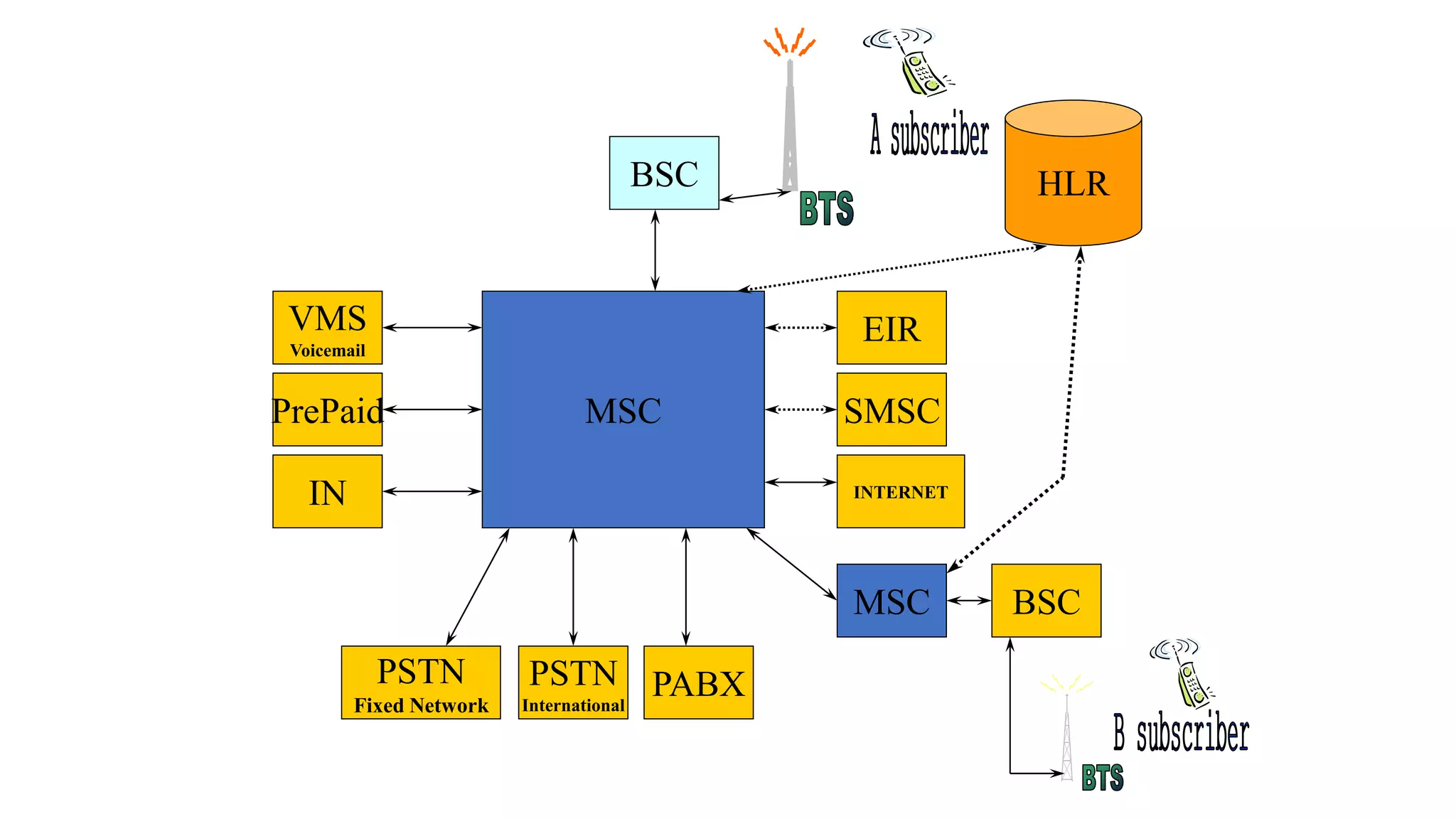
BSC
Base Station Controller
 The call request reaches the BSC from the BTS and
is forwarded to MSC.
 After call is established, the BSC will perform
decoding of the call (in typical config.)
BSC HLR
MSC SMSC
EIR
INTERNETIN
PrePaid
VMS
Voicemail
MSC BSC
PABXPSTN
International
PSTN
Fixed Network
BSC HLR
MSC SMSC
EIR
INTERNETIN
PrePaid
VMS
Voicemail
MSC BSC
PABXPSTN
International
PSTN
Fixed Network
BSC HLR
MSC SMSC
EIR
INTERNETIN
PrePaid
VMS
Voicemail
MSC BSC
PABXPSTN
International
PSTN
Fixed Network
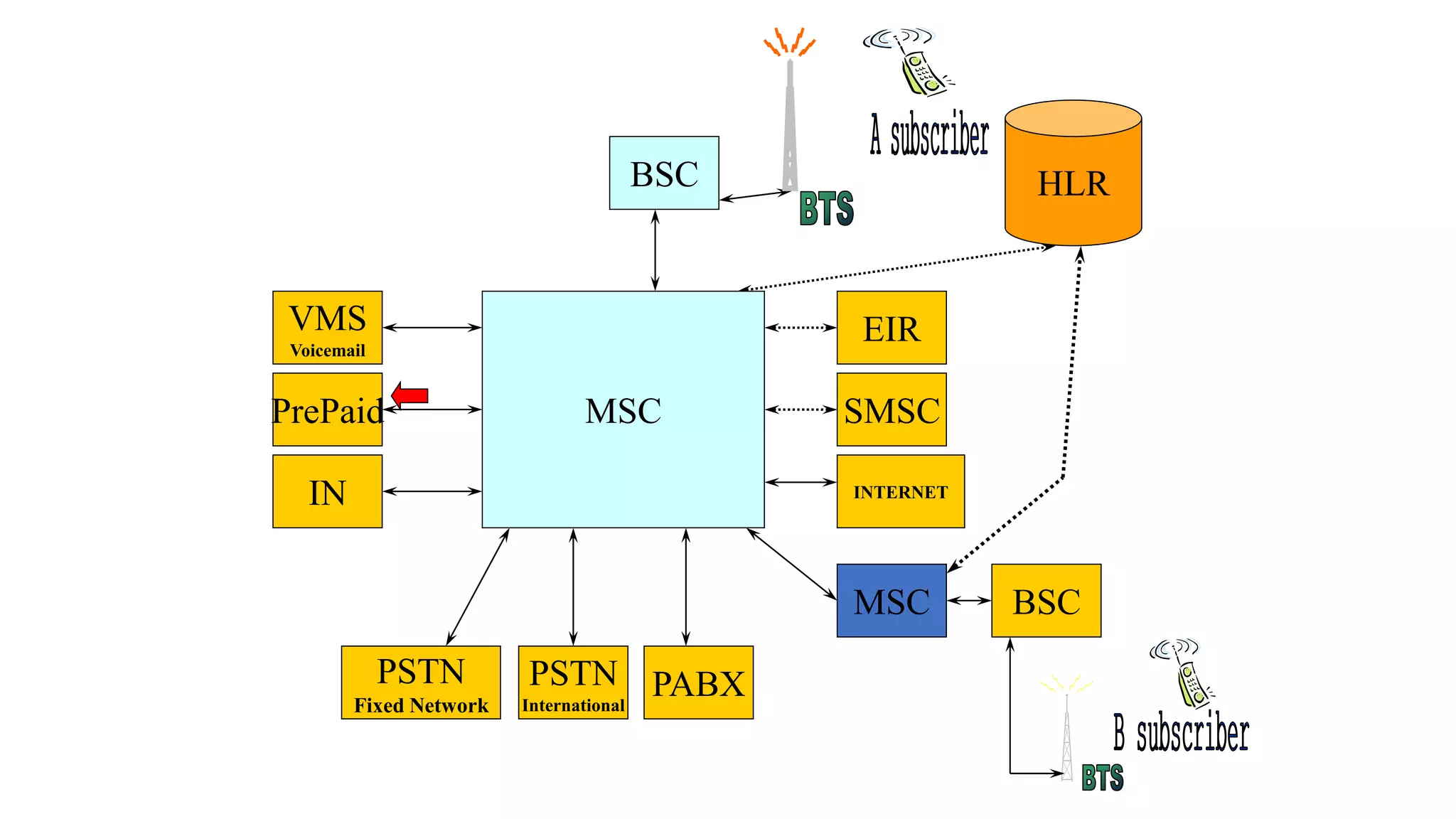
• Checks A number.
• To whom is A subscriber calling?
(Checks B number)
• Example : A subscriber has prepaid
number.
MSC
Mobile Switching Centre
BSC HLR
MSC SMSC
EIR
INTERNETIN
PrePaid
VMS
Voicemail
MSC BSC
PABXPSTN
International
PSTN
Fixed Network
BSC HLR
MSC SMSC
EIR
INTERNETIN
PrePaid
VMS
Voicemail
MSC BSC
PABXPSTN
International
PSTN
Fixed Network
BSC HLR
MSC SMSC
EIR
INTERNETIN
PrePaid
VMS
Voicemail
MSC BSC
PABXPSTN
International
PSTN
Fixed Network
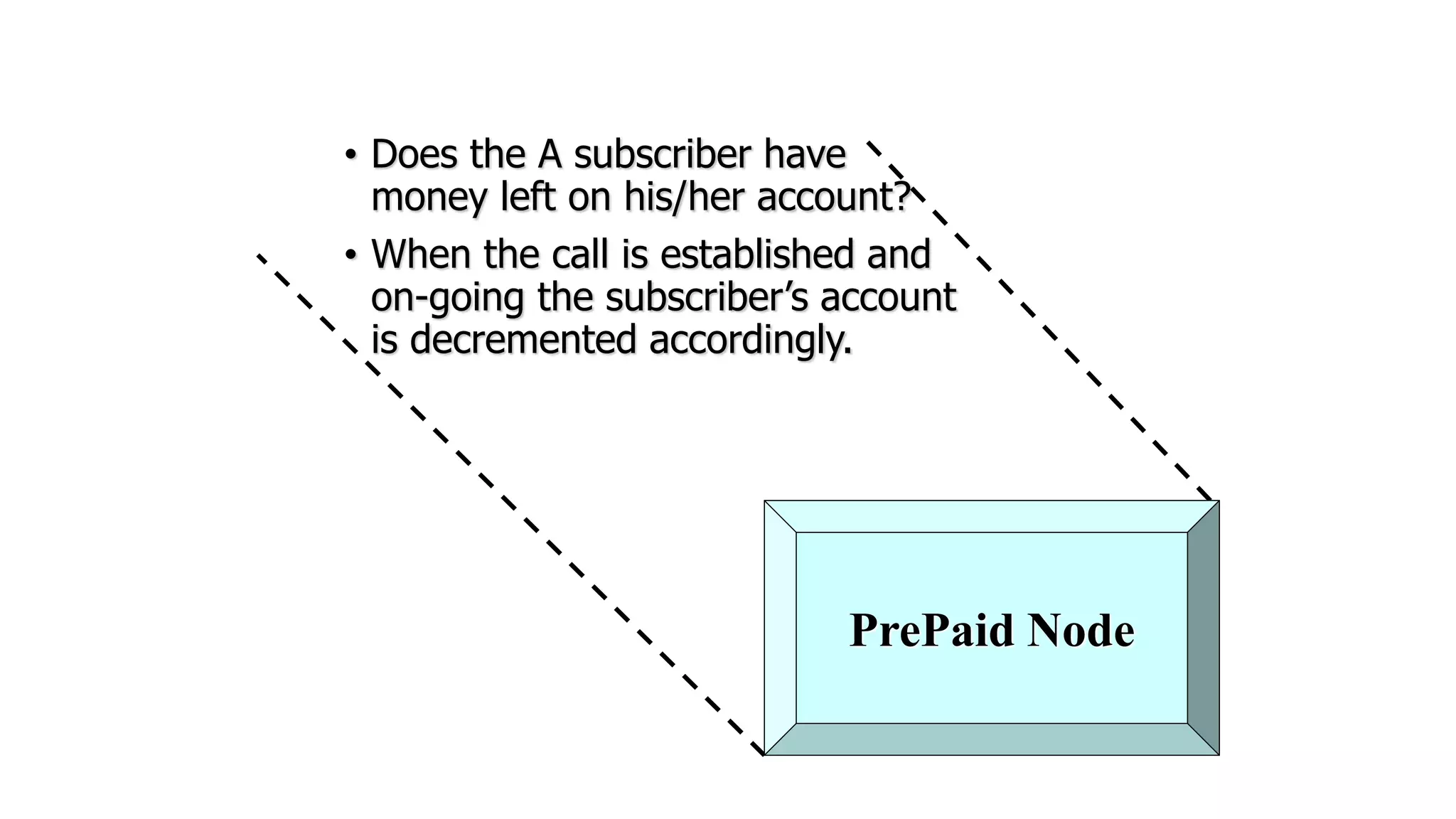
• Does the A subscriber have
money left on his/her account?
• When the call is established and
on-going the subscriber’s account
is decremented accordingly.
PrePaid Node
BSC
HLR
MSC SMSC
EIR
INTERNETIN
PrePaid
VMS
Voicemail
MSC BSC
PABXPSTN
International
PSTN
Fixed Network
BSC
HLR
MSC SMSC
EIR
INTERNETIN
PrePaid
VMS
Voicemail
MSC BSC
PABXPSTN
International
PSTN
Fixed Network
BSC
HLR
MSC SMSC
EIR
INTERNETIN
PrePaid
VMS
Voicemail
MSC BSC
PABXPSTN
International
PSTN
Fixed Network
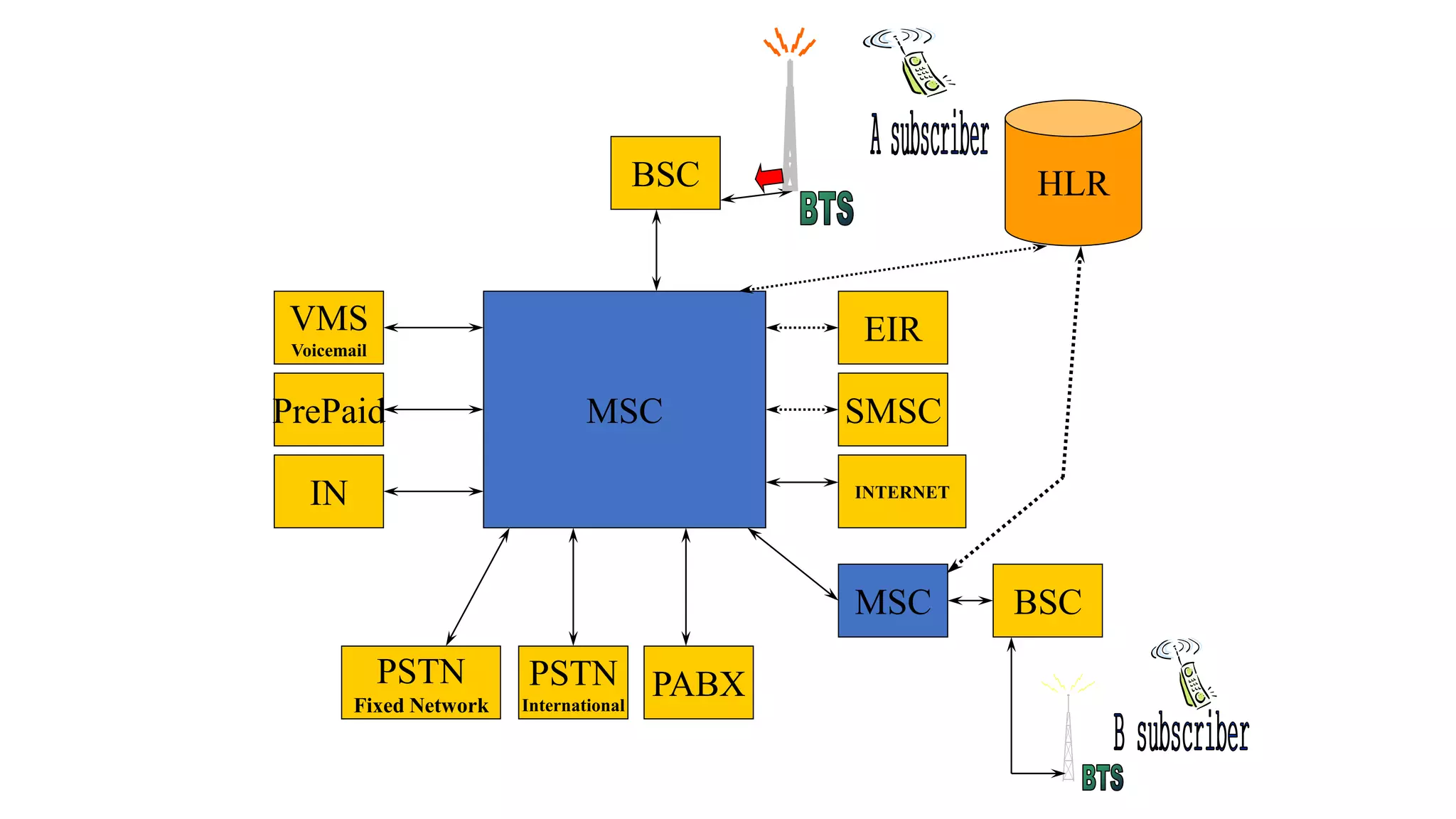
• Where is the B subscriber?
• MSC interrogates in HLR.
(HLR = Home Location Register)
MSC
Mobile Switching Centre
BSC
HLR
MSC
IN
PrePaid
VMS
Voicemail
MSC BSC
PABXPSTN
International
PSTN
Fixed Network
SMSC
EIR
INTERNET
BSC
HLR
MSC
MSC BSC
PABXPSTN
International
PSTN
Fixed Network
IN
PrePaid
VMS
Voicemail
SMSC
EIR
INTERNET
BSC
HLR
MSC
MSC BSC
PABXPSTN
International
PSTN
Fixed Network
IN
PrePaid
VMS
Voicemail
SMSC
EIR
INTERNET
• HLR says ’I am the home of the B
subscriber and I know where he/she is right
now’ (i.e. which VLR)
• Tells this VLR ’Give me a visitor address
for this subscriber’ (Roaming Number)
HLR
Home Location Register
BSC
HLR
MSC
MSC BSC
PABXPSTN
International
PSTN
Fixed Network
IN
PrePaid
VMS
Voicemail
SMSC
EIR
INTERNET
BSC
HLR
MSC
MSC BSC
PABXPSTN
International
PSTN
Fixed Network
IN
PrePaid
VMS
Voicemail
SMSC
EIR
INTERNET
BSC
HLR
MSC
MSC BSC
PABXPSTN
International
PSTN
Fixed Network
IN
PrePaid
VMS
Voicemail
SMSC
EIR
INTERNET
BSC
HLR
MSC
MSC BSC
PABXPSTN
International
PSTN
Fixed Network
IN
PrePaid
VMS
Voicemail
SMSC
EIR
INTERNET
BSC
HLR
MSC
MSC BSC
PABXPSTN
International
PSTN
Fixed Network
IN
PrePaid
VMS
Voicemail
SMSC
EIR
INTERNET
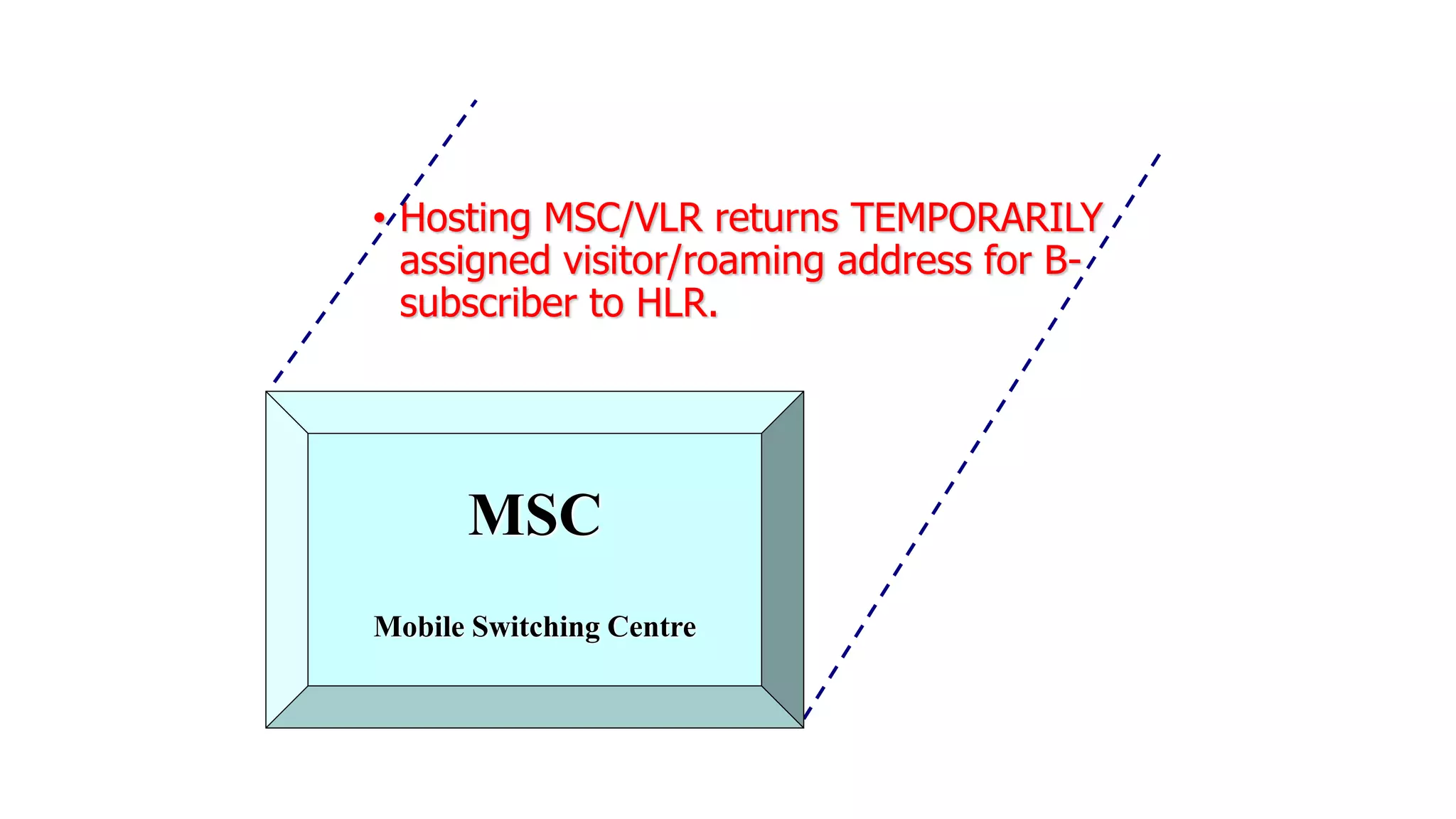
• Hosting MSC/VLR returns TEMPORARILY
assigned visitor/roaming address for B-
subscriber to HLR.
MSC
Mobile Switching Centre
BSC
HLR
MSC
MSC BSC
PABXPSTN
International
PSTN
Fixed Network
IN
PrePaid
VMS
Voicemail
SMSC
EIR
INTERNET
BSC
HLR
MSC
MSC BSC
PABXPSTN
International
PSTN
Fixed Network
IN
PrePaid
VMS
Voicemail
SMSC
EIR
INTERNET
BSC
HLR
MSC
MSC BSC
PABXPSTN
International
PSTN
Fixed Network
IN
PrePaid
VMS
Voicemail
SMSC
EIR
INTERNET
BSC
HLR
MSC
MSC BSC
PABXPSTN
International
PSTN
Fixed Network
IN
PrePaid
VMS
Voicemail
SMSC
EIR
INTERNET
BSC
HLR
MSC
MSC BSC
PABXPSTN
International
PSTN
Fixed Network
IN
PrePaid
VMS
Voicemail
SMSC
EIR
INTERNET
• ’Thanks for the visitor address!’
• ’I will send this address to the MSC
that requested for it.’
HLR
Home Location Register
BSC
HLR
MSC
MSC BSC
PABXPSTN
International
PSTN
Fixed Network
IN
PrePaid
VMS
Voicemail
SMSC
EIR
INTERNET
BSC
HLR
MSC
MSC BSC
PABXPSTN
International
PSTN
Fixed Network
IN
PrePaid
VMS
Voicemail
SMSC
EIR
INTERNET
BSC
HLR
MSC
MSC BSC
PABXPSTN
International
PSTN
Fixed Network
IN
PrePaid
VMS
Voicemail
SMSC
EIR
INTERNET
• ’Thank you, HLR!’
• Speech connection path will set up
now towards the MSC/VLR where the
B subscriber is presently located.
MSC
Mobile Switching Centre
BSC
HLR
MSC
MSC BSC
PABXPSTN
International
PSTN
Fixed Network
IN
PrePaid
VMS
Voicemail
SMSC
EIR
INTERNET
BSC
HLR
MSC
MSC BSC
PABXPSTN
International
PSTN
Fixed Network
IN
PrePaid
VMS
Voicemail
SMSC
EIR
INTERNET
BSC
HLR
MSC
MSC BSC
PABXPSTN
International
PSTN
Fixed Network
IN
PrePaid
VMS
Voicemail
SMSC
EIR
INTERNET
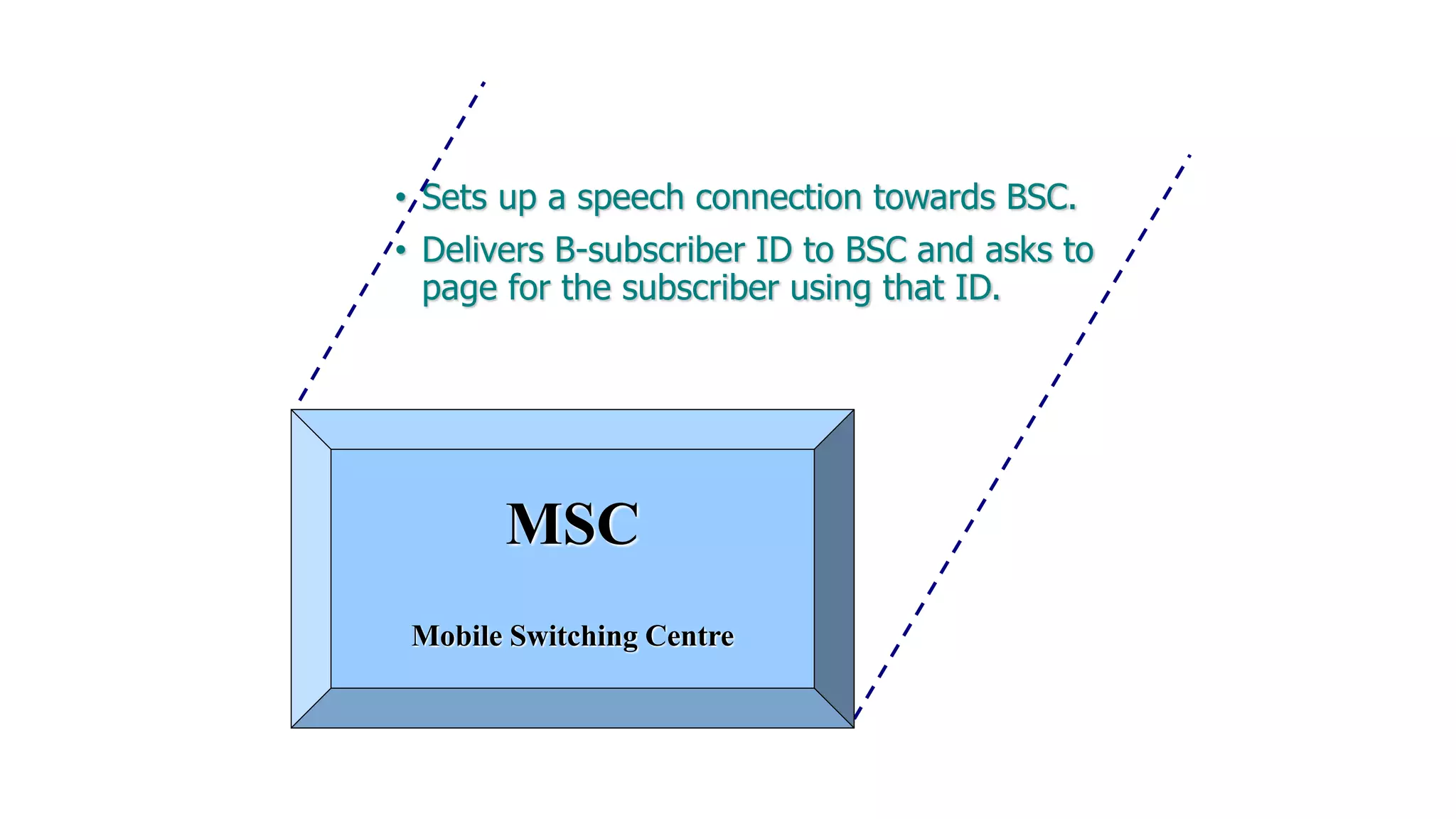
• Sets up a speech connection towards BSC.
• Delivers B-subscriber ID to BSC and asks to
page for the subscriber using that ID.
MSC
Mobile Switching Centre
BSC
HLR
MSC
MSC BSC
PABXPSTN
International
PSTN
Fixed Network
IN
PrePaid
VMS
Voicemail
SMSC
EIR
INTERNET
BSC
HLR
MSC
MSC BSC
PABXPSTN
International
PSTN
Fixed Network
IN
PrePaid
VMS
Voicemail
SMSC
EIR
INTERNET
BSC
HLR
MSC
MSC BSC
PABXPSTN
International
PSTN
Fixed Network
IN
PrePaid
VMS
Voicemail
SMSC
EIR
INTERNET
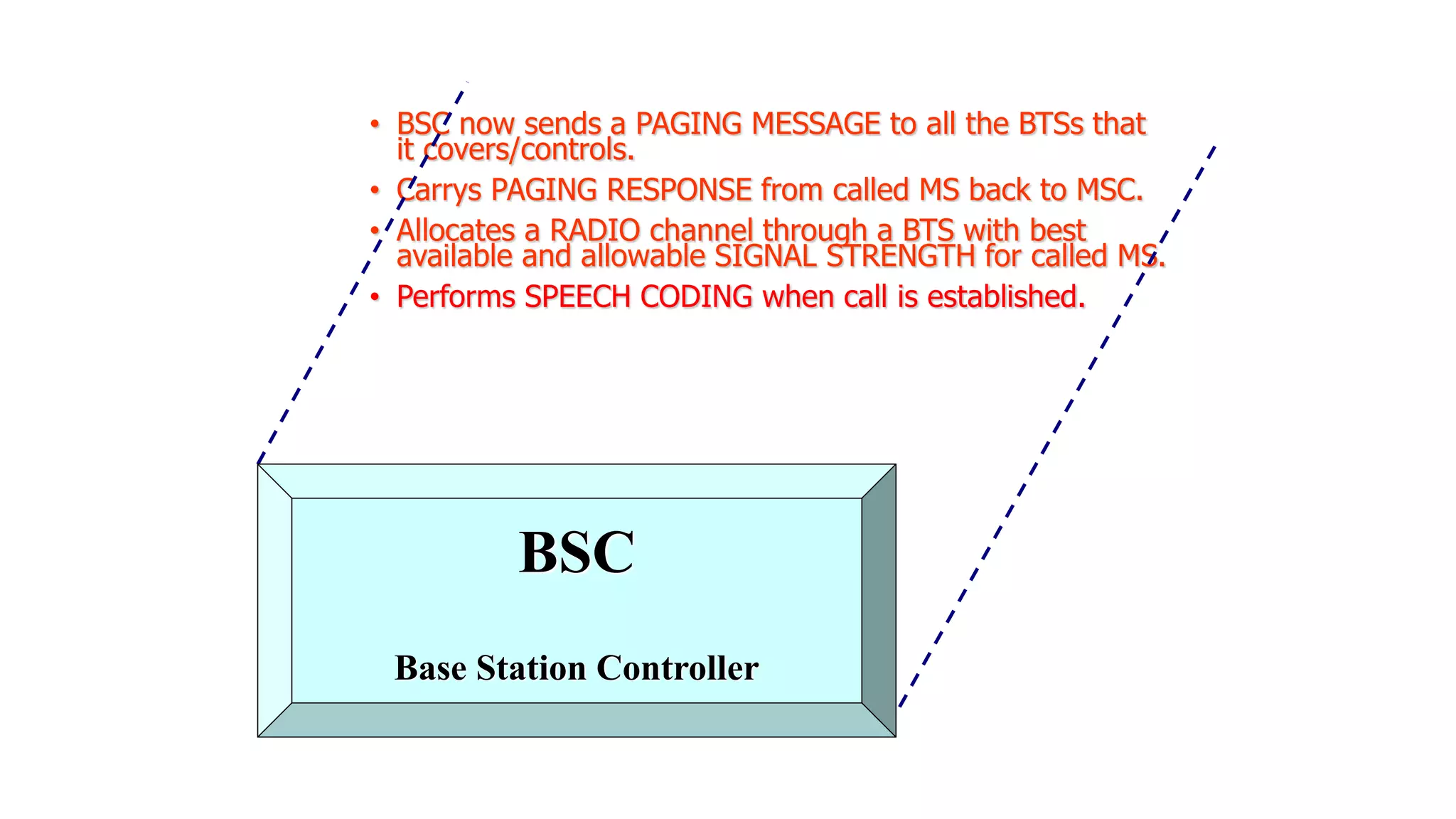
• BSC now sends a PAGING MESSAGE to all the BTSs that
it covers/controls.
• Carrys PAGING RESPONSE from called MS back to MSC.
• Allocates a RADIO channel through a BTS with best
available and allowable SIGNAL STRENGTH for called MS.
• Performs SPEECH CODING when call is established.
BSC
Base Station Controller
BSC
HLR
MSC
MSC BSC
PABXPSTN
International
PSTN
Fixed Network
IN
PrePaid
VMS
Voicemail
SMSC
EIR
INTERNET
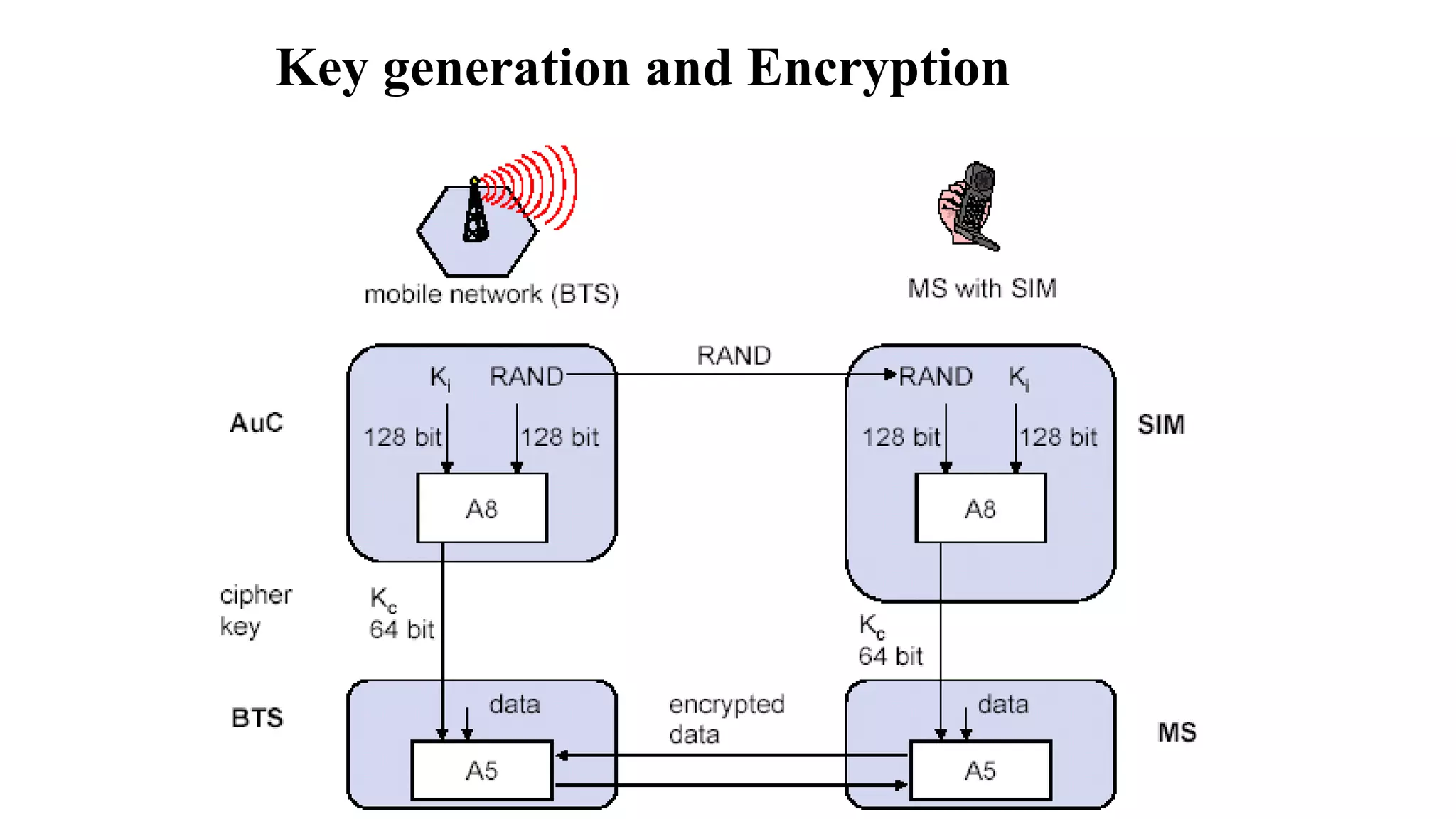
Key generation and Encryption
3G, 3.5G and 4G (LTE)
3G Overview
• 3G is created by ITU-T and is called IMT-2000
Evolution from 2G
IS-95 IS-136 & PDCGSM-
EDGE
GPRS
HSCSD
IS-95B
Cdma2000-1xRTT
Cdma2000-1xEV,DV,DO
Cdma2000-3xRTT
W-CDMA
EDGE
TD-SCDMA
2G
3G
2.5G
3GPP3GPP2
Service Roadmap
Improved performance, decreasing cost of delivery
Typical
average bit
rates
(peak rates
higher)
WEB browsing
Corporate data access
Streaming audio/video
Voice & SMS Presence/location
xHTML browsing
Application downloading
E-mail
MMS picture / video
Multitasking
3G-specific services take
advantage of higher bandwidth
and/or real-time QoS
A number of mobile
services are bearer
independent in nature
HSDPA
1-10
Mbps
WCDMA
2
Mbps
EGPRS
473
kbps
GPRS
171
kbps
GSM
9.6
kbps
Push-to-talk
Broadband
in wide area
Video sharing
Video telephony
Real-time IP
multimedia and games
Multicasting
CDMA
2000-
EVDO
CDMA
2000-
EVDV
CDMA
20001x
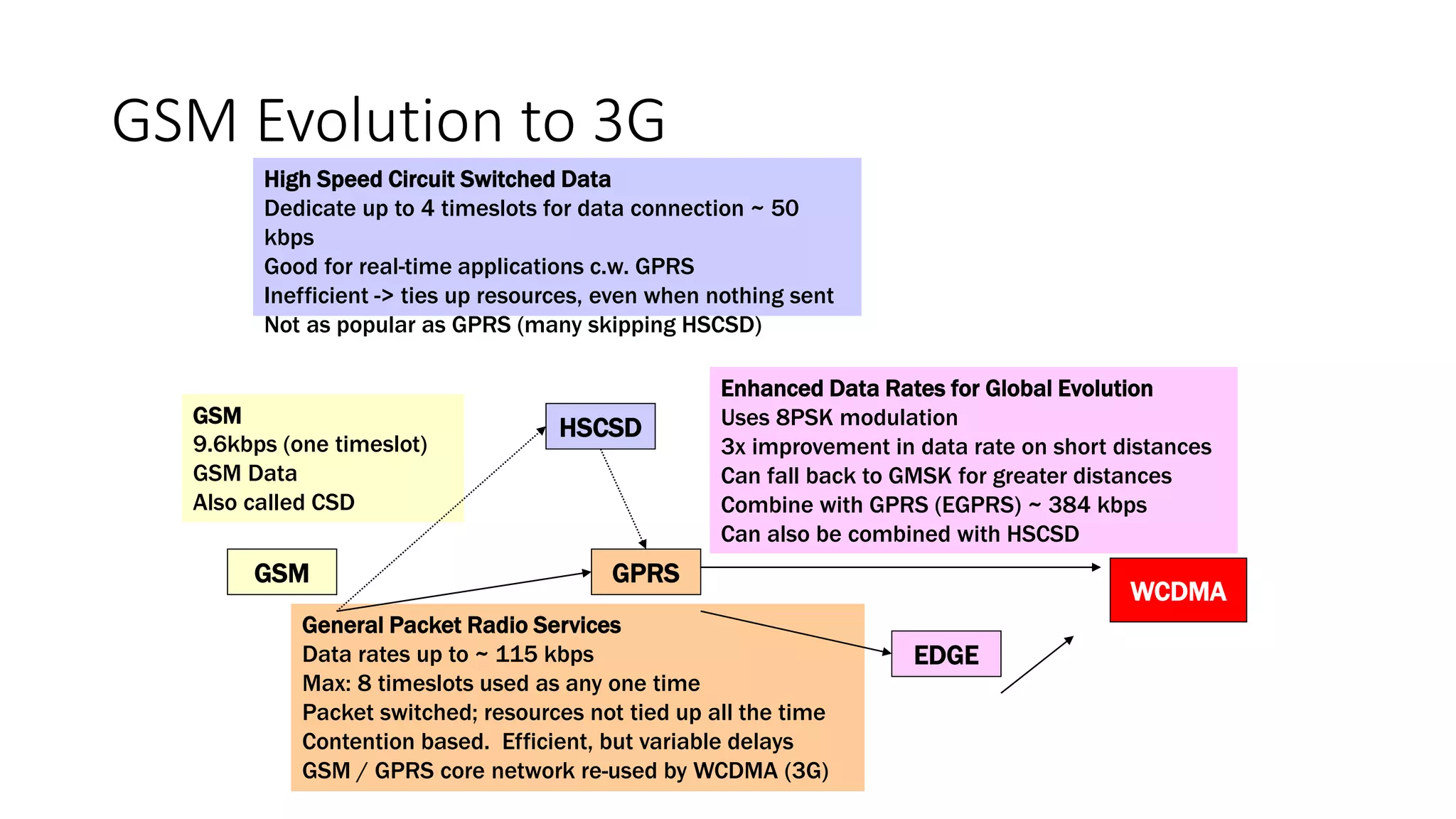
GSM Evolution to 3G
GSM
9.6kbps (one timeslot)
GSM Data
Also called CSD
GSM
General Packet Radio Services
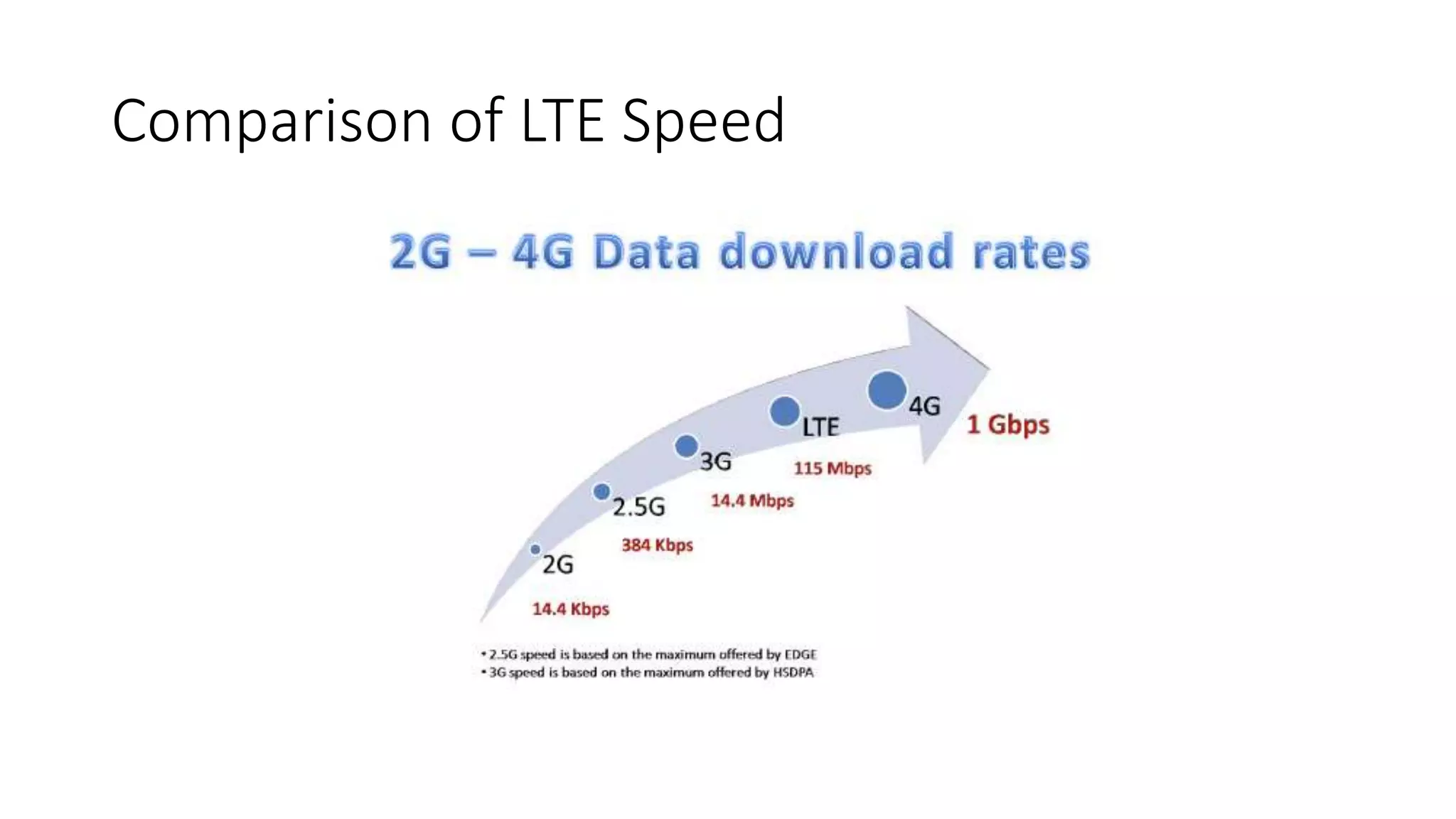
Data rates up to ~ 115 kbps
Max: 8 timeslots used as any one time
Packet switched; resources not tied up all the time
Contention based. Efficient, but variable delays
GSM / GPRS core network re-used by WCDMA (3G)
GPRS
HSCSD
High Speed Circuit Switched Data
Dedicate up to 4 timeslots for data connection ~ 50
kbps
Good for real-time applications c.w. GPRS
Inefficient -> ties up resources, even when nothing sent
Not as popular as GPRS (many skipping HSCSD)
EDGE
Enhanced Data Rates for Global Evolution
Uses 8PSK modulation
3x improvement in data rate on short distances
Can fall back to GMSK for greater distances
Combine with GPRS (EGPRS) ~ 384 kbps
Can also be combined with HSCSD
WCDMA
UMTS
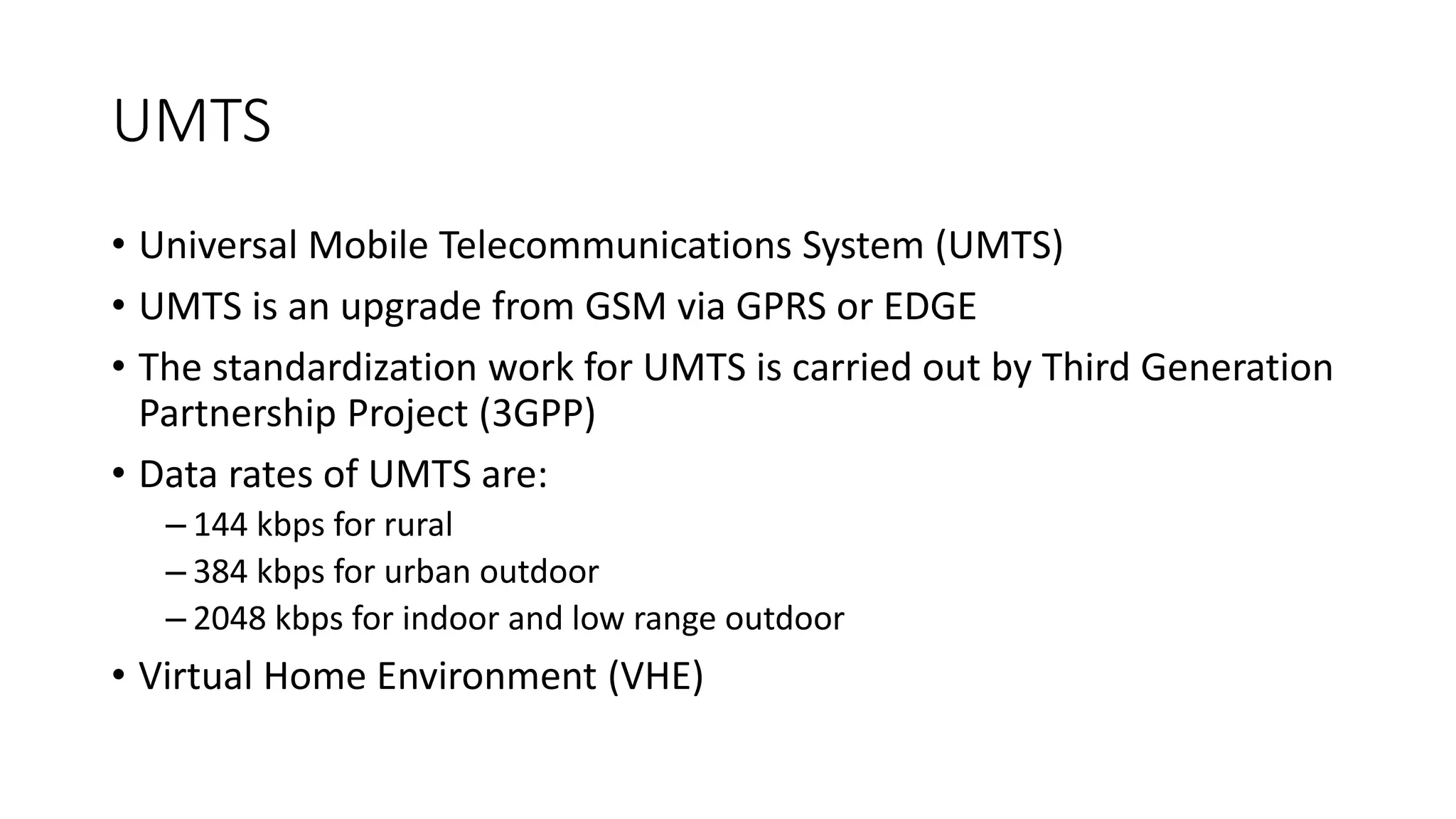
• Universal Mobile Telecommunications System (UMTS)
• UMTS is an upgrade from GSM via GPRS or EDGE
• The standardization work for UMTS is carried out by Third Generation
Partnership Project (3GPP)
• Data rates of UMTS are:
– 144 kbps for rural
– 384 kbps for urban outdoor
– 2048 kbps for indoor and low range outdoor
• Virtual Home Environment (VHE)
UMTS Frequency Spectrum
• UMTS Band
• 1900-2025 MHz and 2110-2200 MHz for 3G transmission
• In the US, 1710–1755 MHz and 2110–2155 MHz will be used instead, as the
1900 MHz band was already used.
UMTS Architecture
SD
Mobile Station
MSC/
VLR
Base Station
Subsystem
GMSC
Network Subsystem
AUCEIR HLR
Other Networks
Note: Interfaces have been omitted for clarity purposes.
GGSN
SGSN
BTS
BSC
Node
B
RNC
RNS
UTRAN
SIM
ME
USIM
ME
+
PSTN
PLMN
Internet
4G (LTE)
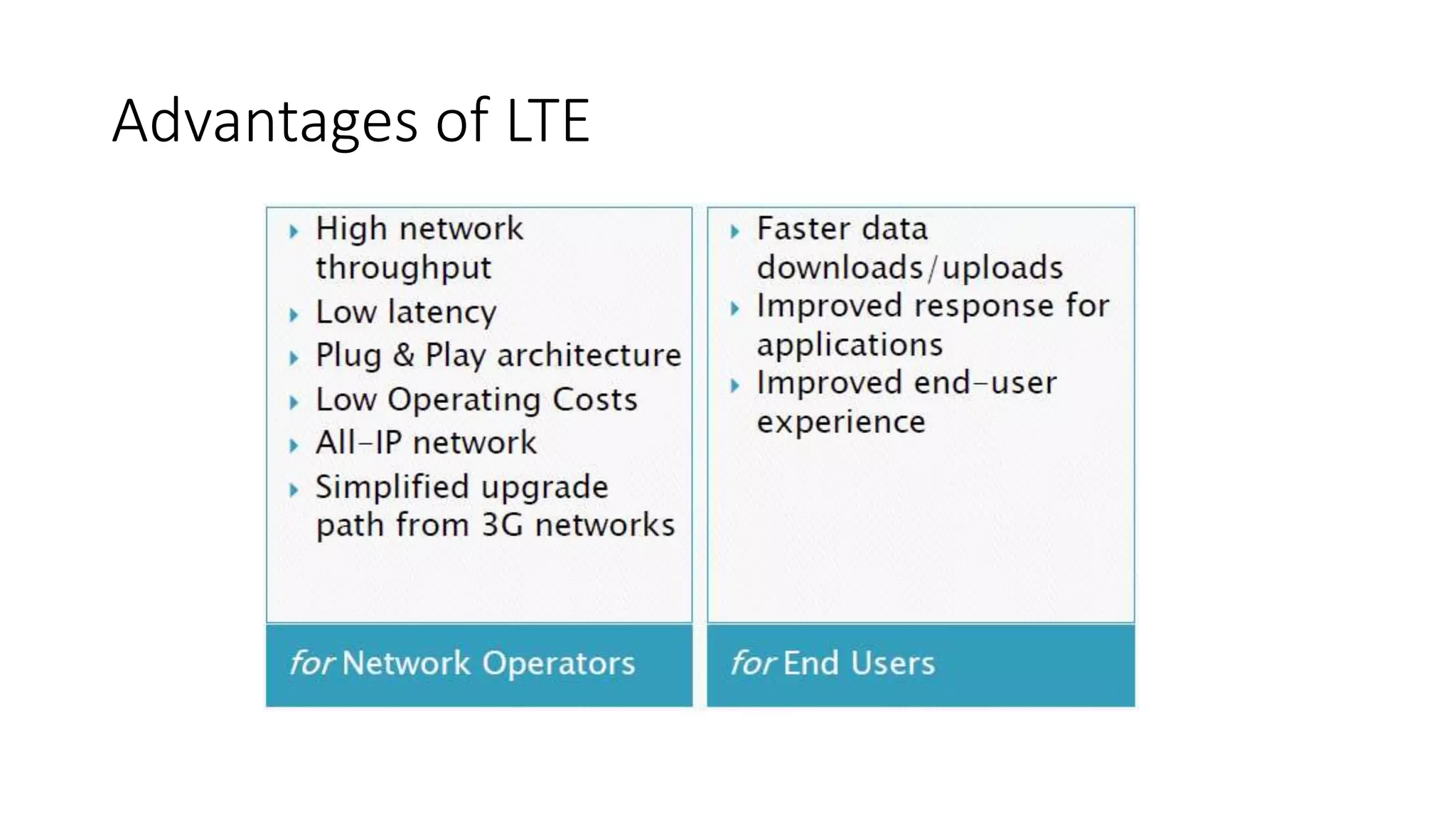
• LTE stands for Long Term Evolution
• Next Generation mobile broadband technology
• Promises data transfer rates of 100 Mbps
• Based on UMTS 3G technology
• Optimized for All-IP traffic
Advantages of LTE
Comparison of LTE Speed
LTE vs UMTS
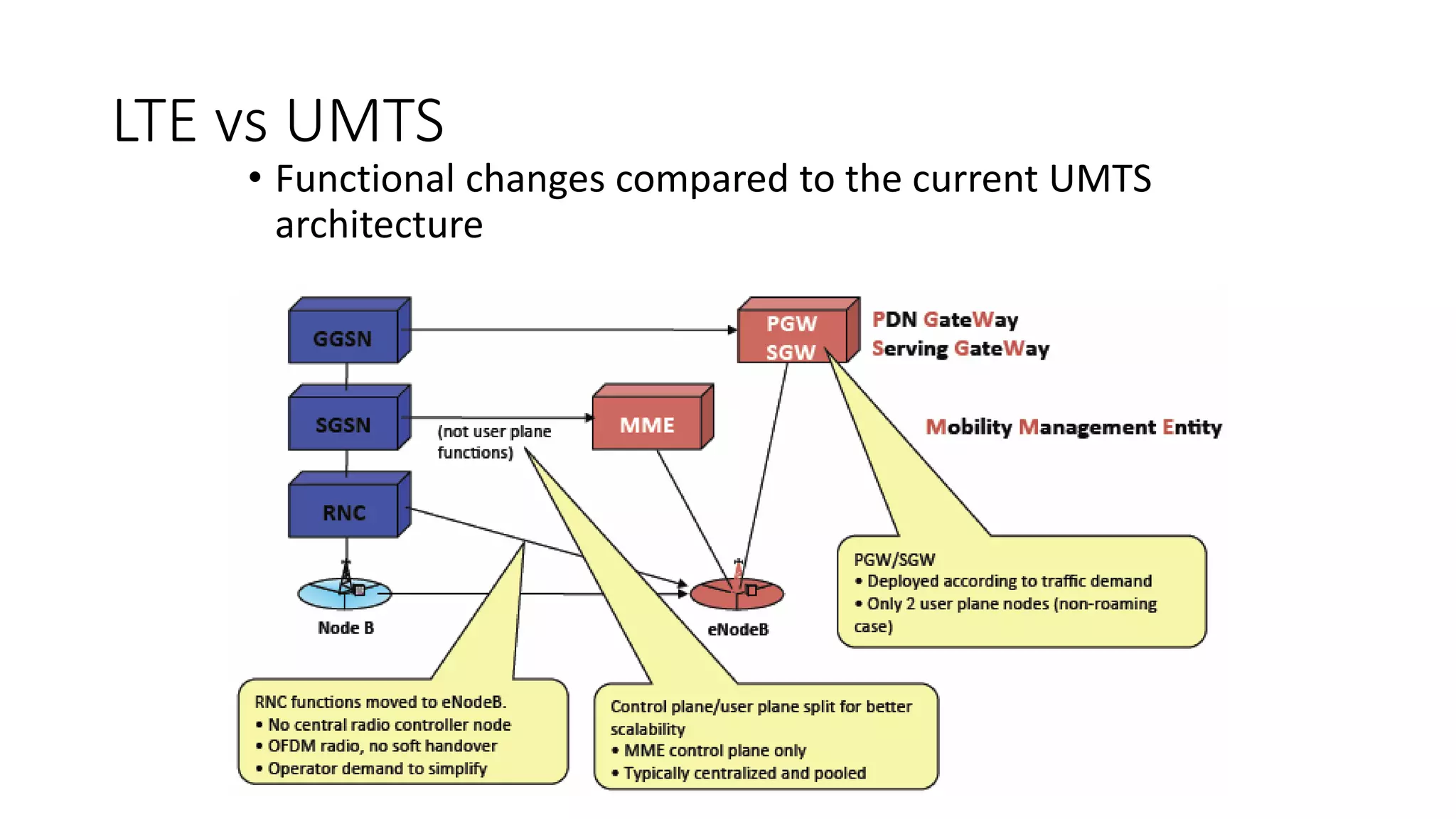
• Functional changes compared to the current UMTS
architecture
Global System for Mobile (GSM)

Global System for Mobile (GSM)