REV-090003r1 IMT-Advanced Evaluation Workshop 17 – 18 December, 2009, Beijing 1
Matthew Baker, Alcatel-Lucent
Chairman 3GPP TSG RAN WG1
LTELTE--AdvancedAdvanced
Physical LayerPhysical Layer
REV-090003r1
REV-090003r1 IMT-Advanced Evaluation Workshop 17 – 18 December, 2009, Beijing 2
Contents
Introduction
Downlink Physical Layer Design
Uplink Physical Layer Design
Specific support for TDD
Specific support for half-duplex FDD
UE categories in Rel-8
Enhancements for LTE-Advanced
REV-090003r1 IMT-Advanced Evaluation Workshop 17 – 18 December, 2009, Beijing 3
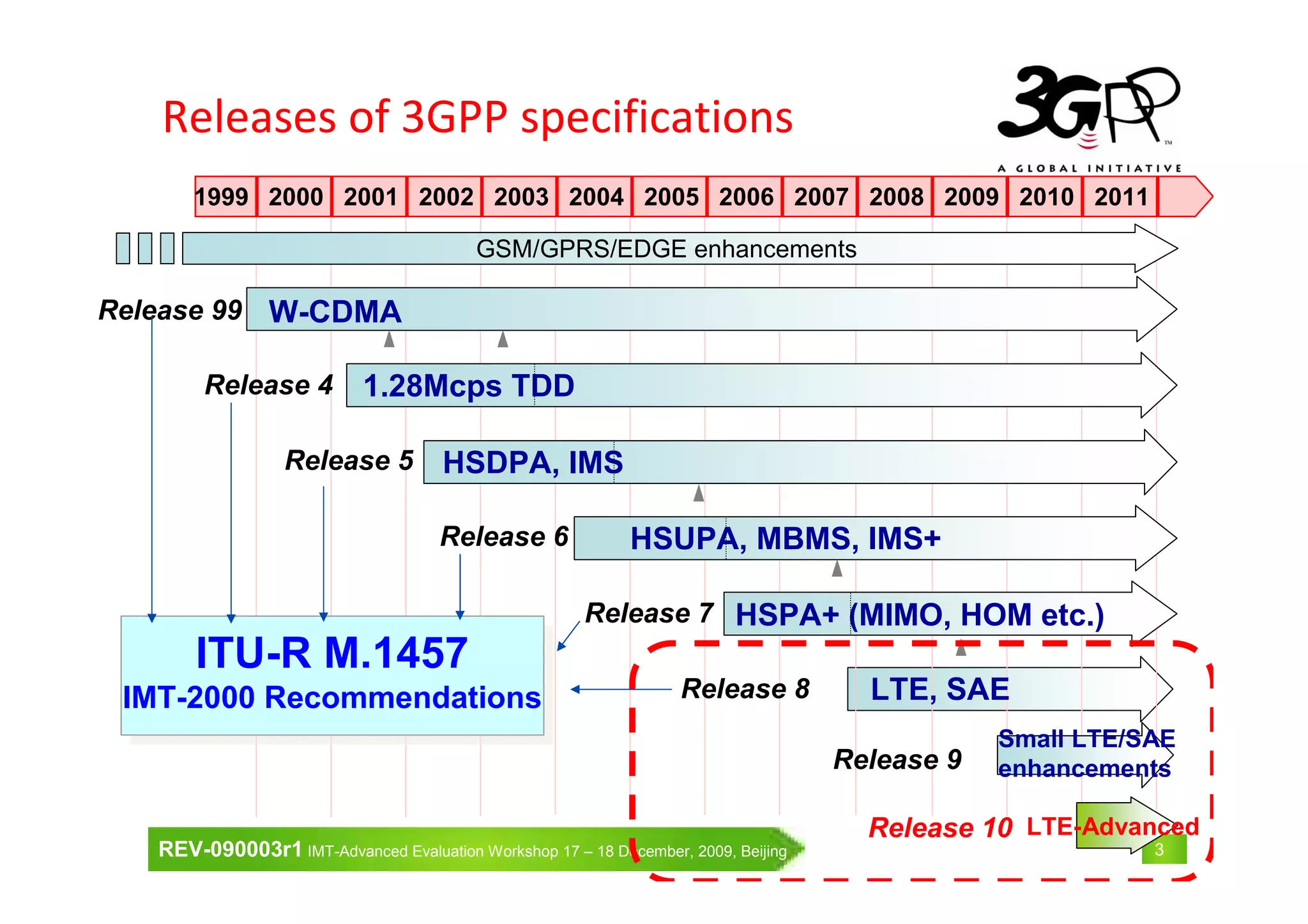
Releases of 3GPP specifications
1999 2000 2001 2002 2003 2004 2005
Release 99
Release 4
Release 5
Release 6
1.28Mcps TDD
HSDPA, IMS
W-CDMA
HSUPA, MBMS, IMS+
2006 2007 2008 2009
Release 7 HSPA+ (MIMO, HOM etc.)
Release 8
2010 2011
LTE, SAE
ITU-R M.1457
IMT-2000 Recommendations
Release 9
LTE-AdvancedRelease 10
GSM/GPRS/EDGE enhancements
Small LTE/SAE
enhancements
REV-090003r1 IMT-Advanced Evaluation Workshop 17 – 18 December, 2009, Beijing 4
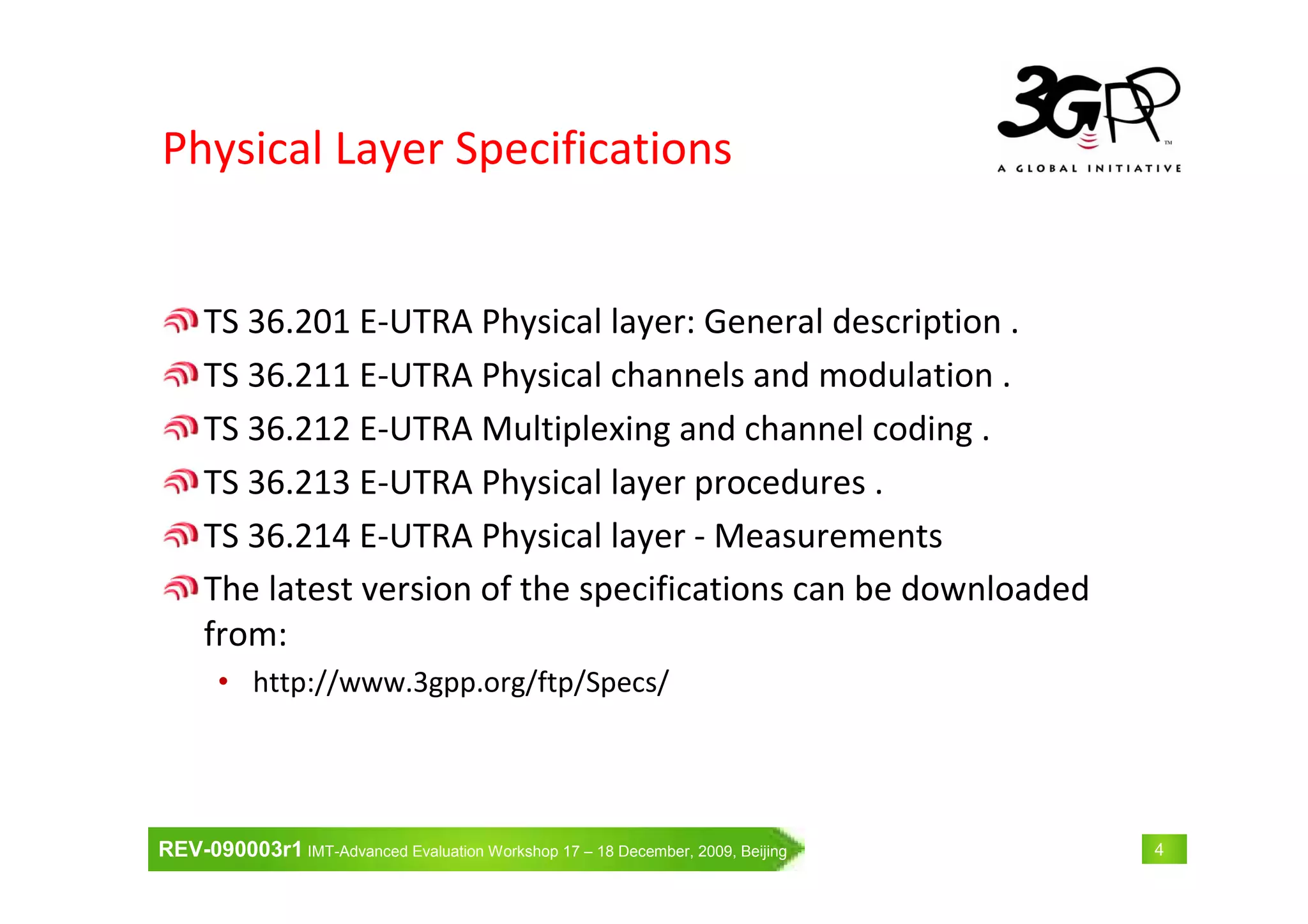
Physical Layer Specifications
TS 36.201 E-UTRA Physical layer: General description .
TS 36.211 E-UTRA Physical channels and modulation .
TS 36.212 E-UTRA Multiplexing and channel coding .
TS 36.213 E-UTRA Physical layer procedures .
TS 36.214 E-UTRA Physical layer - Measurements
The latest version of the specifications can be downloaded
from:
• http://www.3gpp.org/ftp/Specs/
REV-090003r1 IMT-Advanced Evaluation Workshop 17 – 18 December, 2009, Beijing 5
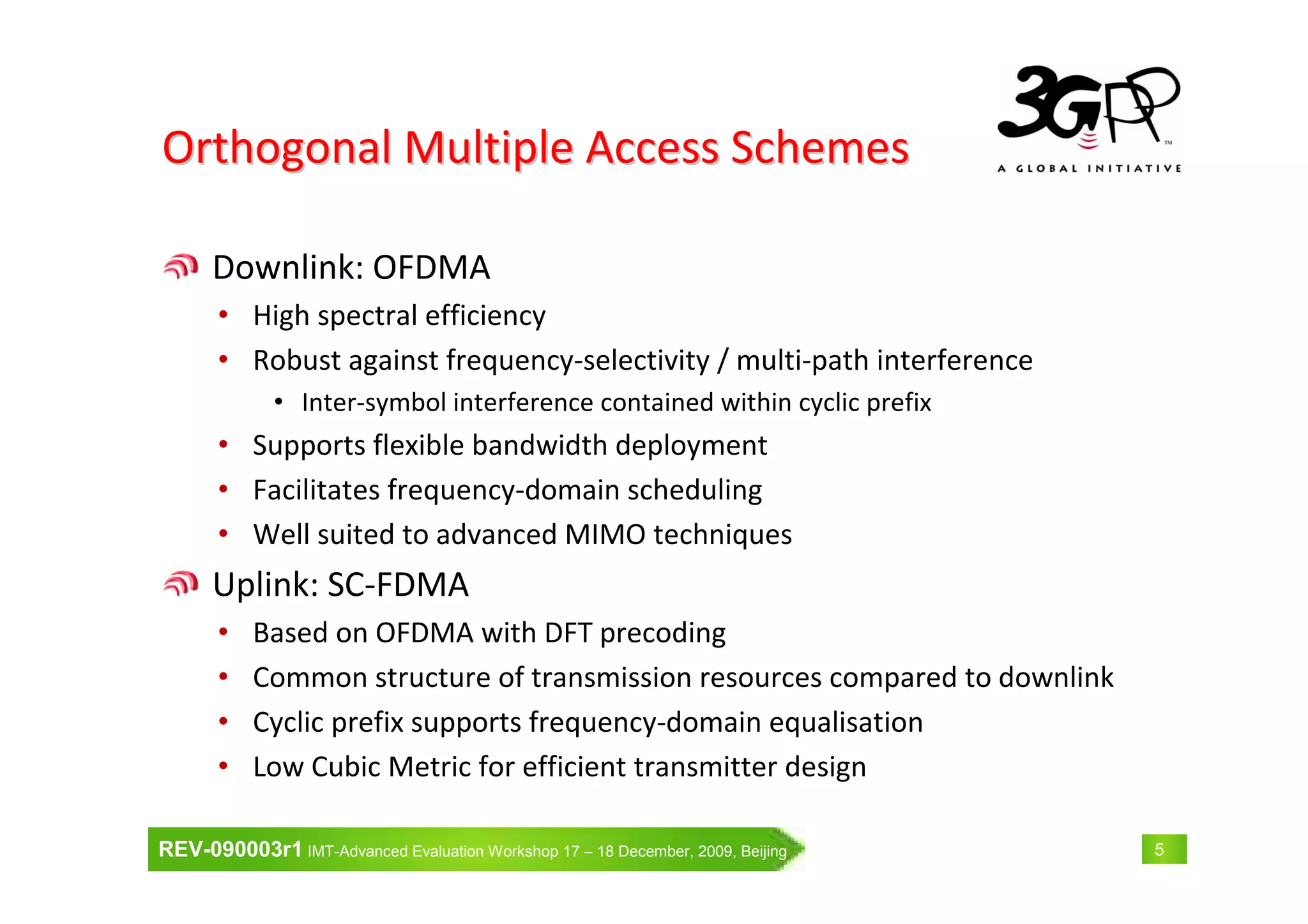
Orthogonal Multiple Access SchemesOrthogonal Multiple Access Schemes
Downlink: OFDMA
• High spectral efficiency
• Robust against frequency-selectivity / multi-path interference
• Inter-symbol interference contained within cyclic prefix
• Supports flexible bandwidth deployment
• Facilitates frequency-domain scheduling
• Well suited to advanced MIMO techniques
Uplink: SC-FDMA
• Based on OFDMA with DFT precoding
• Common structure of transmission resources compared to downlink
• Cyclic prefix supports frequency-domain equalisation
• Low Cubic Metric for efficient transmitter design
REV-090003r1 IMT-Advanced Evaluation Workshop 17 – 18 December, 2009, Beijing 6
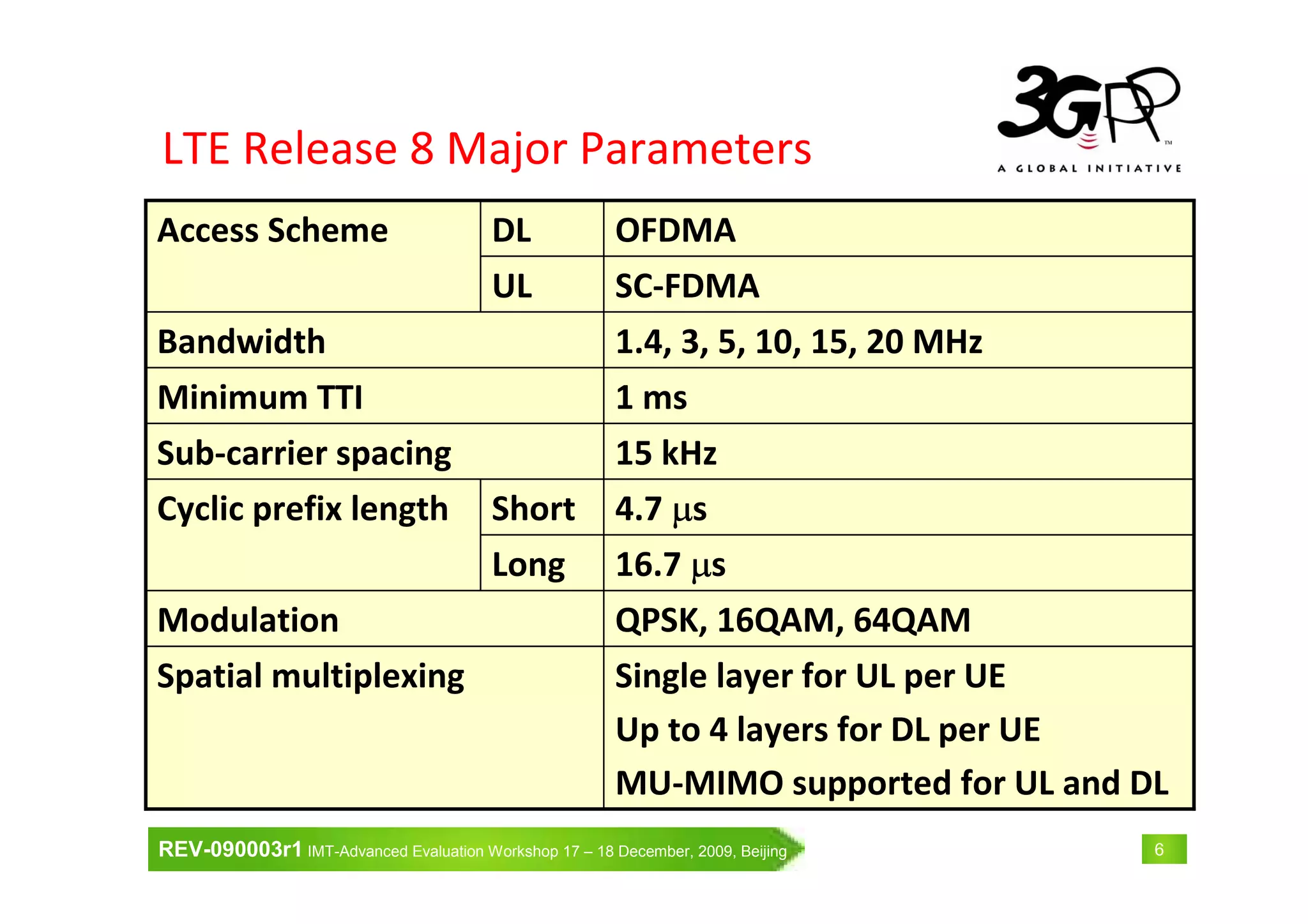
LTE Release 8 Major Parameters
Single layer for UL per UE
Up to 4 layers for DL per UE
MU-MIMO supported for UL and DL
Spatial multiplexing
16.7 µµµµsLong
SC-FDMAUL
Short
DL
QPSK, 16QAM, 64QAMModulation
4.7 µµµµsCyclic prefix length
15 kHzSub-carrier spacing
1 msMinimum TTI
1.4, 3, 5, 10, 15, 20 MHzBandwidth
OFDMAAccess Scheme
REV-090003r1 IMT-Advanced Evaluation Workshop 17 – 18 December, 2009, Beijing 7
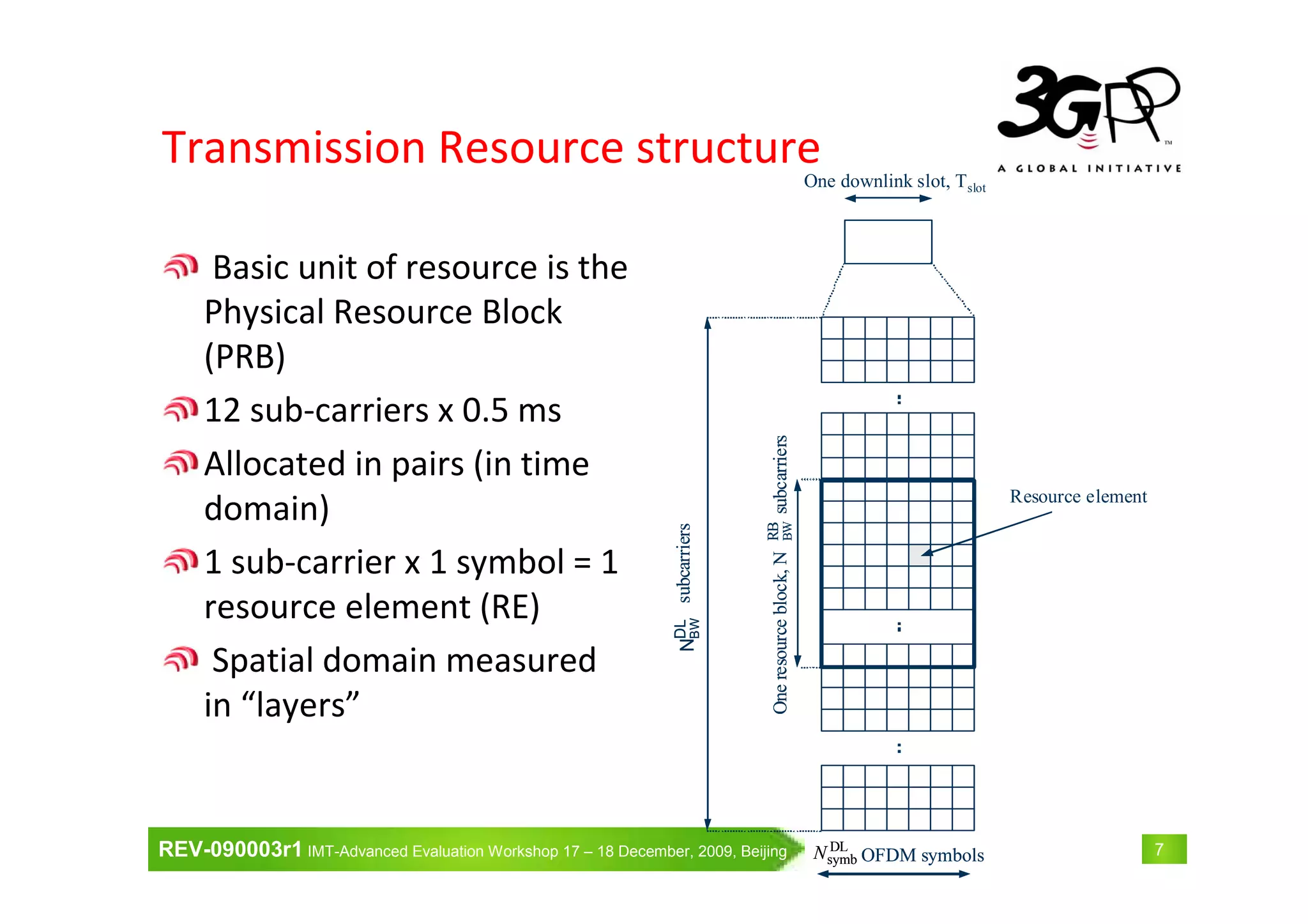
Transmission Resource structure
Basic unit of resource is the
Physical Resource Block
(PRB)
12 sub-carriers x 0.5 ms
Allocated in pairs (in time
domain)
1 sub-carrier x 1 symbol = 1
resource element (RE)
Spatial domain measured
in “layers”
One downlink slot, Tslot
subcarriersNBW
DLsubcarriersNBW
DL
NBW
DL
Resource element
OFDM symbols
DL
symbN OFDM symbols
DL
symbN
Oneresourceblock,NBWsubcarriersRB
REV-090003r1 IMT-Advanced Evaluation Workshop 17 – 18 December, 2009, Beijing 8
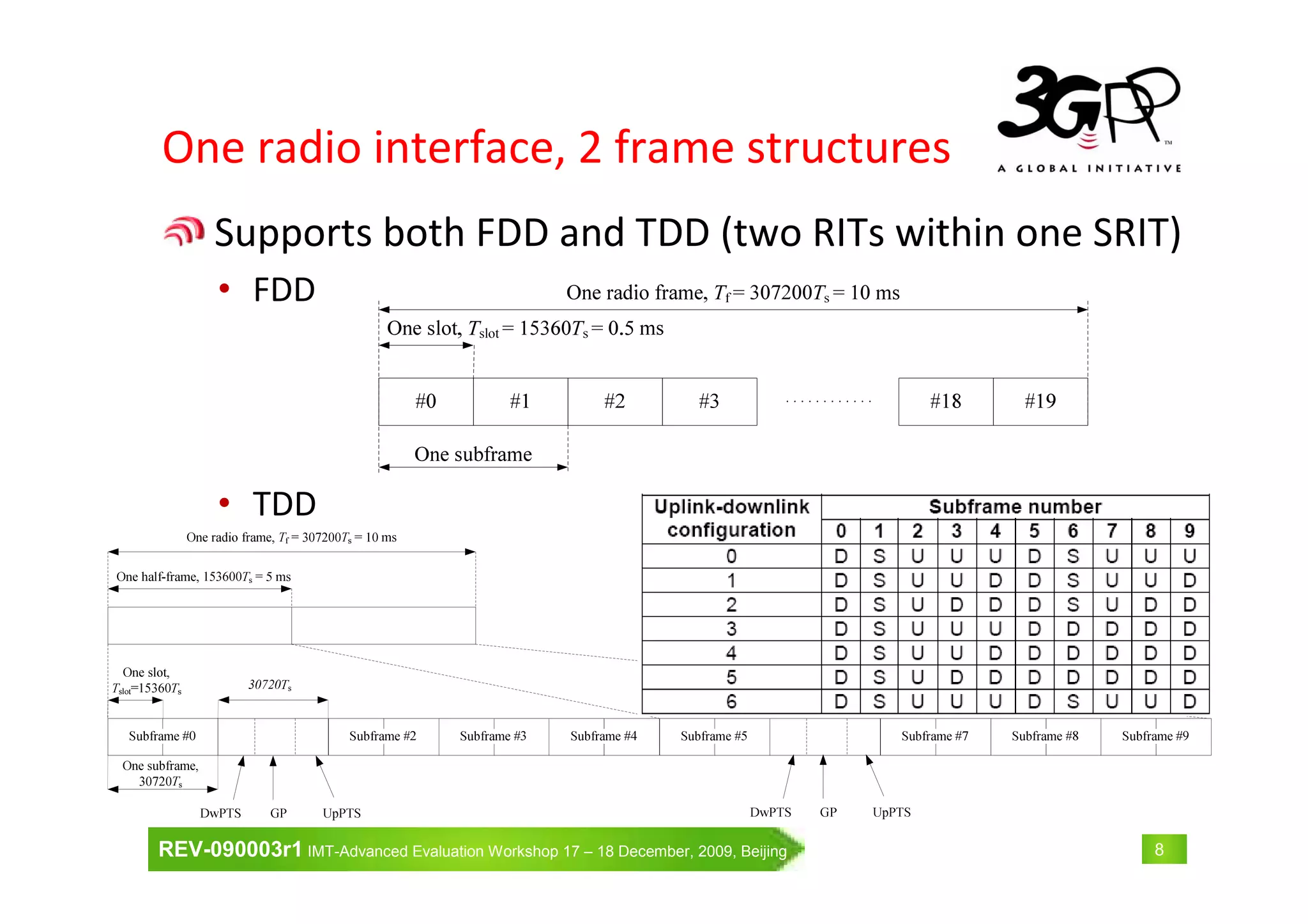
One radio interface, 2 frame structures
Supports both FDD and TDD (two RITs within one SRIT)
• FDD
• TDD
REV-090003r1 IMT-Advanced Evaluation Workshop 17 – 18 December, 2009, Beijing 9
Contents
Introduction
Downlink Aspects
Uplink Aspects
Specific support for TDD
Specific support for half-duplex FDD
UE categories in Rel-8
Enhancements for LTE-Advanced
REV-090003r1 IMT-Advanced Evaluation Workshop 17 – 18 December, 2009, Beijing 10
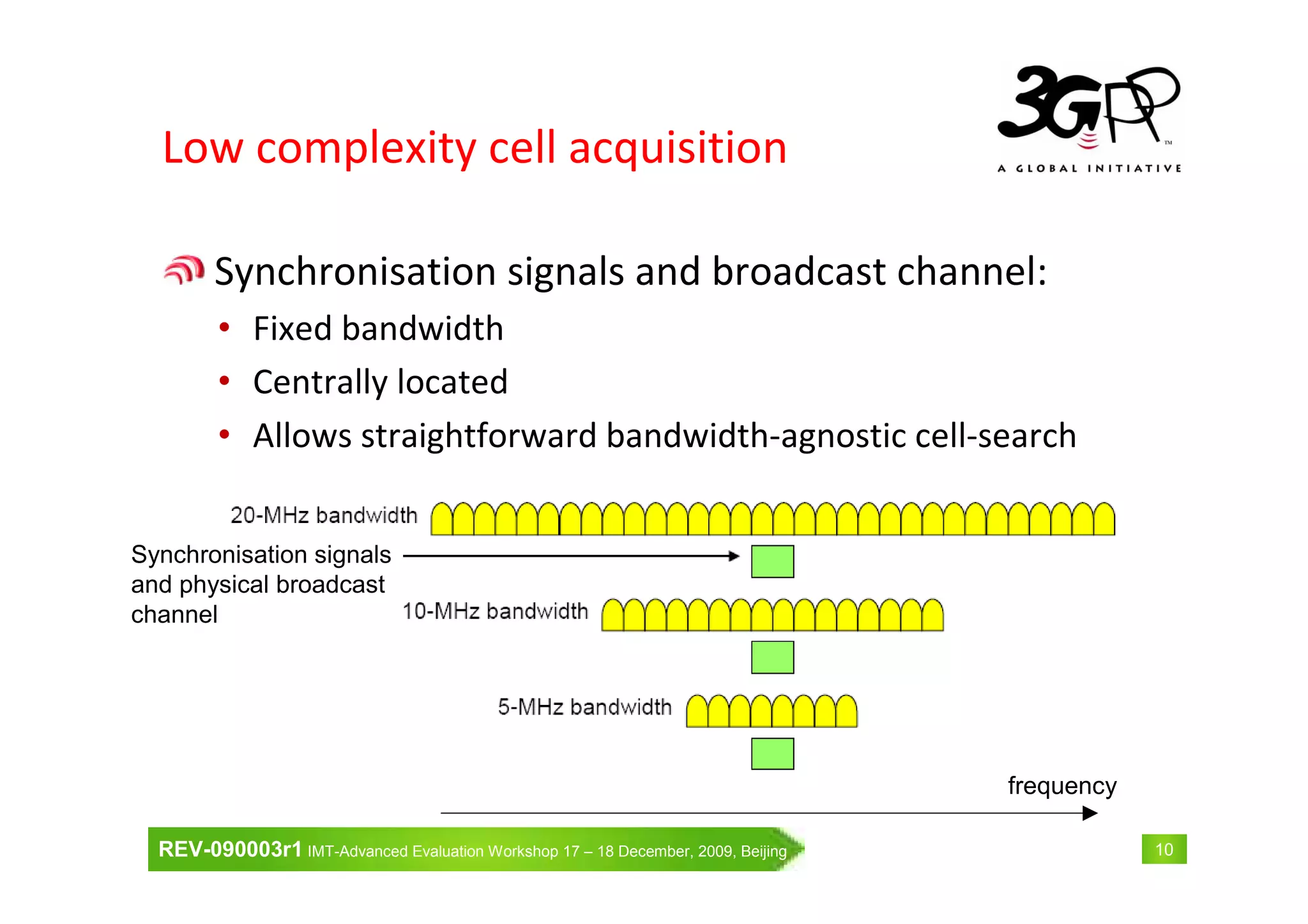
Low complexity cell acquisition
Synchronisation signals and broadcast channel:
• Fixed bandwidth
• Centrally located
• Allows straightforward bandwidth-agnostic cell-search
Synchronisation signals
and physical broadcast
channel
frequency
REV-090003r1 IMT-Advanced Evaluation Workshop 17 – 18 December, 2009, Beijing 11
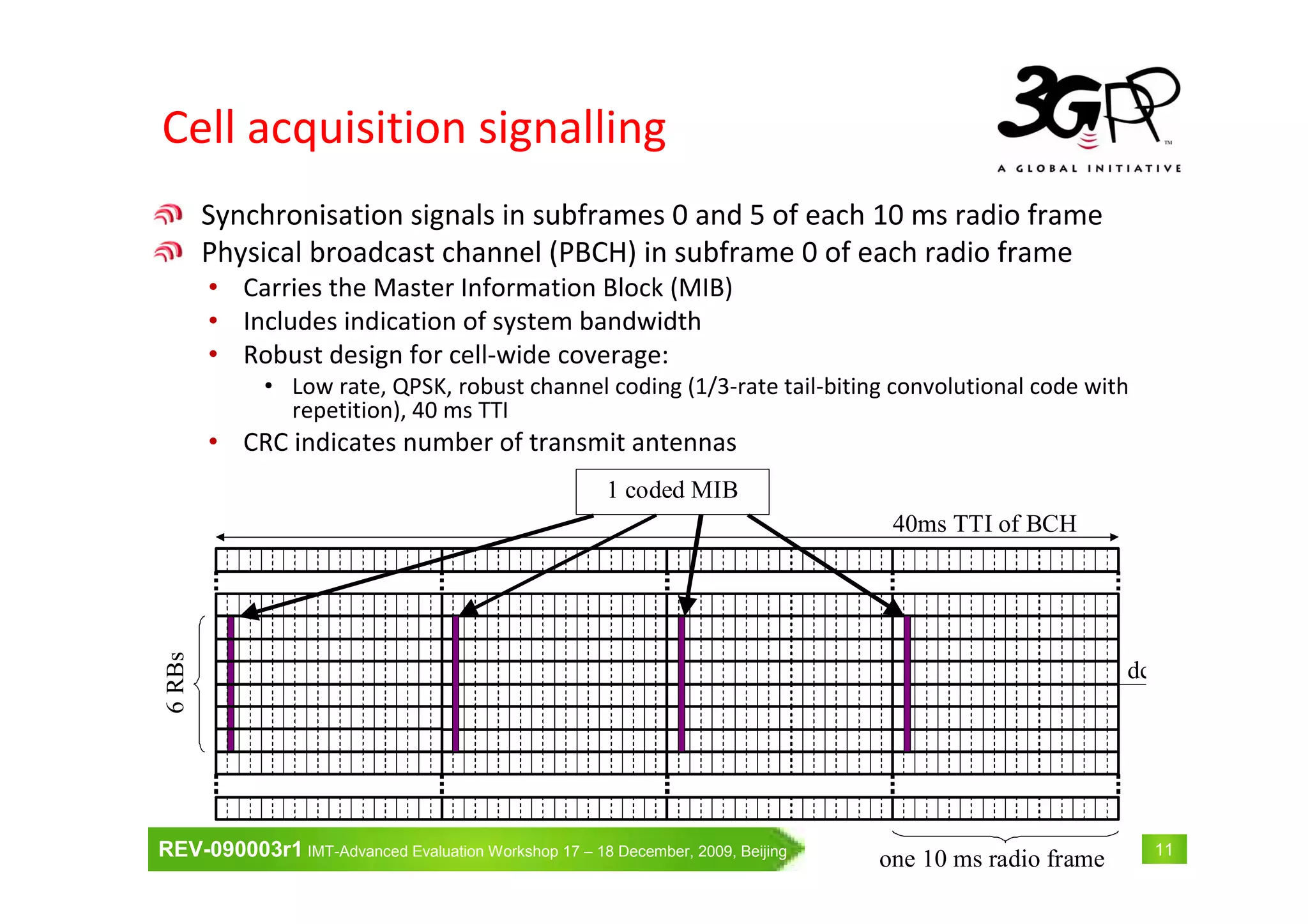
Cell acquisition signalling
Synchronisation signals in subframes 0 and 5 of each 10 ms radio frame
Physical broadcast channel (PBCH) in subframe 0 of each radio frame
• Carries the Master Information Block (MIB)
• Includes indication of system bandwidth
• Robust design for cell-wide coverage:
• Low rate, QPSK, robust channel coding (1/3-rate tail-biting convolutional code with
repetition), 40 ms TTI
• CRC indicates number of transmit antennas
dc
40ms TTI of BCH
one 10 ms radio frame
6RBs
1 coded MIB
REV-090003r1 IMT-Advanced Evaluation Workshop 17 – 18 December, 2009, Beijing 12
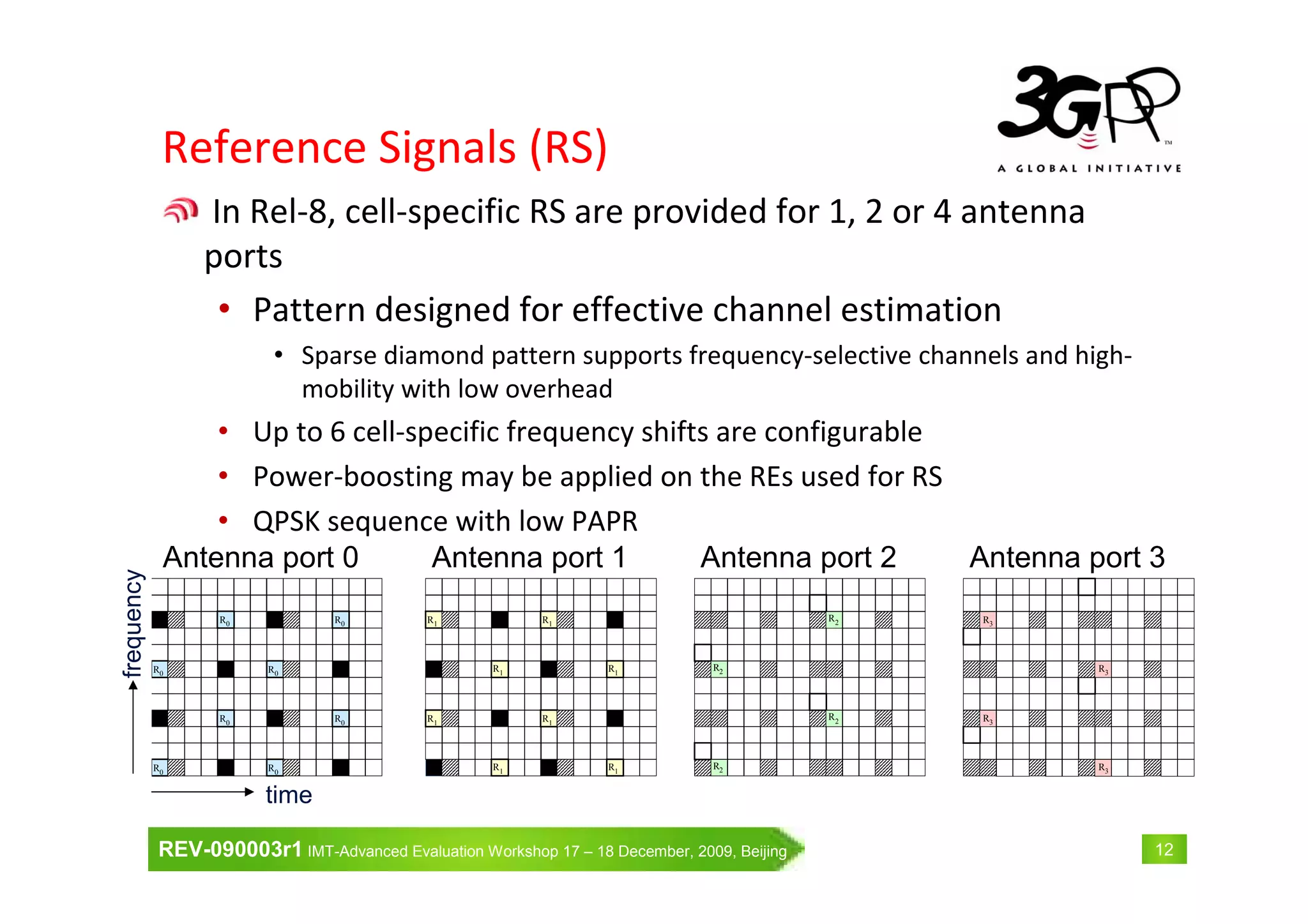
Reference Signals (RS)
In Rel-8, cell-specific RS are provided for 1, 2 or 4 antenna
ports
• Pattern designed for effective channel estimation
• Sparse diamond pattern supports frequency-selective channels and high-
mobility with low overhead
• Up to 6 cell-specific frequency shifts are configurable
• Power-boosting may be applied on the REs used for RS
• QPSK sequence with low PAPR
R3
R3
R3
R3R0
R0
R0
R0
R0
R0
R0
R0
R1
R1
R1
R1
R1
R1
R1
R1
R2
R2
R2
R2
Antenna port 0 Antenna port 2Antenna port 1 Antenna port 3
time
frequency
REV-090003r1 IMT-Advanced Evaluation Workshop 17 – 18 December, 2009, Beijing 13
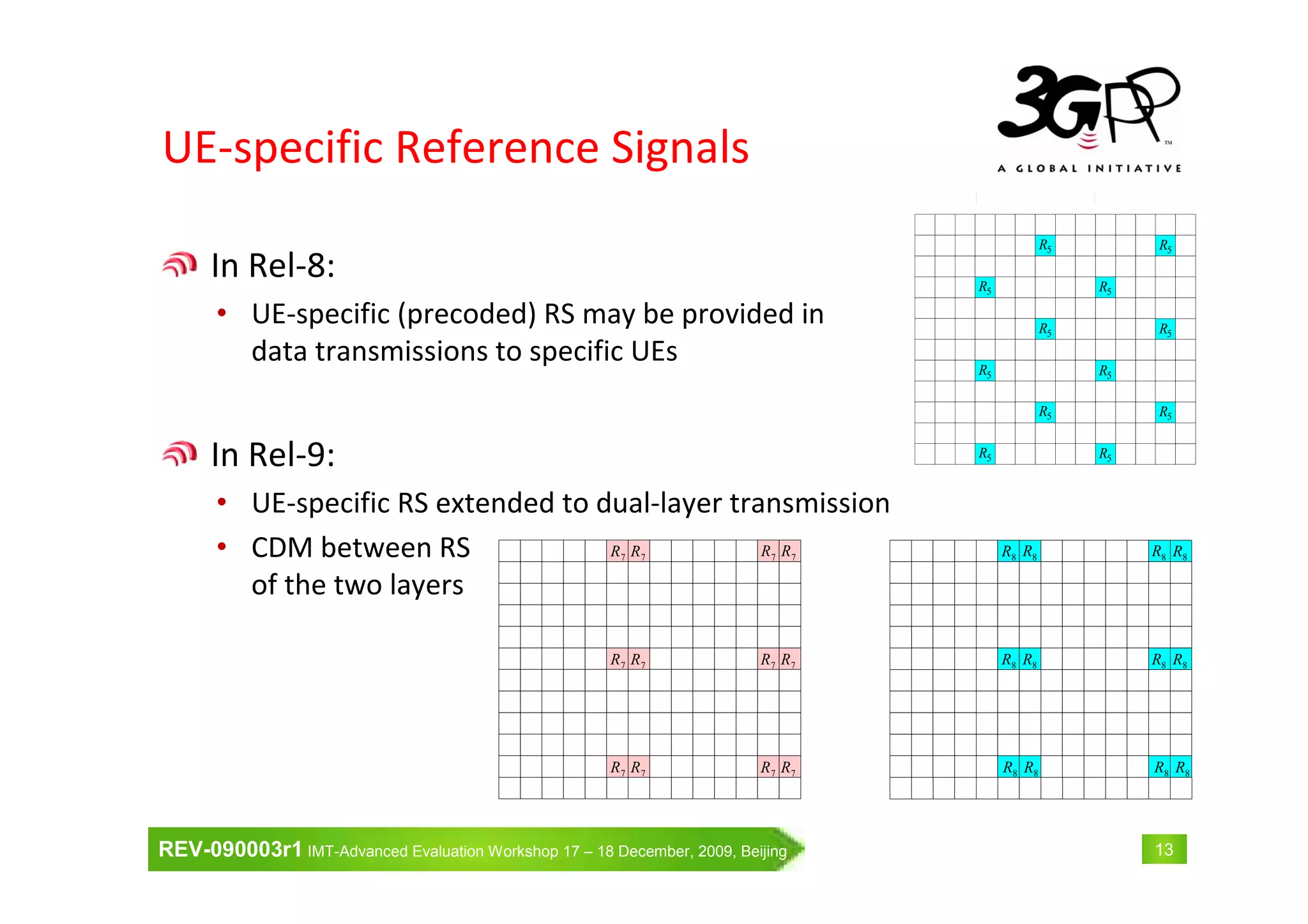
UE-specific Reference Signals
In Rel-8:
• UE-specific (precoded) RS may be provided in
data transmissions to specific UEs
In Rel-9:
• UE-specific RS extended to dual-layer transmission
• CDM between RS
of the two layers
0=l
5R
5R
5R
5R
5R
5R
5R
5R
5R
5R
5R
5R
0=l 6=l6=l
7R7R7R7R
7R7R7R7R
7R7R7R7R
8R 8R8R 8R
8R 8R8R 8R
8R 8R8R 8R
REV-090003r1 IMT-Advanced Evaluation Workshop 17 – 18 December, 2009, Beijing 14
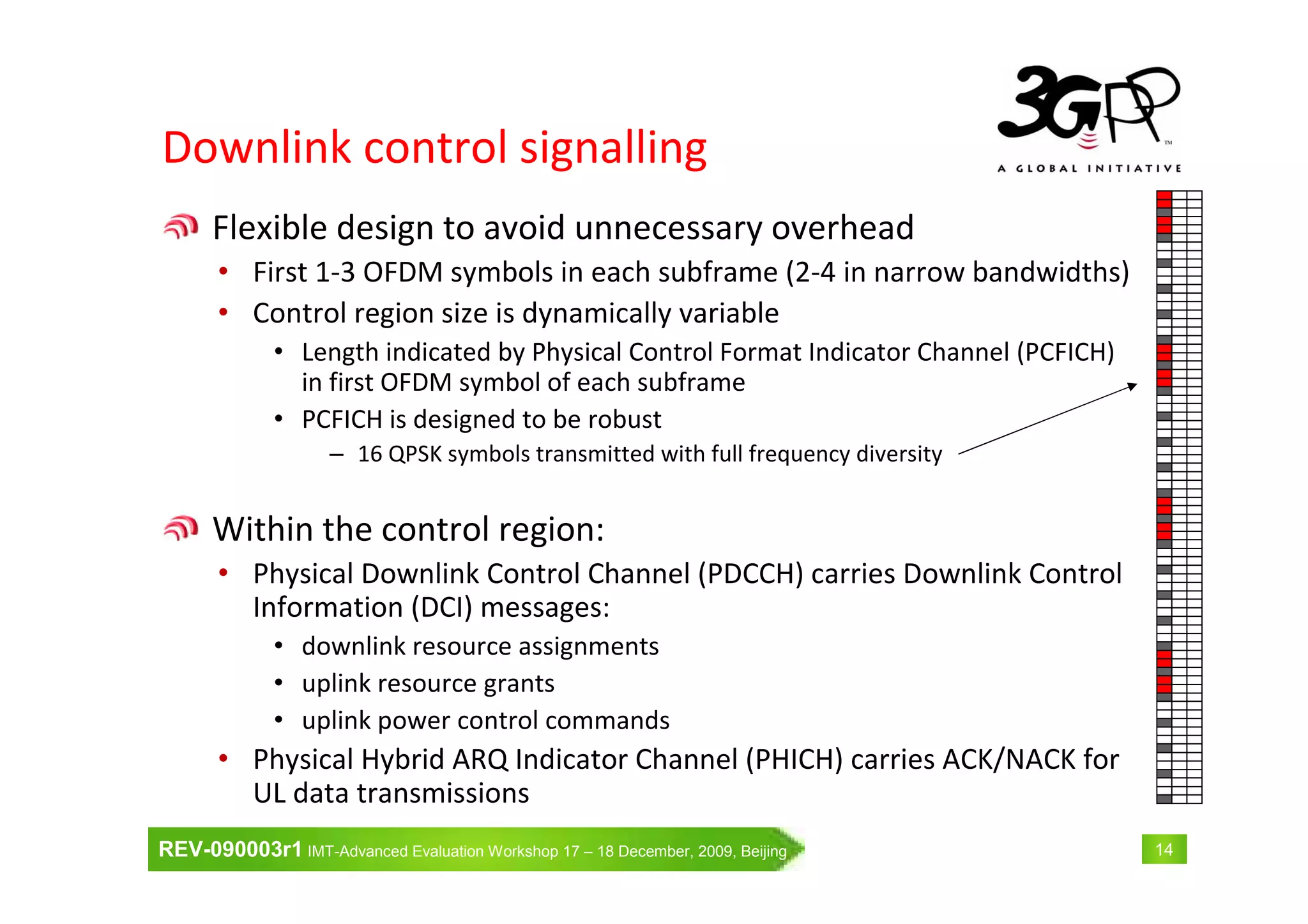
Downlink control signalling
Flexible design to avoid unnecessary overhead
• First 1-3 OFDM symbols in each subframe (2-4 in narrow bandwidths)
• Control region size is dynamically variable
• Length indicated by Physical Control Format Indicator Channel (PCFICH)
in first OFDM symbol of each subframe
• PCFICH is designed to be robust
– 16 QPSK symbols transmitted with full frequency diversity
Within the control region:
• Physical Downlink Control Channel (PDCCH) carries Downlink Control
Information (DCI) messages:
• downlink resource assignments
• uplink resource grants
• uplink power control commands
• Physical Hybrid ARQ Indicator Channel (PHICH) carries ACK/NACK for
UL data transmissions
REV-090003r1 IMT-Advanced Evaluation Workshop 17 – 18 December, 2009, Beijing 15
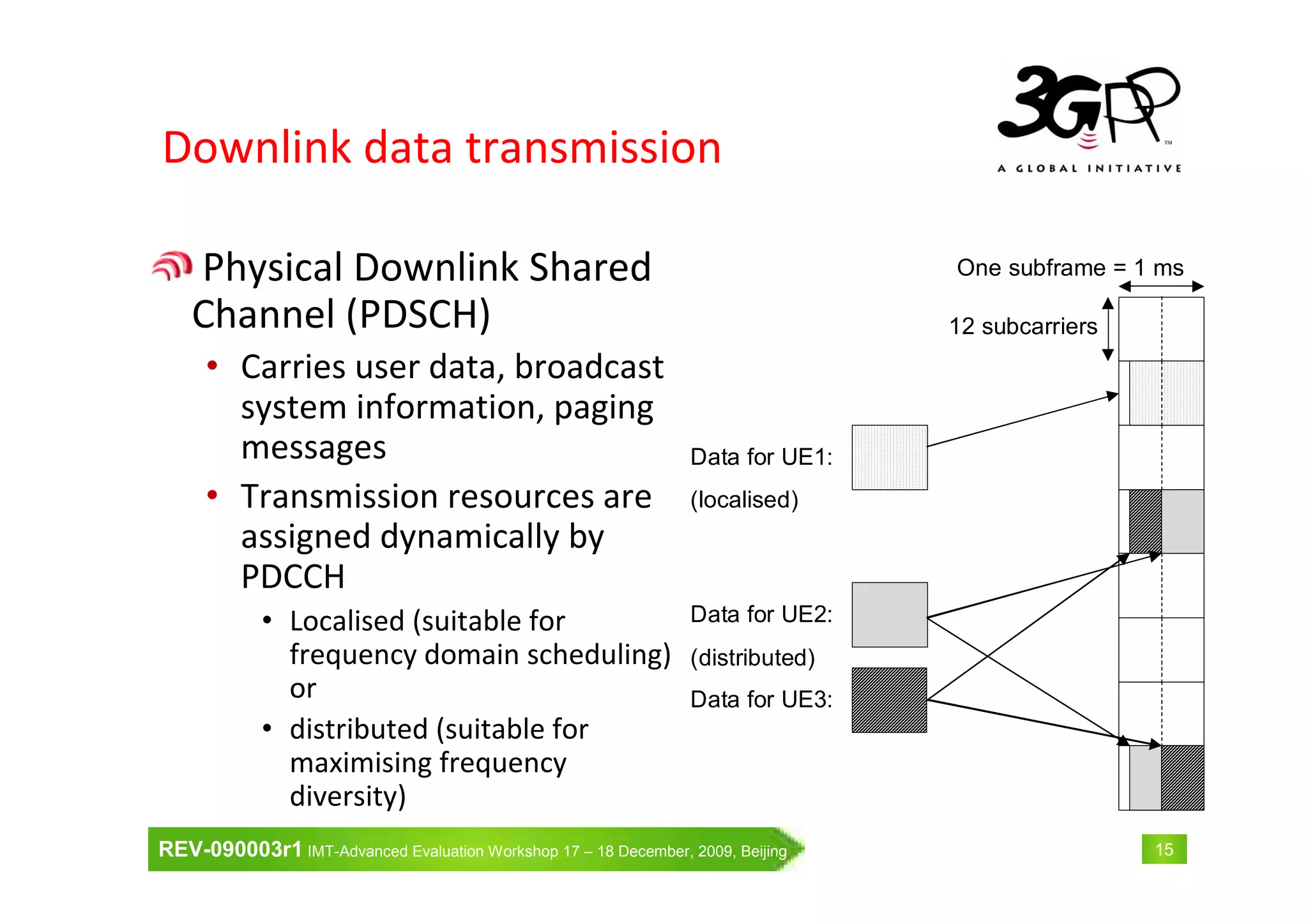
Downlink data transmission
Physical Downlink Shared
Channel (PDSCH)
• Carries user data, broadcast
system information, paging
messages
• Transmission resources are
assigned dynamically by
PDCCH
• Localised (suitable for
frequency domain scheduling)
or
• distributed (suitable for
maximising frequency
diversity)
One subframe = 1 ms
Data for UE2:
Data for UE3:
12 subcarriers
Data for UE1:
(localised)
(distributed)
REV-090003r1 IMT-Advanced Evaluation Workshop 17 – 18 December, 2009, Beijing 16
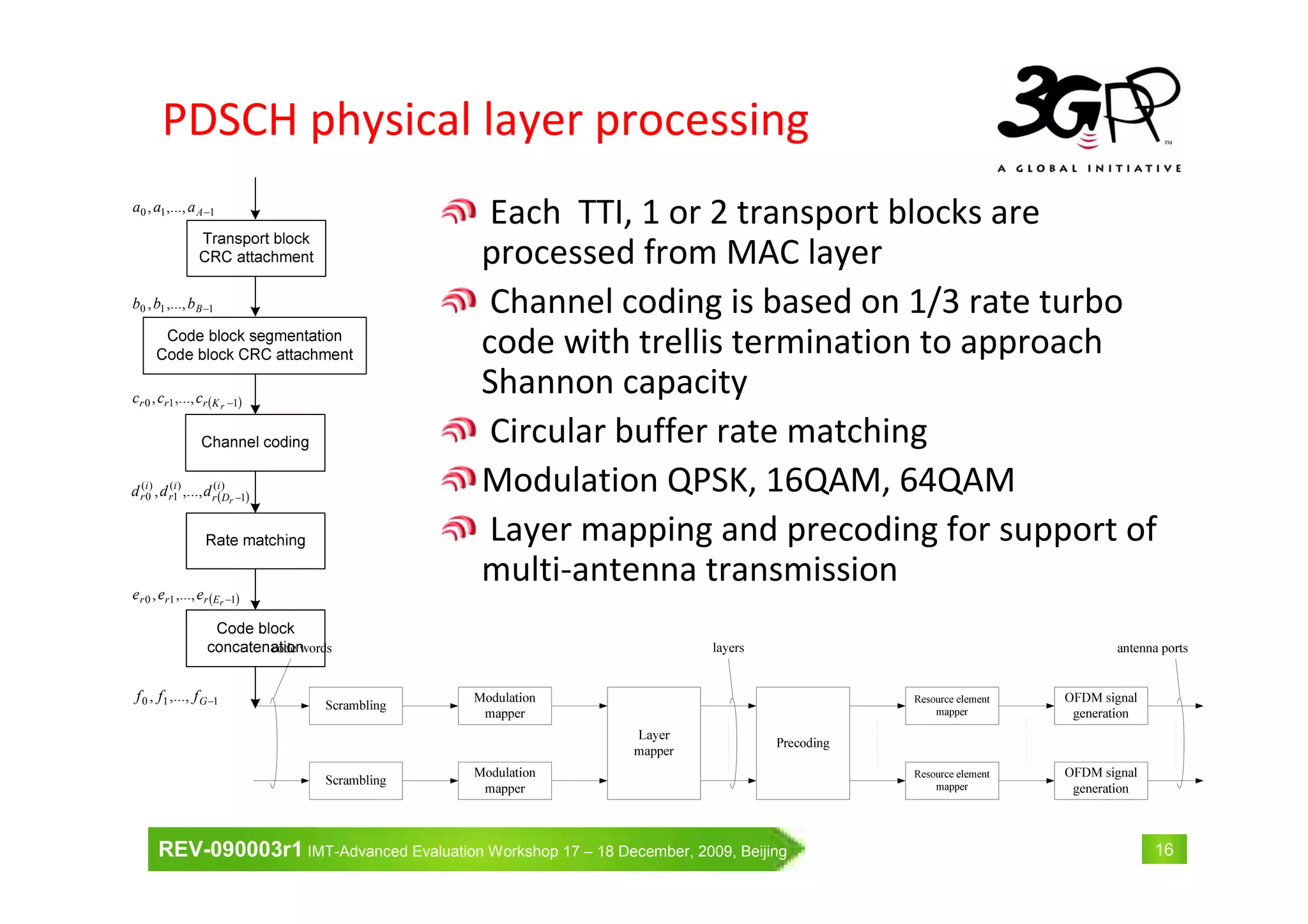
PDSCH physical layer processing
Each TTI, 1 or 2 transport blocks are
processed from MAC layer
Channel coding is based on 1/3 rate turbo
code with trellis termination to approach
Shannon capacity
Circular buffer rate matching
Modulation QPSK, 16QAM, 64QAM
Layer mapping and precoding for support of
multi-antenna transmission
110 ,...,, −Aaaa
110 ,...,, −Bbbb
( )110 ,...,, −rKrrr ccc
( )
)(
1
)(
1
)(
0 ,...,, i
Dr
i
r
i
r r
ddd −
( )110 ,...,, −rErrr eee
110 ,...,, −Gfff
REV-090003r1 IMT-Advanced Evaluation Workshop 17 – 18 December, 2009, Beijing 17
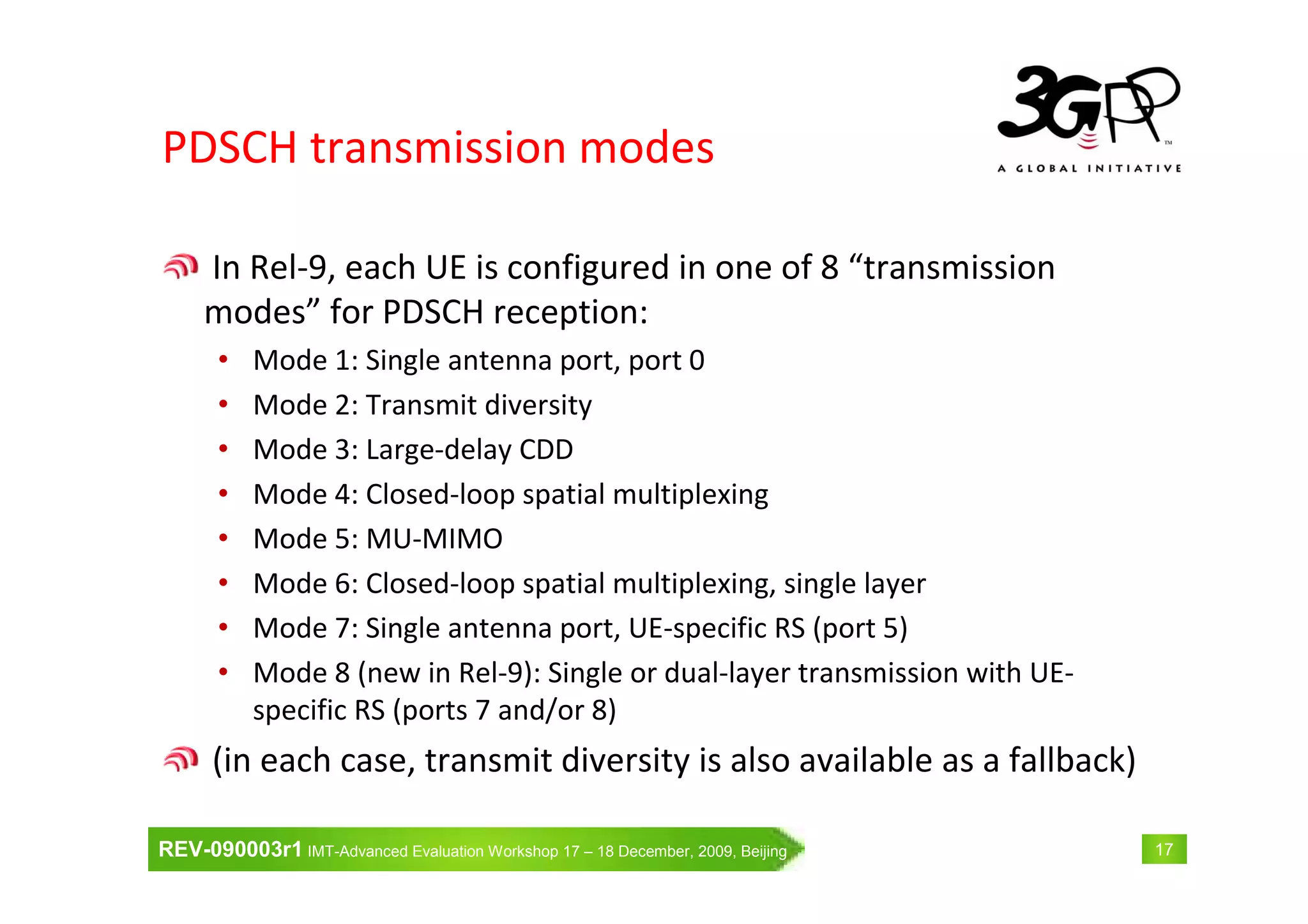
PDSCH transmission modes
In Rel-9, each UE is configured in one of 8 “transmission
modes” for PDSCH reception:
• Mode 1: Single antenna port, port 0
• Mode 2: Transmit diversity
• Mode 3: Large-delay CDD
• Mode 4: Closed-loop spatial multiplexing
• Mode 5: MU-MIMO
• Mode 6: Closed-loop spatial multiplexing, single layer
• Mode 7: Single antenna port, UE-specific RS (port 5)
• Mode 8 (new in Rel-9): Single or dual-layer transmission with UE-
specific RS (ports 7 and/or 8)
(in each case, transmit diversity is also available as a fallback)
REV-090003r1 IMT-Advanced Evaluation Workshop 17 – 18 December, 2009, Beijing 18
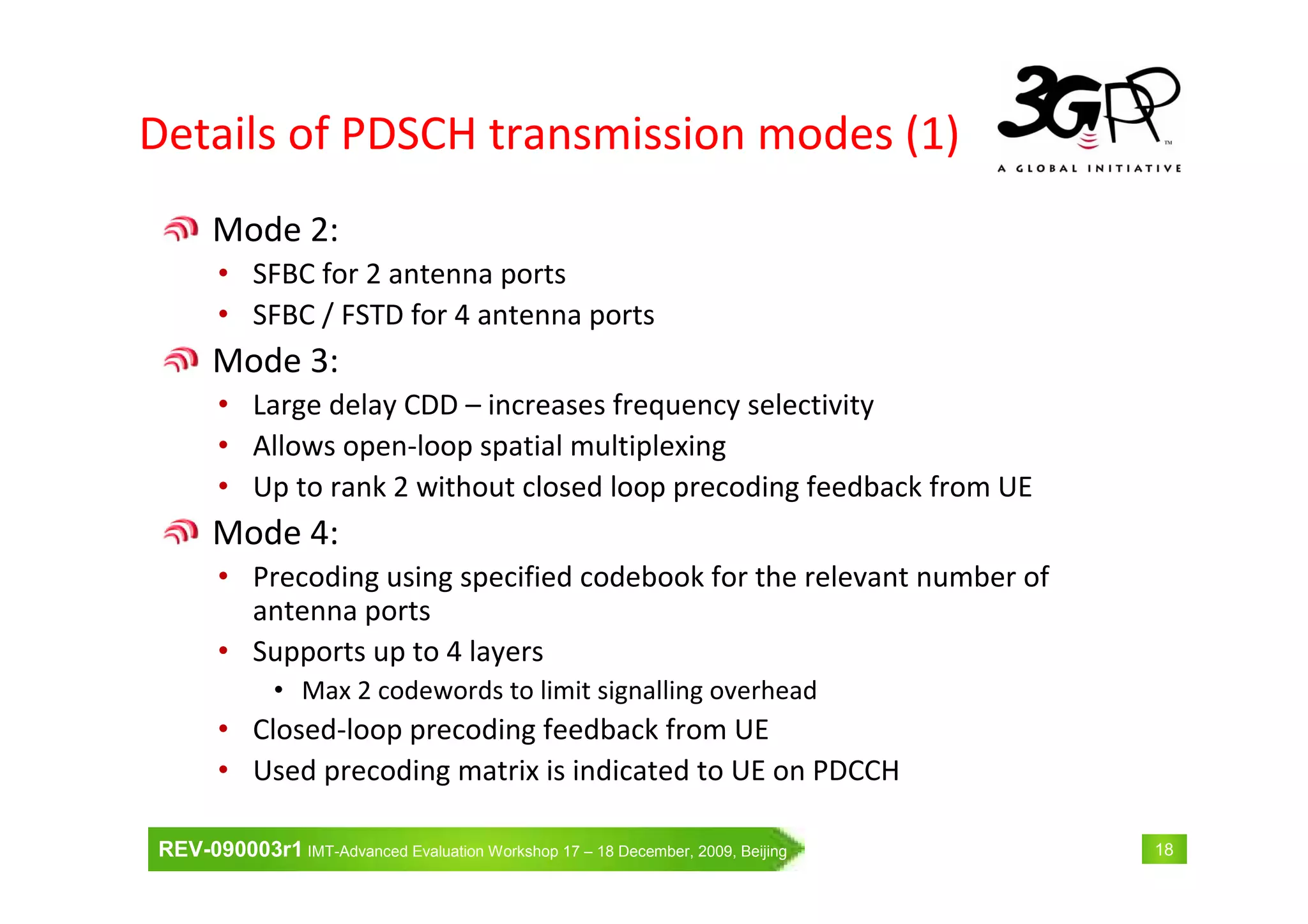
Details of PDSCH transmission modes (1)
Mode 2:
• SFBC for 2 antenna ports
• SFBC / FSTD for 4 antenna ports
Mode 3:
• Large delay CDD – increases frequency selectivity
• Allows open-loop spatial multiplexing
• Up to rank 2 without closed loop precoding feedback from UE
Mode 4:
• Precoding using specified codebook for the relevant number of
antenna ports
• Supports up to 4 layers
• Max 2 codewords to limit signalling overhead
• Closed-loop precoding feedback from UE
• Used precoding matrix is indicated to UE on PDCCH
REV-090003r1 IMT-Advanced Evaluation Workshop 17 – 18 December, 2009, Beijing 19
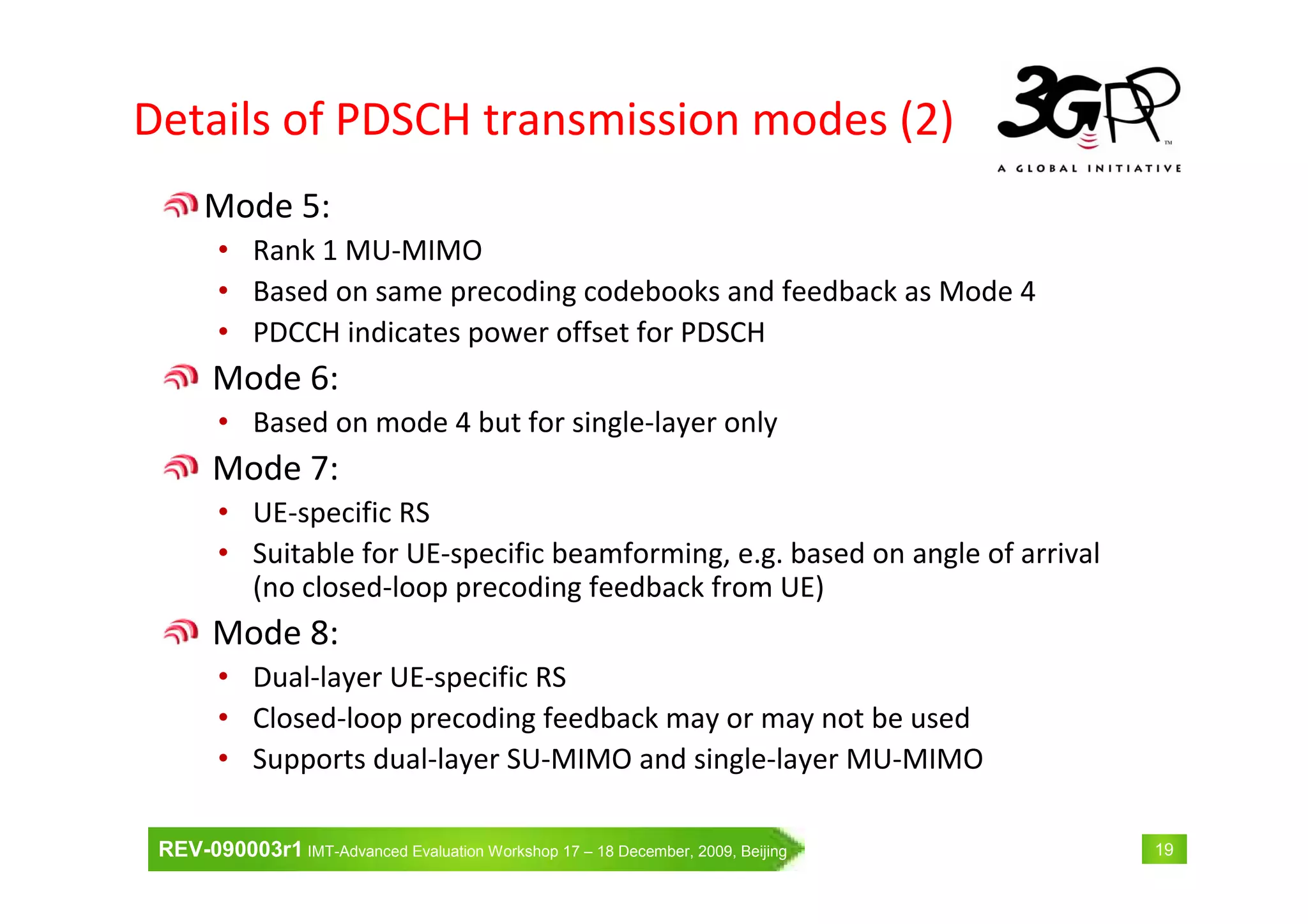
Details of PDSCH transmission modes (2)
Mode 5:
• Rank 1 MU-MIMO
• Based on same precoding codebooks and feedback as Mode 4
• PDCCH indicates power offset for PDSCH
Mode 6:
• Based on mode 4 but for single-layer only
Mode 7:
• UE-specific RS
• Suitable for UE-specific beamforming, e.g. based on angle of arrival
(no closed-loop precoding feedback from UE)
Mode 8:
• Dual-layer UE-specific RS
• Closed-loop precoding feedback may or may not be used
• Supports dual-layer SU-MIMO and single-layer MU-MIMO
REV-090003r1 IMT-Advanced Evaluation Workshop 17 – 18 December, 2009, Beijing 20
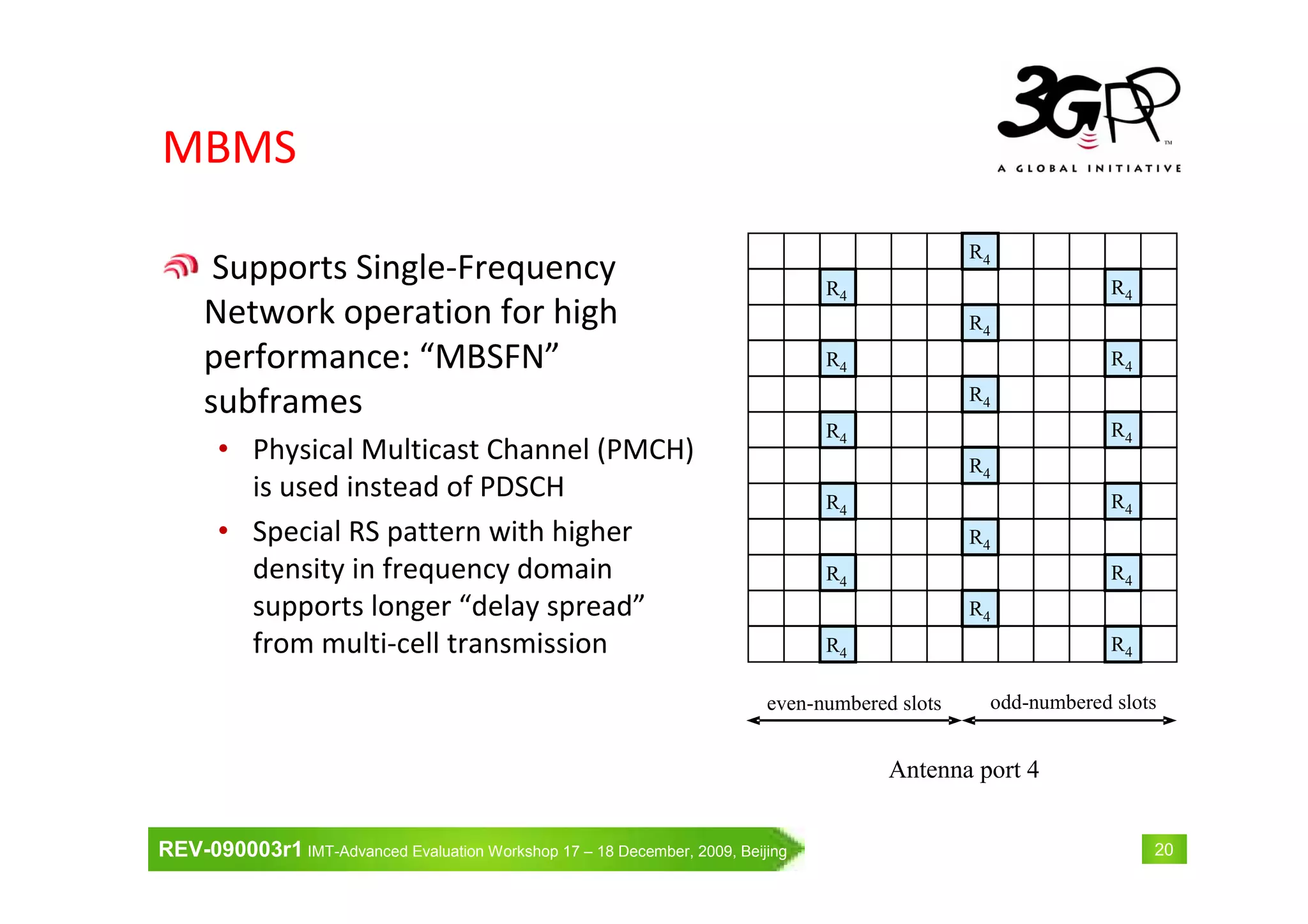
MBMS
Supports Single-Frequency
Network operation for high
performance: “MBSFN”
subframes
• Physical Multicast Channel (PMCH)
is used instead of PDSCH
• Special RS pattern with higher
density in frequency domain
supports longer “delay spread”
from multi-cell transmission R4
R4
R4
R4
R4
R4
R4
R4
R4
R4
R4
R4
R4
R4
R4
R4
R4
R4
even-numbered slots odd-numbered slots
Antenna port 4
REV-090003r1 IMT-Advanced Evaluation Workshop 17 – 18 December, 2009, Beijing 21
Contents
Introduction
Downlink Aspects
Uplink Aspects
Specific support for TDD
Specific support for half-duplex FDD
UE categories in Rel-8
Enhancements for LTE-Advanced
REV-090003r1 IMT-Advanced Evaluation Workshop 17 – 18 December, 2009, Beijing 22
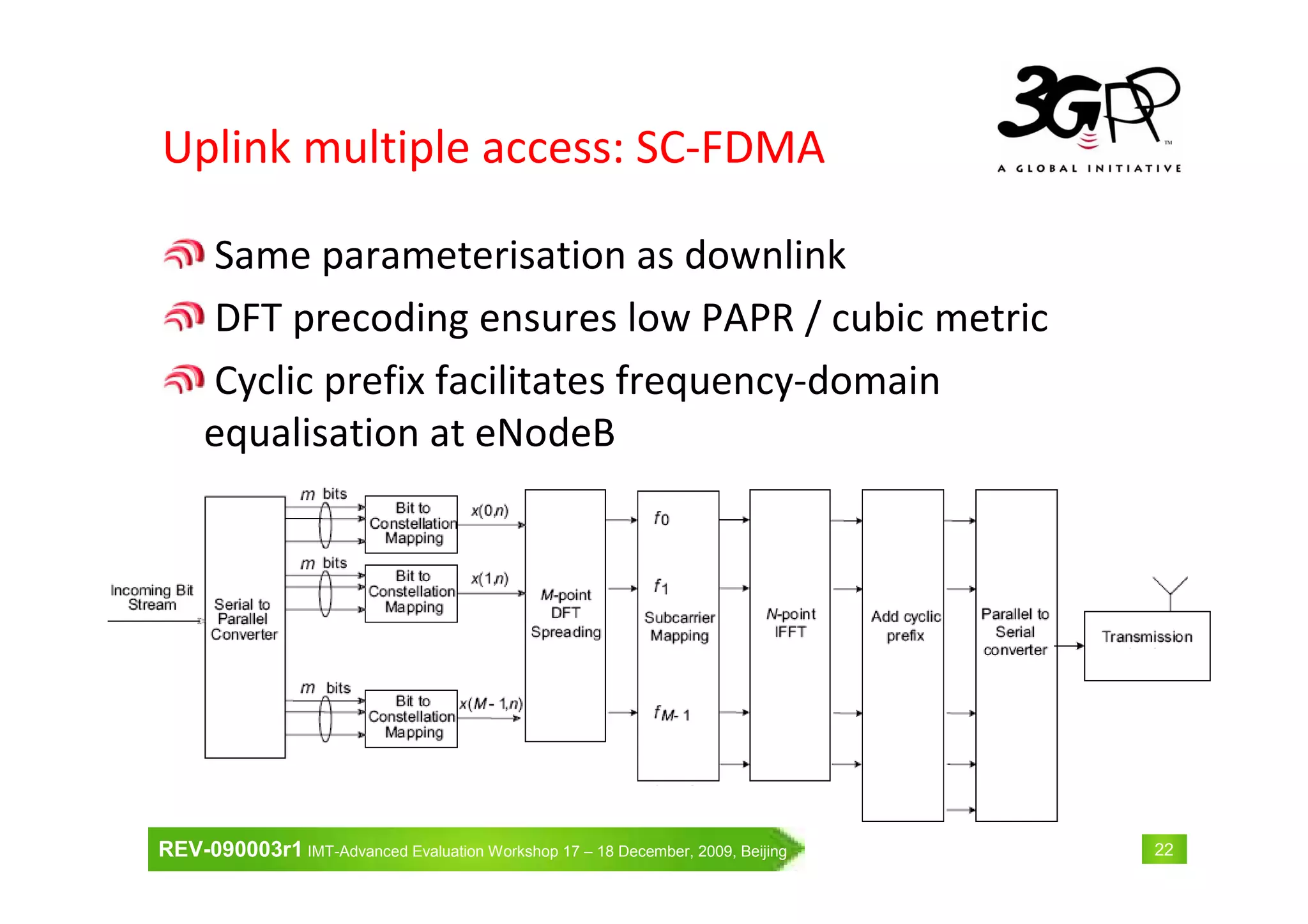
Uplink multiple access: SC-FDMA
Same parameterisation as downlink
DFT precoding ensures low PAPR / cubic metric
Cyclic prefix facilitates frequency-domain
equalisation at eNodeB
REV-090003r1 IMT-Advanced Evaluation Workshop 17 – 18 December, 2009, Beijing 23
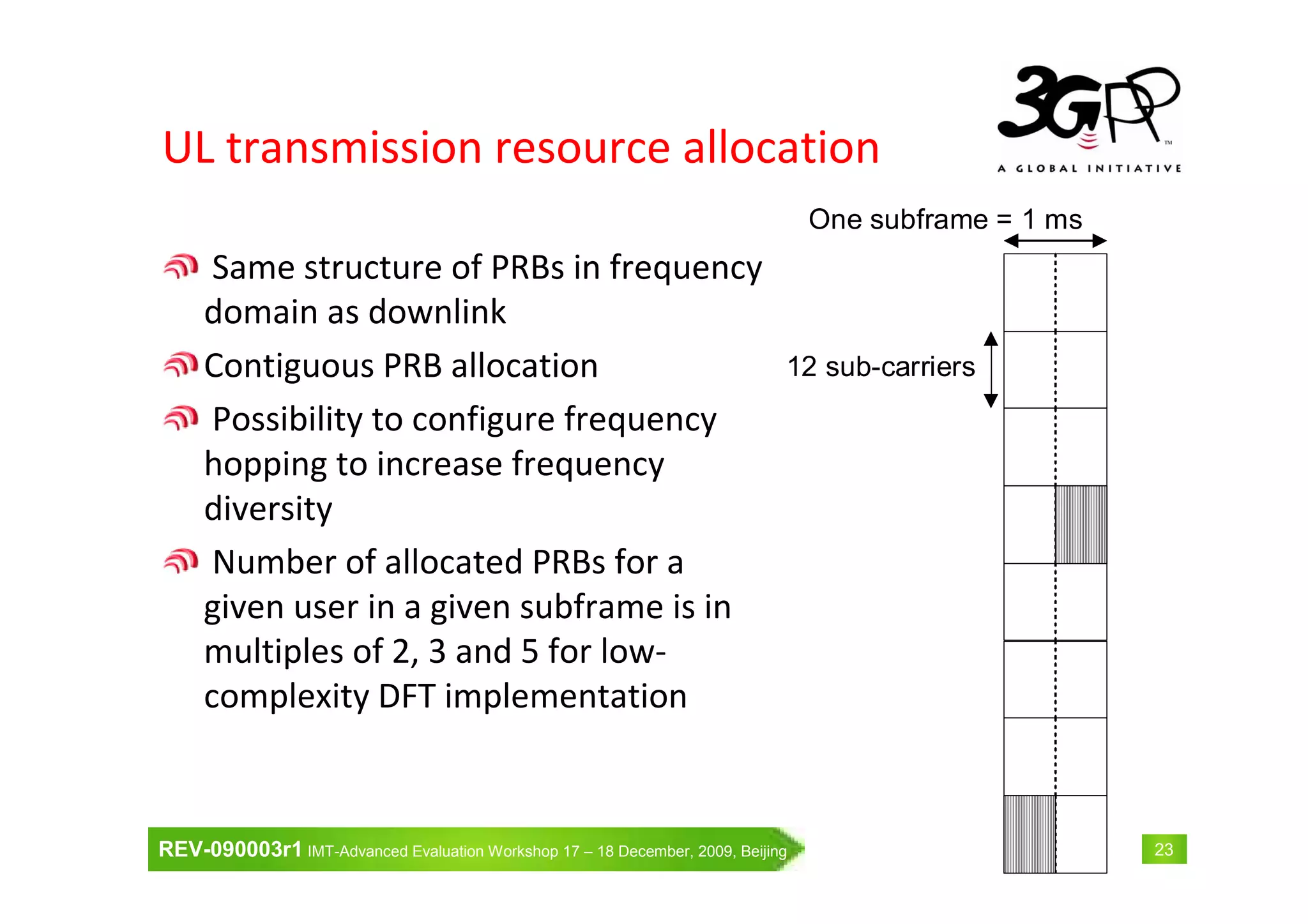
UL transmission resource allocation
Same structure of PRBs in frequency
domain as downlink
Contiguous PRB allocation
Possibility to configure frequency
hopping to increase frequency
diversity
Number of allocated PRBs for a
given user in a given subframe is in
multiples of 2, 3 and 5 for low-
complexity DFT implementation
One subframe = 1 ms
12 sub-carriers
REV-090003r1 IMT-Advanced Evaluation Workshop 17 – 18 December, 2009, Beijing 24
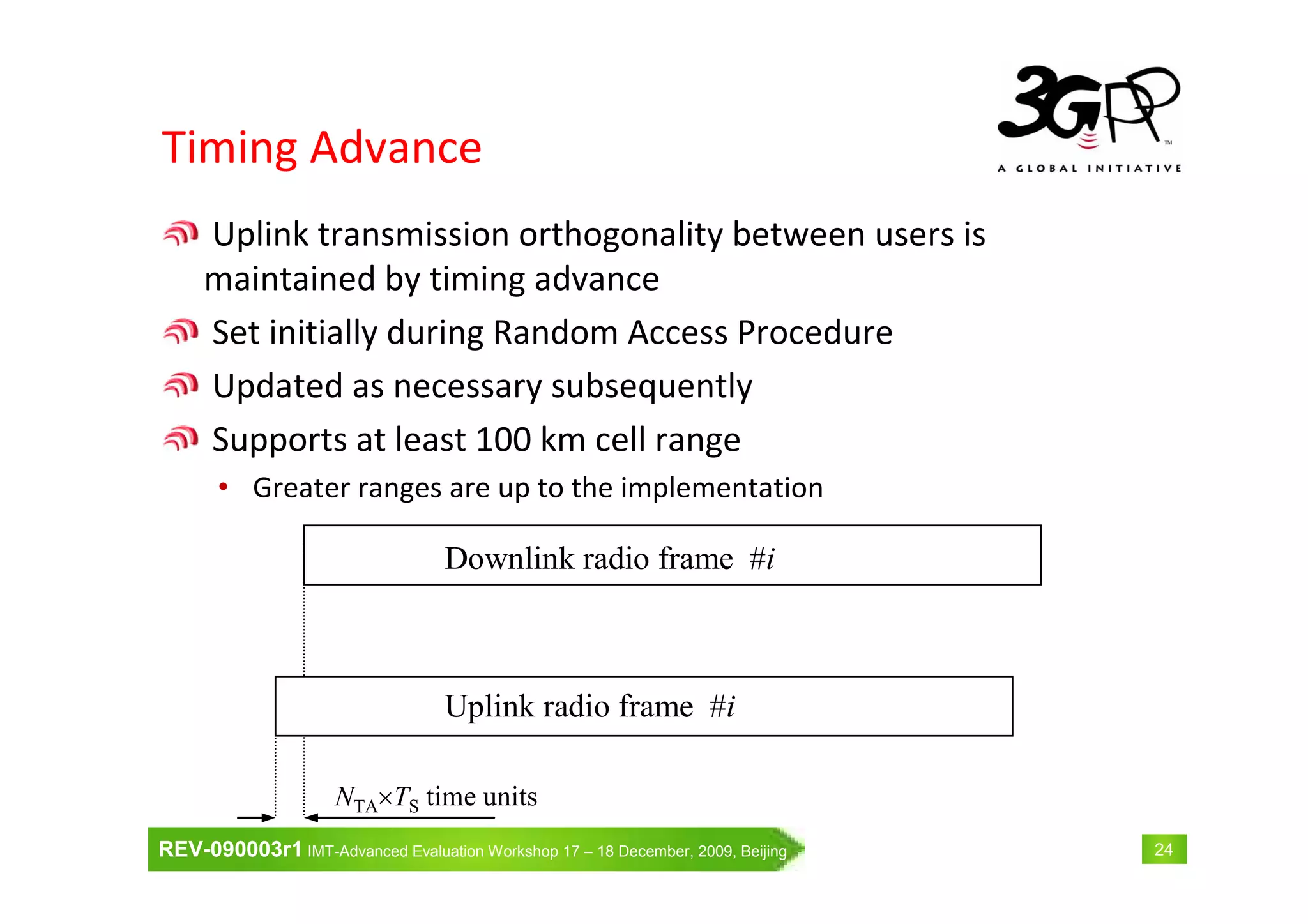
Timing Advance
Uplink transmission orthogonality between users is
maintained by timing advance
Set initially during Random Access Procedure
Updated as necessary subsequently
Supports at least 100 km cell range
• Greater ranges are up to the implementation
Downlink radio frame #i
Uplink radio frame #i
NTA×TS time units
REV-090003r1 IMT-Advanced Evaluation Workshop 17 – 18 December, 2009, Beijing 25
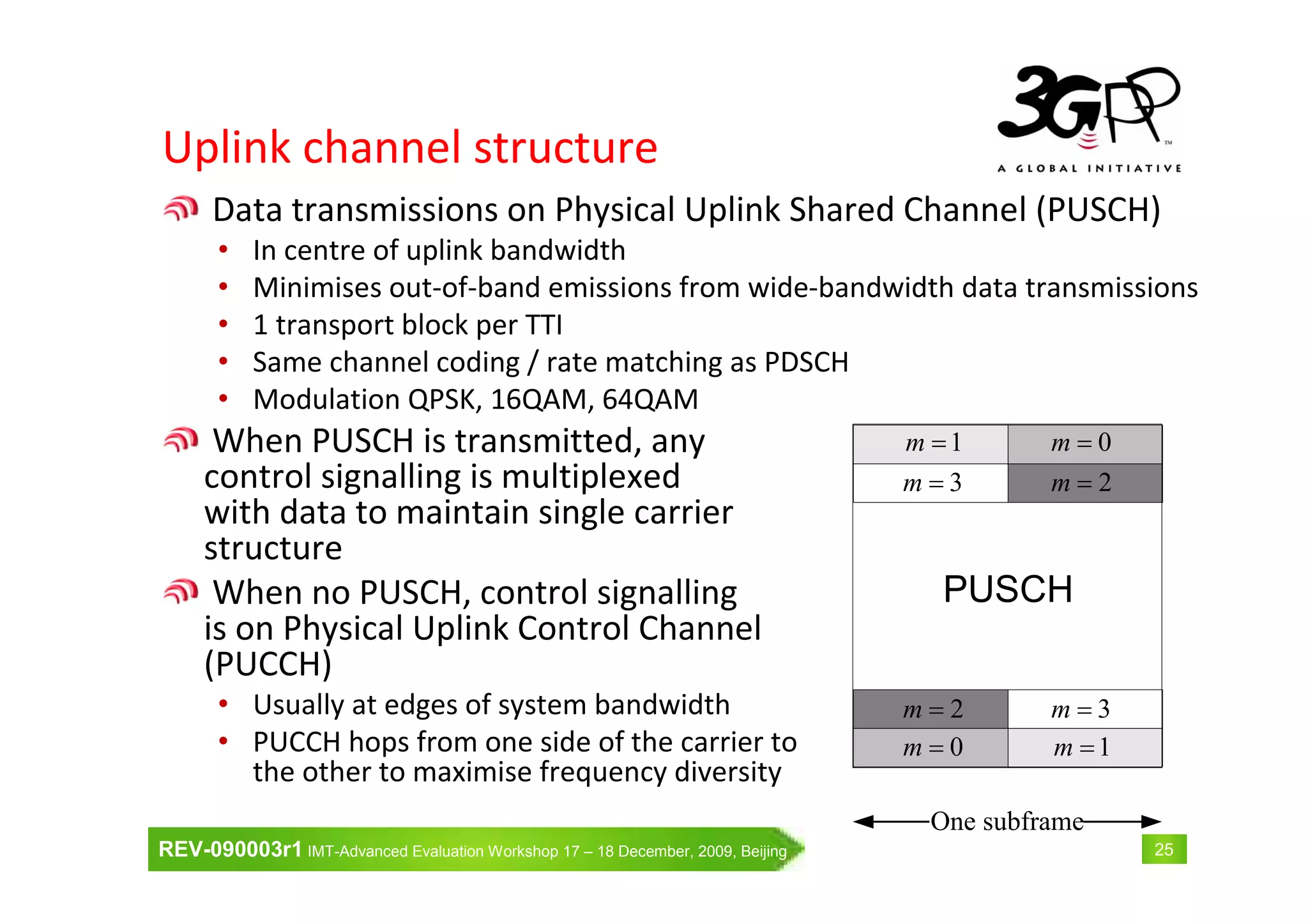
Uplink channel structure
0=m
0=m1=m
1=m
2=m
2=m3=m
3=m
One subframe
0PRB =n
1UL
RBPRB −= Nn
PUSCH
Data transmissions on Physical Uplink Shared Channel (PUSCH)
• In centre of uplink bandwidth
• Minimises out-of-band emissions from wide-bandwidth data transmissions
• 1 transport block per TTI
• Same channel coding / rate matching as PDSCH
• Modulation QPSK, 16QAM, 64QAM
When PUSCH is transmitted, any
control signalling is multiplexed
with data to maintain single carrier
structure
When no PUSCH, control signalling
is on Physical Uplink Control Channel
(PUCCH)
• Usually at edges of system bandwidth
• PUCCH hops from one side of the carrier to
the other to maximise frequency diversity
REV-090003r1 IMT-Advanced Evaluation Workshop 17 – 18 December, 2009, Beijing 26
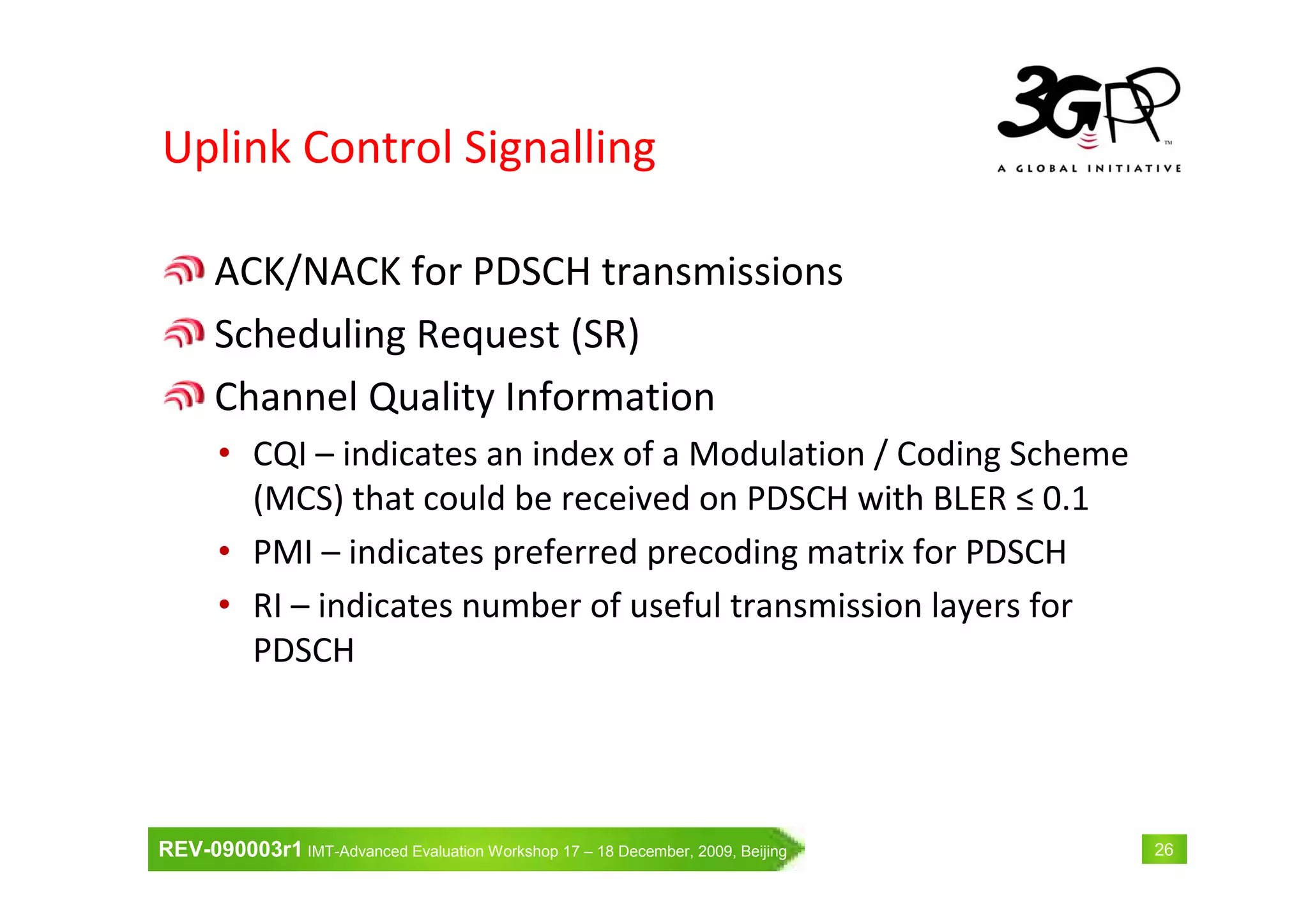
Uplink Control Signalling
ACK/NACK for PDSCH transmissions
Scheduling Request (SR)
Channel Quality Information
• CQI – indicates an index of a Modulation / Coding Scheme
(MCS) that could be received on PDSCH with BLER ≤ 0.1
• PMI – indicates preferred precoding matrix for PDSCH
• RI – indicates number of useful transmission layers for
PDSCH
REV-090003r1 IMT-Advanced Evaluation Workshop 17 – 18 December, 2009, Beijing 27
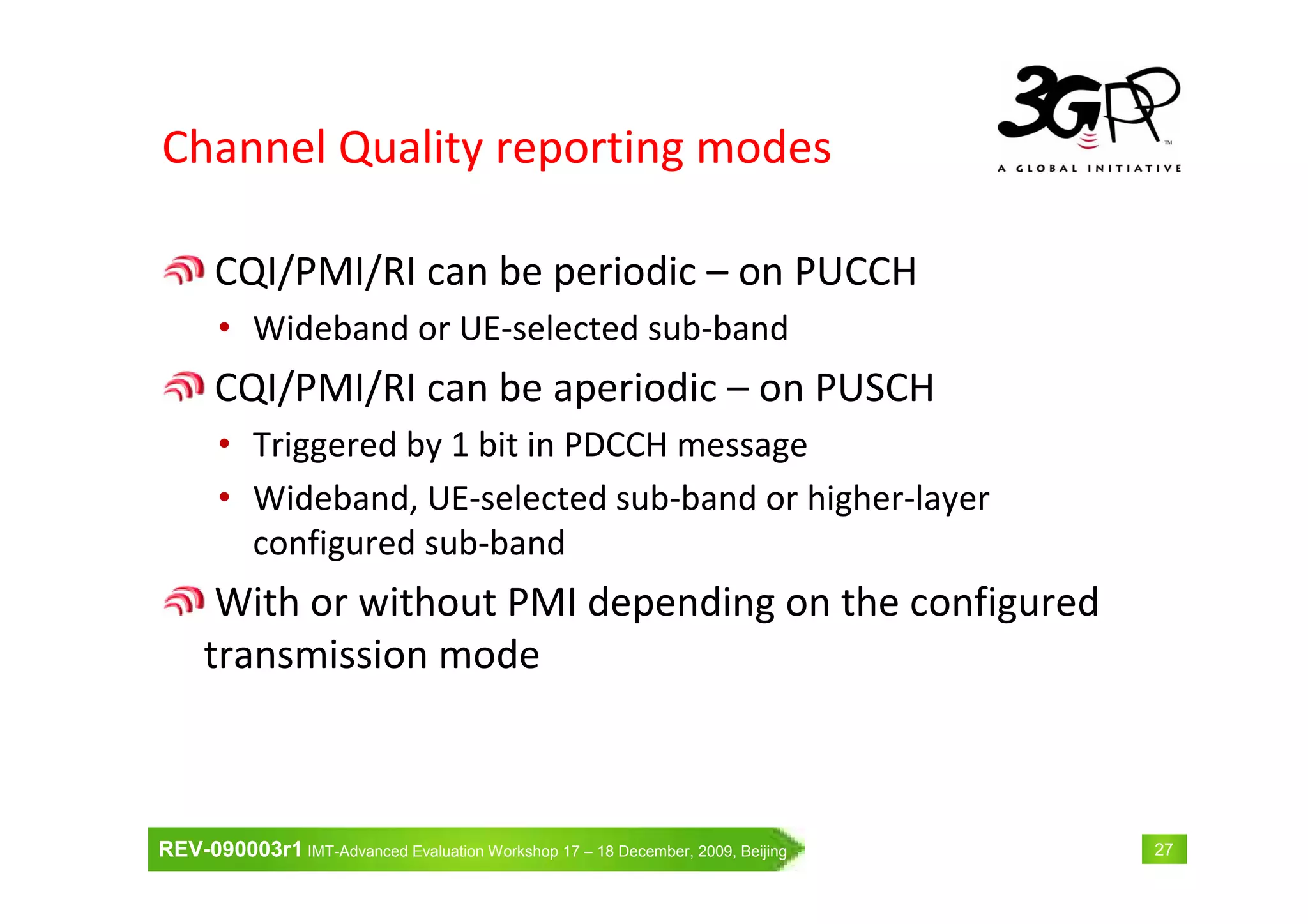
Channel Quality reporting modes
CQI/PMI/RI can be periodic – on PUCCH
• Wideband or UE-selected sub-band
CQI/PMI/RI can be aperiodic – on PUSCH
• Triggered by 1 bit in PDCCH message
• Wideband, UE-selected sub-band or higher-layer
configured sub-band
With or without PMI depending on the configured
transmission mode
REV-090003r1 IMT-Advanced Evaluation Workshop 17 – 18 December, 2009, Beijing 28
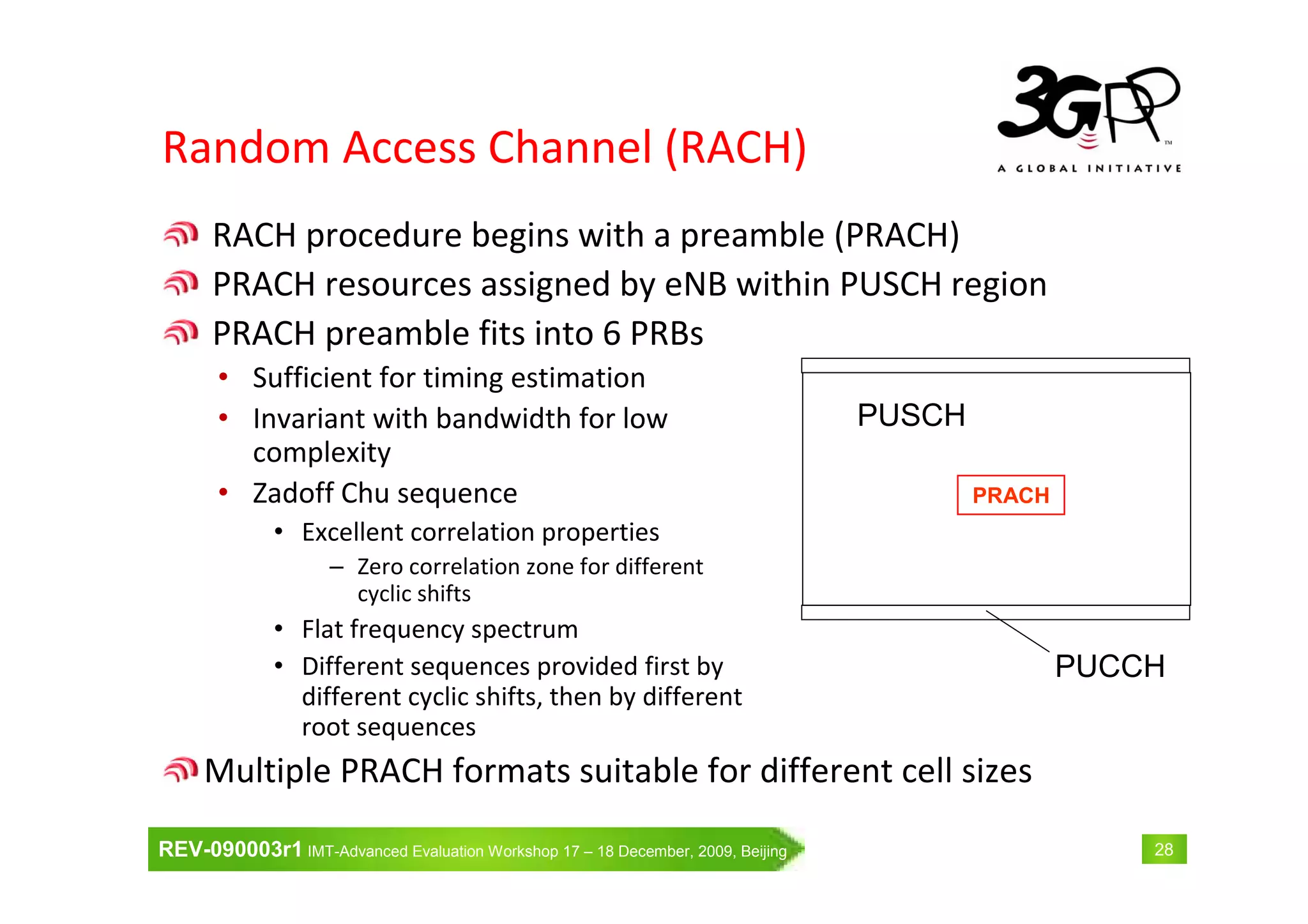
Random Access Channel (RACH)
RACH procedure begins with a preamble (PRACH)
PRACH resources assigned by eNB within PUSCH region
PRACH preamble fits into 6 PRBs
• Sufficient for timing estimation
• Invariant with bandwidth for low
complexity
• Zadoff Chu sequence
• Excellent correlation properties
– Zero correlation zone for different
cyclic shifts
• Flat frequency spectrum
• Different sequences provided first by
different cyclic shifts, then by different
root sequences
Multiple PRACH formats suitable for different cell sizes
PRACH
PUSCH
PUCCH
REV-090003r1 IMT-Advanced Evaluation Workshop 17 – 18 December, 2009, Beijing 29
UL Reference Symbols
Zadoff Chu sequences
Demodulation RS (DM RS)
• Embedded in each PUCCH and PUSCH transmission
• Same bandwidth as control / data transmission
Sounding RS (SRS)
• In last symbol of a subframe
• Can be configured by network
• Supports:
• UL frequency-domain scheduling
• Channel sounding for downlink transmissions, especially for TDD
• Uses interleaving in frequency domain (alternate subcarriers) to
provide additional support for multiple users transmitting SRS in the
same bandwidth
REV-090003r1 IMT-Advanced Evaluation Workshop 17 – 18 December, 2009, Beijing 30
Uplink Power Control
Controls uplink power spectral density
• Total uplink transmit power scales linearly with transmitted bandwidth
Fractional power control can compensate for all or part of path
loss
• Allows trade-off between intra-cell fairness and inter-cell interference
MCS-specific offsets may be applied
Closed-loop power control commands can fine-tune the power
setting
• Carried on PDCCH
• Individual commands in UL resource grants
• Group commands for groups of UEs
Separate power control for PUCCH and PUSCH
REV-090003r1 IMT-Advanced Evaluation Workshop 17 – 18 December, 2009, Beijing 31
UL Multi-Antenna transmission
Rel-8/9 supports:
• Switched antenna diversity
• Closed-loop antenna switching supported by CRC masking on
PBCH
• MU-MIMO
• Different cyclic shifts of DM RS can be allocated to different UEs
REV-090003r1 IMT-Advanced Evaluation Workshop 17 – 18 December, 2009, Beijing 32
Contents
Introduction
Downlink Aspects
Uplink Aspects
Specific support for TDD
Specific support for half-duplex FDD
UE categories in Rel-8
Enhancements for LTE-Advanced
REV-090003r1 IMT-Advanced Evaluation Workshop 17 – 18 December, 2009, Beijing 33
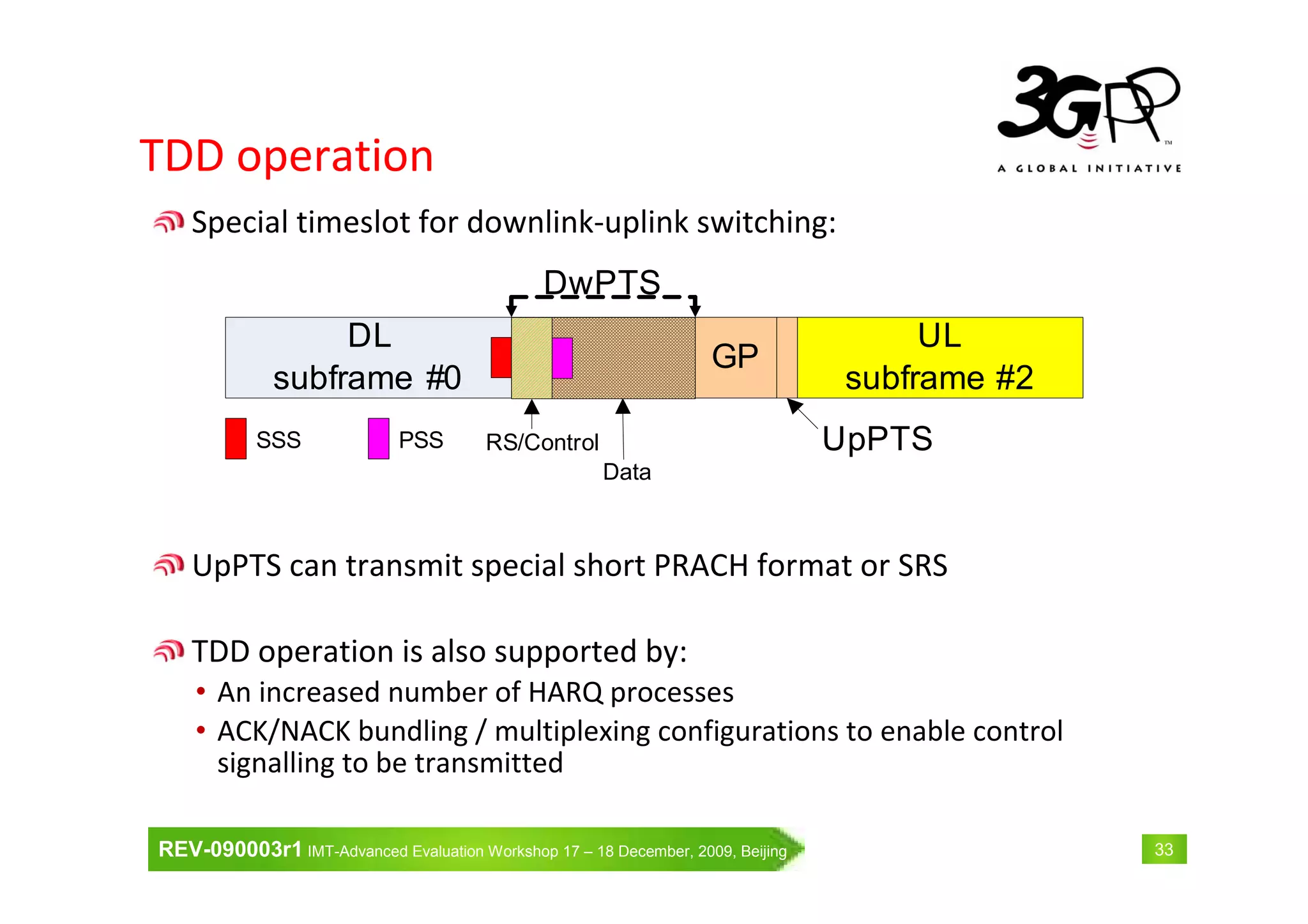
TDD operation
Special timeslot for downlink-uplink switching:
UpPTS can transmit special short PRACH format or SRS
TDD operation is also supported by:
• An increased number of HARQ processes
• ACK/NACK bundling / multiplexing configurations to enable control
signalling to be transmitted
DL
subframe #0
GP
SSS PSS
UL
subframe #2
UpPTSRS/Control
DwPTS
Data
REV-090003r1 IMT-Advanced Evaluation Workshop 17 – 18 December, 2009, Beijing 34
Contents
Introduction
Downlink Aspects
Uplink Aspects
Specific support for TDD
Specific support for half-duplex FDD
UE categories in Rel-8
Enhancements for LTE-Advanced
REV-090003r1 IMT-Advanced Evaluation Workshop 17 – 18 December, 2009, Beijing 35
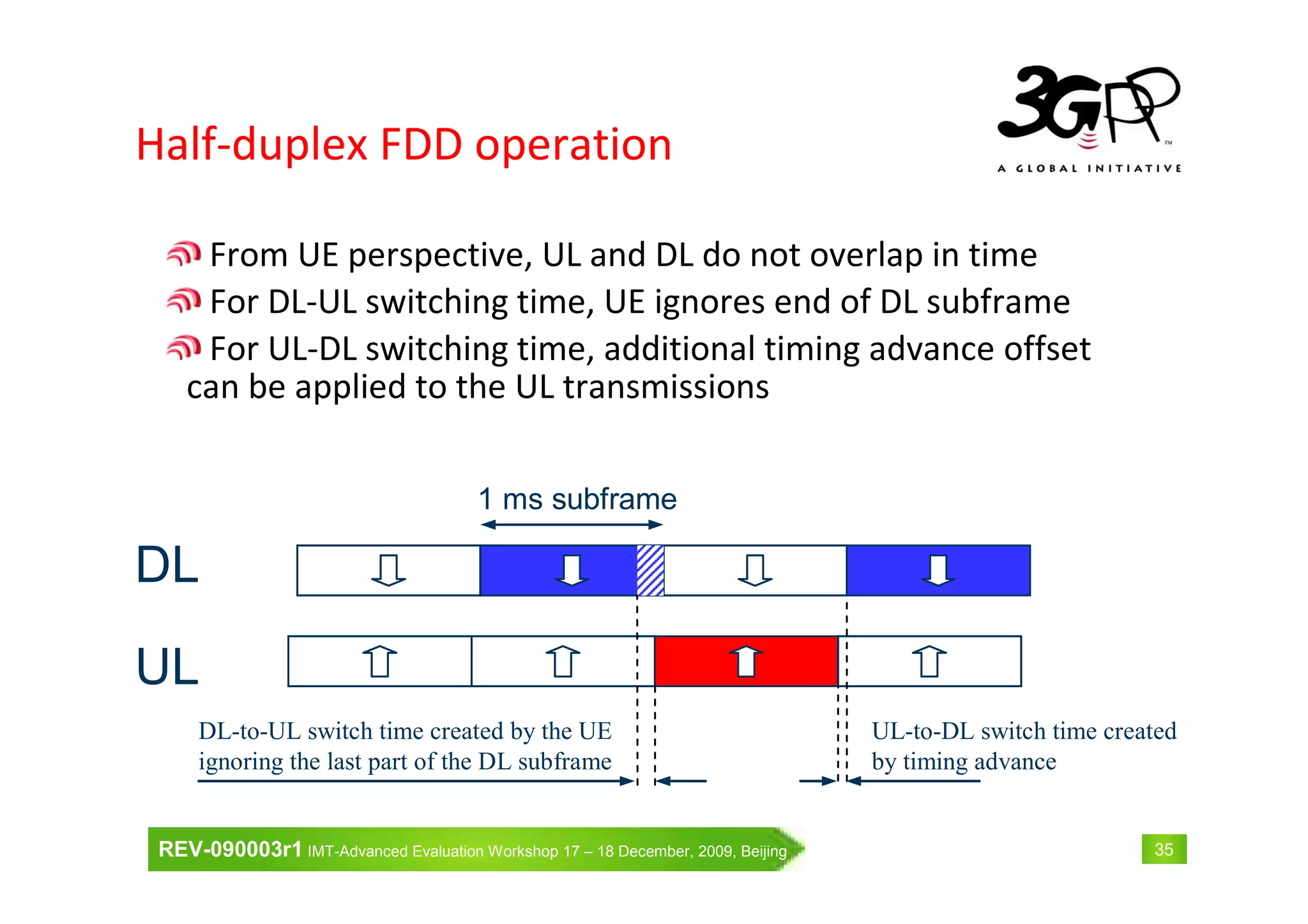
Half-duplex FDD operation
From UE perspective, UL and DL do not overlap in time
For DL-UL switching time, UE ignores end of DL subframe
For UL-DL switching time, additional timing advance offset
can be applied to the UL transmissions
UL-to-DL switch time created
by timing advance
DL-to-UL switch time created by the UE
ignoring the last part of the DL subframe
1 ms subframe
DL
UL
REV-090003r1 IMT-Advanced Evaluation Workshop 17 – 18 December, 2009, Beijing 36
Contents
Introduction
Downlink Aspects
Uplink Aspects
Specific support for TDD
Specific support for half-duplex FDD
UE categories in Rel-8
Enhancements for LTE-Advanced
REV-090003r1 IMT-Advanced Evaluation Workshop 17 – 18 December, 2009, Beijing 37
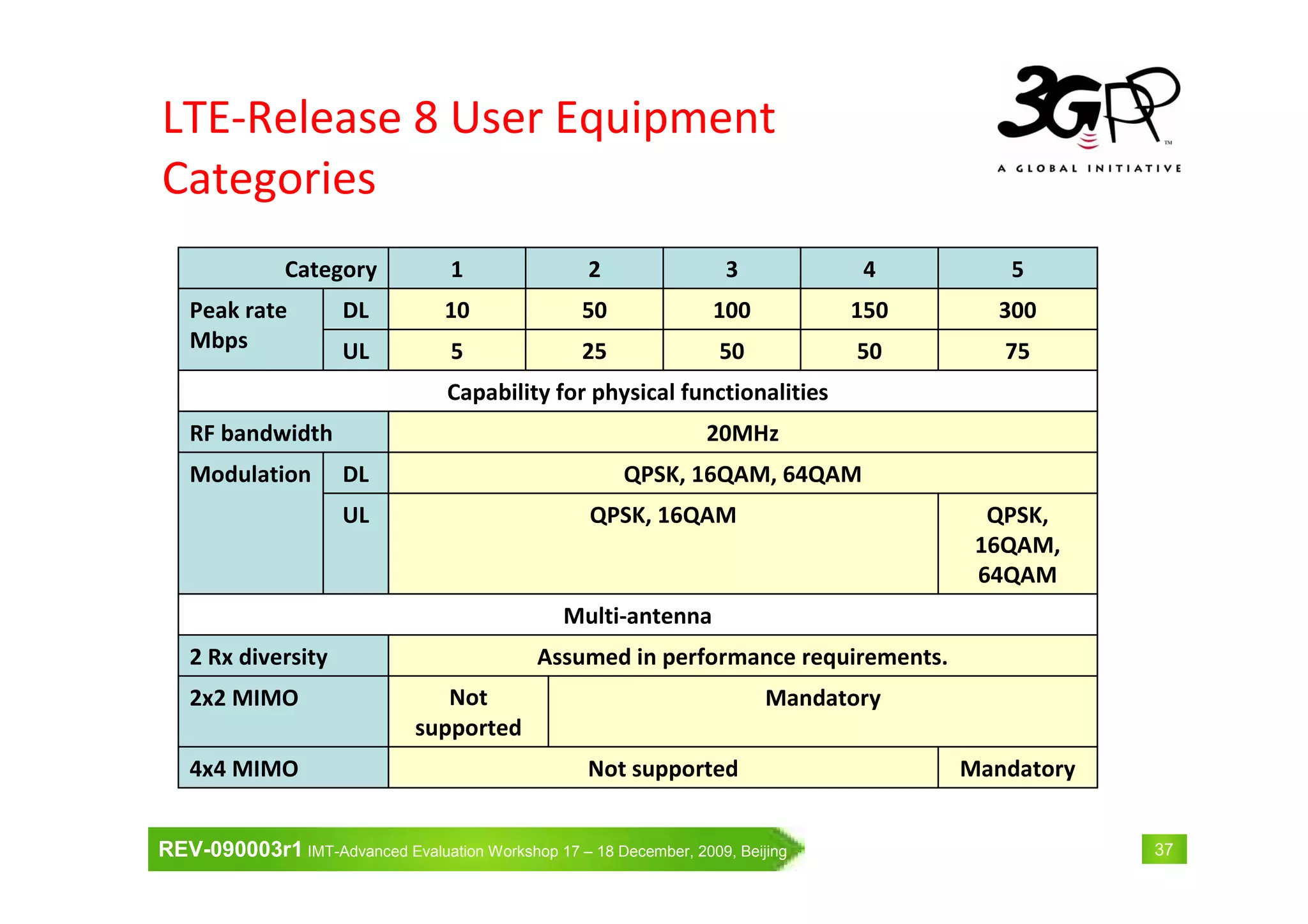
LTE-Release 8 User Equipment
Categories
MandatoryNot supported4x4 MIMO
MandatoryNot
supported
2x2 MIMO
Assumed in performance requirements.2 Rx diversity
Multi-antenna
QPSK,
16QAM,
64QAM
QPSK, 16QAMUL
QPSK, 16QAM, 64QAMDLModulation
20MHzRF bandwidth
Capability for physical functionalities
755050255UL
3001501005010DLPeak rate
Mbps
54321Category
REV-090003r1 IMT-Advanced Evaluation Workshop 17 – 18 December, 2009, Beijing 38
Contents
Introduction
Downlink Aspects
Uplink Aspects
Specific support for TDD
Specific support for half-duplex FDD
UE categories in Rel-8
Enhancements for LTE-Advanced
REV-090003r1 IMT-Advanced Evaluation Workshop 17 – 18 December, 2009, Beijing 39
Peak data rate
• 1 Gbps data rate will be achieved by 4-by-4 MIMO and transmission
bandwidth wider than approximately 70 MHz
Peak spectrum efficiency
• DL: Rel. 8 LTE satisfies IMT-Advanced requirement
• UL: Need to double from Release 8 to satisfy IMT-Advanced
requirement
Rel. 8 LTE LTE-Advanced IMT-Advanced
Peak data rate
DL 300 Mbps 1 Gbps
1 Gbps(*)
UL 75 Mbps 500 Mbps
Peak spectrum efficiency
[bps/Hz]
DL 15 30 15
UL 3.75 15 6.75
*“100 Mbps for high mobility and 1 Gbps for low mobility” is one of the key features as written in
Circular Letter (CL)
System Performance Requirements for
LTE-Advanced
REV-090003r1 IMT-Advanced Evaluation Workshop 17 – 18 December, 2009, Beijing 40
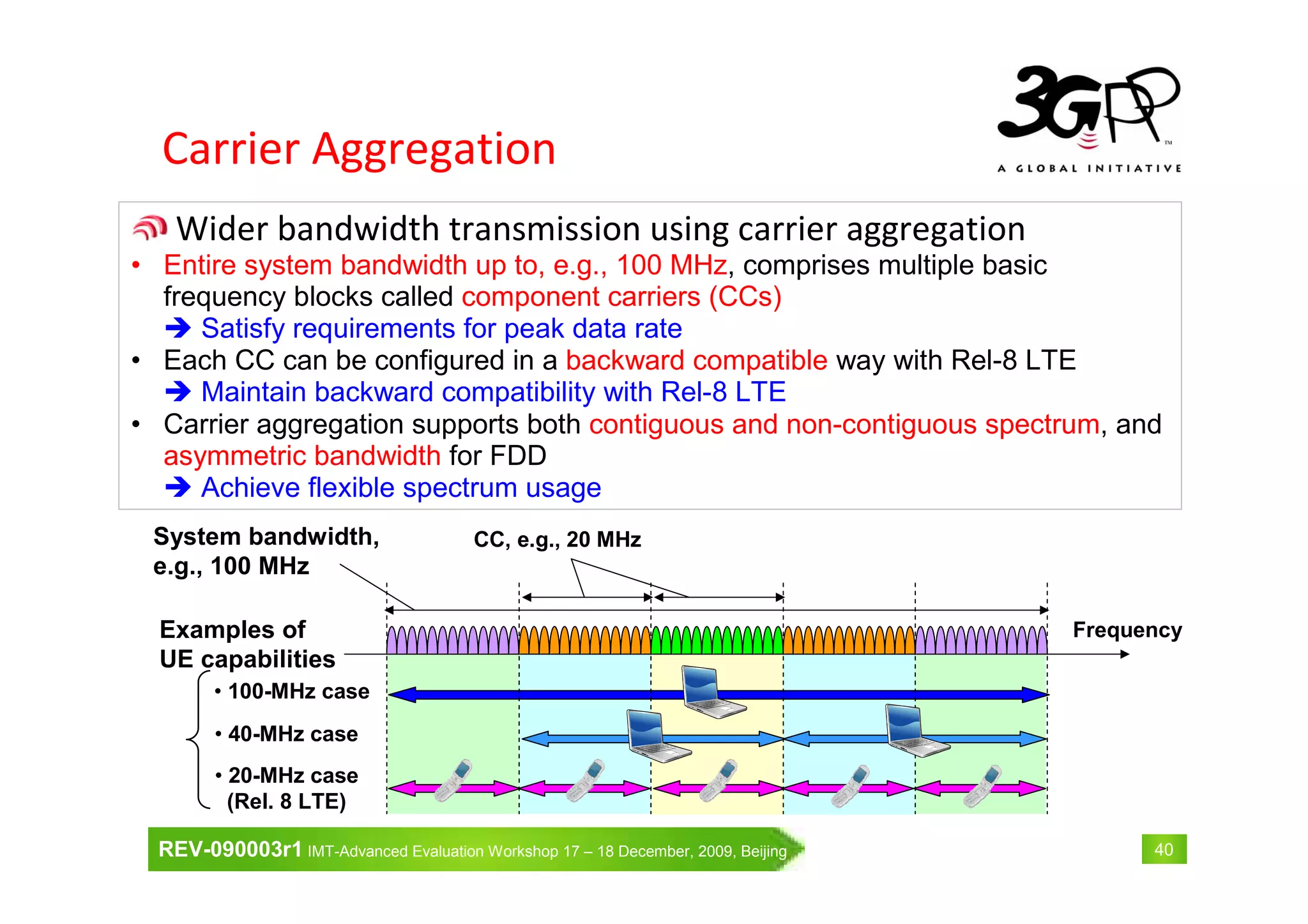
Wider bandwidth transmission using carrier aggregation
• Entire system bandwidth up to, e.g., 100 MHz, comprises multiple basic
frequency blocks called component carriers (CCs)
Satisfy requirements for peak data rate
• Each CC can be configured in a backward compatible way with Rel-8 LTE
Maintain backward compatibility with Rel-8 LTE
• Carrier aggregation supports both contiguous and non-contiguous spectrum, and
asymmetric bandwidth for FDD
Achieve flexible spectrum usage
Frequency
System bandwidth,
e.g., 100 MHz
CC, e.g., 20 MHz
Examples of
UE capabilities
• 100-MHz case
• 40-MHz case
• 20-MHz case
(Rel. 8 LTE)
Carrier Aggregation
REV-090003r1 IMT-Advanced Evaluation Workshop 17 – 18 December, 2009, Beijing 41
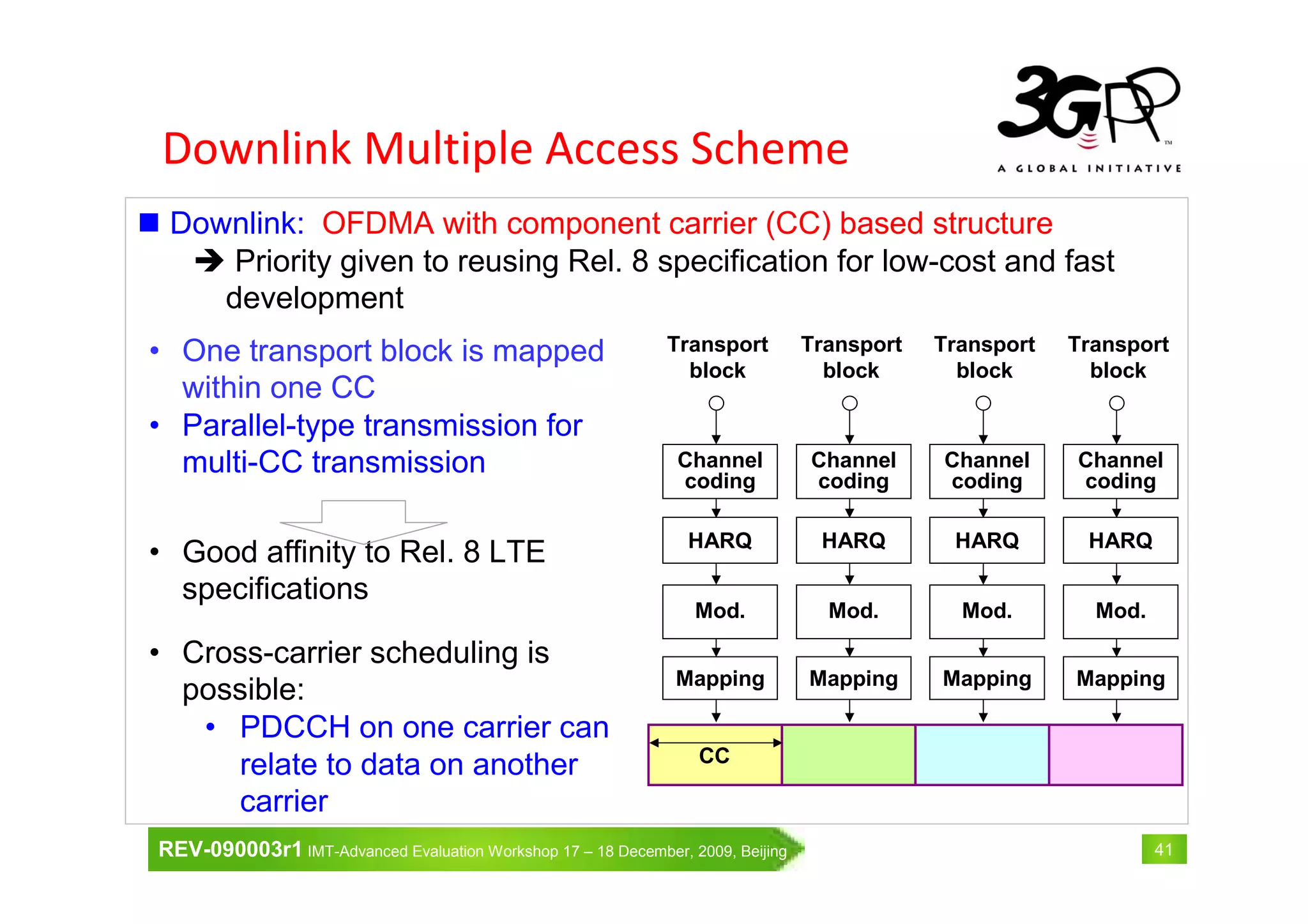
Downlink: OFDMA with component carrier (CC) based structure
Priority given to reusing Rel. 8 specification for low-cost and fast
development
Mod.
Mapping
Channel
coding
HARQ
Mod.
Mapping
Channel
coding
HARQ
Mod.
Mapping
Channel
coding
HARQ
Mod.
Mapping
Channel
coding
HARQ
Transport
block
Transport
block
Transport
block
Transport
block
CC
• One transport block is mapped
within one CC
• Parallel-type transmission for
multi-CC transmission
• Good affinity to Rel. 8 LTE
specifications
• Cross-carrier scheduling is
possible:
• PDCCH on one carrier can
relate to data on another
carrier
Downlink Multiple Access Scheme
REV-090003r1 IMT-Advanced Evaluation Workshop 17 – 18 December, 2009, Beijing 42
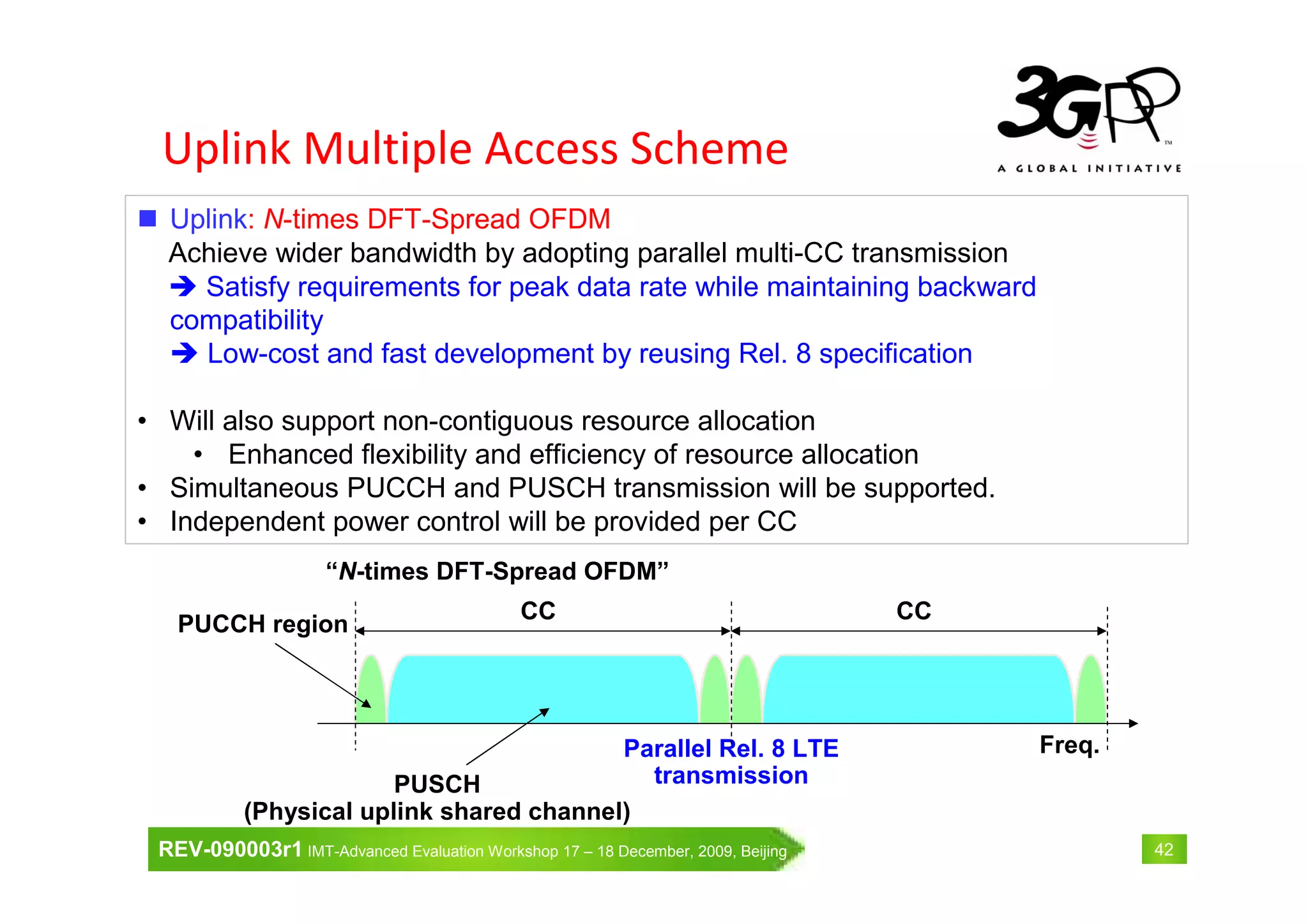
Uplink: N-times DFT-Spread OFDM
Achieve wider bandwidth by adopting parallel multi-CC transmission
Satisfy requirements for peak data rate while maintaining backward
compatibility
Low-cost and fast development by reusing Rel. 8 specification
• Will also support non-contiguous resource allocation
• Enhanced flexibility and efficiency of resource allocation
• Simultaneous PUCCH and PUSCH transmission will be supported.
• Independent power control will be provided per CC
“N-times DFT-Spread OFDM”
CC
Freq.
CC
Parallel Rel. 8 LTE
transmission
PUCCH region
PUSCH
(Physical uplink shared channel)
Uplink Multiple Access Scheme
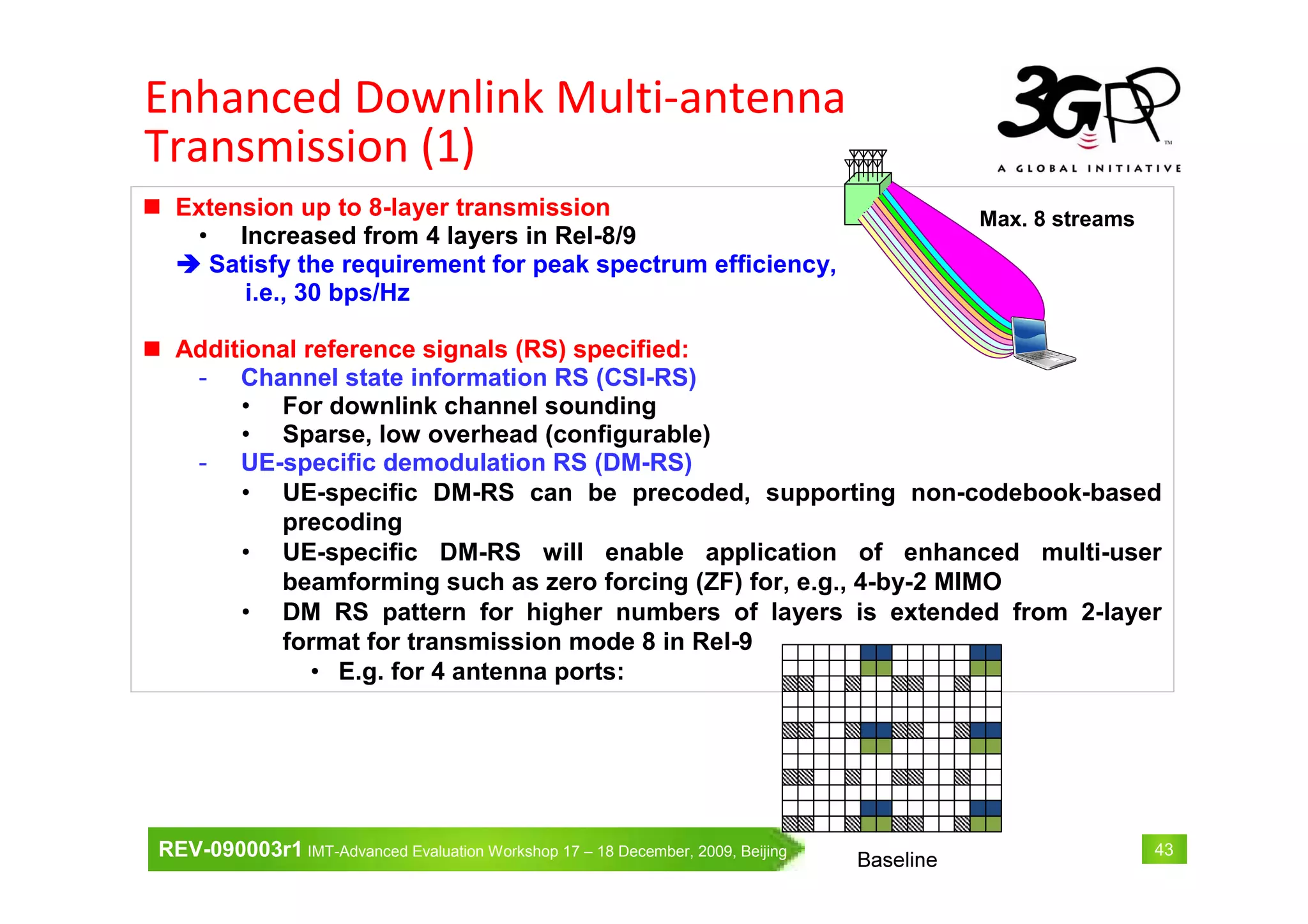
REV-090003r1 IMT-Advanced Evaluation Workshop 17 – 18 December, 2009, Beijing 43
Extension up to 8-layer transmission
• Increased from 4 layers in Rel-8/9
Satisfy the requirement for peak spectrum efficiency,
i.e., 30 bps/Hz
Additional reference signals (RS) specified:
- Channel state information RS (CSI-RS)
• For downlink channel sounding
• Sparse, low overhead (configurable)
- UE-specific demodulation RS (DM-RS)
• UE-specific DM-RS can be precoded, supporting non-codebook-based
precoding
• UE-specific DM-RS will enable application of enhanced multi-user
beamforming such as zero forcing (ZF) for, e.g., 4-by-2 MIMO
• DM RS pattern for higher numbers of layers is extended from 2-layer
format for transmission mode 8 in Rel-9
• E.g. for 4 antenna ports:
Max. 8 streams
Enhanced Downlink Multi-antenna
Transmission (1)
REV-090003r1 IMT-Advanced Evaluation Workshop 17 – 18 December, 2009, Beijing 44
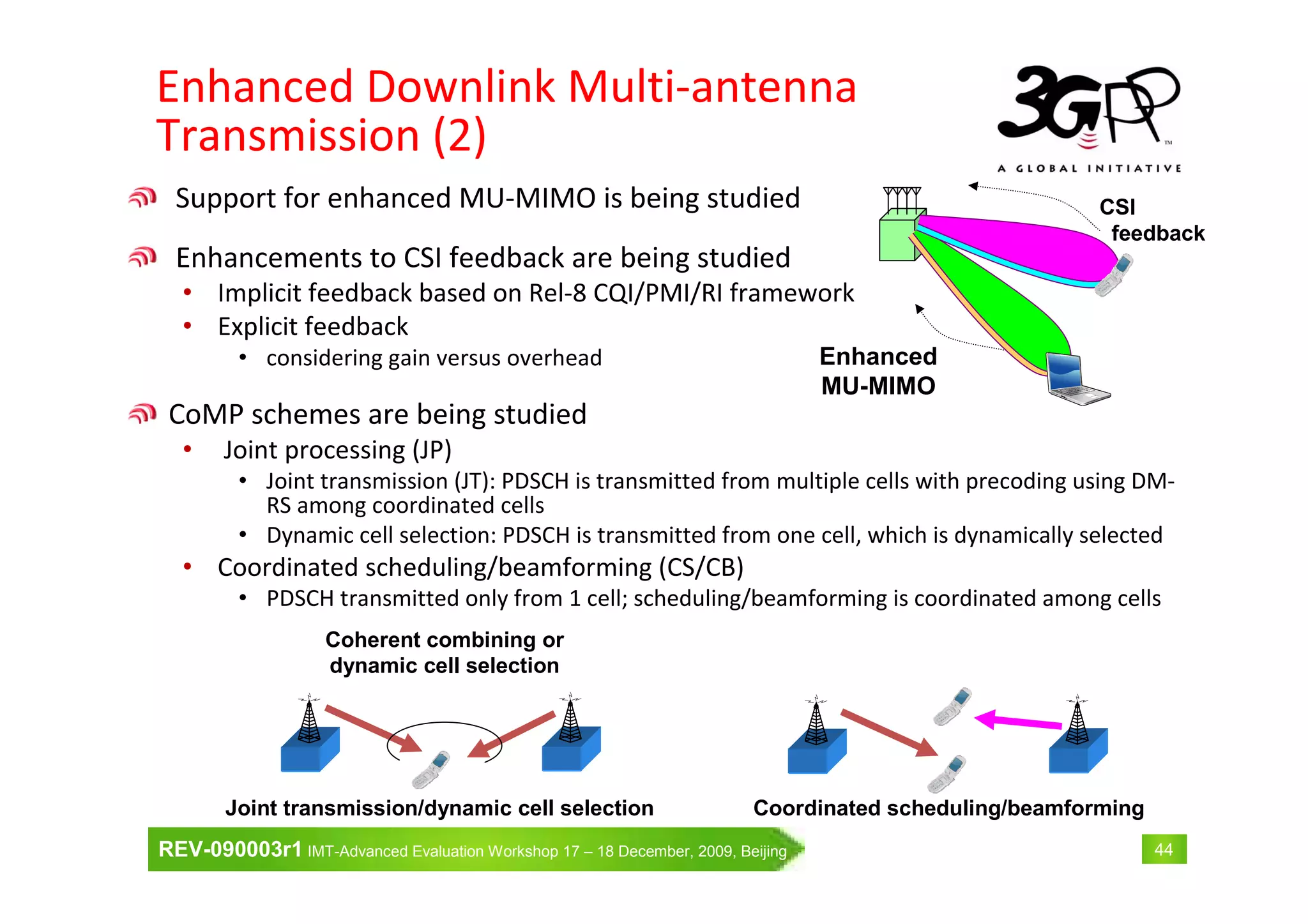
Enhanced Downlink Multi-antenna
Transmission (2)
Support for enhanced MU-MIMO is being studied
Enhancements to CSI feedback are being studied
• Implicit feedback based on Rel-8 CQI/PMI/RI framework
• Explicit feedback
• considering gain versus overhead
CoMP schemes are being studied
• Joint processing (JP)
• Joint transmission (JT): PDSCH is transmitted from multiple cells with precoding using DM-
RS among coordinated cells
• Dynamic cell selection: PDSCH is transmitted from one cell, which is dynamically selected
• Coordinated scheduling/beamforming (CS/CB)
• PDSCH transmitted only from 1 cell; scheduling/beamforming is coordinated among cells
Coherent combining or
dynamic cell selection
Coordinated scheduling/beamformingJoint transmission/dynamic cell selection
Enhanced
MU-MIMO
CSI
feedback
REV-090003r1 IMT-Advanced Evaluation Workshop 17 – 18 December, 2009, Beijing 45
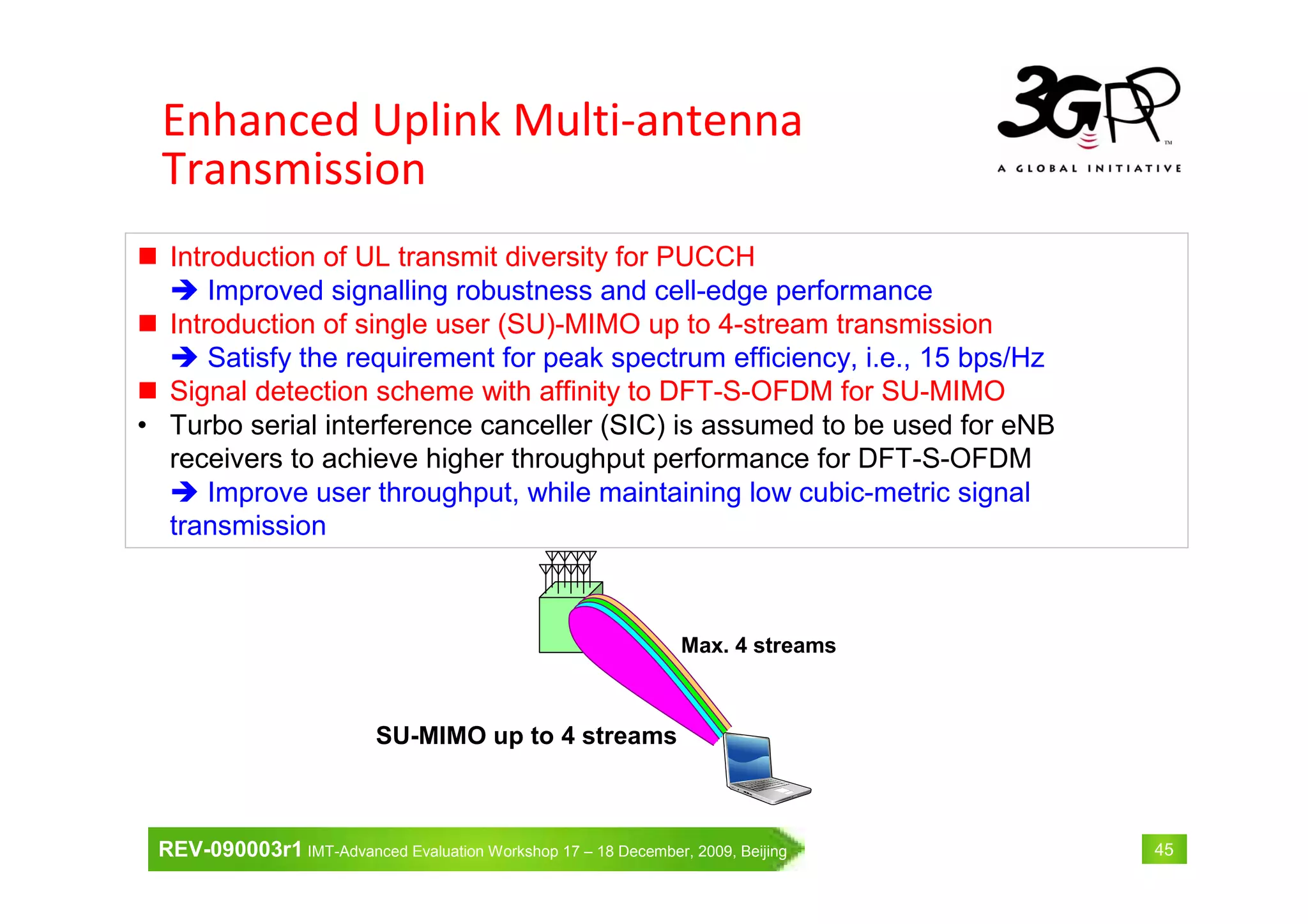
Introduction of UL transmit diversity for PUCCH
Improved signalling robustness and cell-edge performance
Introduction of single user (SU)-MIMO up to 4-stream transmission
Satisfy the requirement for peak spectrum efficiency, i.e., 15 bps/Hz
Signal detection scheme with affinity to DFT-S-OFDM for SU-MIMO
• Turbo serial interference canceller (SIC) is assumed to be used for eNB
receivers to achieve higher throughput performance for DFT-S-OFDM
Improve user throughput, while maintaining low cubic-metric signal
transmission
Max. 4 streams
SU-MIMO up to 4 streams
Enhanced Uplink Multi-antenna
Transmission
REV-090003r1 IMT-Advanced Evaluation Workshop 17 – 18 December, 2009, Beijing 46
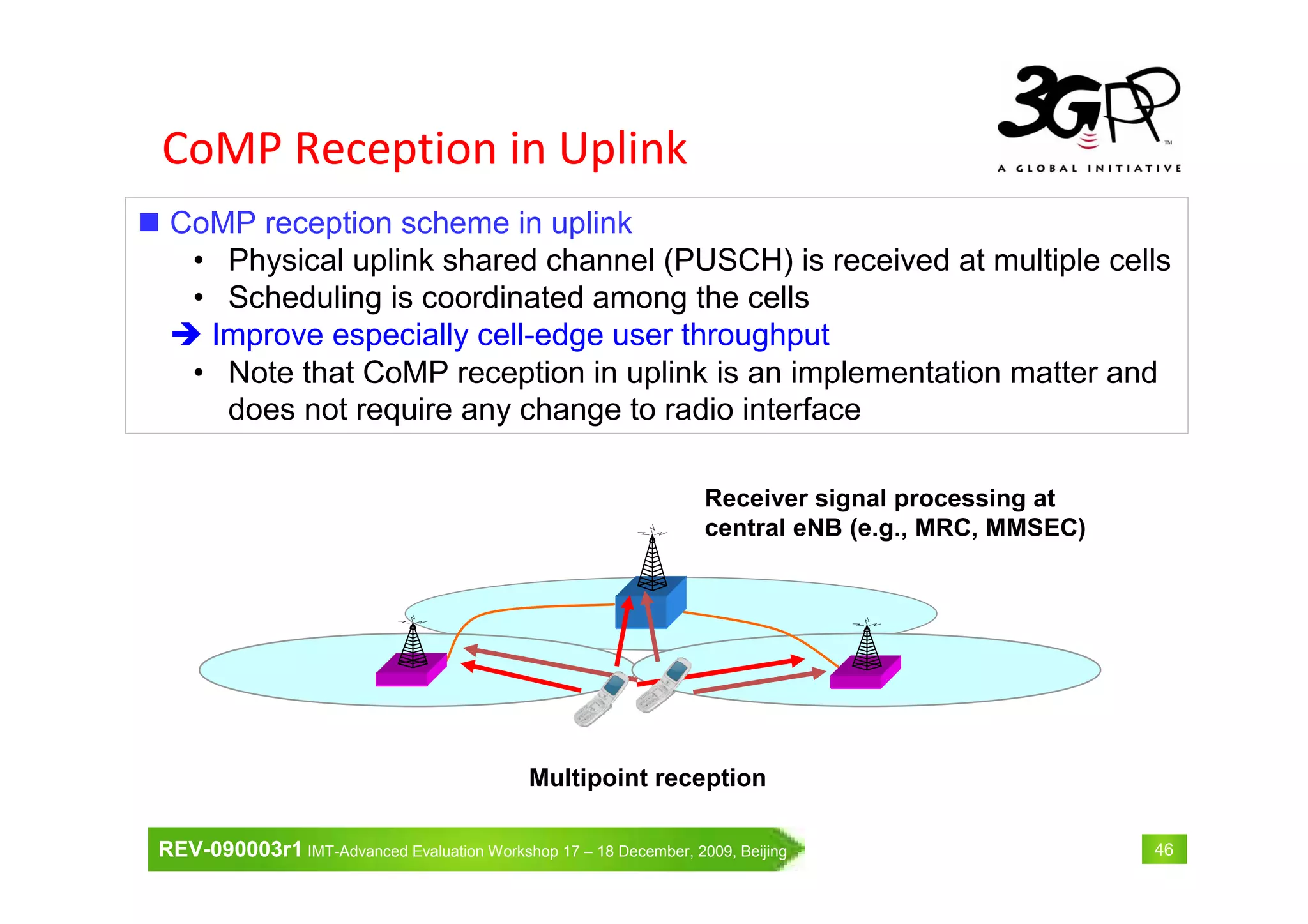
CoMP reception scheme in uplink
• Physical uplink shared channel (PUSCH) is received at multiple cells
• Scheduling is coordinated among the cells
Improve especially cell-edge user throughput
• Note that CoMP reception in uplink is an implementation matter and
does not require any change to radio interface
Receiver signal processing at
central eNB (e.g., MRC, MMSEC)
Multipoint reception
CoMP Reception in Uplink
REV-090003r1 IMT-Advanced Evaluation Workshop 17 – 18 December, 2009, Beijing 47
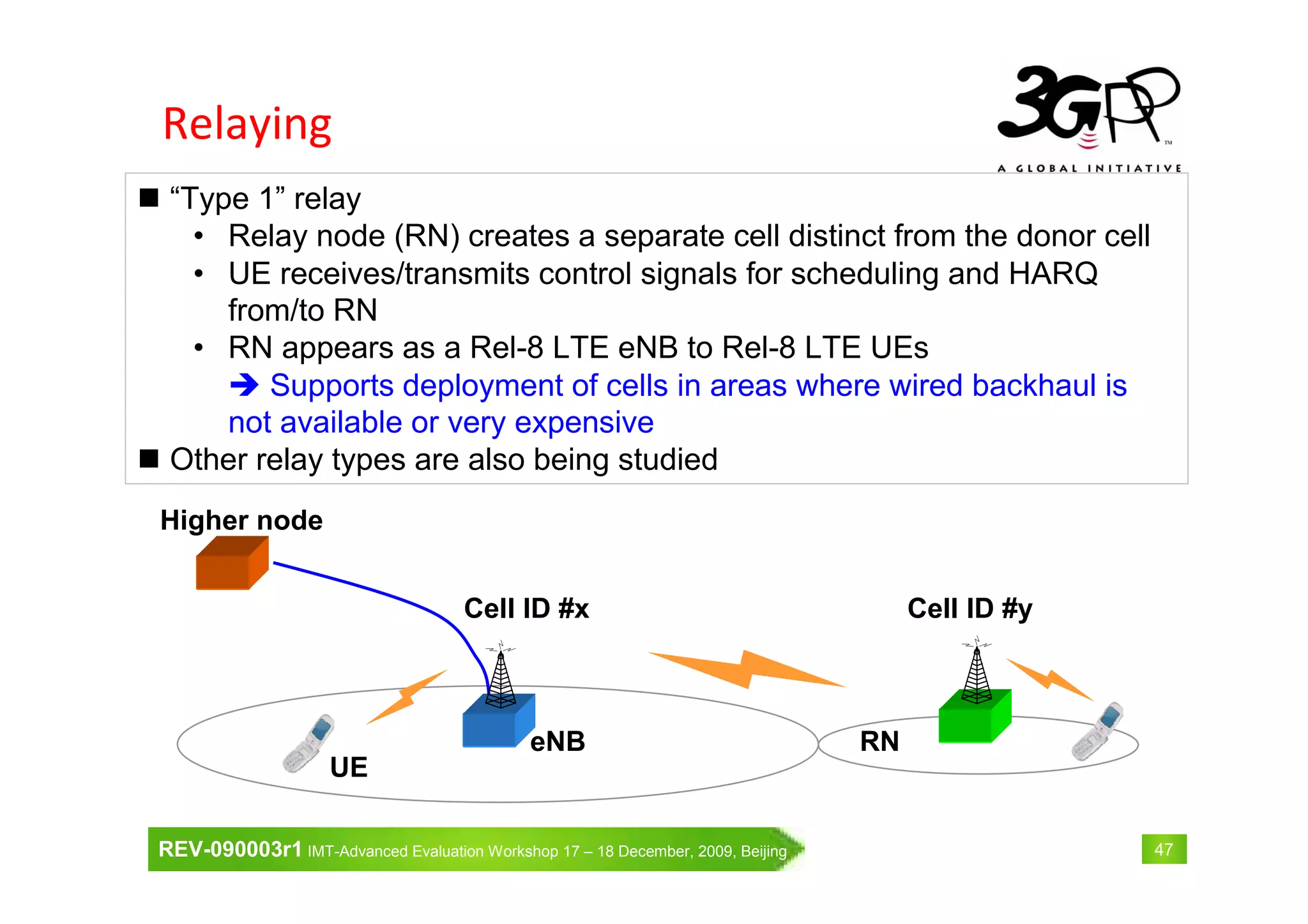
“Type 1” relay
• Relay node (RN) creates a separate cell distinct from the donor cell
• UE receives/transmits control signals for scheduling and HARQ
from/to RN
• RN appears as a Rel-8 LTE eNB to Rel-8 LTE UEs
Supports deployment of cells in areas where wired backhaul is
not available or very expensive
Other relay types are also being studied
eNB RN
UE
Cell ID #x Cell ID #y
Higher node
Relaying
REV-090003r1 IMT-Advanced Evaluation Workshop 17 – 18 December, 2009, Beijing 48
Conclusions
LTE-Advanced is a very flexible and advanced system
Built on the established capabilities of the LTE Rel-8
and Rel-9 physical layer
Further enhancements to exploit spectrum
availability and advanced multi-antenna techniques

LTE-Advanced Physical Layer

  • 1.
    REV-090003r1 IMT-Advanced EvaluationWorkshop 17 – 18 December, 2009, Beijing 1 Matthew Baker, Alcatel-Lucent Chairman 3GPP TSG RAN WG1 LTELTE--AdvancedAdvanced Physical LayerPhysical Layer REV-090003r1
  • 2.
    REV-090003r1 IMT-Advanced EvaluationWorkshop 17 – 18 December, 2009, Beijing 2 Contents Introduction Downlink Physical Layer Design Uplink Physical Layer Design Specific support for TDD Specific support for half-duplex FDD UE categories in Rel-8 Enhancements for LTE-Advanced
  • 3.
    REV-090003r1 IMT-Advanced EvaluationWorkshop 17 – 18 December, 2009, Beijing 3 Releases of 3GPP specifications 1999 2000 2001 2002 2003 2004 2005 Release 99 Release 4 Release 5 Release 6 1.28Mcps TDD HSDPA, IMS W-CDMA HSUPA, MBMS, IMS+ 2006 2007 2008 2009 Release 7 HSPA+ (MIMO, HOM etc.) Release 8 2010 2011 LTE, SAE ITU-R M.1457 IMT-2000 Recommendations Release 9 LTE-AdvancedRelease 10 GSM/GPRS/EDGE enhancements Small LTE/SAE enhancements
  • 4.
    REV-090003r1 IMT-Advanced EvaluationWorkshop 17 – 18 December, 2009, Beijing 4 Physical Layer Specifications TS 36.201 E-UTRA Physical layer: General description . TS 36.211 E-UTRA Physical channels and modulation . TS 36.212 E-UTRA Multiplexing and channel coding . TS 36.213 E-UTRA Physical layer procedures . TS 36.214 E-UTRA Physical layer - Measurements The latest version of the specifications can be downloaded from: • http://www.3gpp.org/ftp/Specs/
  • 5.
    REV-090003r1 IMT-Advanced EvaluationWorkshop 17 – 18 December, 2009, Beijing 5 Orthogonal Multiple Access SchemesOrthogonal Multiple Access Schemes Downlink: OFDMA • High spectral efficiency • Robust against frequency-selectivity / multi-path interference • Inter-symbol interference contained within cyclic prefix • Supports flexible bandwidth deployment • Facilitates frequency-domain scheduling • Well suited to advanced MIMO techniques Uplink: SC-FDMA • Based on OFDMA with DFT precoding • Common structure of transmission resources compared to downlink • Cyclic prefix supports frequency-domain equalisation • Low Cubic Metric for efficient transmitter design
  • 6.
    REV-090003r1 IMT-Advanced EvaluationWorkshop 17 – 18 December, 2009, Beijing 6 LTE Release 8 Major Parameters Single layer for UL per UE Up to 4 layers for DL per UE MU-MIMO supported for UL and DL Spatial multiplexing 16.7 µµµµsLong SC-FDMAUL Short DL QPSK, 16QAM, 64QAMModulation 4.7 µµµµsCyclic prefix length 15 kHzSub-carrier spacing 1 msMinimum TTI 1.4, 3, 5, 10, 15, 20 MHzBandwidth OFDMAAccess Scheme
  • 7.
    REV-090003r1 IMT-Advanced EvaluationWorkshop 17 – 18 December, 2009, Beijing 7 Transmission Resource structure Basic unit of resource is the Physical Resource Block (PRB) 12 sub-carriers x 0.5 ms Allocated in pairs (in time domain) 1 sub-carrier x 1 symbol = 1 resource element (RE) Spatial domain measured in “layers” One downlink slot, Tslot subcarriersNBW DLsubcarriersNBW DL NBW DL Resource element OFDM symbols DL symbN OFDM symbols DL symbN Oneresourceblock,NBWsubcarriersRB Oneresourceblock,NBWsubcarriersRB
  • 8.
    REV-090003r1 IMT-Advanced EvaluationWorkshop 17 – 18 December, 2009, Beijing 8 One radio interface, 2 frame structures Supports both FDD and TDD (two RITs within one SRIT) • FDD • TDD
  • 9.
    REV-090003r1 IMT-Advanced EvaluationWorkshop 17 – 18 December, 2009, Beijing 9 Contents Introduction Downlink Aspects Uplink Aspects Specific support for TDD Specific support for half-duplex FDD UE categories in Rel-8 Enhancements for LTE-Advanced
  • 10.
    REV-090003r1 IMT-Advanced EvaluationWorkshop 17 – 18 December, 2009, Beijing 10 Low complexity cell acquisition Synchronisation signals and broadcast channel: • Fixed bandwidth • Centrally located • Allows straightforward bandwidth-agnostic cell-search Synchronisation signals and physical broadcast channel frequency
  • 11.
    REV-090003r1 IMT-Advanced EvaluationWorkshop 17 – 18 December, 2009, Beijing 11 Cell acquisition signalling Synchronisation signals in subframes 0 and 5 of each 10 ms radio frame Physical broadcast channel (PBCH) in subframe 0 of each radio frame • Carries the Master Information Block (MIB) • Includes indication of system bandwidth • Robust design for cell-wide coverage: • Low rate, QPSK, robust channel coding (1/3-rate tail-biting convolutional code with repetition), 40 ms TTI • CRC indicates number of transmit antennas dc 40ms TTI of BCH one 10 ms radio frame 6RBs 1 coded MIB
  • 12.
    REV-090003r1 IMT-Advanced EvaluationWorkshop 17 – 18 December, 2009, Beijing 12 Reference Signals (RS) In Rel-8, cell-specific RS are provided for 1, 2 or 4 antenna ports • Pattern designed for effective channel estimation • Sparse diamond pattern supports frequency-selective channels and high- mobility with low overhead • Up to 6 cell-specific frequency shifts are configurable • Power-boosting may be applied on the REs used for RS • QPSK sequence with low PAPR R3 R3 R3 R3R0 R0 R0 R0 R0 R0 R0 R0 R1 R1 R1 R1 R1 R1 R1 R1 R2 R2 R2 R2 Antenna port 0 Antenna port 2Antenna port 1 Antenna port 3 time frequency
  • 13.
    REV-090003r1 IMT-Advanced EvaluationWorkshop 17 – 18 December, 2009, Beijing 13 UE-specific Reference Signals In Rel-8: • UE-specific (precoded) RS may be provided in data transmissions to specific UEs In Rel-9: • UE-specific RS extended to dual-layer transmission • CDM between RS of the two layers 0=l 5R 5R 5R 5R 5R 5R 5R 5R 5R 5R 5R 5R 0=l 6=l6=l 7R7R7R7R 7R7R7R7R 7R7R7R7R 8R 8R8R 8R 8R 8R8R 8R 8R 8R8R 8R
  • 14.
    REV-090003r1 IMT-Advanced EvaluationWorkshop 17 – 18 December, 2009, Beijing 14 Downlink control signalling Flexible design to avoid unnecessary overhead • First 1-3 OFDM symbols in each subframe (2-4 in narrow bandwidths) • Control region size is dynamically variable • Length indicated by Physical Control Format Indicator Channel (PCFICH) in first OFDM symbol of each subframe • PCFICH is designed to be robust – 16 QPSK symbols transmitted with full frequency diversity Within the control region: • Physical Downlink Control Channel (PDCCH) carries Downlink Control Information (DCI) messages: • downlink resource assignments • uplink resource grants • uplink power control commands • Physical Hybrid ARQ Indicator Channel (PHICH) carries ACK/NACK for UL data transmissions
  • 15.
    REV-090003r1 IMT-Advanced EvaluationWorkshop 17 – 18 December, 2009, Beijing 15 Downlink data transmission Physical Downlink Shared Channel (PDSCH) • Carries user data, broadcast system information, paging messages • Transmission resources are assigned dynamically by PDCCH • Localised (suitable for frequency domain scheduling) or • distributed (suitable for maximising frequency diversity) One subframe = 1 ms Data for UE2: Data for UE3: 12 subcarriers Data for UE1: (localised) (distributed)
  • 16.
    REV-090003r1 IMT-Advanced EvaluationWorkshop 17 – 18 December, 2009, Beijing 16 PDSCH physical layer processing Each TTI, 1 or 2 transport blocks are processed from MAC layer Channel coding is based on 1/3 rate turbo code with trellis termination to approach Shannon capacity Circular buffer rate matching Modulation QPSK, 16QAM, 64QAM Layer mapping and precoding for support of multi-antenna transmission 110 ,...,, −Aaaa 110 ,...,, −Bbbb ( )110 ,...,, −rKrrr ccc ( ) )( 1 )( 1 )( 0 ,...,, i Dr i r i r r ddd − ( )110 ,...,, −rErrr eee 110 ,...,, −Gfff
  • 17.
    REV-090003r1 IMT-Advanced EvaluationWorkshop 17 – 18 December, 2009, Beijing 17 PDSCH transmission modes In Rel-9, each UE is configured in one of 8 “transmission modes” for PDSCH reception: • Mode 1: Single antenna port, port 0 • Mode 2: Transmit diversity • Mode 3: Large-delay CDD • Mode 4: Closed-loop spatial multiplexing • Mode 5: MU-MIMO • Mode 6: Closed-loop spatial multiplexing, single layer • Mode 7: Single antenna port, UE-specific RS (port 5) • Mode 8 (new in Rel-9): Single or dual-layer transmission with UE- specific RS (ports 7 and/or 8) (in each case, transmit diversity is also available as a fallback)
  • 18.
    REV-090003r1 IMT-Advanced EvaluationWorkshop 17 – 18 December, 2009, Beijing 18 Details of PDSCH transmission modes (1) Mode 2: • SFBC for 2 antenna ports • SFBC / FSTD for 4 antenna ports Mode 3: • Large delay CDD – increases frequency selectivity • Allows open-loop spatial multiplexing • Up to rank 2 without closed loop precoding feedback from UE Mode 4: • Precoding using specified codebook for the relevant number of antenna ports • Supports up to 4 layers • Max 2 codewords to limit signalling overhead • Closed-loop precoding feedback from UE • Used precoding matrix is indicated to UE on PDCCH
  • 19.
    REV-090003r1 IMT-Advanced EvaluationWorkshop 17 – 18 December, 2009, Beijing 19 Details of PDSCH transmission modes (2) Mode 5: • Rank 1 MU-MIMO • Based on same precoding codebooks and feedback as Mode 4 • PDCCH indicates power offset for PDSCH Mode 6: • Based on mode 4 but for single-layer only Mode 7: • UE-specific RS • Suitable for UE-specific beamforming, e.g. based on angle of arrival (no closed-loop precoding feedback from UE) Mode 8: • Dual-layer UE-specific RS • Closed-loop precoding feedback may or may not be used • Supports dual-layer SU-MIMO and single-layer MU-MIMO
  • 20.
    REV-090003r1 IMT-Advanced EvaluationWorkshop 17 – 18 December, 2009, Beijing 20 MBMS Supports Single-Frequency Network operation for high performance: “MBSFN” subframes • Physical Multicast Channel (PMCH) is used instead of PDSCH • Special RS pattern with higher density in frequency domain supports longer “delay spread” from multi-cell transmission R4 R4 R4 R4 R4 R4 R4 R4 R4 R4 R4 R4 R4 R4 R4 R4 R4 R4 even-numbered slots odd-numbered slots Antenna port 4
  • 21.
    REV-090003r1 IMT-Advanced EvaluationWorkshop 17 – 18 December, 2009, Beijing 21 Contents Introduction Downlink Aspects Uplink Aspects Specific support for TDD Specific support for half-duplex FDD UE categories in Rel-8 Enhancements for LTE-Advanced
  • 22.
    REV-090003r1 IMT-Advanced EvaluationWorkshop 17 – 18 December, 2009, Beijing 22 Uplink multiple access: SC-FDMA Same parameterisation as downlink DFT precoding ensures low PAPR / cubic metric Cyclic prefix facilitates frequency-domain equalisation at eNodeB
  • 23.
    REV-090003r1 IMT-Advanced EvaluationWorkshop 17 – 18 December, 2009, Beijing 23 UL transmission resource allocation Same structure of PRBs in frequency domain as downlink Contiguous PRB allocation Possibility to configure frequency hopping to increase frequency diversity Number of allocated PRBs for a given user in a given subframe is in multiples of 2, 3 and 5 for low- complexity DFT implementation One subframe = 1 ms 12 sub-carriers
  • 24.
    REV-090003r1 IMT-Advanced EvaluationWorkshop 17 – 18 December, 2009, Beijing 24 Timing Advance Uplink transmission orthogonality between users is maintained by timing advance Set initially during Random Access Procedure Updated as necessary subsequently Supports at least 100 km cell range • Greater ranges are up to the implementation Downlink radio frame #i Uplink radio frame #i NTA×TS time units
  • 25.
    REV-090003r1 IMT-Advanced EvaluationWorkshop 17 – 18 December, 2009, Beijing 25 Uplink channel structure 0=m 0=m1=m 1=m 2=m 2=m3=m 3=m One subframe 0PRB =n 1UL RBPRB −= Nn PUSCH Data transmissions on Physical Uplink Shared Channel (PUSCH) • In centre of uplink bandwidth • Minimises out-of-band emissions from wide-bandwidth data transmissions • 1 transport block per TTI • Same channel coding / rate matching as PDSCH • Modulation QPSK, 16QAM, 64QAM When PUSCH is transmitted, any control signalling is multiplexed with data to maintain single carrier structure When no PUSCH, control signalling is on Physical Uplink Control Channel (PUCCH) • Usually at edges of system bandwidth • PUCCH hops from one side of the carrier to the other to maximise frequency diversity
  • 26.
    REV-090003r1 IMT-Advanced EvaluationWorkshop 17 – 18 December, 2009, Beijing 26 Uplink Control Signalling ACK/NACK for PDSCH transmissions Scheduling Request (SR) Channel Quality Information • CQI – indicates an index of a Modulation / Coding Scheme (MCS) that could be received on PDSCH with BLER ≤ 0.1 • PMI – indicates preferred precoding matrix for PDSCH • RI – indicates number of useful transmission layers for PDSCH
  • 27.
    REV-090003r1 IMT-Advanced EvaluationWorkshop 17 – 18 December, 2009, Beijing 27 Channel Quality reporting modes CQI/PMI/RI can be periodic – on PUCCH • Wideband or UE-selected sub-band CQI/PMI/RI can be aperiodic – on PUSCH • Triggered by 1 bit in PDCCH message • Wideband, UE-selected sub-band or higher-layer configured sub-band With or without PMI depending on the configured transmission mode
  • 28.
    REV-090003r1 IMT-Advanced EvaluationWorkshop 17 – 18 December, 2009, Beijing 28 Random Access Channel (RACH) RACH procedure begins with a preamble (PRACH) PRACH resources assigned by eNB within PUSCH region PRACH preamble fits into 6 PRBs • Sufficient for timing estimation • Invariant with bandwidth for low complexity • Zadoff Chu sequence • Excellent correlation properties – Zero correlation zone for different cyclic shifts • Flat frequency spectrum • Different sequences provided first by different cyclic shifts, then by different root sequences Multiple PRACH formats suitable for different cell sizes PRACH PUSCH PUCCH
  • 29.
    REV-090003r1 IMT-Advanced EvaluationWorkshop 17 – 18 December, 2009, Beijing 29 UL Reference Symbols Zadoff Chu sequences Demodulation RS (DM RS) • Embedded in each PUCCH and PUSCH transmission • Same bandwidth as control / data transmission Sounding RS (SRS) • In last symbol of a subframe • Can be configured by network • Supports: • UL frequency-domain scheduling • Channel sounding for downlink transmissions, especially for TDD • Uses interleaving in frequency domain (alternate subcarriers) to provide additional support for multiple users transmitting SRS in the same bandwidth
  • 30.
    REV-090003r1 IMT-Advanced EvaluationWorkshop 17 – 18 December, 2009, Beijing 30 Uplink Power Control Controls uplink power spectral density • Total uplink transmit power scales linearly with transmitted bandwidth Fractional power control can compensate for all or part of path loss • Allows trade-off between intra-cell fairness and inter-cell interference MCS-specific offsets may be applied Closed-loop power control commands can fine-tune the power setting • Carried on PDCCH • Individual commands in UL resource grants • Group commands for groups of UEs Separate power control for PUCCH and PUSCH
  • 31.
    REV-090003r1 IMT-Advanced EvaluationWorkshop 17 – 18 December, 2009, Beijing 31 UL Multi-Antenna transmission Rel-8/9 supports: • Switched antenna diversity • Closed-loop antenna switching supported by CRC masking on PBCH • MU-MIMO • Different cyclic shifts of DM RS can be allocated to different UEs
  • 32.
    REV-090003r1 IMT-Advanced EvaluationWorkshop 17 – 18 December, 2009, Beijing 32 Contents Introduction Downlink Aspects Uplink Aspects Specific support for TDD Specific support for half-duplex FDD UE categories in Rel-8 Enhancements for LTE-Advanced
  • 33.
    REV-090003r1 IMT-Advanced EvaluationWorkshop 17 – 18 December, 2009, Beijing 33 TDD operation Special timeslot for downlink-uplink switching: UpPTS can transmit special short PRACH format or SRS TDD operation is also supported by: • An increased number of HARQ processes • ACK/NACK bundling / multiplexing configurations to enable control signalling to be transmitted DL subframe #0 GP SSS PSS UL subframe #2 UpPTSRS/Control DwPTS Data
  • 34.
    REV-090003r1 IMT-Advanced EvaluationWorkshop 17 – 18 December, 2009, Beijing 34 Contents Introduction Downlink Aspects Uplink Aspects Specific support for TDD Specific support for half-duplex FDD UE categories in Rel-8 Enhancements for LTE-Advanced
  • 35.
    REV-090003r1 IMT-Advanced EvaluationWorkshop 17 – 18 December, 2009, Beijing 35 Half-duplex FDD operation From UE perspective, UL and DL do not overlap in time For DL-UL switching time, UE ignores end of DL subframe For UL-DL switching time, additional timing advance offset can be applied to the UL transmissions UL-to-DL switch time created by timing advance DL-to-UL switch time created by the UE ignoring the last part of the DL subframe 1 ms subframe DL UL
  • 36.
    REV-090003r1 IMT-Advanced EvaluationWorkshop 17 – 18 December, 2009, Beijing 36 Contents Introduction Downlink Aspects Uplink Aspects Specific support for TDD Specific support for half-duplex FDD UE categories in Rel-8 Enhancements for LTE-Advanced
  • 37.
    REV-090003r1 IMT-Advanced EvaluationWorkshop 17 – 18 December, 2009, Beijing 37 LTE-Release 8 User Equipment Categories MandatoryNot supported4x4 MIMO MandatoryNot supported 2x2 MIMO Assumed in performance requirements.2 Rx diversity Multi-antenna QPSK, 16QAM, 64QAM QPSK, 16QAMUL QPSK, 16QAM, 64QAMDLModulation 20MHzRF bandwidth Capability for physical functionalities 755050255UL 3001501005010DLPeak rate Mbps 54321Category
  • 38.
    REV-090003r1 IMT-Advanced EvaluationWorkshop 17 – 18 December, 2009, Beijing 38 Contents Introduction Downlink Aspects Uplink Aspects Specific support for TDD Specific support for half-duplex FDD UE categories in Rel-8 Enhancements for LTE-Advanced
  • 39.
    REV-090003r1 IMT-Advanced EvaluationWorkshop 17 – 18 December, 2009, Beijing 39 Peak data rate • 1 Gbps data rate will be achieved by 4-by-4 MIMO and transmission bandwidth wider than approximately 70 MHz Peak spectrum efficiency • DL: Rel. 8 LTE satisfies IMT-Advanced requirement • UL: Need to double from Release 8 to satisfy IMT-Advanced requirement Rel. 8 LTE LTE-Advanced IMT-Advanced Peak data rate DL 300 Mbps 1 Gbps 1 Gbps(*) UL 75 Mbps 500 Mbps Peak spectrum efficiency [bps/Hz] DL 15 30 15 UL 3.75 15 6.75 *“100 Mbps for high mobility and 1 Gbps for low mobility” is one of the key features as written in Circular Letter (CL) System Performance Requirements for LTE-Advanced
  • 40.
    REV-090003r1 IMT-Advanced EvaluationWorkshop 17 – 18 December, 2009, Beijing 40 Wider bandwidth transmission using carrier aggregation • Entire system bandwidth up to, e.g., 100 MHz, comprises multiple basic frequency blocks called component carriers (CCs) Satisfy requirements for peak data rate • Each CC can be configured in a backward compatible way with Rel-8 LTE Maintain backward compatibility with Rel-8 LTE • Carrier aggregation supports both contiguous and non-contiguous spectrum, and asymmetric bandwidth for FDD Achieve flexible spectrum usage Frequency System bandwidth, e.g., 100 MHz CC, e.g., 20 MHz Examples of UE capabilities • 100-MHz case • 40-MHz case • 20-MHz case (Rel. 8 LTE) Carrier Aggregation
  • 41.
    REV-090003r1 IMT-Advanced EvaluationWorkshop 17 – 18 December, 2009, Beijing 41 Downlink: OFDMA with component carrier (CC) based structure Priority given to reusing Rel. 8 specification for low-cost and fast development Mod. Mapping Channel coding HARQ Mod. Mapping Channel coding HARQ Mod. Mapping Channel coding HARQ Mod. Mapping Channel coding HARQ Transport block Transport block Transport block Transport block CC • One transport block is mapped within one CC • Parallel-type transmission for multi-CC transmission • Good affinity to Rel. 8 LTE specifications • Cross-carrier scheduling is possible: • PDCCH on one carrier can relate to data on another carrier Downlink Multiple Access Scheme
  • 42.
    REV-090003r1 IMT-Advanced EvaluationWorkshop 17 – 18 December, 2009, Beijing 42 Uplink: N-times DFT-Spread OFDM Achieve wider bandwidth by adopting parallel multi-CC transmission Satisfy requirements for peak data rate while maintaining backward compatibility Low-cost and fast development by reusing Rel. 8 specification • Will also support non-contiguous resource allocation • Enhanced flexibility and efficiency of resource allocation • Simultaneous PUCCH and PUSCH transmission will be supported. • Independent power control will be provided per CC “N-times DFT-Spread OFDM” CC Freq. CC Parallel Rel. 8 LTE transmission PUCCH region PUSCH (Physical uplink shared channel) Uplink Multiple Access Scheme
  • 43.
    REV-090003r1 IMT-Advanced EvaluationWorkshop 17 – 18 December, 2009, Beijing 43 Extension up to 8-layer transmission • Increased from 4 layers in Rel-8/9 Satisfy the requirement for peak spectrum efficiency, i.e., 30 bps/Hz Additional reference signals (RS) specified: - Channel state information RS (CSI-RS) • For downlink channel sounding • Sparse, low overhead (configurable) - UE-specific demodulation RS (DM-RS) • UE-specific DM-RS can be precoded, supporting non-codebook-based precoding • UE-specific DM-RS will enable application of enhanced multi-user beamforming such as zero forcing (ZF) for, e.g., 4-by-2 MIMO • DM RS pattern for higher numbers of layers is extended from 2-layer format for transmission mode 8 in Rel-9 • E.g. for 4 antenna ports: Max. 8 streams Enhanced Downlink Multi-antenna Transmission (1)
  • 44.
    REV-090003r1 IMT-Advanced EvaluationWorkshop 17 – 18 December, 2009, Beijing 44 Enhanced Downlink Multi-antenna Transmission (2) Support for enhanced MU-MIMO is being studied Enhancements to CSI feedback are being studied • Implicit feedback based on Rel-8 CQI/PMI/RI framework • Explicit feedback • considering gain versus overhead CoMP schemes are being studied • Joint processing (JP) • Joint transmission (JT): PDSCH is transmitted from multiple cells with precoding using DM- RS among coordinated cells • Dynamic cell selection: PDSCH is transmitted from one cell, which is dynamically selected • Coordinated scheduling/beamforming (CS/CB) • PDSCH transmitted only from 1 cell; scheduling/beamforming is coordinated among cells Coherent combining or dynamic cell selection Coordinated scheduling/beamformingJoint transmission/dynamic cell selection Enhanced MU-MIMO CSI feedback
  • 45.
    REV-090003r1 IMT-Advanced EvaluationWorkshop 17 – 18 December, 2009, Beijing 45 Introduction of UL transmit diversity for PUCCH Improved signalling robustness and cell-edge performance Introduction of single user (SU)-MIMO up to 4-stream transmission Satisfy the requirement for peak spectrum efficiency, i.e., 15 bps/Hz Signal detection scheme with affinity to DFT-S-OFDM for SU-MIMO • Turbo serial interference canceller (SIC) is assumed to be used for eNB receivers to achieve higher throughput performance for DFT-S-OFDM Improve user throughput, while maintaining low cubic-metric signal transmission Max. 4 streams SU-MIMO up to 4 streams Enhanced Uplink Multi-antenna Transmission
  • 46.
    REV-090003r1 IMT-Advanced EvaluationWorkshop 17 – 18 December, 2009, Beijing 46 CoMP reception scheme in uplink • Physical uplink shared channel (PUSCH) is received at multiple cells • Scheduling is coordinated among the cells Improve especially cell-edge user throughput • Note that CoMP reception in uplink is an implementation matter and does not require any change to radio interface Receiver signal processing at central eNB (e.g., MRC, MMSEC) Multipoint reception CoMP Reception in Uplink
  • 47.
    REV-090003r1 IMT-Advanced EvaluationWorkshop 17 – 18 December, 2009, Beijing 47 “Type 1” relay • Relay node (RN) creates a separate cell distinct from the donor cell • UE receives/transmits control signals for scheduling and HARQ from/to RN • RN appears as a Rel-8 LTE eNB to Rel-8 LTE UEs Supports deployment of cells in areas where wired backhaul is not available or very expensive Other relay types are also being studied eNB RN UE Cell ID #x Cell ID #y Higher node Relaying
  • 48.
    REV-090003r1 IMT-Advanced EvaluationWorkshop 17 – 18 December, 2009, Beijing 48 Conclusions LTE-Advanced is a very flexible and advanced system Built on the established capabilities of the LTE Rel-8 and Rel-9 physical layer Further enhancements to exploit spectrum availability and advanced multi-antenna techniques